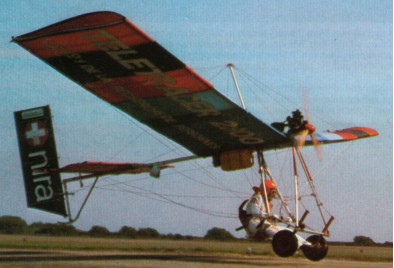
Single seat single engined high wing mono¬plane with hybrid control. Wing has unswept leading and trailing edges, and constant chord; cruciform tail. Pitch control by elevator on tail; yaw control by fully flying rudder; no separate roll control; control inputs through weight shift for pitch/yaw/roll. Wing braced from above by kingpost and cables, from below by cables; wing profile 100% double surface. Undercarriage has two wheels with tailskid. Aluminium tube framework, without pod. Engine mounted at wing height driving tractor propeller. The Daedalus Apex 2, is similar in concept to the Quicksilver E, in that it uses weight shift allied to a rudder and elevator to give hybrid control, a formula which is popular in North America but unusual in Europe. The obvious difference between the Apex 2 and the Eipper product, however, is the choice of power unit and the use of a tractor propeller. Marco uses the Konig SC430 three cylinder radial engine, allied to a three blade propeller, a combination which has proved highly effective. Not only has Marco flown extensively in the Alps with the Apex 2, but he also competed in the 1982 London Paris, where he got a special award for having the quietest aircraft in the competition.
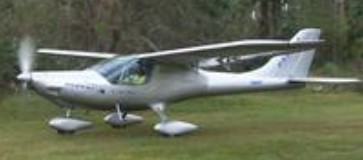
The all-metal Parrot is the first LSA to offer a full-cantilever metal wing, a glass shape in real metal, a forward-hinged canopy, and plenty of payload. Flight tests on the new machine have exceeded expectations. The entire design effort was built around the Sport Pilot (LSA) rules. Designed from the ground up for the American rules and the American market; and uses American-sourced materials, optimized performance to the LSA rules. Its efficient airfoil, developed on high-performance sailplanes, is a key feature unmatched in the industry. The smooth shape, made possible by the Parrots proprietary construction fixtures, also contributes to the quiet ride. With a shape usually considered achievable only on composite aircraft, the Parrots stretch formed and hydroformed panels blend together with flush rivets to give the appearance of composite, with standard full-interior zinc chromate protection on the ready-to-fly machine.
Stall: 30 kt / 35 mph / 56 kmh Cruise: 113 kt / 130 mph / 209 kmh VNE: 137 kt / 157 mph / 253 kmh Empty Weight: 360 kg / 793 lbs MTOW Weight: 599 kg / 1320 lbs Climb Ratio: 1000 ft/min / 5 m/s Take-off distance (50ft obstacle): 750 ft / 229 m Landing distance (50ft obstacle): 400 ft / 122 m
In 1992, Heintz also entered into a license agreement with Czech Aircraft Works of Stare Mesto, Czech Republic, to produce and market his Zodiac CH 601 and STOL CH 701 designs for the European market. The Czech-produced Zodiacs were modified and lightened to meet European rules for microlight aircraft. CZAW produced some 750 such machines under this agreement. On 31 December 2006, after the license agreement, under which the Zenair Zodiac CH 601 and STOL CH 701 light aircraft designs were produced by CZAW, was terminated and the Czech production came to an end.
In 1992, Heintz also entered into a license agreement with Czech Aircraft Works of Stare Mesto, Czech Republic, to produce and market his Zodiac CH 601 and STOL CH 701 designs for the European market. The Czech-produced Zodiacs were modified and lightened to meet European rules for microlight aircraft. CZAW produced some 750 such machines under this agreement. On 31 December 2006, after the license agreement, under which the Zenair Zodiac CH 601 and STOL CH 701 light aircraft designs were produced by CZAW, was terminated and the Czech production came to an end.
Czech Aircraft Works (CZAW) was renamed Czech Sport Aircraft.
The Cyclone Airsports AX2000 is a development of the earlier Cyclone AX3, a UK regulation compliant variant of the French Ultralair Premier AX3. This, in turn, was a three axis development of the US Chotia Weedhopper from the early 1980s.
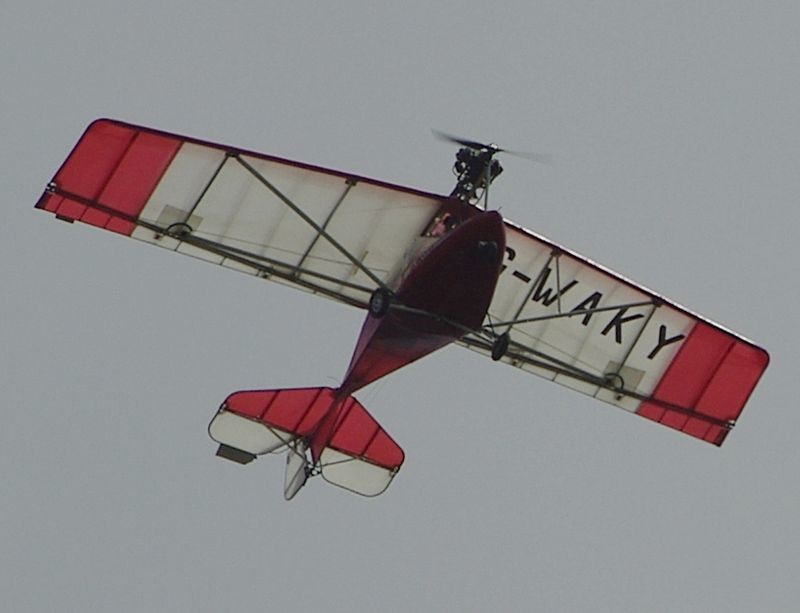
The AX2000 is a British built three axis microlight, with an aluminium tube framed three axis microlight with flying surfaces covered with a polyester fabric with outer PVF lamination (URLAM). The whole aircraft is built around a long, high aluminium keel boom, which bears the engine, wings and empennage.
The wing is a two spar structure, with surfaces formed by upper and lower battens rather than ribs. It carries conventional, full span, tapering ailerons but no flaps. The tailplane is mounted on the keel and has an anti-balance/trim tab on the starboard elevator. There is a small fixed fin below the keel but none above; the rudder is balanced and extends below the elevators, moving in a cut-out.
The short, deep fuselage is built around a wire braced tube beam. Lift and landing loads are taken by V-shaped, cross braced pairs of lift struts from the bottom of the fuselage to each wing, assisted by a centre line strut to the boom at the wing leading edge. The cockpit enclosure is non-structural, with forward opening doors to a pair of side-by-side seats. These are equipped with separate rudder pedals but the occupants share a central control column. The AX2000 has a tricycle undercarriage mounted close to the fuselage.
The engine is mounted, uncowled, ahead and above the wing leading edge, with the propeller shaft on the boom line. One of three engines may be fitted: a 48 kW (64 hp) Rotax 582/48 or 38 kW (50 hp) 503 2V, both upright twin cylinder two strokes, or the 45 kW (60 hp) HKS 700E (either V3 or Beta variants), flat twin four stroke. Both Rotax engines drive propellers with ground adjustable pitch: the 582 has a three blade, composite propeller and the 503 a two blade wooden one.
As well the new engines, the AX2000 differs chiefly from the AX3 in having a completely double surface wing of reduced area and modified structure, a change of alloy for the main keel beam, a revised and lightened fuselage with new undercarriage, an increased fuel capacity and the addition of an elevator anti-balance trim tab. The AX2000 is certificated as a glider tug, for gliders of class 1 and 2. A V-shaped forward tow line extension joins the main line to a pair of tug pillars attached to the rear spar on the under surfaces of the AX2000’s wing.
In mid-2011 there were 29 AX2000s on the UK civil aircraft register.
Wingspan: 9.10 m (29 ft 10 in) Wing area: 15.77 m2 (169.7 sq ft) Length: 5.60 m (18 ft 4 in) Height: 2.10 m (6 ft 11 in) Empty weight: 201 kg (443 lb) Max takeoff weight: 450 kg (992 lb) Fuel capacity: 62 L Maximum speed: 100 km/h; 54 kn (62 mph) manoeuvring Stall speed: 58 km/h; 31 kn (36 mph) Never exceed speed: 145 km/h; 78 kn (90 mph) Crew: 2
This airplane represents a further development of the CA-61 Mini Ace, which first flew in July 1965. The CA-65 is an all wood side by side two seater low-wing monoplane with retractable landing gear and dual controls, designed in 1964-65. It features a streamlined canopy, enclosed engine, tapered wing and fully retrac¬table gear. Its wood construction cuts requirements for tooling and special jigs to a minimum. The wing consists of a centre section and two outer panels set at 3o dihedral. The wing structure is made up of two spruce spars, built up girder type ribs and is completely plywood covered. The fuselage is of conventional wood construction and covered with plywood. A manually operated flap is fitted under the fusealage. The empennage consists of ply covered fixed surfaces and fabric covered control surfaces. On the folded wing version the outer panels fold upwards from the centre section. Mechanically, inward retracting, main undercarriage legs are fitted. Two 11 Imp gallon fuel tanks are installed in the fuselage. Engines from 108 to 150 hp.
The CA-61 can be built as either a single-seat or side-by-side low-wing monoplane. It is designed for amateur builders with little or no previous experience in building light airplanes. With a minimum of tools, the plane can be assembled in less than 1000 working hours. The structure is light with low wing loading, so in addition to the stan¬dard Continental powerplant, a VW conversion can be substituted. Another option is the availability of either fixed tricycle landing gear or retractable tailwheel type. Construction is all wood, and the wing is made in one piece with a main and auxiliary spar
Engine 65-hp Continental Wingspan 27 ft 6 in Length 18 ft 11 in Gross Wt. 950 lb Empty Wt. 606 lb Fuel capacity 17 USG Top 120 mph. Cruise 100 mph. Stall 42 mph. Climb rate 1200 fpm. Takeoff run 200 ft. Landing roll 300 ft. Range 425 miles.