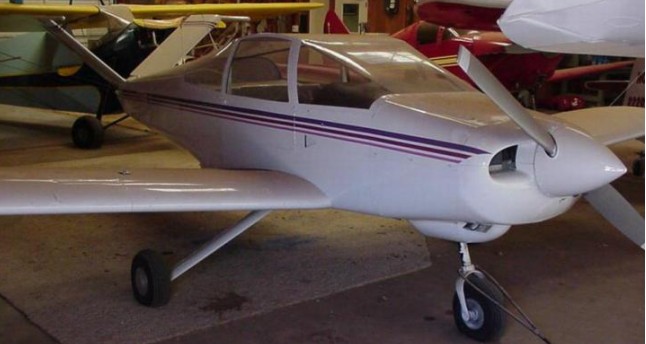
- A smaller & lighter DA-7. DA-6 and later use the USA 35B airfoil modified with a flat bottom. It was sold unfinished, and completed by James Dooley.
Registration: N80157
Engine: Lycoming O-235
Registration: N80157
Engine: Lycoming O-235
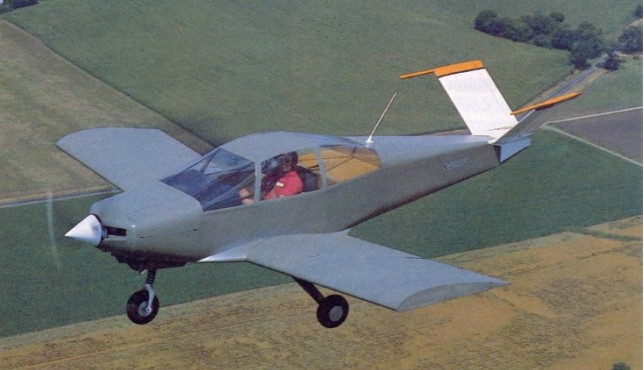
A smaller & lighter DA-6, designed for production. DA-6 and later use the USA 35B airfoil modified with a flat bottom.
Registration N4739V was built by Leeon D Davis in 1984.
Engine: Lycoming O-235
Wingspan: 20′ 6″
Length: 19′ 2″
Empty Weight: 700 lb
Gross Weight: 1260 lb
Seats: 2
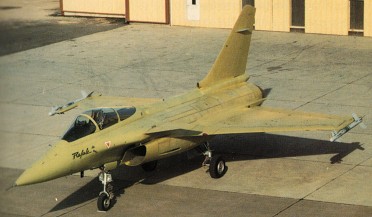
France originally was part of the EFA (European Fighter Aircraft) project, which would result in the Eurofighter. In 1985 France left the project and started its own development of a fighter, which led to the ACX or Rafale A.
The Rafale (‘Squall’) was originally conceived to demonstrate technologies applicable to a French air force Jaguar replacement (ACT= Avions Combat Tactique) and a French navy Crusader and Super Etendard replacement (ACM= Avion de Combat Marine).
It is a single-seat aircraft with a compound-sweep delta wing, an all-moving canard, a single fin, and semi-vented intakes. It incorporates digital fly-by-wire, relaxed stability, a reclined pilot’s seat, a wide-angle headup display, and composite components are used extensively in the airframe. Provision has been made for the introduction of fibre-optics, voice command, and voice warning systems.
Equipped with the multi-mode RBE2 radar which has full air-to-air and air-to-ground capability, it can carry a wide range of weapons, including the APACHE stand-off munitions dispenser and the ASMP nuclear missile.
The Rafale A technology demonstrator, A 01, powered by two General Electric F404 turbofans, was rolled out of the Saint-Cloud factory on 14 December 1985,
First flying on 4 July 1986, Mach 1.3 was exceeded during the flight.
In May 1987 the Rafale A prototype successfully completed a series of approaches to the carrier Clemenceau to establish the feasibility of carrier operations.
In April 1989 the aircraft was laid-up for the substitution of a SNECMA M88-2 augmented turbofan in the port engine bay and flew in this configuration on 27 February 1990. The M88 is the selected engine for production versions of the Rafale.
Developed from the Rafale A was the single seat Rafale C that first flew on 19 May 1991.
The two-seat Rafale B was designed as a dual control conversion trainer for the single seat Rafale C. But the Rafale B has developed as a fully operational variant with full combat capability. Either an instructor, a second pilot or a WSO can assist the pilot from the rear seat. The Rafale B and C aircraft were planned to enter Armée de l’Air (French Air Force) service from 2002 onwards to replace its older Mirage variants and Jaguars. The first production aircraft Rafale B1 flew for the first time on 4 December 1998 and was delivered to the French Air Force.
On April 20, 2001, a Rafale B fitted with conformal fuel tanks made its first flight.

Designed especially for the Aeronavale (French Navy Air Arm) is the carrier capable Rafale M. A fully navilised version first flying on 12 December 1991. The Rafale M has for 80% the same structural design and for 95% the same systems as the Rafale C. It has strengthened main undercarriage, extended nosewheel suitable for catapult launch, hydraulically operated arrester hook, but has no folding wings. The centreline pylon has to be removed because of the longer nosewheel undercarriage. The first production Rafale M aircraft replaced the remaining F-8E(FN) Crusaders in the fighter role. Subsequent deliveries were to replace the Super Etendard and Etendard IVP in the attack and recconnaissance roles.
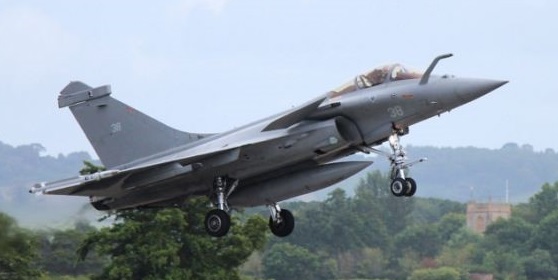
A fourth variant developed for the French Navy, is the two-seat Rafale N to enter service in 2008. The Rafale will become the only combat aircraft in the French Navy when all aircraft are delivered.
The original plan was to order a total of 94 Cs, 78 Ms and 140 Bs.
On December 1, 2001, the French carrier Charles de Gaulle departed to support the war on terrorism with on board seven Rafale M fighters. Although the aircraft did not take part in the large-scale air combat operation over Afghanistan, they flew combat air patrols and were able to practise and test out new tactics.
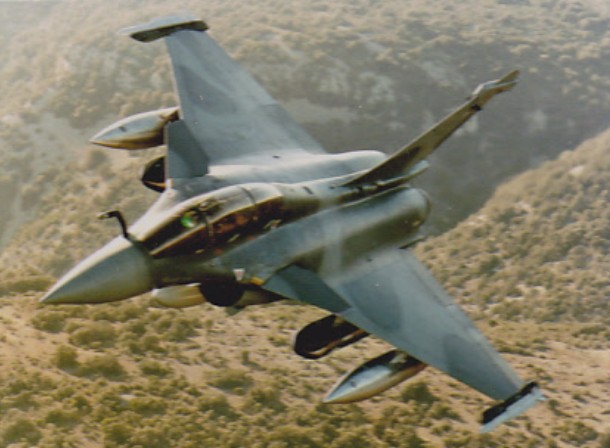
Prototype
Engines: 2 x Snecma M88-2, 16,870 lb thrust
MTOW: 43,000 lb
Rafale A
Engine: 2 x General Electric GE F404-GE-100, 69847 N
Length : 51.837 ft / 15.8 m
Height: 17.06 ft / 5.2 m
Wingspan: 36.745 ft / 11.2 m
Wing area: 505.908 sq.ft. / 47.0 sq.m
Max take off weight: 44100.0 lb / 20000.0 kg
Weight empty: 20947.5 lb / 9500.0 kg
Max. weight carried: 23152.5 lb / 10500.0 kg
Max. speed: 1147 kt / 2124 km/h
Landing speed: 120 kt / 223 km/h
Wing load: 87.33 lb/sq.ft / 426.0 kg/sq.m
Fuel capacity: 1123 gal / 4250 lt
Crew: 1
Armament: 1x MK 30mm DEFA 554, max 12x AIM.
Rafale C
Engines: 2 x SNECMA M88-2 turbofans, 7500kg, 16,500 lb
Max take-off weight: 19500 kg / 42990 lb
Empty weight: 9060 kg / 19974 lb
Wingspan: 10.9 m / 35 ft 9 in
Length: 15.3 m / 50 ft 2 in
Height: 5.34 m / 17 ft 6 in
Max. speed: 2070 km/h / 1286 mph
Armament: 1 x 30mm cannon
Hardpoints: 14
Rafale M
Engines: 2 x SNECMA M88-3 afterburning turbofans, 86.98 kN (19,555 lb st)
Length 15.30m (50 ft 2½ in)
Height 5.34m (17 ft 6¼ in)
Wing span (over AAMs) 10.90m (35 ft 9¼ in)
Empty weight equipped 9670 kg (21,319 lb)
Max Take-Off Weight 21.500 kg (47,399 lb)
Max level speed at 11.000m (36,069 ft) Mach 2.0 or 2125 km/h (1,321 mph)
Service ceiling 16,460m (54,000 ft)
Armament: one DEFA 791 B 30mm cannon; up to 6000 kg (13,228 lb) ordnance
Hardpoints: 13

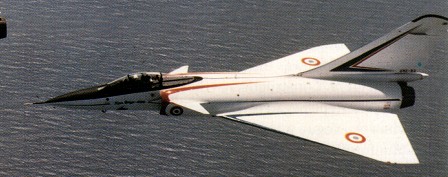
Intended as a multi¬role fighter, the private venture Mirage 4000 prototype was originally known as the Super Mirage 4000.
Powered initially by two SNECMA M53-2 turbofans with afterburning thrust of 8500kg, the Mirage 4000 introduced extensive use of boron and carbonfibre composites for structures, and computer-derived aerodynamics and a fly-by-wire active control system making possible a rearward CG. Built-in armament consisted of two 30mm cannon and external ordnance loads in excess of 8000kg could be distributed between 11 external stations.
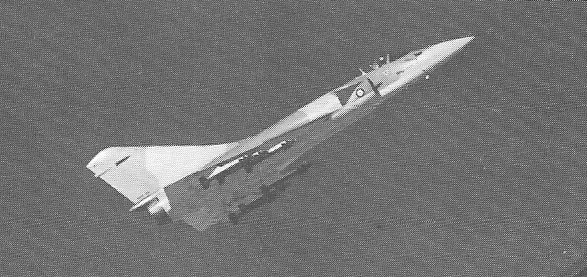
First flown on 9 March 1979, the Mirage 4000 achieved Mach=1.6 during its first flight and Mach=2.2 five weeks later, on 11 April, during its sixth flight.
The single prototype was re-engined with M53-5 turbofans with afterburning thrust of 8790kg during the course of its flight test programme. No production contract was placed for the Mirage 4000, but in 1986, the prototype was re-engined with M53-P2 engines and participated in the Rafale programme.
Mirage 4000
Engine: 2 x SNECMA M53 turbofans, 10000kg
Wingspan: 12.0 m / 39 ft 4.5 in
Length: 18.7 m / 61 ft 4 in
Wing area: 73.0 sq.m / 785.76 sq ft
Max. speed: 2333 km/h / 1450 mph
Ceiling: 20000 m / 65600 ft
Range w/max.fuel: 3700 km / 2299 miles
Armament: 2 x 30mm cannons
Hardpoints: ten

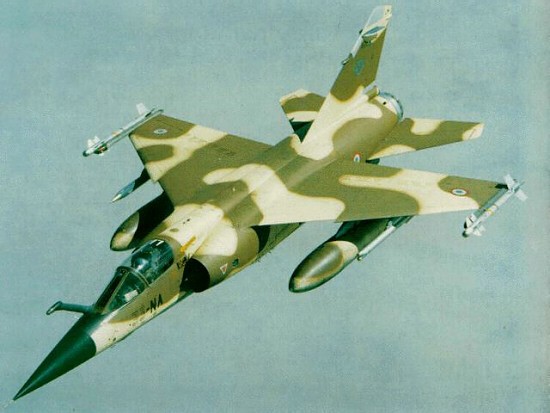
In the 1960s Dassault designed the Mirage F1 as a successor for the Mirage III family. Loss of energy in low-level manoeuvring flight of the delta-winged Mirage III led to development of a traditional layout for the wing.
Evolved in parallel with the Mirage F2 as a scale-down, multi-role single-seat fighter employing a SNECMA Atar turbojet, the Mirage F1 was the subject of a government contract awarded in 1964. Possessing a conventional sweptback wing equipped with high-lift devices, and conventional swept tail surfaces, the private venture prototype F1 flew on 23 December 1966.
On 23 December 1966 the first prototype made its maiden flight. Three pre-series aircraft were ordered in September 1967, the first of these flying on 20 March 1969.
The initial production model for France’s Armee de l’Air was designated F1C, placed emphasis on the intercept mission, was powered by an Atar 9K-50 turbojet affording 7200kg with afterburning, and had an armament of two 30mm cannon, two Matra 550 Magic and two Matra R 530 or Super 530 AAMs. An initial order for the F1C for the Armee de l’Air was placed in 1969, 162 being procured by that service (plus 64 recce F1CRs and 20 two-seat F1B trainers), initial operational capability being achieved in 1974. Many of the Armee de l’Air aircraft were delivered in, or retroactively modified to, F1C-200 standard with an 8cm fuselage plug to accommodate a removable flight refuelling probe.
The Mirage F.1C entered service with France’s air defence command (CAF-DA) in 1973, equipped with Thomson-CSF Cyrano IV all-sector fire-control radar. This type has also met with considerable success on the export market, customers including Ecuador, Greece, Iraq, Jordan, Kuwait, Libya, Morocco. South Africa and Spain. Production of 81 of this variant was followed by 89 Mirage F.1C-200 fighters fitted with a fixed inflight-refuelling probe at the base of the windscreen. The F.1-CR-200 became operational in July 1983, and carries cameras and infrared sensors internally with additional sensors in an under-fuselage pod. Improved navigation systems, radar, and a flight refuelling probe fitted as standard.
The Armée de l’Air (French Air Force) operated the F1C as its main interceptor fighter until the service entree of the Mirage 2000 in 1984.
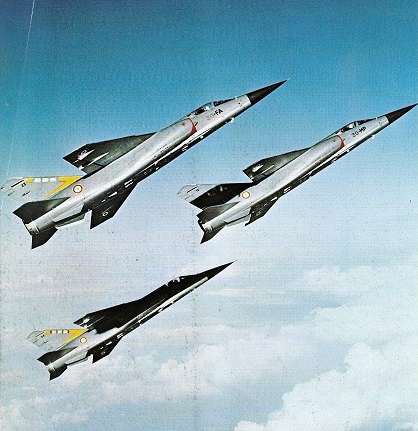
The first flight was made by the Dassault Mirage F.1B two seat dual role trainer/tactical aircraft on 26 May 1976. Twenty Mirage F.1B conversion trainers (based on the Mirage F.1C but lacking its internal cannon) have also been received. It proved attractive to overseas customers, initial orders being received from Ecuador, Iraq, Jordan, Kuwait, Libya, Morocco and Spain.

Single-seat aircraft, including the F.1A with its slightly increased fuel tankage, have a notional maximum weapon-carrying capacity of 13,889 lb (6 300 kg), excluding the fitted cannon. This total is made up of 4,630 lb (2 100 kg) on the centreline; 220 lb (100 kg) of chaff/flare dispensers on the fuselage shoulder; 2,866 lb (1 300 kg) at the inner wing; 1,213 lb (550 kg) on the outer wing pylons, and 331 lb (150kg) on the wing-tip AAM positions. Maximum FIC/E internal fuel capacity is 946 Imp gal (4 300 1) or 7,568 lb (3 433 kg) of Jet A-1 /Avtur whilst three external tanks can hold a further 1,012 Imp gal (4 600 1) or 8,096 lb (3 672 kg). Fuel and weaponry must be traded-off between the confines of a 16,314 lb (7 400 kg) empty weight and 35,715 lb (16 200 kg) max take¬off weight.
French Air Force F.1-Cs were delivered as or converted to F.1-C-200s by the installation of detachable flight refuelling probe.
The Mirage F1E was a dedicated strike and attack aircraft which incorperated upgraded systems, including radar. Dassault also designed a two-seat version of the F1E for training, designated F1D.
A simplified version, lacking certain avionics such as the Cyrano radar, was produced for South Africa (F1AZ and F1CZ for the interceptor variant) and Libya for the clear-weather attack role with ranging radar as the Mirage F.1A, with Aida radar in a slimmer nose filled with much of the electronics previously located behind the cockpit, where more fuel could now be stored. Other additions were Doppler navigation, an inertial platform. and a laser rangefinder. Libya, together with Iraq, Jordan, Morocco, Qatar and Spain, also bought the multi-role Mirage F.1E. An export model, the Mirage F.1E, is based on the F.lC with upgraded Cyrano IVM radar offering terrain-avoidance, air-to-surface ranging, and look-down capability. The model also has an inertial platform, digital computer, and improved head-up display. The Mirage F.1E entered service in 1976, and offered multi-role capability, including anti¬ship attack with the AM.39 Exocet missile.
According to Dassault data the Mirage F1E’s LO-LO combat radius with one centreline Exocet, two Magics, two ECM pods and two 264 Imp gal (1 200 1) external tanks is 435 mls (700 km), including the missile’s range of 37-43 mls (60-70 km). This is achieved at a cruising speed of 400 kts (742 km/h), apart from the first 59 mls (95 km) of the homeward flight, which are flown at 550 kts (1 019 km/h). Radius can be increased to 559 mls (900 km) with one “buddy” refuelling. A larger, 484 Imp gal (2 200 lt), tank is also available, but can be fitted only singly on the centreline pylon and has hitherto been employed mainly for ferrying. With one large and two small tanks and a H1-LO-HI mission profile, the Mirage F.IE’s radius may be increased to 870 mls (1 400 km), but only if the Magics and ECM pods are left at home and the weapon load reduced to just two 250-kg (55l-lb) bombs.
Production of the AM.39 Exocet armed Mirage F.1-EQ6 for the Iraqi Air FoU continued until late 1988. The French Air Force has received the last of its Mirage F.1-CR-200 reconnaissance fighters.
The specialized reconnaissance model is the Mirage F.1CR (based on the Mirage F.1C-200 and with a secondary attack capability) and this replaced the 50 or so Mirage IIIR/RD aircraft which equiped the 33e Escadre at Strasbourg, the French air force’s sole tactical reconnaissance unit. Selected in February 1979, two Mirage F.ICR prototypes were produced for test duties, the first making its maiden flight on 20 November 1981. These two machines being followed by 62 production examples. Mission-related equipment includes OMERA cameras carried internally together with an infra-red sensor, while additional electromagnetic or optical sensors can be housed in an external pod fitted beneath the aircraft’s belly. Air-to-air missiles can also be carried for defensive purposes, while inflight-refuelling gear is also fitted as standard.
First flown on 22 December 1974, and built as an engine test bed under official contract, the Mirage F1.M53 was also envisaged as the basis for a contender in the contest to find a successor for the Lockheed F-104G in service with Belgium, Denmark, the Netherlands and Norway. Evolved from the basic Atar 9K-50 turbojet-powered Mirage F1C, the Mirage F1.M53 – referred to for a brief period as the “F1E”, the suffix letter signifying Exportation and the designation subsequently being reassigned – was powered by the SNECMA M53 turbofan rated at 5550kg dry and 8500kg with maximum afterburning. M53 installation involved significant fuselage structural redesign, and to provide suitability for ground attack and long-range interdiction tasks in addition to that of interception, provision was made for multi-role avionics. By comparison with the F1C, the F1.M53 had increased fuel capacity, enlarged engine air intakes and strengthened undercarriage. The nose profile was revised to provide for the introduction of a retractable flight refuelling probe. The installed armament remained two 30mm cannon and it was proposed to distribute up to 4000kg of ordnance between seven external stations. The other contenders for the multi-national fighter contract were the Saab 37 Viggen and the General Dynamics F-16. With choice of the F-16 as winner of the competition, plans to produce a second prototype F1.M53 for testing and integration of systems were discarded.
Variants of the basic aircraft offered for export, in addition to the F1C, were the F1A with simplified avionics for operation under VFR conditions and the F1E multi-role air superiority/ground attack/reconnaissance version. Export customers were Ecuador (16 F1AJs), Greece (40 F1CGs), Iraq (113 F1EQs), Jordan (17 F1CJs and 17 F1EJs), Kuwait (27 F1CKS), Libya (16 F1ADs and 16 F1EDs), Morocco (30 F1CHs and 20 F1EHs), Qatar (12 F1EDAs), South Africa (32 F1AZs and 16 F1CZs) and Spain (45 F1CEs and 22 F1EEs). Production of the Mirage F1 was completed in 1990 with 731 built (including F1B and F1D two-seat trainers and F1CR reconnaissance aircraft). In 1991, work began on the adaptation of 30 F1C-200S as F1CT ground attack fighters.
In the 1991 Gulf War, the Mirage F1 was operated on both sides. In the 1980s Dassault sold a large number of Mirage F1E and some F1B aircraft to Iraq (designated F1EQ and F1BQ respectively). When coalition forces struck numerous hardened aircraft shelters to neutralize the Iraqi Air Force in support of operation Desert Storm, many of these aircraft were destroyed. Taking part in the coalition was France, supporting air operations with F1CR and F1CT aircraft.
The last French F1 Mirage was retired from active service in June 2014, and stored at Châteaudun air base, near Paris, while waiting for a buyer. Replaced in the French Armée de l’air by the Dassault Mirage 2000 and Dassault Rafale, it was still in use in five air forces around the world. Draken International was after the retired French planes. Instead, in December 2017, it acquired 22 Mirage F1 fighter jets from the Spanish Air Force.
Mirage F1C
Powerplant: one 70.21 kN (15,873 lb st) SNECMA Atar 9K-50 turbojet
Length 15.23m (49 ft 11½ in)
Height 4.50m (14 ft 9 in)
Wing span (over tip missiles) 9.32m (30 ft 10 in)
Wing area: 25 sq.m / 269.10 sq ft
Empty weight: 7400 kg / 16314 lb
Max Take-Off Weight 16.200 kg (35,714 lb)
Max level speed at 12,000m (39,370 ft) Mach 2.2 or 2350 km/h (1,460 mph)
Landing speed: 124 kts / 230 km/h
Cruising speed: 478 kts / 885 km/h
Initial climb rate: 41338.58 ft/min / 210.0 m/s
Service ceiling 20,000m (65,615 ft)
Range w/max.payload: 900 km / 559 miles
Armament: two DEFA 553 30mm cannons (135 rounds/gun), up to 4000 kg (8,818 lb) ordnance
Hardpoints: 7
T/O run: 670 m.
Ldg run: 610 m.
Combat radius lo-lo-lo: 740 km.
Fuel internal: 4300 lt.
Air refuel: Yes.
Crew: 1
Mirage F.1CR
Powerplant: one SNECMA Atar 9K-50 turbojet rated at 7200-kg (15,873-lb) afterburning thrust.
Maximum speed at sea level 1475 km/h (917 mph) or Mach 1.2
Maximum. speed at altitude 2335 km/h (1450 mph) or Mach 2.2
Ferry range 300 km (2,050 miles)
Empty weight 7400 kg (16,314 lb)
Maximurn take-off 16200 kg (35,715 lb)
Wingspan 8.40 m (27 ft 6¾ in)
Length 15.00 m (49 ft 2½ in)
Height 4.50 m (14 ft 9 in)
Wing area 25.00 sq.m (269.1 sq.ft)
Mirage F.1E
Engine: one 15,873-lb (7,200-kg) reheated thrust SNECMA Atar 9K-50 turbojet.
mximum speed, clean Mach 2.2 speed (1,321 mph / 2,125 km/h) at 36,090 ft (11,000 m)
Initial climb rate 39,370 ft (12,000 m) per minute
Service ceiling 20000 m (65,615 ft)
Endurance 3 hours 45 minutes
Radius 265 miles (425 km) on a hi-lo-hi mission with a 7.716-lb (3,500-kg) warload.
Empty weight 7400 kg (16,314 lb)
Maximum take-off 16200 kg (35,714 lb)
Wingspan 8.40 m (27 ft 6 ¾ in)
Length 15.00 m (49 ft 2 ½ in)
Height 4,50 m (14 ft 9 in)
Wing area 25.00sq.m (269.1 sq ft).
Armament: two 30-min DEFA 553 cannon (125 rpg) up to 4000 kg (8,818 lb) ordnance
F1.M53
Max take-off weight: 15200 kg / 33510 lb
Empty weight: 8024 kg / 17690 lb
Wingspan: 8.45 m / 27 ft 9 in
Length: 15.53 m / 50 ft 11 in
Height: 4.56 m / 14 ft 12 in
Wing area: 25.00 sq.m / 269.10 sq ft
Max. speed: 2335 km/h / 1451 mph
Range: 1200 km / 746 miles
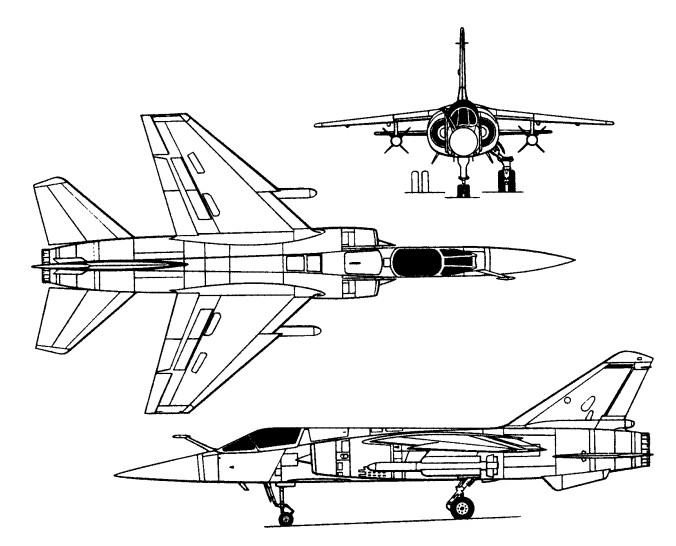
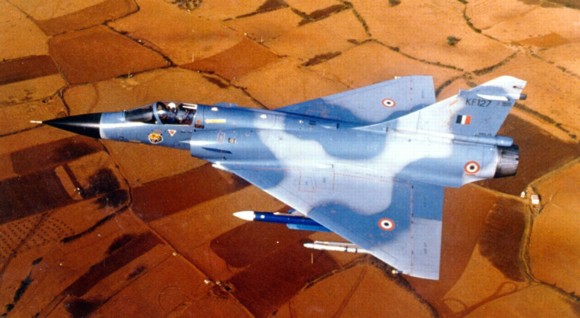
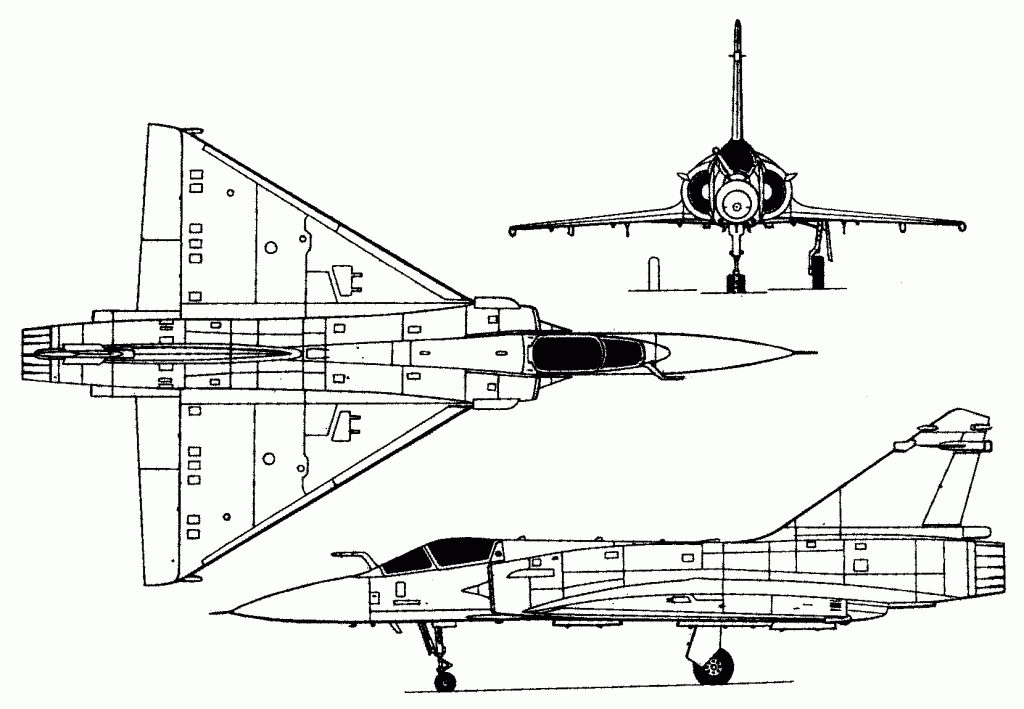
The Mirage 2000 high-performance fighter delta wing used a design with relaxed stability, a variable-camber (produced by two-section leading-edge slats and trailing-edge elevons) and a “fly-by-wire” computerized control system in an airframe that makes extensive use of composite materials.
Developed initially as a single-seat interceptor and air superiority aircraft designated 2000C, the first of four prototypes was flown on 10 March 1978. A company-funded fifth prototype, in tandem two-seat trainer 2000B form, flew on 11 October 1980.
The Mirage 2000 was chosen on 18 December 1975 to become the next primary combat aircraft of the Armee de l’Air, to replace the Mirage III is the interceptor role.
The first production Mirage 2000C flew on 20 November 1982 with a SNECMA M53-5 rated at 5547kg dry and 8790kg with afterburning, this being replaced from the 38th Armee de l’Air Mirage 2000C by the M53-P2 turbofan producing 6557kg dry and 9687kg with afterburning. Armament consisted of two 30mm cannon with a typical intercept weapons mix comprising two Matra 530D or 530F AAMs inboard and two Matra 550 Magic missiles outboard under the wings. For an attack mission, up to 6300kg of ordnance could be distributed between nine external stations.
Deliveries of the initial 37 Mirage 2000C to the first of four Escadres de Chasse began in the summer 1983, this attaining operational capability on 2 July 1984.
The dedicated air-defense Mirage 2000C with an advanced electronic countermeasures system, a “look-down/shoot-down” radar, and a mix of air-to-air missiles with infra-red or semi-active radar guidance, with an active radar-guided type to follow, can also be used in the attack role. The 2000C was also produced in a number of differently suffixed sub-variants for export.
Mirage 2000C aircraft have flown CAP missions during the Gulf War alongside other coalition fighters. The Mirage 2000 also saw action over Bosnia and Kosova in support of NATO.
In 1987, the Dassault company offered a private venture two-phase Mirage 2000 update programme. The first phase, the Mirage 2000-3 with Rafale-type cockpit multifunction displays, flew on 10 March 1988, and the addition of a new central processing unit, an updated head-up display and Thomson- CSF RDY multi-mode radar resulted in the second phase Mirage 2000-5, flown on 24 October 1990.
In 1990 a major upgrade of the 37 Mirage 2000C design resulted in the multi-role Mirage 2000-5F which was first flown on 24 October 1990 and was also ordered by Taiwan. The 2000-5 is a multi-role variant capable of using the Super 530D or Sky Flash air-to-air missiles.
In 1979 Dassault was contracted to build two prototypes designated Mirage 2000P, later Mirage 2000N. The 2000P was being developed for the low-altitude tactical nuclear strike mission to replace the fleet of nuclear-armed Mirage IVPs. The Mirage 2000N made its first flight on 3 February 1983.
Based on the Mirage 2000B two-seat trainer variant, the 2000P has a revised avionics suite and strengthened fuselage for the low-altitude role and the Antilope 5 nose radar optimised for terrain following, ground mapping and navigation and has additional air-to-air and air-to-sea modes. The rear seat is occupied by a WSO which has twin inertial platform navigation systems, a radar altimeter, ECM, a vertical camera, and an additional moving map. The aircraft configured with only the ASMP missile and 2 Magic AAMs is designated 2000N-K1, while the K2 configuration can also carry alternative loads.
Lessening tensions in Europe in the late 1980s reduced the need for nuclear capable aircraft and the orders for the Mirage 2000N were reduced to 75 aircraft. Delays with the Rafale program resulted in a need for additional aircraft with a capability for conventional weapons. This resulted in the Mirage 2000D originally known as Mirage 2000N’ (or N Prime). Developed from the 2000N-K2 is the Mirage 2000D, equipped with GPS it is developed for the use of laser guided weapons, but is not capable of carrying the ASMP missile. The 2000D-R1N1L is equipped with laser guided weapons and Magic AAMs only, while the R1 configuration can be equipped with the full range of conventional weapons. The R2 configuration is upgraded with a fully integrated self-defence suite and is compatible with the Apache stand-off weapons dispenser.
The first Mirage 2000D was flown on 19 February 1991 and the first of 86 aircraft ordered entered service in April, 1993.
Mirage 2000D aircraft flew combat missions over Afghanistan equipped with laser targeting pods and laser guided bombs or free fall 250kg bombs.
The export model of the Mirage 2000D is designated 2000S, where the S stands for Strike.
Mirage 2000-9 is the designation for the upgraded version of the Mirage 2000 export models of the United Arab Emirates.
Dassault marketed the Mirage 2000-5 Mk.2 either as a new aircraft or retrofitted from currently operated Mirage 2000Cs or 2000Es. It features an integrated mission system with a glass cockpit, digital modular avionics and enhanced communications.
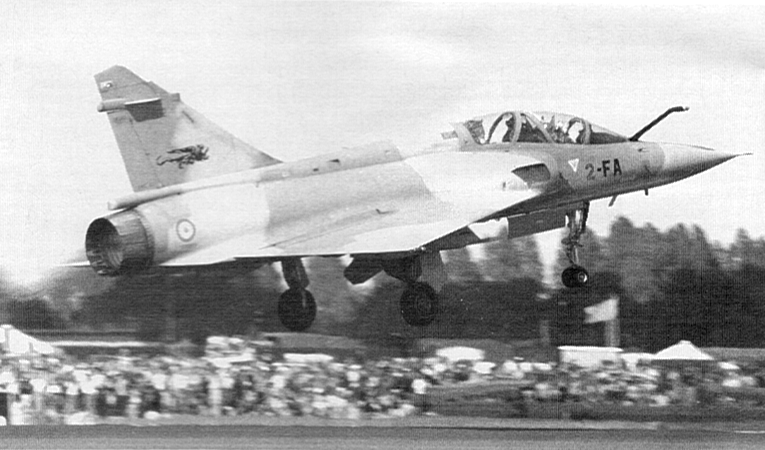
A cockpit development aircraft was designated BX1.
To 1990, more than 260 have been delivered, including the two-seat B and N variants, and more than 160 export Mirage 2000s had been ordered by six nations.
The Mirage 2000 single-seat fighter export customers included Abu Dhabi (22 2000EADs), Egypt (16 2000EMs), Greece (36 2000EGs), India (42 2000Hs), and Peru (10 2000Ps).
At the beginning of 1993, planned Armee de l’Air procurement of the Mirage 2000 totalled 323 aircraft, including 136 single-seat Mirage 2000Cs.
Variants:
2000A (prototype)
2000B
2000C
2000-5
2000-5F
2000E
2000ED
2000ER
2000P
2000N
2000D
2000S
2000-9
2000 BX1
Specifications:
Dassault Mirage 2000
Engine: SNECMA M53-5, 88290 N / 9000 kp
Length: 50.295 ft / 15.33 m
Wingspan: 29.528 ft / 9.0 m
Wing area: 430.56 sq.ft / 40.0 sq.m
Max take off weight: 33075.0 lb / 15000.0 kg
Max. speed: 1320 kts / 2445 km/h
Wing load: 76.88 lb/sq.ft / 375.0 kg/sq.m
Range: 378 nm / 700 km
Crew: 1
Armament: 5000 kg. ext. 9 Pods.
Mirage 2000
Engine: 1 x Snecma M53-P2.
Installed thrust (dry / reheat): 64.5 / 95 kN.
Span: 9 m.
Length: 14.4 m.
Wing span: 29.5ft (9m).
Wing area: 41 sq.m.
Empty wt: 7500 kg.
MTOW: 17,000 kg.
Warload: 6300+ kg.
Max speed: 2.2 Mach.
Initial ROC: 18,000 m / min.
Ceiling: 18,000 m.
T/O run: 430 m.
Combat radius: 740+ km.
Fuel internal: 3800 lt.
Air refuel: Yes.
Armament: 2 x 30 mm, 4 x AAM
Hard points: 9
Mirage 2000C
Engine: one SNECMA M53-P2 turbofan, 21,385-lb (9,700-kg) reheated thrust.
Maximum speed 1,453+ mph(2,338+ km/h) or Mach 2.2+ at 36,090 ft (11,000 m)
Initial climb rate 56,000 ft (17,060 m) per minute
Service ceiling 59,055 ft (18,000 m)
Range 920 miles (1,480 km)
Range w/max.fuel: 3335 km / 2072 miles
Empty weight 16,534 lb (7,500 kg)
Maximum take-off 37,480 lb (17,000 kg)
Wingspan 29 ft 11.5 in (9.13 m)
Length 47 ft 1.25 in (14.36 m)
Height 17 ft 0.75 in (5.20 m)
Wing area 441.3 sq ft (41.00 sq.m)
Armament: two DEFA 554 30-mm cannon (125 rounds/gun), up to 13,890 lb (6,300 kg) of disposable stores.
Hardpoints: 9
Mirage 2000N-K2
Engine: one SNECMA M53-P2 turbofan 95.1 kN (21,385 lb st) afterburning
Length 14.55m (47 ft 9 in)
Height 5.15m (16 ft 10¼ in)
Wing span 9.13m (29 ft 11½ in)
Empty weight 7600 kg (16,755 lb)
Max Take-Off Weight 17.000 kg (37,480 lb)
Max level speed at 11.000m (36,069 ft) Mach 2.2 or 2338 km/h (1,453 mph)
Service ceiling 16,460m (54,000 ft)
Armament: one 900kg (1,984lb) ASMP tactical nuclear missile; up tp 6300 kg (13,889 lb) of ordnance
Hardpoints: 9
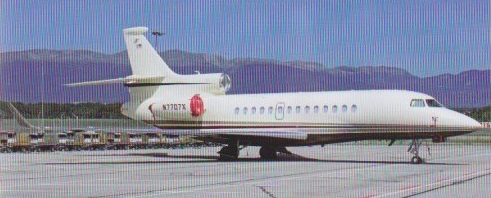
The Falcon 7X first flew on 5 May 2005.
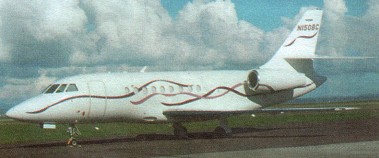
The Falcon 2000 derived from the Falcon 900, but was designed as a smaller transcontinental jet with a reduction in range. That factor allowed Dassault to remove one engine, and make the Falcon 2000 more economical to operate and maintain. Its two remaining engines were developed in partnership with General Electric and Allied Signal specifically for the new jet design.
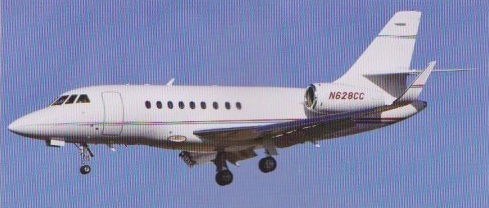
First flew in March 1993, with 3815 lbs of additional fuel, the 2000EX has a range of 3800 sm.
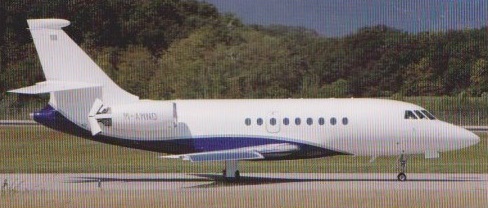
Falcon 2000
Engine: 2 x General Electric / Garrett CFE 738 1-1B, 25467 N / 2596 kp
Length: 66.371 ft / 20.23 m
Height: 23.163 ft / 7.06 m
Wingspan: 63.419 ft / 19.33 m
Wing area: 527.651 sq.ft / 49.020 sq.m
Max take off weight: 35809.2 lb / 16240.0 kg
Weight empty: 20738.0 lb / 9405.0 kg
Cruising speed: 488 kts / 903 km/h
Initial climb rate: 3425.20 ft/min / 17.40 m/s
Service ceiling: 46916 ft / 14300 m
Cruising altitude: 39009 ft / 11890 m
Wing load: 67.86 lb/sq.ft / 331.0 kg/sq.m
Range: 2999 nm / 5555 km
Range (max. weight): 999 nm / 1850 km
Crew: 2
Payload: 8-19pax
Falcon 2000EX
Engines: Pratt & Whitney PW308C turbofan, 7000 lb thrust.

The Dassault Falcon 900 tri-jet was announced in May 1983, initially as the Mystere-Falcon 900, to compete with the Challenger and Gulfstream long-range corporate jets.
Roll-out of the prototype took place in May 1984 and the first (F-WIDE) was first flown on 21 September 1984, from Bordeaux-Merignac.
With a similar configuration to the smaller Falcon 50, the 900 has a wider cabin which can seat up to 19 passengers (three abreast) over transcontinental ranges. The three engines are 4,500 lb st (20 kN) Garrett TFE731-5AR-1C turbofans which give a cruising speed of 500 kts; (927 km/h) at 27,000 ft (8 230 m).
To demonstrate its even more improved long range capability, in 1985, Dassault flew a prototype of the Falcon 900 non-stop from Paris to Little Rock, Arkansas.
DGAC and FAA certification followed in March 1986 and the first customer delivery made in December 1986.
A number of governments have bought Falcon 900s for VIP use including France, Nigeria, Malaysia, Spain and Australia. In September 1987 the Japanese Maritime Safety Agency ordered two specially-adapted long-range maritime surveillance versions of the Falcon 900 fitted with an operations control station, special communications equipment, observation hatches and sonobuoy, marker and flare dropping chutes. The aircraft entered service in September 1989.
Eighty-three had been delivered by the beginning of 1990, all but two for export.

In 1991, the Falcon 900B became the standard production model, with an increase in power and range. The model B was upgraded to the model C in 2000, and the Falcon 900EX in 2004. The primary changes offered more sophisticated avionics.

The Dassault Archange electronic reconnaissance aircraft for the French Aerospace Forces has taken to the skies for the first time. The aircraft is being developed jointly by Dassault Aviation, the developer and manufacturer, and Thales France, the company responsible for the supply of electronic systems.
The basis for the future electronic reconnaissance aircraft is the Falcon 8X civilian aircraft, which made its maiden flight on July 25, 2025 from Bordeaux-Mérignac Airport.

The aircraft is to fill the gap created by the decommissioning of the C160 Gabriel aircraft, which were used for such missions as part of the 1/54 Dunkerque squadron and were withdrawn from service in 2022.
The delivery of the Archange aircraft is expected to take place between 2026 and 2028.
Falcon 900
Engines: 3 x Garrett TFE731-5AR turbofans, 2041kg / 4500 lb each
Wingspan: 19.33 m / 63 ft 5 in
Length: 20.21 m / 66 ft 4 in
Height: 7.55 m / 24 ft 9 in
Wing area: 49.0 sq.m / 527.43 sq ft
Max take-off weight: 20640 kg / 45504 lb
Empty weight: 10240 kg / 22575 lb
Empty wt equipped: 22,575 lbs
Cruise speed: 927 km/h / 576 mph
Economical cruise: M0.75
Ceiling: 15500 m / 50850 ft
Range: 7840 km / 4872 miles
Range, max payload: 3460nm
Crew: 2.
Capacity: max 18 pax.
900B
Engines: 3 x 4750 lb Garrett TFE731-5B.
Falcon 900 C
Engine: 3 x AlliedSignal TFE 731 5AR, 19620 N / 2000 kp
Length: 66.273 ft / 20.2 m
Height: 24.934 ft / 7.6 m
Wingspan: 63.32 ft / 19.3 m
Wing area: 527.436 sq.ft / 49.0 sq.m
Max take off weight: 45511.2 lb / 20640.0 kg
Weight empty: 22424.9 lb / 10170.0 kg
Max. weight carried: 23086.4 lb / 10470.0 kg
Max. speed: 491 kts / 910 km/h
Landing speed: 79 kts / 147 km/h
Cruising speed: 448 kts / 830 km/h
Initial climb rate: 5905.51 ft/min / 30.0 m/s
Service ceiling: 51017 ft / 15550 m
Wing load: 86.31 lb/sq.ft / 421.0 kg/sq.m
Range: 3780 nm / 7000 km
Crew: 2
Payload: 19pax
Falcon 900EX
Engines: 3 x 5,000-lb. Allied Signal TFE731-60 turbofans
Gross weight: 48,300 lb
Empty weight: 23,875 lb
Max cruise: Mach 0.80.
Range: 3,840-4,500 nm.
Ceiling: 51,000 ft
Seats: 8-15.
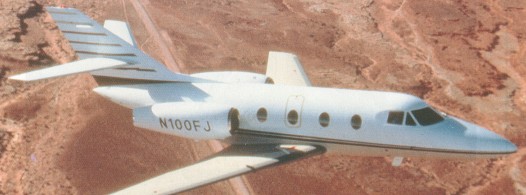
A new business jet project announced for 1982 was the Falcon 100, which was essentially a re¬fined version of the Falcon 10. To supersede the Falcon 10 and certificated in December 1986, the basic airframe remained unchanged, but the Series 100 featured increased weights (Ramp and Max. Take-off), a fourth cabin window on the starboard side, bigger luggage compartment and a ‘glass cockpit’.
The design of the Falcon 100 features no life limited parts. The airplane can fly at Mach .87 and the flight controls are driven by push rods that are boosted by dual hydraulic actuators. An artificial feel computer, called the “Arthur Q,” compensates the control boost for airspeed, so that the Falcon 100 feels the same at all speeds. Should both hydraulic actuators fail, the pilot can continue to fly using the basic mechanical control linkage.The Falcon 100 also has single point pressure refuelling, which is standard on all large jets. To refuel, a hose connects to an outlet in the tailcone, and fuel is pumped into the tanks without the need for an onboard electric pump. Because fuel heaters prevent fuel ice formation, there is no requirement to treat the Falcon 100’s fuel with an anti ice additive.
When production ceased in 1989 223 Falcon 10/100s had been delivered to customers in 24 countries.
Falcon 100
Engines: 2 x Garrett TFE 731-2, 3230 lbs / 1465kg thrust.
Seats: 8/10.
Length: 13.86 m / 45 ft 6 in
Height: 4.61 m / 15 ft 1 in
Wingspan: 13.08 m / 42 ft 11 in
Wing area: 24.1 sq.m / 259.41 sq ft
Wing aspect ratio: 7.1.
Maximum ramp weight: 18,740 lbs.
Maximum takeoff weight: 18,740 lbs.
Standard empty weight: 10,800 lbs.
Maximum useful load: 7940 lbs.
Zero-fuel weight: 13,560 lbs.
Maximum landing weight: 17,640 lbs.
Wing loading: 72.2 lbs/sq.ft.
Power loading: 2.9 lbs/lb.
Maximum usable fuel: 5910 lbs.
Best rate of climb: 4450.
Certificated ceiling: 45,000 ft.
Max pressurisation differential: 9.1 psi.
8000 ft cabin alt @: 45,000 ft.
Maximum single-engine rate of climb: 1050 fpm @ 183 kts.
Single-engine climb gradient: 345 ft/nm.
Single-engine ceiling: 18,000 ft.
Maximum speed: 487 kts.
Max operational speed Mach .87.
Normal cruise @ 39,000ft: 454 kts.
Fuel flow @ normal cruise: 1200 pph.
Stalling speed clean: 123kts.
Stalling speed gear/flaps down: 93 kts.
Turbulent-air penetration speed: 250 kts.
Crew: 2

