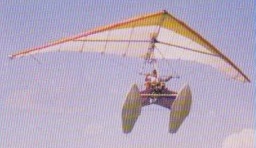
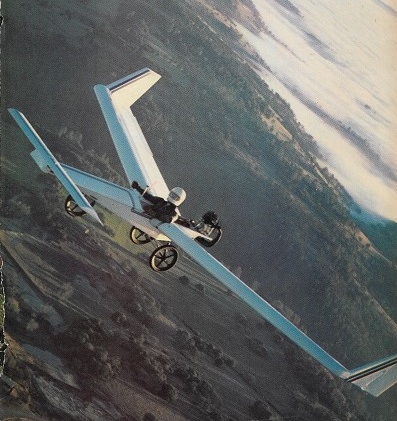
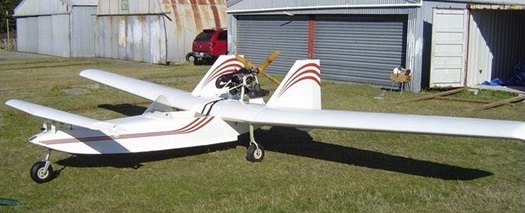
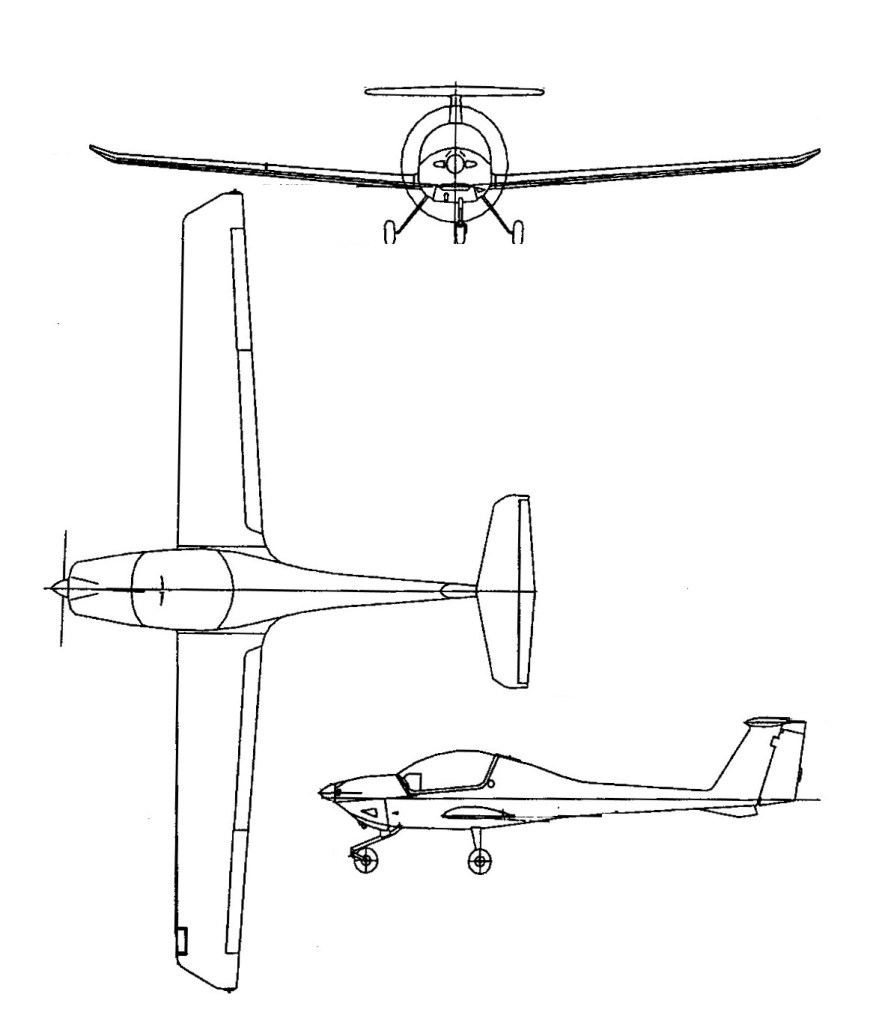
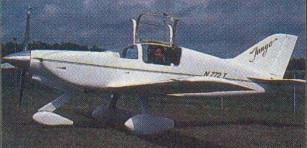
Single seat single engined mid wing monoplane with conventional three axis control. Wing has swept back leading edge, swept forward trailing edge, and tapering chord; two fin tail and canard wing. Pitch control by fully flying canard; yaw control by fin-mounted rudders; roll control by one third span spoilers; control inputs through stick for pitch/roll and pedals for yaw. Cantilever wing; wing profile double surface. Undercarriage has three retractable wheels in tricycle formation; steel spring suspension on all wheels. Push right go right nosewheel steering connected to yaw control. Individual brakes on main wheels. Glass fibre fuselage partially enclosed (total enclosure optional). Engine mounted above wing driving pusher propeller. Composite foam/glass fibre construction with spars in carbon fibre.
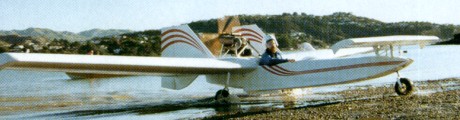
The appearance of the world’s first purpose designed amphibious ultralight created quite a stir when it appeared in prototype form at the ’82 Oshkosh and it has continued to attract great interest ever since.
This composite construction machine has floats at its wing tips and the entire fuselage forms a hull. The main wheels of the XTC Hydrolight retract sideways and outwards and the nosewheel retracts forward, nestling in the nose of the fuselage. Foot operated individual main wheels brakes are fitted.
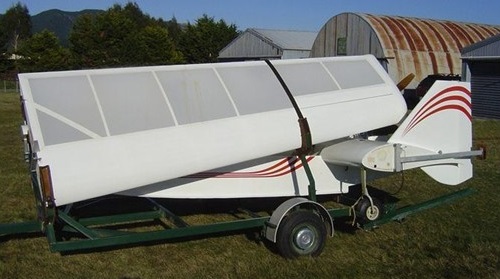
Though originally fitted with a twin cylinder Cuyuna 430RR and later with the Kawasaki TA440 developing 39 hp at 6000 rpm, the XTC Hydrolight is now normally supplied with the KFM 107 engine. The title stands for Cross Terrain Craft and, according to its constructor, is pronounced ‘ecstasy’! To allow trailer transport, the outer wing sections are removable, rigging time being quoted as 10 min with one person. The aircraft is supplied in kit form, requiring some 100 h for completion, for around $6000 in 1982, the exact price depending on the options selected from a long list including bubble canopy, parachute systems, lights, instruments, skis, Tedlar wing covering and a trailer.
Powered by a Rotax 447 it cruises at around 45-50mph at only 4700rpm and uses around eight litres per hour. You can up the cruise to 60-65mph. The hull is constructed of fibreglass and Kevlar, the wing has a fibreglass D-section leading edge and covered with sail cloth, and a carbon fibre capped spar. Wing attach fittings are titanium, and with extensive use of stainless steel and anodised aluminium in a majority of the rest of the metal fittings this is a very low maintenance airframe even if operated in the sea.
Engine: KFM 107, 25 hp at 6280 rpm. Propeller diameter and pitch 52×22 inch, 1.32×0.56m. V belt reduction, ratio 2.1/1. Max static thrust 170 lb, 77 kg. Power per unit area 0.16 hp/sq.ft, 1.7 hp/sq.m. Fuel capacity 5.0 US gal, 4.2 Imp gal, 18.9 litre. Length overall 15.2 ft, 4.62 m. Height overall 4.8ft, 1.44m. Wing span 32.0ft, 9.75m. Chord at root 5.0ft, 1.52m. Chord at tip 3.0ft, 0.91m. Dihedral 3 degs. Canard span 12.0ft, 3.65m. Canard chord 2.5 ft, 0.76 m. Fin height 3.0 ft, 0.91 m. Total wing area 155 sq.ft, 14.4 sq.m. Main wing area 128 sq.ft, 11.9sq.m. Canard area 27.0 sq.ft, 2.5 sq.m. Total spoiler area 4.0 sq.ft, 0.37 sq.m. Fin area 10.0ft , 0.93 sq.m. Rudder area 8.0 sq.ft, 0.74 sq.m. Main wing aspect ratio 8.0/1. Wheel track 6.3ft, 1.93m. Wheelbase 10.2ft, 3.09m. Nosewheel diameter overall 11 inch, 26 cm. Main wheels diameter overall 11 inch, 26 cm. Floats, dimensions 2.4 x 14.0 ft, 0.71 x 4.26 m. Empty weight 247 lb, 112kg. Max take off weight 500 lb, 227kg. Payload 253 lb, 115kg. Max wing loading 3.22 lb/sq.ft, 15.8 kg/sq.m. Max power loading 20 lb/hp, 9.1 kg/hp. Load factors +4.0, 4.0 design; +8.0, 8.0 ultimate. Max level speed 62 mph, 100 kph. Never exceed speed 80 mph, 129 kph. Max cruising speed 60 mph, 97 kph. Economic cruising speed 50 mph, 80 kph. Stalling speed 25 mph, 40 kph. Max climb rate at sea level 600 ft/min, 3.1 m/s. Min sink rate 250 ft/min at 37 mph, 1.3 m/s at 59 kph. Best glide ratio with power off 14/1 at 40 mph, 64 kph. Take off distance 100 ft, 30 m. Landing distance 200 ft, 60 m. Range at average cruising speed 120 mile, 193 km.
Engine: KFM 107 ER, 22 hp. 2.1:1 reduction belt drive. Wingspan 32ft. Wing area 150 sq.ft. Aspect ratio 6:1. Length 14ft. Empty weight 280 lbs. Payload 250-lbs. pilot plus fuel. Wing loading 3.2 lbs/sq.ft. L/D 16:1. Cruise speed 50 mph. Stall speed 26 mph. Vmax 60 mph. Climb rate 600 fpm. Fuel 5 USgal.
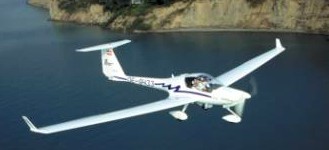
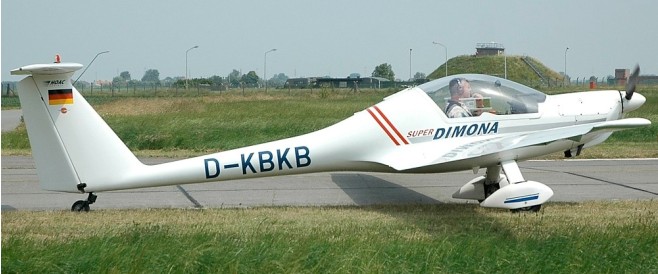
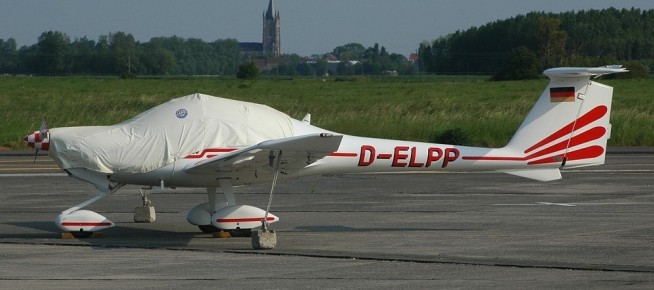
The H-36 Dimona side-by-side two-seat motor glider was designed by Wolff Hoffmann, who left Scheibe to form his own company, Hoffmann Flugzeugbau, to put the Dimona into production at Friesach in Austria, where production was due to start in the summer of 1981. Design work began in 1979 using the Worthmann FX63 137 wing profile. The all-fiberglass two-place self-launching HOAC (formerly Hoffmann) Dimona features a folding wing design which allows two people to fold both wings in several minutes and reduce the aircraft hanger space requirement to no more than that of a sailplane trailer. The Limbach engine drives a Hoffmann 2 blade, 3 position propeller. Of glassfibre construction, the Dimona is a low wing monoplane with a T-tail and a fixed tailwheel undercarriage with spats on the main wheels. The wings can be folded alongside the fuselage and are fitted with air brakes. The cockpit canopy hinges upward for entry, and there are two rear windows. The 80hp Limbach SL2000 EB1 ‘flat four’ engine drives a Hoffmann three-position two blade propeller, and a special engine suspension is featured to ensure low noise and vibration levels.
The prototype made its first flight on 9 October 1980, on sale since summer 1981; some 50 Dimonas had been ordered by the spring of 1981.
The Hk 36 Super Dimona has the wing span increased to 16.2 m. with carbon fiber spar and modified fuselage. It is also offered with wingtip extensions to give a span of 17.6 m. Approach control is with top surface Schempp-Hirth type airbrake. In addition to the Limbach, it is offered with a Rotax 912 A of similar power, or a more powerful Limbach L 2400 EB. Dimonas have been manufactured in Germany and Austria, and is Air Transport Certified.
The two-place self-launching glider, a development of the HOAC HK 36 Super Dimona, is produced in four varieties, the HK 36TC with an 60 kW/ 81 bhp engine and tailwheel landing gear, the HK 36TC with the same engine and tricycle gear, the 86 kW/ 115 bhp HK 36TTS with tailwheel gear, and the HK 36TTC with the same engine and tricycle gear. The variants with the larger engine have the capability of towing lighter sailplanes. The wings fold back to stand vertically parallel with the fuselage for storage.
Hoffmann H-36 Dimona Engine: Limbach SL2000 EB1, 80hp Propeller: Hoffmann three-position two blade Span: 52 ft 6 in Length: 22 ft 5.75 in Height: 5 ft 3 in Wing area: 163.6 sqft Aspect ratio: 16.8 Empty weight: 882 lb Max take-off weight: 1,433 lb Max speed: 130 mph (power on) Economical cruising speed: 112 mph Min sinking speed: 2.95 ft/sec at 50 mph Best glide ratio: 27:1 at 65 mph (power off) Max rate of climb at sea level: 689 ft/min Max range: 621 miles
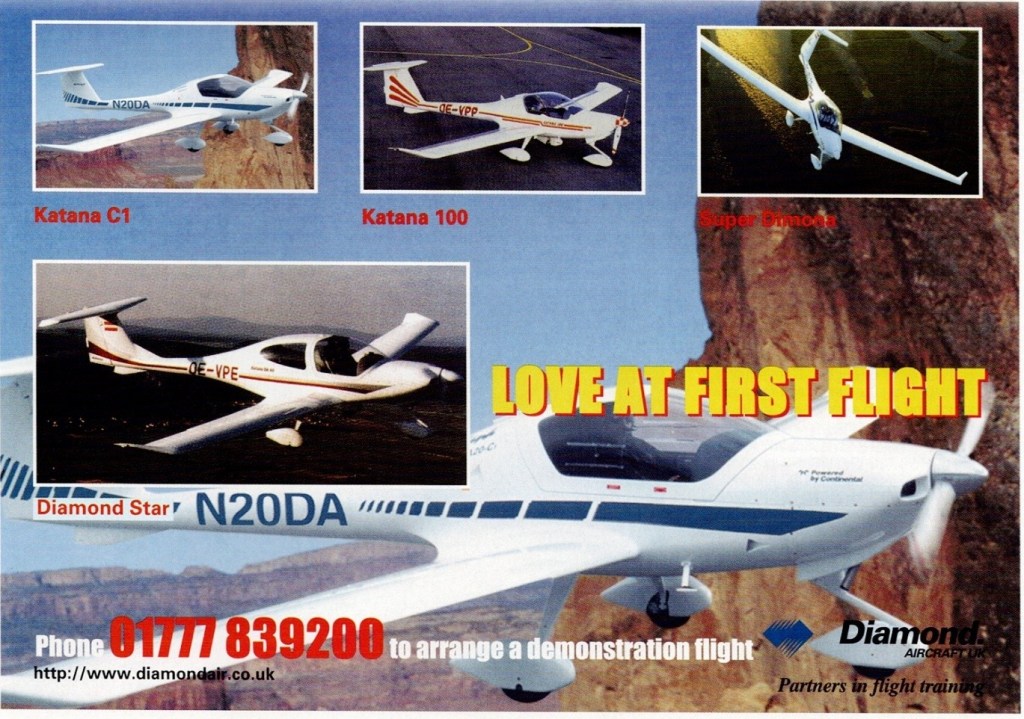
A primary flight trainer based on the HK36 motor glider, with shortened wings, the addition of flaps, and a tricycle landing gear. Production com¬menced in Austria in 1993 with over 150 being produced until 1995. Diamond’s Canada operations were established in June 1992 at London, Ontario, to develop, certify and manufacture a light all-composite, two-place training aircraft. Diamond Aircraft Industries Canada division produced the HK 36 Super Dimona motorglider in four versions. Production of the DV 20 Katana two-seat lightplane stopped in Austria (first flown March 1991 as the HOAC LF 2000, becoming LF2 before DV 20), which evolved into the Diamond DA20 produced in Canada.
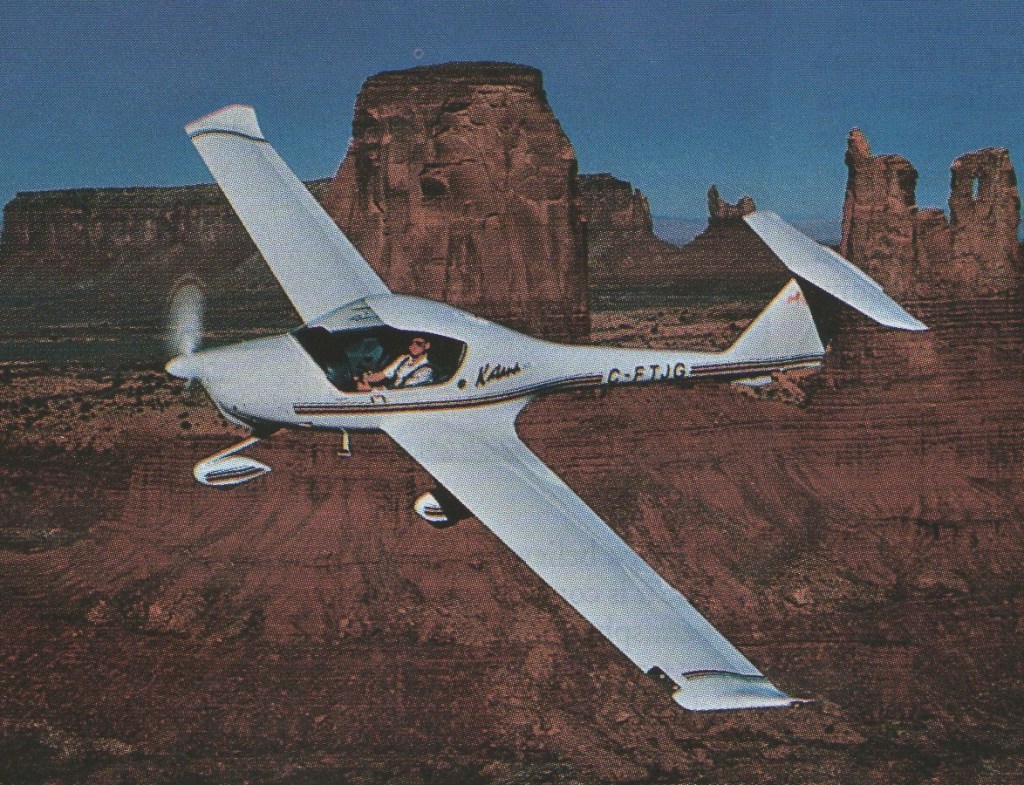
A primary training and sport aircraft of composite construction. Some forty changes were made to the Canadian-built Katana DA20-A1 from the original Austrian DV20. Major changes included a wider cabin, electric trim and a doubling of the electrical system capacity. The original Katana A1 was certified in 1994, with first customer deliveries beginning in January 1995. The last of this model was delivered in April 1998 with a total of 331 manufactured. Over 100 significant design changes were incorporated in the Katana DA20-C1, from the original aircraft. Production deliveries of the Katana Cl started early 1998 with a 1999 production rate of three aircraft per week.
May 2000
The Katana’s fuselage is built as one piece from glass reinforced plastic (GRP), with local areas of carbon reinforced plastic (CRP) with reinforcement in high stress areas. The total length of the aircraft is 7.17 metres (23 ft 6 in) and the skin is made of GRP laminate. The skins of the wings, however, are a GRP/foam/GRP sandwich. The wing is a Wortman laminar profile and the inner 50 percent of the wing features slotted flaps. Each wing is attached to the fuselage with three bolts. In the wing several ribs provide structure and mounting surfaces for guides and support for control bellcranks. The rudder, also made of a GRP/foam/GRP sandwich, is cable operated by dual adjustable pedals. The horizontal stabiliser and elevator are of the same construction with local GRP reinforcement. A steel control tube actuates the elevator, but centering and force gradients on the stick are assisted by two compression coil springs which are mounted concentric to the vertical push/pull tube of the elevator control system. The elevator trim function, which is operated on the central control panel, works by moving the common spring base with an electric actuator. The flaps are actuated electrically through a mechanical linkage that operates to both sides. The ailerons, on the other hand, are driven by steel control tubes and aluminium bellcranks. The landing gear is a conventional, non-re¬tractable tricycle system. The main gear struts are spring aluminium, while the nose gear strut is a steel tube sprung on an elastomeric spring pack. The castoring nose wheel is friction damped and the aircraft is steered by differential braking of the main wheels. The engine is mounted on a conventional welded steel tube frame attached to the ceramic fibre matting and stainless steel skin firewall. The maximum gross weight was increased by 66 lb on 8 April 1999 by the FAA to 780 kg (1720 lb). The Katana has a central control stick that is mounted at the front of the comfortable, and rather deep, four-point harness bucket seats. It is interesting to note that this aircraft is built for the changing Canadian weather and a heating system, as well as air vents at the lower position on the instrument panel, make for an easily controlled cockpit environment.
DA20 Engine TCM IO-240-B3B, 125 hp Propeller Sensenich 2-blade fixed pitch Airworthiness category Utility, spin certified Length 23 ft 6 in Height 7 ft 2 in Wing Span 35 ft 8 in Maximum takeoff weight 1,764 lbs Useful load 600 lbs Fuel capacity, usable 24.0 gal Fuel AVGAS 100LL Takeoff distance, ground roll 1,280 ft Takeoff distance, 50-foot obstacle 1,640 ft Landing distance, ground roll 661 ft Landing distance, 50-foot obstacle 1,360 ft Rate of climb, sea level 1,000 ft/min
DA20-A1 Engine: Rotax 912F-1, 81 hp.
DA20-C1 Engine: Teledyne Continental IO-240-B3B, 125 hp. Recommended TBO: 2,000 hr Prop: 1.75-rn dia Sensenich fixed-pitch wood-fibre. Length: 23 ft 6 in Height: 7ft 2 in Wing span: 10.87 m (35 ft 8 in). Wing area: 11.6sq.m (125 sq.ft). Wing Loading: 13.2 lb/sq ft Power Loading: 13.2 lb/hp Seats: 2. Empty weight, typical: 1,166 lb Maximum gross weight: 1,654 lb Fuel capacity, std: 25 US gal / 93 litres (91 litres usable). Fuel usage @ 2500 rpm: 20 lt/hr. Oil capacity: 6 qt Takeoff distance, ground roll: 952 ft Takeoff distance over 50-ft obstacle: 1,263 ft Max demonstrated crosswind component: 15 kt Rate of climb, sea level: 1105 fpm Cruise Speed @ 75% power, 6,000 ft: 132 ktas Endurance: 4.5 hr. Operating ceiling: 13,123 ft Landing distance over 50-ft obstacle: 1,235 ft Landing distance, ground roll: 550 ft W (best angle of climb): 60 kias Vy (best rate of climb): 75 kias Va (design maneuvering): 106 kias Vfe (max flap extended): 78 kias Vne (never exceed): 163 kias Vs (stall, clean): 42 kias Vso (stall, in landing configuration): 34 kias
2008 Diamond DA20-C1 Eclipse Base Price: US$174,495 Engine: Continental IO-240-B3B, 125 hp@SL TBO (hrs.): 2000 Fuel type: 100LL Propeller: 69-in. Sensenich FP Landing gear type: Tri./Fixed Gross weight (lbs.): 1764 Empty weight, std. (lbs.): 1164 Useful load, std. (lbs.): 600 Payload, full std. fuel (lbs.): 456 Usable fuel, std. (USgals.): 24 Wingspan: 35 ft. 8 in. Overall length: 23 ft. 6 in. Height: 7 ft. 2 in. Wing area (sq. ft.):125 Wing loading (lbs./sq. ft.): 14.1 Power loading (lbs./hp.): 14.1 Seating capacity: 2 Cabin doors: 1 Cabin width (in.): 45 Cabin height (in.): 44 Cruise speed (kts.): 75% power: 138 Fuel consumption (USgph): 75% power: 5.5 Vso (kts.): 45 Best rate of climb, SL (fpm): 1000 Service ceiling (ft.): 13,120 Takeoff ground roll (ft.): 1280 Takeoff over 50 ft. obstacle (ft.): 1640 Landing ground roll (ft.): 661 Landing over 50 ft. obstacle (ft.): 1360
DA20 Engine: TCM IO-240-B3B, 125 hp Propeller: Sensenich 2-blade fixed pitch Airworthiness category: Utility, spin certified Length: 23 ft 6 in Height: 7 ft 2 in Wing Span: 35 ft 8 in Maximum takeoff weight: 1,764 lbs Useful load: 600 lbs Fuel capacity, usable: 24.0 USgal Fuel: AVGAS 100LL Takeoff distance, ground roll: 1,280 ft Takeoff distance, 50-foot obstacle: 1,640 ft Landing distance, ground roll: 661 ft Landing distance, 50-foot obstacle: 1,360 ft Rate of climb, sea level: 1,000 ft/min
Hoffmann Flugzeugbau-Friesach GesmbH Wolf Hoffinann Flugzeugbau KG Hoffmann Aircraft Ltd HOAC AG HOAC-Austria, Flugzeugwerk Wiener Neustadt Gesellschaft mbH Dimona Aircraft Diamond Aircraft Industries GmbH
Hoffmann Flugzeugbau-Friesach GesmbH was founded in Friesach, Austria, in 1981 to produce the newly certified H36 Dimona motorglider. 1983: Wolf Hoffinann Flugzeugbau KG, Sportflugplatz, D 8870 Gfinzburg; West Germany. By 1985, Hoffmann Aircraft Ltd, was a 100% subsidiary of Simmering-Graz-Pauker AG, and in 1985 moved to Vienna and introduces the Dimona Mk II. Production facilities are established at the Wiener Neustadt airport, just south of Vienna in 1987. The airport has a long history, dating back to before the first world war. The Dries family acquired 100% control of the company, now named HOAC AG, in 1989, thereafter being known as HOAC-Austria, Flugzeugwerk Wiener Neustadt Gesellschaft mbH. Immediately, development of the HK36R Rotax 912 powered motorglider and its derivative, the DV20 “Katana”, were started. With a view to supplying the US market with its new technology training aircraft, a full production facility was established in London, Ontario, Canada, in 1992. The company was named Dimona Aircraft. The Austrian built DV 20 Katana is certified in 1993 and the first, DV20, OE-CPU went on a demo tour in the US and Canada. The first Canadian built production DA20-A1 was delivered to Central Missouri State University in 1995 and serial production was ramped up. The DA20-A1 Katana receives the prestigous Flying Magazine Eagle Award, for best light aircraft. Named Diamond Aircraft Industries GmbH since March 1996, Diamond Aircraft Industries Canada division produced the HK 36 Super Dimona motorglider in four versions, but stopped production of the DV 20 Katana two-seat lightplane in Austria (first flown March 1991 as the HOAC LF 2000, becoming LF2 before DV 20), which is now produced in Canada as the DA 20 Katana. Latest aircraft is the four-seat DA 40 Katana (first flown 1998). HOAC introduces 4 new versions of the HK36 motorglider: taildragger or tricycle gear, either with the Rotax 912 or turbo 914 engine. The 4 seater DA40 program is announced in 1997 at the AERO EXPO in Friedrichshafen. The first experimental aircraft are powered by Rotax 914 and TCM IO-240 engines. The Lycoming IO360 is selected for the production version. The Rotax powered Katana, after production of 500 units, is replaced with the all new TCM IO240 powered DA20-C1, featuring improved performance, useful load and comfort. Diamond opens its new Diamond Flight Center, including training facilities and the Katana Kafé restaurant, at the London Airport. HOAC is renamed Diamond Aircraft GmbH, to align with the North American operation, and Diamond Austria acqired the Wiener Neustadt – East Airport (LOAN). In 1998 Diamond Aircraft maintained two research and de¬velopment centres, located in London, Ontario, Canada, and Weiner Neustadt, Austria. Diamond’s primary manufacturing facilities are located at their Canadian base, where the Con¬tinental powered Katana C1 is produced. The new Diamond DA40, four-place aircraft was also to be manufactured in this facility. Production of Diamond’s Katana Xtreme, high performance motor glider/glider tug aircraft takes place at the company’s Austrian facilities. By 1999 over 1250 Diamond aircraft were flying worldwide. The Wiener Neustadt airport and company facilities undergo significant expansion, with the addition of new taxiways, runway lighting, NDB approach, construction of a new administration building, pilot shop, restaurant, and maintenance facilities. The DA20-100, a factory refurbished and re-engined (Rotax 912S-100hp) Katana, is introduced and proves very popular, particularly in Europe. Diamond opens a factory sales, service and flight training center in Egelsbach (Frankfurt). The DA20-C1 Eclipse, an improved and enhanced version of the DA20-C1, enters production. The IFR DA40-180 Diamond Star is certified in 2000 and enters production. The HK36TTC-ECO, a specialized aerial camera platform also enters service. The DA40-180 receives FAA type certification and production for the North American market starts in London, Ontario in 2001. Diamond Austria flies the world’s first modern production GA diesel powered aircraft, the DA40-TDI, in 2001. The DA20-C1 was selected for the USAF Introductory Flight Training Program in 2002. The DA42-TDI project is announced at the Berlin International Airshow in May 02. Company CEO, Christian Dries makes the first test flight on December 9th. The DA40-TDI turbo diesel powered Diamond Star receives European certification. In 2004 the DA42, equipped with the Garmin G1000, receives European certification and serial production is started. The company’s DA42 demonstrator crosses the Atlantic nonstop, direct from St. John’s, Newfoundland to Porto, Portugal, with a total fuel burn of only 72 gallons of jet fuel. DA20 and DA40 receive Chinese CAAC certification and first G1000 equipped DA40’s are delivered to PanAm Beijing. The DA40 FP, a carburated fixed pitch version of the DA40 was certified in 2005. Diamond announces a Chinese joint venture to produce the DA40 Diamond Star for the Chinese market. The DA42 receives FAA certification and first US delivery is made. In 2006 the DA20-C1 was selected for new USAF training program, D-JET completes first flights, the first Diamond Brilliance Center opens in Naples, FL, and DA40 XL introduced. The DA50 Super Star made its first flight in 2007 and the DA40 XLS/CS Launch at AOPA Expo. 2008: 1560 Crumlin Sideroad, London N5V 1S2, Ontario, Canada. Diamond DA42 is certified for Known Icing in 2008 and in 2009 the Turbo diesel Austro Engine AE 300 is certified.
It was in 2017 that China-based Wanfeng Aviation Industry acquired full ownership of the Austria-based Diamond Aircraft Group, founded in 1981 and maker of single- and twin-engine piston aircraft, including the four-seat DA40, four-seat DA42, and seven-seat DA62 models. Wanfeng’s acquisition also included Diamond’s sister company and diesel aerospace engine maker Austro Engine.