EMBRAER EMB-135 / ERJ-130 / ERJ-135 / Legacy / ERJ-140       

ERJ-135ER

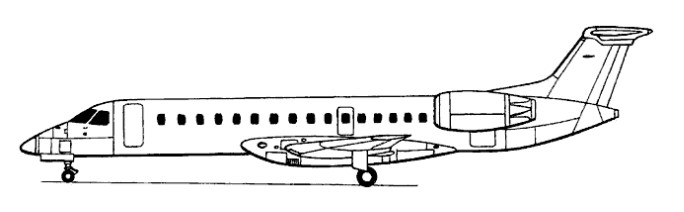
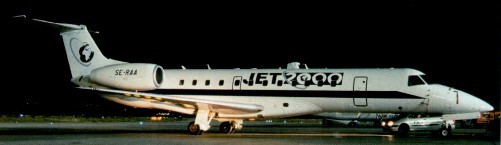
Embraer launched the ERJ-135 on 16 September 1997 as a 37-seat development of the ERJ-145 benefits from more than 95% of parts commonality with the ERJ 145: engines, main systems, cockpit, wing and tail. The fuselage cross section is the same, only 3,6 metres shorter. Rolled-out on 12 May 1998, the ERJ-135 made its first flight on 4 July 1998. A second prototype was flown on 24 September 1998, for systems testing before conversion to production standard in March 1999. Both prototypes were converted from ERJ-145 prototypes.
The public debut was at Farnborough Air Show in September 1998. Brazilian CTA certification was achieved in June 1999 and FAA certification on 15 July 1999.
The first customer delivery was on 23 July 1999 to Continental Express, followed by American Eagle.
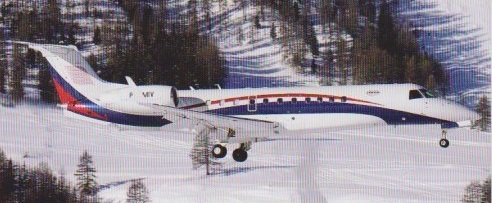
Embraer ERJ-135BJ Legacy P4-MIV

Two basic versions of the ERJ135 were available. The Extended Range (ER) and Long Range (LR). The ERJ135ER is powered by two Rolls Royce Allison AE3007A3 high-bypass ratio turbofans, while the ERJ135LR features an additional fuel tank and slightly more powerful AE 3007A4 turbofans. This ERJ135LR has a range of 3.241 km and a maximum cruise speed of Mach .78 (833 km/h).

In 2000, Embraer started with the development of the Legacy. The Embraer EMB-135BJ Legacy 600 is a twin-engine corporate jet for up to 16 passengers. The Legacy first flew on 31 March 2001. Compared to the commercial versions, the Legacy has more thrust, a new fuel system, increased cabin headroom, new winglets, additional avionics, and a higher service ceiling. The Legacy features additional fuel giving a range with 10 passengers of 5930km (3200nm). The EMB135BJ Legacy is powered by two Rolls Royce Allison AE3007 A1E high-bypass ratio turbofans. The Legacy 600 has a range of 6.019 km and a maximum cruise speed of Mach 0.80. By 2008 over 70 aircraft of the Legacy has sold to operators around the world.
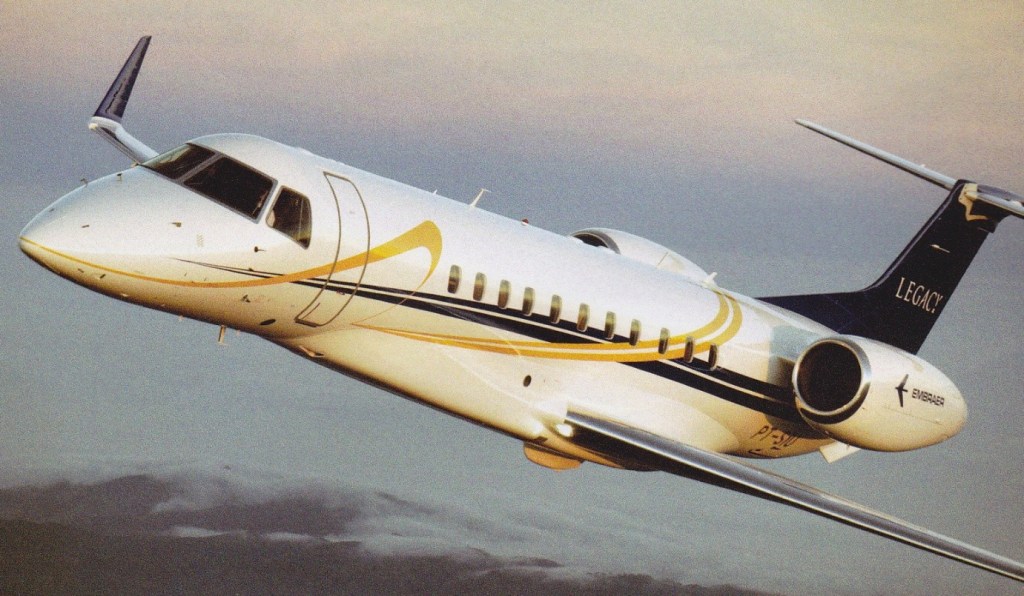
Legacy

The Legacy was available in 10-16 seat Executive, 16-25 seat Shuttle and 37-seat Shuttle HC versions. Additional fuel housed in extended under-fuselage fairings provided a range of up to 3200 nm / 5925 km. While building the Legacy 600, some 80 had been delivered.

The Embraer Legacy 650 first flew on 23 September 2009.

Embraer’s ERJ-140 were flying a year and a half after the ERJ-135. Upgraded versions of each model have followed. The ERJ-145LR came in 1998 and the XR came in 2002, both with larger and more efficient engines, an increased takeoff weight and more fuel capacity for extended range.

Total of 122 firm commercial orders and seven options by 1 January 2004. Additionally, one VIP-configured ERJ-135LR handed over to Greek Air Force on 7 January 2000 and two, also in VIP configuration, to the Belgian Air Force on 4 June and in August 2001, for operation by No. 21 Squadron at Melsbroek with two similarly configured ERJ-145s. Deliveries have been 16 in 1999, 45 in 2000, 27 in 2001, three in 2002 and 14 in 2003.
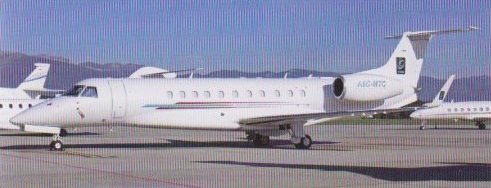
Embraer ERJ-135BJ Legacy A9C-MTC

The ERJ-140 was launched on 30 September 1999 at the European Regional Airline Association annual meeting in Paris, and the first flight of the prototype, modified from the prototype ERJ-135, was on 27 June 2000. The public debut was at Farnborough International Air Show July 2000. Brazilian CTA and FAA certification was achieved in June and 26 July 2001 respectively, with the first delivery to American Eagle late July 2001.

Gallery

Versions;

ERJ-140ER: Standard version. Engineering designation EMB-135KE.
ERJ-140LR: Long-range version. Engineering designation EMB-135KL.

ERJ-140 – Capacity: 44 pax.
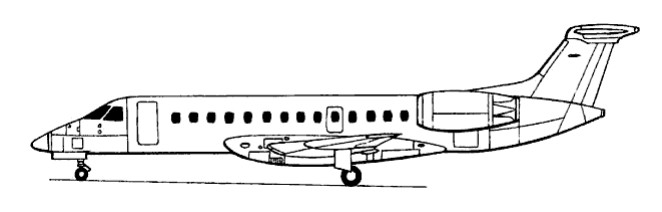
ERJ-135
ERJ-140

EMBRAER CBA-123 Vector

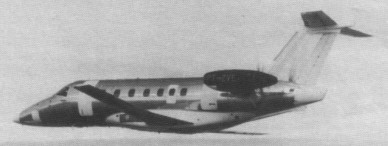
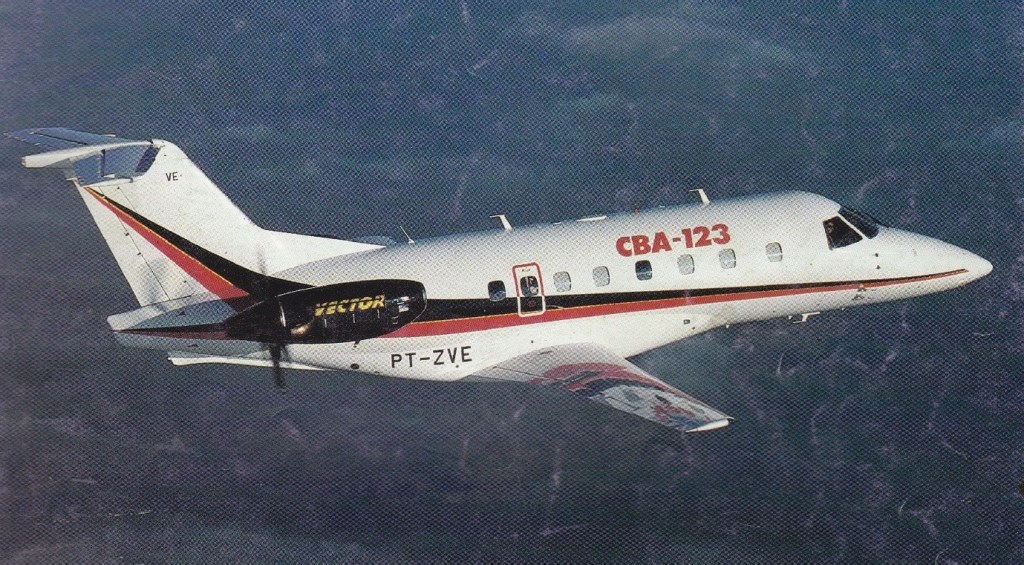
The 19-seat CBA-123 (Co-operation Brazil Argentina) Vector is the outcome of the 1986 collaboration agreement between Embraer and FMA. Support for the programme has been pledged by the Brazilian and Argentine governments, and paid options have been taken on 150 aircraft. The Vector carries two 2,081 shp (1 552 kW) Garrett TPF351-20 turboprops. Two flying prototypes will be built in Brazil and a third in Argentina, for certification in 1991.

EMBRAER CBA-123 Vector Article

The first prototype of the CB 123 made its first flight on 18 July 1990 from Embraer’s airfield in Sao Paulo, Brasil. The aircraft, prototype 801, registered PT ZVE, flew for one hour 20 minutes with a three-man crew in a flight devoted to evaluation of performance, handling and systems operation. Flaps and landing gears were cycled and the aircraft was assessed as to longitudinal stability. The un-painted prototype took off at a weight of 18,500 lb / 8300 kg and reached maximum and minimum speeds of 180 kt / 334 kph and 105 kt / 195 kph. The maximum altitude reached was 20,000 ft / 696 m.

The prototype weighed 18,300 lb on take off and attained maximum and minimum speeds during the flight of 180 knots IAS and 105 knots IAS respectively. Maximum altitude reached was 20,000 ft.

Engines: 2 x Garrett TPF351-20 turboprops, 2,081 shp (1 552 kW)

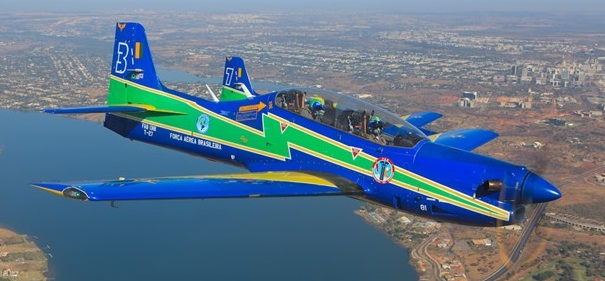
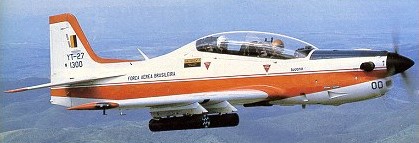
EMBRAER EMB-312 Tucano / EMB 314 Super Tucano / Shorts Tucano

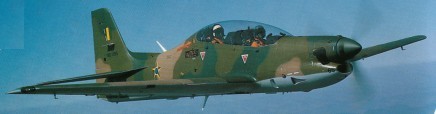
Work on the development of a new basic trainer for the Brazilian air force began in January 1978, the product of a design team led by Ing. Joseph Kovacs. A contract for two prototypes and two static test airframes was awarded to the company by the Brazilian Ministry of Aeronautics on 6 December 1978. Given the company designation EMBRAER EMB-312 and known to the Brazilian air force as the T-27, the type was named Tucano (Toucan) on 23 October 1981.

EMBRAER EMB-312 Tucano Article

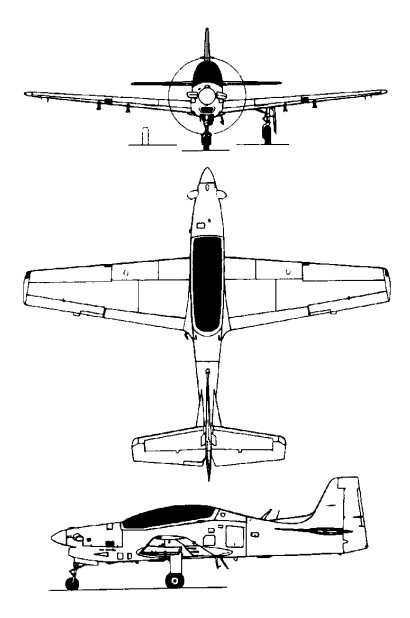
A conventional-looking cantilever low-wing monoplane of light alloy construction, the EMB-312 has retractable tricycle landing gear, enclosed cabin accommodation for two in tandem seated on Martin-Baker ejection seats, and power provided by a Pratt & Whitney Aircraft of Canada PT6A turboprop engine.
The prototype flew for the first time on 16 August 1980 followed by a second on 10 December. A third, built to full production standards, flew in August 1982.

The third prototype incorporated the various modifications to be standardised on the production model. These included provision of an enlarged dorsal fin (retrofitted to the prototypes) to improve stability; reinforced wing hardpoints permitting the external load to be increased from 1323 lb / 600 kg to 2205 lb / 1000 kg; improved cabin ventilation control and air conditioning; better cabin sealing and lighting; redesigned aft fuselage inspection windows; a new modular circuit breaker panel an d engine relight facilities.

By July 1982 testing with external ordnance the Tucano proved capable of 4.4g with four 551 lb / 250 kg bombs (its maximum external load) and of up to 6.0g with 408 lb / 185 kg on each store station. Specifications revealed some weight increases, basic empty weight rising to 3946 lb / 1790 kg, max clean take-off weight to 5622 lb / 2550 kg and max loaded weight to 7044 lb / 3195 kg. These gave some minor performance reductions, maximum level speed to 284 mph / 458 kph at 13,500 ft / 4115 m and maximum initial climb as 1900 fpm / 9.65 m/sec.

Initial deliveries to the Brazilian air force were made in September 1983.

Embraer T-27 Tucano

Ordered by the FAB to replace the Cessna T-37, the type has since found world acceptance and by the middle of 1991 over 350 had been delivered out of 376 firmly ordered, with a further 86 on option. Tucano customers are the Brazilian air force (128), Honduras (12), Egypt (54), Iraq (80), Venezuela (31), Peru (20), Argentina (30), Paraguay (6) and Iran (15).

Argentina received its first five aircraft, from an order for 30, on May 21, 1987. Peru took delivery of its first EMB.312 in April 1987, and in the same month Venezuela received its 30th and last Tucano. The Brazilian Air Force’s 118th aircraft was deliv¬ered in May 1986, and by June 1987 281 had been delivered to eight customers.
Egypt is licence-building the Tucano, both for its own use and for Iraq. Embraer supplied ten complete aircraft at the end of 1984, and by April 1987 had delivered the 100th CKD kit to the Arab Organisation for Industrialisation’s Kader Factory. The combined Egyptian/Iraqi order was for 120 Tucanos, plus options.

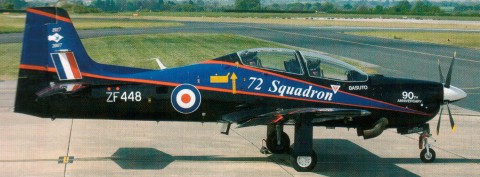
An uprated version was ordered by the UK government in March 1985 to replace Jet Provosts in the Royai Air Force and 130 were in production as the Shorts Tucano T.Mk 1, with 15 more on option. The extensively developed version features a strengthened airframe and significantly enhanced performance powewed by an 820kW Garrett TPE331-12B engine, and has itself attracted orders from Kenya (12) and Kuwait (16). The first Garrett powered aircraft flew in Brazil on February 14, 1986. The first Shorts-built Tucano flew in December 1986, deliveries to the RAF began in June 1987, and about 60 had been built and delivered by mid-1991. Although superficially similar to the original Brazilian-designed aircraft the Shorts Tucano is considerably different to meet the Service’s requirements. The original PT6A has been replaced by 1,100 shp (820 kW) Garrett TPE331-12B turboprop, a ventral airbrake added, a new cockpit layout provided and the structure strengthened for a fatigue life of 12,000 hours. Four underwing hardpoints can be fitted for export customers.

Shorts Tucano

The Embraer EMB 314 Super Tucano Brazilian turboprop aircraft designed for light attack & counter insurgency first flew on 2 June 1999.

Replica: Flying Legends Tucano

Gallery

Variants;
Tucano T.Mk 1: basic trainer version developed and built by Short Brothers in Belfast, in collaboration with EMBRAER. One-hundred-and-thirty, each powered by a Garrett TPE331-12B engine driving a Hartzell four-bladed propeller, ordered for RAF.
Tucano T.Mk 51: Twelve Shorts-built armed aircraft ordered by Kenyan air force in 1988 for weapons training. First example flown in October 1989 and delivered in 1990.
Tucano T.Mk 52: Sixteen Shorts-built basic trainers ordered by Kuwait air force in February 1989 for delivery in 1991.

EMB-312
Engine; 1 x Pratt & Whitney Aircraft Canada PT6A-25A, 560 kW
Max take-off weight; 3175 kg / 7000 lb
Empty weight; 1790 kg / 3946 lb
Wingspan; 11.14 m / 36 ft 7 in
Length; 9.86 m / 32 ft 4 in
Height; 3.40 m / 11 ft 2 in
Wing area; 19.40 sq.m / 208.82 sq ft
Max. speed; 242 kt / 448 km/h / 278 mph
Cruise speed; 319 km/h / 198 mph
Landing speed : 67 kt / 124 km/h
Initial ROC: 644 m/min / 2165ft/min / 11.0 m/s
Service Ceiling: 9150 m / 30000 ft
Fuel internal: 695 lt.
Range w/max.fuel; 1844 km / 1146 miles
T/O run: 380 m.
Ldg run: 370 m
Crew; 2
Warload: ext. 1000 kg
Combat radius: 795 km

Shorts Tucano
Engine; 1,100 shp (820 kW) Garrett TPE331-12B turboprop

EMBRAER EMB-120 Brasilia

EMB-120RT

Encouraged by the successful penetration of the commuter airline market by the EMB-110 Bandeirante, EMBRAER initiated design studies for a completely new and pressurised twin-turboprop regional airliner in September 1979.

EMBRAER EMB-120 Brasilia Article

Designated the EMBRAER EMB-120 Brasilia, the prototype flew for the first time on 27 July 1983 and certification was achieved by May 1985. Primary design objective was to carry a full 30-passenger payload for up to three 185km sectors without refuelling. The fuselage has an interior diameter of 2.28m and a cabin height of 1.76m, the aisle being offset by the two-and-one seating arrangement. In cargo configuration the Brasilia has a maximum available cabin volume of 31.1cu.m and is fitted with a cargo door in the starboard side of the rear fuselage.
Powered by advanced-technology Pratt & Whitney Canada PW118 turbo-props driving four-bladed Hamilton Standard 14RF-9 propellers, the engines can be ground-run without turning the propellers to facilitate speedier turn-rounds, thus obviating the need to shut down during loading or unloading. The starboard engine can act as an auxiliary power unit, to provide ground electrical power and cabin air-conditioning, but a conventional APU is optional. Composite materials equivalent to ten per cent of the aircraft’s basic empty weight have been used in the construction of the Brasilia.
Deliveries began in June 1985 and by 1990 more than 500 orders and options had been recorded, for operators in three continents. In addition to airline use, the EMB-120 Brasilia is in service with the Forca Aerea Brasileira as the C-97 and VIP VC-97.
By early 1991 more than 200 had been delivered and the production rate was six per month.
The EMB 120ER model is the basis for Embraer’s regional jets.

Embraer EMB 120 Brasilia
Engines: 2 x Pratt & Whitney Aircraft of Canada PW118 turboprops, 1342kW / 1,800 shp
Props: 4 blade
Length: 65 ft 7 in / 20.0 m
Height: 20 ft 10 in / 6.4 m
Wingspan: 64 ft 11 in / 19.8 m
Wing area: 424.102 sqft / 39.4 sq.m
Max take off weight: 25357.5 lb / 11500.0 kg
Weight empty: 15589.4 lb / 7070.0 kg
Max. weight carried: 9768.2 lb / 4430.0 kg
Max. speed: 328 kts / 608 km/h
Landing speed: 87 kts / 162 km/h
Cruising speed: 260 kts / 482 km/h
Initial climb rate: 2125.98 ft/min / 10.80 m/s
Service ceiling: 29806 ft / 9085 m
Wing loading: 59.86 lb/sq.ft / 292.00 kg/sq.m
Range: 945 nm / 1750 km / 1087 miles
Crew: 2
Payload: 30pax

EMB-120RT

EMBRAER / Empresa Brasiliera De Aeronautica Sa

Empresa Brasiliera de Aeronautica SA was founded in August 1969 and began operations in January 1970 to promote the Brazilian industry. Brazil found¬ed its industry on a major program to build 112 Italian Aermacchi M.B.326 jet trainers under license for the air force. Although it was set up with government backing, the state shareholding in Embraer has steadily decreased from over 80 percent in 1970.
Embraer officially commenced operations at the beginning of 1970, with a staff of only 600, all Brazilian nationals. Work at the new company continued on the turbo-prop design until, in August ‘72 the first EMB-110 Bandeirante made its maiden flight. During the same period Embraer also began development of a single-engine agricultural aircraft, to be known as the EMB-200 Ipanema. Further expansion of the Embraer product range soon followed, including Bandeirante variants in profusion and the Xingu executive twin, while a number of different models were also built under cooperative agreements with foreign manufacturers.
In August 1974 signed cooperative agreement with Piper Aircraft Corporation, and in 1975 with Northrop. Work on Tiger II components started 1976. Six of the Piper range were produced by the Brazilian company, while the Xavante military jet trainer is built under licence to Aeronautica Macchi of Italy. By 1980 19 models were in production, and still more in development.
Successful production of the Bandeirante twin-turboprop light transport (first flown October 1968) ended in 1994. Other early production programmes included the pressurized EMB-121 Xingu transport, EMB-111A Patrulha for maritime surveillance, and Xavante (license-built Italian Aermacchi jet trainer and attack aircraft). Privatization completed in December 1994, with the Brazilian Federal Government retaining some 15 per cent of capital.
Production in 1999 included the EMB-312 Tucano turboprop trainer (first flown August 1980), EMB-314 Super Tucano (first flown May 1993) and ALX special application version, EMB-120 Brasilia regional transport (first flown 1983), ERJ135 37-passenger regional jet (first flown July 1998), ERJ145 50-seat regional jet (first flown August 1995), and surveillance versions of the ERJ145. International program is AMX combat aircraft with Aermacchi and Alenia of Italy. Divisions of EMBRAER include Industria Aeronautica Neiva SA.
Embraer was a nearly bankrupt concern when it was restructured and privatised in 1995.

Ellison-Mahon Gweduck

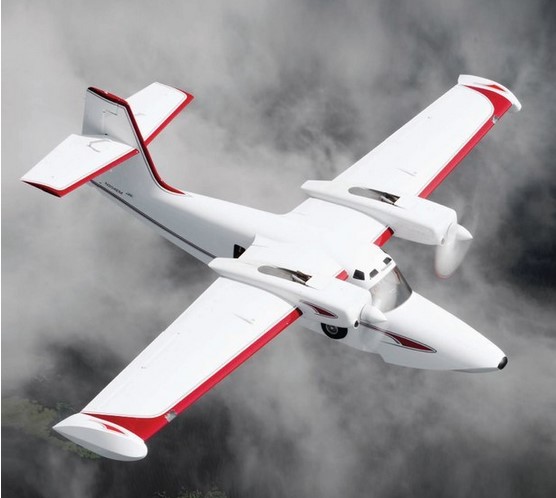
After Ben Ellison reviewed a Widgeon, Ben & Marty Ellison, & Ross Mahon designed the Gewduck around the Widgeon’s shortcomings and, one by one, eliminated them. They started designing the aircraft in 1990. The design involved a hired structural engineer and coaching from David Thurston, and the goal was an airplane that could carry 6 people and 300 lb of cargo.

Gweduck twin engine, six place, 600 hp amphibian. Construction is fibreglass, vinyl-ester resin and carbon fibre. All of the Gweduck’s akins are glass-foam-glass sandwiches of varying thicknesses. The fuselage sides and the wing skins are 3/8 in thick with the closed-cell, polyurethane Last-A-Foam (commonly used in the boating industry).

The landing gear borrows heavily on Grumman concepts with machined billet A-arms pulling the oleo struts up into the fuselage sides and the sealed landing gear wells.

The fuselage basically uses three moulded parts: the sides, the aft bottom, and the forward bottom ahead of the step, which is ¾ inch thick. The entire hull is totally sealed.

The windshield is 3/8 in thick to transfer some of the bow loads up to the top of the hull.

The fuselage is designed to be hosed out with salt water to wash. There is no metal from shoulder-level down, and everything drains into the bilge and is pumped overboard.

The wing has two molded-sandwich skins, top and bottom, and the molded ribs are bonded to the lower skin while it’s still in the mold. The spar is two C-sections back-to back with carbon fibre caps. They bolt the C-sections together and insert 3/8 in aluminium plates between the webs where the wings bolt into the fuselage. Once the top skin is bonded on, the bolts joining the spar halves are superfluous.

The main spar is at 39% and there is a front spar at 10% chord. The leading edge is non-structural for easy repair.

The airfoil is a 15% thick Ribblet, and the ailerons are linked to the flaps, so they go down 15 degrees as the externally hinged Fowler flaps come down 30 degrees.

All of the fuel is in the wings with none in the fuselage. The normal capacity is 200 USG but outboard auxiliary tanks increase the total capacity to 360 USG.

Engines: 2 x Lycoming IO-540, 300 hp
Prop: MTV-9, reversible
Wing span: 52 ft 6 in
Span floats down: 48 ft
Height: 10 ft 10 in
Empty weight: 4200 lb
MAUW: 6000 lb
Fuel cap: 200 USG + 180 USG aux
Cruise speed: 100 kt
Fuel burn econ cruise: 19.5 USG/hr
Seats: 6
Power loading: 10 lb / sq.ft
Wing laoding: 20 lb/sq.ft

Ellipse Virus / Altiss Virus

Before 1987 the French manufacturer Ellipse was named Altiss. Initially made under the name Altiss from 1986, it continued with the Ellipse name, for advanced pilots. No kingpost – struts instead of side wires.

On the 1988 Virus, Ellipse had replaced the lower side cables with profiled rigid stays and thus removed the mat and return cables.

Virus 14
Wing area: 14 m²
Wing span: 11 m
Aspect ratio: 8.6
Hang glider weight: 33 kg
Minimum pilot weight: 50 kg
Maximum pilot weight: 75 kg
Minimum speed: 29 km/h
Maximum speed: 80 km/h
Nose angle: 125°

Virus 15
Wing area: 15.5 m²
Wing span: 11 m
Aspect ratio: 7.8
Hang glider weight: 34 kg
Minimum pilot weight: 70 kg
Maximum pilot weight: 90 kg
Minimum speed: 29 km/h
Maximum speed: 80 km/h
Nose angle: 125°

Virus 134
Wing area: 13.4 m²
Wing span: 10.2 m
Aspect ratio: 7.7
Hang glider weight: 28 kg
Maximum pilot weight: 80 kg
Packed length: 4 m
Number of battens: 32
Nose angle: 125°

Virus 155
Wing area: 15 m²
Wing span: 11 m
Aspect ratio: 7.8
Hang glider weight: 34 kg
Maximum pilot weight: 90 kg
Packed length: 4 m
Number of battens: 32
Nose angle: 125°

Virus 173
Wing area: 17.3 m²
Wing span: 11.6 m
Aspect ratio: 7.7
Hang glider weight: 36 kg
Maximum pilot weight: 110 kg
Packed length: 4.25 m
Number of battens: 32
Nose angle: 125°

Ellipse Speed / Altiss Speed

A 1985 hang glider for advanced pilots. A very nice wing and very handy. The double surface was not sewn on the back which allowed to visit the inside of the double surface and the condition of the tubes.

Before 1987 the French manufacturer Ellipse was named Altiss. The Speed hang glider was built under both names.

Speed 135
Wing area: 13.5 m²
Wing span: 9.2 m
Aspect ratio: 6.3
Hang glider weight: 24 kg

Speed 155
Wing area: 15.5 m²
Wing span: 10 m
Aspect ratio: 6.4
Hang glider weight: 28 kg

Speed 174
Wing area: 17.4 m²
Wing span: 10.6 m
Aspect ratio: 6.4
Hang glider weight: 29 kg

Ellipse Radiant

A 1989 hang glider for Advanced pilots.

Radiant 130
Wing area: 13 m²
Wing span: 10.2 m
Aspect ratio: 8
Hang glider weight: 28 kg
Minimum pilot weight: 40 kg
Maximum pilot weight: 60 kg
Minimum speed: 28 km/h
Maximum speed: 80 km/h
Minimum sink rate: 0.9 m/s
Nose angle: 125°

Radiant 140
Wing area: 14 m²
Wing span: 10.6 m
Aspect ratio: 8
Hang glider weight: 30 kg
Minimum pilot weight: 55 kg
Maximum pilot weight: 70 kg
Minimum speed: 28 km/h
Maximum speed: 80 km/h
Minimum sink rate: 0.9 m/s
Nose angle: 125°

Radiant 145
Wing area: 14.5 m²
Wing span: 11 m
Aspect ratio: 8.3
Hang glider weight: 31 kg
Minimum pilot weight: 65 kg
Maximum pilot weight: 80 kg
Minimum speed: 28 km/h
Maximum speed: 80 km/h
Max glide ratio (L/H): 10
Max glide ratio speed: 35 km/h
Minimum sink rate: 0.9 m/s
Packed length: 6.35 m
Number of battens: 18
Nose angle: 125°

Radiant 155
Wing area: 15.5 m²
Wing span: 11 m
Aspect ratio: 7.8
Hang glider weight: 32 kg
Minimum pilot weight: 80 kg
Maximum pilot weight: 100 kg
Minimum speed: 28 km/h
Maximum speed: 80 km/h
Minimum sink rate: 0.9 m/s
Nose angle: 125°