1980: William J. Fike, Box 683, Anchorage, AK 99501, USA.
Built the Fike Model E
1980: William J. Fike, Box 683, Anchorage, AK 99501, USA.
Built the Fike Model E
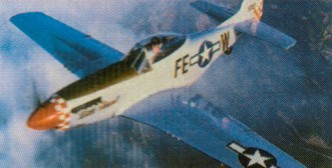
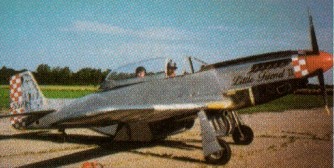
For years, many experimental aircraft builders have strived to re-create their favorite World War II fighters in miniature. For most, many hurdles had to be negotiated to get the right look, feel, sound and, of course, performance—all at the right cost of ownership. Until the advent of composite building techniques, forming all those compound curves of a fighter in metal just wasn’t within the means of your average builder. Then, getting the proper powerplant to look and sound like “the real thing” was next to impossible with the technology and funds at hand. Now with automotive/aviation V-8 conversions attaining a respectable degree of reliability, cost, and power coupled with these modern prepreg, composite techniques, the right combination has been reached. F.E.W.’s P-51D is a 67% scale version of the famous fighter of World War II first flew in 1992, and it looks the part, sounds the part and flies the part. The P-51D is stressed to ±6 G’s for aerobatics and is available in a dual-control version, the P-51TF, which first flew in 1997.
P-51
Speed max: 340 mph.
Cruise: 210 mph.
Range: 750 sm.
Stall: 57 mph.
ROC: 2000 fpm.
Take-off dist: 900 ft.
Landing dist: 1000 ft.
Service ceiling: 18,000 ft.
Engine: V-8, 300 hp.
HP range: 250-350
Fuel cap: 58 USG.
Weight empty: 1300 lbs.
Gross: 2200 lbs.
Height: 8.1 ft.
Length: 20.5 ft.
Wing span: 25.6 ft.
Wing area: 111 sq.ft.
Seats: 1-2.
Landing gear: retractable tail wheel.
P-51TF
Speed max: 340 mph.
Cruise: 210 mph.
Range: 750 sm.
Stall: 57 mph.
ROC: 2000 fpm.
Take-off dist: 900 ft.
Landing dist: 1000 ft.
Service ceiling: 18,000 ft.
Engine: V-8, 300 hp.
HP range: 250-350
Fuel cap: 58 USG.
Weight empty: 1300 lbs.
Gross: 2200 lbs.
Height: 8.1 ft.
Length: 20.5 ft.
Wing span: 25.6 ft.
Wing area: 111 sq.ft.
Seats: 1-2.
Landing gear: retractable tail wheel.
1995-7: Ardmore Airpark No.206, Gene Autry, OK 73436-0206, USA.
P-51 replica builder
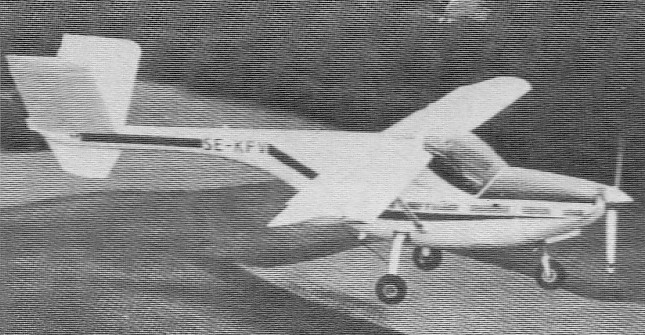
Construction of the BA-14 Starling recreational trainer, designed by Bjorn Andreasson, began 1987.
First flying on 25 August 1988, the BA-14 SE-KFV was the result of a partnership between MFI and FFV Aerotech. The two seat BA-14 is powered by a 115hp Lycoming O-235 and is almost wholly of composite construction, one of its purposes being to allow FFV Aerotech to gain additional experience in the design of primary structure, production, testing and certification with this type of material.
It became a joint venture project between MFI and FFV Aerotech, but later redesigned by MFI to FAR Pt 23A. Development delayed by other work, but resumption of flight testing apparently still awaited.
Engine : Lycoming O 235, 85 hp
Length : 21.654 ft / 6.6 m
Height : 8.858 ft / 2.7 m
Wingspan : 37.402 ft / 11.4 m
Wing area : 122.71 sq.ft / 11.4 sq.m
Max take off weight : 1797.1 lb / 815.0 kg
Weight empty : 1058.4 lb / 480.0 kg
Max. weight carried : 716.6 lb / 325.0 kg
Max. speed : 124 kt / 230 km/h
Landing speed : 40 kt / 75 km/h
Cruising speed : 103 kt / 190 km/h
Initial climb rate : 590.55 ft/min / 3.0 m/s
Service ceiling : 11155 ft / 3400 m
Wing load : 14.56 lb/sq.ft / 71.0 kg/sq.m
Range : 346 nm / 640 km
Crew : 2
First flew in 1988 the BA-14 Starling two-seat lightplane, designed by Bjorn Andreasson and a joint venture with MFI.
Gyroflug Ingenieursgesellschaft Mbh was founded 1978 to develop the SC 01 Speed Canard as full production aircraft based on U.S. Rutan VariEze. 1989 renamed FFT / Gesellschaft Fur Flugzeug- Und Faserverbund-Technologie Mbh, and became subsidiary of Justus Dornier Group 1984. Also developed manned and unmanned surveillance versions, but this program halted. Also took over development of FFA-2000 trainer from FFA, becoming Eurotrainer 2000A.
The FFA Flugzeugwerke FFA-2000 was built for the Swissair training school to replace Piaggio P-149s. After starting studies in 1986, FFA began full development testing of a 10 ft / 3 m span model in the FAF wind-tunnel at Emmen was followed by the decision in February 1988 to build two prototypes, and the Swissair order for eight aircraft was placed on 25 April.
The FFA-2000 is largely of composite construction, using a wing designed in Germany by Gyroflug-FFT.
FFT / Gesellschaft Fur Flugzeug- Und Faserverbund-Technologie Mbh took over development of FFA-2000 trainer from FFA, becoming Eurotrainer 2000A.
Engine: Porsche PFM 3200, 217 hp
Seats: 2
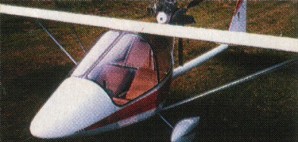
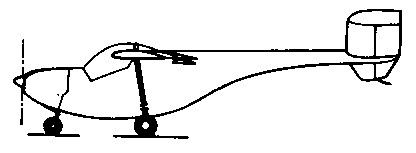
Designed by Bill Ferguson and first flown in 1991, the Fergy was developed from the Kolb Mark III and introduced to the market in 1991. The Fergie won the Grand Champion title at Sun ‘n Fun in 1991. Reviewer Andre Cliche describes it as a “clone”, whilst Noel Bertrand et al. claim it was “inspired by the Kolb Twinstar”. The aircraft differs from the Kolb design in that it has a revised cockpit pod, with centerline-hinged doors and a square-tipped rudder. The horizontal stabilizer was also raised a few inches to give better ground clearance.
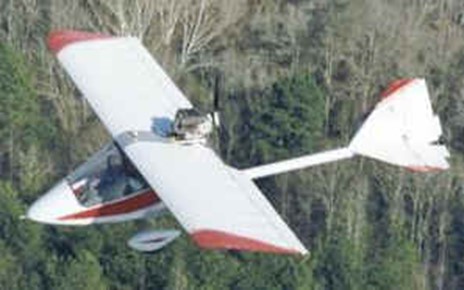
The Precision Tech Fergy F-II B is a two-seat side-by-side, conventional landing gear, strut-braced, high-wing, pusher configuration ultralight aircraft that was manufactured by Ferguson Aircraft and later Precision Tech Aircraft in kit form for amateur construction.
Ferguson Aircraft manufacturers of the Fergie, sold the design to Precision Tech Aircraft out of Cartersville Georgia.
Precision Tech has made some design changes, changing to a new airfoil, landing gear, and tail section. The airfoil change was required when the wing spar was changed to a 6 inch spar.
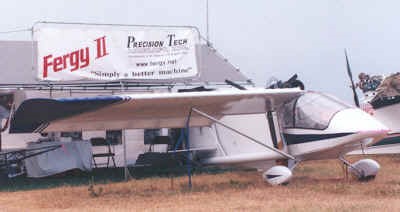
The aircraft is constructed from aluminium tubing, covered with aircraft fabric. The wings fold for storage or trailering. The standard engine supplied with the kit was the 50 hp (37 kW) Rotax 503, with the liquid-cooled 64 hp (48 kW) Rotax 582 optional, although the Fergie can accept engines that range in output from 50 to 80 hp (37 to 60 kW).
The average construction time from the kit was reported by the manufacturer as 350 hours and 40 had been completed by 2001. The unit cost was US$10,900 in 2001.
The aircraft was out of production circa 2002 and no longer available.
Ferguson F-II
Engine: Hirth 2704, 55 hp.
HP range: 46-70.
Height: 5.5 ft.
Length: 21.25 ft.
Wing span: 30 ft.
Wing area: 160 sq.ft.
Fuel cap: 12 USG.
Weight empty: 425 lbs.
Gross: 900 lbs.
Speed max: 90 mph.
Cruise: 70 mph.
Range: 200 sm.
Stall: 32 mph.
ROC: 1200 fpm.
Take-off dist: 200 ft.
Landing dist: 200 ft.
Service ceiling: 10,000 ft.
Seats: 2.
Landing gear: tail wheel.
Ferguson F-II
Engine: Rotax 503, 55 hp.
HP range: 46-70.
Height: 5.5 ft.
Length: 21.25 ft.
Wing span: 30 ft.
Wing area: 140.2 sq.ft.
Fuel cap: 12 USG.
Weight empty: 425 lbs.
Gross: 900 lbs.
Speed max: 90 mph.
Cruise: 70 mph.
Range: 200 sm.
Stall: 32 mph.
ROC: 1200 fpm.
Take-off dist: 200 ft.
Landing dist: 200 ft.
Service ceiling: 10,000 ft.
Seats: 2.
Landing gear: tail wheel.
Ferguson II-B
Wingspan: 29ft. 6 in.
Wing Area: 140 sq. ft
Length: 22 ft.
Height: 5ft. 8in with 2 blade prop
Empty Weight: 400 lbs.
Gross Weight (65 hp): 900 lbs.
Useful Load: 500 lbs.
Fuel Cap: 12.5 gal.
Take-off Roll Pilot only 46 hp: 175 ft
Rate of Climb 46hp: 800 ft/min
Rate of Climb 65hp: 1200 ft/min
Cruise: 50 – 80 mph
VNE: 100 mph
Landing Speed w/Flaperons: 28mph
Landing Speed wo/Flaperons: 34mph
Seats: 2
Storage Aft of Seats: 4 cubic feet
Precision Tech Fergy F-II B
Engine: 1 × Rotax 503, 50 hp (37 kW)
Propeller: 3-bladed ground adjustable
Wingspan: 29 ft 6 in / 8.99 m
Wing area: 140 sq ft / 13 sq.m
Length: 18 ft 8 in / 5.7 m
Empty weight: 400 lb / 181 kg
Gross weight: 1,000 lb / 454 kg
Fuel capacity: 12.5 US gallons / 47 lt
Maximum speed: 90 mph / 145 km/h / 78 kn
Cruise speed: 75 mph / 121 km/h / 65 kn
Stall speed: 28 mph / 45 km/h / 24 kn
Range: 220 mi / 191 nmi / 354 km
Rate of climb: 1,000 ft/min / 5.1 m/s
Wing loading: 7.14 lb/sq ft / 34.9 kg/sq.m
Crew: one
Capacity: one passenger
1995-7: 2431 Ferguson Pl, Dallas, GA 30132, USA.
UL builder
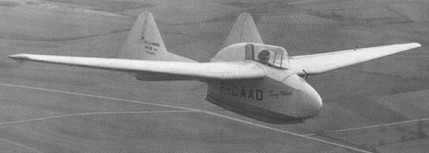
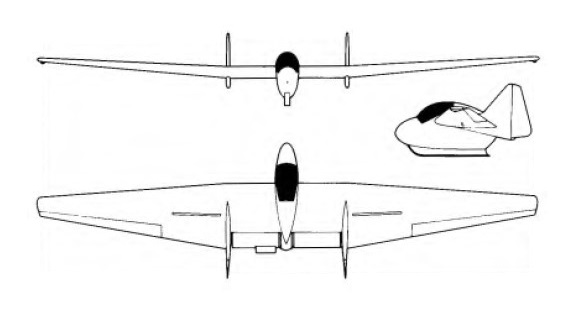
Encouraged by his experience with the acceptance of his previous glider prototypes, Charles Fauvel created the AV-36 in 1951. This retained the characteristic silhouette further improved with the fuselage reduced to a minimal profile (limited almost to the pilot’s cockpit), with a short wing span (11.95 meters) and a diminutive empty weight (120 kg). The AV-36 wing as originally designed could not be disassembled. The wing was constructed of only one piece and transporting the AV-36 by road could be done merely by folding the two rudders against the trailing edge and removing the nose of the fuselage. The AV-36 could then be put on a trailer, the resulting width of 2.38 meters not being more than the allowable road width. Furthermore, this compactness made for a very strong structure and the wing was calculated not to fail until exceeding 12 G’s at 215 kg.
The cantilever shoulder wing is of fabric-covered wooden construction and has no sweep-back because, in a tailless sailplane, the problem of eg range can be neglected since there is no changing load to cater for, and the wing can be designed to obtain the lowest value of induced drag. The elevators are in the trailing edge of the wing centre section, since there is no tailplane, the fins and rudders being carried on two short stublike fairings projecting from the wing; the rudders can be folded forward to reduce overall length for transportation on a trailer. There are Schempp-Hirth retractable air brakes above and below each outer wing, and there is a large trim tab in the port elevator. The fuselage is a short nacelle of wooden construction, with the pilot seated under a sidewaysopening blown Plexiglas canopy; there is provision for oxygen and radio. The nose can be hinged upwards to reduce length when the aircraft is transported sideways on a trailer. The landing gear consists of a flexible rubber-sprung skid, although a monowheel and rear skid can be fitted as an alternative, and there are curved wire ‘bumpers’ under the wing tips.
The prototype of the AV-36, constructed by Charles Fauvel and his son, made its first flight December 31, 1951 demonstrating its outstanding flight qualities immediately along with excellent longitudinal stability. The aircraft earned its French Navigability Certificate quickly, then shortly after came the Canadian certificate and the German certificate (the last officially allowing simple acrobatics). Some fifty examples were constructed by the Wassmer society, in Issoire. This establishment offered subsets (called kits today) for the receiving aeroclubs to assemble. Several were constructed under license in Germany, and many more built not only by amateurs in France, but also in Canada, England, Germany, Brazil and in Italy.
The AV-36 had performance very comparable to other gliders of the era with the advantage of being structurally simpler, stronger and less costly. Many pilots achieved roundtrip distance flights of 500 kilometers. In June 1954, Eric Nessler, the very famous French glider pilot who was a strong supporter of the Fauvel type, participated in the Paris-Biarritz race flying the AV-36. In 1957, Claude Visse earned his FAI Gold Badge in the AV-36.
The AV-36 flew in 16 countries. Fifty or so were built in France as “kits” (parts furnished by the Wassmer works, assembly carried out by the aero-clubs) and about twice that many were built from plans by amateur builders. It was later replaced by an improved model, the AV 36 Mk II, officially designated the AV-361.
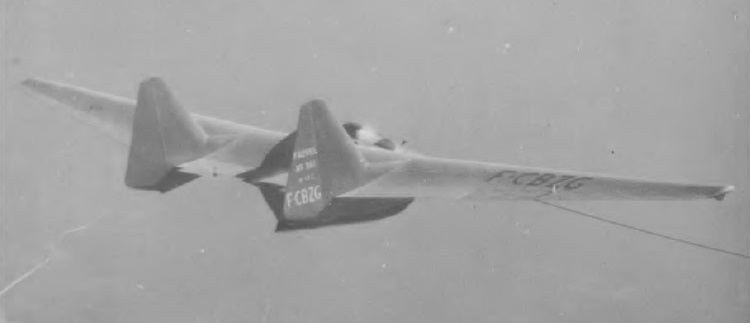
In spite of strong criticism from detractors of the Fauvel flying wing formula, based more on prejudices rather than on the real facts, there existed in 1966 about a hundred AV-36 and AV-361 gliders. The AV-361 whose prototype flew in 1960 was an improvement of the AV-36. This version distinguished itself with a longer wing span (12.78 meters), aerodynamic wing improvements (of Hoerner type), reworked vertical surfaces and installation of perforated Schempp-Hirth type air brakes on top and bottom of the wing. The fuselage was made with a more oval, comfortable shape and a plexiglas bubble canopy permitted a more panoramic view. A nose tow hook replaced the two tow line attachments under the wings. Finally, control input had been modified for more aileron differential, providing better control harmony and less adverse yaw during turns. These changes resulted in an increased glide ratio (L/D) of 2 points, and a reduction in the sink rate of 6 cm/sec. Many of the AV-36’s built were equipped with the improvements that were later incorporated in the model AV-361, notably in Germany. Some German amateur builders went even farther by motorizing the AV-36 with the addition of a small pusher 2-cycle engine and a folding propellor at the rear of the short fuselage located between the dual rudders.
The last perfecting of this design version was the changing of the wing airfoil to the Wortmann Laminar FX-66 HS 159 instead the original Fauvel F4. The result was a glide ratio (L/D) of 30 at 85 km/h.
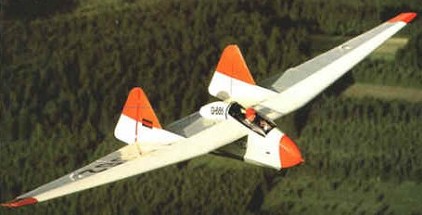
Today, there are still some active AV-36 and AV-361 flying wing gliders in France. It is interesting to note that at least one of them has been transformed into an ultralight motorglider (ULM in France) by the addition of a Koenig 2-cycle pusher engine of 24 Horsepower (like the German versions and the model AV-45) and a tricycle landing gear. In February 1971 Mons Fauvel decided to cease commerical production of his sailplanes, but plans for the AV 361 and other designs are still available for construction by gliding clubs or homebuilders. In Canada, Falconar Avia Inc. of Edmonton, Alberta still sells plans for the AV-361 (English version) as well as some parts as a kit for amateur builders. In France, neither plans nor kits have been available since the death of Charles Fauvel in 1979.
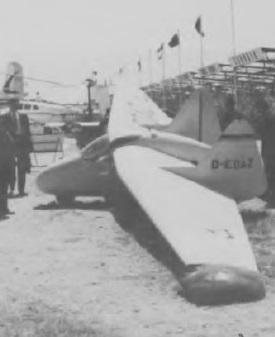
On June 30, 2019, Falconar Avia Inc closed for business and assets dissolved. The Master Sets (Original Drawings, Plans, Info Kits, Documentation) sold included the Fauvel AV-36 / 361 to Excogitare LLC
AV-36
Wing span: 11.95 m
Length: 3.17 m
Wing area: 14.2 sq.m
Airfoil: Fauvel F4 17%
Aspect ratio: 10.04
Empty weight: 120 kg
Max. gross weight: 225 kg
Stall speed: 58 km/h
Max. speed: 180 km/h
Glide ratio: 26:1 at 83 km/h
Sink rate: 0.87 m/sec
Fauvel AV 36 CR Aile Volante
Glider, France, 1951
Length: 10.4 ft / 3.17 m
Wingspan : 39.37 ft / 12.0 m
Max take off weight : 496.1 lb / 225.0 kg
Weight empty : 275.6 lb / 125.0 kg
Landing speed : 13 kts / 24 km/h
Cruising speed : 44 kts / 82 km/h
Glide ratio : 25.0
Crew : 1
AV-361
Wing span: 12.78 m / 41 ft 10.5 in
Length: 3.24 m / 10 ft 8 in
Length folded: 8ft 1 in
Wing area: 14.6 sq.m / 157.2 sq.ft
Airfoil: F2 17% / Wortmann FX-66 H 159 (optional)
Aspect ratio: 11.4
Empty weight: 134 kg / 265 lb
Max gross weight: 258 kg / 570 lb
Water ballast: None
Max speed rough air: 180 km/h / 135 mph
Max speed: 119 kt / 220 km/h
Cruise: 50 mph
Stall: 30 mph / 31 kt / 58 km/h
Best glide ratio: 26 at 45 kt / 83 km/h
Glide ratio: 30:1 at 85 km/h / 53mph (laminar flow section)
Sink rate: 0.74 m/sec / 2.5 ft/sec / 156 fpm at 35 kt / 65 km/h
Seats: 1
Landing gear: single wheel.