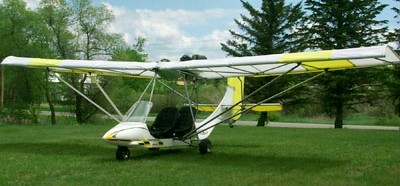
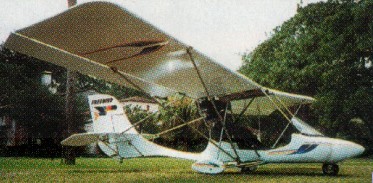
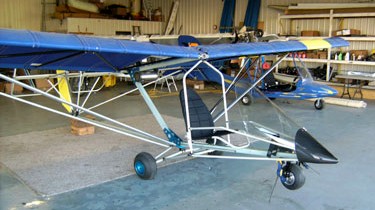
The LiteSport Classic is a side by side, Experimental/UltraLight comes standard with the high lift wing. Like all FBI Aircraft, the Classic has detachable wings for simple trailering. These LSA aircraft come standard with all anodized aluminum, side by side two seater controllable from either seat, with a fiberglass nose cone, hydraulic brakes, and polished aluminum wheels.
LiteSport Classic Cruise: 75 mph Stall: 36 mph Rate of climb: 800 fpm Takeoff dist: 300 ft Landing dist: 300 ft Engine: Rotax 503, 52 hp HP range: 52-85 Fuel capacity: 10 USG Empty weight: 440 lb Gross weight: 870 lb Length: 16.8 ft Wing span: 28 ft Wing area: 142 sq.ft Seats: 2 Cockpit width: 42 in Landing gear: nose LSA: yes
LiteSport Ultra Cruise: 55 mph Stall: 22 mph Range: 90 sm Rate of climb: 850 fpm Takeoff dist: 75 ft Landing dist: 150 ft Engine: Rotax 447 Fuel capacity: 5 USG Empty weight: 330 lb Gross weight: 530 lb Length: 15.6 ft Wing span: 26 ft Wing area: 142 sq.ft Seats: 1 Cockpit width: 22 in Landing gear: nose LSA: yes
LiteSport II Cruise: 75 mph Stall: 32 mph Range: 160 sm Rate of climb: 800 fpm Takeoff dist: 250 ft Landing dist: 150 ft Engine: Rotax 503, 48 hp HP range: 48-80 Fuel capacity: 8.5 USG Empty weight: 375 lb Gross weight: 900 lb Length: 15.2 ft Wing span: 26 ft Wing area: 142 sq.ft Cockpit width: 22 in Seats: 2 Landing gear: nose LSA: yes
The FreeBird 103 was computer designed to make a legal 254lb ultralight with 3 axis control, steerable nose wheel, and the Black Max hydraulic brake system. Using the same basic wing design used on the LS-Ultra, the fuselage was totally redesigned to shave weight without compromising integrity. Designed by Sherman Hawley, the wings fold for storage in a one bay garage, and the craft can be towed by car, and wing unfolded in ten minutes.
Freebird 103
Top speed: 80 mph Cruise: 75 mph Stall: 28 mph Range: 170 sm Rate of climb: 800 fpm Takeoff dist: 125 ft Landing dist: 150 ft Service ceiling: 12,000 ft Engine: Rotax 503, 52 hp Fuel capacity: 10 USG Empty weight: 385 lb Gross weight: 970 lb Height: 4.5 ft Length: 17 ft Wing span: 28 ft Wing area: 132 sq.ft Seats: 2 Landing gear: nose
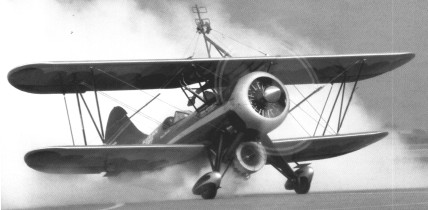
Jimmy Franklin first conceived it, built it, and then flew it. He first debuted the Jet Waco in 1999, and quickly made it one of the air show world’s most popular acts of all time.
The Franklin 1937 UPF-7 Waco bi¬plane that has a conventional radial engine and a 2200-lb-thrust jet unit from a Cessna Citation bolted between the main gear. Warm the Pratt & Whitney R-985 piston engine up well, test the smoke system a few times for good crowd effect, pretend to take off in the normal fashion by pointing the nose into wind up the runway, then give it the gas: full noise but across the runway and straight up. Jimmy Franklin put his Waco into a routine of loops and rolls, with son Kyle Franklin as wing walker, in pure jaw dropping entertainment. With over 4,500 lbs of thrust and 2,000 horsepower, Jimmy performed stunts that no one has ever attempted in this type of aeroplane.
Australian designed and built, this is a microlight that will travel at 100 kts and stalls at 27kts using around 15ltr an hour. Equipped with electric trim, flaps, wing lights, and strobe light, the doors and fuel caps ae lockable.
T200 Terrier
100
200 Engine: Subaru EA81, 130 hp Wing Span: 8.70m Airfoil Section: Chris Mark 4 Length: 6.10m Height: 2.30m Gross Weight: 600 kg Empty Weight: 340 kg Fuel Capacity: 88 Litres Baggage: 30 kg Top Speed: 120 Kts Cruise Speed: 100 Kts Stall Speed: 38 Kts VNE: 130 Kts Rate of Climb: 1500 ft/min Endurance: 6 hrs Glide Ratio (engine idle): 12:1 Fuel Consumption: 15 ltr/hr Take Off Distance: 100 m Landing Distance: 100 m Design Loads: +6G – 4G Landing Gear Track: 2.12m Seats: 2
The RF-10 two-seat motor glider is a development of the RF-9 but primarily of glassfibre instead of wooden construction, as the latter is now considered too expensive in labour costs.
It has a wing built in four sections and incorporating some carbon-fibre componets, as well as folding capability for easier hangar storage. Engine is an 80hp Limbach L2000 or – for customers in the United States – an 80hpmRevmaster with turbocharger and dual ignition. Fuel capacity is increased over the RF-9’s to 8.8 Imp gallons, and the mainwheels are larger.
The prototype RF-10 first flew in the spring of 1981 and production was due to start by September.
One RF-10 had been ordered for a projected London-Australia record flight in 1982.
Span: 57ft 0 in Length: 26 ft 0 in Empty weight: 1,168 lb Min sinking speed: 2.6 ft/sec at 50 mph
Rene Fournier was a ceramist by trade, and started off as a homebuilder with a design he called the RF 01 Avion Planeur (airplane glider). The RF.01 was a single-seat light aircraft/powered sailplane with modified Volkswagen engine, first flown July 6,1960. Government assistance for development of improved RF-2, with 34 hp Rectimo-VW engine, subsequently produced by Alpavia as RF-3, with slightly uprated engine, first flown March 1963. M. Fournier designed a series of light aircraft of similar configuration for Sportavia-Putzer and Indraero. Established subsequently Avions Fournier to develop revised version of his RF-6 Sportsman, designated RF-6B; first flown March 12, 1974. Produced RF-9 motorglider 1982.