1985: Geonic Aero Ind. Pty Ltd. 10 Geonic St, Woodridge, Qld 4114, Australia.
UL builder
1985: Geonic Aero Ind. Pty Ltd. 10 Geonic St, Woodridge, Qld 4114, Australia.
UL builder
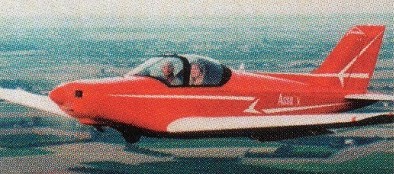
Top speed: 140 mph
Cruise: 125 mph
Stall: 47 mph
Range: 425 sm
Rate of climb: 940 fpm
Takeoff dist: 425 ft
Landing dist: 330 ft
Service ceiling: 12,000 ft
Engine: Limbach 2000, 80 hp
HP range: 75-115
Fuel capacity: 13 USG
Empty weight: 617 lb
Gross weight: 1058 lb
Height: 7 ft
Length: 20 ft
Wing span: 27.3 ft
Wing area: 120sq.ft
Seats: 2
Landing gear: nose or tail
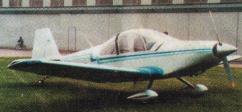
Equipped with folding wings.
Top speed: 175 mph
Cruise: 150 mph
Stall: 52 mph
Range: 750 sm
Rate of climb: 900 fpm
Takeoff dist: 600 ft
Landing dist: 600 ft
Service ceiling: 13,000 ft
Engine: Lycoming O-235, 108 hp
HP range: 85-125
Fuel capacity: 30 USG
Empty weight: 1035 lb
Gross weight: 1600 lb
Height: 9 ft
Length: 23 ft
Wing span: 25 ft
Wing area: 108 sq.ft
Seats: 2
Landing gear: nose or tail
1996: 118 Notre-Dame, Le Gardeur, Quebec J5Z 3C3, Canada.
LSA builder
The CFE738 is a small turbofan engine aimed at the business/commuter jet market manufactured by the CFE Company, and is used on the Dassault Falcon 2000.
The success of the GE27/GLC38 gas generator development of the 1980s led to the formation of the CFE Company by GE and the Garrett Engine Division of Allied Signal (later Honeywell) in 1987.
The CFE738 consists of a single stage fan, driven by a 3-stage low-pressure (LP) turbine, supercharging a 5-stage high-pressure (HP) axial/centrifugal compressor driven by a 2-stage HP turbine. The engine has an overall pressure ratio of 35:1, which is extremely high for an engine with a centrifugal compressor. Other cycle parameters are a bypass ratio 5.3 and airflow of 240 lb/s. The take-off thrust is 5,600 lbf, flat-rated to ISA+15C.
Applications:
Dassault Falcon 2000
Specifications:
Type: Turbofan
Length: 68.3 in
Diameter: 35.50 in (Fan)
Dry weight: 1,214 lb (Basic) Dry Weight: 1,325 lb
Compressor: Fan/Compressor Stages: 1/5+1C
Turbine: High-Pressure Turbine/Low-Pressure Turbine Stages: 2/3
Maximum thrust: Max. Thrust (Sea Level Static): 5,918 lbf, Cruise Net Thrust (Mach 0.8, 40000 ft, ISA): 1310 lbf
Overall pressure ratio: ~30:1, Bypass Ratio: 5.3
Specific fuel consumption: (Sea Level Static): 0.369 lb/hr/lbf, (Mach 0.8, 40000 ft, ISA): 0.645 lb/hr/lbf
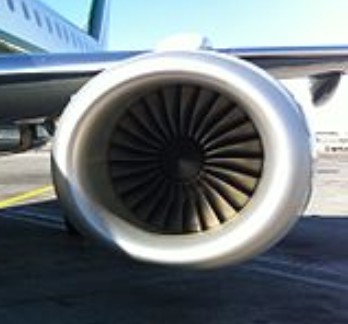
The General Electric CF34 is a civilian turbofan developed by GE Aircraft Engines from its TF34 military engine. First run in the 1960s, the original engines comprise a single stage fan, driven by a 4-stage LP turbine, supercharging a 14-stage HP compressor, driven by a 2-stage HP turbine, with an annular combustor. Later higher thrust versions of the CF34 feature an advanced technology core, with only 10 HP compressor stages. Later variants, the -10A and -10E, were derived from the CFM56 engine family, and have a radically different HP spool, comprising a 9 stage compressor driven by a single stage turbine. The LP spool has 3 core booster stages behind the fan. Static thrust is 18,500 lbf for the -10E variant.
Applications:
CF34-1
Bombardier CL-601-1A
Bombardier CL-601-1A/ER
CF34-3A
Bombardier CL-601-3A
CF34-3A1
Bombardier CRJ100 ER/LR
CF34-3A2
CF34-3B
Bombardier CL-604
Bombardier CL-605
CF34-3B1
Bombardier CRJ200 ER/LR
Bombardier CRJ440 ER/LR
CF34-8C1
Bombardier CRJ700 (Series 701)
CF34-8C5
Bombardier CRJ700 (Series 705)
Bombardier CRJ900
Bombardier CRJ900 NextGen
CF34-8C5A1
Bombardier CRJ1000 NextGen
CF34-8C5B1
Bombardier CRJ700 NextGen
CF34-8E
Embraer E-170
Embraer E-175
CF34-10A
Comac ARJ21
CF34-10E
Embraer E-190
Embraer E-195
Specifications:
CF34-3
Length: 103 in (2.6 m)
Diameter: 49 in (1.2 m)
Dry weight: 1,625 lb (737 kg) – 1,670 lb (760 kg)
Compressor: 1 fan / 14 HP stages
Turbine: 4 LP stages / 2 HP stages
Thrust at sea level: 9,220 lbf (41.0 kN)
Power-to-weight ratio: 5.6:1
Overall pressure ratio at max. power: 21:1
Bypass ratio: 6.2:1
CF34-8
Length: 121.2 in (3.08 m) – 128 in (3.3 m)
Diameter: 52 in (1.3 m) – 53.4 in (1.36 m)
Dry weight: 2,408 lb (1,092 kg) – 2,600 lb (1,200 kg)
Compressor: 1 fan / 10 HP stages
Turbine: 4 LP stages / 2 HP stages
Thrust at sea level: 13,790 lbf (61.3 kN) – 14,510 lbf (64.5 kN)
Power-to-weight ratio: 5.3:1
Overall pressure ratio at max. power: 28:1 – 28.5:1
Bypass ratio: 5:1
CF34-10
Length: 90 in (2.3 m) – 145.5 in (3.70 m)
Diameter: 57 in (1.4 m)
Dry weight: 3,700 lb (1,700 kg)
Compressor: 1 fan + 3 LP stages / 9 HP stages
Turbine: 4 LP stages / 1 HP stage
Thrust at sea level: 18,285 lbf (81.34 kN) – 20,000 lbf (89 kN)
Power-to-weight ratio: 5.2:1
Overall pressure ratio at max. power: 29:1
Bypass ratio: 5:1
The General Electric H80 is a turboprop aircraft engine produced by GE BGA Turboprops. The H80 is an updated derivative of the Walter M601. First run in 2009, FAA certification of the engine obtained at 13 March 2012. Russian type certificate received in October 2012 also approved by EASA, Brazilian Civil Aviation agency (ANAC) and the Argentine Administración Nacional de Aviación Civil.
The H80 will update the legacy M601 in several ways, including power and efficiency. The H80 will be a significant power upgrade over the M601, reaching 800 shaft horsepower (shp) rather than the 650 shp of the M601. Another important upgrade to the engine will be improving its hot day performance. That improvement is a major reason why the H80 was selected to power the Thrush Model 510 as a crop duster for Afghanistan.
Thrush Aircraft has exclusively teamed with General Electric to produce the Thrush 510G powered by the GE H80 turbine engine. The H80 provides increased temperature margins to enhance hot-day takeoff performance and high-altitude cruise speeds. GE chose Thrush to launch this new engine.
The GE H80 turboprop engine that powers the Thrush 510G was initially based upon the Walter M601 engine. The new H80 represents a complete rethink by GE Aviation that resulted in a free-turbine design that is lighter, more powerful, and more fuel efficient. In addition, the H80 has the ability to produce its full-rated 800 shp at high altitudes and field elevations, even on the hottest of days. Plus, the H80 requires no hot section inspection, and has a TBO of 3,600 hours.
Variants:
H80
formerly the M601H-80
H75
750 shp derivative
H85
850 shp derivative
Applications:
Thrush Model 510
Let 410NG
Technoavia Rysachok
Specification:
H80
Type: Turboprop
Length: 66″ (1.670 mm)
Diameter: 22″ (560 mm)
Dryweight: 382 lbs
Pressure Ratio: 6.7
TBO: Hours 3600, cycles 6600
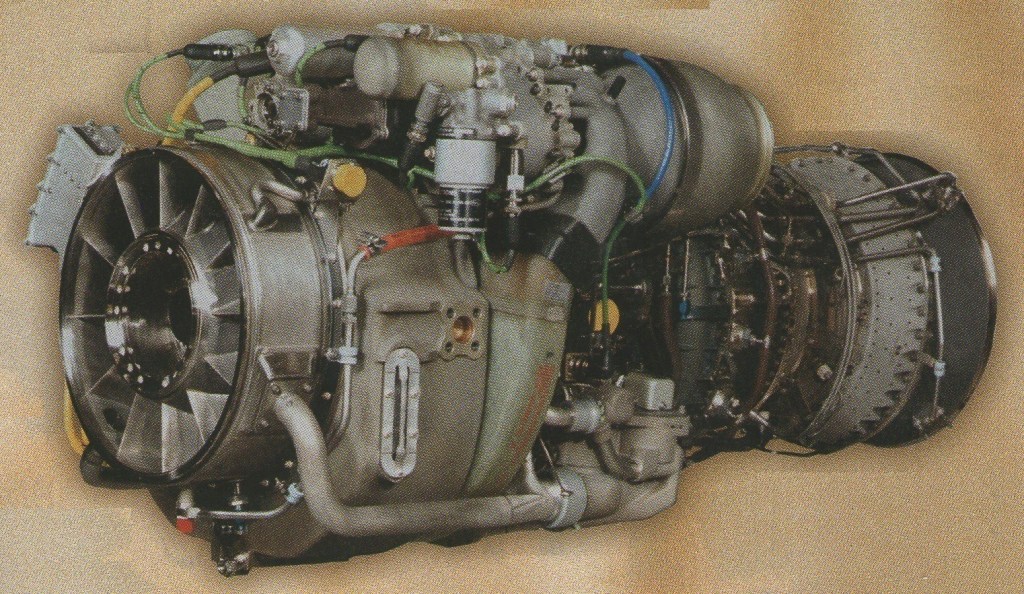
The General Electric T700 and CT7 are a family of turboshaft and turboprop engines in the 1,500-3,000 shp class.
In 1967, General Electric began work on a new turboshaft engine demonstrator designated the “GE12” in response to US Army interest in a next-generation utility helicopter. The Army effort led, in the 1970s, to development of the Sikorsky S-70 Black Hawk, powered by twin GE “T700” turboshafts, the production descendant of the GE12.
The T700 was initially bench-tested in 1973, passed military qualification in 1976, and went into production in 1978. The initial “T700-GE-700” is an ungeared free-turbine turboshaft, with a five-stage axial / one-stage centrifugal mixed-flow compressor, featuring one-piece “blisk” axial stages, with the inlet guide vanes and first two stator stages variable; an annular combustion chamber with central fuel injection to improve combustion and reduce smoke; a two-stage compressor turbine; and a two-stage free power turbine with tip-shrouded blades. The engine is designed for high reliability, featuring an inlet particle separator designed to spin out dirt, sand, and dust. The T700-GE-700 is rated at 1,622 shp (1,210 kW) intermediate power.

The T700-GE-700 was followed by improved and uprated Army engine variants for the UH-60 Black Hawk and the AH-64 Apache helicopters, as well as marinized naval engine variants for the SH-60 Seahawk derivative of the Black Hawk, the SH-2G Seasprite, and the Bell AH-1W Supercobra. T700s are also used on Italian and commercial variants of the AgustaWestland EH101/AW101 helicopter, and Italian variants of the NHIndustries NH90 helicopter. These are all twin-engine machines, except for the three-engined EH101.
The commercial version of the T700 is the “CT7”, with the engine used on the Bell 214ST (an enlarged version of the Huey), commercial Black Hawks, and the Sikorsky S-92 derivative of the Black Hawk, all of which are twin-engine helicopters.
The CT7 turboprop variants use the same core as the turboshaft variants, with a propeller gearbox fitted forward of the core. CT7 turboprops are used on variants of the Swedish SAAB 340 airliner, the Indonesian-Spanish Airtech CN-235 cargolifter, and the Czech Let L-610G airliner, all twin-turboprop aircraft. The baseline CT7-5A provides 1,735 shp (1,294 kW) on takeoff.
In the late 1980s, GE also proposed a much larger turboprop, the T407/GLC38, with a five-stage axial/one-stage centrifugal mixed-flow compressor; an annular combustor with 15 burners; a two-stage compressor turbine; a three-stage power turbine; and max takeoff power of 6,000 shp (4,475 kW).
The YT706 is based on the CT7-8A engine. Compared with the T700 powering H-60 helicopters, the YT706 has a larger compressor, hot section improvements and a full authority digital engine control. The YT706 provides up to 30 percent more power than the current T700-701C and will increase the hot-and-high mission capability of the MH-60M Black Hawk procured by the U.S. Army for its Special Operations applications.
Variants:
T700: Military turboshaft engine.
YT700: Prototype version.
T700-700: Initial T700 variant. The improved T700-GE-701A, -701B, -701C,-701D versions have also been developed fro the original -700.
T700-TEI701D: Licensed produced version of Tusaş Engine Industries of Turkey. Developed for use in the Sikorsky/Turkish Aerospace Industries T-70 Utility Helicopter.
CT7 turboshaft: Commercial version of T700.
CT7-2A : Basic model
CT7-2D : Higher flow compressor and surface coatings to improve resistance to wear and corrosion
CT7-2D1 : Similar to the CT7-2D but uses a CT7-6 type hot section
CT7-6
CT7-6A
CT7-8
CT7-8A
CT7-8A1
CT7-8A5
CT7-8B
CT7-8B5
CT7-8E
CT7-8E5
CT7-8F
CT7-8F5
CT7 turbprop: Turboprop version of CT7.
CT7-5A2
CT7-5A3
CT7-7A
CT7-7A1
CT7-9B
CT7-9B1
CT7-9B2
CT7-9C
CT7-9C3
CT7-9D
CT7-9D2
Applications:
T700/CT7 turboshaft
AgustaWestland AW101
AgustaWestland AW149
AgustaWestland AW189
AgustaWestland CH-149 Cormorant
Bell 214ST
Bell 525
Bell AH-1W SuperCobra
Bell AH-1Z Viper
Bell UH-1Y Venom
Boeing AH-64 Apache
Kaman SH-2G Super Seasprite
Lockheed Martin VH-71 Kestrel
Mitsubishi H-60
NHIndustries NH90
Piasecki X-49
Sikorsky CH-148 Cyclone
Sikorsky HH-60 Jayhawk
Sikorsky HH-60 Pave Hawk
Sikorsky SH-60 Seahawk
Sikorsky UH-60 Black Hawk
Sikorsky S-70
Sikorsky S-92
Sikorsky S-97
CT7 turboprop
CASA/IPTN CN-235
Let L-610G
Saab 340
Sukhoi Su-80
Specifications:
T700
Type: Turboshaft
Length: 47 in (T700-GE-700/701 series) to 48.2 in (T700/T6A)
Diameter: 25 in / 26 in (T700/T6E)
Dry weight: 400 lb (YT700-GE-700); 437 lb (T700-GE-700); 537 lb (T700/T6E)
Compressor: 6 stage-5 stage axial, 1 stage centrifugal.
Combustors: Annular
Turbine: 2 stage gas generator and 2 stage power turbine
Fuel type: JP-4 or JP-5 (YT700-GE-700)
Oil system: self contained, pressurized, recirculating dry sump
Maximum power output:
YT700-GE-700:1,536 shp (1,145 kW);
T700-GE-700: 1,622 shp (1,210 kW);
T700/T6E: 2,380 shp (1,775 kW);
YT706-GE-700: 2,638 shp (1,967 kW)
Overall pressure ratio: 17x
Specific fuel consumption: 0.433 (T700/T6E) to 0.465 (T700-GE-701A)
Power-to-weight ratio: 3.84 shp/lb (YT700-GE-700); 3.71 shp/lb (T700-GE-700); 4.48 shp/lb (T700/T6E)
General Electric began developing the YF120 for the ATF competition in the early 1980s. Unlike competitor Pratt & Whitney, GE elected against developing a conventional low bypass turbofan and instead chose to design a variable cycle engine. This decision was made as a result of the challenging ATF requirement of supercruise. This meant the engine had to produce a large amount of dry thrust (without afterburner) and therefore have high off-design efficiency (“design” being standard cruise conditions).
The core technology used in the YF120 was developed during two industry-government programs, the Advanced Technology Engine Gas Generator (ATEGG) and Joint Technology Demonstration Engine (JTDE) programs.
The YF120’s variable cycle system worked by varying the bypass ratio of engine for different flight regimes, allowing the engine act like either a low bypass turbofan or nearly a turbojet. As a low bypass turbofan, the engine performed similar to comparable engines. When needed, however, the engine could direct more airflow through the hot core of the engine (like a turbojet), increasing the specific thrust of the engine. This made the engine more efficient at high altitude, high thrust levels than a traditional low bypass turbofan.
An expected disadvantage of this variable cycle system would be increased complexity and weight. GE claims to have combated this by using simple pressure driven valves rather than complex mechanically actuated valves to divert airflow. GE stated that this system resulted in the variable cycle system adding only 10 lb to the engine. Additionally a production F120 engine was expected to have 40% fewer parts than the F110 engine.
The YF120 engine featured a two-dimensional thrust vectoring nozzle. The nozzle allowed for vectoring in the pitch direction. This capability gave the aircraft it was installed in a serious advantage in pitch agility by greatly increasing the amount of nose pitching moment available to the aircraft. The pitching moment is traditionally generated by the horizontal stabilizer (and/or canard, if applicable), but with a thrust vectoring nozzle that moment can be agumented by the thrust of the engine. Furthermore, the pitching moment can be maintained even at low airspeed when the reduced dynamic pressure on the control surfaces makes them relatively ineffective.
GE lost the engine competition for this aircraft to Pratt & Whitney F119. While the YF120 engine never went into production, it was installed in the YF-22 used for the high angle of attack demonstration program as part of the ATF competition. During this demonstration, the YF120 powered aircraft flew, trimmed, at 60 degrees angle of attack at 82 knots. At this attitude the aircraft was able to demonstrate controlibility. Later analysis revealed that the aircraft could have maintained controlled, trimmed flight up to 70 degrees angle of attack.
The YF120 was also proposed as the basis for a more exotic engine, the Turbine-Based Combined Cycle (TBCC) engine that was to be used in demonstrator aircraft like the X-43B and future hypersonic aircraft. Specifically, the YF120 was to be the basis for the Revolutionary Turbine Accelerator (RTA-1). The variable cycle technology used in the YF120 would be extended to not only turn the engine into a turbojet but also into a ramjet. In that mode all airflow would bypass the core and be diverted into the afterburner-like “hyperburner” where it would be combusted like a ramjet. This proposed engine was to accelerate from 0 to Mach 4.1 (at 56,000 ft) in eight minutes.
Applications:
Lockheed YF-22
Northrop YF-23
Specifications:
YF120
Type: Twin-Spool, Augmented Turbofan
Length: 4,242 mm
Diameter: 1,067 mm
Dry weight: 1,860 kg
Compressor: Two stage fan, five stage high pressure compressor (estimated)
Combustors: Annular Combustor
Turbine: Single stage HPT, Counter-Rotating Single Stage LPT
Nozzle: Two Dimensional Vectoring Convergent/Divergent
Fuel type: JP-4 or JP-8
Maximum thrust: 35,000 lbf (160 kN) – class

First run on 20 May 1993, GE evolved the F404 into the F412-GE-400 non-afterburning turbofan for the A-12 Avenger II. After the cancellation of the A-12, the research was directed toward an engine for the F/A-18E/F Super Hornet. GE successfully pitched the F414 as a low-risk derivative of the F404, rather than a riskier new engine. In fact, the F414 engine was originally envisioned as not using any materials or processes not used in the F404, and was designed to fit in the same footprint as the F404.
The F414 uses the core of the F412 and its full-authority digital engine control (FADEC), alongside the low-pressure system from the YF120 engine developed for the Advanced Tactical Fighter competition. One of the major differences between the F404 and the F414 is the fan section. The fan of the F414 is larger than that of the F404, but smaller than the fan for the F412. The larger fan section increases airflow by 16% and is 5 inches (13 cm) longer. To keep the engine in the F404’s footprint, the afterburner section was shortened by 4 in (10 cm) and the combustor shortened by 1 in (2.5 cm). Another change from the F404 is the fact that the first three stages of the high pressure compressor are blisks rather than dovetailed blades, saving 50 pounds (23 kg) in weight. Furthermore, the FADEC guided F414 uses a fuel actuated system to manipulate the afterburner section rather than a separate hydraulic system.
The F414 continued to be improved, both through internal GE efforts and federally funded development programs. By 2006 GE had tested an Enhanced Durability Engine (EDE) with an advanced core. The EDE engine provided a 15% thrust increase or longer life without the thrust increase. It has a six-stage high-pressure compressor (down from 7 stages in the standard F414) and an advanced high-pressure turbine. The new compressor should be about 3% more efficient. The new high pressure turbine uses new materials and a new way of delivering cooling air to the blades. These changes should increase the turbine temperature capability by about 150 °F (66 °C). The EDE is designed to have better foreign object damage resistance, and a reduced fuel burn rate.
The EDE program continued with the testing of an advanced two stage blade-disk (Blisk) fan. The first advanced fan was produced using traditional methods, but future blisk fans would be made using translational friction welding with the goal of reducing manufacturing costs. GE touts that this latest variant yields either a 20% increase in thrust or threefold increase in hot-section durability over the previous F414. This version is called the Enhanced Performance Engine (EPE) and was partially funded through the federal Integrated High Performance Turbine Engine Technology (or IHPTET) program.
As of 2009, the F414-EDE was being developed and tested, under a United States Navy contract for a reduced specific fuel consumption (SFC) demonstrator engine.
Over 1,000 F414 engines had been delivered and the engine family has totaled over 1 million flight hours by 2010.
Variants:
F414-GE-400
This variant flies in the Boeing F/A-18E/F Super Hornet. It was also proposed for the unbuilt naval F-117N variant of the F-117 Nighthawk.
F414-EDE
The “Enhanced Durability Engine” or “EDE” variant, includes an improved high pressure turbine (HPT) and high pressure compressor (HPC). The HPT is redesigned to withstand slightly higher temperatures and includes aerodynamic changes. The HPC has been redesigned to 6 stages, down from 7. These changes were aimed at reducing SFC by 2% and three times greater component durability.
F414-EPE
The “Enhanced Performance Engine” or “EPE” variant, includes a new core and a redesigned fan and compressor. The new engine version offers up to a 20 percent thrust boost, which increases its thrust to 26,400 pounds (120 kN), giving it an almost 11:1 thrust/weight ratio.
F414M
Used by the EADS Mako/HEAT. Derated thrust to 12,500 lbf (55.6 kN) dry and 16,850 lbf (75 kN) wet. This version was proposed for international versions of the Korean T-50 series of trainers and fighter aircraft, but was later superseded by a new offer with a standard F414.
F414G
This variant is produced for the Saab JAS 39 Gripen Demonstrator. It is slightly modified for use in a single engine Gripen contrary to a twin-engine aircraft like the F/A-18. With this engine, the Gripen Demonstrator reached Mach 1.2 in supercruise (without afterburner).
F414BJ
Proposed for Dassault Falcon SSBJ. This variant would produce around 12,000 lbf (53 kN) of thrust without use of afterburner.
F414-GE-INS6
India’s Aeronautical Development Agency selected the F414-GE-INS6 engine to power the Mk II version of the HAL Tejas Light Combat Aircraft (LCA) for the Indian Air Force. 99 engines were ordered in October 2010. The engine was to produce more thrust than previous F414 versions. It features a Full Authority Digital Electronic Control (FADEC) system. The F414-GE-INS6 was to have six stages. The engines were to be delivered by 2013.
F414-GE-39E
Version of F414G for Saab JAS-39E/F Gripen.
Applications:
Boeing F/A-18E/F Super Hornet
EADS Mako/HEAT
Saab Gripen Demo/NG
HAL Tejas Mark II
Specifications:
F414-400
Type: Afterburning turbofan
Length: 154 in (3,912 mm)
Diameter: 35 in (889 mm)
Dry weight: 2,445 lb (1,110 kg) max weight
Compressor: Axial compressor with 3 fan and 7 compressor stages
Combustors: annular
Turbine: 1 low-pressure and 1 high-pressure stage
Maximum thrust: 22,000 lbf (98 kN)
Overall pressure ratio: 30:1
Thrust-to-weight ratio: 9:1

