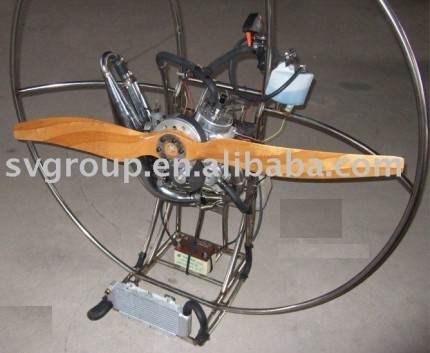
A 150cc Paramotor. 2-stroke, and water-cooled, with electric start for paragliders.
Nett weight: 18kg
A 150cc Paramotor. 2-stroke, and water-cooled, with electric start for paragliders.
Nett weight: 18kg
Turboprop/turbofan derivatives of the HX-321.
A sporting two-seater appeared 1987.
USA
HX-321 sporting two-seater appeared 1987. Work followed on H-1 and HT-2 turboprop/turbofan derivatives.
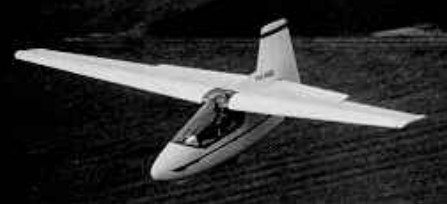
The “Minibat” ultralight single-seater glider was designed by Larry Haig of Muskegan, Michigan, over a three-month period at a cost of $3,500, and made its first flight on March 11, 1979. The Minibat had a cantilever, swept forward wing and used a reflex airfoil. It was constructed of Kevlar, carbon fibres and foam sandwich with glass fibre covering. The fuselage was made up of two halves joined by the metallic structure which formed the pilot’s seat. Wings were demountable in the same way as a conventional glider, and a peculiarity of this machine was that the two ailerons could be raised together to act as spoilers. Extended wing tips were also available, increasing span to 10 meters.
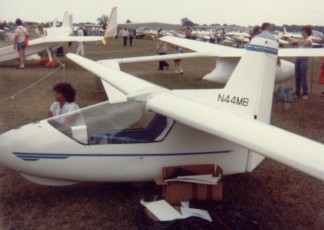
The Minibat was available as fast-build kits for the homebuilder, assembly was said to require only 5 – 10 days using moulded parts. A powered version was planned, using a 3 hp chain saw sustainer engine mounted behind the cockpit and driving a pusher propeller mounted in a slot between the fin and rudder. The Minibat was not a self-launching design but the engine was intended, after launch by auto-tow, winch or bungee, to provide a positive rate of climb.
By January 1982, four Minibats had already had accidents during take-off. It was concluded that this machine should not be made available to just anybody, as it was initially expected. It seems that the airfoil was the major cause for the bad handling characteristics. But yet the Minibat was a very interesting concept of a very light and efficient “minimum” glider.
Minibat
Wing span: 7.62m / 25ft
Length: 2.84 m / 9.33 ft
Height: 5 ft
Wing area: 6.04 sq.m / 64.5sq.ft
Fin area: 7.5 sq.ft
Empty Weight: 50kg / 110lb
Payload: 98kg / 215lb
Gross Weight: 147kg / 325lb
Wing Load: 24.5kg/sq.m / 5lb/sq.ft
Load limit: ±6 G’s
L/DMax: 23 at 55 mph
Stall: 39mph
Min Sink @ 43 mph: 0.91 m/s / 3 fps / 1.78 kt
No. of Seats: 1
Structure: foam and fibreglass
Aspect ratio: 9.6
Max. Smooth air speed: 126 mph
Maneuvering: 88 mph
Flutter Tested To: 140mph
Landing Gear: Fixed
Engine: 3 hp
Fuel Capacity: 2 litre
Endurance: 1 hr
Propeller: 20×10 fixed pitch.
Rate of Climb: 50-100fpm
Minibat Extended Tip
Wing span: 10m / 32.7ft
Wing area: 7.11sq.m / 76.5sq.ft
Empty Weight: 59kg / 130lb
Payload: 100kg / 220lb
Gross Weight: 159kg / 350lb
Wing Load: 22.36kg/sq.m / 4.5lb/sq.ft
Aspect ratio: 14
Structure: foam and fiberglass
L/D Max: 30:1
Minimum Sink: 2.3 ft/sec
V-Stall: 23 mph
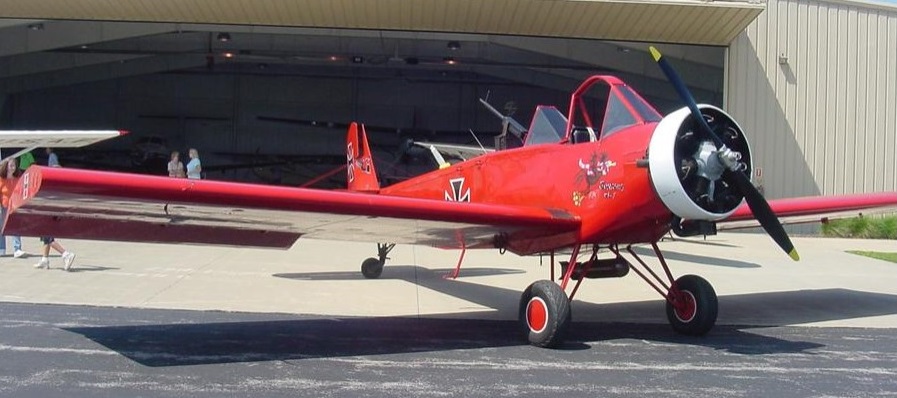
In 1986 Joseph Haig built a Junkers J8 replica in the U.S. This replica was based on a Snow S2A (s/n 1019, built in 1959). The replica was registered as N4976C in 1993 and was used on U.S. Airshows until 2005.
The replica was sold to T.Fissell Flying Service in Clarksville Texas.
Engine: Continental W670
Chicago
U.S.A.
In 1986 Joseph Haig built a Junkers J8 replica in the U.S.

Paraglider circa 1998.
Estive 22
Wing area: 22.7 sq.m
Certification: Afnor
Pilot weight: 55-70 kg
No. of cells: 34
Wing span: 9.4 m
Aspect ratio: 4
Min sink: 1.3 m/s
Max speed: 43 kph
Price (1998) 12,700 Fr
Estive 26
Wing area: 26.5 sq.m
Certification: Afnor
Pilot weight: 70-100 kg
No. of cells: 38
Wing span: 10.6 m
Aspect ratio: 4.4
Min sink: 1.2 m/s
Max speed: 43 kph
Price (1998) 13,300 Fr
Estive 30
Wing area: 30 sq.m
Certification: Afnor
Pilot weight: 90-11- kg
No. of cells: 38
Wing span: 11.4 m
Aspect ratio: 4.4
Min sink: 1.2 m/s
Max speed: 43 kph
Price (1998) 13,900 Fr
Estive 34
Wing area: 34 sq.m
Certification: Afnor
Pilot weight: 105-150 kg
No. of cells: 42
Wing span: 12.6 m
Aspect ratio: 4.7
Min sink: 1.2 m/s
Max speed: 44 kph
Price (1998) 14,500 Fr
Paraglider circa 1998.
Carlit 21
Wing area: 21 sq.m
Pilot weight: 55-70 kg
No. of cells: 25
Wing span: 8.4 m
Aspect ratio: 3.3
Min sink: 1.5 m/s
Max speed: 36 kph
Carlit 24
Wing area: 24 sq.m
Pilot weight: 70-90 kg
No. of cells: 27
Wing span: 9.1 m
Aspect ratio: 3.5
Min sink: 1.5 m/s
Max speed: 36 kph
Carlit 27
Wing area: 27 sq.m
Pilot weight: 85-100 kg
No. of cells: 29
Wing span: 10 m
Aspect ratio: 3.7
Min sink: 1.5 m/s
Max speed: 36 kph
Carlit 32
Wing area: 32 sq.m
Pilot weight: 100-140 kg
No. of cells: 33
Wing span: 10.8 m
Aspect ratio: 3.6
Min sink: 1.5 m/s
Max speed: 40 kph
Xavier Demoury and Jean-Louis Darlet went their own ways in 1997. Demoury bought Gypa-Aile in 1997.
1998: Z.I Point Sud, F-65260 Soulom, France
1998: After ownership by Est Pyrerees, Gypa-Aile is now owned by Xavier Demouury.
Paraglider builder

