Romania
Founded 1953 as a repair factory. First flew its version of the Soviet Yakovlev Yak-52 trainer in 1978, and assisted in other Romanian programs, plus aero engines. Became Aerostar SA in 1991.
1980->
IAE V2500
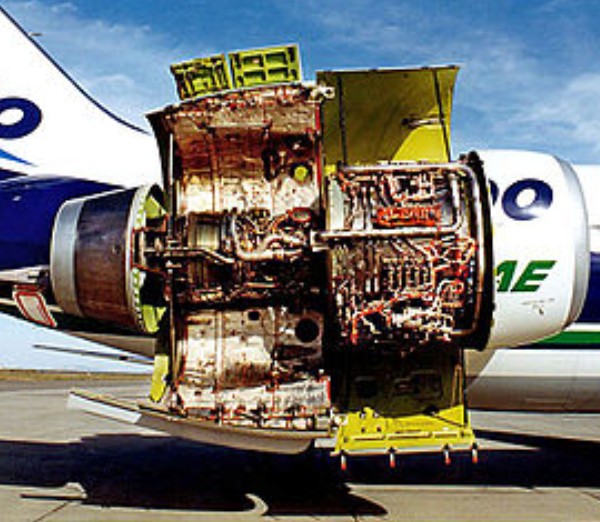
Just a year after IAE was formed, the V2500 two-shaft high-bypass turbofan engine won a position on the Airbus A320 family, formally launching the program. Following a development program, the V2500-A1 engine first entered service with Adria Airways in 1989.
That same year McDonnell Douglas selected the V2500 engine to power the MD-90, providing diversity to the engine program. Delta Air Lines launched this new program with an order for 26 firm aircraft.
Rolls-Royce plc based the HP compressor on a scale-up of the RC34B eight stage research unit used in the RB401-06 Demonstrator Engine, but with a zero-stage added at the front and a tenth stage added to the rear. Pratt & Whitney developed the combustor and the 2-stage air-cooled HP turbine, while the Japanese companies provided the LP compression system. MTU were responsible for the 5-stage LP turbine.
FAA flight certification for the V2500 was granted in 1988.
IAE’s philosophy of continuous improvement was evident from the start, and the first major performance enhancements were introduced into service in 1993 through the V2500-A5 engine. IAE subsequently took the HPT technology developed for the V2500-A5 engine and incorporated it into the V2500-A1 engine in what was termed the “Phoenix Standard” in 1998. This resulted in improved time-on-wing.
The latter part of the 1990s saw IAE and the V2500 engine start to become a dominant force in commercial aviation: (i) the MD-90 entered service; (ii) the first orders were taken from Chinese airlines; (iii) records were broken for deal sizes; and (iv) the first V2500 engine-powered A319 flew in United Airlines’ colors. In addition, the 1,000th V2500 engine was delivered.
The new Millennium saw existing MD-90 operators – China Northern and SAS – select V2500 engine-powered Airbus aircraft for the first time. The engine also became available to power the Airbus Corporate Jetliner (ACJ).
The success story continued throughout the decade as customer numbers approached 200, and a number of record-breaking deals were signed. The 2,000th V2500 engine was delivered in 2002, and the engine program surpassed the milestone of 20 million flying hours.
IAE continued its philosophy of continuous improvement with the introduction of V2500 SelectOne engine in 2005, along with the first comprehensive OEM-managed aftermarket service program in this class. More records were broken as a number of first-run engines remained on wing in excess of 30,000 hours. Following the delivery of the 3,000th V2500 in 2006, orders continued to climb with tremendous success in China with orders from Sichuan Airlines, Hainan Airlines, Shanghai Airlines and Shenzhen Airlines.
The V2500 SelectOne engine gained segment acceptance throughout the decade as customers selected the new engine standard and upgraded their existing fleets with the new retrofit upgrade. The new engine build standard, which debuted with IndiGo in 2008, delivered over 1500 engine units by the end of 2012 and continues to grow. It has a record of exceptional reliability following a flawless entry into service and continued dependable operation. In addition, the V2500 engine became a launch engine for the Airbus A320 Final Assembly Line in Tianjin, China.
An upgrade option for the V2500 SelectOne engine – the V2500 SelectTwo engine was also announced. Meanwhile, the V2500 SelectOne engine reached a major milestone with its 1,000th delivery to IndiGo, and IAE’s order book continued to grow as China Southern became IAE’s largest customer with its order for 65 V2500 SelectOne engines.
In its first military application, IAE was chosen in 2011 by Embraer Defense and Security, in concurrence with the Brazilian Air Force, to provide the powerplant for the country’s new KC-390 multi-role tanker/transport aircraft. The engine will be the V2500-E5 engine.
The 4,000th V2500 engine was delivered to the Brazilian flag carrier TAM and installed on the 4,000th Airbus A320 family aircraft (an A319).
In early 2012, the 5,000th V2500 engine was delivered to SilkAir, and IAE achieved 100 million flying hours.
Variants:
V2500-A1
V2533-A5
A fourth booster stage was introduced into the engine basic configuration to increase core flow. This, together with a fan diameter/airflow increase, helped to increase the thrust to 33,000 lbf (147 kN) thrust, to meet the requirements of the larger Airbus A321-200.
A number of derated, Stage 4 noise compliant engines have been produced from the -A5 configuration, including:
The 23,500 lbf (105 kN) thrust V2524-A5 for the Airbus A319
The 27,000 lbf (120 kN) thrust V2527-A5 for the Airbus A320
The 28,000 lbf (120 kN) thrust V2528-D5 for the McDonnell Douglas MD-90-30.
The 33,000 lbf (150 kN) thrust V2533-A5 for the Airbus A321
V2500SelectOne
On October 10, 2005, IAE announced the launch of the V2500SelectOne with a sale to IndiGo Airlines to power 100 A320 series aircraft. The V2500SelectOne is a combination performance improvement package and aftermarket agreement. In February 2009, Pratt & Whitney upgraded the first V2500-A5 to the SelectOne Retrofit standard; the engine was owned by US Airways and had been in use since 1998.
V2500SelectTwo
On March 15, 2011, IAE announced an upgrade option of V2500 SelectOne Engines to the SelectTwo Program.
Applications:
Airbus A320 family (excluding A318)
Embraer KC-390
McDonnell Douglas MD-90
Specifications:
V2500-A1
Thrust: 111 kN
Bypass ratio: 5.4 : 1
Compression ratio: 35.8 : 1
Fan diameter: 1.587 m
Total length: 3.2 m
Weight: 2,327 kg
Production start year: 1989
Aircraft type: A320
V2522-A5
Thrust: 97.86 kN
Bypass ratio: 4.9 : 1
Compression ratio: 32.8 : 1
Fan diameter: 1.613 m
Total length: 3.2 m
Weight: 2,359 kg
Production start year: 1992
Aircraft type: A319
V2524-A5
Thrust: 106.75 kN
Bypass ratio: 4.9 : 1
Compression ratio: 32.8 : 1
Fan diameter: 1.613 m
Total length: 3.2 m
Weight: 2,359 kg
Production start year: 1996
Aircraft type: A319
V2525-D5
Thrust: 111 kN
Bypass ratio: 4.8 : 1
Compression ratio: 34.5 : 1
Fan diameter: 1.613 m
Total length: 3.2 m
Weight: 2,484 kg
Production start year: 1995
Aircraft type: MD90
V2527-A5
Thrust: 117.88 kN
Bypass ratio: 4.8 : 1
Compression ratio: 32.8 : 1
Fan diameter: 1.613 m
Total length: 3.2 m
Weight: 2,359 kg
Production start year: 1993
Aircraft type: A320
V2528-D5
Thrust: 124 kN
Bypass ratio: 4.7 : 1
Compression ratio: 35.2 : 1
Fan diameter: 1.613 m
Total length: 3.2 m
Weight: 2,484 kg
Production start year: 1995
Aircraft type: MD90
V2530-A5
Thrust: 139.67 kN
Bypass ratio: 4.6 : 1
Compression ratio: 35.2 : 1
Fan diameter: 1.613 m
Total length: 3.2 m
Weight: 2,359 kg
Production start year: 1994
Aircraft type: A321
V2533-A5
Thrust: 146.80 kN
Bypass ratio: 4.5 : 1
Compression ratio: 35.2 : 1
Fan diameter: 1.613 m
Total length: 3.2 m
Weight: 2,359 kg
Production start year: 1996
Aircraft type: A321
International Aero Engines / IAE
IAE International Aero Engines AG is a Zürich-registered joint venture manufacturing company founded in 1983 to develop an engine to address the 150-seat single aisle market.
The original collaboration involved Pratt & Whitney of the United States, Rolls-Royce plc of the United Kingdom, Japanese Aero Engine Corporation of Japan and MTU Aero Engines of Germany. FiatAvio withdrew as a shareholder of the program early on, but the now-renamed Avio S.p.A. remainede as a supplier. The “V” product nomenclature remains as a legacy of the five original shareholders.
The collaboration produced the V2500 – the second most successful commercial jet engine program in production in terms of volume, and the third most successful commercial jet engine program in aviation history.
In October 2011, Rolls-Royce agreed to sell its 32.5% stake in the company to Pratt & Whitney’s parent company, United Technologies (UTC), giving UTC a combined equity ownership share of 49.5% (which is different from UTC’s total program share in the IAE collaboration, which stands at 61%). The transaction was completed on 29 June 2012.
Rolls-Royce remains a major supplier to IAE.
IAE had developed the abortive Superfan for the Airbus A340. IAE’s purpose became the development, production and aftermarket services of the IAE V2500 aero engine family.
By 2012, more than 5,700 engines had been delivered and approximately 1,600 more were on backlog, which is equivalent to nearly five full years production. Over the previous five years, production had doubled with over an engine a day being delivered.
In 2011, the IAE Executive Board of Directors announced the extension of its collaboration agreement to 2045. After receiving regulatory approvals and partner consent, Pratt & Whitney closed on the purchase of Rolls-Royce’s equity and program share in IAE on June 29, 2012. Rolls-Royce were to continue to support IAE as a strategic supplier for the V2500 engine and continue to perform its key responsibilities for IAE, including the manufacture of parts and engines, as well as supply MRO services for IAE’s fleet.
Shareholders in 2012 were:
Pratt & Whitney, USA: 25.00%
Pratt & Whitney Aero Engines International GmbH, Switzerland: 24.50%
MTU Aero Engines, Germany: 25.25%
The Japanese Aero Engine Corporation: 25.25%
The Japanese Aero Engine Corporation consisted of:
Kawasaki Heavy Industries
Ishikawajima-Harima Heavy Industries
Mitsubishi Heavy Industries
Hy-Tek Ultralights
1995-7: 23055 Airport Rd NE No.1, Aurora, OR 97002, USA.
Offers kits to construct Hurricane single-seat microlight, Ultra 103, Clipwing and Hauler.
Hypnos 2000 Skyline / Super Skyline
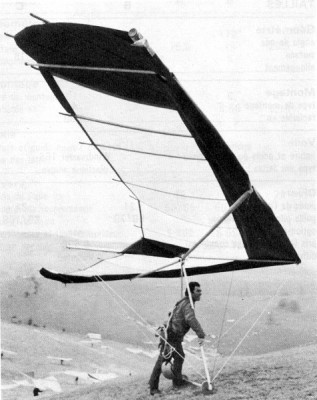
The Hypnos 2000 Skyline and Super Skyline were both 1980 hang gliders.
Hurricane Co Hurricane Hauler
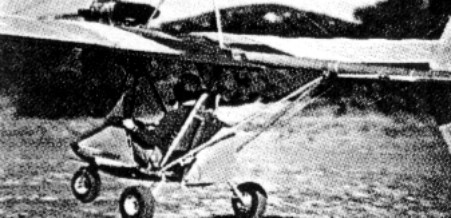
Designed for up to 300 lbs and 6.5 ft pilot. Strengthen undercarriage and 30% longer cockpit.
Speed max: 85 mph.
Cruise: 63 mph.
Range: 100 sm.
Stall: 35 mph.
ROC: 800 fpm.
Take-off dist: 200 ft.
Landing dist: 150 ft.
Service ceiling: 12,000 ft.
Engine: Rotax 503, 52 hp.
HP range: 40-65.
Fuel cap: 10 USG.
Weight empty: 600 lbs.
Height: 8.17 ft.
Length: 16.83 ft.
Wing span: 28 ft.
Wing area: 142 sq.ft.
Seats: 1.
Landing gear: nose wheel.
Hurricane Co Hurricane
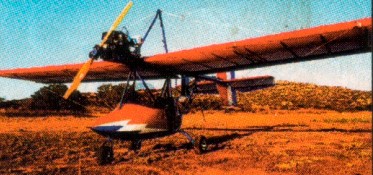
Circa 1995.
Suitable engines include the Rotax 447 to 582.
The Rotax 447 powered 103 ultralight kit was priced at US$8499 in 1997.
The Hurricane H.P./Clipwing has a symmetrical wing for mild aerobatics. Designed for +8 / -6 G, the kit price in 1997 was US$10,199.
Experimental
Engine: Rotax 503, 52 hp.
Wingspan: 28.5 ft.
Wing area: 142 sq.ft.
Length: 16.75 ft.
Height: 8.25 ft.
Seats: 1.
Empty wt: 280 lb.
Max wt: 680 lb.
Fuel cap: 10 USG.
Wing loading: 4.8 lb/sq.ft.
Pwr loading: 13.1 lb/hp.
Vne: 105mph.
Cruise: 70mph.
Stall: 30mph.
ROC: 1000 fpm.
TO dist: 100ft.
Ldg dist: 150 ft.
Endurance no res: 2.75 hr.
Range: 200 mile.
Fuel burn: 2.5 USG/Hr.
Ultralight
Engine: Rotax 447, 40 hp
HP range: 40-55
Wingspan: 28.5 ft.
Wing area: 142 sq.ft.
Length: 16.75 ft.
Height: 8.25 ft.
Seats: 1.
Empty wt: 250 lb.
Max wt: 500 lb.
Fuel cap: 5-7 USG.
Vne: 105mph.
Top speed: 100 mph
Cruies: 60 mph
Stall: 25 mph.
Range: 150 sm.
Takeoff distance: 100 ft
Landing distance: 120 ft
Service ceiling; 12,000 ft
ROC: 850 fpm.
Landing gear: nose wheel.
Hurricane H.P./Clipwing
Top speed: 105 mph
Cruise: 75 mph
Stall: 30 mph
Range: 130 sm
Rate of climb: 1000 fpm
Takeoff dist: 150 ft
Landing dist: 150 ft
Service ceiling: 12,500 ft
Engine: Rotax 503, 52 hp
HP range: 40-75
Fuel capacity: 7-10 USG
Empty weight: 275 lb
Gross weight: 650 lb
Height: 8.2 ft
Length: 17 ft
Wing span: 26-26 ft
Wing area: 133 sq.ft
Seats: 1
Landing gear: tailwheel
Hurricane Co
1995: 1356 Oakleaf Ln., Ramona, CA 92065, USA.
UL builder
Huntwing Avon / Experience
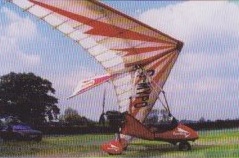
Initially a homebuilt designed and constructed by John Hunt purely for himself, the Avon trike unit and Experience wing were later marketed as an inexpensive flexwing. The wing was bought complete and the rest built from plans.
Empty weight: 160 kg
Wing span: 10.6 m
Wing area: 15.24 sq.m
Fuel capacity: 50 lt
Certification: BMAA
Engine: Rotax 582, 65 hp
MAUW: 372 kg
Seats: 2
Max speed: 121 kph
Cruise speed: 88 kph
Minimum speed: 48 kph
Climb rate: 3.3 m/s
Fuel consumption: 12 lt/hr
Plan price (1998): £115
Huntwing
1998:
Old Railway Inn
Clydach
NP7 0RD Abergavenny
United Kingdom
Trike builder

