A two-seat multipurpose light autogyro, flight tested from 1995.
1980->
Kamerton-N Ltd
Russia
Developed the Ratnik two-seat multipurpose light autogyro, flight tested from 1995.
Kaman Aircraft Corp / Kaman Aerospace
Formed in 1945 by Charles H. Kaman as Kaman Aircraft Corporation to develop a special servo-flap control system for helicopter rotors and “synchropter” lntermeshing twin rotor system, with aim of eliminating anti-torque tail rotor. K-125A built in 1947; K-190 in 1948; K-225 built in small numbers as YH-22 from 1949. HOK-1 delivered in quantity to U.S. Navy and Marines during 1950s; HTK-1 to Navy as trainer/ambulance, and also adopted as remote-controlled drone. By late 1960s well over 200 H-43 Huskie turbine-powered rescue helicopters were serving with the USAF. H-2 Seasprite naval rescue and utility helicopter first flown July 1959, retaining servo-flap system, though on a conventional main rotor. Seasprite developed in many versions, early production models using a single turboshaft engine and later models with twin turboshafts; experiments included stub wings serving as sponsons and gunship version with Minigun chin turret among other weapons.
In the late 1960s much subcontracting undertaken, together with development of Rotorchute and allied devices. Became Kaman Group in 1965 with extended activities, with Aerospace subsidiary subsequently taking the present name Kaman Aerospace Corporation as part of Kaman Group. Current programs include producing upgraded SH-2Fs as SH-2G Super Seasprites for antisubmarine/ anti-shipping, over-the-horizon targeting, SAR, mine countermeasures, vertrep and other roles, for delivery to Royal Australian Navy, Royal New Zealand Navy, Egypt, and U.S. Navy Reserve; production of K-MAX “Aerial Truck” single-seat, turboshaft-powered and twin intermeshing rotor external-lift helicopter (first flown December 1991); and subcontract work on Boeing airliners and for various military aircraft including AH-1, C-17, Comanche, F-22, and V-22.
1995: Old Windsor Rd, PO Box 2, Bloomfield, Conneticut 06002, USA.
In 2000 Kaman Aerospace was se¬lected by MD Helicopters (MDHI) to be the sole supplier of fuselages for its line of single-engine helicop¬ters, including the MD600N, MD520N, MD530F and the MD500E. The agreement is worth a reported $100 million.
Kalbermatten Delka

The 1994 Delka glider apparently flew well enough on early test flights with weight shift for pitch control, and tip rudders for roll however weight shift for pitch must have been compromised with the pilot moved inside the wing (no pendular agumentation). The pitch control was some how assisted by control surfaces.
Apparently the test pilot Didier Favre was killed on testing due to structural failure. Laurent Kalbermatten dropped the concept however has proceeded with the Woopy Fly paraglider hang glider hybrid.
Wing area: 13.7 m²
Wing span: 10.5 m
Hang glider weight: 25 kg
Kaiser DEKO-9 Magic / Dakomat Deko 9 Magic / Deko 9 Magic
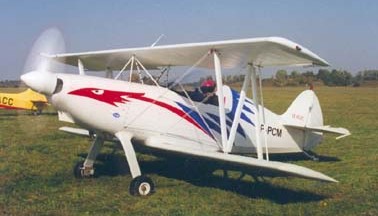
A single-seat aerobatic sports and recreation biplane, the prototype aircraft developed on order from the German Kaiser-Flugzeugbau GmbH. The construction of the prototype, strength tests and flight tests carried out in Military Aviation Plant No. 3 Deblin (later called the Military Aviation Plant No. 1 SA branch) in Dęblinie, Poland. The design work, construction of prototypes and the necessary infrastructure took from 1996 to 1998.
The team headed by Lt.-Col. MSc. Wieslaw Pochylskiego, established a composites laboratory and strength tests, and a thermal tent enabling the study of metal-composite structures at elevated temperatures. Other members included Dr. Eng. Marek Debski and M. Sc. Christopher Kotliński. Builders and MSc. Marian Jakoniuk, MSc. Witold Wiraszka, Eng. Bruno Biernacki and Dr. Eng. Daniel Debski.
Calculations and strength tests were conducted by M.Sc. Vladimir Urbaniak – load, dr. Andrew Szot, MSc. George Mularczyk – static strength tests, Dr. Eng. Wojciech Hajec, MSc. James Kulecki – model airplane spin research, Warsaw University of Technology.
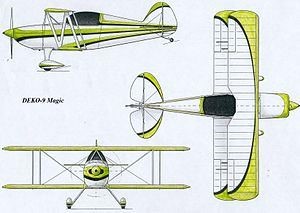
A biplane, the crew seats in tandem with a one-piece canop, and with a fixed main landing gear and tail wheel. The supporting structure of the fuselage is duralumin tube in composite nodes. The wings are double-girder construction with beams made of duralumin tubes and fixed to them duralowej pressed sheet metal ribs. The tail is welded construction made of thin-walled steel pipes. Polish made aircraft are overed with a heat-shrinkable polyester fabric, Dekonit 140 g / m².
First flight of the aircraft on 30 September 2000 and flight tests were performed by test pilot, MSc. , Maciej Aksler. The aircraft was presented at exhibitions air: ILA Berlin 1998 and 2000 and Fredrichshafen AERO 1999 and 2001.
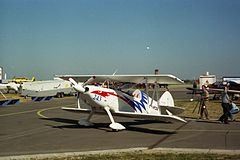
The engine of six produced by PZL Rzeszow was the 200 hp PZL Franklin 6A-350C1R , suitable for inverted flight and driving a three-bladed MT-Propeller MTV-9-DC / C188-18a propeller with hydraulically controlled pitch.
Also developed of four-cylinder Franklin 4A-235B4 92 kW (125 hp) powered version with open cockpit.
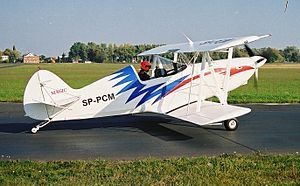
Engine: PZL Franklin 6A-350C1R, 205 hp (150 kW)
Span: 6.8 m
Length: 6.5 m
Height: 2.2 m
Wing area: 15.4 m²
Empty weight: 500 kg
Useful load: 250 kg
MAUW: 750 kg
Fuel capacity: 100 lt
Max speed: 220 km / h (119 kts IAS)
Cruising speed: 190 km / h (103 kts IAS)
Minimum speed: 90 km / h (49 kts IAS)
Vne: 350 km / h (189 kts IAS)
Rate of climb: 12 m / s (2362 ft / min)
Ceiling: 4000 m (13123 ft)
Range: 700 km (378 nm)
Take-off dist: 120 m (393 ft)
Landing dist: 120 m (393 ft)
Load factor design: + 6 / -3 g
Seats: 2
Kaiser Flugzeugbau
Germany
Has developed and is marketing the Kaiser Magic single-seat biplane with a choice of 125 hp or 200 hp PZLFranklin piston engine. Displayed at ILA Berlin in 1998.
Juvenelle Rosario Skua
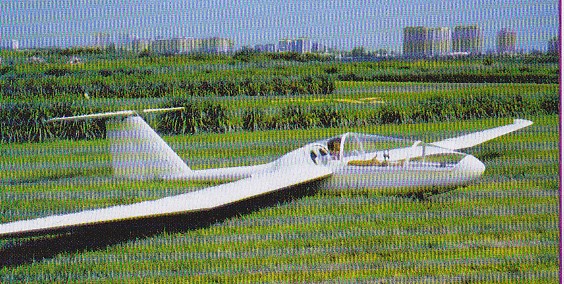
Light sailplane circa 1998. The Skua can be split into three parts for transport on a roof rack or trailer. It came equipped with a BRS.
Weight: 70 kg
Wing span: 12.6 m
Wing area: 12.2 sq.m
Vne: 110 km
Stall: 32km
Glide Ratio: 25
Price (1998) US$15000
Juvenelle Rosario
1998: Estrada da gavea 655, Apt: 1603 sao Conrado, CEP 22 100000 Rio de Janeiro, BRAZIL
Glider builder
Jurkštas RJ-2

In 1998 Jurkštas started the construction of the plane named JR biplane – 2, although it more often fellow aviators called it “Biukeriu” because the similarity to the German aircraft. Jurkštas does not deny the similarity, but argues that the design that the detailed drawings, were followed by five years was work.
The JR-2 is an ultra-light wooden structure biplane. The front part of the fuselage is covered with oilcloth, and the rear with canvas. The front by the engine hss duralumin coated tin. There is a technical requirement that this place is not flammable. The bonnet is formed of glass material.
Wooden structure has two wings spars. The front part of the first spar coated oilcloth. Next frame covered with canvas wings. The upper wings are connected on duraliminio pipes. The lower wings attach to the trunk connectors with 2.5 mm thick stainless steel plates. The wings are tensioned with 5.6 mm diameter steel guys.
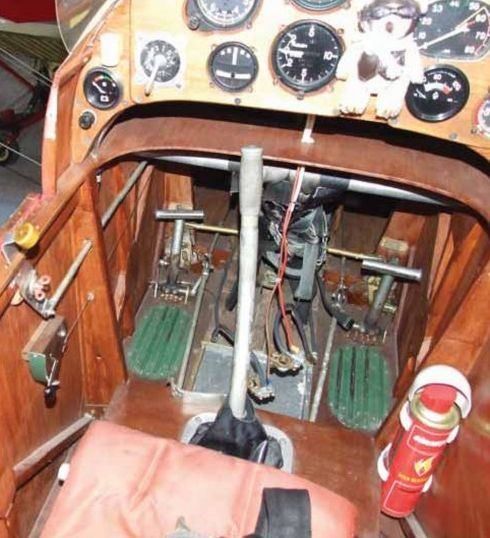
The stabilizer and fin also has two spars. Their profile is NACA 0009. Until the first spar they are oilcloth covered, the rest is canvas. The rudder is coated with canvas. Wheels 350X135 came from a L-13 Blanik glider.
The wood was gathered in one of Silutes sawmills by R.Jurkštas. Jurkštas said that it was created by looking at a Piper Cub.
An air-cooled VW 1600 engine turns a constant pitch 1.52 m diameter propellor, which is made of laminated wood. The pitch is 0.92 m . The engine is 65 hp, maximum shaft speed of 4600 rev / min. The engine cost 250 litas.
The fuel tank is installed in the front of the fuselage. Its capacity of 23 liters. It is attached with duralumin screw bands.
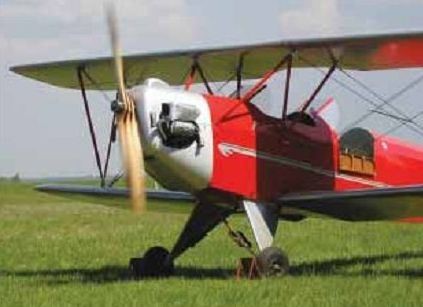
The Lithuanian biplane was completed in 2003, and the first flight was on June 23, 2004, piloted by R.Jurkštas. After the first tests, it was decided that the aircraft would better suit a larger diameter and pitch propeller. That improved its flight characteristics. R.Jurkštas flew more than 60 hours.

Jurkštas RJ-1
1995 R.Jurkštas developed and produced a training glider RJ-1. It was designed to improve children’s school gliding pilots’ skills.

