Knight Twister

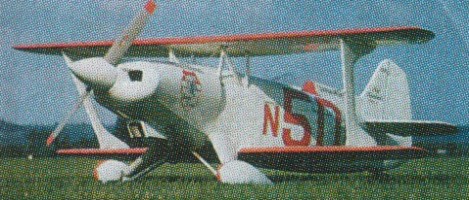
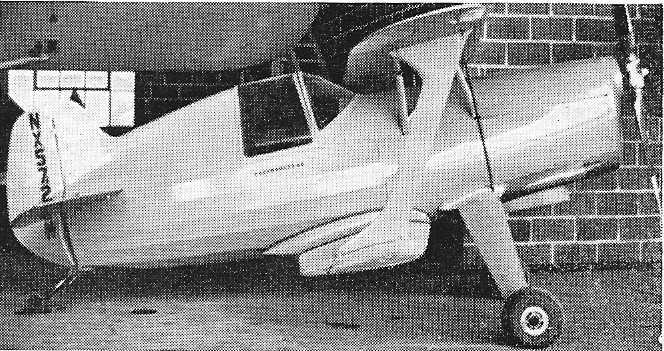
Designed by Vernon Payne in the USA in 1933, the Payne Knight Twister is a single seat biplane with a tube construction fuselage and wooden wings. All fabric covered.

Twister NX5726N built by Ed Effenheim, Milwaukee, 67 hp Tank engine circa 1956.
Later repowered with 85 hp Continental

Engine: Lycoming, 108 hp.
HP range: 85-160.
Span upper: 15.00 ft
Span lower: 13 ft
Wing area: 55 sq.ft.
Length: 13.5 ft.
Height: 5 ft.
Weight empty: 517 lbs.
Gross: 865 lbs.
Fuel cap: 20 USG.
Speed max: 180 mph.
Cruise: 165 mph.
Range: 610 sm.
Stall: 55 mph.
ROC: 1800 fpm.
Take-off dist: 400 ft.
Landing dist: 800 ft.
Seats: 1-2.
Landing gear: tail wheel.

Klüver Twin Racer

As well as the two seat Twin Racer there is also a smaller single seater.

Empty weight: 135 kg
Wing span: 10.6 m
Wing area: 16 sq.m
Fuel capacity: 50 lt
Certification: Vz
Engine: Rotax 582, 58 hp
MAUW: 400 kg
Seats: 2
Max speed: 90 kph
Cruise speed: 80 kph
Minimum speed: 45 kph
Climb rate: 2 m/s
Fuel consumption: 12 lt/hr
Price (1998): 31 088 DM

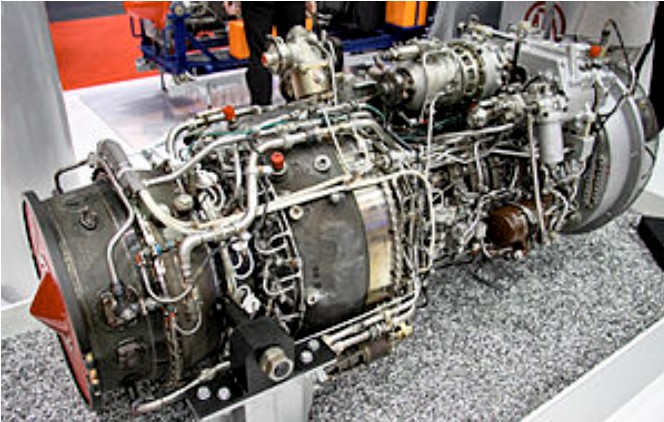
Klimov TV7-117

The TV7-117 is a Russian turboprop engine certified in 1997 to power the Ilyushin Il-114 regional commuter aircraft. The new engine features enhanced reliability, fuel economy and greater service life compared with its predecessors produced in the former Soviet Union. The engine has a modular design. The nine modules can be replaced in the field, which dramatically reduces costs and accelerates repair and maintenance. The engine has an electronic-hydromechanical control system.

The TV7-117 engine has been offered to power the newest Russian turboprop aircraft such as Ilyushin Il-112, MiG-110 and Tu-136. In addition, Klimov developed the TV7-117B turboshaft to power rotary-wing aircraft and marine drives for power high-speed boats and industrial electric power plants. The TV7-117 engine family are produced by Klimov JSC (St. Petersburg), Chernishov JSC (Moscow) and the Baranov JSC (Omsk).

Variants:
TV7-117SM is a variant that was introduced by Klimov in 2002 featuring a Full Authority Digital Electric Control (FADEC) system based on the BARK-12 or BARK-57 electroniс engine control unit, as well as improved reliability, manufacturability and maintainability. It features an enclosed centrifugal wheel that increases its power by 10% while maintaining all the other performance parameters. The Klimov Company holds a patent for the design and manufacturing of such wheels.

TV7-117B is a TV7-117 version that was developed into a turboshaft engine. It is used on modernized Mi-8 helicopters.

TV7-117V/VM is a model with the power shaft in front dedicated to the Mi-38 (VK-3000 family).

TV7-117VK is a version with the power shaft in the rear to upgrade Mi-28 and Ka50/Ka52 helicopters (VK-3000 family).

Applications:
Ilyushin Il-112
Ilyushin Il-114
Mil Mi-8
Mil Mi-17

Specifications:
TV7-117
Type: turboprop/turboshaft
Length: 2,136 mm (84.1 in)
Diameter: 940 mm (37 in)
Dry weight: 530 kg (1,170 lb)
Compressor: single shaft axial flow centrifugal compressor, 5 axial + 1 centrifugal stages
Combustors: annular
Turbine: 2-stage axial flow
Maximum power output: 2800 hp
Overall pressure ratio: 16 (ratio on takeoff)
Fuel consumption: 180 g/hp/hr (cruise)

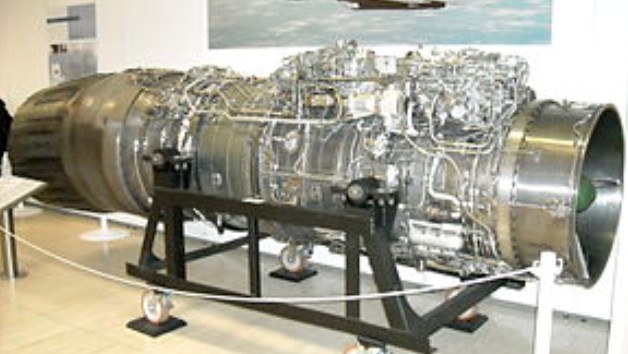
Klimov RD-33 / RD-93 / SMR-95

The Klimov RD-33 is a turbofan engine for a lightweight fighter jet that is the primary engine for the Mikoyan MiG-29. It was developed in OKB-117 led by S. P. Izotov (later OAO Klimov) from 1968 with production starting in 1981. Previous generations of Russian supersonic fighters such as the MiG-21 and MiG-27 used turbojets, but western fighters such as the F-111 and F-4K introduced the use of afterburning turbofans in the 1960s which were more efficient. The RD-33 was the first afterburnering turbofan engine produced by the Klimov company of Russia in the 8,000 to 9,000 kilograms-force (78,000 to 88,000 N; 18,000 to 20,000 lbf) thrust class. It features a modular twin-shaft design with individual parts that can be replaced separately and has a good tolerance to the environment. The RD-33 is simple to maintain and retains good performance in challenging environments.

Variants:
In early 1970s the RD-33 was selected for new light fighter jet, later becoming Mikoyan MiG-29, the other option was Tumansky R-67-300. Years of development has built an extensive engine family. A newly designed thrust vectoring nozzle (TVN) was available. Newer models of the RD-33 family include BARK digital monitoring and control systems. Repair and maintenance of RD-33 engines takes advantage of an information and diagnostics system (IDS).

RD-33
Baseline model developed in 1976 to power the MiG-29.

RD-33B/NB
A model without afterburner for various types of aircraft, such as the Il-102.

RD-93
A variant used to power the JF-17 / FC-1. According to JF-17.com “The most significant difference being the repositioning of the gearbox along the bottom of the engine casing.” The Klimov poster at Zhuhai 2010 airshow gave the thrust of the engine to be up to 98 kN.

SMR-95
A model for upgrading international 2nd and 3rd generation jet fighters. The accessory gearbox is repositioned below the engine, length can be varied depending on the adopted aircraft fuselage. The engine passed bench tests and flight tests on the Super Mirage F-1 and Super Cheetah D-2 aircraft of the South African Air Force and had achieved an improvement in flight performance and combat efficiency by a factor ranging from 1.2 to 3.0.

RD-33 series 3
A revised model with a longer service life used on later or upgraded old variants of the MiG-29 such as MiG-29M and MiG-29SMT. A pair of RD-33 series 3 engine equipped with TVN is currently undergoing flight tests as a component of the MiG-29OVT jet fighter.

RD-33MK
The RD-33MK “Morskaya Osa” (Russian: Морская Оса: “Sea Wasp”) is the latest model developed in 2001. It is intended to power the MiG-29K and MiG-29KUB shipborne fighters, however it has also been adopted for the MiG-35. The RD-33MK develops 7% higher thrust, is digitally controlled FADEC and smokeless unlike earlier RD-33 engines, has increased afterburner thrust to 9,000 kilograms-force (88,000 N; 20,000 lbf) and dry weight 1,145 kilograms (2,524 lb) compared to the baseline model through modern materials used on the cooled blades, although it retains the same length and maximum diameter. Incorporated is an infrared and optical signature visibility reduction systems. Service life has been increased to 4,000 hours. The RD-33MK ensures shipborne fighters unassisted take-off capability, retain performance in hot climate environment and, naturally, a boost in combat efficiency for MiG-29 fighter latest variant.

Specifications:

RD-33
Type: afterburning turbofan
Length: 4,229 mm (166.50 in)
Diameter: 1,000 mm (39.37 in)
Dry weight: 1,055 kg (2,326 lb)
Compressor: 2 spool axial, 4 low pressure stages, 9 high pressure stages
Combustors: annular combustor
Turbine: Single stage high pressure, single stage low pressure
Maximum thrust: 50.0 kN (11,230 lbf) Dry, 81.3 kN (18,285 lbf) Afterburning.
Overall pressure ratio: 21:1
Bypass ratio: 0.49:1
Turbine inlet temperature: 1,407 °C (2,565 °F)
Specific fuel consumption: 75 kg/(kN·h) (0.77 lb/(lbf·h)) dry, 188 kg/(kN·h) (1.85 lb/(lbf·h))
Thrust-to-weight ratio: 4.82:1 (dry), 7.9:1 (afterburning)
Life expectancy: 4,000 hours

RD-93
thrust=49.4 kN Dry, 81.4 – 88.4 kN Afterburning.

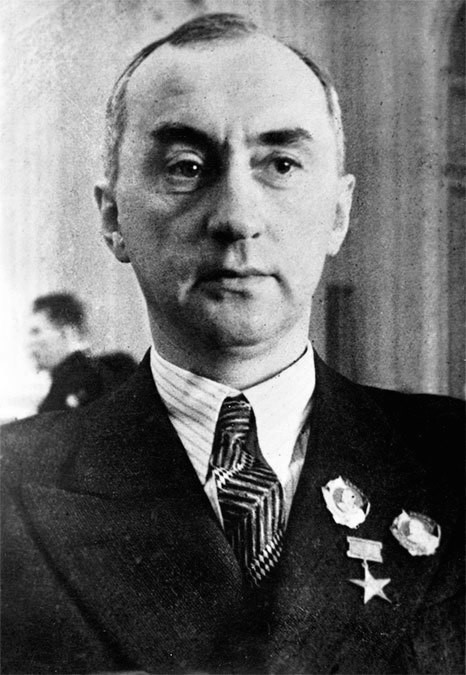
Klimov, Vladimir Yakovlevich

Vladimir Yakovlevich Klimov was born on 23 July 1892 in Moscow and studied at the Technical School Komissarovskom.

In 1918 he graduated from the Faculty of Mechanical Engineering of the Technical State University of Moscow NE Bauman and began his career in October of 1919 in Kolomna factory, an engineering company based in Moscow.

From July 1918 to 1931 he worked interchangeably as chief laboratory engineer, department head, assistant director of the automotive research laboratory of this factory which later became the Soviet Scientific Institute of Engines (NAMI).

After 1931 he became Head of the Department of Technical Control of gasoline engines of the Central Institute of Aviation Engines and at the same time, he worked as a professor at the Moscow Higher Technical School, the Lomonosov Institute and the Military Academy of the Force, Zhukovsky Aerial.

He was also head of the Engine Design Department at the Moscow Aviation Institute.

Vladimir Yakovlevich Klimov participated in the development of the first Soviet air-cooled star-shaped aircraft engines, the M-12, M-23, and others. In 1927 he created the first and most powerful engine of the time (approx. 650 kW (880 horsepower) the M-13 with liquid cooling for cylinders.

In the mid-1930s, it organizes the production of 12-cylinder M-100 engines, whose capacity was 30% more than that of similar foreign engines of the same size, at that time the M-103 series engine for bombers. “SB” designed by AA Tupolev and Arkhangelsk.

In 1935, Vladimir Klimov was appointed Chief Designer of the Rybinsk Engine Plant No. 26.

In August 1941, he worked designing high-power engines for Soviet aircraft destined to defend the USSR during World War II in a factory evacuated to Ufa.

The engines that Klimov had designed in the late 1930s and early 1940s (M-105, VC-105PF, EC-107, EC-108), were installed in Pe-2 dive bombers designed by VM Petlyakov and fighter jets designed by Yakovlev.

In the postwar period Klimov led the design and production of a wide series of jet engines.

During his work and research, Klimov developed and implemented a series of inventions and innovations in aircraft piston engines such as the closed liquid cooling system, the closed system with a special pressure air pump with two speed traction, advanced timing, mixed fuel feed systems in powerful and high-speed engines, and proposed a number of innovative solutions in the construction of the turbojet.

Klimov made a significant contribution to the development of lubrication theory, to the solution of balance piston engine problems, and other aircraft engine problems.

In 1947-1949 he created the first engines with internal centrifugal compressors for jet aircraft.

In 1951, on the basis of the English Nene engine, Klimov created the VK-1F – one of the world’s first turbojet engines equipped with an afterburner.

Vladimir Yakovlevich Klimov was a Deputy of the Supreme Soviet of the USSR from 1946 to 1950.

He reached the degrees of Major General in the USSR Air Engineering Service.

He was also an outstanding academic twice awarded as Hero of Socialist Labor (1940, 1957). Winner of four Stalin Awards (1941, 1943, 1946, 1949).

He died on September 9, 1962. He was buried in the Novodevichy Cemetery in Moscow.

In 2002, the name Klimov was given to a street in the Shevchenko district of Zaporozhye and a park called Academician Klimov already existed there.
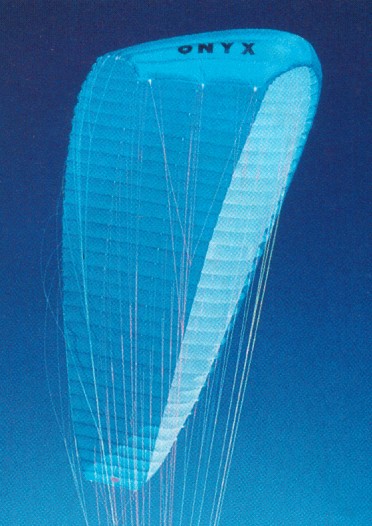
Kimfly Onyx

Paraglider circa 1998.

Onyx L
Wing area: 29.4 sq.m
Pilot weight: 70-85 kg
No. of cells: 37
Wing span: 11.55 m
Aspect ratio: 4.5
Min sink: 1.2 m/s
Max speed: 43 kph
Price (1998) 2400 DM

Onyx M
Wing area: 26.7 sq.m
Pilot weight: 55-75 kg
No. of cells: 37
Wing span: 11 m
Aspect ratio: 4.25
Min sink: 1.2 m/s
Max speed: 43 kph
Price (1998) 2400 DM

Onyx XL
Wing area: 31.5 sq.m
Pilot weight: 80-105 kg
No. of cells: 39
Wing span: 12.25 m
Aspect ratio: 4.7
Min speed: 1.2 m/s
Max speed: 43 kph
Price (1998) 2400 DM