Kolb / The New Kolb Aircraft Co

1982: Kolb Company Inc, RD 3, Box 38, Phoenixvil¬le, Pennsylvania 19460, USA.
1995-8: R.D.3, Box 38, Phoenixville, PA

The New Kolb Aircraft Co. offers 3 excellent designs to cover a wide spectrum of flying missions. The Firefly, was designed in 1995 and more than 500 units were sold worldwide. The Mark 3 Xtra was designed in 1999 by aircraft designer Barnaby Wainfan and more than 100 were sold in the Unites States. The Kolb Flyer SS was granted the S-LSA certificate and sold since July 2008.

König SD 570 / Zanzottera SD 570 / Compact Radial Engines SD 570

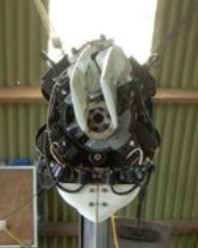
The König SD 570 is a four-cylinder, two-stroke, single ignition radial aircraft engine designed for powered paragliders, powered parachutes and single place ultralight trikes. The SD 570 is an unusual four-cylinder radial engine that is very compact and light weight at only 19 kg (42 lb). The engine features single capacitor discharge ignition, a single Bing 49 diaphragm-type carburetor and rotary valve induction. It was offered without a reduction drive, although when Zanzottera built it an optional 1.75:1 cog belt reduction drive was available. Starting is electric starter only and a recoil starter is not an option.

Earlier versions produced 28 hp (21 kW) at 4200 rpm with a slide-type carburetor and reduction drive. The later version is rated at 24 hp (18 kW) at 4200 rpm. Time between overhaul is rated as 300 hours.

The SD 570 shares the same bore and stroke as the smaller three-cylinder König SC 430 radial engine.

The engine was originally designed and produced by Dieter König of Berlin, Germany. The design was sold to Zanzottera Technologies of Italy and then sold again, along with the rest of Zanzottera’s two-stroke ultralight aircraft engine line to Compact Radial Engines of Surrey, British Columbia, Canada.

Variants:

Zanzottera SD 570
Four-cylinder, two-stroke, single-ignition, radial aircraft engine producing 28 hp (21 kW) at 4200 rpm. Equipped with a slide-type carburetor and an optional reduction drive.

Compact Radial Engines SD 570
Four-cylinder, two-stroke, single-ignition, radial aircraft engine producing 24 hp (18 kW) at 4200 rpm. Equipped with a Bing 49 diaphragm-type carburetor and no reduction drive.

Applications:
MFI BA-12 Sländan

Specifications:
SD 570
Type: Four-cylinder, radial two-stroke aircraft engine
Bore: 66 mm (2.60 in)
Stroke: 42 mm (1.65 in)
Displacement: 579 cc (35.33 cu in)
Dry weight: 19 kg (42 lb)
Valvetrain: rotary valve induction
Oil system: premixed oil and fuel
Cooling system: air-cooled
Reduction gear: none
Power output: 24 hp (18 kW) at 4200 rpm

König SC 430 / Zanzottera SC 430 / Compact Radial Engines SC 430

The König SC 430 is a three-cylinder, two-stroke, single ignition radial aircraft engine designed for powered paragliders and single place ultralight trikes. The SC 430 is a unique three cylinder radial engine that is very compact and light weight at only 17 kg (37 lb). The engine features single capacitor discharge ignition, a single Bing 49 diaphragm type carburetor and rotary valve induction. It was currently offered without a reduction drive, although when Zanzottera built it a 1.75:1 cog belt reduction drive was available. Starting is electric starter only and a recoil starter is not an option.

Earlier versions produced 24 hp (18 kW) at 4200 rpm with a slide-type carburetor and reduction drive. The later version is rated at 20 hp (15 kW) at 4200 rpm. Time between overhaul is rated as 300 hours.

The SC 430 shares the same bore and stroke as the larger four cylinder König SD 570 radial engine.

The engine was originally designed and produced by Dieter König of Berlin, Germany. The design was sold to Zanzottera Technologies of Italy and then sold again, along with the rest of Zanzottera’s two-stroke ultralight aircraft engine line to Compact Radial Engines of Surrey, British Columbia, Canada.

Unit cost from Compact Radial Engines in 2001 was US$3600

Variants:

Zanzottera SC 430
Three cylinder, two stroke, single ignition, radial aircraft engine producing 24 hp (18 kW) at 4200 rpm. Equipped with a slide-type carburetor and reduction drive.

Compact Radial Engines SC 430
Three cylinder, two stroke, single ignition, radial aircraft engine producing 20 hp (15 kW) at 4200 rpm. Equipped with a Bing 49 diaphragm type carburetor and no reduction drive.

Applications:
Air Est Goeland
Alpaero Sirius
Gardner Scout
Stratos 300
UTIAS Ornithopter No.1
Valentin Kiwi 6T
Windex 1200

Specifications:
CR 430
Type: Three cylinder, radial two-stroke aircraft engine
Bore: 66 mm (2.60 in)
Stroke: 42 mm (1.65 in)
Displacement: 430 cc (20.75 cu in)
Dry weight: 17 kg (37 lb)
Valvetrain: rotary valve induction
Oil system: premixed oil and fuel
Cooling system: air cooled
Reduction gear: none
Power output: 20 hp (15 kW) at 4200 rpm

Kollman Raptor

A copy of the Fledge with a composite airframe the same platform as a Fledge. The airfoil was a 2412. It is nearly symetrical with a low pitching moment. The first step was to make the D-tube and load test it. The first D-tube weighed 25 lbs. Jim Marske gave the info and the D-tube was successfully loaded to +7 g’s -4g’s.

The original rigid wing design was scrapped. A new design was started named the Raptor. The Raptor would use the same pitch stable airfoil that’s on the Marske Monarch. A new set of D-tubes were completed. These were made of foam and fiberglass with a carbon fiber spar. They weighed 25 lbs each and were load tested to verify the strength.

While waiting for the sail it was decided to build a hard wing version of the Raptor. Using Marske Monarch molds for the D-tubes, the D-tubes were made to Monarch specs with the addition of some twist. The D-tubes weighed 32 lbs apiece. Since they were built to Monarch strength they were stronger than necessary for a hang glider. The ribs were made of fiberglass and spruce. There was also a spruce trailing edge. The airframe was covered with heat shrinkable Mylar. The empty weight was 140 lbs.

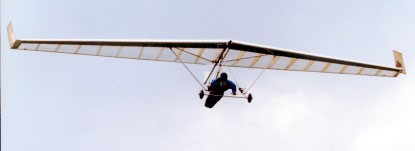
The wing was essentially a Monarch wing swept back with tip rudders. It has a standard control bar with struts and no top rigging. The pilot uses weight shift for pitch. For roll control sliders are used just like on the later Fledge hang gliders.

The plan was to aerotow the Raptor and make short hops and feel it out. The first flights were made in spring of 1994. Ten feet of altitude resulted in a long flat glide. The drag rudders were responsive and predictable. After many hops with the highest being 100′ it was decided to tow to 5000′ and feel it out. The climb up to 5000′ was uneventful. After release the first thing to find out pitch stability. Pulling on the bar, the bar pressure built up steadily. There was very little bar movement but substantial bar pressure. Below 15 mph indicated it felt mushy but wouldn’t break or fall off to one side. The glider never stalled and broke it just goes into a low speed mush with a high sink rate. Direction control is still there because the drag rudders are still working. The slider controls worked well but it was clear I didn’t have enough mechanical advantage on the rudders. When the glider was banked it would tend to tighten up and turn higher unless high side rudder was used. All in all it was a sucessful flight. The Raptor felt stable and controlable. The handling wasn’t great but it was acceptable for a first flight. The Raptor prototype weighed 140 lb.

After a couple months reworking the rudder cables and playing with different dihedral settings the handling got just right. The Raptor was now roll neutral. That means it stays banked at what ever angle it is set at. Deploying a rudder makes the glider roll in that direction. Once the desired bank angle is achieved the rudder is released. The Raptor will continue to turn at that bank angle. To return to level flight the opposite rudder is applied. This was just like weight shifting.

One of the first thing noticed was the Raptor’s ability to turn tight and climb in thermals.

It was decided to set up a production run of three gliders and 6 D-tubes and hardware needed wasn’t available off the shelf. Others wanted collapsible gliders and they wanted smaller gliders. The collapsible was a challenge. The first collapsible glider took almost an hour to put together and it wasn’t easy. It also weighed over 130lbs. To get the smaller size wing and still use the same molds the airfoil was modified. Truck tested the pitch curves were well in excess of what the H.G.M.A. required. By changing the size and modifying the aerfoil the dihedral setting was going to need change. This wing was a lot more sensitive to dihedral settings. The sink rate seemed similar but the glide was definitely better than other hang gliders. This wing isn’t able to generate lift as well at lower speeds.

Through repeated set ups and break downs and modifying the design, at 105 lbs. it set up faster and easier. The sail was made by Dick Cheney. Using the original airfoil with less area than the first prototype, this glider flew great from the first flight. The performance seemed even better than the first glider. The only negative to report is bar pressure. Flying above 45 mph is very difficult because of too much bar pressure.

There was a total of 2 hardwings and 5 collapsible gliders built to September 1999. All of the gliders were load tested and passed. The different D-tubes were all constructed using different techniques and the lightest one was 19 lbs.

The next redesigned was 15 lbs lighter and with the 20 lb D-tubes for a weight of 75lbs. The amount of twist was reduced by 2 degrees, and the also reflex reduced on the airfoil to lessen bar pressure.

The Raptor is now flown by weight shift. The wing is built to cantilever strength with a shifting control bar that is connect to the the rudders. When you shift your weight the control bar shifts deploying the rudders. This is the same system used on other rigid wings except thier cables are connected to spoilers. The beauty of this system is a hang glider pilot gets on it and it flies just like a weight shift glider.

The Raptor 2 appeared in 1994.

Raptor
Wing area: 15.04 m²
Wing span: 12.49 m
Aspect ratio: 10.5
Hang glider weight: 34 kg
Minimum pilot weight: 59 kg
Maximum pilot weight: 112 kg
Max glide ratio (L/H): 18
Max glide ratio speed: 56 km/h

Raptor 2
Max glide ratio (L/H): 18
Koenig Engineering AK.09 Faucon / Junkers Profly Ultima

Junkers Profly Ultima

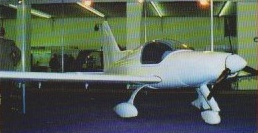
Classed as a microlight under the FAI definition, the all carbonfibre Ultima two seater was at the point of being marketed in 1998.
Koenig Engineering offers kit to construct AK.09 Faucon two-seat composites monoplane, also available from Germany as Junkers Ultima.

Engine: Rotax 912, 80 hp
Wing span: 8.20 m
Wing area: 10.5 sq.m
MAUW: 450 kg
Empty weight: 250 kg
Fuel capacity: 90 lt
Max speed: 260 kph
Cruise speed: 230 kph
Minimum speed: 65 kph
Climb rate: 6.2 m/s
Seats: 2
Fuel consumption: 12 lt/hr
Price (1998): 98 000 DM
Kit price (1998): 52 270 DM

Kobra Traktor Trike II

The Traktor Trike II is a two seater paramotor trike made of stainless steel, ideal for training, tandem flights or aerial patrolling. The Traktor II is made of stainless steel, and can be flown solo from both seats. Kits are available for carrying loads in the rear position, instead of a passenger. Loads can also be released in flight. Traktor II is available with Rotax 503, Rotax 582, Rotax 912, HKS700E engines. Wide choice of accessories and instruments is provided. Rescue parachute is provided as well.
The Traktor II can be flown with different types of paragliders.

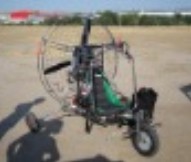
Kobra Traktor Paramotor Trike

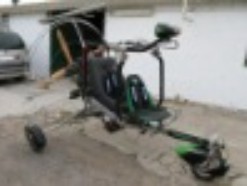
A single seat paramotor trike, powered by a Simonini Mini 2 PLUS engine, 200cc, 23 hp. The Traktor is a very strong and reliable one seater trike made of stainless steel and 7075 T6 alloy. Very easy to mantain. Rear suspention. Wide choise of wheels. Front brake optional. Rear legs dismantable.
High hang point, very stable flight behaviour. Combines with many paramotors, ideally with our Rocco SUPER paramotor, which can be disassembled in 4 parts for easy storage.
Seat is made of fiberglass and is very well padded for high comfort and long flights. Prachutter rescue system is located behind the seat, and can be activated automatically or manually.