MBB BK.117 / Kawasaki BK.117 / IPTN NBK- 117

BK 117

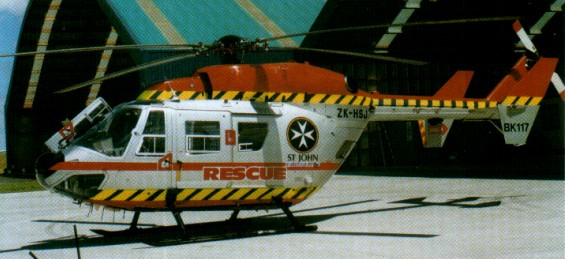
On 25 February 1977, MBB of West Germany and Kawasaki of Japan signed an agreement for the joint development of a twin-turbine utility helicop¬ter suitable for military as well as civil use, following more than two years’ negotiation. Joint development costs were to be divided equally, the financing being guaranteed by the respective governments. MBB was to be responsible for the main rotor and tail rotor, tail boom, empennage, hydraulic system and controls, while Kawasaki was to develop the landing gear, fuselage, transmission and other minor components. This emerged as the BK 117, which uses the BO 105’s rigid main rotor and a Japanese-developed transmission.

The original programme was based on four prototypes, two to be built by MBB in Munich and two by Kawasaki in Gifu, all to be completed by mid 1979. In each case, one of the prototypes was intended for flight testing and the other for static tests. However although the German company succeeded in completing its two models by the end of 1979, only one of the Japanese prototypes was ready on time.

A fair percentage of parts and systems are identical to those of the German Bo.105 helicopter. The hydraulic system is based on the original Bo.105 version and even the rotor is taken from the Bo.105, suitably enlarged to match the demands of the bigger and heavier BK-117. The four-blade rotor is of the rigid type with a titanium hub and reinforced fiberglass blades. The transmission is derived from the Japanese KH-7 project: a seven-ten-seat helicopter which was to have been fitted with two 590shp Lycoming turbine engines. The BK-117 also has a pair of Avco-Lycoming LTS-101-650B-1 engines, delivering 600shp on take-off and 550shp maximum continuous power. The fuel tanks, with a total capacity of 605 liters, are housed in the lower part of the fuselage.

The executive version of the BK-117 carries a pilot and five passengers, but the volume of 3.22cu.m gives room for nine passengers in the high density version or in those used for commuter and offshore services to oil platforms. It can be loaded through two large sliding doors, one on either side of the fuselage. Behind the passenger cabin is a large baggage hold with a capacity of 1.34cu.m, which is reached through two hinged doors at the rear of the fuselage. A cargo hook can be fitted to the cabin floor for external lift work.

German and Japanese prototypes flew for the first time on 13 June 1979 (D-HBKA) and 10 August 1979 (JQ0003, the third BK.117) respectively. Kawasaki was first to fly a production aircraft (JQ1001) on 24 December 1981; MBB followed with D-HBKC on 23 April 1982, this machine being the first production aircraft to be delivered to a customer, in early 1983.

By the beginning of 1982, the BK-117 prototypes had logged more than 750 flying hours and type approval by the German Federal Authorities followed shortly afterwards. Half of the 130 aircraft ordered by February 1982 were for customers in the United States, where deliveries began in early 1983, from two production lines, in Germany and Japan.

Combining utility troop trans¬port and anti-tank capability, the BK.117A-3M was originally conceived as a contender for the Belgian Aeromobility 1 requirement. Based on the civilian BK.117A-3 airframe, the A-3M is offered in a multirole military configuration equipped with an under-nose Lucas 12.7mm or 0.5in gun turret with helmet sight, HOT anti-tank missiles with stabilised roof mounted sight, rocket pods, AAMs, and an ECM and Racal radar warning system, managed by a Racal 3000 Series avionics management system. Provision is also made for a mast mounted sight. Up to 11 troops can be carried in the utility role. Powered by twin Lycoming LTS1O1-650B-1 turboshafts, the BK.117 A-3M has a maximum take-off weight of 3,200kg and an operating range (minus auxiliary tanks) of 495km. MBB later abandoned its armed military BK 117A-3M.

The 1990 production version was the BK.117B-1. This was certificated in 1987 and is powered by two 592 shp (442 kW) Textron Lycoming LTS 101-750B-1 turboshafts.
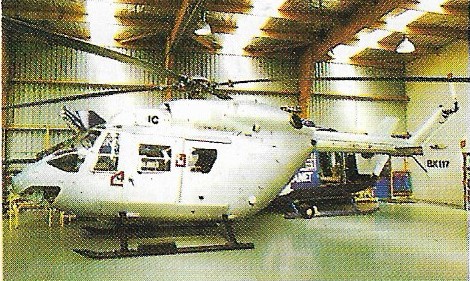
BK 117 B1

The B-2 model has an increased MTOW and an extended C of G range.

Germany’s ministry of defence used one BK 117 as a composites testing aircraft.

More than 180 BK 117s had been delivered from the production lines in Germany and Japan by 1990.
The BK 117M is a military version, six.of which were delivered for trials with the West German Army.

An agreement was concluded in 1982 for the type to be built in Indonesia under licence by IPT Nurtanio as the NBK-117.

By January 1990 more than 250 BK 117s had been delivered worldwide, including 36 by Kawasaki, the standard aircraft being the BK 117B-1.

Since April 1990 a BK 117 engine testbed has been flying equipped with Turbomeca Arriel turboshafts in an effort to offer customers an alternative engine, and certification was scheduled for 1992.

On 1 September 1991, MBB transferred its Helicopter Division to Eurocopter Hubschrauber GmbH. This was later integrated with Aerospatiale’s helicopter interests into the Paris-based Franco-German Eurocopter Holdings, along with the NH-90, BO 105, BO 108 and BK 117.
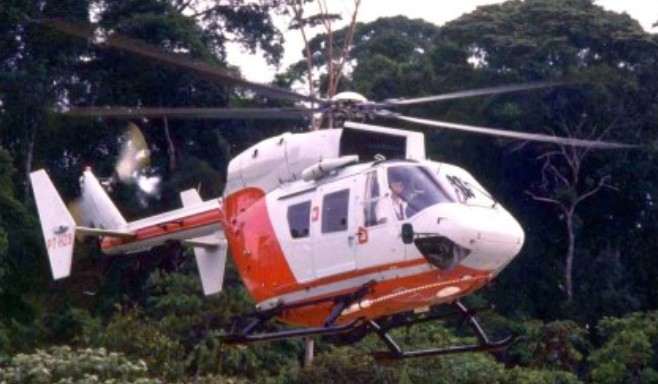
Gallery

Variants:

BK 117A-1
Initial production version with LTS 101-650B-1 engines

BK 117A-3
Certificated in March 1985 with larger tail rotor fitted with twisted blades and take-off weight increased to 3200kg

BK 117A-4
Certificated in July 1986 with increased transmission limits at take-off power, improved tail rotorhead, and extra internal fuel (on German aircraft), all giving enhanced performance

BK 117 B-1
Fitted with more-powerful LTS 101-750B-1 engines to provide further increased performance and 140kg more payload; certificated in 1987

BK 117M
Military version of A-1 proposed by MBB in 1985, and flying since 1988; fitted with taller skids, a Lucas turret mounted under the fuselage houses a Browning 12.7mm automatic machine-gun and 450 rounds of ammunition, controlled by a helmet-mouted sight; outrigger pylons can carry up to eight HOT II or TOW antitank missiles, air-to-air missiles, rocket-pods, or forward-firing cannons; a doorway gunners position with a 12.7mm gun can also be installed, or 11 troops can be carried

Specifications:

MBB/Kawasaki BK 117
Engine: 2 x Lycoming LTS101-650B-1, 650 shp / 410kW
TBO: 2400 hr
Main rotor: 36.1 ft / 11m
Seats: 8/10
Length: 32.7 ft / 9.91m
Length rotors turning: 13m
Height: 10.9 ft / 3.83m
Max ramp weight: 6283 lb
Max takeoff weight: 6283 lb / 2850kg
Standard empty weight: 3505 lb / 1650kg
Max useful load: 2778 lb
Max landing weight: 6283 lb
Max sling load: 2645 lbs
Disc loading: 6.1 lbs/sq.ft
Power loading: 7.4 lbs/hp
Max usable fuel: 1058 lbs
Max rate of climb: 1830 fpm
Service ceiling: 17,000 ft / 4570m
Hover in ground effect: 11,000 ft
Hover out of ground effect: 8700 ft
Max speed: 150 kts
Normal cruise @ 3000 ft: 139 kt / 250km/h
Fuel flow @ normal cruise: 463 pph
Endurance @ normal cruise: 2.1 hr
Range max payload: 500km

BK.117
Engine: 2 x Lycoming LTS 101-750A3, 986 shp
Empty wt: 1849 kg
Cruise: 130 kts
Range: 540 km (340nm)

BK.117B-2
Engine: 2 x Lycoming LTS 101-750B-1
Instant pwr: 548 kW
Rotor dia: 11 m
MTOW: 3350 kg
Useful load: 1595 kg
Max speed: 150 kts
Max cruise: 133 kts
Max range: 540 km
Crew: 2
Pax: 10
Seats: 8/11.

BK.117C-1
Engine: 2 x Turbomeca Arriel 1E2
Instant pwr: 574 kW
Rotor dia: 11 m
MTOW: 3350 kg
Useful load: 1585 kg
Max speed: 140 kts
Max cruise: 133 kts
Max range: 540 km
Crew: 2
Pax: 10
Seats: 8/11

BK.117M
Engines: two 592-shp (441-kW) Lycoming LTS 101-650B-1 turboshafts
Maximum speed 155 mph (250 km/h) at sea level
Initial climb rate 1,476 ft (450 m) per minute
Service ceiling 15,000 ft (4,570 m)
Range 308 miles (495 km)
Empty weight 5,644 lb (2,560 kg)
Maximum take-off weight 7,055 lb (3,200 kg)
Main rotor diameter 36 ft 1 in (11.00 m)
Length overall, rotors turning 42 ft 8 in (13.00 m)
Height 11ft 0.3 in (3.38 m) to top of rotor head
Main rotor disc area 1,022.96 sq ft (95.03 sq.m)
Armament: one 0.5-in (12.7-mm) machine gun and disposable weapons
Hardpoints: 2
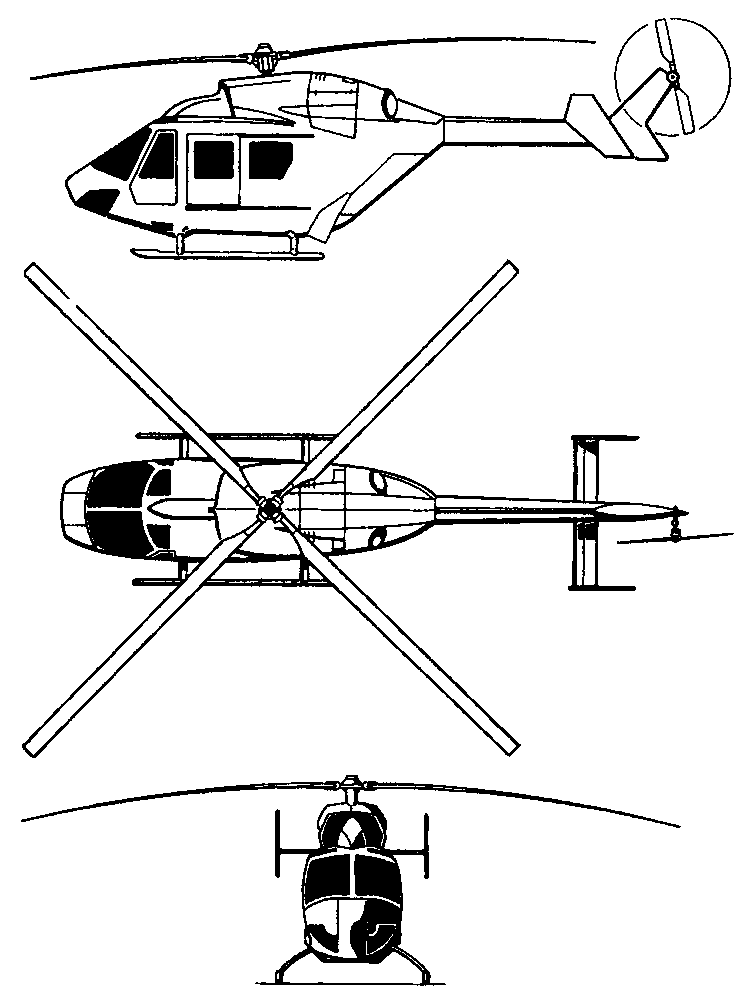
MBB / Messerschmitt-Bölkow-Blohm GmbH

Formed 14 May 1969 as merger of Messerschmitt-Bölkow GmbH and Hamburger Flugzeugbau GmbH, headquarters at Ottobrun, Munich. Inherited its forebears’ production programs, including Bolkow’s 208C Junior, 209 Monsun and 223 Flamingo light aircraft and Bo.105 helicopter, also HFB’s Hansa executive jet.

Siebel ATG (SIAT) joined MBB in 1973.

Produced Bo.105 and Tornado, latter by virtue of its 42.5% holding in Panavia, and participated in Airbus, Transall, and Fokker F-28 programs; took over VFW January 1981.
Became part of Deutsche Aerospace AG in 1989.

By 1995, Aerospatiale and MBB had merged to form Eurocopter.

Maxair Drifter

Maxair Drifter

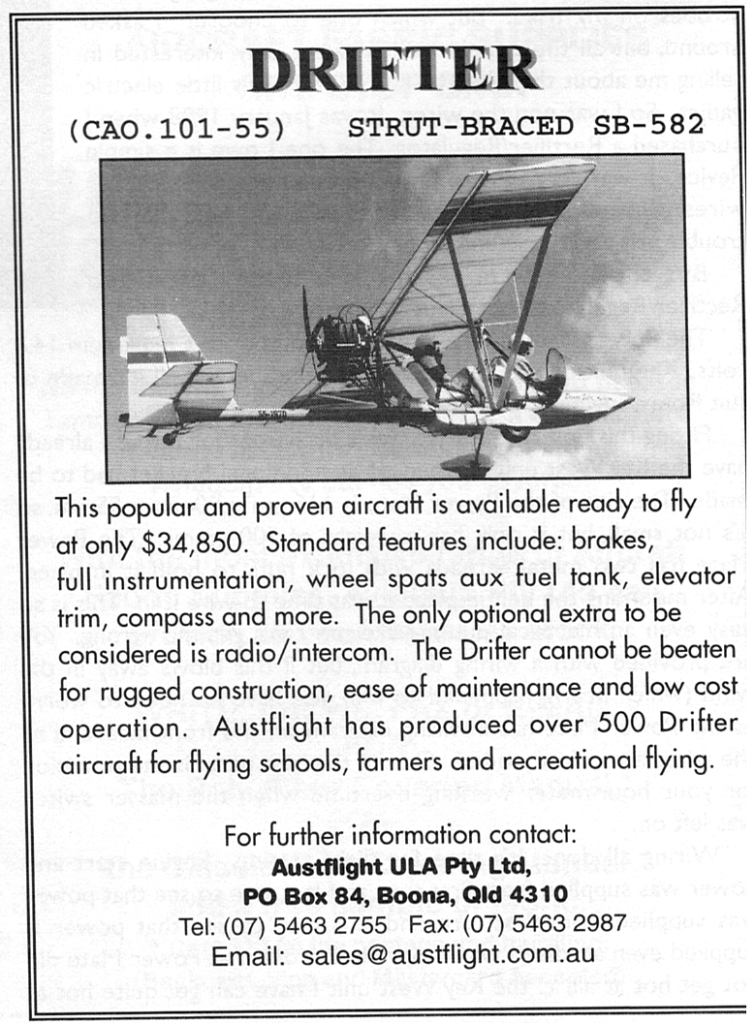
Single seat single engined high wing monoplane with conventional three axis control. Wing has unswept leading and trailing edges, and constant chord; conventional tail. Pitch control by elevator on tail; yaw control by fin mounted rudder; roll control by full span ailerons; control inputs through stick for pitch/roll and pedals for yaw. Wing braced from above by kingpost and cables, from below by cables; wing profile; double surface. Undercarriage has three wheels in tail dragger formation; suspension on all wheels (type NC). Push right go right tailwheel steering connected to yaw control. Optional brakes on main wheels. Aluminium tube framework, without pod. Engine mounted at wing height driving pusher propeller. Dacron wing covering.

The Drifter started life as a modified Hummer, the brainchild of the late Klaus Hill. Maxair Sports dealer Roy Pinner built the first Drifter from a Hummer kit, with some notable design changes. On the Drifter, in place of the V-tail empennage, Pinner built a conventional cruciform tail, sporting a regular set of stabilizing surfaces — vertical and horizontal. Along with the stabilizing surfaces Pinner constructed a rudder and elevator. Maxair also added bent sheet aluminum to strengthen the fuselage boom. New landing gear built of springy 4130 chrome-moly steel replaced Hummer’s complex aluminum-tube gear. The wing utilizes a flatter profile, sporting a batten-braced lower surface with some curvature, enabling the craft to slice through the air with less effort. And less effort required means that the Drifter flies faster on the same power as Hummer, even though both sport approximately the same wing area, despite Drifter’s higher empty weight.

The Duralumin and Dacron Drifter made its first public appearance as a prototype at Oshkosh in 1982, where it was on static display only, since the aircraft had not at that time completed its flight test programme. The design is by Roy Pinner, marketing director of Maxair Sports, who conceived the Drifter as an improved version of the Hummer from the same company, with a remodelled structure and a conventional tail in place of the characteristic V tail, as designed by Klaus Hill.

The Drifter has been on sale since May 1983, Maxair Sports differentiating the new model from the Hummer, which is still in production, by emphasising its sprung suspension on the main undercarriage and its increased track, which allows more rough¬terrain use. It also points out that the tail has become conventional, with large control surfaces, and that the ailerons are now full span. The improved control authority of the Drifter gives better cross wind capabilities and its performance has been increased by the 38.5 hp delivered by its twin cylinder in line Kawasaki TA440A engine. Priced in 1983 at US$5500.

The XP 503 was first introduced at Oshkosh in 1983. A two-seat high wing microlight powered by a pusher 48 hp Rotax 503. Max speed is 63 mph.

By 1984 600 Drifters had flown.

Its cable-braced wing and aluminum fuselage tube resulted in a rigid design that was soon expanded to include a two-seat trainer version and a short-wing, overpowered single-seat hot rod that was well outside ultralight limits. Some Drifters were equipped with monohull or dual floats.

March 1999

Maxair declared bankruptcy in 1991, and the Drifter project was picked up by Phil Lockwood, who had worked for Maxair. Lockwood Aviation has reintroduced the design. When powered by the 582 Rotax engine the craft will climb out at 900 feet a minute cruise a 70 m.p.h. and stall in the 38/40 m.p.h. range.

Leza Lockwood Drifter

Drifter
Engine: Kawasaki TA440A, 38.5 hp at 6000 rpm.
Propeller diameter and pitch 58 x 36 inch, 1.47 x 0.91 m.
V belt reduction, ratio 2.25/1.
Max static thrust 230 lb, 104kg.
Power per unit area 3.94 hp/sq.ft, 2.7 hp/sq.m.
Fuel capacity 5.0 US gal, 4.2 Imp gal, 18.9 litre.
Length overall 19.0 ft, 5.79 m.
Height overall 7.6ft, 2.32m.
Wing span 30.0ft, 9.14m.
Constant chord 5.0ft, 1.52m.
Dihedral 4 deg
Sweepback 0 deg
Tailplane span 7.4 ft, 2.23 m.
Fin height 6.0ft, 1.83m.
Total wing area 152 sq.ft, 14.1 sq.m.
Fin area 15.0 sq.ft, 1.39 sq.m.
Tailplane area 26.0 sq.ft, 2.41 sq.m.
Wing aspect ratio 5.9/1.
Wheel track 6.0 ft, 1.83 m.
Wheel¬base 15.6 ft, 4.72 m.
Tailwheel diameter over¬all 4 inch, 10 cm.
Main wheels diameter overall 12 inch, 30cm.
Empty weight 233 lb, 106kg.
Max take off weight 505 lb 229 kg.
Payload 272 lb, 123kg.
Max wing loading 3.32 lb/sq.ft, 16.2 kg/sq.m.
Max power loading 13.1 lb/hp, 5.9kg/hp.
Load factors +6.0, 3.0 design.
Max level speed 63 mph, 101 kph.
Never exceed speed 63 mph, 101 kph.
Max cruising speed 60 mph, 97 kph.
Economic cruising speed 50mph, 80kph.
Stalling speed 25 mph, 40 kph.
Max climb rate at sea level 1100 ft/min, 5.6 m/s.
Min sink rate 300 ft/min at 40 mph, 1.5 m/s at 64 kph.
Best glide ratio with power off 9/1 at 42 mph, 68kph.
Take off distance 100ft, 30 m.
Land¬ing distance 100 ft, 30 m.
Range at average cruising speed 150 mile, 241 km.

Drifter DR 277
Empty wt. lbs: 252
Max wt. lbs: 500
Wing span: 30 ft
Wing area sq.ft.: 152
Height: 8’4”.
Length: 19’
Fuel cap: 5 USG.
Construction: Aluminium, Dacron.
Wing loading lbs/sq.ft: 2.9
Power loading lbs/hp: 17.86
Engine: Rotax 277 (268cc) 28 hp.
Drive: 2.25-1.
Prop: 56 in.
Static thrust: 230 lbs.
Max speed mph: 63
Cruise mph: 50
Stall mph: 26
Vne mph: 75
Climb rate: 600 fpm @ 40 mph.
Design limits: +6, -3.3g.
Glide ratio: 8.2-1.
Seats: 1.

Drifter DR 532
Empty wt. lbs: 310
Max wt. lbs: 570
Wing span: 23ft
Wing area sq.ft.: 117
Wing loading lbs/sq.ft: 4.8
Power loading lbs/hp: 8.91
Engine: Rotax 532
Max speed mph: 95
Cruise mph: 65
Stall mph: 34
Vne mph: 100.

Drifter MU 532
Empty wt. lbs: 360
Max wt. lbs: 900
Wing span: 30ft
Wing area sq.ft.: 152
Wing loading lbs/sq.ft: 4.8
Power loading lbs/hp: 14.06
Engine: Rotax 532
Max speed mph: 80
Cruise mph: 60
Stall mph: 35
Vne mph:84
Seats: 2.

Drifter XP 503
Empty wt. lbs: 335
Max wt. lbs: 785
Wing span: 30ft
Wing area sq.ft.: 152
Wing loading lbs/sq.ft: 4.7
Power loading lbs/hp: 15.1
Engine: Rotax 503
Max speed mph: 75
Stall mph: 31
Vne mph: 79
Seats: 2.
Glide ratio: 8: 1
Cruise: 48 knots (46-50 knots)
Take-off: 108 m
Landing: 108 m
Rate of climb: 450 to 600 fpm
Useful load: 204 kg

Drifter DK 440
Empty wt. lbs: 270
Max wt. lbs: 575
Wing span: 30 ft
Wing area sq.ft.: 152
Height: 8’4”
Length: 19’
Fuel cap: 5 USG
Construction: Aluminium, Dacron
Cruise: 45-63 mph
Vmax: 70 mph
ROC: 900 fpm
TO run: 100-200 ft
Ldg roll: 185-285 ft

Tiger Aviation Drifter SB
Top speed: 90 mph
Cruise: 74 mph
Stall: 36 mph
Range: 250 sm
Rate of climb: 600 fpm
Takeoff dist: 350 ft
Landing dist: 350 ft
Engine: Rotax 582, 64 hp
HP range: 64-80
Fuel capacity: 15 USG
Empty weight: 550 lb
Gross weight: 1100 lb
Height: 7 ft
Length: 18.5 ft
Wing span: 30 ft
Wing area: 156 sq.ft
Seats: 2
Landing gear: tailwheel

Maxair

Franklin Manufacturing Corporation
Maxair Sports Inc

Maxair Sports was founded in 1973 under the name of Franklin Manufacturing Corporation to make metal components for the hang gliding industry.
By 1982 the name had changed to Maxair Sports Inc.
1982-4: Maxair Sports Inc, PO Box 95, 32 Water Street, Glen Rock, Pennsylvania 17327, USA.
Maxair declared bankruptcy in 1991, and the Drifter project was picked up by Phil Lockwood, who had worked for Maxair.

UL builder

Maupin Woodstock

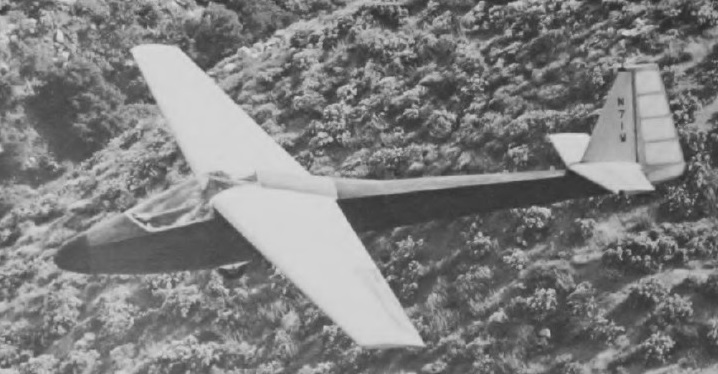
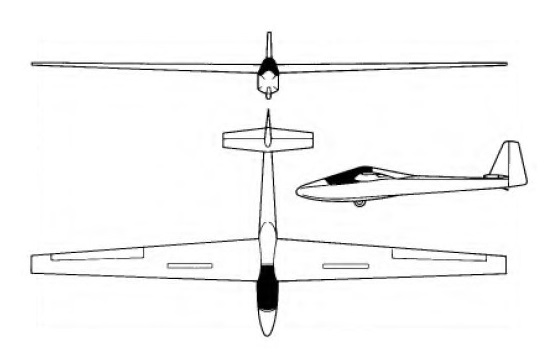
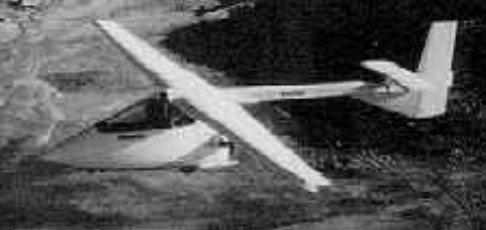
Jim Maupin of San Pedro, CA offered an inexpensive way to get into the action, with his homebuilt sailplane Woodstock, designed with the philosophy, “Build it light, build it small, build it cheap and simple.” Only basic tools are needed. Woodstocks wing, designed by lrv Culver, is built around a single main spar, formed as a hollow box out 8 feet and as a c-section beyond. Ribs are sawn from ¼-inch fir plywood, glued to the spar fore and aft. Spar runs the full length of the wing. Wing forward of the spar is covered with 1/4 -inch birch ply as a D section. Fuselage and tail are equally simple to build. An info kit was $5, plans $105 ($115 overseas).

Woodstock was designed with a wing having an 18 % section for the root, 13 % at the tip and no twis. The principal design objectives were low cost and simplicity of construction. Douglas Air was used for all major structural parts and all tail and wing skins were birch. It first flew in 1978 and won the Sailplane Homebuilders Association design contest in 1984. A tail wheel is an option instead of a skid. The main wheel is fixed. Approach control is by wing top surface spoilers. As an option, wings of 13.1 m./ 43.0 ft.

Woodstock
Wing span: 11.89 m / 41.5 ft
Wing area: 9.73 sq.m / 104.7 sq.ft
Aspect ratio: 14.5
Airfoil: Culver
Length 5.43 m / 17 ft 10 in
Height: 1.22 m / 4ft 0 in
Empty Weight: 111 kg / 245 lb
Payload: 95 kg / 210 lb
Gross Weight: 206 kg / 455 lb
Water ballast: None
Wing Load: 20.9 kg/sq.m / 4.29 lb/sq.ft
L/DMax: 24 at 72 kph / 39 kt / 45 mph
MinSink: 0.79 m/s / 2.6 fps / 1.54 kt
Seats: 1

Woodstock 15M
Wing span: 15 m / 49.2 ft
Wing area: 10.18 sq.m / 109.6 sq.ft
Height: 3.5 ft
Length: 19 ft
Empty Weight: 111 kg / 245 lb
Payload: 120 kg / 265 lb
Gross Weight: 206 kg / 455 lb
Wing Load: 22.69 kg/sq.m / 4.65 lb/sq.ft
Aspect ratio: 16.8
Airfoil: Culver
Seats: 1
L/DMax: 26.5 72 kph / 39 kt / 45 mph
MinSink: 0.79 m/s / 2.6 fps / 1.54 kt
Stall: 35 mph
Landing gear: single wheel
Load limit 5.0 G

Maupin Windrose

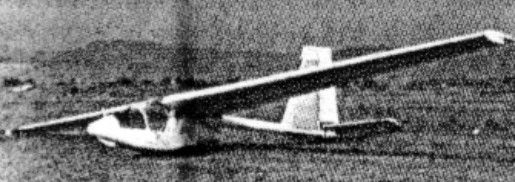
Designed by Jim Maupin and Irv Culver to meet SHA Homebuilt Sailplane Design Contest criteria: easy to built, low cost, soarable, self-launching, safe, the definitive powered Windrose first flew in 1984. The structural backbone is a hollow plywood box with corners longerons which carry the engine mounts, landing gear and fiberglass cockpit shell. The wings are shaped foam covered with fiberglass, but without a conventional spar. The spars are bands of unidirectional roving expoxied into recesses in the upper and lower wing skins, and separated by rows of vertical dowels between the bands to take compression loads off the foam. Ailerons are set inboard from the root to approximately two-thirds span operated by pushrods from the fuselage. The wing structure is free of controls, pushrods, cables etc. Glidepath control is by a triangular spoiler which rises above the wing center section. Both tail surfaces are all-moving. The design comes in 12.65 and 15.0 m models.
Windrose was offered as partial or complete kit, or plans only. Plans used to cost $175 in the US and Canada, airmail overseas for $195.

The Windrose II motor glider has an optional shorter wing span or Cuyuna UL-II-02 engine.

Windrose
Wing span: 12.65 m / 41.5 ft
Wing area: 8.92 sq.m / 96 sq.ft
Aspect ratio: 17.9
Empty weight: 355 lb
Gross weight: 565 lb
Wing loading: 5.93 lb/sq.ft.
Airfoil: Culver
Seats: 1

Windrose
Engine: 25 kW/ 33 bhp Cuyuna ULII-02 / Rotax 503, 46 hp
Wing span: 12.65 m / 41.5 ft
Wing area: 8.92 sq.m / 96 sq.ft
Empty Weight: 177 kg / 390 lb
Payload: 95 kg / 210 lb
Gross Weight: 272 kg / 600 lb
Wing Load: 28.51 kg/sq.m / 6.3 lb/sq.ft
Aspect ratio: 17.9
L/D Max: 29 84 kph / 45 kt / 52 mph
Min Sink: 0.70 m/s / 2.3 fps / 1.36 kt at 46 mph
Airfoil: Culver
Seats: 1

Windrose
Gross Wt. 650 lb
Empty Wt. 440 lb
Wingspan 41’7”
Wing area 95.25 sq.ft
Aspect ratio 18.25 to 1
Wing loading 6.82 lb/sq.ft
Engine 35-hp Cuyuna UL 11-02
Takeoff run, standard day 600 ft
Climb rate 500 fpm @ 52 mph
L/D max 30/1 @ 49 mph
Min sink 2.3 fps @ 41.5 mph.

Windrose 15M
Wing span: 15m / 49.2 ft
Wing area: 9.54 sq.m / 102.66 sq.ft
Empty Weight: 232 kg / 512 lb
Payload: 104 kg / 228 lb
Gross Weight: 336 kg / 740 lb
Wing Load: 37.67 kg/sq.m / 7.7 lb/sq.ft
Seats: 1
L/DMax: 38 82 kph/ 44 kt/ 51 mph
MinSink: 0.56 m/s / 1.85 fps/ 1.10 kt
Aspect ratio: 23.26
Airfoil: Culver
Engine: 34 kW/ 46 bhp Rotax 503

Windrose II
Cruise: 132 mph
Stall: 50 mph
ROC: 700 fpm
Take-off dist: 500 ft
Landing dist: 300 ft
Service ceiling: 13,000 ft
Engine: Rotax 503, 46 hp
Fuel cap: 5 USG
Weight empty: 512 lb
Gross: 740 lb
Length: 21.6 ft
Wing span: 49.2 ft
Wing area: 102 sq.ft
Seats: 1
Landing gear: single wheel

Maupin Carbon Dragon

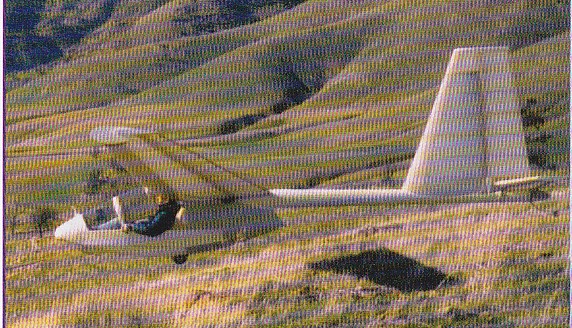
Designed by Jim Maupin & Irv Culver, the Carbon Dragon first flew in 1988. Altrough meeting the FAI definition of a hang glider, the Carbon Dragon can be launched by foot, aerotow, or bungee. Roll control and approach control are by full span 30 % chord flaperons, and at least one has been modified by the addition of a pentagonal shaped spoiler in the wing section, similar to that on the Maupin Windrose. It has a fixed main wheel. It complies with U.S. FAA Part 103 rules. In 1994 it became the first sailplane in that class to win against conventional gliders in a scheduled, non-handicapped cross-country contest.
An ultralight sailplane, basic wood construction with use of carbon epoxy to reduce weight and improve stiffness. Was available as plans for $150. Price (1998) $ 170 (Plans)
Building time estimated at 1500 hours.

Weight: 65 kg / 145 lb
Gross Weight: 151kg / 335lb
Payload: 85kg / 190lb
Wing span: 13.2 m / 44 feet
Wing area: 14.25sq.m / 153.34sq.ft
Vne: 112 km / 70 mph
L/D: 25:1 at 32 mph
Stall: 20 mph
Min sink: 0.51 m/s / 100 fpm / 0.99 kt at 26 mph.
Seats: 1
Wing Load: 10.61 kg/sq.m / 2.18 lb/sq.ft
Aspect ratio: 12.62
Airfoil: Culver CD
Landing gear: single wheel