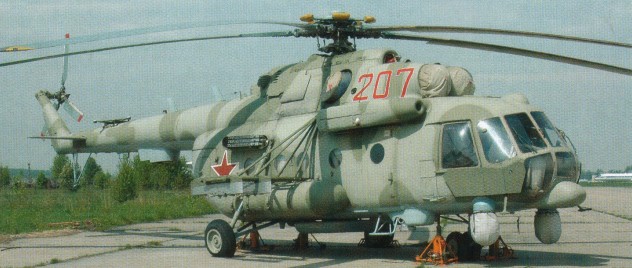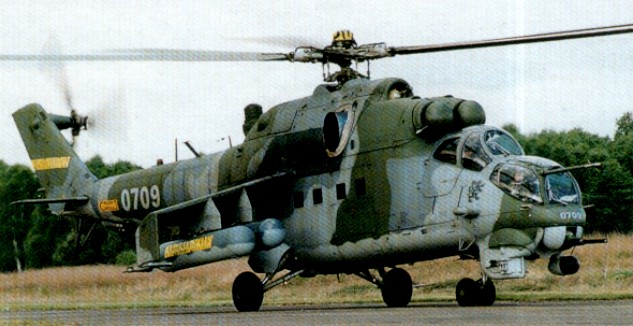
Mil Mi-24 / Mil Mi-25 / Mil Mi-35

Mi-24V

The development of the product design “240” (B-24) began immediately after the publication of the Decree of the Council of Ministers of the USSR and the Central Committee of the CPSU on May 6, 1968 at the Design Bureau of M. L. Mil, as first fire support helicopter in USSR, with accommodation for eight armed troops. Prototype machines (OP-1 and OP-2) were ready in a year. Significant part and assemblies were in common with the Mi-8 and Mi-14. Twelve prototypes were built with the first flown on 19 September 1969 (test pilot G.V. Alferov). The Mi-24 has the NATO reporting name ‘Hind’.

The prototype helicopter had a common front two-seat cockpit (the so-called “veranda”) with dual controls. Crew – pilot and operator. Later, a flight engineer was added to the crew. In the middle of the helicopter was a cargo compartment with a capacity of up to 8 personnel. On the right and left sides of the cargo compartment are double doors, with upper and lower wings. The opening windows were equipped with pivot mounts for firing during flight from personal weapons. Both cabs are sealed, supercharged by engines. Initially, the crew’s equipment included specialized flight helmets and body armor. Cabin reservation is represented by frontal bulletproof glass, armored crew seats, and local armored plates on the sides of the cabin and on the engine hoods.

Due to the unavailability of the Sturm weapons complex, it was decided on the first machines to equip the K4V complex of the Mi-4 helicopter – the Falanga-M missiles with a manual guidance system and the NUV-1 machine-gun mount with the A-12.7 machine gun, four beam holders under NUR or free-falling bombs.

Factory tests started on September 15, 1969 and almost immediately began the construction of an experimental series of ten helicopters. At the end of 1970, two machines were finished – to improve stability at speeds of more than 200 km / h, the helicopter was equipped with a wing with a negative V-12 degrees and an elongated cockpit. The first production helicopters Mi-24A (product “245”), designed in this form and equipped with the Falanga-M complex, entered the army for pilot operation.

First reported in the West in 1972, photographs became available in 1974 when two units of approximately squadron strength were based in East Germany. The Mi-24 uses the TV3 engines, transmission and rotor of the Mi-17 on a new fuselage, with stub wings carrying rockets and other offensive armament.

Two basic versions exist: the Hind A/B/C assault helicopter has a four-man crew under an extensive glasshouse canopy, while the anti-tank Hind D/E/F has a two-man crew under separate armoured glass canopies in a steel-plated forward fuselage. Both versions have stub wings to carry up to 1,500kg of stores, and eight combat equipped troops can be carried in the fuselage.

Mi-24A was produced by a factory in the city of Arsenyev. Almost 250 vehicles were built, which were put into service with the formed army aviation structures, in separate helicopter regiments of the combined arms armies and air assault brigades. On the basis of the Mi-24A, a trainer, the Mi-24U (ed. “244”) was created with full dual control.

Mi-24B (ed. ”241 ″) received a new USPU-24 machine gun mount with a YakB-12.7 machine gun (4500 h / min), the Falanga-P missile system. But the helicopter’s debugging was suspended and fundamental changes were made – the cockpit was converted into a tandem, the tail rotor and gearbox were mounted from the Mi-14 – the propeller became a pulling propeller, which sharply increased the efficiency of track control. The helicopter received the name “Mi-24V”, or product “242”. But due to the lack of knowledge of the Sturm complex, helicopters with a new cockpit had to be equipped with the Mi-24B type, and this “intermediate version” went into series under the designation Mi-24D (product “246”). Just in case, they decided not to use “G” … It took 8 years to finish the Mi-24V. In 1976, the helicopter was officially adopted and was produced in the mass series.

Thus, by 1973, the appearance of a helicopter had developed, which had become widely known throughout the world.
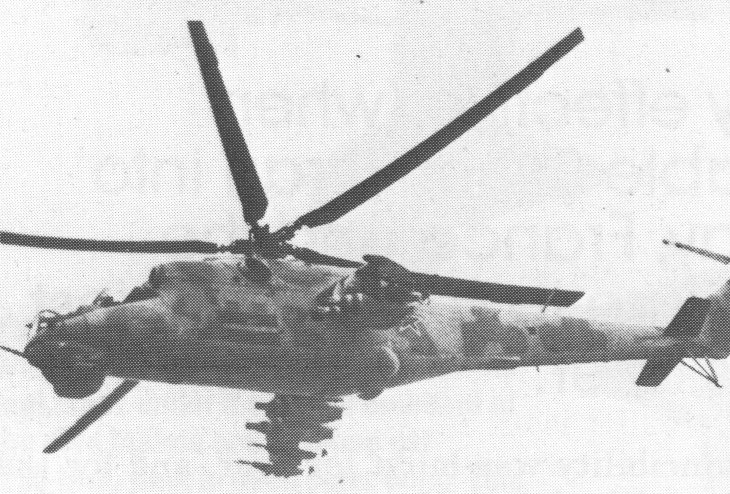
Mi-24 is made according to the classic single-rotor scheme with a five-blade three-joint bearing and three-blade tail rotors.

The undercarriage is three-leg, retractable, with a s steerable front wheel. In the bow of the fuselage there is a double crew cabin according to the tandem scheme: the operator-gunner is in a separate front cockpit, followed by a pilot, whose cockpit is raised by 0.3 m above the cockpit nose, the flight engineer can be located on the folding seat in the equipment compartment behind the cockpit. The crew is housed in pressurized cabins equipped with a heating and ventilation system. To prevent the entry of contaminated air and radioactive dust into them, a slight overpressure is maintained

Steel plates were used to armor the crew cabin, gearbox, engine oil tanks, gearbox and hydraulic tank. The pilot’s seat is armored, with a folding armored back and armored head, the nose is not armored, there is an armored partition between the cockpits, the windshields are armored, flat, equipped with wipers, the side convex glass is silicate, not armored.

The central section of the fuselage consists of a cargo compartment, which can accommodate up to eight paratroopers, and a rear cone-shaped part for equipment and niches for cleaning the main landing gear.
The transmission and the duplicated control system are the same as on the Mi-8 helicopter.
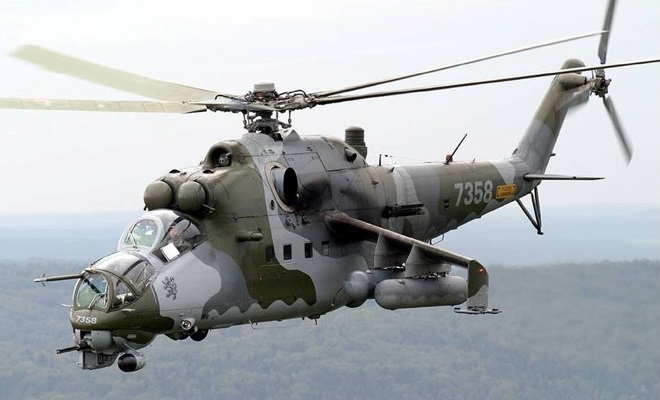
The rotor shaft is tilted not only forward by 4.5 degrees, but also to the right by 2.5 degrees. This ensures stability during forward straight flight.

One of the main features of the helicopter is a wing with an area of 6.75 sq.m. with a negative transverse V – 12 degrees., Which provides from 22 to 28 percent of the lifting force, depending on speed and other factors.

Especially for the Mi-24 in the late 1970s, the GUV-1 helicopter gondolas (including the AGS-17 Flame automatic grenade launcher) and the GUV-8700 (one Yakb-12.7 four-barreled machine gun and two four-barrel GShG-7.62 machine guns) were created .The Mi-24 is also capable of carrying two cannon containers UPK-23-250 with a GSh-23L gun and an ammunition load of 250 shells.

At the end of the 1980s, some Mi-24Ps received 2 R-60 / R-60M air-to-air missiles to repel the attacks of enemy fighters and to combat enemy helicopters. APU with missiles mounted on internal holders. The Mi-24 is also capable of carrying two cannon containers UPK-23-250 with a GSh-23L gun and an ammunition load of 250 shells.

At the end of the 1980s, some Mi-24Ps received 2 R-60 / R-60M air-to-air missiles to repel the attacks of enemy fighters and to combat enemy helicopters. APU with missiles mounted on internal holders.

Identified by Nato is the anti-tank Hind E, armed with AT-6 Spiral missiles. A version of the Hind E without the 12.7mm Gatling-type gun in the nose, but with a twin-barrel cannon pod attached to the fuse-lage side, has been named Hind F by Nato. Hinds have also been reported carrying air-to¬-air missiles.

The Mi-24D has a gunship configuration, with stepped tandem seating for two crew and heavy weapon load on stub-wings, the fuselage is wide eniugh to carry eight troops. Dynamic components and power plant was originally as the Mi-8, but soon upgraded to Mi-17-type power plant and port-side tail rotor. Main rotor blade section NACA 230, thickness/chord ratio 11 to 12%; tail rotor blade section NACA 230M; stub-wing anhedral 12 degrees, incidence 19 degrees; wings contributing approximately 25% of lift in cruising flight; fin offset 3 degrees.

Five-blade constant-chord main rotor; forged and machined steel head, with conventional flapping, drag and pitch change articulation; each blade has aluminium alloy spar, skin and honeycomb core; spars nitrogen pressurised for crack detection; hydraulic lead/lag dampers; balance tab on each blade; aluminium alloy three-blade tail rotor; main rotor brake; all-metal semi-monocoque fuselage pod and boom; 5mm hardened steel integral side armour on front fuselage; all-metal shoulder wings with no movable surfaces; swept fin/tail rotor mounting; variable incidence horizontal stabiliser.

The landing gear is tricycle type; rearward-retracting steerable twin-wheel nose unit; single-wheel main units with oleo-pneumatic shock-absorbers and low-pressure tyres, size 720 x 320mm on mainwheels, 480 x 200mm on nosewheels. Main units retract rearward and inward into aft end of fuselage pod, turning through 90 degrees to stow almost vertically, discwise to longitudinal axis of fuselage, under prominent blister fairings. Tubular tripod skid assembly, with shock-strut, protects tail rotor in tail-down take-off or landing.

Power is from two Klimov TV3-117MT turboshafts, each with maximum rating of 1,434kW, side by side above cabin, with output shafts driving rearward to main rotor shaft through combining gearbox. There is 5mm hardened steel armour protection for engines. Main fuel tank in fuselage to rear of cabin, with bag tanks behind main gearbox. Internal fuel capacity 1,500kg; can be supplemented by 1,000kg auxiliary tank in cabin (Mi-24D); provision for carrying (instead of auxiliary tank) up to four external tanks, each 500 litres, on two inner pylons under each wing. Optional deflectors and separators for foreign objects and dust in air intakes; and infra-red suppression exhaust mixer boxes over exhaust ducts.

Pilot (at rear) and weapon operator on armoured seats in tandem cockpits under individual canopies; dual flying controls, with retractable pedals in front cockpit; if required, flight mechanic on jump-seat in cabin, with narrow passage between flight deck and cabin. Front canopy hinged to open sideways to starboard; footstep under starboard side of fuselage for access to pilot’s rearward-hinged door; rear seat raised to give pilot unobstructed forward view; anti-fragment shield between cockpits. Main cabin can accommodate eight persons on folding seats, or four stretchers; at front of cabin on each side is a door, divided horizontally into two sections, hinged to open upward and downward respectively, with integral step on lower portion. Optically flat bulletproof glass windscreen, with wiper, for each crew member.

Systems include cockpits and cabin heated and ventilated. Dual electrical system, with three generators, giving 36, 115 and 208V AC at 400Hz, and 27V DC. Retractable landing/taxying light under nose; navigation lights; anti-collision light above tailboom. Stability augmentation system. Electrothermal de-icing system for main and tail rotor blades. AI-9V APU mounted transversely inside fairing aft of rotor head. Blind-flying instrumentation, and ADF navigation system with DISS-1SD Doppler-fed mechanical map display. Air data sensor boom forward of top starboard corner of bulletproof windscreen at extreme nose.

Mission equipment includes undernose pods for electro-optics (starboard) and Raduga-F semi-automatic missile guidance (port). Many small antennae and blisters, including SRO-2 Khrom (NATO ‘Odd Rods’) IFF transponder.

Sirena-3M radar warning antennae on each side of front fuselage and on trailing-edge of tail rotor pylon. Infra-red jammer (L-166V-11E Jspanka microwave pulse lamp: ‘Hot Brick’) in ‘flower pot’ container above forward end of tailboom. ASO-2V flare dispensers under tailboom forward of tailskid assembly initially; later triple racks (total of 192 flares) on sides of centre-fuselage. Gun camera on port wingtip.

Armament is one remotely controlled YakB-12.7 four-barrel Gatling-type 12.7mm machine gun, with 1,470 rounds, in VSPU-24 undernose turret with field of fire 60 degrees to each side, 20 degrees up, 60 degrees down; gun slaved to KPS-53AV undernose sighting system with reflector sight in front cockpit; four 9M17P Skorpion (NATO AT-2 ‘Swatter’) anti-tank missiles on 2P32M twin rails under endplate pylons at wingtips; four underwing pylons for UB-32 rocket pods (each 32 S-5 type 57mm rockets), B-8V-20 pods each containing 20 80mm S-8 rockets, 130 mm S-13 and 250mm S-24 rockets, UPK-23-250 pods each containing a GSh-23L twin-barrel 23mm gun, GUV pods each containing either one four-barrel 12.7mm YakB-12.7 machine gun with 750 rounds and two four-barrel 7.62mm 9-A-622 machine guns with total 1,100 rounds or an AGS-17 Plamia 30mm grenade launcher, up to 1,500kg of conventional bombs, mine dispensers, night flares or other stores. R-60 (AA-8 ‘Aphid’), R-73 (AA-11 ‘Archer’) and Igla air-to-air missiles fitted experimentally. Helicopter can be landed to install reload weapons carried in cabin. PKV reflector gunsight for pilot. Provisions for firing AKMS guns from cabin windows.

Reconfiguration of the front fuselage changed the primary role to gunship. The new version was first observed in 1977. In the early Mi-24A the pilot sat behind the armament operator and had relatively poor forward vision but the later Mi-24D provided a raised rear seating position for the pilot and a bubble nose for the weapons position.

The Mi-24 was used operationally in Chad, Nicaragua, Ceylon, Angola, Afghanistan, Chechnya and Iran/Iraq war, when at least one Iranian F-4 Phantom II destroyed by AT-6 (NATO ‘Spiral’) anti-tank missile from Mi-24.

Low-rate production continued for export until 1994. Late models continued to be available from Rostvertol. By 1991 more than 2,300 had been built at Arsenyev and Rostov. An FAI record was set by the A-1O experimental variant of the ‘Hind’ on 2 September 1978 over a 15/25km course it achieved a speed of 368.4km/h.

The Mi-24 has been widely exported and a number are in service on most continents, with examples delivered to, or operating in, Afghanistan, Algeria, Angola, Bulgaria, Chad, Cuba, Czechoslovakia, Germany, Hungary, India, Iraq, Libya, Mozambique, Nicaragua, North Korea, Peru, Poland, Sri Lanka, Syria, Vietnam and Yemen.
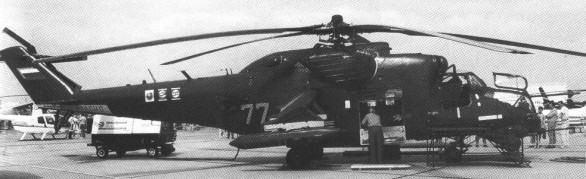
Mi-35M

Some export variants of the Mi-24 are desig¬nated Mi-25 and Mi-35, indicating a different equipment standard. The Mi-35M having fixed undercarriage.

The Mil Experimental Design Bureau demonstrated a fundamentally modernized derivative, designated the Mi-24VM (Mi-35M), of the Mi-24 helicopter that has made a perfect showing under complicated combat conditions. The features of the modernization consist in modular updating of the Mi-24. Any module (unit) can be individually modernized in accordance with the customer’s request and financial potentialities.

The Mi-25 was an export version of Mi-24D tandem-cockpit variant and Mi-35 as second and improved export variant based on upgraded versions of Mi-24.

Installation of a new main rotor provided with blades made of glass fiber plastics, a hub furnished with elastolar bearings, and an X-shaped tail rotor developed for the Mi-28N helicopter, makes it possible to decrease the mass of the flying machine, increase its hovering ceiling and rate of climb, and improve its overall operating characteristics and invulnerability.

In modernizing the airframe, armament system and communications facilities, the Mil Design Bureau offers to install a shortened wing and nonretractable landing gear and retrofit the hydraulic system. The primary emphasis has been placed on an increase of weapon effectiveness. The Ataka air-to-ground guided missiles (ammunition establishment has been increased up to 16 missiles) have been introduced into the helicopter’s armament system. The missiles can also be used against air targets similar to the Igla-V guided missiles. The 12.7mm machine-gun mount has been replaced by a 23mm aircraft cannon. The most up-to-date BVK-24 computer and a laser range finder have been introduced into the heliborne equipment. A modernization program on this scale makes it possible to increase the accuracy against a single target 1.5 times, while increasing the kill zone 2 to 2.5 times when delivering cannon fire. The combat effectiveness of employing the guided missiles increases twofold on average.

The use of night-vision goggles with flight information displayed in the field of view, and equipping the helicopter with an optronic fire-control station comprising of thermal imaging and TV channels, control channel, and laser range finder, as well as display systems, enables the crew to detect and recognize targets at night and employ the heliborne weapons both by day and night.

Most of over 2,500 built between 1970 and 1989, though smallscale production up to 1996.

Gallery

Versions:

Mi-24 ‘Hind’
Early production version, reported in 1972 but not seen until 1973; introduced into Soviet service in 1973/74

Mi-24 ‘Hind-A’
Second production model, with tail rotor moved from the starboard to port side of the tailfin; used as armed assault helicopter, carrying eight troops and three crew members

Mi-24 ‘Hind-B’
Initial production model with tail rotor on starboard side, wings without anhedral, no wingtip stations and only four underwing hardpoints; test use only

Mi-24 ‘Hind-C’
Dedicated training helicopter similar to ‘Hind-A’, but without nose-gun installation and wingtip stations

Mi-24BMT
Modified 1973 for minesweeping.

Mi-24D: (Type 24-6; ‘Hind-D’)
Interim gunship version; design began 1971; entered production at Arsenyev and Rostov plants 1973; about 350 built 1973-77. Basically as late model ‘Hind-A’ with TV3-117 engines and port-side tail rotor, but entire front fuselage redesigned above floor forward of engine air intakes; heavily armoured separate cockpits for weapon operator and pilot in tandem; flight mechanic optional, in main cabin; transport capability retained; USUP-24 gun system, with rangefinding; undernose JakB-12.7 four-barrel 12.7mm machine gun in turret, slaved to adjacent KPS-53A electro-optical sighting pod, for air-to-air and air-to-surface use; Falanga P (Phalanx) anti-tank missile system; nosewheel leg extended to increase ground clearance of sensor pods; nosewheels semi-exposed when retracted.

Mi-24DU
Dual-control training version has no gun turret.

Mi-24K (korrektirovchik: corrector) (‘Hind-G2’)
As Mi-24R, but with large camera in cabin, f8/1,300mm lens on starboard side; six per helicopter regiment for reconnaissance and artillery fire correction; gun and B-8V-20 rocket pods retained. No target designator pod under nose; upward hingeing cover for IR sensor. About 150 built 1983-89.

Mi-24P (Type 24-3; ‘Hind-F’)
Development started 1974; about 620 built 1981-90; first shown in service in 1982 photographs; P of designation refers to pushka = cannon; as Mi-24V, but nose gun turret replaced by GSh-30-2 twin-barrel 30mm gun (with 750 rounds) in semi-cylindrical pack on starboard side of nose; bottom of nose smoothly faired above and forward of sensors.

Mi-24PS
Special version for Russian Ministry of Internal Affairs; prototype exhibited at Moscow Air Show ’95. Equipment includes undernose FLIR, searchlight on port side, loadspeaker pack on starboard side; hoist, climbdown ropes, stations for radio operator.

Mi-24R ‘Hind-G 1’
Fitted with wingtip ‘grapplers’ or ‘clutching hands’ apparently used in connection with NBC technology, the Mi-24R was first reported in 1986 after the Chernobyl disaster

Mi-24RKR (‘Hind-G1’)
Identified at Chernobyl after April 1986 accident at nuclear power station; no undernose electro-optical or RF missile guidance pods; instead of wingtip weapon mounts, has ‘clutching hand’ mechanisms on lengthened pylons, to obtain six soil samples per sortie for NBC (nuclear/biological/chemical) warfare analysis; air samples sucked in via pipe on port side, aft of doors; datalink to pass findings to ground; lozenge-shaped housing with exhaust pipe of air filtering system under port side of cabin; bubble window on starboard side of main cabin; small rearward-firing marker flare pack on tailskid; crew of four wear NBC suits; six helicopters are deployed per regiment throughout RFAS ground forces. Designation (also appearing as Mi-24RCh) indicates Razvedchik: reconnaissance/chemical. About 150 built 1983-89.

Mi-24RR
Derivative of Mi-24R for radiation reconnaissance.

Mi-24U
Unarmed dual-control trainers (first flight 1972).

Mi-24V (Types 20-1 and 24-2; ‘Hind-E’)
As Mi-24D, but modified wingtip launchers and four underwing pylons; weapons include up to eight 9M114 (NATO AT-6 ‘Spiral’) radio-guided tube-launched anti-tank missiles in pairs in Shturm V (Attack) missile system; ASP-17V enlarged undernose automatic missile guidance pod on port side, with fixed searchlight to rear; R-60 (K-60; NATO AA-8 ‘Aphid’) air-to-air missiles optional on underwing pylons; pilot’s HUD replaces former reflector gunsight. Deliveries to former Soviet Air Force began 29 March 1976; about 1,000 built at Arsenyev and Rostov 1976-86.

Mi-24VM
Proposed upgrade first shown in model form at Moscow Air Show ’95.

Mi-24VP
Variant of Mi-24V with twin-barrel 23mm GSh-23 gun, with 450 rounds, in place of four-barrel 12.7mm gun in nose; photographed 1992; small production series built at Rostov.

Mi-24W ‘Hind-E’
Improved version of ‘Hind-D’ gunship first reported in early 1980s; equipped with 12 AT-6 ‘Spiral’ radio-guided ATMs mounted on stub wings together with AA-8 ‘Aphid’ air-to-air missiles for self-defence

Mi-24 Ecological Survey Version
Modification by Polyot industrial research organisation, to assess oil pollution on water and seasonal changes of water level. First seen 1991 with large flat sensor ‘tongue’ projecting from nose in place of gun turret; large rectangular sensor pod on outer starboard underwing pylon; unidentified modification replaces rear cabin window on starboard side.

Mi-25
Export Mi-24D ‘Hind-D’, including those for Afghanistan, Cuba and India with inferior electronics.

Mi-35
Export Mi-24V ‘Hind-E’. Unarmed, dual-control trainer version also produced for India.

Mi-35M
Upgraded Mi-24/35 designed to meet the latest air mobility requirements of the Russian Army.

Mi-35M1
Upgrade of production standard of Mi-24VP.

Mi-35P
Export Mi-24P ‘Hind-F’.

ATE ‘Super Hind’
Upgrade configuration proposed by South Africa’s Advanced Technologies and Engineering. Derived from Denel/Kentron PZL W-3WB Huzar upgrade. Extended nose in front of cockpit with undernose Kentron IR/EO sight and 20mm chain gun, cheek fairing to port for ammunition feed, designator, improved displays, new night vision systems and provision for Denel/Kentron Ingwe or Mokopa ATMs. Prototype ZU-BOI rolled out at Grand Central Airport, Midrand, by 15 February 1999.

Tamam Mi-24 HMOSP
Israeli upgrade configuration. US$20 million contract placed for upgrade of 25 (possibly Indian) Mi-24s based on existing Helicopter Multimission Optronic Stabilised Payload System, with TV, FLIR and automatic target tracker, integrated with helmet sight, digital moving map, integrated DASS and a new mission planning system. Cockpits can be reorganised to put pilot in front, weapon operator in rear.

Specifications:

Mi-24
Engine: 2 x Klimov TV3-117
Instant pwr: 1633 kW
Main rotor diameter: 18.8m
Height: 4.17m
Empty weight: 7580kg
Normal take-off weight: 10,500 kg
MTOW: 11,500 kg
Payload: 2400 kg
Max external load: 2400 kg
Internal fuel: 2100 kg
Average fuel consumption: 780 l / h
Max speed: 180 kts / 335km/h
Max cruise: 100 kts
Cruise speed: 217-270km/h
HOGE: 4920 ft / 1500m
Rate of climb: 12.5m/s
Range: 1000km
Service ceiling: 14,750 ft / 5000m
Permissible roll angle: 50 degrees.
Allowed pitch angle: 30 degrees.
Crew: 2-3
Pax: 8

Hind-A
Engines: 2 x 2200 hp / 1640 kW TV3-117
Gross weight: 22,000 lb / 9500 kg approx
Max speed: 180 mph / 276 mph
Armament: usually one 12.7 mm gun aimed from nose; two stub wings providing rails for four wire-guided anti-tank missiles and four other stores (bombs, missiles, rocket or gun pods). (Hind-B) two stub wings of different type with four weapon pylons.

Mi-24 Hind D
Engine: 2 x Isotov TV3, 2,200-shp
Installed pwr: 3280 kW
Rotor dia: 17 m
Fuselage length: 17.5 m
Length rotors turning: 21.5 m
Disc area: 226.98 sq.m
Height: 6.5m
No. Blades: 5
Empty wt: 8400 kg
MTOW: 12,500 kg
Payload: 1500 kg
Max speed: 310 kph
ROC: 750 m/min
Service ceiling: 4500 m
HOGE: 2200 m
Range: 750 km
Crew: 2
Pax: 8
Armament: one 12.7-mm (0.5-in) multi-barrel machine gun and up to 5,732 lb (2,600 kg) of disposable stores.

Mi-24P
Primary Function: Armed assault/attack helicopter
Engines: Two Klimov TV3-117 turboshafts, 1635 kW
Main rotor: five blade
Tail rotor: 3-blade
Length: 57 ft 5 in (17.51 m)
Rotor Diameter: 56 ft 9 in (17.30 m)
Height: 13 ft 1 in (3.97 m)
Empty: 18,078 lb (8200 kg)
Maximum Takeoff: 26,455 lb (12,000 kg)
Speed: 335 km/h
Ceiling: 14,750 ft
Range with aux. fuel: 1000 km
Crew: Two
Cabin: 8 troops or 14 stretchers

Mi-24VM
Crew: 2-3
Rotor diameter: 17.20m
Fuselage length with a gun: 18.57m
Height: 4.39m
Max take-off weight: 10800-11500kg
Empty weight: 8090kg
Max speed: 310km/h
Cruising speed: 260km/h
Service ceiling: 5700m
Hovering ceiling: 3100m
Range: 500km
Fuel: 2050 lt
Armament: 23mm cannon, 4 x “Ataka” anti-tank missiles, 2 x “Igla” anti-aircraft missiles, 40 x 80mm rockets

Mil Mi 24 W
Engines: 2 x TW3-117WM, 2195 shp
Length: 57.448 ft / 17.51 m
Height: 17.946 ft / 5.47 m
Rotor diameter: 56.759 ft / 17.3 m
Max take off weight: 25357.5 lb / 11500.0 kg
Max. speed: 181 kts / 335 km/h
Service ceiling: 15092 ft / 4600 m
Range: 607 nm / 1125 km
Crew: 2
Armament: 1x MG 12,7mm JakB-12,7, 1200kg ext.

Mi-24A

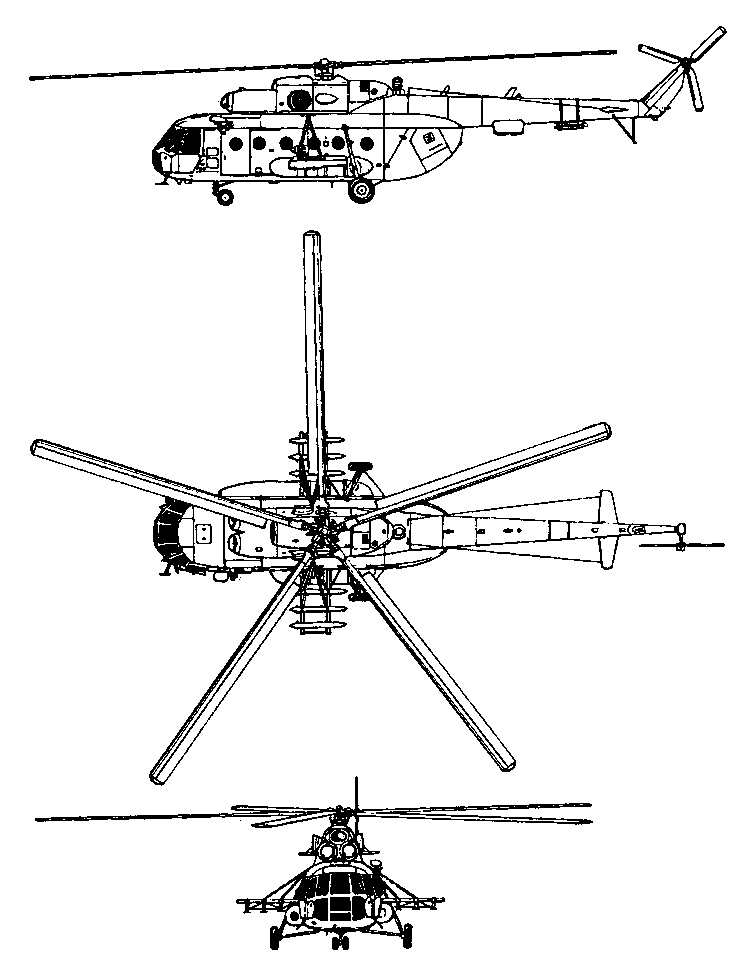
Mil Mi-8M / Mi-17 / Mi-19 / Mi-171 / Mi-172

Mi-17

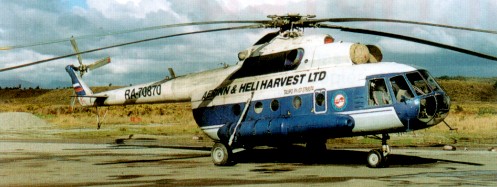
First identified in 1980-81, the Mi-17 is virtually a revision of the Mi-8 design using a combination of the ‘Hip’ airframe but with the port-side tail rotor, and fitted with the more powerful powerplants of the Mi-14. A new rotor hub of titanium alloy was developed for the Mi-17. These result in an overall improvement in performance, particularly the hovering ceiling. The Mi-17 retains the codename ‘Hip-H’.

Mil Mi-17 Article

Distinguished from basic Mi-8 by port-side tail rotor; shorter engine nacelles, with air intakes extending forward only to mid-point of door on port side at front of cabin; small orifice each side forward of jetpipe; correct rotor speed maintained automatically by system that also synchronises output of the two engines. For operation in ‘hot and high’ conditions, Kazan commercial versions can be supplied with TV3-117MT engines and tail rotor with wider-chord blades.

Mil Mi-17

The basic Mi-17 is powered by two 1,434kW (1,923 shp) Klimov TV3-117MT turboshafts. Should one engine stop, output of the other increases automatically to contingency rating of 1,637kW (2,195 shp), enabling flight to continue. An APU for pneumatic engine starting is provided,and deflectors on engine air intakes prevent ingestion of sand, dust and foreign objects. Single flexible internal fuel tank, capacity 445 litres; two external tanks, each side of cabin, capacity 745 litres in port tank, 680 litres in starboard tank; total standard fuel capacity 1,870 litres. Provision for one or two ferry tanks in cabin, raising maximum total capacity to 3,700 litres.
Configuration and payloads generally as Mi-8 but six additional centreline seats optional. Military Mi-17-1V carries up to 30 troops or 20 wounded troops in ambulance configuration. Civilian Mi-17 promoted as essentially a cargo-carrying helicopter, with secondary passenger transport role.

Mi-17V/171 systems include AI-9V APU for pneumatic engine starting, and AC electrical supply from two 40kW three-phase 115/220V 400Hz GT40/P-48V generators. Avionics include Baklan-20 and Yadro-1G1 com radio and Type 8A-813 weather radar. Optional are ASO-2 chaff/flare dispenser under tailboom and IR jammer (NATO ‘Hot Brick’) at forward end of tailboom.

Equipment and armament options are as for the Mi-8, plus, on military versions, external cockpit armour; engine nozzle IR suppressors and a VMR-2 fit for air-dropping, 23mm GSh-23 gun packs, AAMs and newer ASMs on Mi-8AMTSh.

Revealed to the world at the 1981 Paris air show, the Mi-17 is known by the Russian military as the Mi-8M. Export customers and Russian civilian operators use the Mi-17 designation.

Entered service with Soviet forces in 1977 as Mi-8MT. The first export examples were delivered to Cuba in 1983, and Mi-17s were in service in Angola, Hungary, India, North Korea, Nicaragua, Papua New Guinea, Peru and Poland, as well as the CIS.

Mi-171

Mi-8 derivatives include Mi-17 (first flown August 1975) with change of engines and other modifications and Mi-171/Mi-172 export models, and lengthened Mi-173. Individual factories continue to develop new Mi-17 variants, like the Mi-171 produced by the Ulan Ude factory. Production of Mi-17M/V and Mi-172 for both civil and military use as a cargo-carrying helicopter, with secondary capability as a passenger transport capable of carrying up to 24 passengers, or 12 stretcher cases when used as an ambulace was at Kazan and Mi-171 at Ulan-Ude plants, from where they are marketed. More than 810 exported by Aviaexport. Production of both the Mi-8 and Mi-17 continued in 1987.

Long-range modification: AEFT (Auxiliary External Fuel Tanks) system by Aeroton adds a further 1,900 litres in two internal tanks, plus 2,850 litres in six tanks on the stores pylons of Mi-8MT, -AMT, -MTV-1, civil MTV and Mi-17 variants. Operational range with all eight auxiliary tanks is 1,300km; ferry range 1,850km.

Versions:

Mi-17 (‘Hip-H’)
Mid-life update of Mi-8 with more powerful turboshafts, giving overall performance improvement, particularly hover ceiling. All versions in RFAS military service retain Mi-8 designation.

Mi-17KF
Derivative of Mi-17 jointly developed by Kazan and Mil, with systems integration provided by Kelowna Flightcraft (Canada). First flown 3 August 1997. Certified to FAR Pt 29 for full IFR operation.

Mi-17LL (laboratoriya: laboratory)
Flying testbed.

Mi-17MD
Prototype converted from Mi-8MTV (RA70937); displayed at 1995 Paris Air Show; with rear loading via a short ramp and two clamshell doors; further modified with large single-piece rear loading ramp and other changes. Given dual designation Mi-17MD/Mi-8MTV-5 when equipped with IR jammer and flight deck armour. Also known as Mi-17N (Noch: Night). First delivered to South Korean Police.

Mi-17P (Mi-8 MTPB) (‘Hip-K derivative’)
ECM communications jammer; two observed in Hungarian service in 1990; antenna array much more advanced than that of Mi-8 (‘Hip-K’); large 32-element array, resembling vertically segmented panel, aft of main landing gear each side; four-element array to rear on tailboom each side; large radome each side of cabin, below jet nozzle; triangular container in place of rear cabin window each side; six heat exchangers under front fuselage.

Mi-17PI
As Mi-17P but single D-band jamming system able to jam up to eight sources simultaneously over 30degree sector.

Mi-17PG
As Mi-17P but with H/I-band system for jamming pulse/CW and CW interrupted equipment.

Mi-17-1V
Export version of Mi-8MTV (‘Hip-H’) (Visotnyi: high altitude); TV3-117VM turboshafts for improved ‘hot and high’ performance, built by Kazan Helicopter Plant; optional armament, nose radar, flotation gear and firefighting equipment. Civil version designated Mi-8MTV-1, military Mi-8MTV-2; civil export version Mi-8MTV-GA (Grazhdanska Aviatsia).

Mi-17-5V
Kazan-built production model with port side door enlarged from 0.83m to 1.25m; new 0.83m wide starboard sliding door; rear flat ramp with single hydraulic cylinder drive installed on helicopter floor and capable of being lowered to horizontal position in flight, permitting disembarkment of up to 36 troops in 15 seconds. Series production started in 1999. Military equivalent designated Mi-8MTV-5.

Mi-171 (‘Hip-H’)
First displayed 1989 Paris Air Show; more powerful TV3-117VM turboshafts, each 1,545kW; improved rates of climb and hover ceilings; other weights and performance generally unchanged. Export version of Mi-8AMT.

Mi-171AG
Proposed long-range version with TV3-117SB3 turboshaft engines and improved main rotor blades; range up to 1,500km.

Mi-171Sh
Export version of Mi-8AMT built at Ulan-Ude.

Mi-17-1VA
Version produced for Ministry of Health of former Soviet Union as flying hospital equipped to highest practicable standards for relatively small helicopter; interior, with equipment developed in Hungary, had provision for three stretchers, operating table, extensive surgical and medical equipment, accommodation for doctor/surgeon and three nursing attendants.

Mi-171

Mi-172 (Mi-8MTV-3)
As Mi-17M/17V, also from Kazan, but with equipment changes and planned for certification to FAR Pt 29 standards; TV3-117VM Srs 2 engines, giving maximum cruising speed of 218km/h and service ceiling of 6,000m; air conditioning and heating systems, main and tail rotor blade de-icing, canopy demisting and heating of engine air intakes standard; options include flotation gear, Doppler, weather radar, DME, GPS, VOR, ILS, transponder and VIP interiors for seven, nine and 11 passengers. Standard seating for up to 26 passengers. First exhibited at 1994 Singapore Air Show. Seven ordered by Mesco, India, Spring 1995.

Mi-172-II
Converted from ‘Hip-H’ in former Czechoslovakia for electronic warfare role; first seen in Czech Air Force service at Dobrany-Line airbase, near Plzen, 1991; each of two examples had a tandem pair of large cylindrical containers mounted each side of cabin; assumed that containers made of dielectric material and contain receivers to locate and analyse hostile electronic emissions; each of two operators’ stations in main cabin has large screens, computer-type keyboards and oscilloscope; several blade antennae project from tailboom.

Mi-19
Generally similar to Mi-9; command relay platform variant of Mi-8MT (Mi-17).

Mi-8AMTSh
Counterpart of Mi-8MTV series built at Ulan-Ude; combat and troop-carrying version with thimble radome on nose and chin-mounted electro-optics pod. Armament includes Igla-V AAM or Shturm-V ASM missile systems, B8V20 rocket pods and GSh-23 gun.

Mi-8AMT
Designation for unarmed version of Mi-8MT used by RFAS, but also applied to some civil (perhaps ex-military)
examples.

Mi-8MT (‘Hip-H’)
Designation of standard Mi-17s in RFAS military service. Twin or triple stores racks, but normal armament is 40 x 80mm S-8 rockets in two BV-8-20A packs. Afghan experience led to adoption of nose armour, IR jammer, IR suppressors and provision for door-mounted PKT machine gun (rear starboard) and AGS-17 Plamya grenade launcher or NSV 12.7mm Utyos heavy machine gun (forward port cabin door).

Mi-8MT EW
More than 30 EW versions of the Mi-8MT serve with RFAS armed forces, under the designations Mi-8MTSh, Mi-8MTPSh, Mi-8MTU, Mi-8MTA, Mi-8MTP, Mi-8MTPB, Mi-8MTR, Mi-8MTI, Mi-8MTPI and Mi-8MTTs.

Mi-8MTPB (or Mi-17P, Mi-17PP) (‘Hip-H EW’)
ECM (radar and communications jammer) and comint helicopter, with three jamming systems in D/F band range over 30 degree sector and other frequencies over 120 degrees. Operating time 4 hours. Antenna array more advanced than that of Mi-8PPA (‘Hip-K’); large 32-element array, resembling vertically segmented panel, aft of main landing gear each side; four-element array to rear on tailboom each side; large radome each side of cabin, below jet nozzle; triangular container in place of rear cabin window each side; six heat exchangers under front fuselage. (Mi-17P designation used also for civil export versions.) Similar versions include Mi-8MTI (Mi-17 with small horizontal array on forward part of boom and larger box-like radome on cabin side); Mi-8MTTs2 and Mi-8MTTs3 with non-rectangular (‘teardrop’) radome on cabin sides and less regularly shaped arrays on sides of rear cabin.

Mi-8MTV (‘Hip-H’)
(V=visotnyi: high altitude); TV3-117VM turboshaft for improved ‘hot and high’ operation. Civil version built at Kazan is Mi-8MTV-1; Russian presidential aircraft with new Abvis navigation system is designated Mi-8MTV-1S; missile-armed, radar-equipped military version with six-hardpoint stub-wing is Mi-8MTV-2; export equivalent is Mi-17-1V, with optional armament, nose radar, flotation gear and firefighting equipment. Mi-8MTV-5 is military version with one-piece rear loading ramp: Ulan-Ude equivalent to Kazan Mi-17MD.

Gallery

Specifications:

Mi-17
Engines: two Isotov TV3-117MT turboshafts, 1400kW / 1,900 shp (with 2,200 shp emergency)
Normal take-off weight: 24,470 lb (11100 kg)
Max take-off weight: 28,660 lb (13 000 kg)
Max useful load: 8,818 lb (4 000 kg)
Max speed: 155 mph (250 km/h)
Max cruise: 149 mph (240 km/h)
Service ceiling: 16,405 ft (5 000 m)
Service ceiling max weight 11,810 ft (3600 m)
Cabin: 812 cu ft (23 cu.m)
Passengers: 24
Main rotor diam: 69.86 ft (21.294 m)
Overall length: 83.18 ft (25.352 m)
Fuselage length: 60.45 ft (18.424 m)
Height: 4.76m
Hovering ceiling, OGE: 1760m
Range: 465km
Payload: 3000-5000kg

Mi-17 Hip-H
Engine: 2 x Klimov TV3-117MT
Instant pwr: 1434 kW
Rotor dia: 21.6 m
MTOW: 13,000 kg
Payload: 4000 kg
Max speed: 135 kts
Max cruise: 130 kts
Max range: 495 km
HOGE: 5575 ft
Service ceiling: 16,400 ft
Crew: 2
Pax: 32
Rotor dia: 69 ft 10 in / 21.6 m
Length overall: 82 ft 10 in
Fuselage length: 59 ft 8 in
Height: 18 ft 7 in
Disc area: 3932 sq.ft

Mil Mi 17 T
Engines: 2 x TW 3-117MT, 1874 shp
Length: 59.744 ft / 18.21 m
Height: 18.537 ft / 5.65 m
Rotor diameter: 69.849 ft / 21.29 m
Max take off weight: 28665.0 lb / 13000.0 kg
Weight empty: 15655.5 lb / 7100.0 kg
Max. speed: 135 kts / 250 km/h
Cruising speed: 119 kts / 220 km/h
Service ceiling: 16404 ft / 5000 m
Range: 594 nm / 1100 km
Fuel capacity: 494 gal / 1870 lt
Crew: 3
Payload: 28-32 pax

Mi-171
Engines: 2 x 1545 kW (2070 shp) Klimov (Isotov) TV3-117M turboshaft
Max speed: 135 kts
Max cruise speed: 124 kts
Service ceiling: 18,700 ft
Range with res: 307nm
Range with 2 ext. tanks: 575 nm
Empty equipped Wt: 15,555 lbs
MTOW: 28,660 lbs
Rotor dia: 69 ft 10 in
Length overall: 83 ft 2 in
Fuselage length: 60 ft 6 in
Height: 18 ft 7 in
Disc area: 3932 sq.ft

Mi-17

Mil

Mikhail Mil

Mikhail Leontyevich Mil (died January 1970) began developing helicopters and autogyros in 1929. Mil was a contemporary of Nikolai Kamov at the TsAGI (Central Aero and Hydrodynamic Institute) during the 1930s, was given charge of his own design bureau in March 1947 and became responsible for the first Soviet helicopter to go into quantity production. The GM-1 / Mi-1.

Mi-1 first flown 1948, also manufactured by PZL-Swidnik in Poland 1956-1965. Mi-2 first flown in Soviet Union but production transferred to Poland. Enlarged Mi-4 introduced 1952, also built in China. Mi-6 with detachable wings to provide up to 20 percent of required lift in cruise flight first flown June 1957, then world’s largest helicopter, and 864 built at Rostov-on-Don (now Rostvertol) factory 1959-80, plus 50 at Moscow-Fili 1960-62. Mi-6 formed basis for Mi-22 airborne command post. Mi-8 first flown June 1961, becoming much produced medium civil and military helicopter (well over 7,000 built since 1965 and continuing), as turbine replacement for Mi-4; Mi-8 derivatives include Mi-9 tactical airborne command post (first flown 1977) and Mi-19 variant for use by commanders of tactical rocket units, Mi-17 (first flown August 1975) with change of engines and other modifications and Mi-171/Mi-172 export models, and lengthened Mi-173. Mi-10 flying crane development of Mi-6 first flown 1960, produced up to 1971. Two Mi-6 rotor/power packages used on giant Mi-12 with an overall rotors span of 67m, then the largest helicopter in world. Mi-14 became shorebased amphibious anti-submarine, SAR and mine-countermeasures helicopter (first flown August 1967).
Mi-26 first flown December 1977 as very heavy lift helicopter with two powerful turboshaft engines and single eightblade main rotor, with Mi-27 as airborne-command-post derivative. Series of helicopter gunships began with Mi-24 (first flown September 1969) and joining Soviet armed forces from 1970s, with Mi-25 as export version of Mi-24D tandem-cockpit variant and Mi-35 as second and improved export variant based on upgraded versions of Mi-24; most of over 2,500 built between 1970 and 1989, though smallscale production up to 1996. The Mi-28 attack helicopter was first flown November 1982. Mi-34 first flown November 1986 as piston-engined lightweight sporting and training fourseat helicopter. Proposed new types include Mi-40 eighttroop armoured and armed assault helicopter, Mi-46 heavy transport helicopter, Mi-52 three-seat light piston helicopter, Mi-54 utility helicopter, Mi-58 medium civil helicopter, and Mi-60MAI two-seat light training helicopter. Approximately 25,000 Mil helicopters have been built.
Became Mil Moscow Helicopter Plant. Has 25 percent shareholding in Euromil.

1995: (Moskovsky Vertolyotney Zavod), 2 Sokolnichyesky Val, Moscow 107113, Russia.

Mikoyan-Gurevich MiG-110

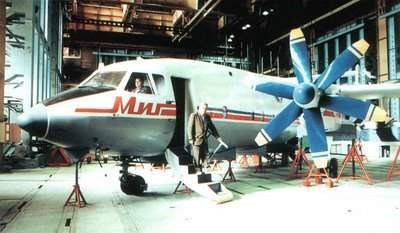
The Mikoyan MiG-110 designed by the Russian company Mikoyan-Gurevich is a multipurpose transport aircraft for cargo and passenger transport developed in 1995. It is powered by two turboprop engines.

The aircraft is capable of carrying up to 15 passengers and a cargo of 3500 kg (passenger version – 35 people). In the 1990s Russian Prime Minister Yevgeniy Primakov signed the agreement in Austria on cooperation between the MiG and Austria in the production. It can carry up to 3.5 tons of cargo or 24-48 passengers up to a distance of 1,600 km.

The aircraft would possess STOL and tailgate features. The aircraft components were produced in Russia and final assembly was done in Austria. Austria also invested in the testing and certification of the aircraft.

Engines: 2 x 2,500 HP TV7-117SV or Pratt & Whitney Canada PW127C turboprops, 1,846 kW (2,475 hp) each
Wingspan: 25.0 m
Length: 18.9m
Height: 5.4m
Maximum takeoff weight: 18,000 kg
Load: 5,500 kg
Top speed: 500km/h
Range: 3,710 km
Crew: 2
Capacity: Passengers: 49

Mikoyan-Gurevich I.42/44 MFI

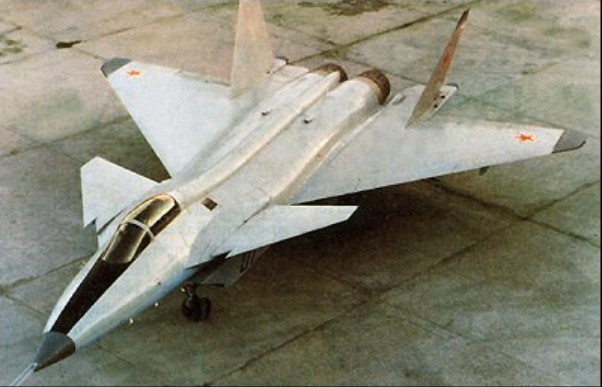
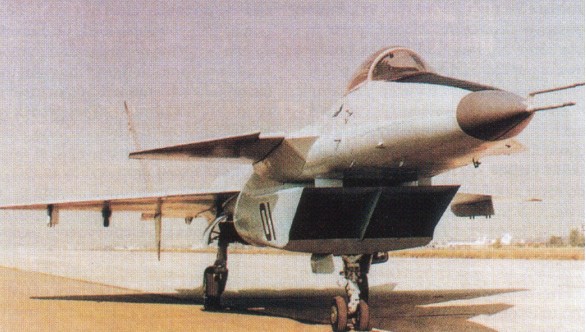
Designed as a replacement for the Su-27, the MiG 1.42 MFI (Mnogo-Funktsionalniy Istrebitel – Multi-Role Fighter) was publicly rolled out in January 1997.

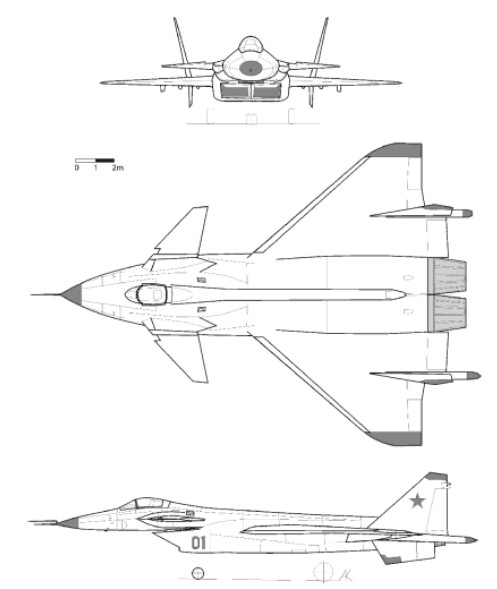
The MiG 1.42 Mnogofunktsionalny Frontovoi Istrebitel (Multifunctional Frontline Fighter), or MFI, was designed as a response to the American F-22. Its makers, MAPO-MiG, say it will be able to outperform the most advanced US fighter, the F-22 Raptor. Like the F-22, the MiG 1.42 has a “thrust vectoring” system that gives it greater manueverability than current fighters. It also has similar stealth capabilities, employing composite materials, a special shape, S-shaped compressor channels, internal weapon storage, and perhaps an active radar cancellation system or a plasma cloud stealth system to avoid detection. Considering previous Russian fighters, such as the super-manoeuvrable Su-37, the MiG 1.42 will definitely enjoy greater manoeuvrability. Additionally, MAPO-MiG also claims that it would be stealthier than the F-22. And, since it is bigger, the MiG 1.42 will have a greater range. The MiG 1.42 is a twin-engine aircraft with a cranked delta wing, canards, twin tail fins, jet intakes under the nose, and 3D vectoring nozzles. It features the new Phazotron N-014 phased array fire control radar as well as a rear-facing N-012 radar.

The delta canard has a wing sweep of between 40 and 45 degrees, with a vortex generating dogtooth on the canard. The large wing of slender section, three sets of trailing edge control surfaces, and pronounced actuator fairings. External pylons are visible.

The stated intent of the delta canard configuration was to provide for excellent high AoA performance, and low supersonic energy bleed, by avoiding the trim drag associated with a conventional configuration.

The paired, outwardly canted vertical stabilisers are attached to a pair of large tailbooms, which house aft looking avionics and enclose the innermost trailing edge surfaces. Two ventral keels protrude beneath the vertical stabilisers, mounted on the tailbooms.

The aft fuselage is dominated by the paired and closely spaced Lyulka/Saturn AL-41F afterburning turbofans. These were to be fitted with circular thrust vectoring nozzles, which would be limited to 2D vertical vectoring should the tailboom arrangement be retained for production aircraft. The large single mainwhhels retract forward into the fuselage, close to the wing roots. The fuselage geometry provides for a modest inlet tunnel S-bend, which will reduce the inlet tunnel and compressor face RCS.

The inlets are variable, ventrally mounted, and feature a stepped multiple shock design. Two supporting struts, angled outward to reduce RCS, are employed to stiffen the inlet and nose structure. The clearance between the upper inlet lip and lower nose is intended to provide for good boundary layer separation at high AoA.

The structure is reported to comprise 30% composite materials, 35% aluminium lithium alloys, and 30% steel alloys.

MiG 1.42
Crew: 1
Engine: 2 x Lyulka AL-41F turbofans, ~200kN
Max take-off weight: 25000-30000 kg / 55116 – 66139 lb

MAPO MiG 1.42

Mikoyan-Gurevich MiG-31

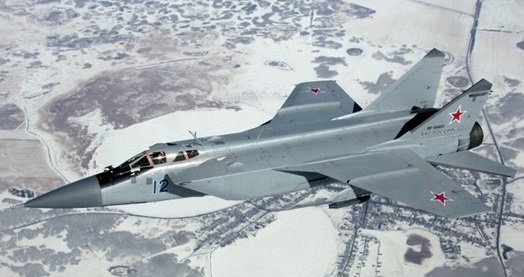
The MiG-25 was designed to counter high-flying threats. The MiG-31 was the result of the demand to counter low-level threats, such as the B-1B and cruise missiles. Development began in 1967 and the S-155MP avionics complex was ordered for the Ye-155MP interceptor in 1968.
The Ye-155MP ‘831’ was a converted Type 83 MiG-25MP, serving as the prototype of the design, and first flew on 16 September 1975. The second prototype (‘832’), with radar, first flew 22 April 1976.

Mikoyan-Gurevich MiG-31 Article

Designed as a long-range, extended-endurance PVO interceptor to replace the Tu-128 and MiG-25 based on the MiG-25 many changes were necessary to improve range and flight performance at low altitude. The fuselage was strengthened to make it suitable for supersonic flight at low level. The ‘Foxhound’ is powered by two D-30F6 turbofans which improved range drastically over the MiG-25 engines. The D-30F6 needed larger air intakes and larger exhaust nozzles. The key to success of the MiG-31 as an interceptor is the Zaslon SBI-16 phased array radar. This fire control radar is capable of tracking 10 targets at ranges up to 120 kilometers (75 miles) and engage four targets at once. Tracking and engagement is the task of the WSO which is seated behind the pilot. It is armed with four long-range R-33 (AA-9 Amos) air-to-air missiles carried under the fuselage.
Two preproduction aircraft (011 and 012) built by Sokol and flown 13 July and 30 June 1977, followed by six development aircraft (201 to 203 and 301 to 303).

Full production (of about 450) started 1979 and in 1982 the NATO reporting name ‘Foxhound’ was made public. The first of 11 regiments were operational by 1983, replacing MiG-23 and Su-15 in the air defence role.

By 1987 over 150 MiG-31s were deployed across the Soviet Union, especially in the west and far east.

The MiG-31B incorporated an improved Zaslon-A fire control radar, superior long-range missiles (R-33S), additional missiles (the R-40TD medium-range missiles and R-60 short-range missiles), modernised navigation computer and new data exchange modes. The MiG-31B was also equipped with in-flight refuelling system, whereas the MiG-31BS designation was used for MiG-31B upgrades lacking this ability.

The MiG-31D was a specialised variant for the Russian equivalent of the ASAT program, carrying a single anti-satellite missile. It can be recognized by the big vertical fins at the wing tips.

In 1992 the MiG-31E (export) was first presented on the Berlin Air Show ILA. Only one aircraft was built.
The MiG-31FE was a proposed multipurpose variant of the MiG-31 with improved weapons systems and avionics. It is able to operate the majority of the Russian air-to-surface missiles. Laser and TV equipment for missile guidance would have been accommodated in an external pod. Intended for export, it did not receive any orders.

The MiG-31M is a highly improved version of the original MiG-31. It has new IRST and phased-array radar to engage six targets at the same time. It is capable of carrying the R-37, which is an improved version of the R-33 AAM. And it is also capable of carrying the R-77 (AA-12 Adder), instead of the R-40TD, which was used on the MiG-31B. The cockpit was redesigned and features three colour multi function displays. Other changes include larger fuel capacity, no gun, uprated engines, aerodynamic improvements, larger brake chute housing, redesigned nosewheel. Six prototypes were built but none were ordered.

The MiG-31BM is an upgraded MiG-31B which adds an air-to-surface capability. New onboard computer systems and a new fire control radar capable of tracking up to 24 targets simultaneously.

In 2003 a MiG-31 claimed a 100 km closed circuit speed world record of 840 kts, a time to climb to 66,550 ft world record of 8 min 23 sec and an absolute altitude world record of 72,175 ft.

Kazakhstan inherited around 30 MiG-31 Foxhounds after the break up of the Soviet Union. Some of these aircraft remained in operational service.

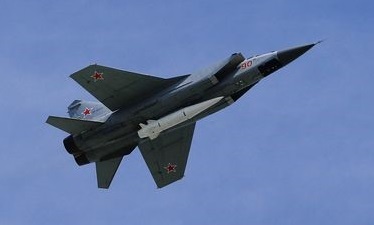
The Kinzhal hypersonic weapon, as carried by a MiG31K fighter.

Reportedly a contract with China was signed in 1992 for 24 MiG-31 interceptors. The plan included a newly set-up factory in Shenyang and were expected to enter service in 2000. At some point it was expected that at least 200 MiG-31s would be deployed by 2010. The contract was either cancelled or was never signed. Instead China opted for the Su-27/30 Flanker (J-11) as their long range interceptor.

Gallery

Variants:
Ye-155MP (prototype)
MiG-31 (Foxhound-A)
MiG-31B/BS (Foxhound-A)
MiG-31D
MiG-31M (Foxhound-B)
MiG-31BM
MiG-31F/FE
MiG-31E

Specifications:

MiG-31
Engines: 2 x D-30F6, 151.9kN
Max take-off weight: 41000-46000 kg / 90390 – 101413 lb
Empty weight: 29120 kg / 64199 lb
Wingspan: 13.5 m / 44 ft 3 in
Length: 22.7 m / 74 ft 6 in
Height: 6.2 m / 20 ft 4 in
Wing area: 61.6 sq.m / 663.06 sq ft
Max. speed: 3000 km/h / 1864 mph
Cruise speed: 2500 km/h / 1553 mph
Ceiling: 20000 m / 65600 ft
Range w/max.fuel: 3000 km / 1864 miles
Range w/max.payload: 1200 km / 746 miles
Armament: 1 x 23mm cannon, 8 missiles
Crew: 2

Mikoyan Gurevich MiG 31
Fighter Interceptor and Reconnaissance, Russia, 1976
Engine : 2 Klimov R 31 F, 134691 N / 13730 kp
Length : 68.898 ft / 21.0 m
Height : 18.373 ft / 5.6 m
Wingspan : 45.604 ft / 13.9 m
Wing area : 602.784 sqft / 56.0 sq.m
Max take off weight : 77175.0 lb / 35000.0 kg
Weight empty : 46812.2 lb / 21230.0 kg
Max. payload weight : 30362.9 lb / 13770.0 kg
Max. speed : 1320 kts / 2445 km/h
Service ceiling : 80052 ft / 24400 m
Wing load : 128.13 lb/sq.ft / 625.0 kg/sq.m
Range : 1026 nm / 1900 km
Crew : 2
Hardpoints: 4 under fuselage, 4 under wing.

MiG-31B ‘Foxhound-A’
Powerplant: two 151.9 kN (34,170 lb st) Aviadvigatel D-30F6 afterburning turbofans
Length 22.69m (74 ft 5¼ in)
Height 6.15m (20 ft 2¼ in)
Wing span 13.46m (44ft 2 in)
Empty weight 21.825 kg (48,115 lb)
Max Take-Off Weight 46.200 kg (101,850 lb)
Max level speed at 17,500 m (57,400 ft) more than Mach 2.8 or 3.000 km/h (1,865 mph)
Service ceiling 20,600m (67,600 ft)
Armament: one 23mm GSh-6-23 six-barrel gun / 260 rounds; eight air-to-air missiles (4 R-33 and 4 R-60 AAMs, or 3 R-33 and 2 R-40TD AAMs)

Mig-31BM
Top speed: M2.83

Mikoyan/Gurevich MiG-31

Mikoyan-Gurevich MiG-29 / MiG-33

Designed to a 1972 requirement intended to replace the MiG-21, MiG-23, Su-15 and Su-17 with the Soviet air force, the MiG-29, originally revealed in a US satellite photograph and designated ‘Ram-L’, made its first flight on 6 October 1977. After many design changes the first deliveries of ‘Fulcrum As’ were made to Soviet Frontal Aviation in 1983, the type was declared operational early in 1985, and more than 275 were operational by early 1987, according to US estimates.

Mikoyan-Gurevich MiG-29 Article

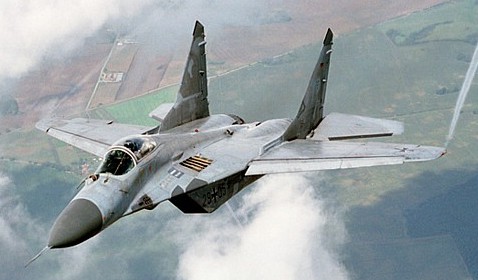
The MiG-29 (NATO reporting name ‘Fulcrum’) is a single-seat air superiority fighter, developed by Mikoyan Design Bureau, Russia. Although it has little sophisticated avionics and no fly-by-wire flight control system, the MiG-29’s agility and maneuverability make it equal to the contemporary Western fighter aircraft, like the American F-16 Falcon and F-15 Eagle. The two RD-33 turbofan engines give the MiG-29 a high thrust-to-weight ratio, enabling vertical climb with acceleration. The MiG-29 was the first fighter to be equipped with dual-mode air intakes. When in the air the large intakes under the fuselage take in the air for the engines. On the ground, these intakes are closed and the much smaller intakes on top of the forward wing take in the air. This reduces the chance of objects to be sucked into the engines, enabling the MiG-29 to operate from unprepared airstrips.

The MiG-29 is equipped with the N-019 (NATO ‘Slot Back’) radar, enabling the MiG-29 to intercept air targets beyond visual range with R-27 missiles. The forward looking infra red search and track (IRST) sensor provides target aquisation for IR guided missiles, such as the R-60 and R-73 missiles. The helmet mounted target designation reticle, combined with its high turning agility and maneuvrability, enables the MiG-29 to engage targets with IR guided weapons at close range outside the MiG-29’s forward direction.

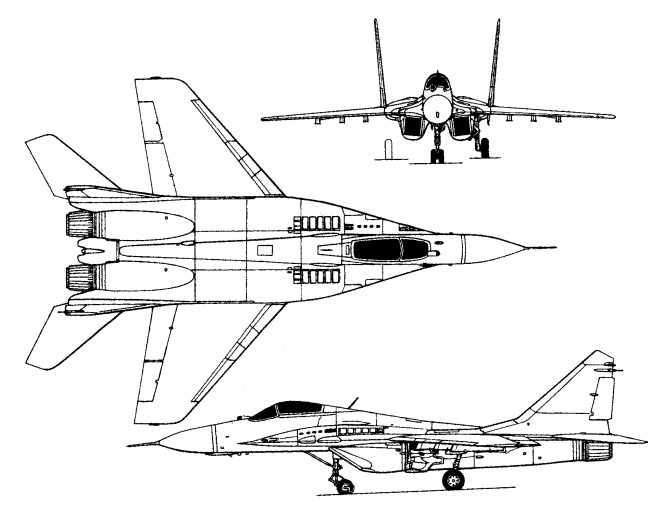
The first hard information became available when the aircraft was examined by Western authorities during an exchange visit to Finland by a MiG-29 unit in 1986. The supersonic and agile MiG-29 has a swept (45°) low-mounted wing above twin reheated turbofan engines buried in the fuselage but under the wing. The tail-plane has two vertical and two horizontal stabilisers. A conventional landing gear has twin steerable nosewheels and large single low-pressure mainwheels.

The aircraft is assessed by the Pentagon as having true look-down, shoot-down capability, with a pulse-Doppler radar and up to six AA-10 medium-range AAMs. A single six-barrel 30mm gun is mounted in the port strake, and an infrared sensor is located at the base of the wraparound forward section of the canopy.
A 17-tonne-class aircraft with a 12m wing span, the MiG-29 is powered by two l20kN Tumansky R-33D turbofans. Estimated performance includes a Mach 2.2 maximum speed at altitude, and a combat radius of 1,150km.

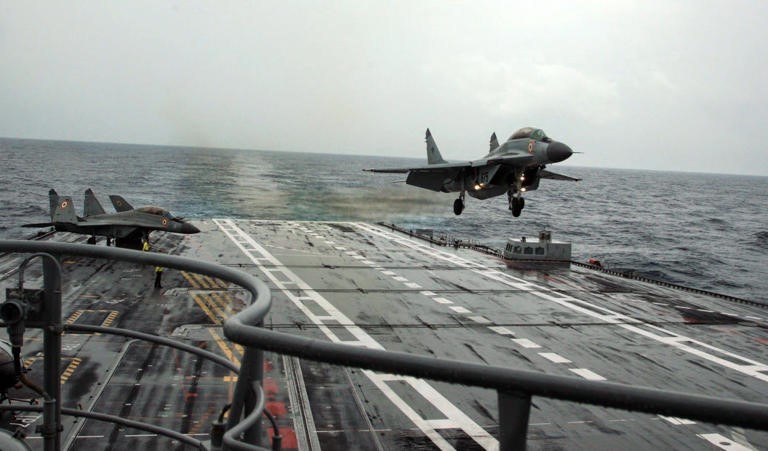
Development of the MiG-29K commenced in the 1980s. It is the carrier-based version of the MiG-29 fighter, conceived as an aircraft capable of effective operation from the Soviet Union’s future aircraft carriers. However, progress on the MiG-29 K was halted following the collapse of the USSR and the financial difficulties faced by its manufacturer. Interest in the MiG-29K was revived after 2000, largely due to investment from India.

Indian MiG-29K

India continues to utilise the MiG-29K, but this does not come without challenges. A series of accidents involving these Russian-acquired fighters has drawn international attention.
Additionally, Indian military officials have repeatedly criticised the MiG-29K for its insufficient combat capabilities, mainly due to underpowered engines (notably affecting performance during take-offs with heavy armament and substantial fuel loads) and landing gear that requires frequent maintenance.

The Warsaw Pact allies were not the first export customers for the Fulcrum. India received 44 in the first half of 1987, while Syria is reported to have taken delivery of its first aircraft. Both countries are receiving full Soviet-standard MiG-29s rather than cut-back export versions. In India the type is licence-built by Hindustan Aeronautics for the air force as the Baez (Eagle).

Mig-29UB

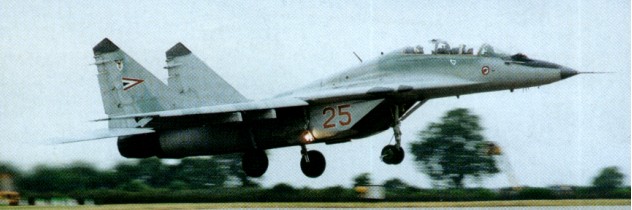
The MiG-29UB is a two-seat variant.

The later Fulcrum C has an enlarged avionics bay behind the cockpit and was operational with the Soviet Air Forces by 1990.

MiG-29 Fairford Collision Article

The upgraded MiG-29 Sniper demonstrator had its maiden flight in 2000, in the hands of Daimler-Chrysler Aerospaces (DASA) chief test pilot Wolfgang Schirdewann. One of the reasons for the Sniper upgrade is to present a MiG-29 that is able to respond to NATO/ICAB compatibility and interoperability requirements. Aerostar SA of Bacau, Romania, Daimler-Chrysler Aerospace (DASA) of Germany and Elbit Systems of Israel have developed the variant, which includes a new digital mission computer, communications system, navigation and identification system, displays, radar warning receiver, HOTAS (hands on throttle and stick) system and a new ABC (air data computer).

One upgraded version is the MiG-29MRCA which was offered to Austria to compete with the Eurofighter Typhoon and Saab Gripen.

More than 600 MiG-29s were in service with the former Soviet forces, and the type has been exported to Cuba, Czechoslovakia, East Germany (later serving with the Luftwaffe), Iran, Iraq, North Korea, Poland, Romania, and Yugoslavia.

Gallery

Variants:
MiG-29 (Fulcrum-A)
MiG-29UB/UBT (Fulcrum-B)
MiG-29C (Fulcrum-C)
MiG-29K/KVP (Fulcrum-D)
MiG-29KUB
MiG-29G
MiG-29GT
MiG-29M/ME/MT (MiG-33)
MiG-29N
MiG-29S/SD/SE
MiG-29SMT
MiG-29MRCA/M/M2
MiG-29OVT

Operators:
Russia
Algeria
Angola
Belarus
Bangladesh
Bulgaria
Cuba
Czech Republic
Eritrea
Germany
Hungary
India
Iran
Iraq
Kazakhstan
Malaysia
Moldova
Myanmar
North Korea
Peru
Poland
Romania
Slovakia
Sudan
Syria
Turkmenistan
Ukraine
USAF (stored)
Uzbekistan
Yemen
Yugoslavia

Specifications:
Engines: 2 x Klimov RD-33, 81.4kN
Max take-off weight: 27215 kg / 59999 lb
Empty weight: 15000 kg / 33070 lb
Wingspan: 11.4 m / 37 ft 5 in
Length: 17.3 m / 56 ft 9 in
Height: 4.7 m / 15 ft 5 in
Wing area: 38.0 sq.m / 409.03 sq ft
Max. speed: 2445 km/h / 1519 mph
Ceiling: 17000 m / 55750 ft
Range w/max.fuel: 2900 km / 1802 miles
Range w/max.payload: 630 km / 391 miles
Armament: 1 x 30mm cannon, 3000kg of weapons
Crew: 1

Mikoyan Gurevich OKB MiG 29
Fighter bomber, Russia, 1978
Engine : 2 x Klimov RD 33, 79853 N / 8140 kp
Length : 55.774 ft / 17.0 m
Height : 15.42 ft / 4.7 m
Wingspan : 37.402 ft / 11.4 m
Wing area : 378.893 sqft / 35.2 sq.m
Max take off weight : 39690.0 lb / 18000.0 kg
Weight empty : 18003.8 lb / 8165.0 kg
Max. weight carried : 21686.2 lb / 9835.0 kg
Fuel capacity : 1153 gal / 4365 lt
Max. speed : 1318 kts / 2440 km/h
Landing speed : 124 kts / 230 km/h
Cruising speed : 540 kts / 1000 km/h
Initial climb rate : 64960.63 ft/min / 330.00 m/s
Service ceiling : 55774 ft / 17000 m
Wing load : 104.76 lb/sq.ft / 511.0 kg/sq.m
Range : 1134 nm / 2100 km
Crew : 1
Armament : 1x MK 30mm, 8x ext. / 2000kg ext.

Mig-29 Fulcrum A
Engines: 2 x Tumansky R-33D turbofans, 18,300 lb st (81,4 kN)
Installed thrust (dry / reheat): 100 / 165 kN
Span: 11.36m (37ft 3½ in)
Length: 17.32m (56 ft 10 in)
Height: 4.73m (15 ft 6½ in)
Wing area: 35.5 sq.m
Empty weight: 7800 kg
Clean weight: 15,240 kg (33,600 lb)
MTOW: 18,500 kg (40,785 lb)
Max speed: 2.3 Mach / 2,445 km/h / 1,520 mph
Service ceiling: 17,000m (55,775 ft)
Combat radius: 1150 km
Fuel internal: 4000 kg
Air refuel: No
Armament: one 30mm Gsh-30-1 cannon / 150 rounds; 3000 kg (6,614 lb) of disposable stores
Hardpoints: 6 external
Seats: 1.

Mig-29 Fulcrum B
Engines: 2 x Tumansky R-33D turbofans, 18,300 lb st (81,4 kN)
Seats: 2
Max speed: M 2.3 (1,320 kts/2,440 km/h) at altitude
Armament: 1x 30-mm cannon

Mig-29UB
Seats: 2

Mikoyan/Gurevich MiG-29

Mikoyan-Gurevich

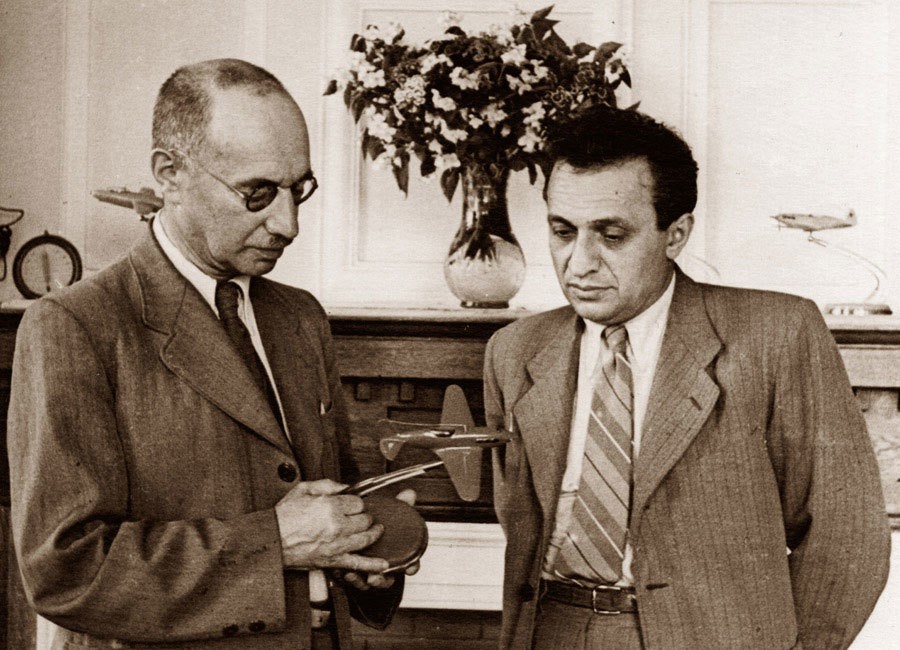
Mikhail Iosifovich Gurevich and Artem Ivanovich Mikoyan with a model of the MiG-3 fighter

A. Mikoyan and G. Gurevich design bureau established December 1939; still operating in 1990 as MAPO “MiG” as part of MIG “MAPO-M” organization, although Gurevich retired in early 1960s and Mikoyan died December 9,1970.

MiG-1 fighters with AM-35 engine produced 1940-1941; developed MiG-3 produced until 1942. First jet aircraft built in quantity was MiG-9 with twin RD-20 (BMW 003A) engines, flown 24 April 1946. Swept-wing MiG-15 with Russian copy of Rolls-Royce Nene introduced 1947, built under license in Czechoslovakia and Poland. Followed by approximately 9,000 of derived MiG-17, with redesigned wing, manufactured 1950-1957. Twin Mikulin AM-5-powered MiG-19 flown September 1953, built under license in Czechoslovakia, Poland, and China. Superseded by delta-winged MiG-21, in service in the USSR from 1959 and, when built in India, was first Russian aircraft manufactured in non-communist country.

Col-Gen Mikoyan died in 1970.

As ANPK “MiG” named after A.I. Mikoyan Aviation Scientific- Production Complex, produced MiG-23 (4,278 constructed 1969-1985; also built in India) and MiG-27 (over 900 between 1973 and 1983) related variable-geometry fighter and ground-attack aircraft, MiG-25 Mach 2.8+ reconnaissance aircraft and interceptor (some 1,200 built up to 1985), and MiG-31 long-range interceptor (about 400, operational from 1983).

MAPO ‘MiG’ produced MiG-21 upgrade as MiG-21 -93, MiG-29 Fulcrum lightweight close-air-combat fighter (first flown October 1977 and over 1,500 built, serving since 1983), improved MiG-29M (first flown April 1986) and MiG-33 export version, MiG-29K shipborne fighter prototype (first flown July 1988, first landing on aircraft carrier Admiral KuznetsovNovember 1989, and development restarted in 1996 after earlier program halt), MiG-35 multirole fighter (first flight 1999?), MiG 1-44 uniquely configured newgeneration combat aircraft (first seen February 1999), and MiG-AT/UTS/AC series of advanced and combat trainers. MiG-301/321 are reported hypersonic reconnaissance aircraft, thought to be under development. Also developing MiG-110 light multipurpose transport and MiG-115 and MiG-125 transports.

Migavia – the first national aircraft manufacturer in Russia aircraft corporations. RAC “MiG” is integrated company in which all technologies of design, production and improvement of aircraft are collected together in one legal frame. Corporation Migavia holds the shares of other corporations which are included into the complex of firms developing and producing the aircraft engines.

Mike Adams Balloon Loft

1982: Mike Adams Balloon Loft, DeKalb Peachtree Airport, Atlanta, Georgia 30341, USA.

PO Box 12168
Atlanta
Georgia 30355
USA

Adams offers seven models of balloons, all of which can be fitted with options such as an additional fuel tank with vapor takeoff or an electric digital py¬rometer. Envelope volumes range from 27,000 .to 83,000 cubic feet. Price, quoted on request, includes complete leather trimmed basket and all FAA required instruments.

Mignet HM 1100 Cordouan

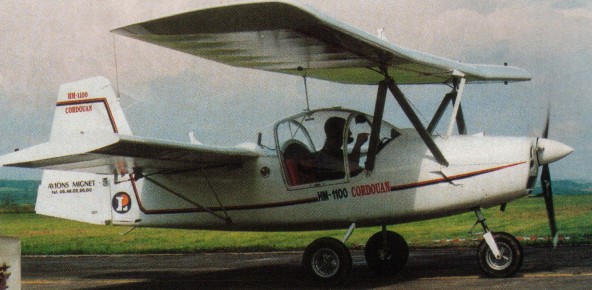
Avions Henri Mignet HM.1100 Cordouan first flew in 1998.

The type was not intended to be sold as a kit, but it meets the French ULM or ultralight category, having a maximum take-off weight under 1000 lb.

The fuselage is steel tube framed with a composite shell, and it seats two, side by side. It has a nose wheel undercarriage and although retaining the tandem wings (which traditionally do away with the need for ailerons) Mignet has incorporated ailerons on the rear wing, giving a classic three-axis control via rudder pedals and a single central control stick. If requested a two control model can be made.

Fitted with a Rotax 912, the prototype maximum speed is 117 mph and normal cruise 93 mph. It won’t stall, and it can take off fully loaded from a 260 ft grass strip, and land even shorter. Rate of climb is about 900 fpm.

The Cordouan’s forward wing is entirely free of pitch, control being effected through aerodynamic compensator. The ailerons are on the trailing edge of the rear wing. The fuselage is moulded in composite.

Mignet Aviation HM 1100 Cordouan
Engine: Rotax 912, 80 hp
Wing span: 7.30 m
Wing area: 18.50 sq.m
MAUW: 450 kg
Empty weight: 260 kg
Fuel capacity: 50 lt
Max speed: 190 kph
Cruise speed: 160 kph
Minimum speed: 65 kph
Climb rate: 5 m/s
Seats: 2
Fuel consumption: 14 lt/hr
Price (1998): 260 000 Fht