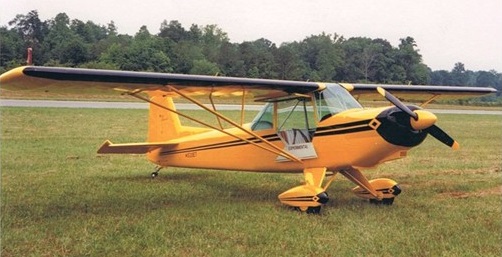
This original design high wing light plane was designed by Jerry Mills, who started the construction in 1978. After the death of designer the construction was continued by Edward J. Thomason and James Smith of Calhoun, Georgia, USA. Registered N520ET on May 9, 1994, the aircraft was first flown a year later, May 20, 1995. The one-of-a-kind single-seat aircraft, nicknamed Puddle Jumper, has a 150 hp Lycoming O-320-E2D engine, and features a mixed steel/aluminium (fuselage) and wood/fabric (wings) construction. On July 28, 2005, the aircraft was registered to Jack Hurdle of Senoia, Gerogia.
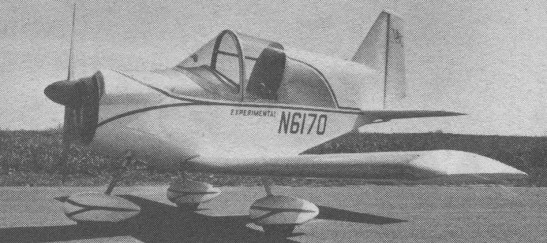
The Mini-Hawk combines the economy of the Volkwagen engine with that of detachable wings for towing or storage. Standard VW engines up to 67 hp can be used. The wings can be removed in under 10 minutes. Its all-metal construction is built around a configuration which includes low wings with trailing-edge flaps and seating for one under an enclosed canopy. The tricycle landing gear includes a steerable nosewheel, disc brakes and wheel fairings all around.
Gross Wt. 800 lb Empty Wt. 525 lb Fuel capacity 12 USG Wingspan 18 ft Length 13 ft 3 in Engine 72-hp Revmaster Volkswagen Top speed 175 mph Cruise 160 mph Stall 50 mph Climb rate 1000 fpm Ceiling 10,000 ft Takeoff run 400 ft Landing roIl 400 ft Range 700 nm
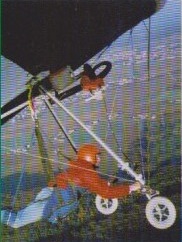
Originally introduced in the 1990s, Jim Millett’s Hornet returned in 2004 with a new team. One of the features is a large rubber donut shock-absorber that is centrally located in the fuselage to bear the load from the main gear.
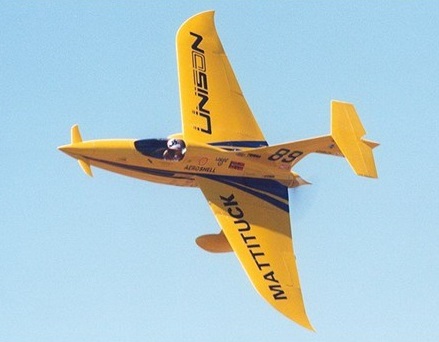
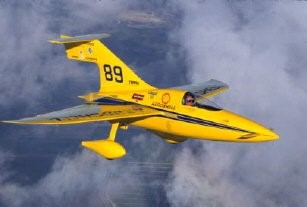
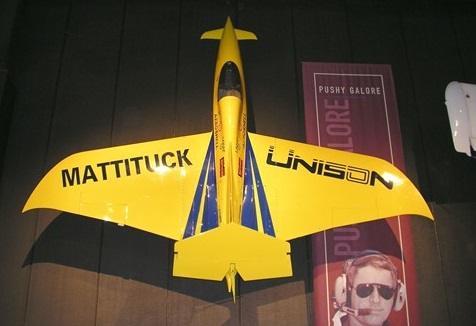
The Miller-Bohannon JM-2 Special, named Pushy Galore, is a one-of-a-kind American homebuilt Formula One racing and record-setting aircraft, based on Jim W Miller’s Miller JM-2 design, but highly modified by Bruce Bohannon.
Bohannon began construction of Pushy Galore in 1988 and first flew it in the early part of 1989, first entering it in a race in June 1989.
The aircraft features a cantilever mid-wing, a single-seat enclosed cockpit under a bubble canopy, fixed main tricycle landing gear with a retractable nose wheel, a t-tail, nose mounted canard and a single engine in pusher configuration. The aircraft is made from welded steel tubing covered in molded carbon fiber. As required by the Formula One rules, its engine is a 100 hp (75 kW) Continental O-200A.
Only one example was ever built, N189BB.
Bohannan entered the aircraft in the Reno Air Races in 1994, qualifying in third place in the Formula One class, with a speed of 236.153 mph (380.051 km/h).
In 1995 Bohannan flew the aircraft to second place in the Formula One Gold championship race at Reno, Nevada.
Bohannan also used the aircraft to set world time-to-climb records in the Fédération Aéronautique Internationale (FAI) C-1.A class. At AirVenture 1994 Bohannan set a new world time-to-climb record, climbing to 6,000 m (19,685 ft) in 12 minutes and 50 seconds. In January 1996, Bohannan climbed the aircraft to 9,000 m (29,528 ft) in 41 minutes and 35 seconds, setting class world time-to-climb, absolute altitude and altitude in horizontal flight records. In July 1996 at AirVenture in Oshkosh, Bohannan set a third FAI class time-to-climb record of 3,000 m (9,843 ft) in three minutes and eight seconds.
After the climb records were set in 1996 Bohannan retired the aircraft and in 1998 donated it to the AirVenture Museum.
JM-2 Special Pushy Galore Engine: 1 × Continental O-200A, 100 hp (75 kW) Wingspan: 18 ft 5 in (5.61 m) Length: 17 ft 2 in (5.23 m) Height: 6 ft 3 in (1.91 m) Maximum speed: 250 mph (402 km/h; 217 kn) Crew: one
Design began in 1983 of the Mi-38 medium transport helicopter with a model shown at the 1989 Paris Air Show, when the aircraft was at the mockup stage. Modifications in evidence by 1993 included fixed landing gear with wider track and a reduced base.
Of conventional pod and boom configuration, the power plant is above the cabin. A six-blade main rotor has considerable non-linear twist and swept tips. The main rotor has hydraulic drag dampers, a single lubrication point at the driveshaft; and rotor brake standard. A Krasny Oktyabr transmission, comprising main, intermediate and tail gearboxes and tail rotor drive shaft takes the engine input of 19,017 rpm. Two independent two-blade tail rotors, set as narrow X on same shaft are fitted, with a sweptback fin/tail rotor mounting, and small horizontal stabiliser. Control is fly-by-wire, with manual back-up.
The composites main and tail rotors are by Kazan, with a low-profile titanium main rotor head, with elastomeric bearings, built by Stupino. The fuselage, mainly composites, is built by Kazan. Landing gear is a fixed tricycle type: single wheel on each main unit; oleo-pneumatic shock absorbers; twin, self-centring nosewheels; low-pressure tyres; optional pontoons for emergency use in overwater missions. Main tyres 950mm diameter, pressure 5.88 bar; nose tyres 600mm diameter, pressure 4.90 bar.
Those helicopters for CIS customers powered by two Klimov TVA-3000 (TV7-117 derivative) turboshafts, each rated at 1,838kW for T-O; single-engine rating 2,610kW and transmission rated for same power. Optional are two 2,461kW P&WC PW127 rurboshafts, which are also available, in PW127T/S form, for Western customers. Power plant above cabin, to rear of main reduction gear; air intakes and filters in sides of cowling. Bag fuel tanks beneath floor of main cabin; provision for external auxiliary fuel tanks. Liquid petroleum gas fuel planned as alternative to aviation kerosene.
Crew of two on flight deck, separated from main cabin by compartment for majority of avionics; single-pilot operation possible for cargo missions. Lightweight seats for 30 passengers as alternative to unobstructed hold for 5,000kg freight. Ambulance and air survey versions planned. Passenger door, forward, port; freight door, forward, starboard; cargo ramp at rear; hatch in cabin floor, under main rotor driveshaft, for tactical/emergency cargo airdrop and for cargo sling attachment; optional windows for survey cameras in place of hatch. Provision for hoist over portside door, remotely controlled, hydraulically actuated rear cargo ramp, powered hoist on overhead rails in cabin, and roller conveyor system in cabin floor and ramp.
Air conditioning by compressor bleed air, or APU on ground, maintains temperature of not more than 25 degrees C on flight deck in outside temperature of 40 degrees C, and not less than 15 degrees C on flight deck and in main cabin in outside temperature of –50 degrees C. Three independent hydraulic systems; any one able to maintain control of helicopter in emergency. Electrical system has three independent generators, two at 12kW DC and one 60kW AC; optional fourth generator 40 or 60kW AC; two batteries; electric rotor blade de-icing, main and tail. Independent fuel system for each engine, with automatic crossfeed; forward part of cowling houses VD-100 APU, hydraulic, air conditioning, electrical and other system components.
A preset flight control system allows full autopilot, autohover and automatic landing. Avionics controlled by large central computer, linked also to automatic nav system with Doppler, ILS, satellite nav system, main radar, autostabilisation system and automatic radio compass.
Instrumentation: Six colour CRTs for use in flight and by servicing personnel on ground. Equipment monitoring, failure warning and damage control system. Closed-circuit TV for monitoring cargo loading and slung loads.
Under December 1992 agreement, Eurocopter will integrate flight deck, avionics and passenger systems, and will adapt Mi-38 for international market; Euromil joint stock company established September 1994 to advance collaboration, adding Kazan production plant (as main manufacturing and final assembly centre); funding for Euromil granted in October 1994 by European Bank for Reconstruction and Development. Sextant and Pratt & Whitney Canada added as risk-sharing parties for avionics and engine. Funding by Russian Ministry for Defence Industries 1996. Mi-38 rotor blades began test flying on an Mi-17 in early 2001.
By 1997, Euromil was anticipating first flight in 1999 and start of production two years later, following FAR Pt 29 certification. However, contracts for completion of demonstrator not signed until 18 August 1999, following unilateral decision of Euromil board in December 1998 to launch programme and fly demonstrator at Kazan in 2001, although this subsequently slipped to 2002 and then to mid-2003. Demonstrator (PT-1) is third airframe, following test articles at Mil Moscow and Kazan. Four further prototypes to follow, including two for static testing.
Mi-38 Engine: 2 x Klimov TVA-3000 Instant pwr: 1838 kW Main rotor diameter: 21.1m Length without rotors: 19.95m Height: 5.13m Width: 4.9m Max take-off weight: 15600kg Empty weight: 8300kg Max speed: 290km/h / 148 kts Cruising speed: 275km/h Service ceiling: 5200m / 21,325 ft Hovering ceiling: 2500m HOGE: 8200 ft Range with max take-off weight and with 3500kg payload: 800km Payload: 6000kg, Crew: 2 Pax: 30
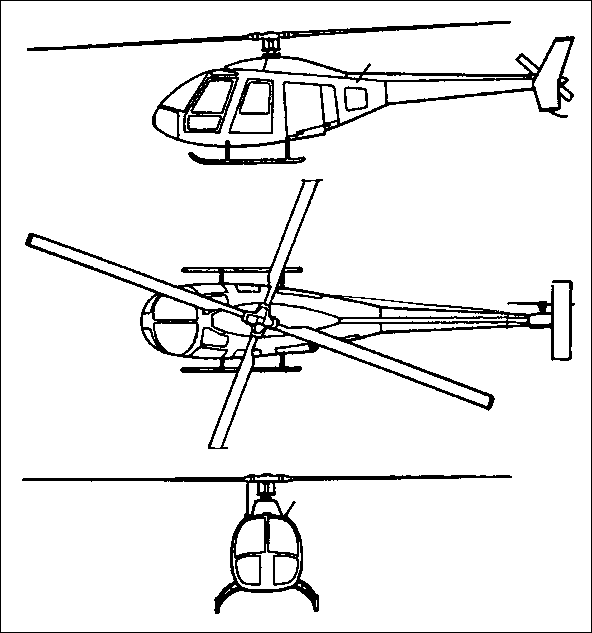
Codenamed ‘Hermit’ by NATO, the Mi-34 is a two/four-seat light helicopter powered by a piston engine. The first of two prototypes flew for the first time in 1986, and the type was revealed to the West for the first time at the Paris air show in June 1987. First flown on 17 November 1986, two prototypes and a structure test airframe were completed by mid-1987.
An acrobatic helicopter, it was the first helicopter built in former USSR to perform normal loop and roll. Intended initially for training and international competition flying, it has a conventional pod and boom configuration, powered is from a 325 h.p. Vedeneyev M-14-V26 engine.
Aerobatic capabilities include backwards flight at 130km/h and rotation about main rotor axis at 120 degrees/s. The flying controls are manual, with no hydraulic boost. The semi-articulated four-blade main rotor with flapping and cyclic pitch hinges, has natural flexing in the lead/lag plane. Blades are of GFRP with CFRP reinforcement, attached by flexible steel straps to the head. The two-blade tail rotor is of similar composites construction, on the starboard side. The riveted light alloy fuselage has a sweptback tailfin with small unswept T tailplane.
Landing gear is conventional fixed skids on arched support tubes and a small tailskid protects the tail rotor. One 239kW VOKBM M-14V-26V nine-cylinder radial air-cooled engine is mounted sideways in the centre of the fuselage. Fuel capacity is 176 litres in a system for inverted flight.
The normally one or two pilots, side by side, are in an enclosed cabin, with optional dual controls. The rear of the cabin contains a low bench seat, available for two passengers and offering a flat floor for cargo carrying. There is a forward-hinged door on each side of flight deck and on each side of rear cabin.
The primary electric power is provided by 27V 3kW engine-driven generator. A secondary power supplys 115V AC, 400 Hz, single-phase and 36V AC, 400 Hz, three-phase; 27V 17Ah battery.
The Mi-34S/34C completion was at Moscow plant of LVM, but subsequently reverted to Arsenyev.
Planned completion of 30 in 1994-95 was hampered by a lack of funding, with five delivered in 1995, and one in the first half of 1996.
Trials in 1999 by a civil pilot training school at Omsk showed Mi-34 to be 2.8 times cheaper and more effective to operate than current fleet and the school was to acquire three Mi-34Cs and obtain up to 10 more in long term. In 2001, an upgraded variant was proposed with M-14 engine rated at 272kW, IFR instrumentation and auxiliary fuel tank. An agricultural variant was planned for debut in 2003.
The Mi-34S is the basic version, marketed in Russia as the Mi-34, and certified by the Interstate Aviation Committee Aviation Register (initially at 1,350kg max take-off weight), with helicopter, engine and noise type certificates, meets FAR Pt 27 requirements. (Note that until 1999, all marketing literature for this version used the hybrid Roman/Cyrillic ‘Mi-34C’ to indicate certified status.)
Total of 23 sold and 18 delivered by mid-2002, compared with estimated 425 called for in Russia’s 1992-2000 civil aviation development plan. Had increased to 21 deliveries (from Arsenyev) by March 2003. First three for Mayor’s office, Moscow. Others used by Bashkir Airlines and Mi-Avia for patrol and training. One operated by Bosniac and Croat Federation Air Force. Three delivered to Nigerian Air Force in 2001, along with six Mi-35s; these were from first batch of six Mi-34s built at Arsenyev, after pause of several years; further five delivered to Nigeria by end of 2002. LVM reportedly ordered 20 Mi-34s for construction at Arsenyev in 2001, but only delivery in that year apart from Nigerians was one to Sibneft. In June 2002, Russian sources reported foreign (assumed Nigerian) negotiations for “several dozen” Mi-34s although only known 2003 production commitment is follow-on batch of four for Nigeria and five for Omsk Civil Aviation Flying and Technical College by end of 2005.
Costs: US$400,000, fully equipped (2003).
A twin-engine version is built by the VAZ motor car works at Tolyatti. The Mi-34VAZ features a totally new rotor head made from carbon fibre.
A development was under way to re-engine the Mi-34 with two 164kW VAZ-430 rotary engines normally used to power VAZ cars, and which run on Mogas. First flight of the prototype, designated Mi-34V, was scheduled for 1993.
The Mi-34P (patrulnyi: patrol) is a version of the Mi-34S, equipped for police duties. Renewed interest in 2001 from Gazprom for pipeline patrol.
Mi-34 Engine: 1 x VMKB M-14V-26 Instant pwr: 243 kW Main rotor diameter: 10.0m Tail rotor diameter: 1.48m Overall length, rotors turning: 11.415m Fuselage length: 8.71m Max width: 1.42m Overall height: 2.75m Normal take-off weight: 1280kg Max take-off weight: 1450kg Empty weight: 950kg Max level speed: 210km/h Max cruising speed: 170km/h Service ceiling: 4000m Hovering ceiling, OGE: 900m Range with max fuel at 500m: 356km Crew: ½ Pax: 2 Seats: 4
Mi-34VAZ Engine: 2 x VAZ-430 rotary Instant pwr: 170 kW Rotor dia: 10 m MTOW: 1960 kg Useful load: 550 kg Max cruise: 110 kts Max range: 600 km Crew: 1-2 Pax: 2 Seats: 4
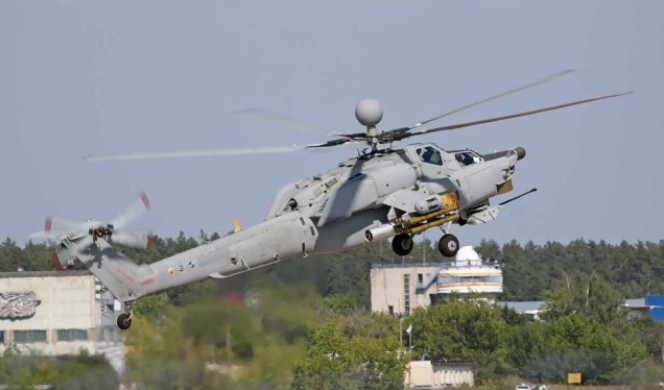
The Mi-28 is a tandem two-seat, twin-turbine anti-armour helicopter, NATO name Havoc. Design started in 1980 under Marat N Tishchenko, the first of two flying Mi-28 prototypes (012) flew on 10 November 1982.
Each prototype different with the first and second (022) having upward-pointing exhaust diffusers and fixed undernose fairing for electro-optic equipment. The first also had conventional three-blade tail rotor, the second replaced this with the definitive “Delta-H” configuration. The first two prototypes were powered with 1,434kW TV3-117BM engines and VR-28 gearbox.
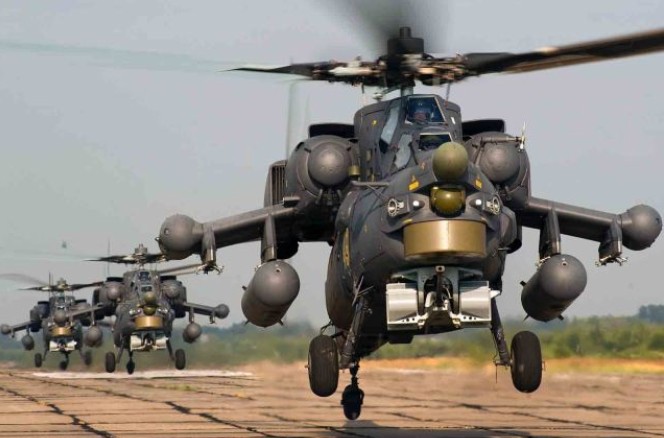
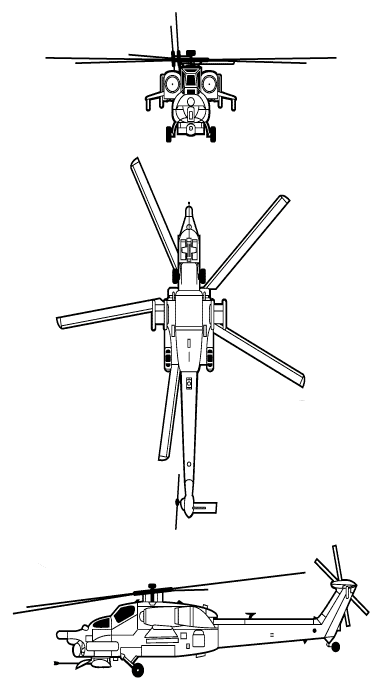
The three prototypes had a conventional three-bladed tail rotor but was replaced by a ‘delta 3’ x-configured rotor comprising two independent two-bladed propellers mounted on the same shaft. The gunner, seated in a heavily-armoured front cockpit ahead of the pilot, controls a 30mm cannon normally used on ground vehicles. This is mounted under the nose, which contains a low light level TV and FLIR night control systems. Stub wings, each fitted with two hardpoints, can carry AT-6 ‘Spiral’ radio-guided ATMs, UV-20 pods, or fuel tanks. Infra-red suppressors and decoy dispensers are also fitted to the ‘Havoc’.
The third and fourth aircraft built were of Mi-28A (Type 280) basic version.
The first Mi-28A (032) introduced the definitive downward-pointing exhaust suppressors and flew in January 1988, with the second Mi-28A prototype (042) demonstrated at Moscow in 1992 representing the intended production configuration. It had the definitive moving E-O sensor turret undernose, downward-pointing exhaust diffusers and wingtip electronics/chaff dispenser pods. In emergencies an inflatable crew chute is deployed beneath the door sills. The fuel tanks of the ‘Havoc’ are self-sealing and fire retardant.
Mi-28NE
Flying controls are hydraulically powered mechanical type with the horizontal stabiliser linked to the collective, and controls for the pilot only.
The five-blade main rotor blades have very cambered high-lift section and sweptback tip leading edge. A full-span upswept tab is on the trailing-edge of each blade. Structure comprises numerically controlled, spirally wound glass fibre D-spar, blade pockets of Kevlar-like material with Nomex-like honeycomb core, and titanium erosion snip on the leading-edge. Each blade has single elastomeric root bearing, mechanical droop stop and hydraulic drag damper. A four-blade GFRP tail rotor with elastomeric bearings for flapping is fitted. A rotor brake lever is on the starboard side of the cockpit. A machined titanium main rotor head with elastomeric bearings, requires no lubrication. Power output shafts from the engines drive the main gearbox from each side, and a tail rotor gearbox, at the base of the tail pylon, is driven by an aluminium alloy shaft inside a composites duct on top of the tailboom. Sweptback mid-mounted wings have a light alloy primary box structure, leading- and trailing-edges of composites, and no wing movable surfaces. There is provision for countermeasures pods on each wingtip, housing chaff/flare dispensers and sensors. The light alloy semi-monocoque fuselage has titanium armour around the cockpits and vulnerable areas. A composites access door is aft of the wing on port side. The swept fin has a light alloy primary box structure, composites leading- and trailing-edges, and a cooling air intake at the base of the fin leading-edge, and exhaust at the top of the trailing-edge. There is a two-position composites horizontal stabiliser.
Landing gear is a non-retractable, tailwheel type, with a single wheel on each unit. Mainwheel tyres size 720×320, pressure 5.40 bar; castoring tailwheel with tyre size 480×200.
Power is from two Klimov TV3-117VMA turboshafts, each 1,636kW, in pod above each wingroot; three jetpipes inside downward-deflected composites nozzle fairing on each side of third prototype shown in Paris 1989; upward deflecting type also tested. Deflectors for dust and foreign objects forward of air intakes, which are de-iced by engine bleed air. The internal fuel capacity is 1,720 litres. Provision for four external fuel tanks on underwing pylons.
The navigator/gunner is in the front cockpit, the pilot behind, on an elevated seat, with a transverse armoured bulkhead between. The flat non-glint tinted transparencies are of armoured glass. A navigator/gunner’s door is on the port side, and pilot’s door on the starboard side.
The cockpits air conditioned and pressurised by engine bleed air. Duplicated hydraulic systems, pressure 152 bar are fitted, and a 208V AC electrical system is supplied by two generators on the accessory section of the main gearbox, ensuring continued supply during autorotation. A low-airspeed system is standard, giving speed and drift via main rotor blade-tip pitot tubes at -50 to +70km/h in forward flight. Main and tail rotor blades are electrically de-iced. An Ivchenko AI-9V APU in the rear of the main pylon structure supplies compressed air for engine starting and to drive a small turbine for preflight ground checks.
A radio for missile guidance is in the nose radome. Daylight optical weapons sight and laser range-finder are in a gyrostabilised and double-glazed nose turret above gun. A wiper on the outer glass protects the inner optically flat panel.
Two fixed IR sensors on the initial basic production Mi-28; IR suppressors, radar and laser warning receivers standard. Mi-28N has integrated Vitebsk DASS with Pastel RWR, Mak IR warning system, Platan jammer and UV-26 flare dispensers.
Armament is one 2A42 30mm turret-mounted gun (with 250 rounds in side-mounted boxes) in NPPU-28 mount at nose, able to rotate 110 degrees, elevate 13 degrees and depress 40 degrees. The maximum rate of fire is 900 rds/min air-to-air and air-to ground. The two pylons under each stub-wing, each have a capacity of 480kg. The main 2A42 gun is fired and guided weapons launched normally only from front cockpit. Unguided rockets are fired from both cockpits. (When fixed, the gun can also be fired from rear cockpit.)
A small-scale pre-series production was planned, but not initiated, by Rostvertol, Rostov-on-Don, which stated in mid-2001 that it was ready to begin series production.
The Mi-28 was scheduled to enter full service with the CIS forces in 1992, but lost out to the Kamov Ka-50.
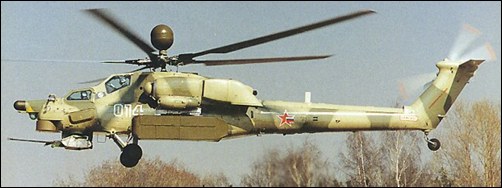
The Mi-28N (Nochnoy: Night) added night/all-weather operating capability. Russian Army funding was announced in January 1994 and a demonstrator (014) was modified from the first Mi-28 prototype (012). The first hover was on 14 November 1995, and formal roll-out on 16 August 1996. The first flight was on 30 April 1997. The Mi-28N is equipped with a mast-mounted 360 degree scan millimetre wave Kinzhal V or Arbalet radar (pod soon enlarged in vertical plane), an FLIR ball beneath missile-guidance nose radome and above new shuttered turret for optical/laser sensors, including Zenit low-light-level TV. The cockpit has EFIS. New composites rotor with sweptback blade tips added later. The Mi-28N introduced uprated VR-29 transmission and IKBO integrated flight/weapon aiming system, with automatic terrain-following and automatic target search, detection, identification and (in formations of Mi-28Ns) allocation; Ramenskoye Breo-28N mission control system. The Mi-28N can carry the Igla (SA-16 ‘Gimlet’) AAM and new-generation ASMs.
Prototype Mi-28N ‘014’ first flight 30 April 1997, Panki, near Moscow.
Total of five trials Mi-28Ns were to be built by Rostvertol; TV3-117VMA engines initially, but 1,839kW Klimov VK-2500s to be installed later. A second helicopter was funded jointly by Rostvertol and Southwest Sberbank.
Mi-28NE
The Mi-28NEh (Nochnoy, Ehksport: Night, Export) version was offered to South Korea in 2000, and evaluated by Swedish Army in 2001 against Boeing AH-64 Apache and Eurocopter Tiger.
The Mi-28NEh is of conventional gunship configuration, with two crew in stepped cockpits. The original three-blade tail rotor was superseded by a low noise ‘scissors’ or “Delta-H” type comprising of two independent two-blade rotors set as narrow X (35 deg/145 deg) on the same shaft with self-lubricating bearings, the resulting flapping freedom relieves flight loads. Agility is enhanced by doubling hinge offset of the main rotor blades compared with the Mi-24. The crew compartments are protected by titanium and ceramic armour and armoured glass transparencies. The new composites main rotor can withstand a hit from a round of up to 30mm calibre. Multiple self-sealing fuel tanks in the centre-fuselage are enclosed in a composite second skin, outside the metal fuselage skin. Energy absorbing seats and landing gear protect the crew in crash landings at descent rate of 12m/s. The crew doors are rearward-hinged, to open quickly and remain open in emergency. Parachutes are mandatory for Russian Federation and Associated States (CIS) military helicopter aircrew, but no provision for rotor separation. A port-side door, aft of wing, provides access to an avionics compartment large enough to permit combat rescue of two or three persons, although it lacks windows, heating and ventilation.
A hand crank, inserted into the end of each stub-wing, enables stores of up to 500kg to be winched on to pylons without hoists or ground equipment. The main rotor shaft has 5 degrees of forward tilt, providing tail rotor clearance. The transmission is capable of running without oil for 20 to 30 minutes at the main rotor rpm of 242. With main rotor blades and wings removed, the helicopter is air-transportable in an An-22 or Il-76 freighter.
Mi-28N development cost US$150 million (2000) and unit cost approximately US$15 million to US$16 million (2002).
Mi-28 Engines: 2 x Klimov TV3-117VM turboshaft, 1620kW Main rotor diameter: 17.2m Length with rotors turning: 21.6m Height: 3.82m Max take-off weight: 11200kg Empty weight: 7000kg Fuel: 1337kg Max speed: 300km/h Cruising speed: 270km/h Rate of climb: 13.6m/s Service ceiling: 5800m Range with max fuel: 460km HIGE: 19,025 ft HOGE: 11,810 ft Crew: 2
Mi-28N Engines: 2 x Klimov TV3-117VMA turboshafts, 1,863kW Main rotor diameter: 17.20m Fuselage length with a cannon: 17.01m Height: 3.82m Max take-off weight: 11700kg Max speed: 320km/h Cruising speed: 270km/h Hovering ceiling: 3600m Range with 10500kg take-off weight: 500km Range with max fuel: 1000km Armament: 1 x 30mm cannon, 16 x “Shturm” or “Ataka” anti-tank missiles or 8 x “Igla-V” AA missiles Crew: 2
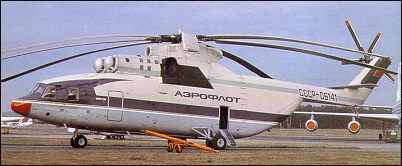
Designed to provide Aeroflot with a heavylift helicopter to assist in the exploitation of undeveloped regions, this aircraft began life in the early 1970s (initially as Mi-6M), as soon as it became clear that the V-12 was not going to fulfil this role. It required the design and development of a completely new rotor and transmission system, plus the need to meet an official requirement that the aircraft’s empty weight should be only half that of its maximum take-off weight, meant that it was not until 14 December 1977 that the V-26 prototype achieved its first hovering flight. NATO name Halo.
Weight has been saved by in-house design of the main gearbox providing multiple torque paths, GFRP tail rotor blades, titanium main and tail rotor heads, main rotor blades of mixed metal and GFRP, and use of alumimum-lithium alloys in airframe.
Equipped with a rear-loading ramp/doors, the main rotor rpm is 132, and the main rotor spindle is inclined forwards 4 degrees. Flying controls are hydraulically powered cyclic and collective pitch controls actuated by small parallel jacks, with redundant autopilot and stability augmentation system inputs. A fly-by-wire system flight was tested in 1994.
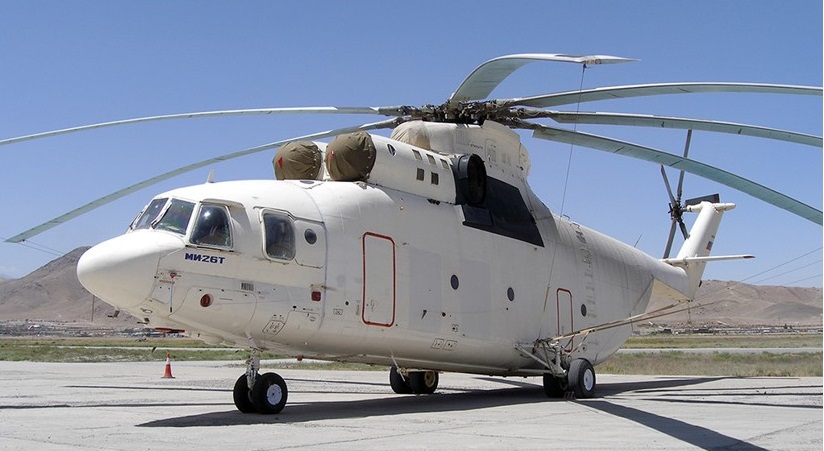
An eight-blade constant-chord main rotor has flapping and drag hinges, droop stops and hydraulic drag dampers. No elastomeric bearings or hinges, each blade has a one-piece tubular steel spar and 26 GFRP aerofoil shape full-chord pockets, honeycomb filled, with ribs and stiffeners and non-removable titanium leading-edge abrasion strip. Blades have moderate twist, taper in thickness toward tip, and are attached to small forged titanium head of unconventional design. Each has ground-adjustable trailing-edge tab. A five-blade constant-chord tail rotor on the starboard side, has GFRP blades and forged titanium head. A conventional transmission, with tail rotor shaft inside cabin roof, all-metal riveted semi-monocoque fuselage with clamshell rear doors, and flattened tail boom undersurface. The engine bay is of titanium for fire protection. All-metal tail surfaces and swept vertical stabiliser/tail rotor support are profiled to produce sideways lift. There is a ground-adjustable variable incidence horizontal stabiliser.
Landing gear is a non-retractable tricycle type with twin wheels on each unit. The steerable nosewheels have tyre size 900×300, and mainwheel tyres size 1,120×450. A retractable tailskid is at the end of the tailboom to permit unrestricted approach to the rear cargo doors. The length of the main legs is adjusted hydraulically to facilitate loading through rear doors and to permit loading on varying surfaces. A device on main gear indicates takeoff weight to flight engineer at lift-off, on panel on shelf to rear of his seat.
Power if from two 8,500kW ZMKB Progress (Soloviev) D-136 free-turbine turboshafts, side by side above cabin, forward of main rotor driveshaft. Air intakes fitted with particle separators to prevent foreign object ingestion, and have both electrical and bleed air anti-icing systems. Above and behind is central oil cooler intake. VR-26 fan-cooled main transmission, rated at 14,914kW, with air intake above rear of engine cowlings. System for synchronising output of engines and maintaining constant rotor rpm; if one engine fails, output of other is increased to maximum power automatically. Independent fuel system for each engine; fuel in eight underfloor rubber tanks, feeding into two header tanks above engines, which permit gravity feed for a period in emergencies; maximum standard internal fuel capacity 12,000 litres; provision for four auxiliary tanks. Mi-26TS normal capacity is 13,020 litres. Two large panels on each side of main rotor mast fairing, aft of engine exhaust outlet, hinge downward as work platforms.
Crew of five on flight deck: pilot (on port side) and co-pilot side by side, tip-up seat between pilots for flight technician, and seats for flight engineer (port) and navigator (starboard) to rear; upgrade proposal revealed in early 2001 involves installation of new avionics and will result in reduction of flight deck crew to three. Four-seat passenger compartment aft of flight deck. Loads in hold include two airborne infantry combat vehicles and a standard 20,000kg ISO container; about 20 tip-up seats along each sidewall of hold; maximum military seating for 90 combat-equipped troops; alternative provisions for 60 stretcher patients and four/five attendants. Heated windscreen, with wipers; four large blistered side windows on flight deck; forward pair swing open slightly outward and rearward. Downward-hinged doors, with integral airstairs, at front of hold on port side, and each side of hold aft of main landing gear units. Hold loaded via downward-hinged lower door, with integral folding ramp, and two clamshell upper doors forming rear wall of hold when closed; doors opened and closed hydraulically, with back-up hand pump for emergency use. Two LG-1500 electric hoists on overhead rails, each with capacity of 2,500kg, enable loads to be transported along cabin; winch for hauling loads, capacity 500kg; roller conveyor in floor and load lashing points throughout hold. Flight deck fully air conditioned.
It has a cargo hold 3.20m wide, 3.15m/ 10.25 ft high and 15m/49 ft deep. The maximum payload is 5000kg or 70-100 passengers. The helicopter has a crew of four, with room for an additional handler, and has a full range of navigational electronics and an automatic hover system.
Two main and one emergency hydraulic systems, operating pressure 157 and 206 bar. Electrical system three-phase 200/115V 400Hz; single-phase 115V 400Hz; three-phase, 36V 400Hz; single-phase 36V 400Hz; DC 27V. TA-8V 119kW. APU under flight deck, with intake louvres (forming fuselage skin when closed) and exhaust on starboard side, for engine starting and to supply hydraulic, electrical and air conditioning systems on ground. Electrically heated leading-edge of main and tail rotor blades for anti-icing. Only flight deck pressurised.
Systems include: Radar: Groza 7A813 weather radar in hinged (to starboard) nosecone. Flight: Integrated PKV-26-1 flight/nav system and automatic flight control system, Doppler, map display, HSI, and automatic hover system. Optional GPS. Self-defence: Military versions can have IR jammers and suppressors, IR decoy dispensers and colour-coded identification flare system.
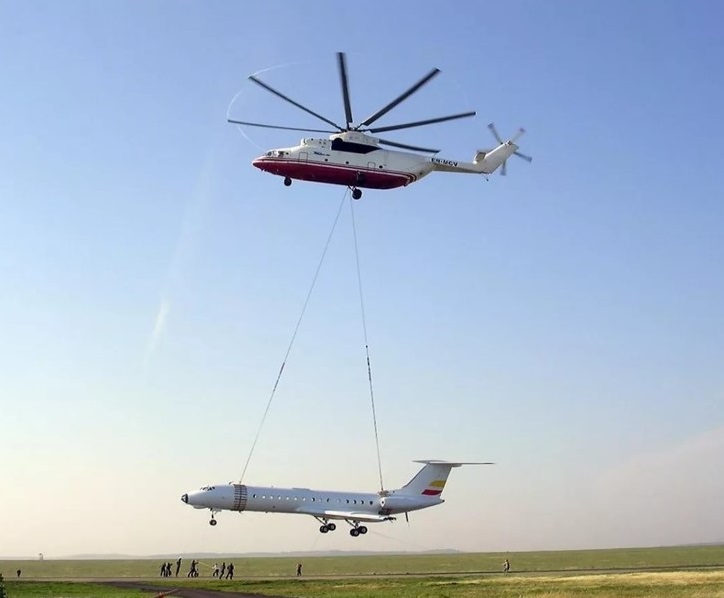
A hatch for a load sling is in the bottom of the fuselage, in line with the main rotor shaft, the sling cable attached to internal winching gear. Closed-circuit TV cameras observe slung payloads. Specialised versions can utilise firefighting equipment.
Mi-26T
The first production aircraft rolled out in October 1980 and one of several prototype or preproduction Mi-26s (SSSR-06141) was displayed at the 1981 Paris Air Show. In-field evaluation began early 1982 and the type was fully operational in 1983. The production model carries a crew of five, and up to 85 combat-equipped troops, or two airborne infantry combat vehicles. More than 50 were in service in 1987.
On 3 February 1982, as just one of a string of new records established by the Mi-26, a “standard production” Mi 26 lifted a total mass (helicopter plus payload) of 56768.8kg to a height of 2000m. Also in February, 1982, set several load to height records, including lifting 25,000 kg (55,115 lbs) to 4,100 metres (13,451 ft).
In a series of flights with different crews the helicopter set various records; 25,000 kg / 55,115 lb to 4100m / 13,451 ft 20,000 kg / 44,092 lb to 4600m / 15,092 ft 15,000 kg / 33,069 lb to 5600m / 18,373 ft 10,000 kg / 22,046 lb to 6400m / 20,997 ft
The Mi-26 is reported to have entered service with Aeroflot in either 1982 or 1983.
India is the only export customer to 1987, with an order for ten. The first two were delivered in June 1986.
Production continued at low rate, with manufacture and marketing by Rostvertol.
Mi-26T
Nearly 300 were built by 2001. Reportedly sold to about 20 countries; operators include Belarus (15), Cambodia (two), Congo Democratic Republic (one), India (10), Kazakhstan, North Korea (two), South Korea (one), Mexico (two second-hand) in 2000, Peru (three), Russian Army (35), Russian Ministry of Emergencies, Mil-Avia and Ukraine (20). Russian Army deliveries included four in 1994.
COSTS: US$8 million to US$10 million (Mi-26T) (2000).
Mi-26A Modified military Mi-26, tested in 1985, with PNK-90 integrated flight/nav systems for automatic approach and descent to critical decision point, and other tasks. Not adopted.
Mi-26T Basic civil transport (Izdelie 209), generally as military Mi-26. Production begun in 1985. Variants include Geological Survey Mi-26 towing seismic gear, with tractive force of 10,000kg or more, at 180 to 200km/h at 55 to 100m for up to 3 hours. The mockup of an Mi-26 two-crew flight deck was shown al the 1997 Moscow Air Show and was again displayed at Farnborough 2002, when Rostvertol said decision to install new avionics on helicopter dependent upon outcome of discussions undertaken at Farnborough; if go-ahead is given, new designation Mi-26T2 will apply. New avionics suite will include PNK-26M flight-navigation system, incorporating five colour MFDs, two data input panels and a digital computer, plus GPS receiver and digital map and weather radar; increased automation will eliminate need for navigator/communications operator and flight engineer, although loadmaster will be retained. Military version will be adapted for night operations, using OVN-1 Skosok NVGs and GOES-321 gyrostabilised observation turret, containing a FLIR sensor and a laser range-finder. No designation has been announced for military versions.
Mi-26TS (sertifitsywvannyi: certified) Mi-26T (Izdelie 219), but prepared for certification and marketed (in West as Mi-26TC) from 1996. Preproduction version, with gondola (port, front), positioned a 16,000kg TV tower, 30m long, in Rostov-on-Don in 1996. One delivered to Samsung Aerospace Industries in South Korea on 13 Septernher 1997; supplied with Twin Bambi Bucket fire-suppressant system and fulfils dual transport/ firefighting roles. This version is subject of upgrade proposal involving installation of new avionics suite and other improvements that will reduce crew numbers from five to three and offer benefits in area of operational effectiveness; if implemented, is expected to result in improved helicopter becoming available in about 2006.
Mi-26MS Medical evacuation version of Mi-26T, typically with intensive care section for four casualties and two medics, surgical section for one casualty and three medics, pre-operating section for two casualties and two medics, ambulance section for five stretcher patients, three seated casualties and two attendants; laboratory; and amenities section with lavatory, washing facilities, food storage and recreation unit. Civil version in use by MChS Rossii (Ministry of Emergency Situations). Alternative medical versions available, with modular box-laboratories or fully equipped medical centres that can be inserted into the hold for anything from ambulance to field hospital use. As field ambulance can accommodate up to 60 stretcher patients; or seven patients in intensive care, 32 patients on stretchers and seven attendants; or 47 patients and eight attendants in other configurations, which can include 12 bunks in four tiers forward, or patent Rostvertol box laboratory behind the first row of bunks, with 16 bunks behind. The box includes an operating table, diagnostic equipment, anaesthetic and breathing equipment and other systems. Another configuration includes a larger theatre box by Heinkel Medizin Systeme and 12 stretchers behind, and the helicopter can be fitted with an X-ray laboratory or form the central element of a deployable air-portable field hospital.
Mi-26NEF-M ASW version with search radar in undernose faired radome, extra cabin heat exchangers and towed MAD housing mounted on ramp.
Mi-26P Transport for 63 passeugers, basically four abreast in airline-type seating, with centre aisle; lavatory, galley and cloakroom aft of flight deck.
Mi-26PK Flying crane (kran) derivative of Mi-26P with operator’s gondola on fuselage side, next to cabin door on port side. First produced in 1997.
Mi-26PP Reported ECM version. First noted 1986; current status unknown.
Mi-26S Hastily developed version for disaster relief tasks following explosion at Chernobyl nuclear facility; equipped with deactivating liquid tank and underbelly spraying apparatus.
Mi-26TM Flying crane, with gondola for pilot/sling supervisor under fuselage aft of nosewheels or under rear-loading ramp. First produced in 1992.
Mi-26TP Firefighting (pozharnyi) version that appeared in 1994, with internal tanks able to dispense up to 15,000 litres fire retardant from one or two vents, or 17,260 litres of water from an underslung VSU-15 bucket, or from two linked EP-8000 containers. Can fill tanks on the ground using pumps with 3,000 litres/min throughput. Prototype RA-06183 operated by Rostvertol. One delivered to Moscow Fire Brigade on 19 August 1999.
Mi-26TZ Tanker version that emerged in 1998, with 14,040 litres of T2, TS1 or R2 aviation fuel or DL, DZ or DA diesel oil fuel and 1,040 litres lubricants (in 52 jerry cans), dispensed through four 60m hoses for aircraft, or 10 20m hoses for ground vehicles. Conversion to/from Mi-26T takes 1 hour 25 minutes for each operation.
Mi-26M Upgrade under development; all-GFRP main rotor blades of new aerodynamic configuration, new ZMKB Progress D-127 turboshafts (each 10,700kW), and modified integrated flight/nav system with EFIS. Transmission rating unchanged, but full payload capability maintained under ‘hot and high’ conditions, OEI safety improved, hovering and service ceilings increased, and greater maximum payload (22,000 kg) for crane operations.
Mi-27 Two prototypes of a command support version of the Mi-26 are reported to have been built in 1988, with designation Mi-27. These feature new antennas along lower ‘corner’ of fuselage, blade and box-type and with long folded masts which are horizontal in flight, vertical when deployed on ground. Orders for production helicopters do not appear to have been placed.
Specifications:
Mi-26 Engines: 2 x ZMKB Progress D-136 Instant pwr: 14,710 kW Rotor dia: 32 m MTOW: 56,000 kg Payload: 20,000 kg Max speed: 159 kts Max range: 800 km HOGE: 5900 ft Service ceiling: 15,100 ft Crew: 5 Pax: 85
Mi-26 Halo A Engines: 2 x Lotarev D-136, 11,400 shp Installed pwr: 17,000 kW Rotor dia: 32 m Fuselage length: 33.7 m Height: 8.06m (26 ft 5.25 in) Wheelbase: 8.95m (29ft 4.5in) Tail rotor dia: 7.61m (24 ft 11.5in) No. Blades: 8 Empty wt: 28,200 kg MTOW: 56,000 kg Internal payload: 5000 kg External payload: 20,000 kg Max speed: 295 kph Cruise speed: 255 kph Ceiling: 4500 m HOGE: 1800 m Range: 800 km Crew: 5 Pax: 100
Mi-26T Engines: 2 x Progress D-126 turboshaft, 7355kW Main rotor diameter: 32.0m Length with rotors turning: 40.03m Width: 8.15m Max take-off weight: 56000kg Empty weight: 28200kg Fuel: 12000kg Max speed: 295km/h Cruising speed: 255km/h Service ceiling: 4600m Hovering ceiling, OGE: 1800m Range with 18000kg payload: 670km Payload: 20000kg Crew: 4 Passengers: 70