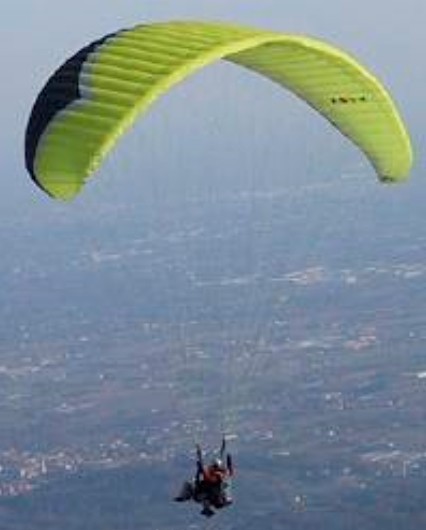
Nova certified its Tandem glider, Phor 2 (DHV 1-2 / Tandem). In the construction of the Phor 2, Nova has used Gelvenor fabric for the sail and mylar inserts in the cell openings, to “ensure fantastically easy take-offs throughout the course of its life”. The factory designers remark its safe flying behaviour and untiring handling, which allows the pilot to “concentrate entirely on the passenger”. Some features of the Phor 2 include extensive diagonal finger-rib construction, inside stitching for the top surface, and a take-off weight range of 130 to 220 kg.
Nova are based in Innsbruck in Austria, and from there they design and test gliders from sites in the Inn Valley. They’ve been involved in paraglider manufacture since the end of the 1980s, and have a number of very successful models in their history. The designer is Hannes Papesh.
1998: Bernhard Hofel.str.14, A-6020 Innsbruck, AUSTRIA
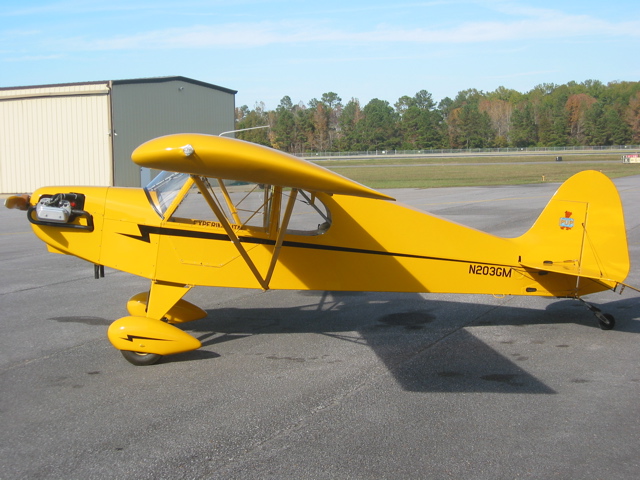
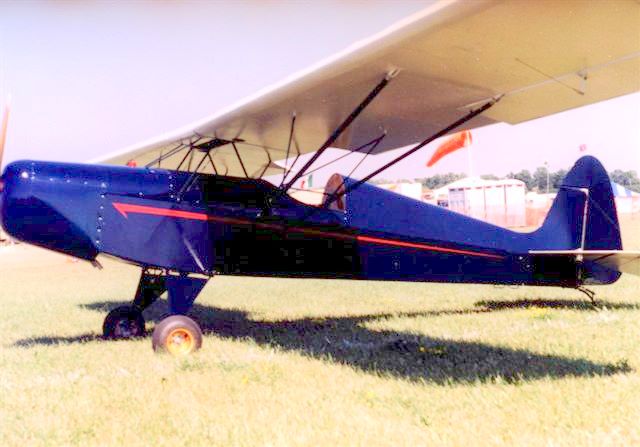
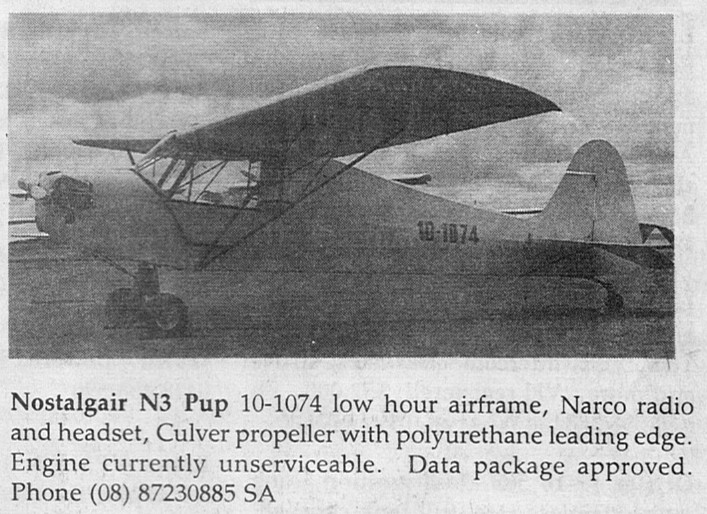
Bob Counts developed the single-seat N-3 Pup in the mid-’80s as what might be termed the third generation of ultralights. The Pup was among the first ultralights to resemble a general aviation aircraft, the Piper J-3 Cub in this case. Like several innovative ultralights, the N-3 Pup won a Best New Design award at its first Sun ’n Fun appearance.
The original N-3 Pup being a ¾ scale Super Cub replica. Centre mounted joy stick, rudder pedals, tailwheel steerable through rudder pedals. The N3 Pup has a welded chromemoly steel fuselage and a two-cylinder horizontally-opposed Global engine to add to its air of authenticity. By 1995 marketed as the Preceptor Aircraft Corp Pup from 1230 Shepard St, Hendersonville, NC 28792, USA.
The N-3 Pup can be ordered with folding wings. In less than ten minutes you can fold your wings and take your pup home with you, or unfold them and go flying. The N-3 Pup is a real joy to fly with easy, docile handling. The N-3 Pup built as a bare minimum plane will meet the FAR 103 requirement.
The N-3 Pup was followed by Counts’ larger, souped up version of the N-3, the Super Pup. Empty weight (450 pounds) and flight speeds take it out of the ultralight category. The Super Pup has folding wings, short takeoff and landings and a reliable 4 stroke engine. Wing sub-kits come with ailerons, all hardware, brackets, fittings, fuel tanks, ribs, skins, spars and lift struts. No fabric.
Fuselage sub-kits come with stabilizers, elevators, rudder, landing gear, seat cusions, control systems, all glass, blank instrument panel, wheels and brakes, tailwheel, stringer formers, shock struts, brackets, fittings, firewall and all hardware and necessary accessories. No fabric.
Firewall forward package comes with engine, exhaust stacks, intake manifolds, carb heat, engine mount, prop, carburetor and hardware Engine prices will vary depending on model, Horsepower and electrical option.
The two place Ultra Pup features folding wings, roomier cabin, and electric starting, which all called for a redesigned fuselage. The CG was shifted to accommodate the extra weight up front. Instead of adding weight in the tail, they used heaver-gauge tubing at strategic locations. Thus, we achieved the desired CG shift by adding strength, not just dead weight. Building smarter safer aircraft for all to enjoy has always been the “Preceptor Way”.
Wing sub-kits come with ailerons, all hardware, brackets, fittings, fuel tanks, ribs, skins, spars and lift struts. No fabric.
Fuselage sub-kits come with stabilizers, elevators, rudder, landing gear, seats cusions, control systems, all glass, blank instrument panel, wheels and brakes, tailwheel, stringer formers, shock struts, brackets, fittings, firewall, all hardware and necessary accessories. No fabric. Firewall forward package comes with engine, exhaust stacks, intake manifolds, carb heat, engine mount, prop, carburetor and hardware. Engine prices will vary depending on model, Horsepower and electrical option.
Stinger
The LSA Stinger uses the same fuselage as the N-3 with front fuselage wider, cabin structure deleted and combing added. The (1995) US$6700.00 kitset came complete with paint and ready to assemble. Skis and floats are optional. Preceptor has taken the same fuselage as used on the time proven N-3 Pup, made the front of the fuselage wider, left off the cabin structure, added a combing and have come up with one of the cutest and nicest flying little open cockpit parasols going. The Stinger brings back the joy of owning and flying an open cockpit airplane that has performance that will keep you smiling. A real beauty that looks and feels like an antique racer of the good old days.
Initially produced by Nostalgair, N-3 kits were subsequently made by Mosler Motors, which eventually sold kit production rights back to Counts. A company named TEC took over engine production from Mosler, but it quit making engines in 1991. At that point, Preceptor began assembling VW-based engines of various strengths. The 70-hp version remains the recommended engine for the Super Pup. Wing and fuselage kits may be bought separately, but one can save $1400 if they’re purchased together. A firewall-forward package for $7600 is for the 70-hp Preceptor VW-based engine that claims a 1400-fpm climb rate. Bob Counts’ son Duwayne runs Preceptor Aircraft by 1995, marketing the Cubs.
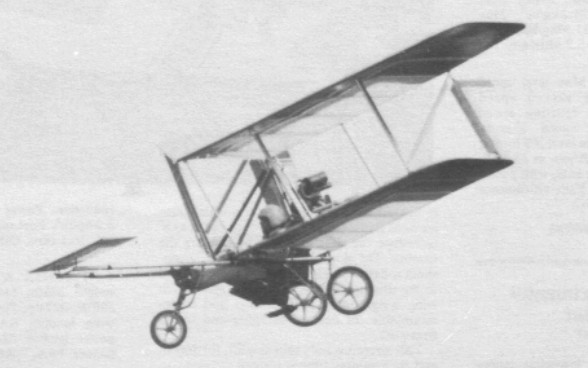
Single seat single engined biplane with two-axis control. Wings have swept back leading and trailing edges, and constant chord; no tail, canard wing. Pitch control by fully flying canard; yaw control by tip rudders between wings; no separate roll control; control inputs through stick for pitch and pedals for yaw. Wings braced by struts and transverse X cables; wing profile; double surface. Undercarriage has three wheels in tricycle formation; glass fibre suspension on main wheels. Push-right go left nosewheel steering independent from yaw control. Brake on nosewheel. Aluminium tube framework, without pod. Engine mounted between wings driving pusher propeller.
Shown at Sun ‘n’ Fun in March 1983 at Lakeland, Florida, the Viking is a variation on the famous Easy Riser theme.Whereas UFM of Kentucky has fitted the Easy Riser with a conventional tail giving rise to the Aeroplane (a 1983 model), Northstar had preferred a canard of variable incidence, thus acting as an elevator, for its Viking.
Designed for cross countries, it gives its pilot comfort and a large speed range. Its Kawasaki TA440 is equipped with an electric start, making it necessary to have a 12 V battery on board. The fuel tank is moulded into the seat back, whose structure is of glass fibre, and other nice touches include a twin blade ground adjustable variable-pitch propeller and a rudder bar which is adjustable according to the height of the pilot. Northstar supplies its Viking in kit form requiring 75 100 h for assembly at an introductory price (March 1983) of $5395. The kit does not require any special tools, assembly being largely with pop rivets.
Engine: Kawasaki TA440, 38.5hp at 6000rpm Propeller 60 in / 1.52 m ground adjustable) inch Micro V belt reduction, ratio 2.25/1 Max static thrust 235 lb, 107 kg Power per unit area 0.22 hp/sq.ft, 2.4 hp/sq.m Fuel capacity 5.0 US gal, 4.2 Imp gal, 18.9 litre Wing span 32.0 ft, 9.75 m Total area of main wings 170 sq.ft, 15.8 sq.m Nosewheel diameter overall 16 inch, 41 cm Main wheels diameter overall 20 inch, 51 cm Empty weight 244 lb, 11.1kg Max take off weight 502 lb, 228 kg Payload 258 lb, 117 kg Max wing loading 2.95 lb/sq.ft, 14.4 kg/sq.m Max power loading 13.0 lb/hp, 5.9kg/hp Load factors +5.0, 3.0 design Max level speed 54 mph, 87 kph Never exceed speed 55 mph, 88 kph Max cruising speed 45 mph, 72 kph Stalling speed 23 mph, 37 kph Max climb rate at sea level 800 ft/min, 4.1 m/s Best glide ratio with power off 7/1
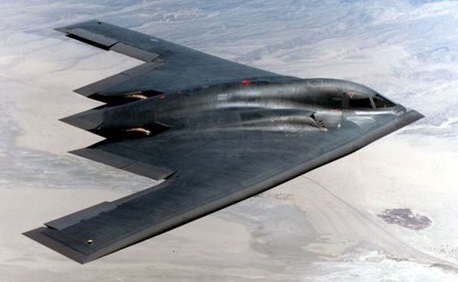
Development of the B-2 was begun in 1978, and in designing the Advanced Technology Bomber (ATB), as the B-2 project was originally known, the Northrop Company decided on an all-wing configuration from the outset. Flying-wing devotees such as Hugo Junkers and Jack Northrop argue that a flying wing will carry the same payload as a conventional aircraft while weighing less and using less fuel. The weight and drag of the tail surfaces are absent, as is the weight of the structure that supports them. The wing structure itself is far more efficient because the weight of the aircraft is spread across the wing, rather than concentrated in the centre.
The B-2 design is a flying wing with straight 40 degree sweep leading-edges and a sawtooth trailing edge. Its centrebody is smoothly contoured into the upper wing surface. The centrebody houses the two-man crew compartment and the two weapons bays, one on each side of the centreline. The cockpit compartment is accessed through a ventral hatch and has large cockpit windows to improve the pilots angular field of view, yet the nose-down view remains very limited. The engines lay outboard the weapon bays in the upper wing surface. The exhausts are positioned forward of the wing trailing edge to reduce heat signature.
Because of the big wing area and wing span, the lift needed per square foot of wing is not as high compared to other designs of the same weight. Therefor the B-2 does not need complex flaps. It operates over a smaller angle of attack.
The all-wing approach was selected because it promised to result in an exceptionally clean configuration for minimizing radar cross-section, including the elimination of vertical tail surfaces, with added benefits such as span-loading structural efficiency and high lift/drag ratio for efficient cruise. Outboard wing panels were added for longitudinal balance to increase lift/drag ratio and to provide sufficient span for pitch, roll and yaw control. Leading-edge sweep was selected for balance and trans-sonic aerodynamics, while the overall planform was designed for neutral longitudinal (pitch) static stability. Because of its short length, the aircraft had to produce stabilizing pitchdown moments beyond the stall for positive recovery. The original ATB design had elevons on the outboard wing panels only but, as the design progressed, additional elevons were added inboard, giving the B-2 its distinctive ‘double-W trailing edge. The flight-control surfaces are operated by a fly-by-wire control system to ensure optimum control responses in this design of relaxed stability intended for positive aerodynamic control at all times, throughout the airframe, emphasis is placed on completely smooth. The wing leading edge is so designed that air is channelled into the engine intakes from all directions, allowing the engines to operate at high power and zero airspeed. In trans-sonic cruise, air is slowed from supersonic speed before it enters the hidden compressor faces of the GE F118 engines.
A stores management processor is in place to handle the B-2’s 22,730kg weapons load. A separate processor controls the Hughes APQ-181 synthetic-aperture radar and its input to the display processor. The Ku-band radar has 21 operational modes, including high-resolution ground mapping. The B-2 lifts off at 260km/h, the speed independent of take-off weight. Normal operating speed is in the high subsonic range and maximum altitude around 15,240m. The aircraft is highly manoeuvrable, with fighter-like handling characteristics.
The US Air Force originally wanted 133 examples, but by 1991 successive budget cuts had reduced this to 21 aircraft.
First revealed in November 1988, the prototype flew on 17 July 1989, and the first production B-2 was delivered to the 393rd Bomb Squadron of the 509th Bomb Wing at Whiteman AFB, Missouri, on 17 December 1993. Northrop delivered 21 B-2A Spirit stealth bombers, achieving initial operational capability with the USAF in April 1997 and full capability with the 715th Bomb Squadron in 1999.
With a crew of two, it is powered by four 19,0001b thrust F 118 GE 100 engines (as used in the F 16) and has a published speed of 0.72 Mach. The multi role bomber is publicised as fuel efficient, able to carry a “substantial bomb load” and with “excellent range”. Unit cost: Approximately US$750 million
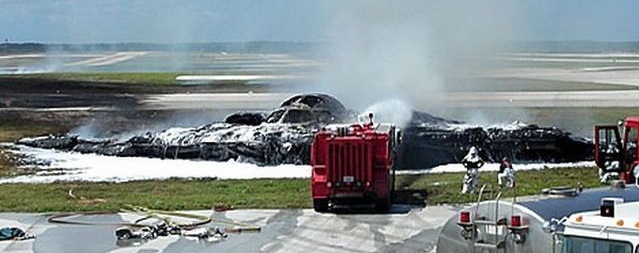
When B-2 89-0127, named the Spirit of Kansas, crashed on takeoff at Andersen Air Force Base in Guam, it immediately became the most expensive accident in USAF history. The crash was determined to have been caused by moisture in the port transducer units which resulted in the distortion of information sent to the aircraft’s air data system. The B-2’s flight control computers calculated an incorrect air speed and angle of attack, causing the nose to pitch-up 30 degrees and sending the aircraft into an unrecoverable stall. The pilots ejected safely, though the Spirit of Kansas was reduced to a $1.4 billion pile of burning wreckage.
Northrop B-2A Spirit Engines: 4 x General Electric F-118-GE-100 turbofan, 17,300 lb / 7,847 kg Length: 69 ft (20.9 m Height: 17 ft / 5.1 m Wingspan: 172 ft / 52.12 m Wing area: 3982.68 sq.ft / 370.0 sq.m Takeoff Weight (Typical): 336,500 lb / 152,635 kg MTOW: 371,000 lb / 168,286 kg Max speed: 475 mph / M0.76 Cruising speed: 516 kt / 955 km/h Ceiling: 50,000 ft / 15,152 m Op radius: 3800 mile / 6115 km Payload: 40,000 lb / 18,144 kg Crew: Two pilots, with provisions for a third crew station
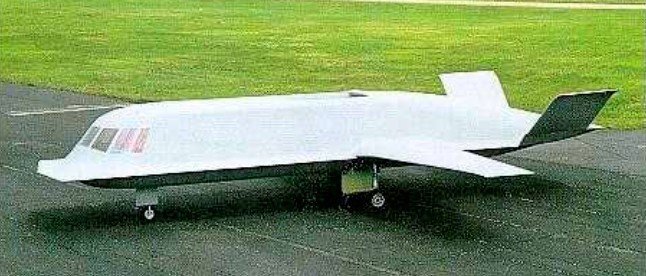
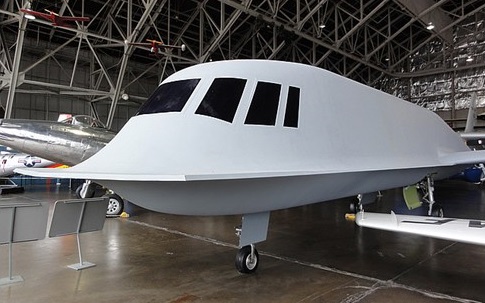
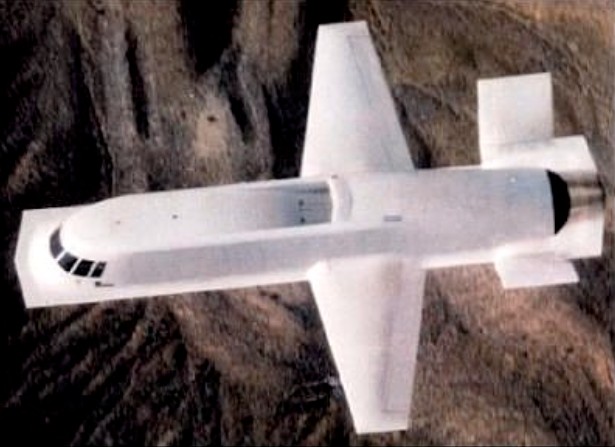
The “Tacit Blue” was built to test the advances in stealth technology. The aircraft made its first flight in February 1982 and by the conclusion of the program in 1985 had flown 135 times.
The entire program cost $165 million and Northrop, as the main contractor, received $136 million. The data collected from the Tacit Blue project was later used on the B-2 Spirit, also made by Northrop.
Tacit Blue Engines: 2 x Garrett ATF3-6 Max take-off weight: 13500 kg / 29763 lb Wingspan: 14.69 m / 48 ft 2 in Length: 17.0 m / 55 ft 9 in Height: 3.23 m / 10 ft 7 in Cruise speed: 460 km/h / 286 mph Ceiling: 9000 m / 29550 ft
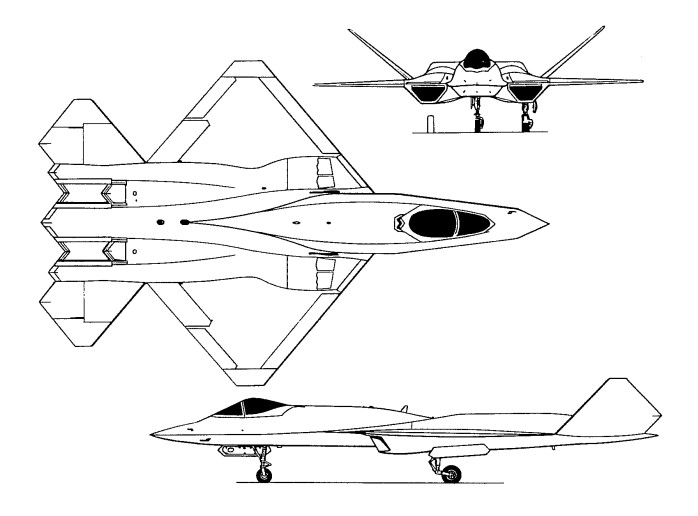
The first prototype, 87-800 (N23IYF reserved, but not used) was rolled out at Edwards AFB on 22 June 1990. The first flight was achieved on 27 August 1990 powered by P&W YF119s. The first air refuelling was achieved on the fourth sortie, on 14 September 1990. Mach 1.43 ‘supercruise’ was achieved on 18 September 1990 (the fifth sortie). The first use of afterburner was on the sixth sortie, on 21 September 1990. An altitude of almost 50,000ft was reached on 25 September 1990 (seventh sortie), and the final flight was on 30 November 1990. A total of 34 sorties/43hr.
The second prototype, 87-801 (N232YF reserved, but not used) had GE F120 powerplants, and had a first flight at Edwards 26 October 1990. ‘Supercruise’ in excess of Mach 1.6 was achieved on 29 November 1990. The final flight was made on 18 December 1990 after a total of 16 sorties/22 hrs.
The YF-23 had achieved Mach 1.8 at 50,000ft (15,240m) in afterburner. No missile launches were made, and no thrust vectoring was used. The aircraft were in storage at Edwards AFB from December 1990.
YF-23 Engines: 2 x Pratt & Whitney YF119-PW-100, 155.7kN with afterburner Max take-off weight: 29030 kg / 64001 lb Empty weight: 16783 kg / 37000 lb Wing span 43ft 7.25in / 13.29m Length overall 67ft 4.75in / 20.54m Height overall 13ft 10.75in / 4.24m Wing area: 87.8 sq.m / 945.07 sq ft Max. speed: 2080 km/h / 1292 mph Ceiling: 19800 m / 64950 ft Range: 1200 km / 746 miles Crew: 1
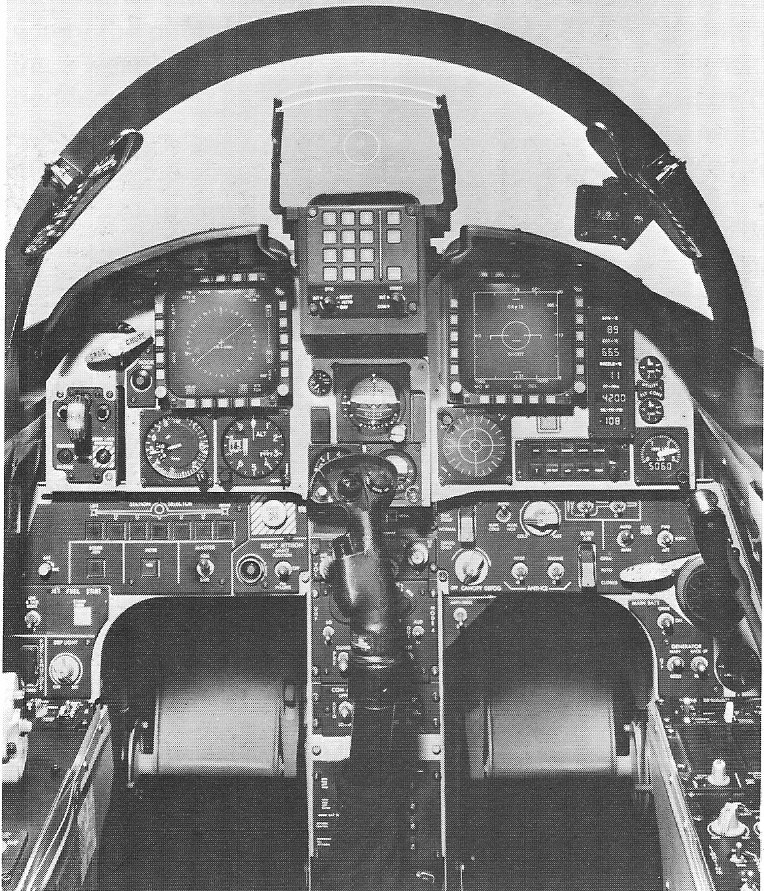
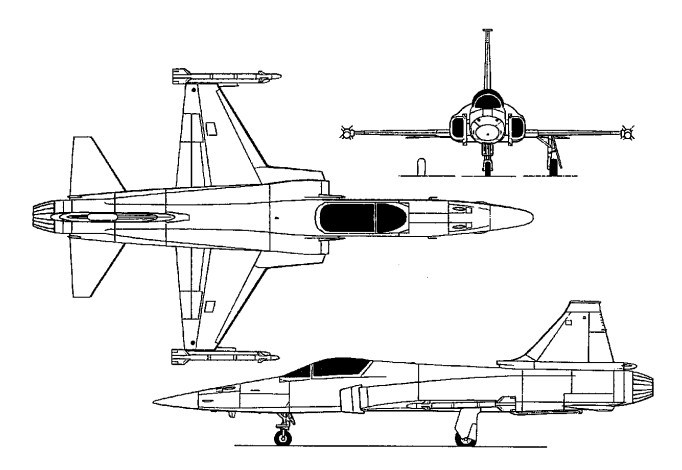
Initially known as the F-5G and officially redesignated F-20 in November 1982, the Tigershark single-seat tactical fighter was evolved as a company-funded development of the basic F-5E, having an 80% increase in engine thrust and only 21% increase in empty weight.
1981
A much modified F-5E, the F-5G / F-20 has a General Electric F404-GE-100 low-bypass turbofan of 10,900 lb (4 943kg) dry thrust and 16,390 lb (7 433 kg) with afterburning, and an armament of two 20mm cannon and could carry up to 3175kg of ordnance on five stations. Three prototypes of the F-20, each embodying progressive improvements, were flown, these entering flight test on 30 August 1982, 26 August 1983 and 12 May 1984. A fourth prototype in the proposed fully-operational configuration was under construction when, following the October 1986 decision that an upgraded F-16A was to succeed F-4 and F-106 as the USAF’s air defence fighter, Northrop terminated further development of the F-20 and ceased marketing efforts.
The danger of G-LOC was brought home when two of the three prototype F-20 crashed during demonstration routines killing their pilots only months apart. One was lost during a demonstration at Suwon, South Korea, in October 1984, and the other crashed at Goose Bay, Newfoundland, in May 1985, during practice for the Paris Air Show.
F-5G / F-20A Tigershark General Electric F404-GE-100 turbofan, 10,900 lb (4 943kg) dry thrust / 16,390 lb (7433 kg) afterburning Span: 7.70 m (25 ft 3 in) Length: 14.38 m (47 ft 2 in) Height: 4.22 m / 13 ft 10 in Wing area: 186 sq ft (17,1 sq.m) Empty weight: 11,220 lb (5 088 kg) Loaded weight: 17,500 lb (7 936 kg) Gross weight: 9379 kg (20 680 lb) Wing loading: 94 lb/sq ft (464 kg/ sq.m) Internal fuel: 4,440 lb (2 013 kg) Maximum speed: 1489 km/h (925 mph) Thrust/weight ratio: 0.94 Fuel fraction: 25.4 per cent Range w/max.fuel: 2965 km / 1842 miles