Biaster Bipo
Paraglider circa 1997/8.
Wing area: 39 sq.m
Certification: Afnor
Pilot weight: 130-220 kg
No. of cells: 44
Wing span: 117 m
Aspect ratio: 3.51
Price (1998) 6160000 Lr
1980->
Para Delta Ben Hur T5
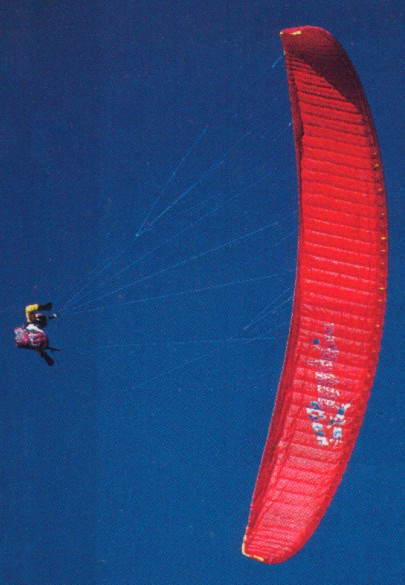
Ben Hur G
Paraglider circa 1997/8.
Wing area: 31.54 sq.m
Pilot weight: 95-125 kg
No. of cells: 63
Wing span: 12.1 m
Aspect ratio: 4.64
Price (1998) 6646000 Lr
Ben Hur M
Paraglider circa 1997/8.
Wing area: 29.2 sq.m
Certification: Afnor
Pilot weight: 85-110 kg
No. of cells: 59
Wing span: 11.2 m
Aspect ratio: 4.37
Price (1998) 6516000 Lr
Ben Hur T 5 deg dg
Paraglider circa 1997/8.
Wing area: 28.1 sq.m
Pilot weight: 85-110 kg
No. of cells: 98
Wing span: 12.71 m
Aspect ratio: 5.75
Price (1998) 8735000 Lr
Ben Hur 5 deg m
Paraglider circa 1997/8.
Wing area: 26.3 sq.m
Certification: Afnor
Pilot weight: 80-105 kg
No. of cells: 90
Wing span: 11.65 m
Aspect ratio: 5.16
Price (1998) 8600000 Lr
Para Delta
1998: Via Quasimodo 3, 1-43100 Parma, ITALY
Paraglider builder
Para-Cycle Segovia
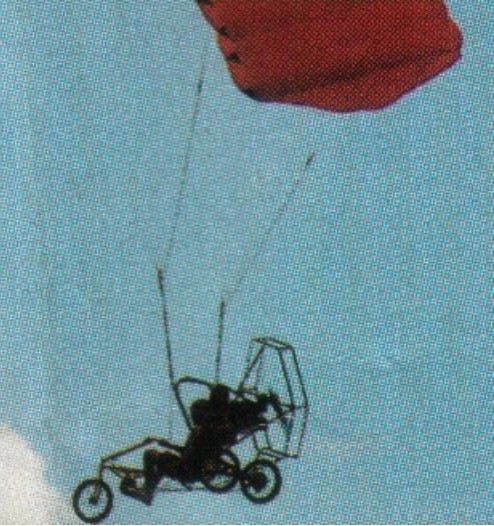
First manufactured in the USA in 1997. The unit is a street legal pedalling trike. A parachute and motor are attached by three bolts.
Engine: 2si 460F, 40 hp
hp range: 22-50
Height: 6 ft
Length: 6.8 ft
Wing span: 39 ft
Wing area: 400 sq.ft
Empty weight: 147 lb
Gross weight: 467 lb
Fuel capacity: 2.5 USG
Cruise: 26 mph
Range: 40 sm
Rate of climb: 400 fpm
Takeoff dist: 100 ft
Landing dist: 25 ft
Service ceiling: 10,000 ft
Seats: 1
Para-Cycle
1998: PO Box 1906, Windermere, FL 34786, USA.
Trike builder
Paraborne Mustang
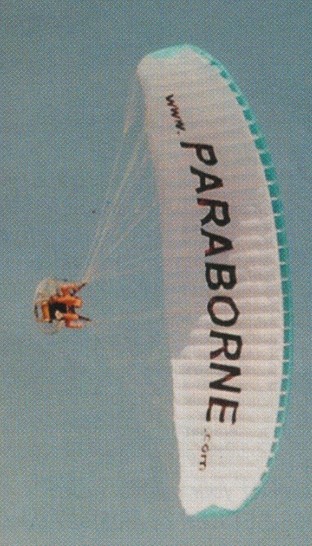
Paraborne Buckshot / Goodwin Buckshot
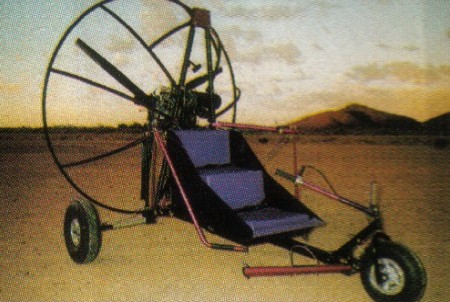
The Goodwin Buckshot is an American powered parachute that was designed and produced by FL Goodwin of Phoenix, Arizona and introduced in 1998.
Designed as a US FAR 103 Ultralight Vehicles two seat trainer, it features a parachute-style high-wing, two seats in side-by-side configuration, tricycle landing gear and a single engine in pusher configuration. The standard engines supplied were the 45 hp (34 kW) 2si 460F-45 and the 45 hp (34 kW) Zenoah G-50 engine, although any light, two-cylinder, two-stroke engine can be used.
The aircraft is built from bolted anodized aluminium tubing to save weight. In flight steering is accomplished via foot pedals that actuate the canopy brakes, creating roll and yaw. On the ground the aircraft has tiller-controlled nosewheel steering. The main landing gear does not incorporate suspension and the aircraft relies on large tundra tires to provide this.
The aircraft was distributed by Paraborne Aviation of Kissimmee, Florida. The Buckshot is out of production.
The rectangular canopy is made from double ripstop, mylar and kevlar. The trike design utilises shroud lines and risers.
Engine: Rotax 503, 46 hp
hp range: 40-65
Height: 7 ft
Length: 9 ft
Wing span: 50 ft
Wing area: 502 sq.ft
Empty weight: 230 lb
Gross weight: 730 lb
Fuel capacity: 13.5 USG
Cruise: 26 mph
Rate of climb: 700 fpm
Takeoff dist: 50 ft
Landing dist: 30 ft
Service ceiling: 10,000 ft
Seats: 2
Buckshot
Engine: 1 × 2si 460F-45, 45 hp (34 kW)
Empty weight: 230 lb / 104 kg
Fuel capacity: 13.5 U.S. gallons / 51 lt / 11.2 imp gal
Cruise speed: 25 mph / 22 kph / 40 km/h
Crew: one
Capacity: one passenger
Unit cost: US$9000 (2001)
Paraborne Aviation
1998: PO Box 423217, Kissimmee, FL l 34742, USA.
Trike and paraglider builder
Papa 51 Thunder Mustang

The Thunder Mustang was originally designed by Martin Hollmann for Dan Denny in 1988. Martin later finished the design and performed the flutter analysis for high performance aircraft.
Papa 51 Inc has produced kits to build Thunder Mustang two-seat 75 percent-scale representation of P-51 fighter, first flown 1996. Papa51 Co. Ltd., the original manufacturer of the Thunder Mustang is no longer in business.
The Thunder Mustang was not in production. The Thunder Builders Group L.L.C. acquired the assets required to manufacture the Thunder Mustang through foreclosure on a loan. These assets were posted as for sale.
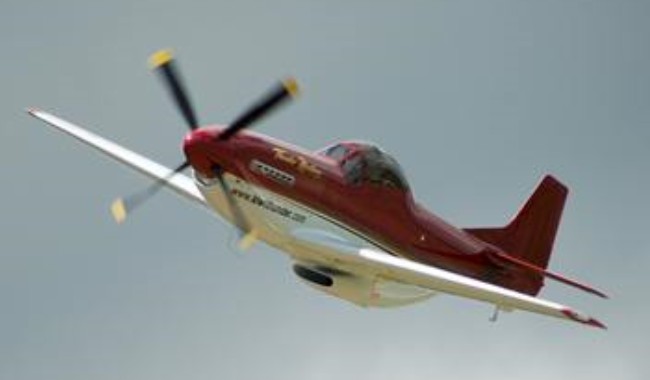
First flown in 1996, the two seat Thunder Mustang offers its owner a unique blend of speed, maneuverability and mystique. Given the power to weight ratio, it outperforms the original North American P-51D fighter at a fraction of the cost.
Thunder Mustang kits are complete, containing everything from the spinner, prop and engine to the tail wheel, less your choice of instruments, avionics, paint and upholstery. Extensive prefabrication helps reduce construction time and eliminate hassles. The complete use of carbon fiber in the structure produces incredible strength and light weight.
The 8 foot diameter, constant-speed 4-blade prop is manufactured by MT Propellers. The gear box ratio of 2.8:1 turns the prop at 1607 RPM for the optimum ratio for the best prop efficiency and high speed with the V-12 turning 4500 RPM. The 100 lb. propeller is of composite construction utilizing a wood core, which is self-dampening and non-fatiguing. This saves weight compared to metal propellers and reduces the gyroscopic effect of the prop on takeoff.

Thunder Mustang
Powerplant: Falconer V-12, 640hp
Displacement: 601 cubic inches
Propeller: MT 94″ 4-blade constant speed
Length: 24.2 ft
Frontal Area: 8.1 sq. ft
Wing Span: 23.8 ft
Wing Area: 104 sq. ft
Height: 9.4 ft
Maximum Level Speed @ Sea Level: 326 kts (375 mph, 603 kph)
Cruise Speed: @ 75% Power: 300 kts (340 mph, 547 kph)
Vne (never exceed): 439 kts
Vsl (stall, clean): 77 kts
Vso (stall, in landing config.): 68 kts
Range: 1300 nautical miles
Rate of Climb @ gross: 5200 ft/min
Takeoff distance: 1000 ft
Landing distance: 2500 ft
Service Ceiling: 25,000 ft.
Gross Weight: 3200 lb
Empty Weight: 2200 lb
Useful Load: 1000 lb
Payload w/full Fuel: 400 lb
Basic Fuel Capacity: 102 gallons (in wings)
Baggage Capacity: 50 lb
Wing Loading: 28.84 lbs/sq.ft
Power Loading: 4.69 lbs/hp
Design Limit Load Factor: +9g / -6g @ 2600 lb / +7.3 / -4.9 g @ 3200 lb
Vx (best angle of climb): 87 kts
Vy (best rate of climb): 156 kts
Va (design maneuvering): 222 kts
Vfe (max flaps extended): 165 kts
Vle (max landing gear extended): 148 kts
Best Glide: 153 kts
Seats: 2
Engine: Falconer V-12, 640 hp
Wing span: 7.25 m
Wing area: 9.57 sq.m
MAUW: 1361 kg
Empty weight: 907 kg
Fuel capacity: 401 lt
Max speed: 603 kph
Cruise speed: 555 kph
Minimum speed: 109 kph
Climb rate: 26 m/s
Seats: 2
Kit price (1998): $195,000
Papa 51 Inc.
Has produced kits to build Thunder Mustang two-seat 75 percent-scale representation of P-51 fighter, first flown 1996.
1997-8: 102 N. Kings RD. Nampa, ID 8368, USA.
Papa 51 Co. Ltd., the original manufacturer of the Thunder Mustang is no longer in business.
The Thunder Mustang was not in production. The Thunder Builders Group L.L.C. acquired the assets required to manufacture the Thunder Mustang through foreclosure on a loan. These assets were posted as for sale.

