1995-8: 738 Maple Ave, Southampton, NJ 08088-1725, USA.
Powered paraglider builder
1995-8: 738 Maple Ave, Southampton, NJ 08088-1725, USA.
Powered paraglider builder
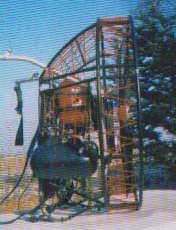
The Hirth engined Skywalker developed with a tuned exhaust and fan cooling with a 93 cm propeller.
Skywalker 210
Empty weight: 23 kg
Engine: Solo, 18 hp
Certification: vz
Reduction: 1:2.25
Prop diameter: 86 cm
Fuel capacity: 5 lt
Price (1998): 7400 DM
Skywalker 330
Empty weight: 24.5 kg
Engine: Hirth, 22 hp
Certification: vz
Reduction: 1:2.25
Prop diameter: 86 cm
Fuel capacity: 5 lt
Price (1998): 8300 DM
1998:
Krefelder Str. 110
D 52146 Wűrselen
Germany
Paramotor builder
A twin-engined light utility biplane of 1991
Founded 1991 as joint Bulgarian/Russian company to develop LKhS twin-engined light utility biplane.
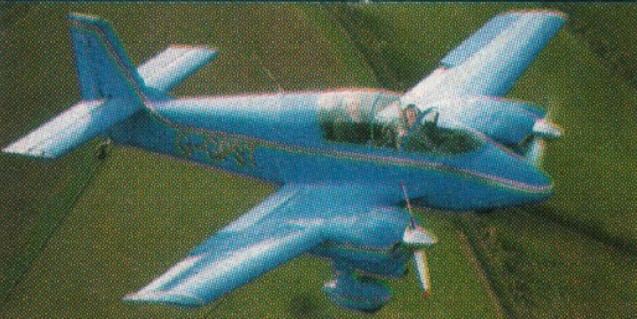
A fully aerobatic light twin, first flown in 1991. Partial and or prefabricated parts were available.
Mk.I
Engine: 2 x Continental O-200, 100 hp
Mk.II
Speed max: 220 mph
Cruise: 200 mph
Range: 1300 sm
Stall: 60 mph
ROC: 3500 fpm
Take-off dist: 600 ft
Landing dist: 600 ft
Service ceiling: 25,000 ft
Engines: 2 x Lycoming IO-320, 160 hp
Fuel cap: 96 USG
Weight empty: 1500 lb
Gross: 2250 lb
Height: 6.83 ft
Length: 22.83 ft
Wing span: 26 ft
Wing area: 120 sq.ft
Seats: 2
Landing gear: tail wheel
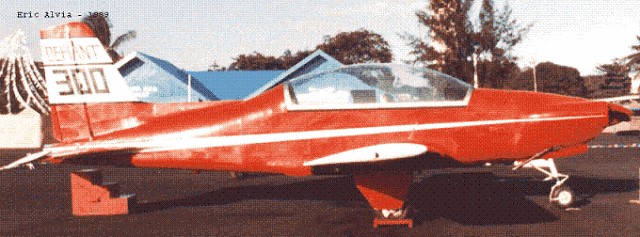
In 1981 Gold Wings Aviation, a private company under Capt. Panfilo Villaruel Jr. (who later became chief of the Air Transportation Office (ATO) and president of the Philippine Aerospace Development Corporation (PADC)), conceived an aircraft research and development undertaking called the Norlindo program, named after one of its first engineers. The program covered a progressive development of a high-performance trainer primarily intended for use by the Philippine Air Force (PAF). The program was launched as an innovative step to build an aircraft of local design and utilizing indigenous materials. Out of these experiences, a single, piston engine trainer aircraft was conceived, designed, built and flown within three years.
The two-seat tandem Defiant prototype (registered as RP-X239) was a technical arrangement of various systems and parts taken from different types of aircraft in the PAF inventory. The landing gears, flight controls and flaps motor were taken from the Beechcraft T-34 Mentor, seats from the Cessna U-17B, rudder and brake pedals from the Boeing-Stearman PT-13 and various instrument items from the Britten-Norman BN-2 Islander, T-34 Mentor, Sikorsky S-76 and SIAI-Marchetti SF.260. The Defiant was powered by a single Lycoming IO-540-K1B5 piston engine on loan from the PADC, the same engine that powers the BN-2 Islander.
The airframe was fabricated from palosapis wood and the skin from tanguile veneer plywood. The engine mount was fabricated from chrome molybdenum steel and a one-piece plastic canopy was fabricated. Fuel tanks were constructed with 5052-H34 aluminum alloys. The development cost about 40 million.
Only one prototype was built, in 1986. The two-seater aircraft made its first flight on 22 February 1988, flying for about an hour.
Based on the successful flights of the prototype, Gold Wings planned to build another prototype of a modified Defiant (appropriately named Defiant 500) with an all-metal airframe and power rating increased to 500 hp. Due to lack of financial support from the government, the plan did not go ahead.
The Defiant 300 went on display in a hangar at the Philippine State College of Aeronautics.
Defiant 300
Engine: 1 × Textron Lycoming IO-540-K1B5, 224 kW (300 hp)
Wingspan: 9.52 m (31 ft 3 in)
Wing area: 12.55 m² (135.1 sq ft)
Airfoil: NACA 2418 (root), NACA 2412 (tip)
Length: 8.51 m (27 ft 11 in)
Height: 3.73 m (12 ft 3 in)
Empty weight: 1,278 kg (2,818 lb)
Max. takeoff weight: 1,583 kg (3,490 lb)
Maximum speed: 357 km/h (222 mph; 193 kn)
Stall speed: 110 km/h (68 mph; 59 kn) (flaps down)
Range: 1,896 km (1,178 mi; 1,024 nmi)
Service ceiling: 7,520 m (24,670 ft)
Rate of climb: 7.8 m/s (1,540 ft/min)
Crew: Two
Government corporation established in 1973 to promote development of a Philippines aerospace industry. Aircraft manufacture was undertaken until 1982 by a subsidiary company, National Aero Manufacturing Corporation. Assembled 44 MBB BO 105 helicopters and 67 Britten-Norman Islanders. A four-seat utility high-wing monoplane powered by a 300 hp Textron Lycoming engine was designed. Assembled 24 SIAI-Marchetti S211 jet trainers, 18 SF.260TP turboprop trainers, and eight Lancair lightplanes. Became partner in Eurocopter Philippines to assemble Eurocopter helicopters from kits (plus sales and maintenance). Philippine Helicopter Services Inc subsidiary maintains BO 105s and MD 500s.

Single seat single engined high wing mono¬plane with conventional three axis control. Wing has elliptical planform and tapering chord; inverted V tail. Pitch/yaw control by elevon; roll control by wing warping; control inputs through stick for pitch/roll and pedals for yaw. Cantilever wing; wing profile; double surface. Undercarriage has three wheels in tricycle formation; suspension on all wheels. Push right go right nosewheel steering connected to yaw control. No brakes. Aluminium tube framework, without pod. Engine mounted below wing driving pusher propeller.
Conceived by J Bruce Emmons, the Eclipse was one of the new releases at Sun ‘n’ Fun of March 1983 at Lakeland, Florida. The Eclipse is also the first rigid wing ultralight to use wing warping for roll control (with the possible exception of the British Ladybird, which is not yet in production). With the Eclipse, the accent has been put on flight stability. The strength of the airframe has not been neglected, this ultralight having been static tested to as much as ± 9 g, more than the requirements for a light aircraft to be classed in the aerobatic category. The wings can be placed parallel with the framework by removing three bolts; demounted like that the machine can be transported either on a trailer or a roof rack. All the pieces in the kit are delivered pre formed, cut and drilled. Sold for $5495 in 1983, the kit thus provided is claimed to need only 30 h for completion.
Engine: KFM 107, 25 hp at 6000 rpm
Propeller diameter and pitch 54×23 inch, 1.37×0.58m
V belt reduction, ratio 2.0/1
Max static thrust 175 lb, 79 kg
Power per unit area 0.22 hp/sq.ft, 2.4hp/sq.m
Fuel capacity 5.0 US gal, 4.2 Imp gal, 18.9 litre
Length overall 14.0 ft, 4.27 m
Height overall 5.0ft, 1.52m
Wing span 32.2ft, 9.80m
Chord at root 4.0 ft, 1.22 m
Dihedral 0 deg
Tailplane span 8.0 ft, 2.44 m
Total wing area 114 sq.ft, 10.6 sq.m
Wing aspect ratio 9.1/1
Wheel track 4.0 ft, 1.22 m
Wheelbase 6.0 ft, 1.83 m
Nose¬wheel diameter overall 11 inch, 27 cm
Main wheels diameter overall 11 inch, 27 cm
Empty weight 165 lb, 75kg
Max take off weight 465 lb, 211kg
Payload 300 lb, 136kg
Max wing loading 4.071b/sq.ft, 19.9kg/sq.m
Max power loading 18.6 lb/hp, 8.4kg/hp
Load factors +6.0, 6.0 design; +9.0, 9.0 ulti¬mate
Max level speed 63 mph, 103kph
Max cruising speed 55 mph. 88kph
Economic cruising speed 50mph. 80kph
Stalling speed 25mph, 40kph
Best glide ratio with power off 15/1 at 35mph. 56kph
Range at average cruising speed 150 mile, 241 km
1983: 1334 Lutheran Church Road, Dayton, OH 45427, USA.
UL builder

