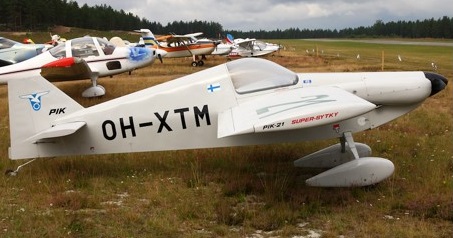
The 1981 PIK-21 Super-Sytky is a mid-wing monoplane Formula V racer, powered by a 53 hp VW-1600 engine. A Tavastia College student project of wooden construction, the two built, OH-XTM & OH-XMR, have a wing span of 5.3 m.
The 1981 PIK-21 Super-Sytky is a mid-wing monoplane Formula V racer, powered by a 53 hp VW-1600 engine. A Tavastia College student project of wooden construction, the two built, OH-XTM & OH-XMR, have a wing span of 5.3 m.
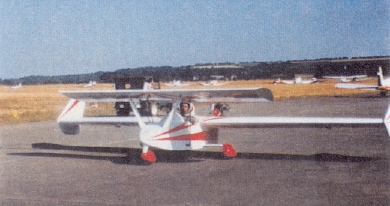
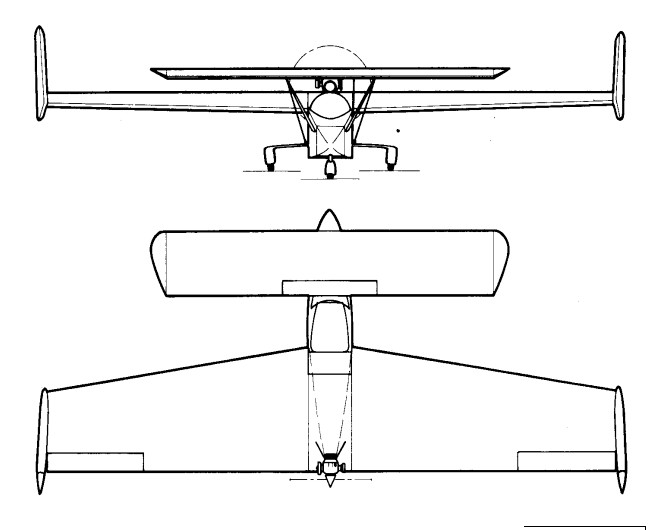
At the end of 1981 Piel completed plans of his CP 150 Onyx microlight it should have flown during 1982 but was held back by the demise of its designer. Single seat single engined double monoplane in tandem with conventional three axis con¬trol. Two fin tail. Pitch control by fully flying wing; yaw control by fin mounted rudders; roll control by ailerons; control inputs through stick for pitch/roll and pedals for yaw. Under¬carriage has three wheels in tricycle formation with additional tailskid; suspension on all wheels. Push right go right nose¬wheel steering connected to yaw control. No brakes.
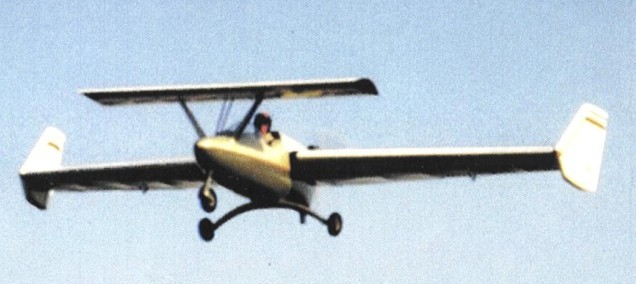
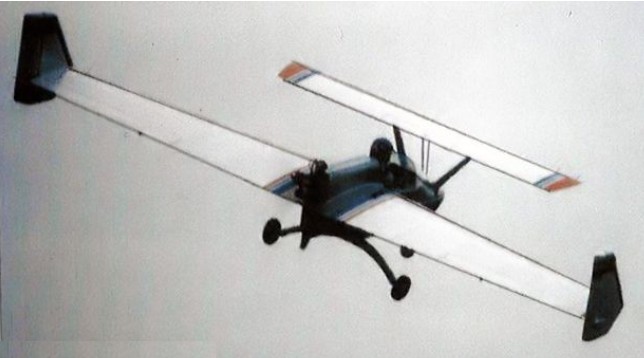
Wood/fabric fuselage, partially enclosed. Engine mounted above main wing driving pusher propeller. The CP 150 is a double tandem monoplane whose front wing has a NACA 23012 profile and is adjustable for incidence. It thus acts as the elevator and is stabilised by an anti servo tab. It is much smaller than the rear wing which has a NACA 23015 profile and a swept back leading edge but an unswept trailing edge. Both wings are cantilevered, the front mounted on two faired supports on which it is articulated, with incidence control via pushrods. The rear wing is fitted with ailerons and has large fins at the wing tips on which the rudders are hinged. The fuselage is largely made from wood as are the wing, wing spars and vertical tail surfaces. Of rectangular section, the fuselage is covered with plywood, the two wings use a covering of Tergal and are de mountable, so that the Onyx is trailer transportable.
Designed for low power engines, the Onyx was tested at the beginning of 1982 with a Solo 12 hp engine.
The 2nd version had a longer wingspan with a fiberglass body. It was developed by R. Francois, an enthusiast for the design. This was the only version with a steerable nose wheel.
The third version, the one that is available as plans, is the wood fuselage with the longer wingspan of the fiberglass body.
The 4th version was the 2 seat produced by Veritas, probably developed by R. Francois.
Madame Piel distributes plans for aircraft.
Engine (prototype): Solo, 12 hp
Propeller: 35″ dia. x 14″ pitch
Length: 11.6 ft
Total Area: 137.7 sq ft, 12.8 sq.m
Height overall 5.4 ft, 1.61 m
Rear wing span 23.9 ft, 7.30 m
Rear wing chord at root 5.3 ft, 1.60 m
Rear¬wing chord at tip 3.3ft, 1.00 m
Front wing span 14.6 ft, 4.46 m
Front wing constant chord 2.9ft, 0.84m
Empty Weight: 265 lbs
Max Takeoff Weight: 475 lbs
Fuel: 5 USG
Power per unit area 0.09 hp/sq.ft, 0.9 hp/sq.m
Front wing dihedral 0 deg
Front wing sweepback 0 deg
Fin height 3.5 ft, 1. 05 m
Rear wing area 98 sq.ft, 9.1 sq.m
Front ¬wing area 40 sq.ft, 3.7 sq.m
Total aileron area 6.8 sq.ft, 0.60 sq.m
Fin area 8.9 sq.ft, 0.83 sq.m
Rudder area 6.8 sq.ft, 0.63 sq.m
Rear wing aspect ratio 5.9/1
Front wing aspect ratio 5.4/1
Max Speed: 62 mph, 100 kph
Minimum Speed: 28 mph
Cruise Speed: 50 mph, 80kph
Economic cruising speed 37mph, 60kph
Vne: 85 mph
Stall Speed: 22 mph, 35kph
Take off distance 100ft, 30m
Landing distance 200 ft, 60 m
Rate Of Climb: 300 fpm
Complete set of plans 2009: US$90
Wheel track 4.9ft, 1.50m
Wheelbase 5.5ft, 1.68m
Nosewheel diameter overall 8 inch, 20 cm
Main wheels diameter overall 10 inch, 25 cm
Load factors; +4.0, 2.0G
Engine: Solo, 15 hp
HP range: 15-20
Length: 11.6 ft
Wing span: 24 ft
Wing area: 137.7 sq.ft
Empty weight: 265 lb
Gross weight: 595 lb
Fuel capacity: 5 USG
Top speed: 62 mph
Cruise: 50 mph
Stall: 22 mph
Range: 200 nm
Rate of climb: 300 fpm
Takeoff dist: 200 ft
Landing dist: 100 ft
Service ceiling: 5000 ft
Seats: 1
Landing gear: nosewheel
Engine: 18 hp
Propeller: 35″ dia. x 14″ pitch
Span: 24.0 ft
Length: 11.6 ft
Total Area: 137.7 sq ft
Empty Weight: 265 lbs
Max Takeoff Weight: 475 lbs
Fuel: 5 USG
Max Speed: 70 mph
Minimum Speed: 30 mph
Cruise Speed: 60 mph
Vne: 85 mph
Stall Speed: 25 mph
Takeoff Distance: 150 ft
Landing Distance: 100 ft
Rate Of Climb: 450 fpm
Complete set of plans 2009: US$90
The CP 100 Super Emeraude was the basis for the Cap 10 acrobatic aircraft was is still in production in 1983 at Avions Mudry.
Piel Aviation Sa
Avions Claude Piel
Claude Piel produced a series of light aircraft from the early 1950s, most famous of which was the Emeraude two-seater with, in its original CP.30 form, a 65 hp Continental engine. Hundreds of Emeraudes of varying types were built under license by companies in a number of countries. This company (instead of original Piel Aviation SA) continues to market Piel aircraft in plans form, including single-seat CP.80 Zef racing monoplane, CP.90 Pinocchio single-seat monoplane (single-seat variant of Emeraude), CP.328 Super Emeraude (also has been commercially built), CP.402 Donald single-seat high-wing cabin monoplane (first flown 1953), CP.605 Diamant three/four-seat cabin monoplane (first flown 1964 in CP.604 prototype form) and is certificated for commercial production, CP.751 Beryl tandem two-seat monoplane, and CP.1320 Saphir three-seat monoplane.
An aeronautical engineer, he designed a complete family of aircraft. Claude Piel died in August 1982.
1983: Madame Vetive Piel, 104 cote de Beulle, chemin des Alouettes, 78580 Maule, France.
1982: Piccard Balloons, Box 1902, Newport Beach, California 92663, USA.
Soon to introduce its eighth model (in 1982), Piccard has a wide selection of balloons. Envelopes range in volume from 33,000 to 90,000 cubic feet, and baskets are interchangeable. Larger models have been custom built. Basic prices of Piccard balloons range from $3,656 to $16,000 in 1982.
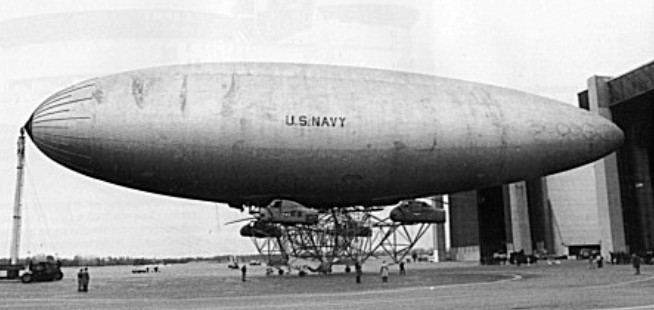
The Piasecki PA-97 Heli-Stat project began in the mid 1970s with a view to combining the lift capability of a lighter-than-air vehicle with the precise manoeuvrability of the helicopter, and following support from the US Forestry Service and the US Navy, construction of a prototype Heli-Stat began at Lakehurst, New Jersey, in 1979. The hybrid aircraft uses an airship-based envelope, attached via a skeletal structure to the front fuselage portions of four Sikorsky SH-34J helicopters, each powered by a standard Wright radial engine driving the conventional main rotor system and mounted at the four corners of the aircraft. The tail rotors are replaced by large diameter propellers to provide propulsion and full controllability.
At the beginning of 1984 it was expected that the Heli-Stat would fly in 1985, following a redesign of the structure which had failed under load tests. The following data is provisional
Richard Burke, 29.07.2008
I spent 7 years on this project starting first at the MAIN engineering facility drafting this monster along with 15 other people on Island Avenue in Philadelphia and later moved to Lakehurast during the structural pluck tests. I was there up until the ground manuvering tests where being performed. If you have any questions I can answer them I was over every single part of the airframe / Sh34J’s (Modified) and the aerostat (ZPG2 envelope). [The photo] was a roll out for a photo op dog and pony show note the lack of inverted v fins on the aerostat and the lack of pusher props on the helos also US Forrest Service was not painetd on the envelope yet . I am actually in this photo aft center stern of ship next to the guy with the bike, Joe O’Halleren
It was truly a combination of four SH-34 helicopters and a ZP-3 patrol blimp. It had B-52 landing gear and P-51 reduction gear boxes driving H-3 tail rotors as pusher props.
Piasecki Heli-Stat
Engines: 4 x Wright R-1820-84A, 1525shp
Overall width: 60.05m
Overall length: 74.07m
Empty weight: 24895kg
Gross weight: 50469kg
Maximum speed: 132km/h
Service ceiling: 3810m
Range: 3307km
Range with maximum payload: 80km
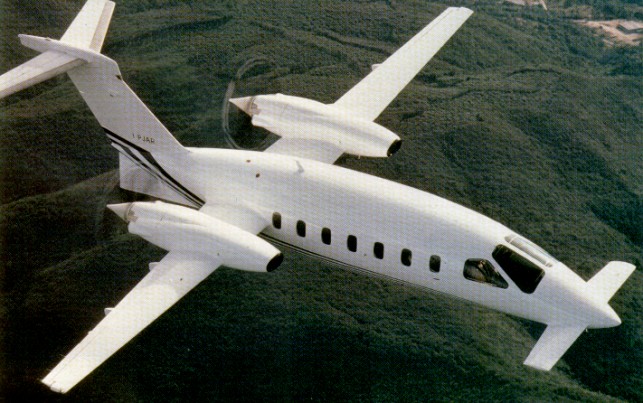
At the 1983 NBAA convention in Dallas, Texas, Piaggio announced a new twin turbo-powered business aircraft. Design work on the P.180 Avanti had begun at Piaggio’s Genoa headquarters in 1979. Seating six to 10 passengers it was a radical departure from anything the company had previously produced. The major design feature of the aircraft is its use of three lifting surfaces. The main wing is fitted above the mid-set position in the fuselage, with the main spar running behind the passenger cabin. Its straight leading edge is broken only by the engine nacelle inlets and the wing has a slight dihedral of 2 degrees. The T-tail and elevator act as the second lifting surface, in addition to being orthodox control surfaces. The foreplane is not a simple canard, but provides a positive lift component in addition to that produced by the wing. This in turn allows the wing to be reduced in size, thus decreasing overall weight and drag.

The engines were originally specified as Pratt & Whitney Canada PT6A-66A turboprops, but these were later changed in favour of more powerful PT6A-61s. Each drives a five-bladed Hartzell fully-feathering reversible-pitch propeller with spinner. The engines are mounted in composite-material nacelles. The Avanti makes considerable use of composites. Carbonfibre and a Graphite/ Epoxy mix represent about 10% of the aircraft’s weight, and all of these components are built by Sikorsky arid Edo. Wings and tail sections are produced by Piaggio at Genoa, while the forward fuselage is the responsibility of Piaggio Aviation in Wichita. Final assembly is completed in Italy. Aircraft intended for the American market are flown ‘green’ to the US to a specialist outfitters and there are plans to eventually assemble all aircraft in the United States.
The cockpit is fitted with a Collins EFIS system, comprising three CRTs and Col-lins navigation and weather radar systems are standard. The aircraft is certified for single pilot operations. The main cabin is pressurised and air conditioned, is fitted with a galley and folda-way tables. An emergency exit is situated at the front on the starboard side with the airstairs on the port side.
In 1983 Gates Learjet became a partner in the project, but withdrew for economic reasons in January 1986. All the tooling and the forward fuselages of the three pre-production Avantis which were on the line at Wichita, were then transferred to Italy.
Assembly of the first P.180 began on Piaggio’s Finale Ligne plant in 1986 and the first flight was made on 23 September 1986 (I-PJAV). This was followed by the second aircraft (I-PJAR) on 14 May 1987. The Avanti was certified by the Italian authorities in March 1990, and in May of that year the first production aircraft was rolled out. The final hurdle of US certification was passed in October 1990 and the first customer delivery took place the following September.
By early 1993 only 20 Avantis had been delivered.
Engines: two Pratt & Whitney PT6A-66, 850-shp / 1107kW
TBO: 3000 hrs
Props: 5 blade 85in counter-rotating Hartzell
Wingspan: 14.03 m / 46 ft 0 in
Wing area: 172.2 sq.ft / 16.0 sqm
Length: 14.41 m / 47 ft 3 in
Height: 3.94 m / 13 ft 11 in
Max ramp weight: 5262 kg
Max take-off weight: 5080 kg / 11200 lb
Empty weight: 3384 kg / 7460 lb
Max ldg wt: 4965 kg
Max zero fuel: 4310 kg
Max fuel: 1170 kg
Max wing loading: 67.1 lbs/sq.ft
Max pwr loading: 6.79 lbs/hp
Service ceiling: 12500 m / 41000 ft
Vmo: 260 kt
Mmo: .67 Mach
Max speed: 395 kts
Stall (MLW): 93 kt
ROC: 2950 fpm
SE ROC: 2950 fpm
TO dist (50 ft): 2850 ft
Ldg dist (50 ft): 2860 ft
Max range with res: 1400 nm
Seats: 7-11
Cabin ht: 5 ft 9 in
Cabin width: 6 ft 1 in
Cabin length: 14 ft 7 in
Piaggio Aero P.180 Avanti II
Price: $6.8 million 2009
Engine: 2 Pratt & Whitney PT6A-66B: 850 shp (derated from 1630)
Max Takeoff Weight: 12,050 lb
Useful Load: 4300 lb
Max Payload: 2000 lb
Empty Weight, Std: 7800 lb
Wing Span: 46.03 ft
Cabin Height: 5.74 ft
Cabin Width: 6.07 ft
Cabin Length: 14.93 ft
Rate Of Climb: 2950 fpm
Max Certified Altitude: 41,000 ft
Max IFR Range: 1507 nm
Max Cruise Speed: 402 KTAS
Takeoff Distance: 2850 ft
Landing Distance: 2860 ft
SA Piaggio & Co, an engineering and shipbuilding company, produced some Caproni aircraft and parts during the First World War at a Finale Ligure factory, but subsequently abandoned aircraft manufacture until it took over Pegna & Bonmartini in 1923. First product was the Piaggio-Pegna pursuit monoplane with Hispano-Suiza engine. Later was associated with Societa di Costruzioni Meccaniche Aeronautiche in license-construction of Domier Wal flying-boats. Built P.32 twin-engined heavy bomber at end of 1930s and several four-engined P.108 heavy bombers during Second World War.
Resumed aeronautical work in late 1946 with conversion of Dakotas for airline service. Built P.136 five-seat twin-engined amphibian, prototype flying in 1948, followed by a series of trainers for the Italian Air Force; the P.149 was also license-built by Focke-Wulf in Germany. Produced the P.166 executive transport in 1957, with two Lycoming engines and pusher propellers, as with the P.136; P.166-DL3 turboprop variant later developed and produced, with final P.166-DL3-SEM Maritime variant for search and surveillance, coastal patrol and other roles still available in 1998, but only to special order. Signed agreement with U.S. Douglas company in 1961 for joint development of light utility aircraft, first flown in 1964. Designated PD.808 and powered by two Bristol Siddeley Viper turbojets, only a small number was built.
The present Rinaldo Piaggio company was formed in February 1964 as a separate concern, but in 1994 was put under insolvency protection; 51 percent shareholding in the company was purchased by Tushav, a Turkish holding company, in mid-1998, and protection was thereafter lifted. P.180 Avanti twin-pusher turboprop business aircraft flown September 1986, but only 43 production aircraft ordered; turbofan derivative may be developed. Has manufactured components for Aeritalia/Alenia, AMX International, Dassault and Panavia.
In 1998 three Italian industrial families bought the debt-free assets from the Government and formed Piaggio Aero Industries SpA.
In 2024 Italy approved the sale of Piaggio Aerospace to the Turkish unmanned combat aerial vehicle (UCAV) producer Baykar. In 2023, Baykar ranked among the top 10 exporters in Türkiye across all sectors, racking up $1.8 billion in exports. Türkiye dominates 65% of the global unmanned aerial vehicle (UAV) export market, with Baykar alone holding nearly 60% of the market – three times the size of its closest US competitor. In recent years, Baykar has generated more than 90% of its revenues from exports, delivering Bayraktar TB2 UCAVs and Bayraktar AKINCI UCAVs to 35 countries.
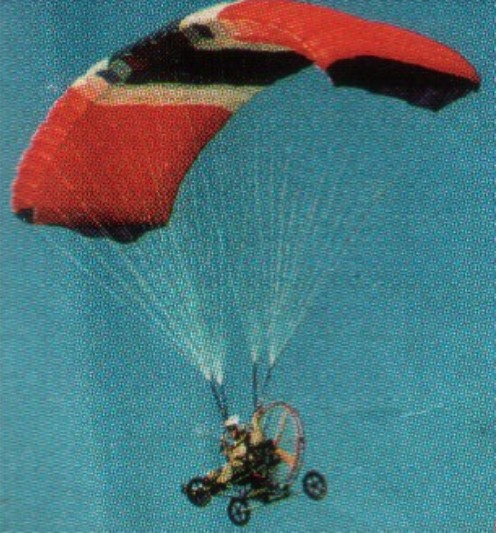
Manufactured in the US, kit prices (US$7590) includes the engine and prop. The wing was available in two sizes, and nose wheel steerable.
Engine: Zenoah G25, 22 hp
Height: 5 ft
Length: 6 ft
Wing span: 30 ft
Wing area: 315 sq.ft
Empty weight: 120 lb
Gross weight: 360 lb
Fuel capacity: 2.5 USG
Cruise: 20 mph
Range: 30 sm
Rate of climb: 350 fpm
Takeoff dist: 150 ft
Landing dist: 0-10 ft
Service ceiling: 5000 ft
Seats: 1
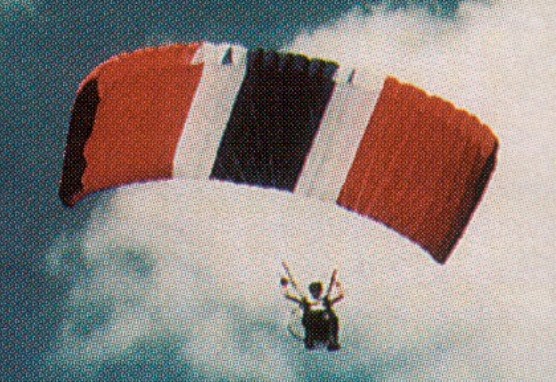
Powered parachute.
Speed max: 22 mph
Cruise: 20 mph
ROC: 350 fpm
Take-off dist: 5-50 ft
Landing dist: 0-5 ft
Service ceiling: 5,000 ft
Engine: Zenoah G75, 22 hp
HP range: 15-30
Fuel cap: 2.5 USG
Weight empty: 76 lb
Gross: 305 lb
Height: 2.5 ft
Length: 1.5 ft
Wing span: 30 ft
Wing area: 315 sq.ft
Seats: 1
Landing gear: nose wheel

