Cycle: 2 stroke No cylinders: 3 Bore: 83.4 mm Stroke: 61 mm Displacement: 1014 cc Cooling: Liquid Ignition: Electronic Reduction: Integral mechanical 2-2.4/1 Dimension: 680 x 380 x 380 mm Weight: 45 kg Max pwr: 90 hp at 5500 rpm Price 1998: 42 000 Fttc
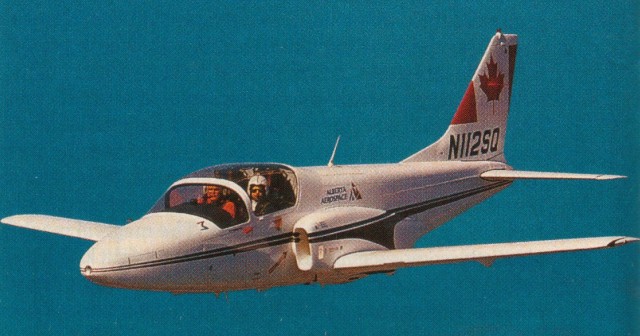
A Belgian enterprise, the Jet Squalus was designed and built around the Garrett TFE109 engine by General Avia in Italy. Designed by Stelio Frati, the prototype Jet Squalus made a successful first flight on April 30, 1987. Three prototypes of the “all through” side by side seat trainer were built and flown to Belgium. The Squalus was promoted as “the first and only third generation global trainer”, offering ab initio and advanced training from one cockpit.
Two proto¬types of the Jet Squalus are being built by General Avia in Italy, the first powered by a Garrett TFE-109 turbofan, and the second by a more powerful Williams International FJ-44. Following completion of initial flight trials the aircraft will be flown to Belgium, where production, marketing, and support of the “all-¬through” jet trainer will be administered by Promavia.
The initial 1,330 lb st (5.92 kN) -1 unit was replaced by the Garrett TFE 109-3 turbofan of 1,600 lb st (7,12 kN). Light weapons and/or drop tanks can be carried on underwing hardpoints.
No orders had been placed for the aircraft by 1988.
In 1995 the Belgian company Promavia licensed Alberta Aerospace to begin development of an ab initio trainer version of its Jet Squalus, under the name Phoenix FanJet. Eventually Promavia sold Alberta Aerospace the flying Jet Squalus prototype for conversion (to include new Williams- Rolls FJ44 turbofan engine in a revised airframe, new “glass” cockpit, larger flying control surfaces and more), allowing certification in about the year 1999. After Promavia ceased trading, Alberta Aerospace purchased other Promavia assets, allowing eventual production in Canada.
Based in Calgary, Canada, Alberta Aerospace obtained the two prototypes built with plans to install Williams-Rolls FJ44-1a engines. Almost 80% of the structural and stress testing for certification was completed by Frati, who tested the airframe to +7 and –3.5G. With a 140 kt gear extension speed, the aircraft did not meet the 61 kt stall speed required for civilian certification for single engine, so the wing span was to be extended by four feet.
A flight demonstrator was fitted with the Williams FJ44 engine.
Jet Squalus Engine: 1 x Garrett F109-1, 1,330 lb st (5.92 kN) Span: 9 m Length: 9.4 m Wing area: 13.6 sq.m Empty wt: 1200 kg MTOW: 2000 kg Max speed: 584 kph Initial ROC: 975 m / min. Ceiling: 11,280 m T/O run: 366 m Ldg run: 336 m Fuel internal: 720 lt Range: 1850 km Combat radius: 460 km Hardpoints: 4
Jet Squalus Engine: 1 x Garrett TFE 109-3 turbofan, 1,600 lb st (7,12 kN).
Jet Squalus Engine: 1 x Williams-Rolls FJ44-1A, 1600 lb ROC SL: 2360 fpm Max cruise: 315 kt at 20,000 ft Max range; 715 nm at 261 kt MTOW: 5100 lb Equipped weight; 3408 lb Useful load: 1692 lb Fuel capacity: 185 USG
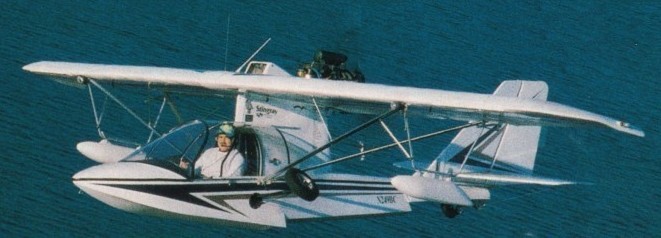
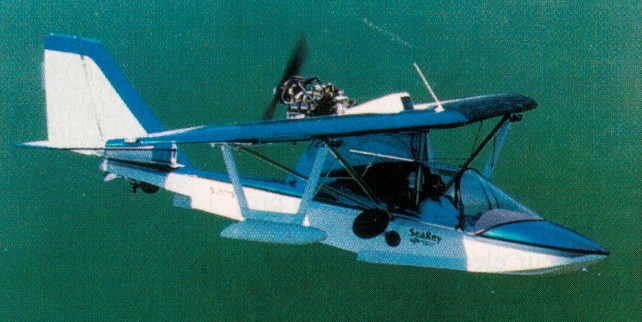
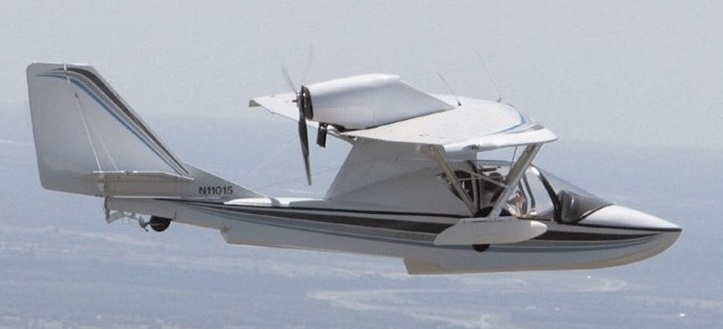
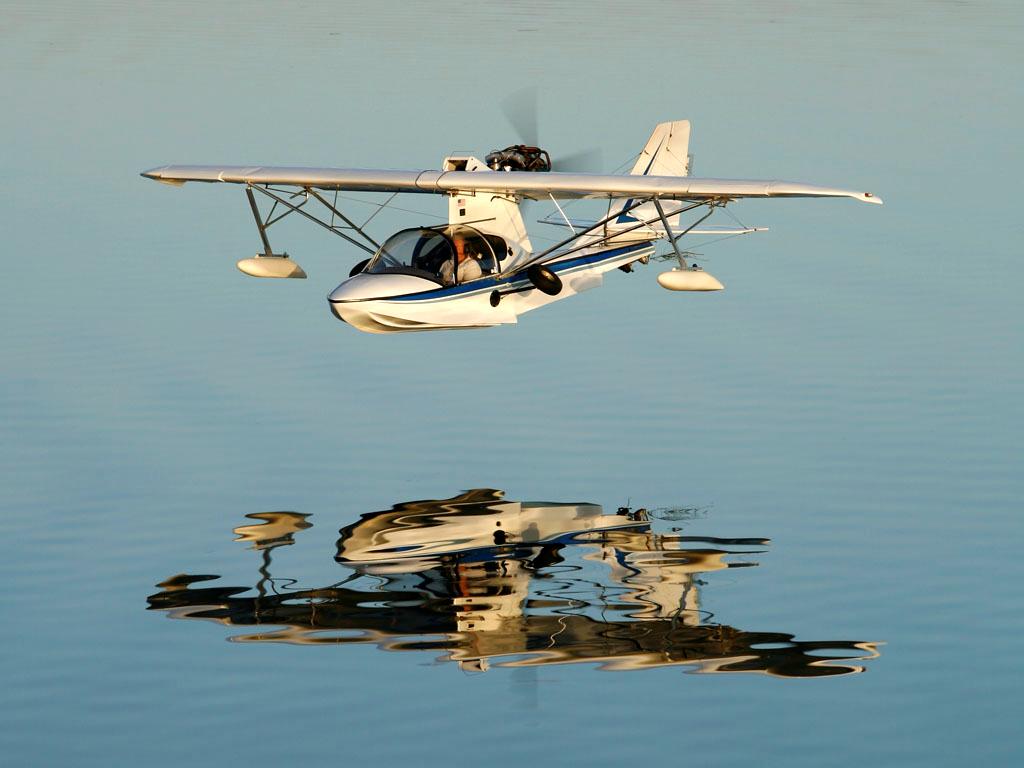
A side-by-side, high wing amphibian, related to the Adventure Air Adventurer 333. It is a high wing, pusher, tail dragger configuration, and a panoramic lexan cockpit. The wings are swept back at the leading edge with a straight trailing edge to form a tapered wing. The engine is mounted on top of the wing, which is supported above the fuselage by a vertical pylon.
The Cabin is designed with side-by-side seating. Entry into the cabin is through a sliding canopy into the 44 in/112cm cockpit. Dual flight controls enable flying from either seat. There is storage space behind the seats (L48 x W44 x H17 in.) for baggage.
The SeaRey is the ability to fly unaffected with the individual dual sliding canopies either opened or closed. The retractable landing gear handles unimproved grass runways. The take off roll on land at gross weight is about 375 feet (115m). Lift off takes place at around 45-50 mph (40 – 45 knots), and 65-70 mph (55-60 knots) is the best rate of climb speed. Rate of climb is 1,000+ ft per min (300m+ per min) Solo and around 800 feet per minute (245m per min) at gross weight.
In cruise the SeaRey settles at 90 mph (80 knots). Top speed is 113 mph (98 knots). Due to the installation of special leading edge extensions on the wings, the stall is very docile and the aircraft is spin resistant. Upon throttling back and applying 20 degrees of flaps, the aircraft slows to the stall speed of around 40 mph (34 knots). The stall is gentle and straightforward and recovery is conventional. The retractable undercarriage comes with a simple manual system or alternatively an electric mechanism. An over center lock mechanism is a feature of this simple design.
Best approach speed for a water landing is 65 – 70 mph (55-60 knots) with 10 degrees of flaps. Upon reaching short final, 20 degrees of flaps can be initiated to further slow the aircraft’s touch down speed on the water. Landing flare begins lower than conventional land-only aircraft. A nice touch down speed is 45-50 mph (40-45 knots). This lands the aircraft “on step” and produces very smooth contact with the water.
The SeaRey is capable of handling quite rough water conditions but until such time as the pilot has developed their seaplane water experience, operations in moderate conditions with wave size under 12 inches (30cm), is recommended.
With 20 degrees of flaps for takeoff the SeaRey will come “on plane” in around 4 seconds. A further 6 to 8 seconds to get airborne. The hull produces a very flat spray pattern preventing water from going through the propeller. Accelerating to 45-50 mph (40-45 knots) to rotate and lift off. Established in the climb and at a safe height, reduce the flaps to 10 degrees.
The LSA Searay has dual controls with electric trim, and engine options include 65, 74, 80, and 115 hp Rotaxs.
The basic kit was $21,900 less engine in 2000.
By 2012, the American-made SeaRey has been out in kit form for 21 years (600 kits delivered) and was also an S-LSA. The 2012 models were the Sport and Elite S-LSAs, and the LSX kit (E-LSA or EAB). Prices: US$144,000 (Elite); US$125,000 (Sport) and US$34,900 (LSX airframe-only kit).
1995-2007: 520 Clifton St, Orlando, FL 32808, USA.
Progressive Aerodyne was founded in 1991 by Kerry Richter and his business partners, Wayne Richter and Paige Lynette. With a long family history of building ultralight amphibious aircrafts, the company took the opportunity to create a new amphibious aircraft design and named it the Searey. Thus, the Searey took form and began flying in November 1992.
The next year, the Searey Classic was introduced to the general public and was very well received, assuring two years worth of orders for the company.
Progressive Aerodyne is a family business of Kerry Richter, and three generations of his family, together with their friend and partner Paige Lynette, all work in the company that has produced over 400 flying aircraft.
In 2009 Kerry is the President of the company and was in full time research and development of improvements to the SeaRey and of new aircraft designs for the future. A full time aeronautical engineer, Damir Blazevic has over 30 years engineering experience, the last 19 of which were with Airbus including on the Airbus 380 design. Damir has personally built over 9 aircraft, many of his own design. Damir’s specialty is quality control. The team works with state of the art computers and aircraft design software to ensure airworthiness and compliance with aviation standards.
In January 2010, a significantly improved model, the Searey LSX, was introduced to the aviation community. To date, close to 600 Searey Kits had been delivered to customers and over 500 are flying worldwide.
In May 2010, the company moved their headquarters from Orlando to Tavares, Florida, to facilitate its growth. A year later, Adam Yang, also a Searey pilot, owner, and builder, joined Progressive Aerodyne as CEO.
In June 2014, Searey expanded it global reach with the opening of its sales office in Shanghai, China, to support the sale of Searey Light Sport Amphibious Airplanes. The Searey was first presented to the China market at air shows in 2009, where interest in Searey airplanes was overwhelming. Since then, Progressive Aerodyne participated in subsequent air shows and invested in research and marketing in order to advance the Searey in China. The company is currently working with Chinese aviation authorities to gain certification of the Searey. The Shanghai office to manage all marketing and sales and work with government authorities in China.
Progressive Aerodyne in Tavares, Florida manufactures finished Searey seaplanes in full production of two configurations of Searey models, the Searey Sport and the Searey Elite, both of which have received FAA certification for airworthiness. In addition, the company continued to manufacture Searey Kit Airplanes.