Robertson B2-RD Instructor

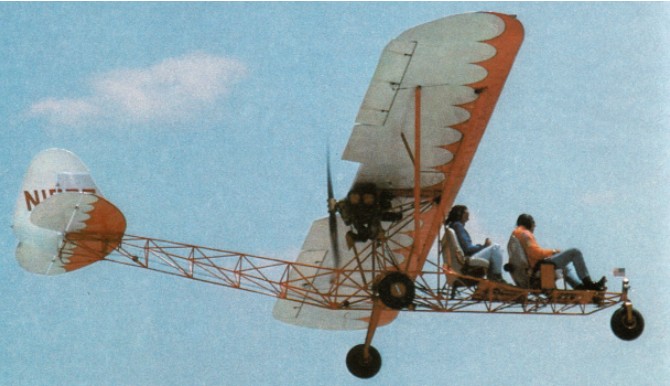
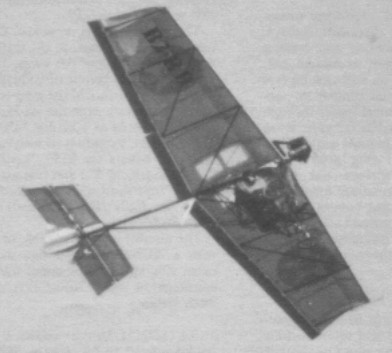
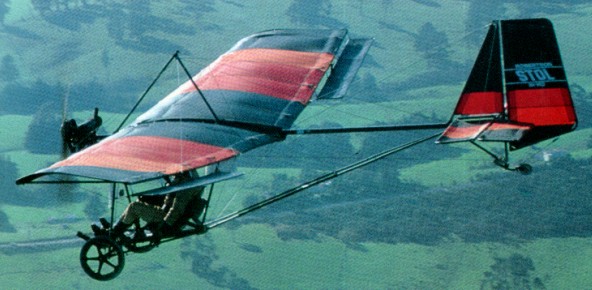
The B2 RD is the same as the B1-RD except: Side by-side two seater. Wing has swept back leading edge, swept forward trailing edge and tapering chord. Shown for the first time at Sun ‘n’ Fun in Lakeland, Florida in March 1983, the B2 RD is basically an extrapolation of the Bl RD concept, the principal differences between the two aircraft being the wing design and the power unit. The B2 RD wing uses a swept back leading edge and has a larger area and span than its single seat stablemate, while the Cuyuna engine is replaced by a Rotax 503. Being a two seater, the B2 RD is not classified as an ultralight in the US, and the company announced in April 1983 that the aircraft will only be sold to dealers.

Engine: Rotax 503, 42hp at 6200rpm
Propeller diameter and pitch 72 x 36 inch, 1.83 x 0.91 m
V belt reduction, ratio 2.7/1
Max static thrust 320 lb, 145 kg
Power per unit area 4.8 hp/sq.ft, 2.4 hp/sq.m
Fuel capacity 7.0 US gal, 5.8 Imp gal, 26.5 litre
Length overall 18.4 ft, 5.61 m
Height overall 8.0ft, 2.44m
Wing span 32.6ft, 9.93m
Chord at root 7.3 ft, 2.21 m
Chord at tip 5.0ft, 1.52m
Dihedral 3 deg
Sweepback 0 deg
Tailplane span 10.0ft, 3.05m
Fin height 3.0 ft, 0.91 m
Total wing area 190 sq.ft, 17.7 sq.m
Total aileron area 18.0 sq.ft, 1.67 sq.m
Fin area 3.0 sq.ft, 0.28 sq.m
Rudder area 13.0 sq.ft, 1.21 sq.m
Tailplane area 30.0 sq.ft, 2.79 sq.m
Total elevator area 15.0 sq.ft, 1.39 sq.m
Wing aspect ratio 5.6/1
Wheel track 5.0 ft, 1.52 m
Wheelbase 16.0 ft, 4.87 m
Tailwheel diameter overall 5 inch, 13 cm
Main wheels diameter overall 16 inch, 41 cm
Empty weight 325 lb, 147kg
Max take off weight 725 lb, 328 kg
Payload 400 lb, 181 kg
Max wing loading 3.81 lb/sq.ft, 18.6 kg/sq.m
Max power loading 17.3 lb/hp, 7.8 kg/hp
Load factors +3.0, 2.0 design
Max level speed 55 mph, 88 kph
Never exceed speed 75 mph, 121 kph
Max cruising speed 48 mph, 77 kph
Economic cruising speed 35 mph, 56 kph
Stalling speed 24 mph, 38 kph
Max climb rate at sea level 450 ft/min, 2.3 m/s
Min sink rate 300 ft/min at 30 mph, 1.5 m/s at 48 kph
Best glide ratio with power off 5.5/1 at 30mph, 48 kph
Take off distance 140 ft, 43 m
Land¬ing distance 100ft, 30m
Service ceiling 12,000 ft, 3660 m
Range at average cruising speed 110 mile, 177 km
Robertson B1-RD

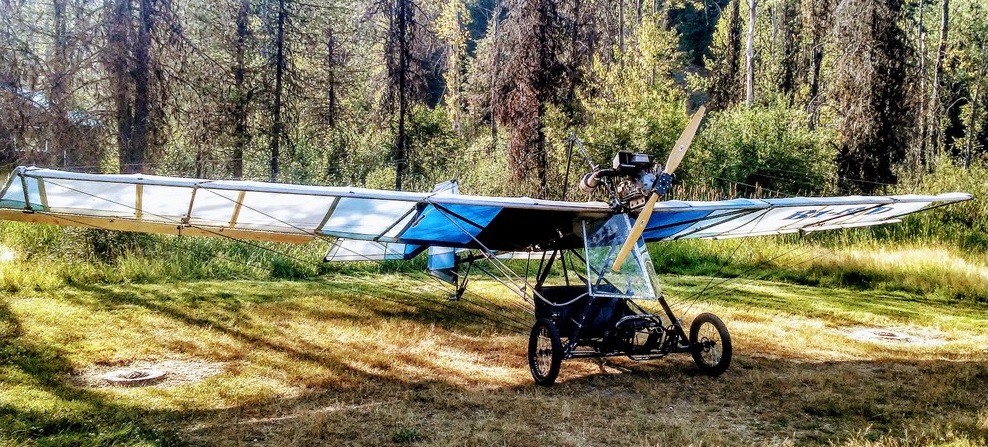
Single seat single engined high wing monoplane with conventional three axis control. Wing has unswept leading edge, swept forward trailing edge, and tapering chord; cruciform tail. Pitch control by elevator on tail; yaw control by fin mounted rudder; roll control by half span ailerons; control inputs through stick for pitch/roll and pedals for yaw. Wing braced from above by kingpost and cables, from below by cables; wing profile; single surface (double surface optional). Undercarriage has three wheels in tail dragger formation; nylon rope suspension on all wheels. Push right go right tailwheel steering connected to yaw control. No brakes. Aluminium tube/steel tube framework, with optional pod. Engine mounted at wing height driving tractor propeller.

Robertson B1-RD Article

Courtesy Greg Zupan

The B1 RD was designed by Glenn and Bruce Bashforth and the first production models were delivered in June 1982, production having begun at one per day but scheduled to increase up to two aircraft per day. The single seater has a remarkably low stalling speed for a semi rigid winged microlight, and is sold ready to fly for $6595 or as a kit for $5995 in 1983. The B1 RD in standard form originally had the Cuyuna 215R 20 hp engine and was only fitted with the 430R as an option, but this was later standard and could be replaced by the new ULII 02 Cuyuna.

A number of options are offered including custom sails, remote starter and choke kit for $50, 20 inch (51 cm) wheels $35, windscreen $50, chrome fenders and hardware $40, chromed axle $40, tow hook with quick release $50, strobe light $200, double surface wing $500, electric start $350, instruments, floats, parachute and storage bags.

Engine: Cuyuna 430R, 30 hp at 5500 rpm
Propeller diameter and pitch 72 x 36 inch, 1.83 x 0.91 m
V belt reduction, ratio 3.1/1
Power per unit area 0.19 hp/sq.ft, 2.0 hp/sq.m
Fuel capacity 4.0 US gal, 3.3 Imp gal, 15.1 litre
Length overall 21.0 ft, 6.40 m
Height overall 7.2ft, 2.18m
Wing span 32.0ft, 9.75m
Mean chord 5.1ft, 1.54m
Dihedral 3 deg
Sweepback 0 deg
Tailplane span 10.0 ft, 3.05 m
Total wing area 162 sq.ft, 15.1 sq.m
Total aileron area 18.0sq.ft, 1.67 sq.m
Fin area 3.0 sq.ft, 0.28 sq.m
Rudder area 13.0 sq.ft, 1.21 sq.m
Tailplane area 30.0 sq.ft, 2.79 sq.m
Total elevator area 15.0 sq.ft, 1.39 sq.m
Wing aspect ratio 6.3/1
Wheel track 5.0 ft, 1.52 m
Wheelbase 16.0 ft, 4.87 m
Tailwheel diameter overall 5 inch, 13 cm
Main wheels diameter overall 16 inch, 40cm
Empty weight 220 lb, 100kg
Max take off weight 500 lb, 227kg
Payload 280 lb, 127 kg
Max wing loading 3.09 lb/sq.ft, 15.1kg/sq.m
Max power loading 16.7 lb/hp, 7.6kg/hp
Load factors +3.0, 2.0 design
Max level speed 50 mph, 80 kph
Never exceed speed 75 mph, 121 kph
Max cruising speed 38 mph, 61 kph
Stalling speed 15 mph, 24 kph
Max climb rate at sea level 850 ft/min, 4.3 m/s
Min sink rate 300 ft/min at 30 mph, 1.5 m/s at 48 kph
Best glide ratio with power off 8.54 at 30 mph, 48 kph
Take off distance 75 ft, 23 m
Landing distance 50 ft, 15 m
Service ceiling 14,000 ft, 4270 m
Range at average cruising speed 125 mile, 201 km

Michele Davies
lvpetech@gmail.com
How do I get a hold of a Vintage B1RD two seater Trainer – manual so I can have all spec and how to build one. we have one that we need to check all specs on.
13 May 18

Roberts Cygnet

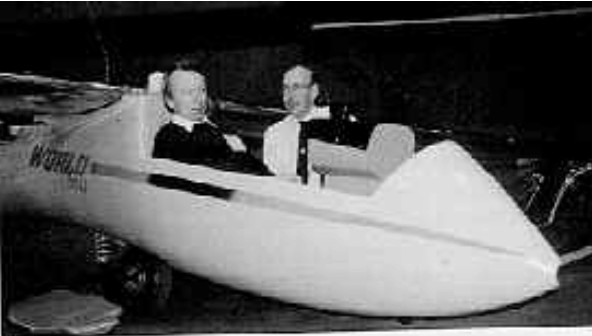
Designed by Donald Roberts, the Cygnet, which first flew in 1992, was the only U.S. entrant in the IGC/ OSTIC World Class sailplane design contest (won by the Polish designed PW-5). It has balanced DFS type airbrakes for approach control, and is fitted with a ballistic parachute emergency recovery system. The structure is steel tube and aluminum with GFRP fairings.

Wing span: 13 m / 42.65 ft
Wing area: 9.57 sq.m / 103 sq.ft
Aspect ratio: 18
Empty Weight: 165 kg / 364 lb
Payload: 110 kg / 242 lb
Gross Weight: 275 kg / 606 lb
Wing Load: 28.7 kg/sq.m / 5.88 lb/sq.ft
Water Ballast: 0 kg
Seats: 1
No. Built: 1

RLU RLU-1 Breezy / Breezy Aircraft RLU-1 Breezy

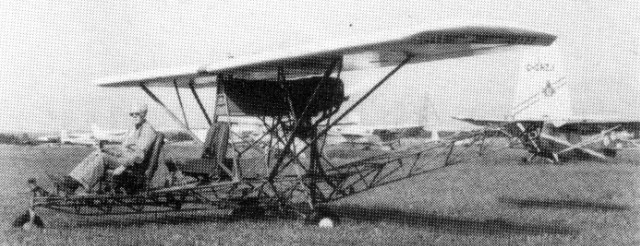
Designed and constructed by Charles Roloff, Carl Unger, and Bob Liposky, the Breezy was first introduced in 1965, and hailed as one of the most distinctive and unusual homebuilt designs to ever attend an EAA Fly-in.

RLU RLU-1 Breezy Article

The original Breezy was designed and built to accept a set of PA-12 wings. For that reason, there are no wing drawings with the plans. It is possible to substitute Champ, Taylorcraft, PA-14, PA-18, or J-3,4, or 5 wings. It’s also possible to order wing kits that replicate a J-3 wing. Breezy’s fuselage is an open framework steel tube truss. It is a three-place airplane with two seated abreast on the second seat, but it could easily be adapted as a single-seater or tandem two-seater.

Power for the prototype, which now hangs in the EAA Aviation Museum in Oshkosh, WI, is a Continental C-90. The original design utilizes a Piper Super Cruiser wing.

Plans could be purchased through:
Carl Unger, 8751 S. Kilbourn, Oak Lawn, IL 60456, USA.

Gallery

Engine 85-125hp
Span 33ft
Wing area 165 sq.ft
Length 22ft 5in
Max wt: 1200 lb
Empty wt: 700 lb
Fuel capacity 18 USG
Top speed 105 mph
Cruise 56kt
Stall 25 mph
ROC 500 fpm
Takeoff run 450 ft
Landing roll 450 ft
Range 250 mile
Seat: 2-3

Ritz Standard ‘A’

Strut-braced high wing monoplane, conventional tail, geodetic wing & tail construction. Landing gear: Tricycle. Price 1984: $2,495. Certified to PUMA standards.

Engine: 22 hp Zenoah
Wingspan 36’
Wing area 140 sq.ft
Empty weight 200 lb
Gross weight 500 lb
Cruise speed 30-50 mph
Stall speed 15mph
Vmax 65 mpg
Climb 400 fpm
Takeoff run 120 ft
Landing roll 200 ft
Setup time 15min

Rithner Garuda

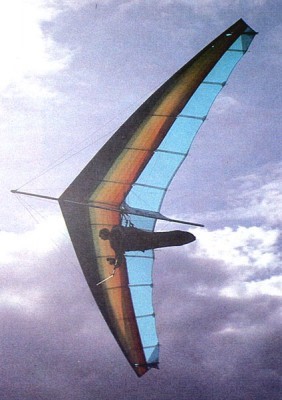
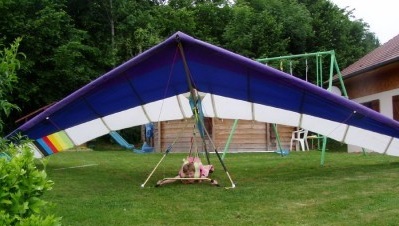
The 1984 Garuda (sometimes spelt Garouda) was a copy of the Sapphire of Bautek. Not a true copy but it was much cheaper which explains its popularity for advanced pilots.

Very good little wing, handy and light, with modest but respectable performances, wing made above all for a pleasure and pleasure of the maximum flight.

Wing area: 17 m²
Wing span: 10.8 m
Aspect ratio: 6.9
Hang glider weight: 32 kg
Minimum sink rate: 0.95 m/s
Packed length short: 3.2 m
Nose angle: 132°

Garuda 162
Wing area: 16.2 m²
Wing span: 10 m
Aspect ratio: 6.2
Hang glider weight: 26 kg
Packed length: 5.80 m
Packed length short: 2.50 m
Number of battens: 16
Nose angle: 130°

Rithner France

The Master and the 1984 France were absolutely identical, “inspired” of the Magic III, with 14 slats on the extrados and 4 laths of intrados. For reasons of pure marketing, E. Rithner sold this wing in France under the name of “France”.

Wing area: 15 m²
Wing span: 10 m
Aspect ratio: 6.65
Hang glider weight: 27 kg

Wing area: 16.37 m²
Wing span: 10.60 m
Aspect ratio: 6.80
Hang glider weight: 29 kg

Rihn DR-109

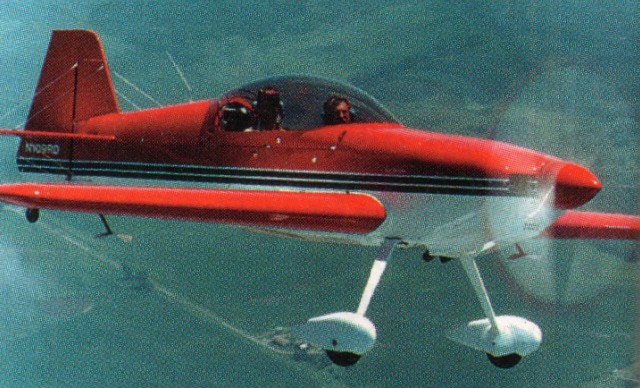
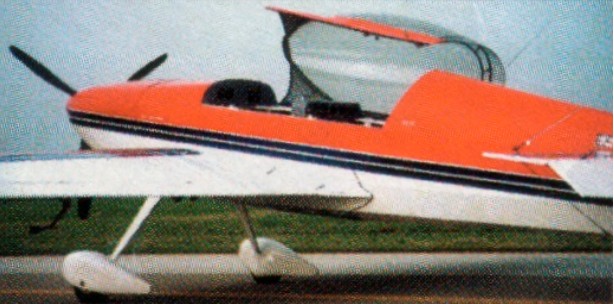
Dan Rihn’s Rihn 109 is a two-place tandem designed for aerobatic training, unlimited competition and airshow performances. Capable of handling Lycoming engines from 200 to 300 hp, the new design is said to feature excellent visibility, featherweight controls, a roll rate in excess of 360 degrees/second, and a load limit of +/- l0 G.

Construction of the DR-109 is a welded steel tube fuselage and tail group with fabric covering, fibreglass cowl, plywood covered wings, and a one piece spring steel gear. The wings feature Douglas Fir box spars and plywood ribs. The seats are adjustable in both the forward and rearward positions.

The Rihn 109 is designed with gyroscopic manoeuvres in mind.

Aircraft Spruce was selling the 109 in seven subkits. In 1996 the cost for the complete kit was US$50,000.

Engine: Lycoming, 200 hp
HP range: 200-300
Height: 5.5 ft
Length: 22 ft
Wing span: 24 ft
Wing area: 114 sq.ft
Fuel capacity: 30 USG
Empty weight: 1260 lb
Gross weight: 1950 lb
Top speed: 205 mph
Stall: 59 mph
Cruise: 168 mph
Range: 500 sm
Takeoff dist: 600 ft
Landing dist: 1500 ft
Seats: 2
Landing gear: tailwheel