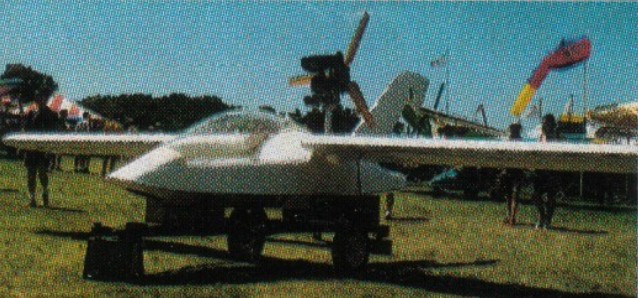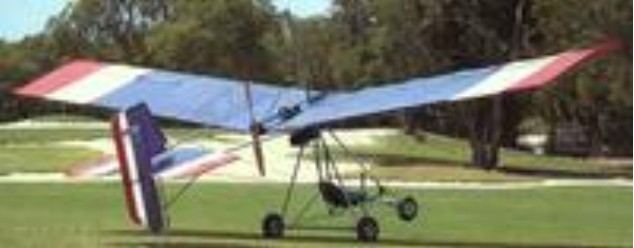
Seahawk Industries Condor

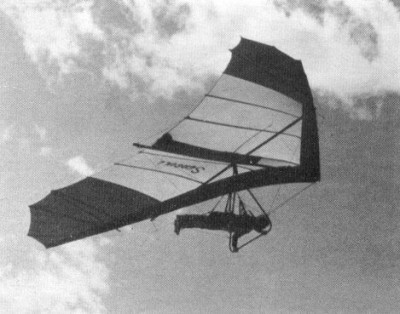
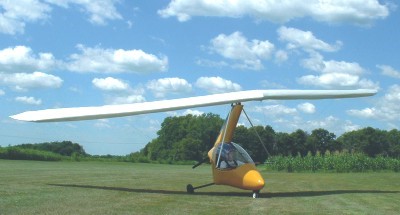
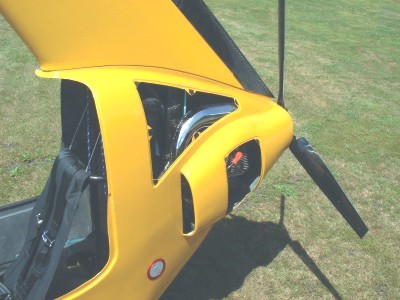
The Condor is a single-engine, high-wing monoplane has a cruciform tail and kingpost and cable braced single-surface wing. The Condor is controlled solely by weight shift. The engine is a twin-cylinder Kawasaki with 2.0 reduction is mounted in the center below the wing. Drive shaft to pusher prop is above the wing. The taildragger gear has torsion bar suspension. Fourteen-inch wheels have pneumatic tires.

The Condor II has three-axis aerodynamic controls include stick controls for elevator and spoilerons plus rudder pedals. The engine is a Kawasaki twin-cylinder 440 engine has 2.0 reduction and is mounted below the wing in the center. It drives a pusher prop of 54×32-inch wood. Some of the two seaters were equipped with Kawasaki liquid cooled engines of 80 hp. The taildragger gear has 14-inch main wheels with pneumatics and torsion bar suspension. The plane is has a single surface wing, and is wire braced. The kit came as a simple bolt together assembly taking approximately 75 hours to assemble.

The Condor single place and two place were produced up until about 1984.

Condor
Wingspan, 32 ft
Wing area 160 sq.ft
Empty weight, 164 lb
Wing loading, 2.06 lbs/sq.ft
Fuel capacity, 3.1 USG
Engine displacement, 440cc
Rated HP, 40 hp

Condor II
Wingspan, 32 ft
Wing area, 160 sq.ft
Empty weight, 196 lbs
Wing loading, 2.26 lbs/sq.ft
Fuel capacity, 3.1 USG
Engine displacement, 440cc
Rated HP, 40 hp

Condor
Stall: 22 kt / 25 mph / 40 kmh
Cruise: 30 kt / 35 mph / 56 kmh
VNE: 56 kt / 65 mph / 105 kmh
Empty Weight: 106 kg / 234 lbs
MTOW Weight: 215 kg / 475 lbs
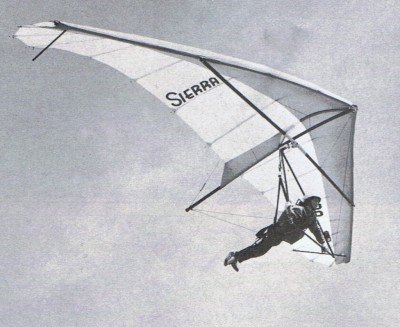
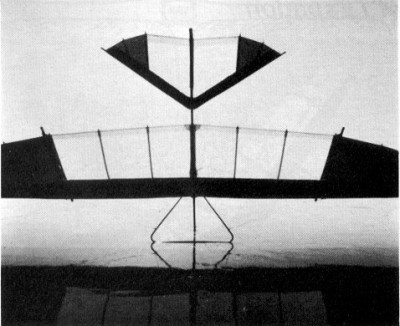
Seagull Aircraft Sierra

The Seagull Sierra, designed in 1980 by Tom Peghiny, was Seagull’s only double-surface glider. It was never offered for sale, as Seagull went defunct before the glider was HGMA certified. A few prototypes were flying in 1980; these were reported to have good performance but poor handling characteristics.

Seagull Aerosports Escape Pod / Pod Racer

Manufactured by Seagull Aerosports, the Escape Pod is the first fully enclosed trike with retractable landing gear. According to Michael Riggs is President and Founder of Seagull Aerosports the Seagull was designed “starting from a clean piece paper, trying to change the trike genre.”

Developed by Michael Riggs, Riggs’ company Seagull Aerosports, will fully build the Escape Pod and its unpowered sibling, the Pod Racer, buth weight-shift control with a fully enclosed cockpit. Since empty weight is well under Part 103’s 254-pound limit, ready-to-fly construction is completely proper.

The fuselage, or “pod,” is made from composite foam sandwich construction of PVC and graphite prepreg materials. The shape is vacuum-bag molded and oven cured for minimum weight and maximum strength. The complete lower shell and main structural bulkhead weigh only 16 pounds out of the mold, and the entire trike chassis weighs less than 80 pounds with engine and parachute. The bottom of the fuselage is flat so that if an outlanding is necessary and terrain does not encourage use of the gear, a belly landing can be made. In addition, the shape of the nose will prevent shoveling and possible flipover. A foam crush zone forward of and under the pilot adds another layer of protection as does a four-point seat restraint system.

The tricycle gear is fully retractable, which were allowed under Part 103 though not for LSA. Maingear legs are made of a filament wound graphite, and the gear is retracted using racing catamaran hardware.

Abandoning the forward tube, the Escape Pod uses a streamlined, tapered composite mast that has enough vertical area to provide yaw stability for high performance hang glider wings.

The Pod has been designed for full enclosure in a molded acrylic canopy with graphite frames. To facilitate control movements, the triangular control bar passes through a Neoprene-covered slot running fore to aft in the canopy following the control bar’s arc, thus accommodating a full range of motion.For summer use or if customers prefer, a shorter summer windscreen was also to be available. The fuel tanks are mounted internally and the engine is fully enclosed.

A rocket-deployed parachute is mounted on the rear of the main structural bulkhead and fires through a hatch on the side. The handle is on the floor between the pilot’s legs (and emergency responder labels.

The Escape Pod is powered by a 25-hp Cors-Air M-21Y and Powerfin three-blade propeller. An unpowered variation, called the Pod Racer, is also available and is launched via a winch or aerotow.

The powered Escape Pod and unpowered Pod Racer can be used with any hang glider wing that will accommodate the weight of chassis, pilot, engine, fuel and parachute system.

Like most trikes, the Escape Pod can be broken down small enough for storage in your garage or in the corner of your hangar. Its light weight will allow loading to trailer or pickup.

Riggs was anticipating that the Escape Pod would fly by the fall of 2004

Seagull Aerosports

Michael Riggs

Michael Riggs is President and Founder of Seagull Aerosports. He holds degrees in Aerospace Engineering and Industrial Design. His experience includes 25 years in consumer product development with annual line responsibilities reaching more than $400 million. He has achieved executive management at the vice president level. He has designed, built and flown several aircraft. In 1969, he founded and operated for nine years what became one of the largest international manufacturers of hang gliders and accessory equipment. In 1981 Riggs designed, built and flew an aircraft prototype intended to fit the then new FAA Part 103 Ultralight Rules. He is a founding member of the United States Hang Gliding Association, and he has served as a director of that organization. He is also the co-founder of the United States Hang Glider Manufacturers Association (HGMA), responsible for establishing aerodynamic and structural standards for hang glider aircraft. He is a highly decorated Army gunship pilot with two Vietnam tours.

Seaflight (NZ) Shearwater

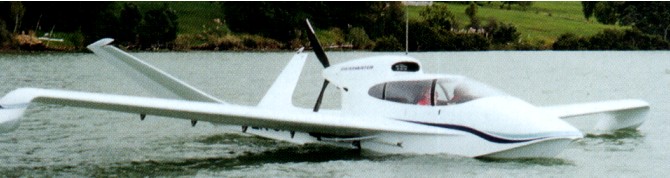
The desire to have a four-seat amphibian led to the development of the Seaflight Shearwater ZK-SFA. Designed by Bill Townson over a three-year period via a series of 1/5th scale models

Construction began in 1997 and incorporated a PZL-built development of the 210 hp Franklin pusher engine mounted lower than normal. This required a lower, cut down rear fuselage. The aircraft is equipped with a V-tail.

Registered ZK-SFA, the Shearwater first flew in November 2001, piloted by Andrew Buttle.

SeAero 1

First flown in September 1997.

Engine: Zenoah G50, 42hp
HP range: 21-65
Gross Wt. 550 lb
Empty Wt. 289 lb
Fuel capacity 5 USG
Wingspan 26.5ft
Length 17.3ft
Wing area: 109sq.ft
Height: 5.8 ft
Seats: 1
Top speed: 63 mph
Cruise speed: 63 mph
Stall: 24 mph
Range: 90sm
Climb rate: 1100 fpm
Ceiling: 19,000 ft
Takeoff run: 101ft
Landing roll: 169ft