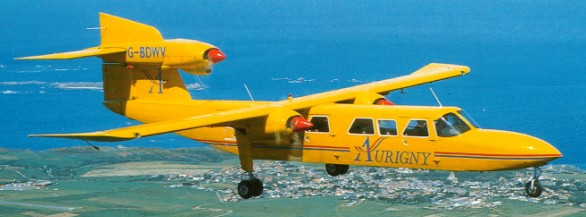
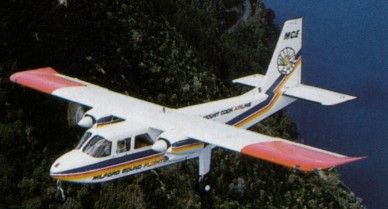
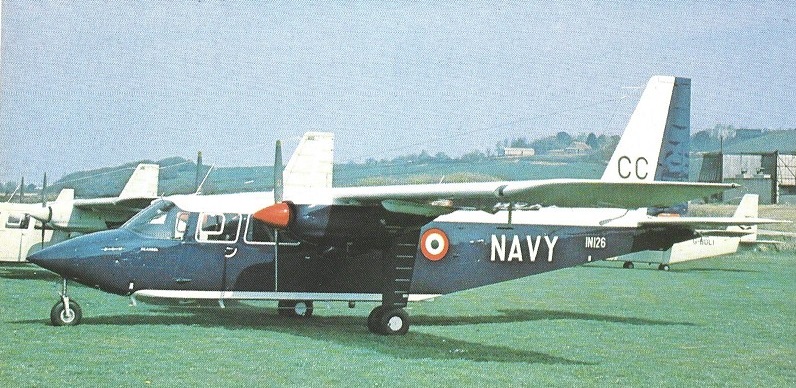
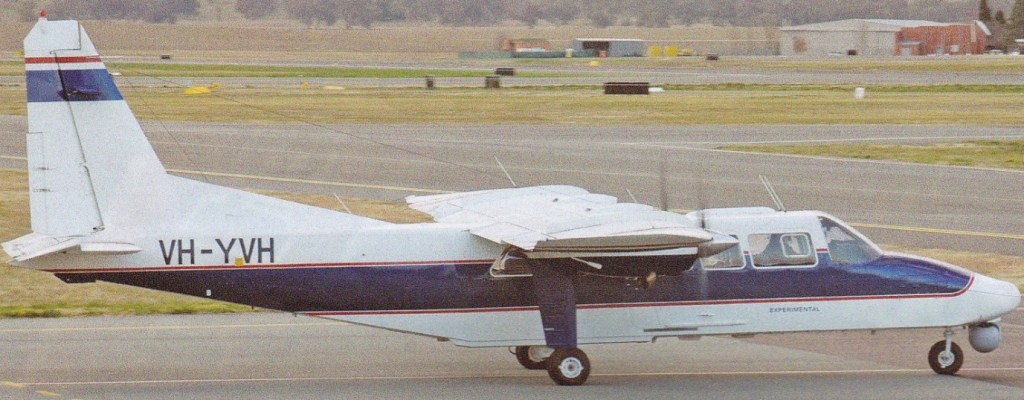
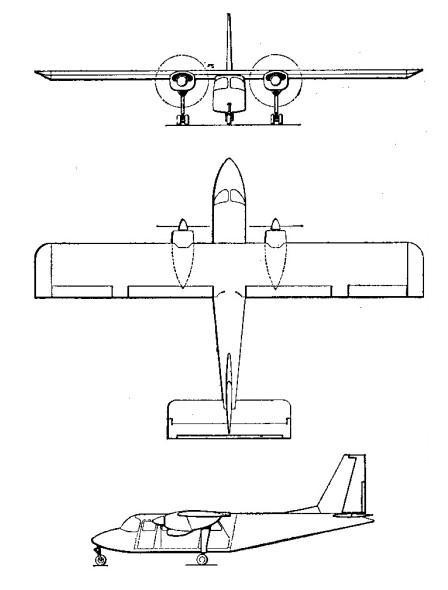
The Trislander was born out of the Islander concept during 1970. The creation of a Trislander involved a larger and strengthened tail fin, a stronger rear fuselage structure, new main landing gear units and the insertion of a 2.29 fuselage “plug” to create space for 17 passengers and a pilot. Designated BN2A Mk.III, the prototype first flew in September 1970. Full UK CAA certification came in May 1971 and the first delivery came on 29 June, less than 300 days after the prototype first flew. Some 73 Trislanders were manufactured but the downturn in general aviation in the late 70s and upheavals at Britten Norman led to the production line at Gosselies being closed down and subsequently new owner, Pilatus, decided to withdraw the jigs and tooling from Belgium. The aircraft was still selling albeit slowly and did not promise to provide a significant return on invest-ment. The Trislander was placed on hold. In August 1982 production rights were sold to the International Aviation Corporation based in Miami, Florida. Included in the deal were eight complete aircraft and components for a further twelve aircraft. IAC renamed the aircraft the Tri Commutair and announced their intention to deliver 35 aircraft by July 1984 as well as a turbine variant. It is thought that production was never initiated. BN2A-2 Mk.III Trislander has a long nose, droop flap and wing tip tanks. The commuters are powered by three 260 hp Lycoming O 540-E4C5 engines, have a wingspan of 53 feet and a MAUW of 10,000 lbs. With an airframe that is 75% common with the twin engined BN2. The Mk.III-2 versions incorporated a longer nose and forward baggage compartment.
In 1962 the two partners, John Britten and Desmond Norman, decided to build a plane of their own. The essential factors were low cost, all-weather construction, twin engine reliability and a good payload. The design was of classic simplicity: a one-piece wing with no dihedral, Hoerner-type tips, slab-sided fuselage with seating for up to 10 passengers. The prototype was powered by two 210-hp Continental engines with a fixed tricycle undercarriage. Bench-type seats for two people eliminated the need for a central aisle and these were accessed by three doors, two port and one starboard, with the rear door being of extra width to allow ease of cargo loading. The Islander can also be operated as a freighter carrying more than a ton of cargo. Passenger baggage is stored in a large 30 cu.ft. bin behind the cabin with an access door on the port side. The first metal was cut in September 1964 and the aircraft was hand crafted on a “Dexion” jig. The prototype took to the air for its first flight of 70 minutes on 13 June 1965 with both John Britten and Desmond Norman at the controls. There were some shortcomings which an increase in wing span by 1.22 metres and more powerful Avco Lycoming 260-hp engines cured.
A choice of wings was offered, so the plane could be fitted with the standard 49-foot-span wings or extended 53-foot wings, using raked tips and auxiliary fuel tanks. Delivery of the Islander began in August 1967, but the great number of orders from over 50 countries forced Britten-Norman to subcontract manufacture of a number of the mini-airliners to the British Hovercraft Corporation. Others were produced in Romania by IRMA which was then trucked to Bembridge for completion. Buyers were able to choose Lycoming engines: 260 or 300 hp. A Rajay turbocharging unit increased the Islander’s twin-engine ceiling to 26,000.
Britten Norman developed two other variants for demonstration at the 1976 Farnborough Show, the “Firefighter” and “Agricultural Islander”. While both designs proved themselves technically, no orders were forthcoming and the variants were shelved. Arrangements were made with Rornaero in Bucharest, Romania, to produce the airframes. The engines, propellers, and undercarriage are trucked across Europe to where the aircraft are assembled under UK CAA supervision then, with basic instrumentation and a pilot’s seat fitted, the aircraft is flown in dull grey primer to Bembridge to be completed to customer’s requirements. The BN-2 Super was developed by inserting a 33-inch plug in the fuselage of the production prototype, G-ATWU, allowing for an additional row of seats, however, the version was never put into production. To increase the Islander’s hot and high performance Lycoming IO-540K 300-hp fuel-injected engines were fitted. Another modification involved fitting wingtip tanks which increased the span to 53 feet while droop flaps and droop leading edges increased performance. The first turbine powered Islander flew in April 1977. Designated the BN2A-41, it was powered by Lycoming LTP 101 turboprops and, although its performance was described as “sparkling”, it was overpowered and the fitting of the engines required major wing modifications. The project was discontinued. In 1980 the production BN2T Turbine Islander took off with Allison 250 B17C engines. Wing fences were fitted to improve stall recovery and the prototype headed off for hot and high in Kenya and to Finland for cold weather trials. Pilatus introduced a beefed up Islander, the BN2B, featuring a 300 pound increase in landing weight, including the BN-2B-20 and BN-2B-26.
In 1979 it was decided to diversify, looking at different roles as against taking people. Those sort of roles are fisheries protection, border patrol and parachuting etc. In 1978 they looked at putting a more sophisticated airborne radar into the aircraft, entering into a joint venture with Thorn EMI, using their Skymaster radar to increase the ground warning time from three or four minutes to 20 30 minutes. The name “Defender” came at that point, referring to an Islander with four wing mounted hardpoints. Stressed to take 750lbs on the inboard pair and 350lb outboard, the hardpoints designed to carry long range fuel tanks or military stores.
Available with 260 hp, turbo-charged 260 hp, or 300 hp engines, and optional 28 cu.ft. capacity nose extension.
Defender – For general military duties PBN developed the Defender from the basic piston-engined Islander utility aircraft and, with the introduction of the Allison 250-B17C powered Turbine Islander, a parallel turbine Defender was offered. The Defender is capable of a wide range of military roles including troop trans¬port, SAR, forward air control, electronic warfare, logistic support, and medevac.
Operationally launched by PBN on March 6, 1987, The AEW Defender is a low-cost AEW system offered in conjunction with Thorn-EMI’s Skymaster lightweight multi-mode pulse-Doppler track-while-scan radar. Acquisition and tracking of targets is auto¬matic, and air-to-air/air-to-ground datalinks, 1FF and navigation systems may be fully integrated with the radar’s display and control system. The Skymaster system can also be used to detect surface vessels during maritime reconnaissance missions. A large undernose radome houses the 360’-scan antenna. With appropriate computer software modifications, the AEW Defender/Skymaster combination is being offered as a solution to the British Army’s Astor requirement for an airborne battlefield surveillance radar. The British Army has bought Defender AL Mk 1s to replace Beavers.Another Defender has been flown with a Ferranti surveillance radar installed in connection with the Army’s earlier Corps Airborne Stand-Off Radar (Castor) requirement. The AEW Defender is based on the BN-2T Turbine Defender airframe.
The Maritime Defender is designed for coastal patrol, fishery and oil rig protection, and SAR durties. The Maritime Defender has Bendix RDR-1400 search radar in the nose, and four under-wing pylons to carry weapons, survival packs or other items. Either 6600 lb maximum all up weight piston engined or 7000 lb MAUW turbine powered, the aircraft comes with both Omega and short range sector scan radar.
The Defender was officially added to the ranks of the British Army on March 10th, 1989. Design is wholly utilitarian and is most characteristically defined by the high-mounted monoplane wings. Each wing maintains an Allison 250-B17F turboprop engine powering a three-bladed propeller. The cockpit compartment is held well forward in the squared off fuselage with slab sides and features a useful sloped nose for improved downward visibility. The undercarriage is a conventional tricycle arrangement and made up of two double-tired main landing gear legs and a single-tired nose landing gear leg – as a whole, the undercarriage is non-retractable. The empennage is dominated by a single large-area vertical tail fin clipped at the top and sporting some sweep along the leading edge. Horizontal tailplanes are affixed to the vertical fin tail. Typical accommodations are for two pilots and up to six passengers. Entry/exit is via side doors, two forward and two aft. Her gross weight is listed at 7,000lbs. Each wing can field four hardpoints for various munition options to include gun pods, rocket pods and bombs if need be or external fuel tanks for extended loitering times and operational range. Specialized reconnaissance and surveillance mounts are fitted with applicable tailored equipment, cameras and jamming pods as well as communications options. Airborne Early Warning (AEW) Defenders sport a hideous-looking nose radome that quickly identifies the type and its role.
In 2003, the UK military purchased three (some sources state four) Defenders to help with the deteriorating conditions in Iraq following the 2003 coalition invasion. These aircraft carried the designation of Defender 4S AL Mk 1 and sported underwing dispensers to protect against surface-to-air guided munitions. This model was furthered defined by the implementation of an electro-optical turret under the extreme end of the nose.
The Defender 4000 is a military version of the Defender series and first flight of this system was achieved in August of 1994. The Defender 4000 features a larger wing component similar to that of the Trislander and operates with increased weight tolerances. Her engines are more powerful than previous versions and has an enlarged nose section for the fitting of search radar. Top speed is a reported 225 miles per hour.
BN-2T-4S Defender 4000
By 1990, over 1,100 Islanders have been built with Lycoming piston engines or, in the BN-2T Turbine Islander, two 400 shp (298 kW) Allison 250-B17C turboprops.
In 1970, Britten-Norman introduced an enlarged version of the twin-engine Islander with a third engine mounted high on the tail in a tractor position. The three engines were 260-hp 0-540-E4C flat-sixes turning Hartzell two-blade constant-speed fully feathering propellers. Three versions of the Trislander are the BN-2A Mk 111-2 (a standard version with extended nose baggage compartment), the BN-2A Mk 111-3 (with an automatic feathering system for the props), and the BN-2A Mk 111-4 (with a rocket engine for additional thrust if an engine fails on takeoff).
Britten Norman BN-2 Islander (1968) Powerplant: two Lycoming O-540-E4B5, 260 bhp Propellers: Hartzell constant-speed feathering two-blade 80 in diameter. Wingspan, 49 ft Length, 35 ft 71 in Height, 13 ft 8 in Gross wing area, 325 sq.ft Max. usable floor area, 43.4 sq.ft Max. usable cabin volume, 140 cu.ft Max. cabin length, 160 in including flightdeck Max. width, 43in Max, height, 51 in. Accommodation: max. high density seating 9 passengers and pilot at 30 in pitch Basic operational weight, 3280 lb Total fuel, 800 lb Max. take-off, 5500 lb Max. landing, 5500 lb Max. payload (volume limited), 1920 lb Max. zero fuel, 5200 lb Power loading (max. take-off weight), 10.6 lb/hp Wing loading (max. take-off weight), 16.95 lb/sq.ft Wing loading (max. landing weight), 16.95 lb/ft High-speed cruise, 138 kt. at 6500 ft Long-range cruise, 132 kt. at 13,000 ft Approach speed, 62 kt Take-off field length, ISA at sea level, 1000 ft Landing field length, ISA at sea level, 990 ft Range with allowances, max. fuel, 1450 lb payload, 738 nm
BN2A-8 Engine: 2 x Lycoming O-540-E4C5, 260 hp. Seats: 10. Wing loading: 19.6 lb/sq.ft. Pwr loading: 12.7 lb/hp. Gross wt: 6200 lb. Empty wt: 3400 lb. Equipped useful load: 2449 lb. Payload max fuel: 1633 lb. Range max fuel 75% pwr: 564nm/4hr. Range max fuel 55% pwr: 625nm/5.3hr. Service ceiling: 13,000 ft. 75% cruise: 139 kt. 55% cruise: 119 kt. Vmc: 39 kt. Stall: 44-50 kt. 1.3 Vso: 57 kt. ROC: 950 fpm. SE ROC: 170 fpm @ 65 kt. SE service ceiling; 4450 ft. Min field length: 1160 ft. Fuel cap: 816 lb.
BN2A-9 Engine: 2 x Lycoming O-540-E4C5, 260 hp. Seats: 10. Wing loading: 20.3 lb/sq.ft. Pwr loading: 12.12 lb/hp. Gross wt: 6,300 lb. Empty wt: 3250 lb. Equipped useful load: 2699 lb. Payload max fuel: 1523 lb. Range max fuel/75% pwr: 856nm/6.1hr. Range max fuel / 55% pwr: 934nm/7.9hr. Ceiling: 13,000 ft. 75% cruise: 139 kt. 55% cruise: 119 kt. Vmc: 39 kt. Stall: 44-50 kt. 1.3 Vso: 57 kt. ROC: 950 fpm. SE ROC: 170 fpm @ 65 kt. SE ceiling: 4450 ft. Min field length: 1160 ft. Fuel cap: 1176 lb.
BN-2A-20 Engine: 2 x Lycoming IO-540-K1B5, 300 hp. Seats: 10. Wing loading: 19.6 lb/sq.ft. Pwr loading: 11 lb/hp. Gross wt: 6560 lb. Empty wt: 3640 lb. Equipped useful load: 2569 lb. Payload max fuel: 1753 lb. Range max fuel 75% pwr: 534nm/3.6hr. Range max fuel 55% pwr: 609nm/4.7hr. Service ceiling: 18,000 ft. 75% cruise: 147 kt. 55% cruise: 131 kt. Vmc: 39 kt. Stall: 44-50 kt. 1.3 Vso: 57 kt. ROC: 1130 fpm @ 57 kt. SE ROC: 225 fpm @ 75 kt. SE service ceiling; 3,100 ft. Min field length: 1100 ft. Fuel cap: 816 lb.
BN-2A-21 Engine: 2 x Lycoming IO-540-K1B5, 300 hp. Seats: 10. Wing loading: 20.3 lb/sq.ft. Pwr loading: 11 lb/hp. Gross wt: 6600 lb. Empty wt: 3695 lb. Equipped useful load: 2554 lb. Payload max fuel: 1378 lb. Range max fuel 75% pwr: 799nm/5.4hr. Range max fuel 55% pwr: 924nm/7.1hr. Service ceiling: 18,000 ft. 75% cruise: 147 kt. 55% cruise: 131 kt. Vmc: 39 kt. Stall: 44-50 kt. 1.3 Vso: 57 kt. ROC: 1130 fpm. SE ROC: 225 fpm @ 75 kt. SE service ceiling; 3,100 ft. Min field length: 1100 ft. Fuel cap: 1176 lb.
Britten-Norman BN-2A-21 Maritime Defender Engines: 2 x Avco Lycoming IO-540-K1B5, 300 hp Length: 36.319 ft / 11.07 m Height: 12.402 ft / 3.78 m Wingspan: 53 ft ft / 16.15 m Wing area: 342.295 sq.ft / 31.8 sq.m Max take off weight: 6593.0 lb / 2990.0 kg Weight empty: 4013.1 lb / 1820.0 kg Max. speed: 157 kts / 290 km/h Cruising speed: 148 kts / 274 km/h Service ceiling: 18045 ft / 5500 m Endurance (2 x 56 Imp.Gal. drop tanks): 15 hr.
BN2B First built: 1967. Engine: 2 x Lycoming O-540-E4C5, 260 hp. TBO: 2000 hrs. Prop: Hartzell 2 blade, constant speed 80 in. Seats: 10. Length: 35.7 ft. Height: 12.4 ft. Wingspan: 49 ft. Wing area: 325 sq.ft. Wing aspect ratio: 7.4. Max ramp wt: 6600 lbs. Max take off wt: 6600 lbs. Standard empty wt: 3612 lbs. Max useful load: 2988 lbs. Max landing wt: 6300 lbs. Wing loading: 20.3 lbs/sq.ft. Power loading: 11 lbs/hp. Max useable fuel: 1176 lbs. Climb rate: 1130 fpm @ 65 kts. Climb gradient: 1043 ft/nm. Rate of climb @ 8000 ft: 550 fpm. Service ceiling; 18,000 ft. SE rate of climb: 225 fpm @ 62 kts. SE climb gradient: 218 f/nm. SE ceiling: 7000 ft. Max speed: 139 kts. Cruise @ 65% power @ 8,000ft: 135 kts. Fuel flow @ 65% power @ 8,000ft: 160 pph. Endurance @ 65% power @ 8,000ft: 7.1 hr. Stalling speed clean: 49 kts. Stall speed gear/flaps down: 42 kts. Turbulent air penetration speed: 107 kts. Fixed undercarriage. Wing load: 19.27 lb/sq.ft / 94.0 kg/sq.m Maximum range: 1134 nm / 2100 km Crew: 2+2 Payload: 8Pax / 1015kg
BN-2T Engines: 2 x Allison 250-B17C
Turbine Defender Engine: 2 x Allison 250 600 kW, 480 kW. Span: 14.9 m. Length: 10.9 m. Wing area: 30.2 sq.m. Empty wt: 1914 kg. MTOW: 3175 kg. Payload: 1270 kg. Cruise speed: 285 kph. Initial ROC: 320 m / min. Ceiling: 7620 m. T/O run: 225 m. Ldg run: 228 m. Fuel internal: 814 (+454) lt. Range: 1350 km. Capacity: 10 pax.
Britten-Norman BN2T-4S Defender 4000 Engines: 2 x Allison 250-B17F/1 turboprop, 400 shp Props: 3 blade, 80 in. Length: 35.86ft (10.93m) Width: 48.98ft (14.93m) Height: 13.78ft (4.20m) Maximum Speed: 225mph (362kmh; 195kts) Max cruise: 178 kts ROC: 1210 fpm. SE ROC: 223 fpm Maximum Range: 437miles (703km) External Fuel Tanks capacity: 2,500lbs Accommodation: 2 + 6 Hardpoints: 4 Empty Weight: 4,998lbs (2,267kg) Maximum Take-Off Weight: 8,499lbs (3,855kg)
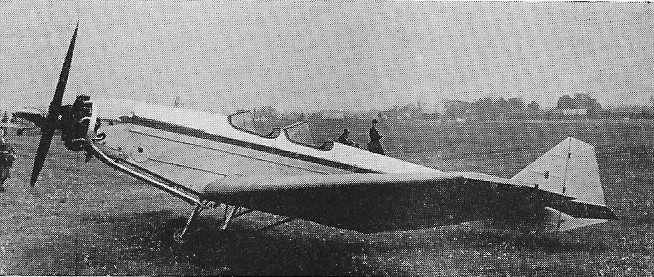
In 1951 John Britten and Desmond Norman designed and built and flew an ultra-light monoplane, their first aircraft, which made its first flight at Bembridge, Isle of Wight, on 16 May 1951. This machine crashed on an early flight, when the petrol supply to the 40 hp Aeronca JAP J-99 twin cylinder air-cooled engine faded out. Modifications were made to the tail unit by adding smll ancillary fins to improve the directional stability, inset ailerons were fitted, the JAP engine was replaced by a 55-hp Lycoming horizontally-opposed twin and the undercarriage was replaced with braced arrangement with rubber bungee springing. It was first flown in this form in May 1951 and was withdrawn from use in 1953. It was then on exhibition in the Solent Sky Museum, Southampton, England, on loan from Michael Short of Austin Texas, USA. The general arrangement of the BN-1 is similar to that of the Comper Swift in particular G-ABUS, an aircraft that Desmond Norman was associated with along with fellow de Havilland Technical School apprentice, Tony Cole, that they jointly acquired in 1948 and restored to flying condition.
Engine: 1 × Lycoming flat-four, 55 hp (41 kW) Propeller: two-bladed fixed-pitch Length: 16 ft 7 in (5.06 m) Wingspan: 23 ft 0 in (7.01 m) Height: 10 ft 5 in (3.18 m) Gross weight: 630 lb (286 kg) Maximum speed: 84 mph (135 km/h) Cruise speed: 75 mph (120 km/h) Crew: 1
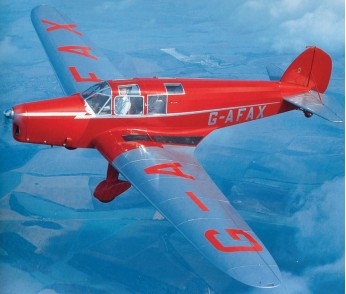
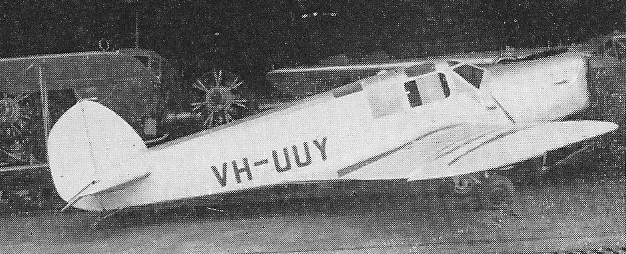
A version of the Klemm KI 32 redesigned in England by G H Handasyde was built in the UK by the British Klemm Aeroplane Co (later renamed British Aircraft Manufacturing Co) under the name Eagle; this was powered by a 130 hp de Havilland Gipsy Major engine. The BA Eagle II was produced with both fixed and retractable undercarriages and normally powered by a 130 hp de Havilland Gipsy Major engine. The cabin seated three, two on a bench seat at the rear.
BA Eagle II
Forty-two Eagles were built at Hanworth Aerodrome, Middlesex, to 1937.
British-Klemm BKA Eagle 1 Engine: de Havilland DH Gipsy Major, 130 hp Max level speed: 148 mph Cruise speed: 130 mph Absolute ceiling: 16,000 ft Range: 650 miles Seats: 3 Price 1934: £1250
BA Eagle II Engine: 130 hp de Havilland Gipsy Major Wingspan: 39 ft 3 in Length: 26 ft Height: 6 ft 9 in Empty weight: 1450 lb Loaded weight: 2400 lb Max speed: 148 mph Cruise: 130 mph ROC: 700 fpm Range: 650 mi Seats: 3
The Swallow design sterns directly from the German Klemm monoplanes first flown in 1927. Their popularity spread to Britain and thirty were sold there by 1933. They were comfortable and safe, if slow, aircraft, and the demand prompted Major E. F. Stephen of S. T. Lea Ltd, who had the selling rights, to produce a strengthened version with Salmson or Pobjoy engines.
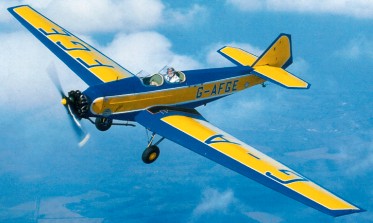
He formed the British Klemm Aeroplane Company Limited at Hanworth in 1953 and by the end of that year the prototype, G-ACMK, powered by the Salmson A.D.9 radial, had flown. This and the following 27 aircraft were known as B.K. Swallows. In 1935, the year the company changed its name to the British Aircraft Manufacturing Co, a new version appeared. It closely resembled the B.K. Swallow but was more angular in appearance, with all the curves straightened in the wings, rudder, tailplane and fuselage top decking. Most of these B.A. Swallow 2s were powered by Pobjoy Cataract engines and G-AFGE was the 71st and last Pobjoy Swallow built.
A further version, the Cirrus engined Swallow 2, was produced in large numbers prior to WW2.
Late production Cirrus Minor powered G-AEMW was fitted with a cockpit canopy.
The Swallow 2 of 1937 was the last of the Pobjoy-engined aircraft.
Swallow II Engine: Cirrus Minor.
British-Klemm L25C-1A Swallow Wingspan: 42 ft 8.5 in Length: 27 ft Height: 7 ft Engine: Pobjoy Cataract II, 85 hp Empty weight: 990 lb Loaded weight: 1500 lb Max speed: 104 mph Cruise speed: 90 mph ROC: 800 fpm Absolute ceiling: 17,000 ft Range: 420 miles Price 1934: £695
A single-seat light aircraft, modified from a B.A.C. VII sailplane. The rear cockpit was deleted, and a 600cc Douglas engine was mounted on a pylon on top of the wings, driving a pusher prop.
The first Planette flew in Autumn of 1932 and the type was further developed, and put into production as the B.A.C. Drone.
It is recorded that in 1936 the British Aircraft Co. (1935) Ltd produced a prototype Flying Trainer single-engine, single seat, primary training monoplane.