The Brown Aeronautical Company of Baltimore, Maryland built its second hydroplane design, aptly named Lord Baltimore II in 1911. This design is sometimes described as an amphibian, but this cannot be proved from the photograph. The design had a strong similarity to the Curtiss Hydroplanes, a not uncommon feat as these Curtiss designs were leading the field.
Carl Dryden Browne, formerly one of the “generals” in the famous Coxey Army of unemployed men who marched on Washington in 1894, built what he called an octoplane. It was equipped with a stationary elliptic plane, running lengthwise of the machine, measuring 4 feet at its widest part and tapering to a point at each end, designed to act as a stabilizer. The motive power was furnished by a 30-horsepower motor, operating a tractor propeller and two large four-bladed revolving planes on each side, similar to the paddles of a sidewheel steamer. The span of the machine was 26 feet and the length 28 feet. The elevating and vertical control surfaces were similar in shape and operation to those of a standard Curtiss.
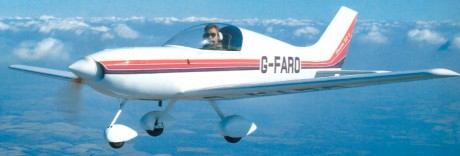
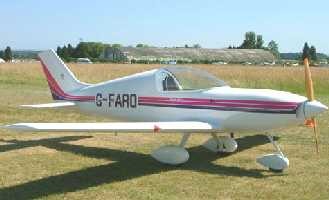
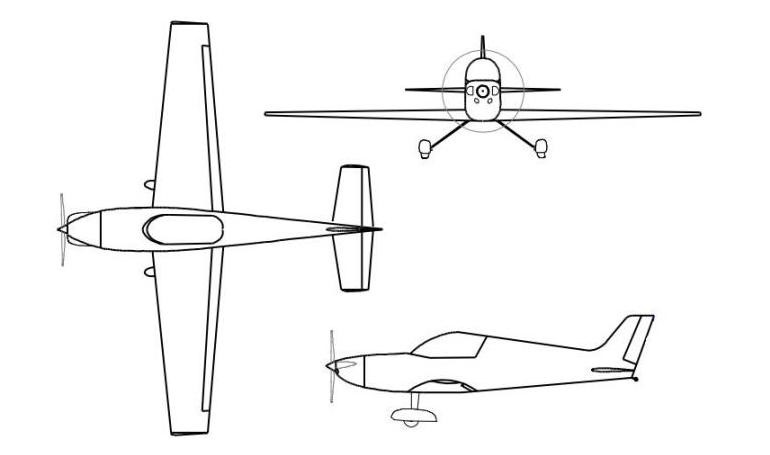
Mark Brown created this aircraft in the early 1980s. First flying on 17 May 1983, the original Star-Lite weighed 195 lb and achieved 110 mph with 20 hp. The 1983 price was $4000. Thirty-five were flying by February 1988.
One small single place machine providing 150 knot cruise on only 40hp caused minor sensation amongst would be constructors when it appeared in the marketplace around 1985. The Starlite was conceived by design engineer and computer buff Mark Brown as a sleek, easy to build runabout. Marketed in kit form, the package was complete with everything required with one exception, the trim colour, which the designer reasoned would remain the choice of the individual constructor.
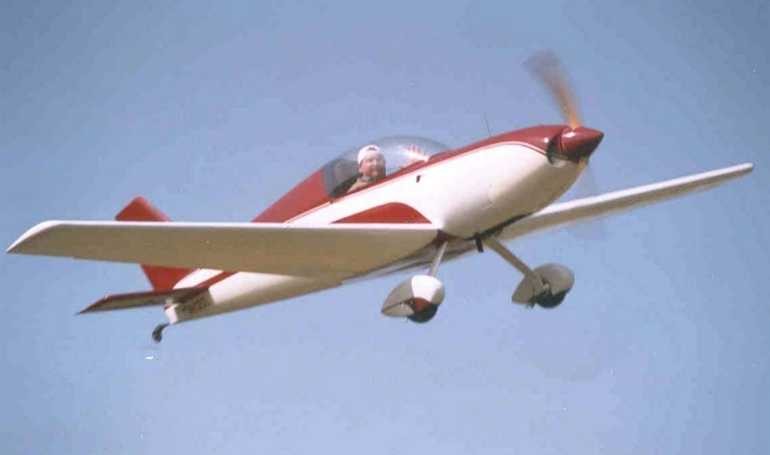
Having grabbed everyone’s attention, the next from the Brown stable was the ¬two place Pulsar. Using a similar form of construction as the Starlite, the Pulsar has undergone extensive flight testing in preparation for release in kit form.
Built up from premoulded sandwich composite parts made of pre-pregnated fibreglass surrounding a structural foam core, the Pulsar fuselage halves come as moulded units epoxied together at joints consisting of internal flanges; no wet lay ups are required. Parts are simply taped together as the epoxy glue cures, then the tape is removed. Composite sandwich bulkheads are cut to shape, using full size templates, by the builder and are attached by fibreglass tapes and epoxy filler. Three bulkheads support the wings, seats and undercarriage. Construction simplicity is a feature of Mark Brown’s designs. Wing construction differs considerably from that of the fuselage, being substantially from wood. The mainspar, machined from aircraft spruce, has factory laminated tapered unidirectional fibreglass spar caps both top and bottom to reduce inboard bending. One inch thick, pre-cut, foam ribs are spaced eight inches apart and one sixteenth inch thick plywood is wrapped around and bonded to the structure to form the aerofoil. Each spar extends inboard and overlap inside the fuselage, pinned together and to the fuselage with five-eights shear pins, glider style. The tailplane is likewise removable, providing a road transportable/ confined storage aircraft. Modern epoxy adhesives and new flexible polyurethane finishes virtually eliminate the main disadvantages of wood built aircraft and, properly protected from moisture, the designer claims that the Pulsar will survive as long as full composite and aluminium counterparts.
Preliminary flight tests of the Pulsar, powered by a water cooled two stroke 64 hp Rotax 532, have demonstrated encouraging performance figures and fuel economy.
SL-1 Star-Lite Wing Span: 6.5 m Length: 5 m Height: 1.2 m MTOW: 200 kg Fuel Capacity: 19 ltr Maximum Speed: 104 kts Optimum Speed: 87 kts Take Off Distance: 244 m Landing Distance: 305 m Absolute Ceiling: 13,000 ft Optimum Ceiling: 10,000 ft Maximum Range: 340 NM Maximum Climb Rate: 800 ft/min Seats: 1
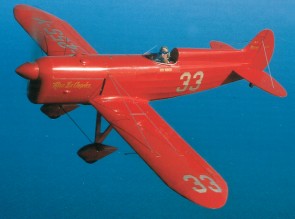
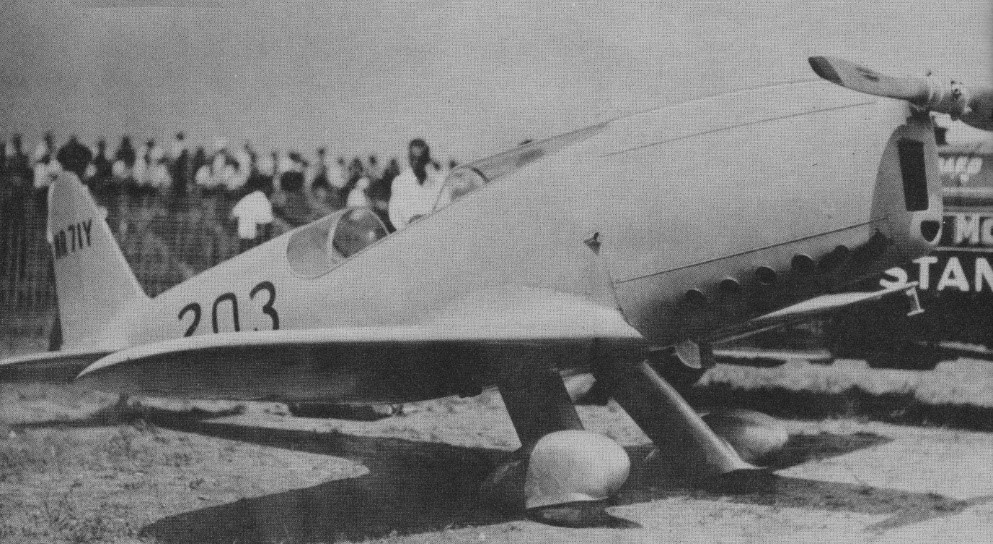
Alden Brown incorporated some novel features in his Racer NR71Y #203. The cockpit enclosure had no break or reversal in the fuselage contour. Top of the transparent enclosure was faired into the body lines and the fuselage forward of the cockpit was cut down at an angle of about 10 degrees with the fuselage centreline. Vision forward was poor during ground operations and still marginal in the air.
The Brown had been designed for a retractable undercarriage but time did not permit its installation, so it was fitted with cantilever struts and completely enclosed wheels. It was painted a light blue.
Alden Brown’s plane suffered a mishap on its first take-off at the Nationals. Roy Minor was at the controls. The close fitted wheel pants filled with mud and locked the wheels, causing the ship yo rear up enough to damage the cowl and propeller. As it came to rest the gear also collapsed so the ship was out of competition for the balance of the races.
Lee Shoenhair was the pilot in 1933. During the early part of the year he and Alden experimented with a retractable gear but were unable to get it to function properly so they reverted to the original gear. Lee was careful about use of the wheel pants and when in question on a slightly muddy or rough field these were not used. The aircraft appeared as often in 1933 without wheel pants as it did with them. She now wore the Gilmore Oil insignia and a dorsal tail fin with a small headrest above the glassed-in cockpit enclosure. This improved lateral stability and increased the pilot’s vision. The racer placed fourth in the 1000 cubic inch displacement free-for-all at the Nationals. During this race Lee experienced super-charger trouble with the engine and achieved only 137.52 mph. This was the last year the Alden Brown Racer appeared at the races. After that its whereabouts are unknown.
Model 203’s wing span was 18-19 feet and its length about the same.
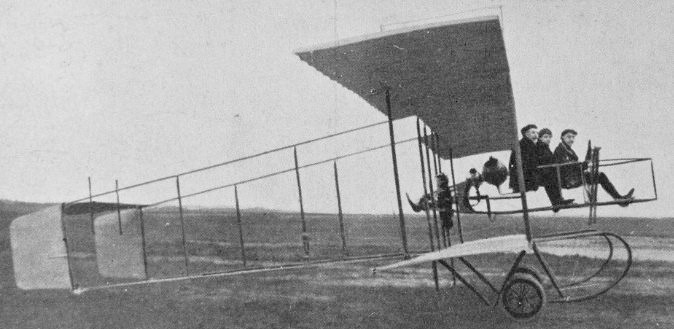
Before WWI, Leon de Brouckère of Belgium designed and built Farman-like pusher biplanes, which were equipped with Deperdussin-style controls. The 1912 three-seat machine was powered by a 50 hp Gnôme rotary and was described as a “military type”.
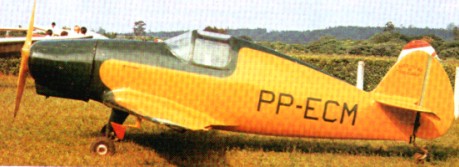
Designed as a private venture in the late ‘thirties, the Bichino subsequently served as a test-bed for the IPT (Instituto de Pesquisas Tecnológicas or Technological Research Institute) of the São Paulo State University. Four examples were built. In 1938, the IPT’s Aviation Research Department was, by a fair margin, the most important aviation research centre working in Brazil and had completed a long series of studies of the use of native Brazilian woods in aircraft. A special technique had been developed for producing in industrial quantities a new kind of plywood for aircraft using Brazilian pine, and studies had been made of freijo, a Brazilian hardwood 20 per cent stronger and heavier than spruce. One of the principal researchers at the IPT was Frederico Abranches Brotero, who was also a gifted aircraft designer. In company with Orthon Hoover, an American who had come to Brazil as a demonstration pilot for Curtiss in 1911 and had decided to stay, Brotero set about putting freijo and the new plywood to the test in a light aircraft. Work on Brotero’s tiny wooden aeroplane, designed around a 60 hp Walter Mikron engine, began late in 1939 in a workshop of the São Paulo Polytechnic School under IPT supervision and it was transferred to Rio Claro city aero club for completion and first flight. The latter was effected in 1940. The Little Bug was of all wood construction, the cantilever low-wing being a two-spar structure with a Clark Y aerofoil; the spars were of paumarfim, ribs of freijo and covering of Brazilian pine plywood. Ailerons were fabric covered; fixed letter-box slots were incorporated ahead of the ailerons and split flaps extended along each trailing edge from aileron to fuselage. The wooden monocoque fuselage structure had guapuruvu longerons and freijo reinforcements with plywood construction. Tail unit construction was of freijo with fabric covering for the elevators and rudder; there was a controllable trim-tab in the starboard elevator. The fixed landing gear had rubber-in-compression shock absorbers and a steel tail skid. Phenolic resin was used to bond the wooden components. The open cockpit was just wide enough for a pilot of average build, but was comfortable and afforded good visibility. In 1943, the Bichino prototype (PP-THH) was purchased by the IPT to be used as a flying test bed and three more examples were put in hand, with some structural redesign to reduce weight and improve performance. The three new Bichinos had 65 hp, 75 hp and 85 hp Continental engines respectively. By this time, IPT had completed other prototypes designated the IPT- 1, IPT-2 and IPT-3, and the Bichino was consequently given the designation IPT-0, the three new examples becoming the IPT-0-A, -B and -C respectively. The fourth and last was completed in 1947 and proved to be the best performer and most pleasant to fly
Ray Broome designed and built two ultralight aircraft in the late 1980s early 1990s based on the Resurgam parameters.
Number one was completed in 1987 as a landplane with a tricycle undercarriage although it was operated on floats for a time. The fuselage of the first aircraft was built solely from fibreglass. It was sold unregistered in 1991 and reconfigured as a taildragger and was still flying in NSW, Australia, as late as mid-2014.
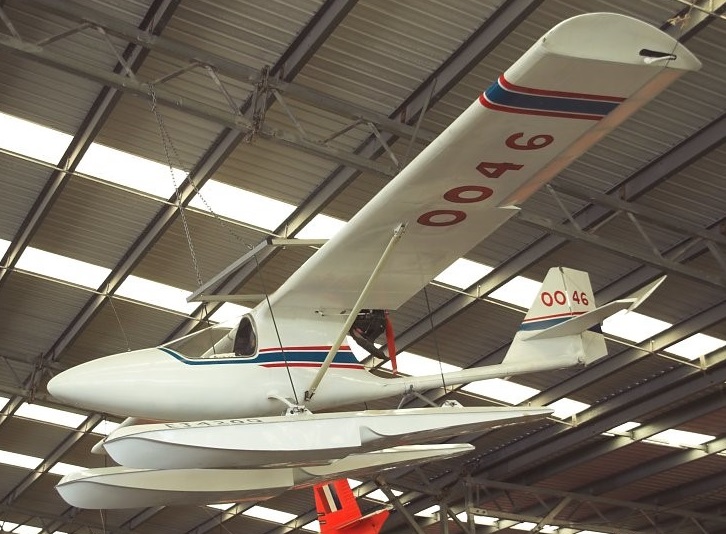
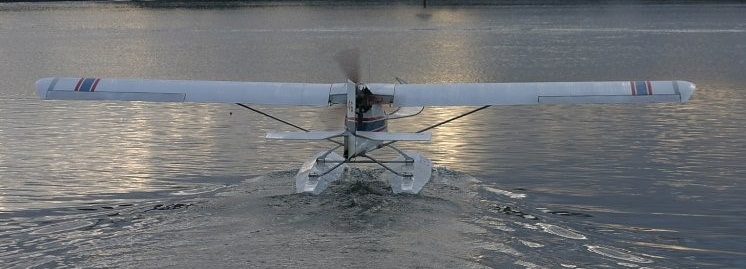
The second aircraft was built in 1992 and took up the registration 10-0046 C/N 2. It was always operated as a floatplane, mostly around the Moreton Bay area until 2008 by which time it had accumulated approximately 330 hours in service.
The fuselages of both aircraft were built on a mould taken from the front section of a damaged Club Libelle glider which inspired the name LeBeau. The composite was 6mm Kevlar foam sandwich. The rear fuselage is an aluminium tube with the tail sections having timber ribs on aluminium spars. The wings similarly have timber ribs with a double sided plywood main spar and plywood nose skin. Wing, rudder and tailplane are covered with Stits aircraft fabric painted in two-pack.
second aircraft
The floats are single skin fibreglass with plywood ribs and sealed flotation chambers. The engine is a 2-stroke, 4-cylinder Konig SD-570, rated at 28hp at 4200 rpm with a toothed belt reduction drive. The propellor is a 3 bladed ground adjustable in pitch. A third nose cone and fuselage was moulded but not taken any further.
second aircraft
The second aircraft was delivered by road to QAM Caloundra by the builder/donor Ray Broome.