The Cri Cri was superseded by prototypes of the D57 Phryganet (first flight 7 November 1950) of similar general layout and D.21T-4 Super Phryganet (first flown July 30,1951). All three designed Paul J. Deville of Salmson.
A development of the pre-War Salmson D.2, the post-War D.21T-4 Super Phryganet is externally similar to the pre-War model and is of wooden construction.
D.21T-4 Super Phryganet Engine: 135 hp Salmson 7AQ Wingspan: 38 ft 8 in Length: 25 ft 11 in Height: 7 ft 7 in Wing area: 241 sq.ft Empty weight: 1716 lb Loaded weight: 2750 lb Max speed: 134 mph Cruise: 120 mph Service ceiling: 14,300 ft Range: 500 mi
The Cri Cri was superseded by prototypes of the D57 Phryganet (first flight 7 November 1950) of similar general layout and D21T-4 Super Phryganet (first flown July 30,1951). All three designed by Paul J. Deville of Salmson.
The D.57 Phryganet is basically a two-seat side-by-side adaptation of the D.7 Cri-Cri Major. The width of the fuselage was increased and a number od design refinements were included.
Engine: 85 hp Salmson 5 AQ Wingspan: 35 ft 11 in Height: 8 ft 6 in Length: 23 ft 3 in Wing area: 200 sq.ft Empty weight: 1034 lb Loaded weight: 1625 lb Max speed: 99 mph Cruise: 87 mph Range: 310 mi
Compagnie Française d’Aviation (usually known as CFA) was established in 1936 as a division of the Salmson engine company to handle the mass-production of the Salmson D-6 Cri Cri light aircraft.
The CFA D.7 Cricri Major was a postwar-built light high-wing monoplane development of the Salmson D-6 Cri Cri with enclosed two-seat tandem glazed cabin and a fixed tail-wheel undercarriage, powered by a Salmson 5Aq-01 radial engine.
First flying on 15 March 1949, an initial series of ten Cricri (Cricket) Majors was completed and these were bought by aero clubs and private pilots. The design was rather outdated and no further examples were completed.
D.7 Cri-Cri
Four D.7s remained in service in 1956 and one, F-BFNG remained airworthy in 1967. This aircraft has been restored to airworthiness and was operational in 2005.
Engine: 1 × Salmson 5Aq-01, 90 hp (67 kW) Wingspan: 35 ft 11 in (10.95 m) Wing area: 200 ft2 (18.58 m2) Length: 23 ft 3 in (7.09 m) Height: 8 ft 6 in (2.59 m) Empty weight: 1,023 lb (464 kg) Gross weight: 1,585 lb (719 kg) Maximum speed: 93 mph (150 km/h) Cruise speed: 80 mph (129 km/h) Range: 312 miles (500 km) Service ceiling: 13,120 ft (4,000 m) Crew: 1 Capacity: 1 passenger
Compagnie Française d’Aviation (usually known as CFA) was established in 1936 as a division of the Salmson engine company to handle the mass-production of the Salmson D-6 Cri Cri light aircraft.
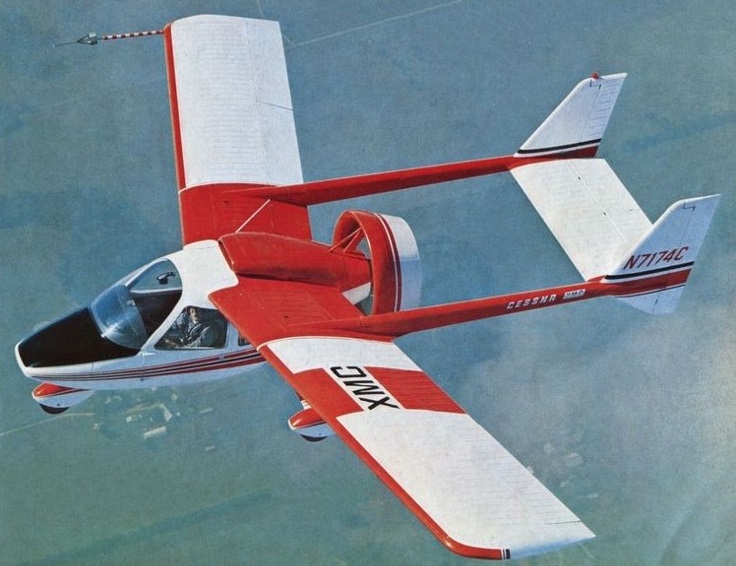
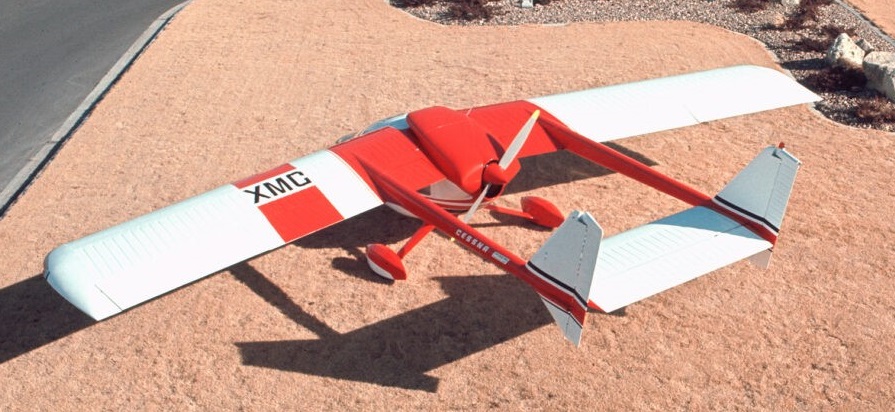
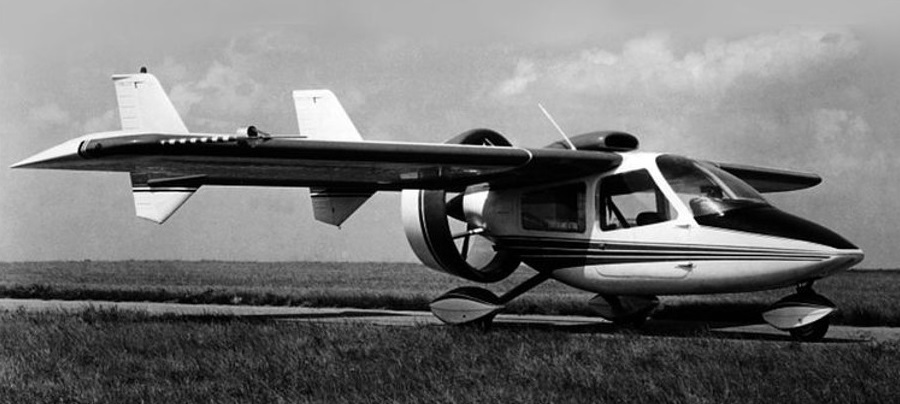
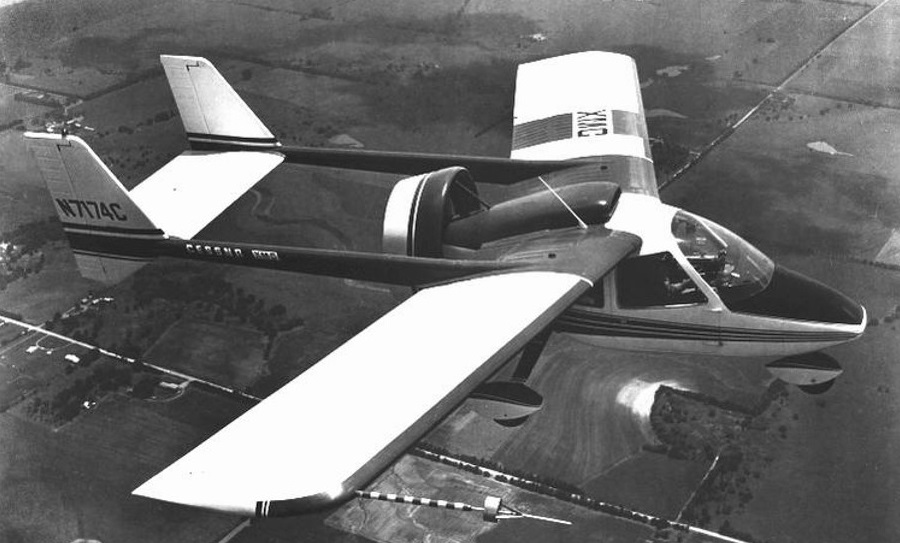
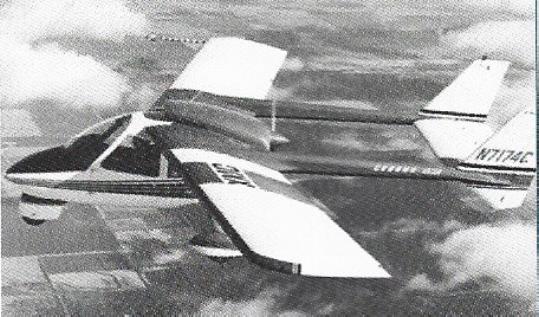
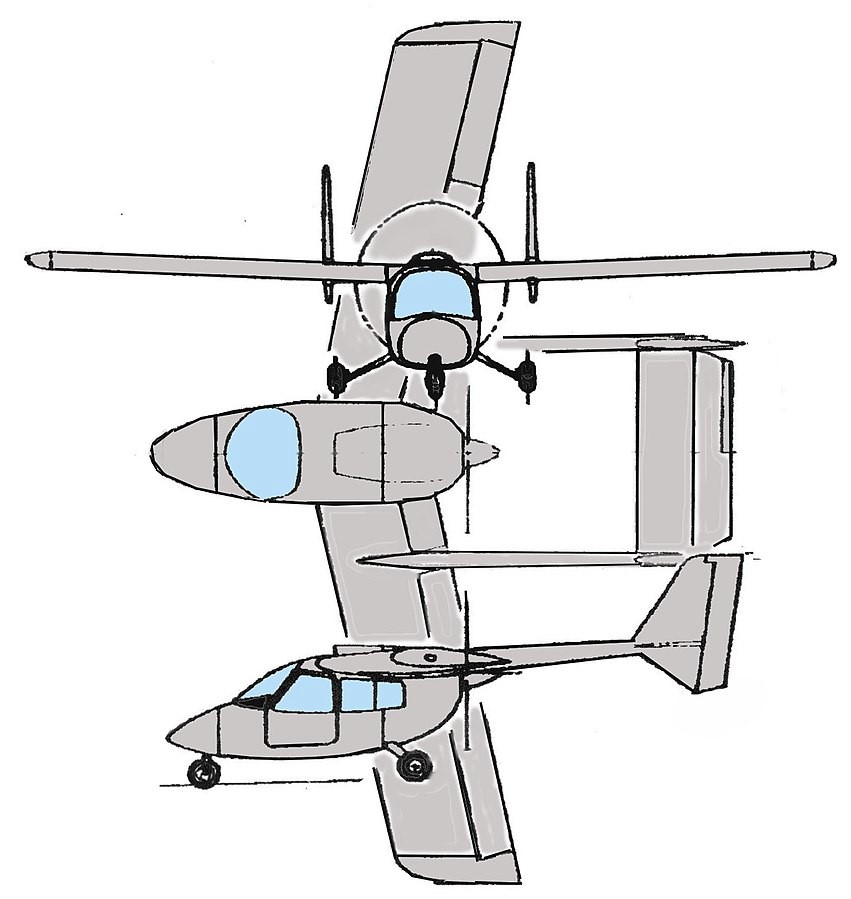
The two-seat Cessna XMC prototype technology demonstrator was built to test several concepts in light aircraft design including a ducted propeller and swept cantilever wing. The XMC employed metal-to-metal bonding, allowing for experimentation in expanded use for bonding in other types in the Cessna commercial product line. Additional stress testing was also conducted as necessary as the aircraft entered further testing and modification.
The sole prototype was registered as N7174C and given Cessna serial number 674. It was powered by a Continental O-200 100 hp (75 kW) engine mounted in pusher configuration. This was the same powerplant used in the then-current production Cessna 150. The tail boom was similar in design to that used on the Cessna Skymaster.
The first flight of the 1014 model was made on January 22, 1971 by Cessna test pilot Bruce Barrett. Then testing ground handling, flying characteristics and visibility.
Phase II testing began in May 1971, exploring methods of reducing weight and production costs for single and twin-engine Cessnas.
The aircraft was modified in 1972 and given a new model number, 1034. In this configuration it was first flown June 1, 1972, again with Bruce Barrett at the controls, using a shrouded propeller to test improvements in propeller efficiency and reduction of noise in Phase III. The spatted nose gear was replaced by a wheel fairing, as was the main gear. An increased vertical stabilizer area and revised wing tips were also tested.
The XMC project ended in 1972. The aircraft configuration proved to have higher cabin noise levels than the production Cessna 150 and offered no performance advantages over the older design.
Cessna XMC prototype Powerplant: 1 × Continental O-200, 100 hp (75 kW) Wingspan: 32 ft 0 in (9.75 m) Length: 23 ft 0 in (7.01 m) Seats: 2
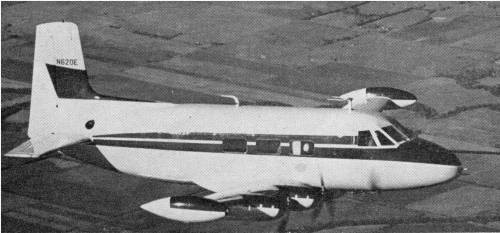
The four-engine, pressurized Cessna Model 620 first flew on August 11, 1956 with Ralph Harmon at the controls. This attempt at a business transport was soon dropped in 1957 as it was apparent that there were too many surplus airplanes on the market for this approach to be a financial success. By all accounts, the airplane did fly nicely. The fuselage was sold as scrap and became a house trailer.
Engines: 4 x Continental GSO-526-A, 320 hp Wing span: 55 ft Length: 31 ft 6 in Height: 16 ft 6 in Cruise: 235 mph Max speed: 269 mph
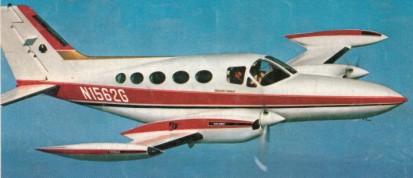
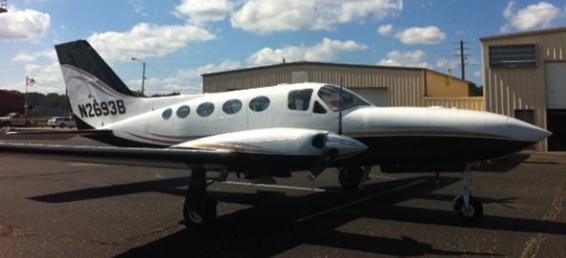
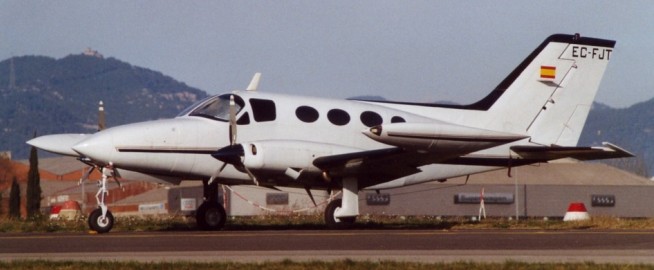
A development of the CE 411A, designed in 1965 as the replacement for the model 411, the pressurised model 421 was not a great deal different in external appearance. The CE-421 first flew on 14 October 1965. Derived from the Model 401/411, the Model 421 differed primarily in its original configuration by having a fail-safe pressurised fuselage structure and an AiResearch air-conditioning and pressurisation system. Deliveries of initial production aircraft began in May 1967, following certification of the type on the fist day of that month.
Two new versions of the Model 421 were introduced for 1970, the Model 421B Golden Eagle and Model 421B Executive Commuter. Both had a number of improvements including lengthening of the nose to provide more avionics and baggage capacity, an increase in wing span, strengthening of the landing gear for operation at higher gross weights, and many detail refinements. The Executive Commuter was basically the same as the Golden Eagle, but the interior was laid out with lightweight easily-removable seating to provide alternative passenger/cargo configurations which could accommodate a maximum of 10 passengers. Production increased so that 1000 models had been built by 1975. These two versions were replaced in 1976 by the Model 421C Golden Eagle, which introduced some important changes. These included a new wing that dispensed with the distinctive wingtip tanks, replaced by integral fuel tanks of the type introduced at a later date on the Model 414. Other changes provided increased area for the vertical tail surfaces and larger-capacity engine turbochargers. Four versions were available, the Model 421C Golden Eagle and Model 421C Executive Commuter, both produced in Model 421C II, versions with a factory-installed avionics/equipment package.
The Executive Commuter was discontinued for 1978, the Golden Eagle then being available in standard as well as Model 421C II and Model 421C III versions with differing avionics/equipment packages. By late-1985 when production ceased, 1,909 Golden Eagles of all versions had been delivered, including three examples for the Royal New Zealand Air Force.
CE-421 Engines: 2 x Continental GTSIO-520-N, 280kW Max Take-off weight: 3379 kg / 7449 lb Empty weight: 2129 kg / 4694 lb Wingspan: 12.53 m / 41 ft 1 in Length: 11.09 m / 36 ft 5 in Height: 3.49 m / 11 ft 5 in Wing area: 19.97 sq.m / 214.96 sq ft Max. speed: 478 km/h / 297 mph Cruise speed: 356 km/h / 221 mph Ceiling: 9205 m / 30200 ft Range: 2752 km / 1710 miles
CE-421B Golden Eagle Engine: Continental GTSIO 520H, 375 hp. Prop: 3 blade, 90 in, full feathering. Wing span: 41 ft. 10 in. Length: 36 ft. 1 in. Height: 11 ft. 7 in. Wing area: 211.09 sq. ft. Wing loading: 34.25 lb./sq. ft. Seats: 6-8. Empty weight, equipped: 5,000 lbs. Useful load, equipped: 2,250 lbs. Gross weight: 7,250 lbs. Max landing weight: 7,200 lbs. Power loading: 9.67 lb/hp. Fuel cap (std): 170 USG. Fuel cap (with res): 196 to 248 USG. Baggage cap: 1,340 lb/ 73.3 cu.ft. Takeoff dist: 1,838 ft. Takeoff dist 50 ft: 2,325 ft. SE takeoff dist 50 ft: 4,283 ft. ROC: 1,950 fpm. SE ROC: 345 fpm. Service ceiling: 31,800 ft. SE service ceiling: 15,000 ft. Max speed: 283 mph/246 kts. Cruise speed (75% power): 270 mph/234 kts. Economical cruise: 224 mph/194 kts. Range (at max cruise, std tanks): 1,067 sm/926 nm. Range (at econ. cruise, std tanks): 1,194 sm/1,031 nm. Stall speed (clean): 97 mph/84 kts. Stall speed (gear & flaps down): 86 mph/75 kts. Landing dist: 720 ft. Landing distance 50 ft: 2,178 ft.
CE-421C Golden Eagle Engines: Continental GTSIO-520-L, 375 hp each. TBO: 1600 hrs. Props: McCauley 3-blade, 90-in. Seats: 8. Length: 36.4 ft. Height: 11.5 ft. Wingspan: 41.1 ft. Wing area: 215 sq.ft. Wing aspect ratio: 7.9. Maximum ramp weight: 7500 lbs. Maximum takeoff weight: 7450 lbs. Standard empty weight: 4640 lbs. Maximum useful load: 2860 lbs. Zero-fuel weight: 6733 lbs. Maximum landing weight: 7200 lbs. Wing loading: 34.7 lbs/sq.ft. Power loading: 9.9 lbs/hp. Maximum usable fuel: 1572 lbs/262 USG. Best rate of climb: 1940 fpm @ 111 kts. Climb gradient: 1049 ft/nm. Rate of climb @ 8,000 ft: 1640 fpm. Certificated ceiling: 30,000 ft. 8000ft cabin alt @: 21,700 ft. Maximum single-engine rate of climb: 350 fpm @ 111 kts. Single-engine climb gradient: 189 ft/nm. Single-engine service ceiling: 14900 ft. Maximum speed: 258 kts. Max cruise speed: 241 kts. Range max fuel/75% pwr: 1310nm/5.3hr. Range max fuel / 55%: 1457nm/7.3hr. 75% cruise: 242 kt. 55% cruise: 201 kt. Cruise @ 65% pwr @ 8,000ft: 190 kts. Cruise @ 65% power @ 18,000ft: 208 kts. Fuel flow @ 65% pwr @ 18,000 ft: 230 pph. Endurance at 65 % pwr @ 18,000 ft: 6.7 hrs. Max range: 1,487 nm. Stalling speed clean: 83 kts. Stalling speed gear/flaps down: 74 kts. Turbulent-air penetration speed: 150 kts. Takeoff Dist 50 ft obstacle: 2,323 ft. Landing Dist 50 ft obstacle: 2,293 ft.
To provide the pressurised 414 twin-engined transport, Cessna married the basic fuselage of the Model 421 with the wing developed for the Model 401. The resulting aircraft was flown for the first time on 1 November 1968 and certificated during the following August. New features introduced on the aircraft included engine cowlings with flush intakes to improve engine cooling and an accurate fuel monitoring system developed by Cessna to provide better fuel management. From the time of its introduction until 1976, improvements introduced for the Model 402 were reflected in the Model 414, and in that year the name Chancellor was adopted. It was available for 1976 in standard and Model 414 II versions, the latter incorporating a package of factory-installed avionics and equipment. After 513 of the original Model 414s had been built, Cessna combined the air¬frame that was developed for the Golden Eagle in 1978 with the 310 hp engines of the 414 to produce the 414A Chancellor. The engines are direct drive Continental TSIO 520s. The gross weight and useful load of the new airplane both are substantially greater than those of the old 414, which gives it much better payload and endurance numbers and makes it a more viable corporate transport. The pressure differential five pounds per square inch is greater so that the airplane can cruise at higher altitudes. Major changes included a redesigned and increased-span wing incorporating integral fuel tanks and more baggage capacity in an extended nose.
Cessna CE-414A
Versions available between 1978 and 1986, were the standard Model 414A Chancellor, the Chancellor II and later the Chancellor III, all with differing factory installed avionic/equipment packages. When Model 414/414A production ended in 1986 a total of 1,067 variants had been built.
The old 414’s service ceiling was 11,350 feet, and with the same engines and gross weight 400 pounds greater, the new airplane does 19,850 feet. The new airplane has four and a half feet more span as well as 30 more square feet of wing area, and these two factors do wonders for single engine ceiling. On the old 414, fuel was carried in as many as six tanks, only two of which were standard equipment. Fuel management included the operation of transfer pumps, the monitoring of fuel return and the bother of tank selection. The new air¬plane carries a standard 103 gallons in each wing, virtually no management is required and the total capacity is greater than was available with all six tanks on the 414.
Scenic Air Lines, in 1977, acquired from American Jet Industries engineering and manufacturing rights for turboprop conversions of Cessna Models 402 and 414, now known as Turbo Star 402 and Turbo Star Pressurised 414.
CE-414 Engine: 2 x Continental TSIO-520-N, 310 hp. Seats: 7. Wing loading: 32.4 lb/sq.ft. Pwr loading: 10.2 lb/hp. Gross wt: 6350 lb. Empty wt: 4126 lb. Equipped useful load: 1889 lb. Payload max fuel: 671 lb. Range max fuel/75% pwr: 1168nm/5.1hr. Range max fuel / 55%: 1309nm/7.2hr. Ceiling: 30,100 ft. 75% cruise: 225 kt. 55% cruise: 183 kt. Vmc: 84 kt. Stall: 74-86 kt. 1.3 Vso: 96 kt. ROC: 1580 fpm. SE ROC: 240 fpm @ 105 kt. SE ceiling: 11,350 ft. Min field length: 2350 ft. Fuel cap: 600/1218 lb. Cabin pressure: 4.2 psi.
CE-414A Chancellor Engines: Continental TSIO-520-NB, 310 hp, 231kW. TBO: 1400 hrs. Props: McCauley 3-blade, 76.5-in. Seats: 6/8. Length: 11.09 m / 36 ft 5 in. Height: 3.49 m / 11 ft 5 in. Wingspan: 13.45 m / 44 ft 2 in. Wing area: 20.98 sq.m / 225.83 sq ft. Wing aspect ratio: 8.6. Wing loading: 29.7 lb/sq.ft. Power loading: 10.8 lb/hp. Maximum ramp weight: 6785 lbs. Maximum takeoff weight: 3062 kg / 6750 lbs. Standard empty weight: 4368 lbs. Maximum useful load: 2417 lbs. Zero-fuel weight: 6515 lbs. Maximum landing weight: 6750 lbs. Wing loading: 29.9 lbs/sq.ft. Power loading: 10.9lbs/hp. Maximum usable fuel: 1236 lbs/204 USG. Best rate of climb: 1520 fpm @ 108 kts. Climb gradient: 853 ft/nm. Rate of climb @ 8,000 ft: 1400 fpm. Certificated ceiling with oxygen equipment: 30,000 ft. Certificated ceiling without oxygen equipment: 25,000 ft. 8000ft cabin alt @: 21700 ft. 10,000ft cabin alt at: 26,500 ft. Maximum single-engine rate of climb: 290 fpm @ 108 kts. Single-engine climb gradient: 161 ft/nm. Single-engine service ceiling: 19850 ft. Maximum speed: 235 kts. Max cruise, 77.5 % power at 24,500 ft: 225 kts. Duration at max cruise: 5.67 hrs. Cruise @ 65% pwr @ 8,000ft: 177 kts. Cruise @ 65% power @ 18,000ft: 190 kts. Fuel flow @ 65% pwr @ 18,000 ft: 180 pph. Endurance at 65% pwr @ 18,000 ft: 6.5 hrs: Econ cruise, 60.8% power at 20,000 ft: 187 kts. Duration at econ cruise: 7.14 hrs. Stalling speed clean: 82 kts. Stalling speed gear/flaps down: 72 kts. Turbulent-air penetration speed: 144 kts. Takeoff Dist 50 ft obstacle: 2,595 ft. Landing dist 50 ft obstacle: 2,393 ft. Pressurization differential: 5.0 psi.
1980 Cessna 414A Engines: RAM Overhauled TSIO-520-B, 335 hp TBO: 1600 hour Propellers: McCauley Series Saber Tip C500, Model 3AF32CC515, 3 Bladed Prop TBO: 2000 Gross Ramp Weight: 7140 lb Max Gross Takeoff Weight: 7105 lb Empty Weight: 5120.72 lb Useful Load: 1979.28 lb Useful load W/full main tanks (206USG): 743.28 lb Nose Baggage capacity: 332 lb Fuel burn: 35.8GPH @ 185-195K @ 16000 – 17000 Ft. Range with 206USG: 800 miles w/ 1 hr reserve. Seats: 7 / 8
CIDC Turbo Star 414 / Cessna 414 Engines: 2 x Allison 250-B17B, 420 hp. Seats: 6/8. Wing loading: 33.5 lb/sq.ft. Pwr loading: 7.7 lb/hp. Max TO wt: 6525 lb. Empty wt: 3705 lb. Equipped useful load: 2492 lb. Payload max fuel: 534 lb. Range max fuel/cruise: 996 nm/4.4 hr. Range max fuel /range: 1390 nm/ 6.7 hr. Service ceiling: 25,000 ft. Max cruise: 226 kt. Max range cruise: 209 kt. Vmc: 81 kt. Stall: 70-85 kt. 1.3 Vso: 91 kt. ROC: 2180 fpm. SE ROC: 510 fpm @ 86 kt. SE ceiling: 13,800 ft. Min field length: 1290 ft. Fuel cap: 1512/1958 lb.
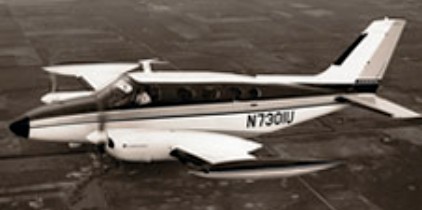
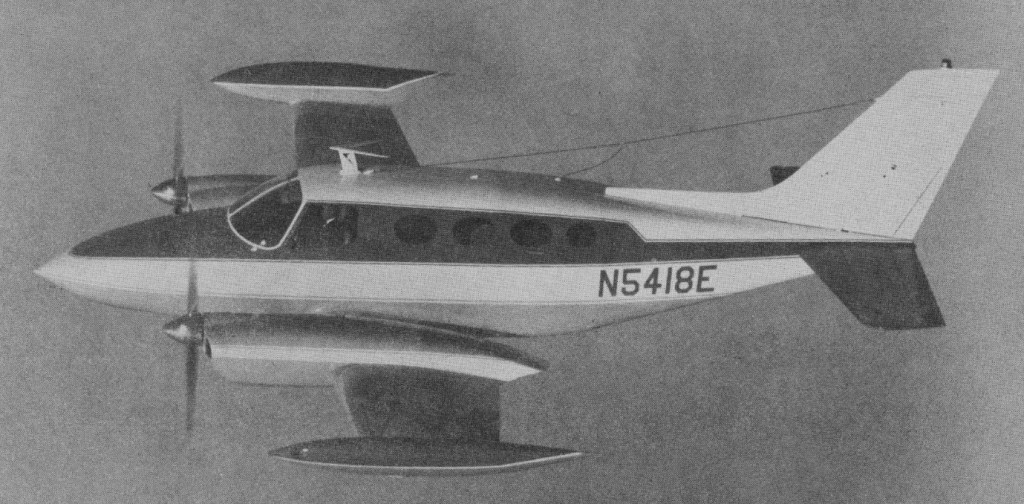
When flown for the first time on 18 July 1962, the Cessna Model 411 then represented the company’s largest business aircraft. Generally similar in configuration to the Model 310, it differed by having slightly increased wing span and area, a lengthened fuselage, more powerful 254kW Continental GTSIO-520-C flat-six turbocharged engines and accommodation for a crew of two and four to six passengers. Priced at $120,000, the 6-7 place was indicating 240mph optimum cruise at 22,000 ft with a range over 1000 mi with standard fuel, in tests.
Deliveries begin of the Model 411 in 1965, but production of the Model 411 was discontinued in June 1978, after the production of 400 examples, a small number of which were supplied to the French air force.
Engines: 2 x 254kW Continental GTSIO-520-C Gross weight: 6500 lb Top speed: 265 mph Cruise: 230 mph at 16,000 ft Wingspan: 39.86 ft Length: 33 ft Height: 11.1 ft Price: $120,000