Continental A-70

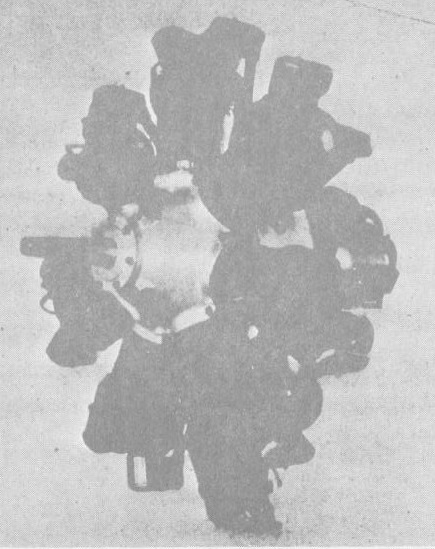
The 1928 A-70 (ATC 32) featured a cast aluminium crankcase in two sections, a two piece forged chrome-nickel steel crankshaft, and one piece master connecting rod. All rods were H section. The crankshaft was mounted on ball and roller bearings.

The pistons were unribbed cast aluminium in composite steel and aluminium cylinder assemblies. The heads were screwed and shrunk to steel barrels. The valves were tulip, tungsten inake and CNS exhaust.

All accessory drives except pump cross shaft were on plain bearings with full pressure lubrication. The rocker arms were on ball bearings.

There was no rotary induction system, but a double branch manifold feeding a horseshoe header. The lubrication system elibinated all internal and external piping.

The engine could be installed in the mounting ring without removal of any accessories.

Standard equipment was the exhaust nose ring and piping complete, nose cowling, air heater and cleaner assemblies, priming pump and fittings, ignition switch, and tool kit.

Accessories available at extra cost were any starter (including Heywood) using standard SAE mounting cylinders drilled for Heywood fittings, any generator with SAE flange, any fuel pump with SAE flange, and propeller hub.

Type: 7 cylinder air cooled radial
Dept of Commerce Approved Certificate
Rating: 165 hp at 2000 rpm
Displacement: 544 cu.in
Compression ratio: 5.4-1
Bore: 4 5/8 in
Stroke: 4 5/8 in
Length: 39 in
Diameter: 41 3/4 in
Weight: 430 lb
Fuel consumption: not more than .55 lb/hp/hr
Oil consumption: not more than .035 lb/hp/hr
Lubrication: Pressure and scavenger gear pumps, 75 lb/sq.in
Ignition: 2 Scintilla magneto
Carburation: Stromberg
Spark plugs: 2 per cylinder B.G.
Price: $2700

Continental Motors

Founded in 1929, Continental Motors, Inc. is an aircraft engine manufacturer located at the Brookley Aeroplex in Mobile, Alabama. Although Continental is most well known for its engines for light aircraft, it was also contracted to produce the air-cooled V-12 AV-1790-5B gasoline engine for the U.S. Army’s M47 Patton tank and the diesel AVDS-1790-2A and its derivatives for the M48, M60 Patton and Merkava main battle tanks. The company also produced engines for various independent manufacturers of automobiles, tractors, and stationary equipment (pumps, generators and machinery drives) from the 1920s to the 1960s.

In 1929, Continental introduced its first aircraft engine, a seven-cylinder radial designated as the A-70, with a displacement of 543.91 cu in (8.91L) that produced 170 hp (127 kW). In August 1929, the Continental Motors Company formed the Continental Aircraft Engine Company as a subsidiary to develop and produce its aircraft engines.

During the late 1930s, early 1940s the Gray Marine Motor Company adapted Continental engines for maritime use. On 14 June 1944 the company was purchased by Continental for US$2.6 million. John W. Mulford, the son of one of Gray’s founders was appointed general manager of Gray by Continental. Gray’s continued to make marine engines in the post-war period until its closure by Continental in about 1967.

As the Great Depression unwound, 1930 saw the company introduce the 37 hp (28 kW) A-40 four-cylinder engine. A follow-on design, the 50 hp (37 kW) A-50 was introduced in 1938 and was used to power the Taylor Cub and derivative Piper Cub. As the Second World War started in 1939 Continental commenced building aircraft engines for use in British and American tanks. Continental formed Continental Aviation and Engineering (CAE) in 1940 to develop and produce aircraft engines of over 500 hp (373 kW) Continental ranked 38th among United States corporations in the value of wartime production contracts.

During the late 1930s, early 1940s the Gray Marine Motor Company adapted Continental engines for maritime use. On 14 June 1944 the company was purchased by Continental for US$2.6 million. John W. Mulford, the son of one of Gray’s founders was appointed general manager of Gray by Continental. Gray’s continued to make marine engines in the post-war period until its closure by Continental in about 1967.

During the 1950s, the A-65 was developed into the more powerful 90 hp (67 kW) C-90 and eventually into the 100 hp (75 kW) O-200. The O-200 powered a very important airplane design milestone: the Cessna 150. By the 1960s turbocharging and fuel injection arrived in general aviation and the company’s IO-520 series came to dominate the market.

In 1969, Teledyne Incorporated acquired Continental Motors, which became Teledyne Continental Motors (TCM). That same year, the Continental Tiara series of high output engines were introduced, although they were dropped from the line after 1978. The company brought the TSIO-520-BE for the Piper PA-46 to market in 1984 and it set new efficiency standards for light aircraft piston engines. Powered by a liquid-cooled version of the IO-240, the Rutan Voyager was the first piston-powered aircraft to circumnavigate the world without refueling in 1986.

NASA selected Continental to develop and produce GAP in 1997, a new 200 hp (150 kW) piston engine to operate on Jet-A fuel. This was in response to 100-octane aviation gasoline becoming less available as a result of decreased demand, due to smaller turboprop engines becoming more prevalent.

In 2008, Teledyne Continental’s new president, Rhett Ross announced that the company was very concerned about future availability of 100LL avgas and as a result would develop a diesel engine in the 300 hp (220 kW) range for certification in 2009 or 2010. By the fall of 2009 the company was feeling the effects of the economic situation and the resulting reduced demand for aircraft engines. The company announced that it would close its plant for two one-week periods in October 2009 and January 2010. Salaried employees would move to a four-day work week with one week vacations for Thanksgiving and Christmas, with the aim “to protect as much of our valuable employee base as possible”.

On December 14, 2010, Continental’s parent Teledyne announced that Teledyne Continental Motors, Teledyne Mattituck Services and its general aviation piston engine business would be sold to Technify Motor (USA) Ltd, a subsidiary of AVIC International, for US$186 million in cash. AVIC is owned by the Chinese government. In May 2011, the transaction was reported as complete and the company renamed Continental Motors, Inc.

Diesel engines are manufactured in Germany by Continental Motors Group, Ltd., an AVIC International Holding Corporation company. Previously the company was known as Centurion Aircraft Engines before its 2013 acquisition by Continental. Several diesel engines were available from Continental in 2016: the CD-135 and CD-155 four cylinders and V6 CD-300, producing 310 hp.

Diesel engines are manufactured in Germany by Continental Motors Group, Ltd., an AVIC International Holding Corporation company. Previously the company was known as Centurion Aircraft Engines before its 2013 acquisition by Continental. Several diesel engines were available from Continental in 2016: the CD-135 and CD-155 four cylinders and V6 CD-300, producing 310 hp.

A90
A100
C90
C145
C175
E250
GR-9A
Voyager 200
Voyager 370
Voyager 550
O-110
O-200
O-240
O-255
O-315
O-368
O-520
O-526
OL-200
OL-370
Continental-Honda OL-370
OL-1430
V-1650 (Merlin)
XH-2860
R-545
227
300
320
324
325
352
354
356
500
TD-300
TS325
TP-500
R-20
RJ35 Ramjet
RJ45 Ramjet
RJ49 Ramjet
T69
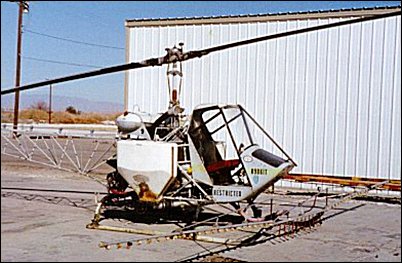
Continental Copters El Tomcat

In 1959, Continental Copters Inc. of Fort Worth, Texas, developed and produced a specialised single-seat agricultural aircraft based on the Bell Model 47G-2. Payload is increased by deletion of unnecessary structure and equipment. Known as the El Tomcat Mk.II, this aircraft flew for the first time in April 1959 and received an FAA supplementary type certificate soon afterwards. An improved variant, the El Tomcat Mk.III, made its maiden flight in April 1965 as an improved version of the Mk.II, and subsequent variants were progressively introduced. The Tomcat Mk.III weighs empty 540kg and 1105kg loaded.
The El Tomcat Mk.IIIA was flown in January 1966 with 200hp Franklin 6V4-200-C32, 210hp 6V-335-A or a 235hp 6V-350-A engine.
The El Tomcat Mk.IIIB of 1967 had a still lower and repositioned windscreen, modified glassfibre nose, lower cabin roof and a 6V-350 engine.
The Mk.IIIC of 1968 was an improved version with a 200-235hp 6V4-200-C32, 6V-335-A or 6V-350A engine and was first flown in May 1968.
The Mk.V (first flown in June 1968) entered production in 1968 with a 220hp Lycoming VO-435-B1A engine (empty weight 620kg and maximum weight 1105kg), followed by the improved Mk.V-A with a 260hp VO-435-A1F engine and a folding jump-seat to permit carriage of a flagman to distant work sites. The latest version is the 265hp VO-435-BlA-engined Mk.V-B.

El Tomcat Mk.II

El Tomcat Mk.III
Empty weight: 540kg
Loaded weight: 1105kg

El Tomcat Mk.IIIA
Engine: 200hp Franklin 6V4-200-C32, 210hp 6V-335-A or 235hp Franklin 6V-350-A

El Tomcat Mk.IIIB
Engine: Franklin 6V-350

El Tomcat Mk.IIIC
Engine: 200-235hp Franklin 6V4-200-C32, Franklin 6V-335-A or Franklin 6V-350A

El Tomcat Mk.V
Ngine: 220hp Lycoming VO-435-B1A engine
Empty weight: 620kg
Maximum weight: 1105kg

El Tomcat Mk.V-A
Engine: 260hp VO-435-A1F
Disc loading: 2.6 lb/sq.ft.
Pwr loading: 9.42 lb/hp.
Max TO wt: 2450 lb.
Empty wt: 1420 lb.
Equipped useful load: 991 lb.
Payload max fuel: 817 lb.
Range max fuel/ cruise: 81 nm/ 1.3 hr.
Service ceiling: 10,500 ft.
Max sling load: 844 lb.
Cruise speed: 65 kt.
Working endurance: 1.5 hr.
ROC: 1500 fpm.
HIGE: 5900 ft.
HOGE: 1400 ft.
Fuel cap: 174 lb.
Seats: 1.

El Tomcat Mk.V-B
Engine: 265hp VO-435-BlA

Mk.VI-B
Engine: Lycoming TVO-435-B1A, 260 hp.
Seats: 1.
Disc loading: 2.6 lb/sq.ft.
Pwr loading: 10.9 lb/hp.
Max TO wt: 2850 lb.
Empty wt: 1490 lb.
Equipped useful load: 1321 lb.
Payload max fuel: 1147 lb.
Range max fuel/ cruise: 50 nm/ 0.8 hr.
Service ceiling: 10,500 ft.
Max sling load: 1194 lb.
Cruise speed: 65 kt.
Working endurance: 1.5 hr.
ROC: 1800 fpm.
HIGE: 5900 ft.
HOGE: 1400 ft.
Fuel cap: 174 lb.

Constantin et d’Astanières No2 biplane

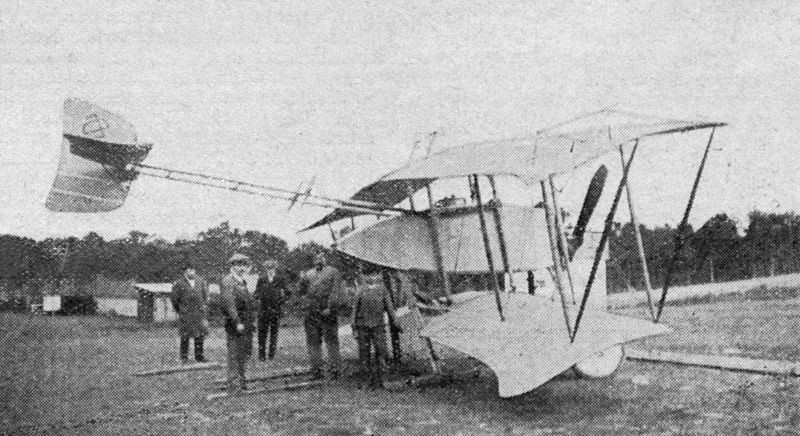
This second design of the duo Louis Constantin (designer) and M. d’Astanières (sponsor) never participated in the Concours de la sécurité (1914) for which it was intended, because it was not ready and still had problems that needed to be fixed. The machine was claimed to have three special features: A special design of the leading edges of the wings to improve their efficiency, automatic lateral stability by negative dihedral wings, and improved longitudinal stability by minimal its longitudinal moment of inertia. The last two of these appear rather counterintuitive, but perhaps… It was first tested only days before the outbreak of WW1, which stopped any further experimenting.

Constantin et d’Astanières No.1

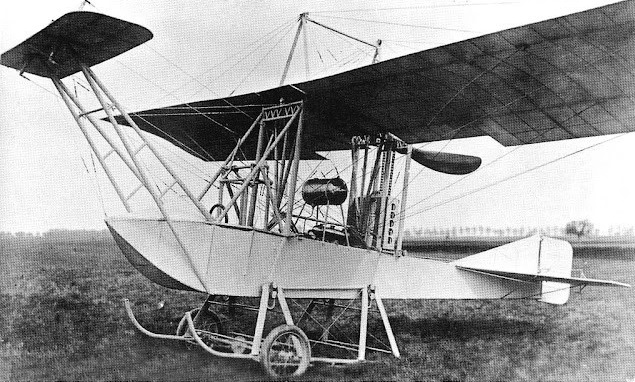
An aircraft designed following the ideas a patent of Francois d’Astanières about an automatically-stable monoplane. Built by Louis Clement, it was tested initially in 1913. The aircraft was later modified with some safety features patented by Louis Costantin (concave leading-edge flaps and modified elevators), the then called Constantin-d’Astanieres monoplane took part in the 1914 Concours de Sécurité.

Powered by a fuselage-mounted car engine that drove, via chains, a pusher propeller. The Constantin-d’Astanieres has a fairly orthodox rear fuselage and tail feathers, sles conventional was its additional front elevator on outriggers. The icing in the cake was its “slighty flexible” wings intended to absorb wind gusts.

The d’Astanières autostable in its second configuration, was under test at Bois d’Arcey in May 1913.

Contal 1910 monoplane

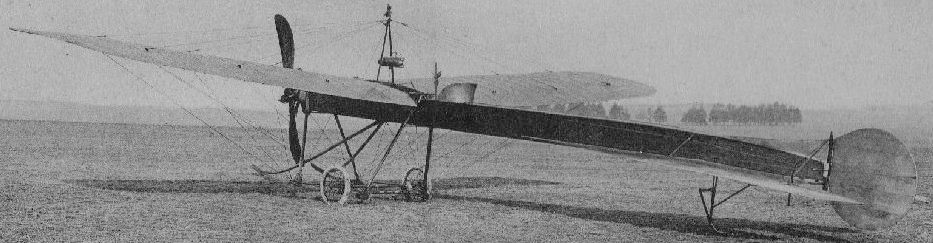
During 1909 and 1910 Camille Contal of Mourmelon, France, the inventor of a three-wheeled car called the Mototri, built several monoplanes. The 1910 machine had a narrow triangular fuselage was covered with sheets of mahogany with a 50 hp Gnome overhung at the nose. The rectangular wings could be warped, with the front spars fixed through steel fittings to the top two ash longerons, and the rear spars hinged. The pilot sat with his legs extended so that he could set his back easily against the seat without having to be strapped in.

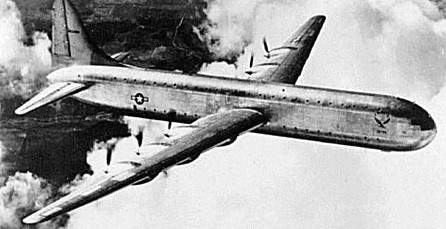
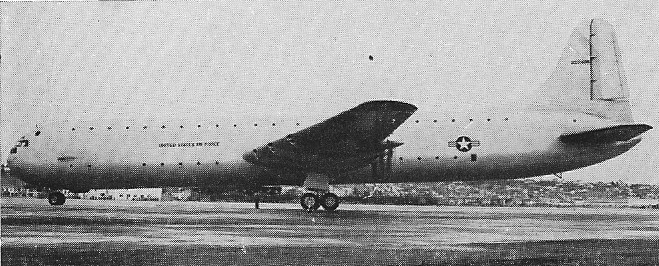
Consolidated 37 / XC-99

Shortly after starting to develop the B-36 bomber, Convair began the parallel design of a transport late in 1942 (Model 37). The XC-99 used the same wings, empennage, landing gear, and six 3,500hp (2,600kW) Pratt & Whitney Wasp Major engines as in the ‘Peacemaker’, but it had a large pressurized, double-decked fuselage capable of carrying 400 troops or more than 100,000lb (45,350kg) of cargo.

Only a single aircraft was built which flew on 23 November 1947, it subsequently acquired bogie main wheel units and weather radar. By 1955 it had carried 35 million pounds of freight in 4,000 flying hours. It was used successfully by the US Air Force for special transport operations until retired in 1957.

Engines: 6 x Pratt & Whitney R4360-41 Wasp Major, 3,500hp (2,600kW).
Span: 230 ft
Length: 182 ft 6 in
Height: 57 ft 6 in
Empty weight: 132,000 lb
Loaded weight: 265,000 lb
Max. Speed: over 300 m.p.h.
Service ceiling: 30,000 ft
Payload: 400 troops or 100,000+lb (45,350kg) of cargo.
Maximum range w/10,000 lb: 8100 miles

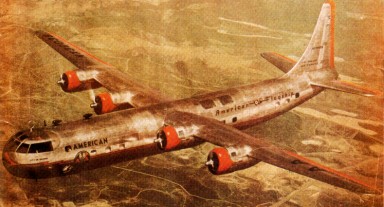
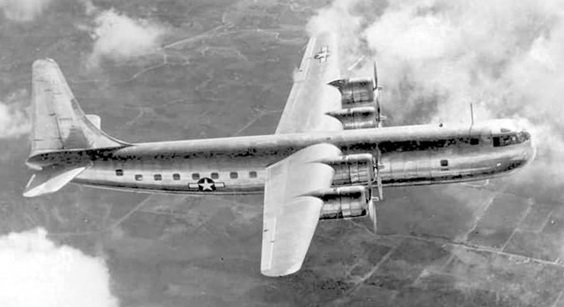
Consolidated 39 Liberator Liner

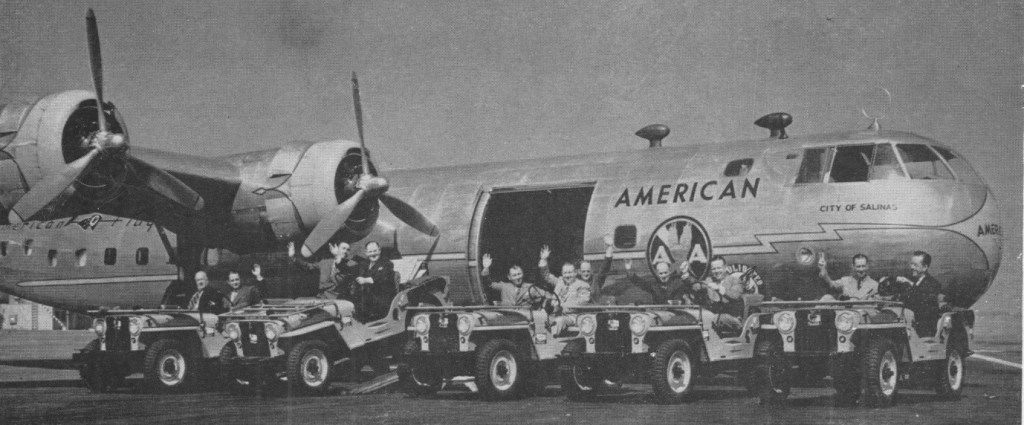
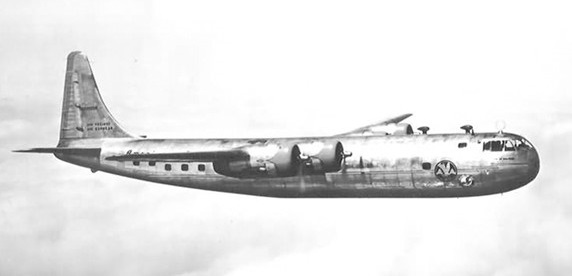
The Model 39 Liberator Liner was derived from the B-24 Liberator bomber via the PB4Y-2 Privateer patrol bomber and RY-3 Liberator Express transport. The design Model 39 started in early 1943.It retained the basic wing, landing gear, empennage, and engine nacelles of the Privateer; however, the fuselage was completely redesigned to carry 48 passengers in a day-time configuration or 24 at night. Like the Privateer, the Liberator Liner had four 1,350hp (1,000kW) Pratt & Whitney R-1830-94 Twin Wasp engines.

After the merger of Consolidated and Vultee the type was continued as the Convair Model 104. Convair was the trade name of Consolidated Vultee after the 1943 merger.

The US Navy became interested and signed a letter of intent for 253 aircraft in March 1944. The first prototype NX30039 (c/n 1) was flown for the first time on 15 April 1944 piloted by Phil Prophett and his crew. Due to design deficiencies the Navy cancelled its order but Convair received permission to purchase and complete the second prototype in Navy colours. Thus the second aircraft was completed as the Convair 104 XR2Y-1 and fitted with R-1830-65 engines NX3939 (c/n 2) and made it first flight on 29 September 1944. Eventually this aircraft was given the US Navy registration 09803.

In a demonstration five jeeps were flown from Detroit to Los Angeles in 10 hours. A full cargo of fruit and vegetables made up the return load.

American Airlines operated the first aircraft, named City of Salinas (top), with the support of Convair for three months transporting fresh fruits between Salinas and El Centro, California and cities in the east like Boston and New York. A cargo of 18,500 lb (8,392 kg) could be loaded straight from flat trucks into the aircraft through large fuselage doors.

The Liberator Liner never really had a chance because of the many Douglas C-54s that were about to be released for civilian use. Both were scrapped late in 1945 after it became obvious that the design had no potential.

Engines: 4 x Pratt & Whitney R-1830-94 Twin Wasp, 1,350hp (1,000kW).
Cruise: 240mph (385km/h).
Max range: 4,000ml (6,400km).
Payload: 12,000 lb+

Consolidated XP-81

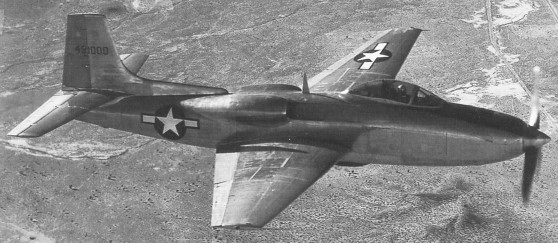
The Consolidated Vultee XP-81 (its newly-merged builder soon to be better known as Convair) was the first American aircraft powered by a turboprop engine. Ordered by the USAAF on 11 February 1944, the XP-81 was intended as a long-range escort fighter using compound power, with one 1230kW General Electric TG-100 turbo-prop and one 1701kg thrust Allison I-40 jet engine, eventually designated J33-A-5. When delays with the turboprop powerplant were encountered, the prototype XP-81 was flown on 11 February 1945 with a Packard V-1650-7 Merlin installed temporarily in the nose.
The first flight with the intended turboprop engine followed on 21 December 1945 and the turboprop provided no advantage in performance over the Merlin. A second XP-81 flew in early 1946 to join the first machine in testing, but war’s end, the disappointing results with the TG-100, and the superiority of pure jet designs resulted in cancellation of an order for 13 YP-81 service-test aircraft.
Both XF-81 airframes have survived derelict on a test range at Edwards AFB, California.

Wingspan: 15.39 m / 50 ft 6 in
Length: 13.67 m / 44 ft 10 in
Height: 4.27 m / 14 ft 0 in
Wing area: 139.48 sq.m / 1501.35 sq ft
Max take-off weight: 12700 kg / 27999 lb
Empty weight: 5785 kg / 12754 lb
Max. speed: 815 km/h / 506 mph
Cruise speed: 442 km/h / 275 mph
Ceiling: 10800 m / 35450 ft
Range: 4000 km / 2486 miles
Armament: 6 x 12.7mm guns or 6 x 20mm cannon planned, 1450kg underwing bombs