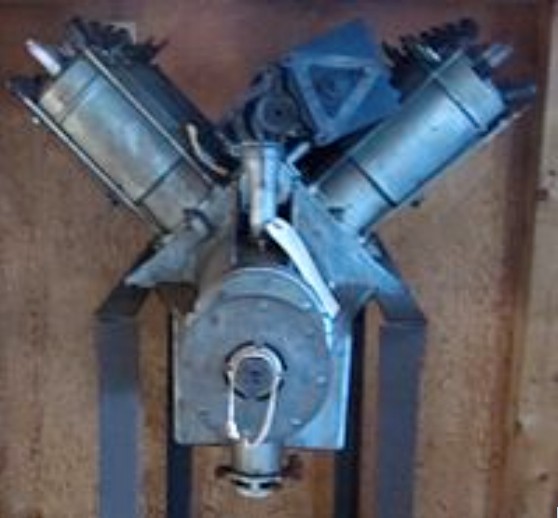
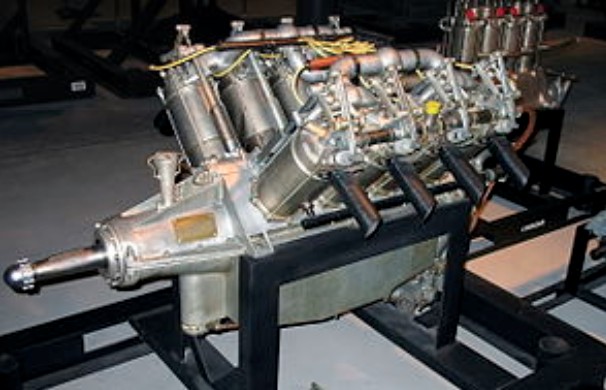
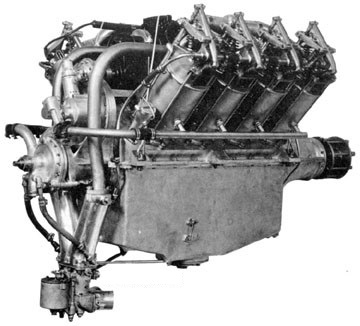
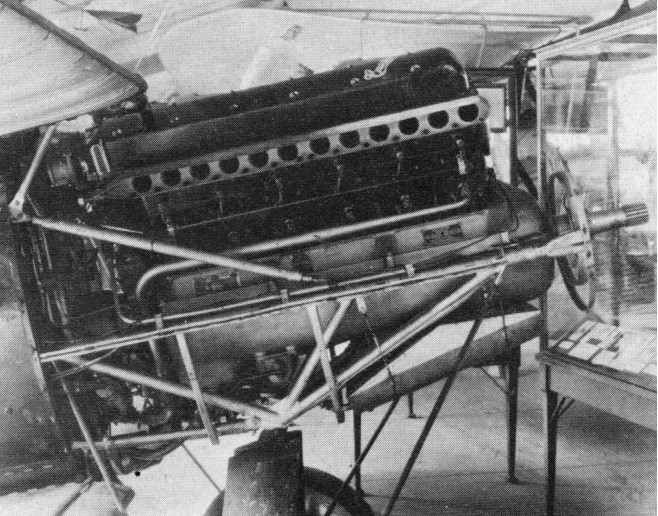
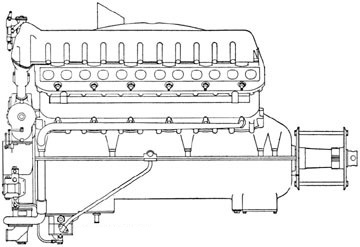
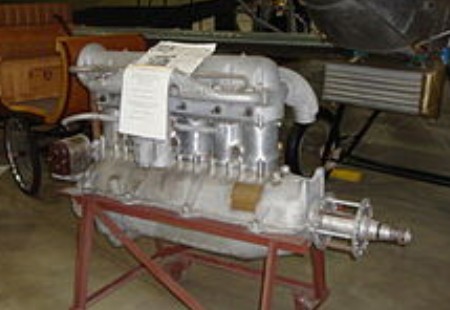
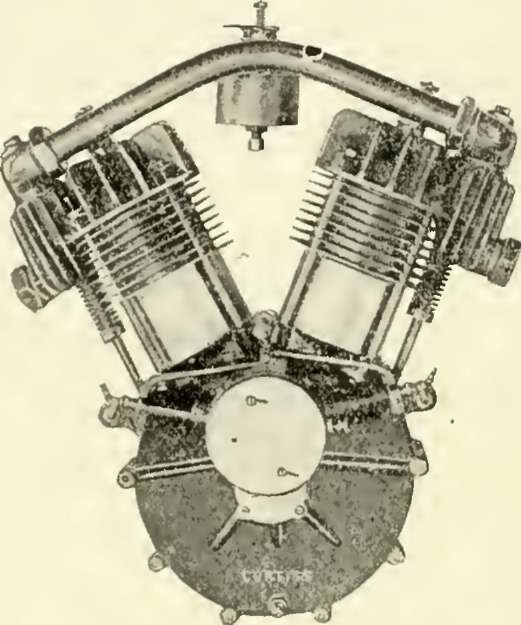
The OX-5 was the last in a series of Glenn Curtiss designed V engines, which had started as a series of air-cooled V-twins for motorcycles in 1902. A modified version of one of these early designs was sold as an aircraft engine in 1906, and from then on the company’s primary market was aircraft. The basic design had slowly expanded by adding additional cylinders until they reached the V-8 in 1906. They also started enlarging the cylinders as well, but this led to cooling problems that required the introduction of water cooling in 1908. These early engines used a flathead valve arrangement, which eventually gave way to a cross-flow cylinder with overhead valves in 1909, leading to improved volumetric efficiency. The US Navy ordered a version of this basic design in 1912 for its A-1 amphibious aircraft, which Curtiss supplied as the OX. These improvements and others were worked into what became the OX-5, which was first built in 1910. The OX-5 was almost identical with OX-2 but Berlin magneto and Zenith carburetor. By this point engine design was a team effort; the team included Charles Manley, whose earlier Manley-Balzer engine had held the power-to-weight ratio record for 16 years.
First run in 1915, the OX-5 was an early V-8 American liquid-cooled aircraft engine built by Curtiss. It was the first US-designed engine to enter mass production, although it was considered obsolete when it did so in 1917. It found widespread use on a number of aircraft, the most famous being the JN-4 “Jenny”. Some 12,600 units were built through early 1919. The wide availability of the engine in the surplus market made it common until the 1930s, although it was considered unreliable for most of its service life. The engine can be found powering many Edwardian automobile racing specials on the historic racing scene.
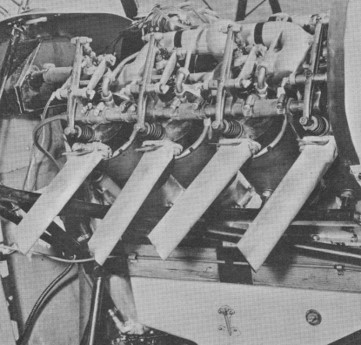
Like most engines of the era, the OX-5’s high-temperature areas were built mostly of cast iron, using individual cylinders bolted to a single aluminum crankcase, wrapped in a cooling jacket made of a nickel-copper alloy. Later versions used a brazed-on steel jacket instead. Cylinder heads were also attached to the crankcase, using X-shaped tie-downs on the top of the head attached to the block via four long bolts. Fuel was carbureted near the rear of the engine, then piped to the cylinders via two T-shaped pipes, the cylinders being arranged so the intake ports of any two in a bank were near each other. The cylinders had one intake and one exhaust valve, each operated by a pushrod from a camshaft running between the banks. This arrangement caused the outer exhaust valves to have a rather long rocker arm. The pushrods were arranged one inside the other, the exhaust valve rod being on the inside and the intake valve rod a tube around it. The aluminum camshaft bearings were a split type bolted together and held in place by lock screws. The pistons were cast aluminum.
The OX-5 was not considered particularly advanced, nor powerful, for its era. By this point rotary engines such as the Oberursel or Gnome-Rhone were producing about 100 hp (75 kW), and newer inlines were becoming available with 160 hp (120 kW) or more. Nevertheless the OX-5 had fairly good fuel economy as a result of its slow RPM, which made it useful for civilian aircraft. The OX-5 was used on the Laird Swallow, Pitcairn PA-4 Fleetwing II, Travel Air 2000, Waco 9 and 10, the American Eagle, the Buhl-Verville CW-3 Airster, and some models of the Jenny. The primary reason for its popularity was its low cost after the war, with almost-new examples selling as low as $20. It was often used in boats as well as in aircraft.
1927 Swallow OX-5
The engine was considered unreliable, but unreliable is a relative term: aviation engine technology had not fully matured at the end of WWI. Certainly the JN4 with the OX-5 was underpowered, but the OX-5 proved a much better engine than the Hall Scott A7A that was the achilles heel of the Standard J-1, the substitute primary trainer. In particular the valve gear was fragile, and it had no provisions for lubrication other than grease and oil applied by hand, leading to an overhaul interval as short as fifty hours. Additionally the engine featured a single spark plug in each cylinder, and a single ignition system, in an era when ignition equipment was less reliable.
Built by several contractors in large numbers, the OX-5 suffered from uneven quality control. However, while the overwhelming majority of training accidents in the U.S. were in JN-4s, this was because JN-4s were flown by the vast majority of trainee pilots, and the accident rate in the US for primary training was four times less than the advanced training rate in France (virtually all US airmen getting advanced training in France), approximately 2800 flying hours in the US primarily in OX-5 powered JN-4s per fatality to 761 hours per fatality in France in other types. Very few fatal accidents were caused by engine failure, although the lack of power may have been the cause of the many tailspins that took about forty five percent of training lives. The replacement of the A7A in Standard J-1s was contemplated, but the cost of $2,000 per aircraft compared with the need (by the time the J-1s were grounded in June 1918 JN-4s were in sufficient supply) led to the rejection of this idea.
The OX-5 itself would be replaced by the well-proven Wright Aeronautical-built version of the 150 hp Hispano-Suiza HS-8a V8 engine in the nearly 930 examples of the later production Curtiss JN-4H Jenny biplanes.
OX-5 Type: 8-cylinder water-cooled 90° Vee piston engine Bore: 4.0 in (102 mm) Stroke: 5.0 in (127 mm) Displacement: 503 in³ (8.2 l) Length: 56.75 in (1441.45 mm) Width: 29.75 in (755.65 mm) Height: 36.75 in (933.45 mm) Dry weight: 390 lb (177 kg) Valvetrain: One intake and one exhaust valve per cylinder, pushrod-actuated Fuel system: Duplex Zenith Carburetor Oil system: Gear-pump 40 to 60 psi 3-gallon sump Cooling system: Water-cooled Power output: 90 hp (67 kW) at 1,400 rpm 105 hp (78 kW) at 1,800 rpm for brief periods Specific power: 0.21 hp/in³ (9.5 kW/l) Compression ratio: 4.9:1 Fuel consumption: 8.0 US gal/h (30.8 l/h) at 75% power Specific fuel consumption: 0.53 lb/(hp·h) (0.32 kg/(kW·h)) at 75% power Oil consumption: 0.5 US gal/h (1.9 l/h) at 75% power
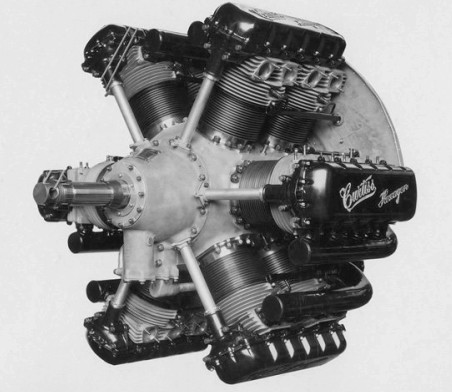
The H-1640 was an air-cooled, two-row 12-cylinder radial with the cylinders aligned fore and aft in a hexagonal layout. The cylinder banks were placed at 60° intervals. One piece cylinder heads shared a single overhead camshaft, the propeller was directly driven. It was thought that the use of a Townend ring would prove more aerodynamically efficient over an inline engine. The engine first ran in 1927, by aligning the cylinders the diameter of the engine was less than more conventional radial engines.
The H-1640 was the first airworthy ‘inline radial’ and was sponsored for flight testing in a range of aircraft by the U.S. Government. Among the types selected were the Thomas-Morse XP-13 and the Curtiss XO-18. Although the engine was also intended for civil use in the 600 horsepower class continued cooling problems with the rear cylinders caused the project to be canceled with few production engines being built.
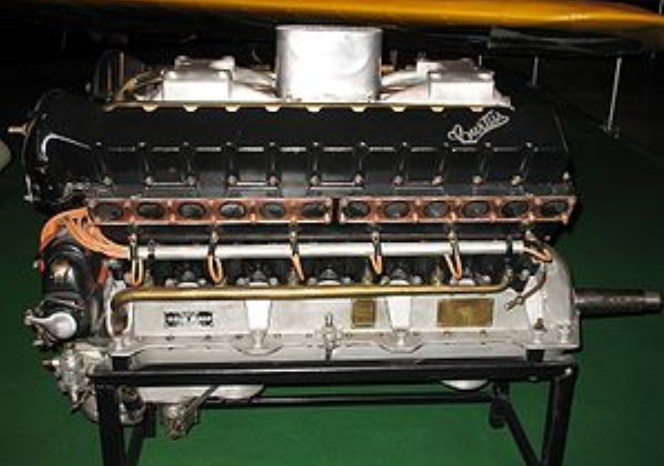
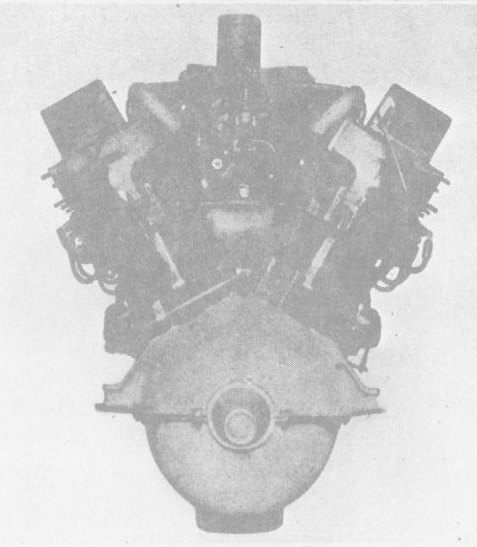
The 1922 Curtiss D-12 (ATC 10) was an aero engine of 18.8 litres capacity. A re-designed K-12 by Arthur Nutt. It was a water-cooled V12, producing 443 hp (330 kW) and weighing 693 lb (314 kg). It was designed by Arthur Nutt in 1921 with enbloc type jacket construction in two banks of six each. The cylinders were of heat treated hydraulically forged carbon steel with the head end closed.
Four interchangeable tulip valves seating directly in each cylinder head. The crankshaft was carried in eight bearings. The gear assembly is removable as a unit. The pistons are ribbed head type aluminium alloy. The connecting rods are master and articulating.
An accesssories costing extra was the Eclispe hand inertia starter.
Three Curtiss D-12 was used in the Curtiss CR-3 for the 1923 Schneider Trophy race. In racing trim the V-1400 D-12 gave 619 hp, against the normal 435 hp.
Fairey Aviation of England imported 50 Curtiss built examples in 1926, renaming them the Fairey Felix.
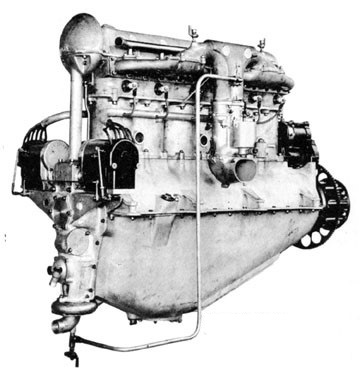
The 1922 Curtiss C-6 is a six-cylinder, water-cooled, inline aircraft engine and is a development of the Curtiss K-6 engine redesigned by Arthur Nutt. The C-6 features an overhead cam and aluminum cylinder jackets.
C-6 Type: 6-cylinder water-cooled inline Dry weight: 420 lb Valvetrain: Two intake and two exhaust valves per cylinder, pushrod-actuated Cooling system: Water-cooled Power output: 160 hp at 1,250 rpm 161 hp at 1,760 rpm Fuel consumption: .5 lbs per hp per hr Oil consumption: .016 lbs per hp per hr Power-to-weight ratio: 0.38 hp/lb
The Curtiss B-8 was an early air-cooled 8-cylinder engine used for a number of aircraft and one motorcycle designed by Glenn Curtiss. It powered the AEA June Bug in 1908, becoming the first Curtiss engine to power a heavier-than-air aircraft in sustained flight.
Applications included: AEA June Bug AEA White Wing AEA Red Wing Curtiss V-8 motorcycle
Specifications Weight: 150 pounds (68 kg) Bore×Stroke: 3.625×3.25 in. Power: 40 horsepower (30 kW) Displacement: 268 cubic inches (4,390 cc)
The A-2 was a small 2 cylinder V-type engine built by the Curtiss Aeroplane and Motor Company around the early 1900s. It was developed from an earlier Curtiss motorcycle engine. The first Curtiss aircraft engine, a 5.2 kW (7 hp) air cooled, V-twin, was built T S Baldwin’s dirigible and first flew on 3 August 1904.
A-2 Type: Two-cylinder, V-type, air-cooled Bore: 3.25in (82.55mm) Stroke: 3.625in (92.08mm) Displacement: 60.14 cuin (986cc) Dry weight: 50lb (22.7kg) Cooling system: Air cooled Power output: 7 hp (5.2 kW) at 1,500 rpm
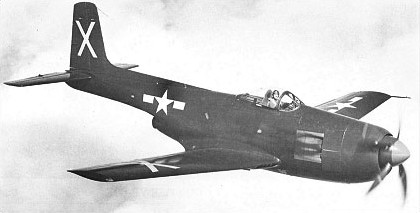
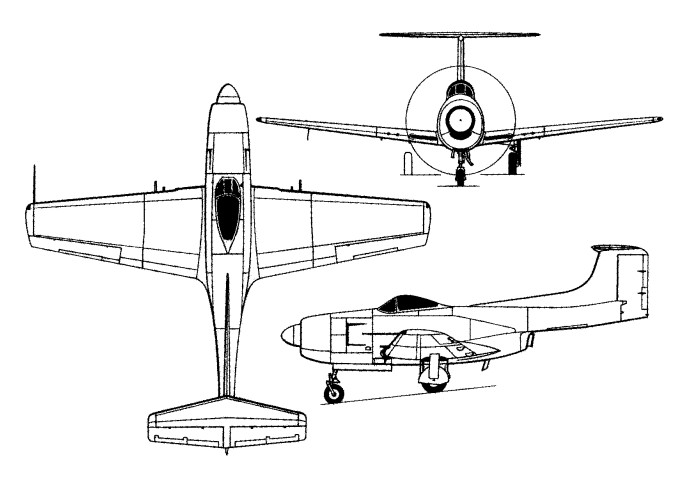
US Navy interest in the mixed-power concept for shipboard fighters had resulted in orders for three prototypes of the Ryan XFR-1, and 100 production FR-1s. Taken a stage further, on 7 April 1944 a contract for three prototypes of the more powerful XF15C-1 was placed with Curtiss. This was to be powered by a 2,100hp Pratt & Whitney R-2800-34W 18-cylinder two row radial in the front with a four-bladed propeller and a 1226kgp Allison-Chalmers J36 (Halford H-1B) turbojet in the belly. Armament was to comprise four wing-mounted 20mm cannon. The first XF15C-1 was flown on 27 February 1945, without the turbojet installed, this fitted by April, but the aircraft was lost on 8 May when it crashed during a landing approach. The second XF15C-1 flew on 9 July 1945, and was joined soon after by the third, both subsequently having their low-set horizontal tail surfaces replaced by a T-tail arrangement. The flight test programme continued until October 1946, by which time the US Navy had lost interest in the mixed power arrangement and cancelled further development.
Engines: 1 x Pratt & Whitney R-2800-34W 18-cylinder two row radial, 2,100hp / 1566 kW and 1 x Allison-Chalmers J36 (Halford H-1B) turbojet, 1226kgp / 2700-lb Max take-off weight: 7543 kg / 16630 lb Empty weight: 5 737 kg Wingspan: 14.63 m / 47 ft 12 in Length: 13.41 m / 43 ft 12 in Height: 4.65 m / 15 ft 3 in Wing area: 37.16 sq.m / 399.99 sq ft Max. speed: 469 mph / 755 km/h Range: 2228 km / 1384 miles
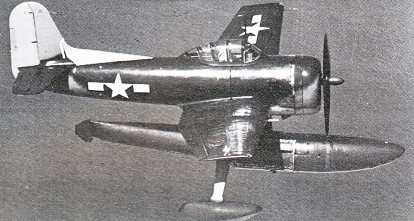
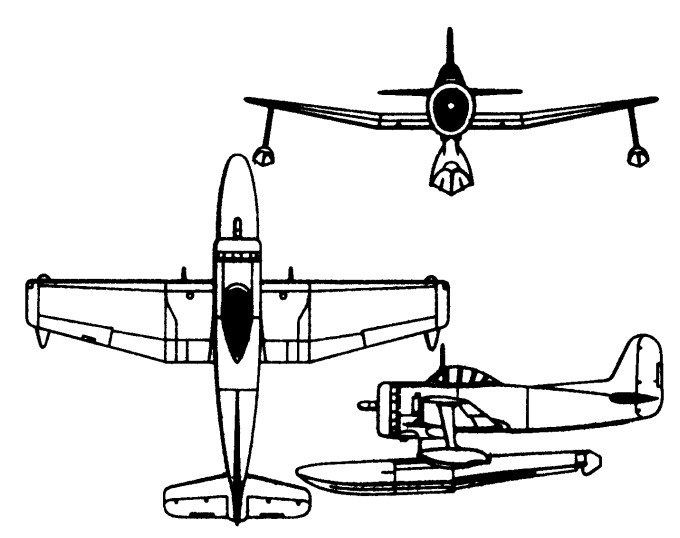
Development of the Curtiss SC Seahawk began in June 1942, when the US Navy requested the company to submit proposals for an advanced wheel/float scout aircraft. An easily convertible landing gear configuration was required so that the aircraft could be operated from aircraft carriers and land bases, or be catapulted from battleships. The type was required to replace the rather similar Curtiss Seamew and Vought Kingfisher which stemmed from a 1937 role. The Curtiss Model 97 design proposal was submitted on 1 August 1942 but it was not until 31 March 1943 that a contract for two XSC-1 (Model 97A) prototypes was issued. An all-metal cantilever low-wing monoplane, the SC Seahawk had folding wings with considerable dihedral on their outer panels and strut-mounted wingtip stabiliser floats. The central float, which could also accommodate some auxiliary fuel, and the main wheeled landing gear units shared common attachment points. Power was a Wright R-1820-62 Cyclone 9 radial engine. The first prototype made its maiden flight on 16 February 1944, and was followed by 500 production SC-1 (Model 97B) aircraft which had been contracted from June 1943. All were delivered as land-planes, the stabiliser floats and Edo central float being purchased separately and installed as and when required by the US Navy. Delivery of production aircraft began in October 1944, the first equipping units aboard the USS Guam. A second batch of 450 SC-1s was contracted, but of these only 66 had been delivered before contract cancellation at VJ-Day. An improved version was developed, changes including the installation of a 1063kW R-1820-76 engine, a clear blown canopy, and a jump seat behind the pilot. The modified prototype, at first designated XSC-1A and then XSC-2 (Model 97C), led to a contract for similar production SC-2 (Model 97D), but only 10 had been delivered by the war’s end.
XSC-1 – Prototype Designation; two examples produced.
SC-1 – Initial Produciton Model Designation; 566 examples produced; introduced in 1944.
SC-2 – Improved two-seat SC-1; nine examples produced; appearing in 1946.
Curtiss SC-1 Seahawk Engine: 1 x Wright R-1820-62 Cyclone radial, 1,350 hp / 1007kW Wingspan: 12.50 m / 41 ft 0 in Length: 11.09 m / 36 ft 5 in Height: 3.89 m / 12 ft 9 in Wing area: 26.01 sq.m / 279.97 sq ft Wing load: 32.19 lb/sq.ft / 157.0 kg/sq.m Max. speed: 272 kt / 504 km/h / 313 mph Cruise speed: 201 km/h / 125 mph Maximum Range: 631miles (1,016km) Rate-of-Climb: 2,500ft/min (762m/min) Service Ceiling: 37,303ft (11,370m) Armament: 2 x 0.50 cal (12.7mm) fixed, forward-firing heavy machine guns. 2 x 100- or 250lb general purpose bombs held underwing. Crew: 1 Hardpoints: 2 Empty Weight: 6,321lbs (2,867kg) Maximum Take-Off Weight: 8,999lbs (4,082kg)
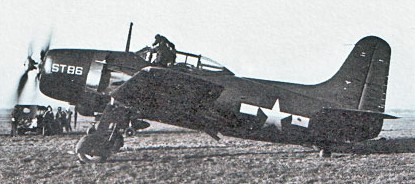
In late 1943 Curtiss received a US Navy order for two single-seat torpedo-bomber aircraft Model 96 prototypes under the designation XBTC-1 931401/314020. A low-wing monoplane with considerable dihedral on the outer wing panels, retractable tailwheel landing gear and a 2237kW Pratt & Whitney R-4360-14 Wasp Major engine and three-blade contrarotating prop, but before the first flew, a slightly different version of XR-4360-8A engine was installed in each aircraft, bringing the redesignation XBTC-2. Armament was four 20mm wing cannon. However, Curtiss was now in competition with Douglas, Fleetwings and Martin for this requirement, losing out to Douglas and Martin whose contenders were produced as the AD-1 Skyraider and AM Mauler respectively.
Curtiss XBTC-2
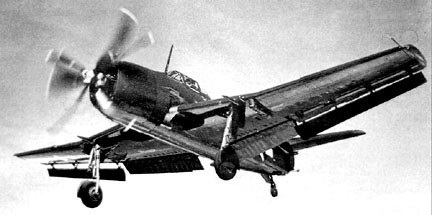
In March 1945 Curtiss gained a contract for 10 of the generally similar XBT2C-1. This Model 98 differed by having a lower-powered Wright R-3350-24 engine, reduced armament, accommodation for a crew of two and a search radar pod mounted beneath the starboard wing. Only nine of the 10 were built, and these were the last Curtiss-built aircraft for the US Navy.
96 / XBTC Engine: 2237kW Pratt & Whitney R-4360-14 Wasp Major Wingspan: 14.02 m / 45 ft 12 in Length: 11.51 m / 37 ft 9 in Height: 3.76 m / 12 ft 4 in Wing area: 34.84 sq.m / 375.01 sq ft Empty weight: 4 800 kg Useful load: 3963 lb Max. speed: 611 km/h / 380 mph Cruise speed: 180 mph Stall: 85 mph Ceiling: 28,000 ft Range: 2180 km / 1355 miles Seats: 1
98 / XBT2C-1 Engine: 1 x 1864kW Wright R-3350-24 radial Take-off weight: 8618 kg / 19000 lb Empty weight: 5565 kg / 12269 lb Wingspan: 14.50 m / 47 ft 7 in Length: 11.94 m / 39 ft 2 in Height: 3.68 m / 12 ft 1 in Wing area: 38.65 sq.m / 416.02 sq ft Max. Speed: 531 km/h / 330 mph Ceiling: 8015 m / 26300 ft Range: 2108 km / 1310 miles Armament: 2 x 20mm cannon, 907kg of bombs Seats: 1