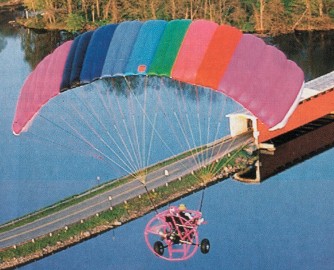
Development Technology Aero / DTA Combo

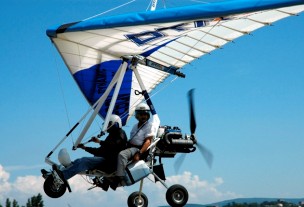
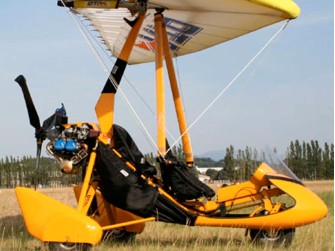
Available with the Rotax 503 and 582 as well as the Rotax 912 and 912S, this machine gives you performance capabilities and robust strength not normally found in an affordable and easy to inspect/maintain aircraft. With the available option of the Voyageur-II’s cantilever mast, this machine can be flown with no front strut.

Stall: 27 kt / 31 mph / 50 kmh
Cruise: 54 kt / 62 mph / 100 kmh
VNE: 86 kt / 99 mph / 160 kmh
Climb Ratio: 1000 ft/min / 5 m/s
Glide Ratio: 8

Development Technology Aero / DTA Voyager

Voyageur 912 XP15

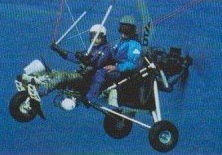
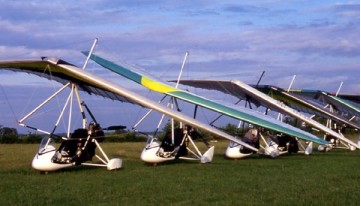
The Voyageur 912 XP15 is a large trike with a topless wing, designed for aerial work or long rallies. It features individual composite seats.

The basic design is an aluminum sandwich with extra reinforcing structure. It also has a safety cable running through the sandwich. The sandwich is riveted and also bonded with aeronautical Araldite structural epoxy.
The Voyageur 912 was created for this purpose and became the first trike to be fitted with the 4-stroke 80HP Rotax 912 engine.
With the available option of the Voyageur-II’s cantilever mast, this machine can be flown with no front strut, just like its big brother.
The Voyageur II trike features a cantilever mast that is structurally strong enough to eliminate the need for the standard front tube. The basic design is an aluminum sandwich with extra reinforcing structure. It also has a safety cable running through the sandwich. The sandwich is riveted and also bonded with aeronautical Araldite structural epoxy.
The Voyageur trike utilizes only 4130 chromoly steel, a primarily stainless steel frame and aircraft grade aluminium, and is made in France.
Features that come standard on the Voyageur II include:
Full front and rear shock absorbers (rear gas shocks)
3-wheel brakes with parking brake
Cruise throttle
Large aviation tires
Padded seat covers
Rear seat head rest
Side luggage bags
Large capacity fuel tank with fuel level gauge
Instrument panel
RPM gauge, hourmeter, water temp gauge
Full electrical system
Assembled pitot system

Voyageur II / Dynamic 16
Engine: Rotax 582

Voyageur II / Dynamic 15/430
Engine: Rotax 582
Engine: Rotax 912 UL
Engine: Rotax 912S ULFR

Voyageur II / Dynamic 450
Engine: Rotax 582
Empty Weight: 407 lbs
Gross Weight: 992 lbs
Useful load (582): 585 lbs
Useful load (912/S): 532 lbs
Wingspan: 33’ 5” (10.2 m)
Wing Area: 167 sq. ft (15.5 sq.m)
Length: 9’ 9” inches
Height: 12’ 5”
Fuel Capacity: 18 gallons
Cruise Speed: 56 mph
Vne: 90 mph
Rate of Climb: 700 fpm
Takeoff distance at gross weight: 262 feet
Takeoff distance over a 50′ obstacle:n 590 feet
Landing distance at gross weight: 165 feet
Landing distance over a 50′ obstacle: 560 feet

Voyageur 912 XP15
Empty weight: 225 kg
Wing span: 10 m
Wing area: 15.50 sq.m
Fuel capacity: 80 lt
Engine: Rotax 912, 80 hp
MAUW: 450 kg
Seats: 2
Max speed: 135 kph
Cruise speed: 100 kph
Minimum speed: 63 kph
Climb rate: 5 m/s
Fuel consumption: 10 lt/hr
Price (1998): 220 950 Fttc

Engine: Rotax 912S ULFR
Empty Weight: 460 lbs

Development Technology Aero / DTA Feeling

Dynamic 15-430
Engine: Rotax 582
Max take-off weight (lbs): 946
Empty weight (lbs): 398
Useful Load (lbs): 548
Wing surface : 13.6 sq.m
Max speed (mph): 85
Min speed (mph): 34
Max rate of climb at 45 mph (ft/min): 866

Dynamic 16
Engine: Rotax 582
Max take-off weight (lbs): 880
Empty weight (lbs): 400
Useful Load (lbs): 480
Wing surface : 14.5 sq.m
Max speed (mph): 75
Min speed (mph): 32
Max rate of climb at 45 mph (ft/min): 905

Dynamic 450
Engine: Rotax 582
Max take-off weight (lbs): 990
Empty weight (lbs): 416
Useful Load (lbs): 574
Wing surface : 15.5 sq.m
Max speed (mph): 84
Min speed (mph): 31
Max rate of climb at 45 mph (ft/min): 945

Dynamic 450
Engine: Rotax 912
Max take-off weight (lbs): 990
Empty weight (lbs): 469
Useful Load (lbs): 521
Wing surface : 15.5 sq.m
Max speed (mph): 85
Min speed (mph): 39
Max rate of climb at 45 mph (ft/min): 984

Dynamic 450
Engine: Rotax 912S
Max take-off weight (lbs): 990
Empty weight (lbs): 469
Useful Load (lbs): 521
Wing surface : 15.5 sq.m
Max speed (mph): 87
Min speed (mph): 39
Max rate of climb at 45 mph (ft/min): 1181

Detroit Aeroplane Co 1910 Monoplane / Miss Detroit

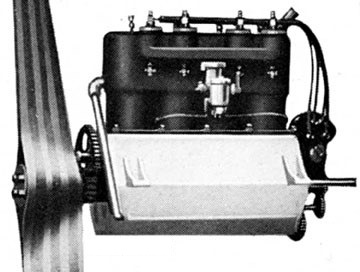
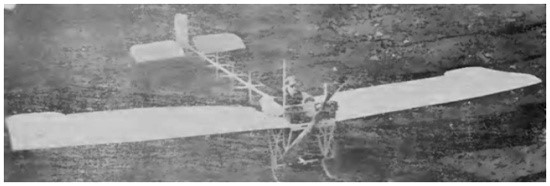
The Detroit Aeroplane Co. displayed a monoplane fitted with the company’s two-cylinder opposed 30 hp engine at the 1910 Philadelphia show, where it was “the hit of the show”. Two of them were sold, one to Atlantic City, where a training school is to be started next summer. It had a main plane with a span of 30 ft and an area 150 sq. ft. Stability was achieved by an arrangement where “the extremities of the wings sections have been cut out and hinged to the rear lateral beam. These float in the air stream in flight, being depressed individually through their attachment to the steering column”, i.e. ailerons… The fuselage was a single seamless steel tube of large diameter, braced with wires over cruciform horizontal and vertical masts.

Destiny 2000

The Destiny 2000 features bucket seats equipped with a standard 5 point harnes. Landings are controlled both by power and flare. The chassis absorbing landings. Gear legs have built in suspension with fibreglass rods and 22-in tundra tires. With a frame built around such large tires, gives a 4-inch-higher clearance.

Destiny Powered Parachutes’ Destiny 2000 first flew in November 1999.

The Destiny 2000 has no cargo area, but comes with saddle bags. The Destiny 2000 has individual bucket seats in tandem and a 5-point restraint harnesses.

Destiny offered three different canopies. They have 500- and 550-square-foot square canopy models supplied both by Apco and Elan as well as a newer Chiron elliptical canopy. The Chiron (pronounced sha-RONE) canopy is made in Israel by Sycon Aircraft. After being sewn and tested in Israel, the canopies are again tested in Austria, which Brown feels provides extra assurance to buyers. Aluminum airframe, 4130 chromoly steel. Nylon canopy with Dacron suspension lines. The carriage made in the USA.

The instructor works the throttle from the rear, all the student does initially is steer the nosewheel with the hand control on the left. Since it operates fore and aft to steer left and right, it may take some time to acquire comfort with this system.

In light or no winds, the controlling foot bar will be held to a minimum but the instructor can always aid control by hand pulling the canopy’s lines at either side. Pulling in toward you by hand is similar to pushing with your legs in physical exertion and an experienced instructor can stay on top of the controls in this manner.

Despite a 20% increase in glide angle and some boost in handling qualities, most buyers don’t request the Chiron canopy. The added $900 expense no doubt accounts for some of this hesitancy, and the Chiron is somewhat more temperamental in the launch phase. If the lines are sufficiently entangled the canopy won’t inflate. The reliable square canopy rarely has this problem.

The Chiron canopy on the Destiny proved diving turns to 45 mph are possible with the Chiron’s wider speed range. The throttle at each seat is close and convenient; throttle also moves conventionally (i.e., lever forward is more power).

There is no rear steering system; at least other than an instructor tugging on lines by hand. Controls seem counterintuitive for 3-axis pilots: no flying is done by hand (though general aviation pilots all use rudders, which aren’t so different from powered parachute steering bars); and nosewheel steering is non-intuitive until you acquire some experience with it. The higher aspect ratio Chiron canopy brings glide improvement – around 5:1 versus about 4:1. The Chiron is also capable of faster gliding turns. The speed barely passes 40 mph even in a descending diving turn.

The Rotax 503 was standard at $13,800. Standard Features were Digital Engine Information System (EIS), spun aluminum wheels, strobe, adjustable front seat, 5-point seat belts, and side stash pouches. Options were a 66-hp Rotax 582, electric start, and brake. Destiny later added a small roll bar to better protect occupants, especially the rear person.

Destiny Powered Parachutes specialised in delivering a fully ready-to-fly powered parachute with many features built into the base price.

Destiny 2000
Span: 38 ft
Length: 10 ft
Width: 6.7 ft
Wing area: 500 or 550 sq.ft
Empty weight: 370 lb
Gross weight: 850 lb
Top speed: 30 mph
Cruise: 26 mph
Fuel capacity: 10 USG
Rate of Climb: 700 fpm
Take off roll: 150 ft
Landing roll: 150 ft

Destiny 2000 Chiron canopy
Engine: Rotax 503, 50 hp at 6,250 rpm
Canopy Area: 340 square feet
Empty weight: 365 pounds
Gross weight: 850 pounds
Fuel capacity: 10 US gallon
Cruise speed: 29 mph
Rate of climb at gross: 700 fpm
Takeoff distance at gross: 100-150 feet
Landing distance at gross: 100-150 feet
Canopy Loading: 2.5 pounds/square foot
Power loading: 17.0 pounds per hp
Seating: 2-seat, tandem