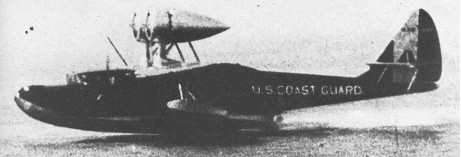
A PJ 2 of the US Coast Guard was converted by the Naval Aircraft Factory from a PJ 1, with pusher propellers, to the PJ 2 tractor. All PJs were equipped with an undercarriage to enable them to beach under their own power.
A PJ 2 of the US Coast Guard was converted by the Naval Aircraft Factory from a PJ 1, with pusher propellers, to the PJ 2 tractor. All PJs were equipped with an undercarriage to enable them to beach under their own power.
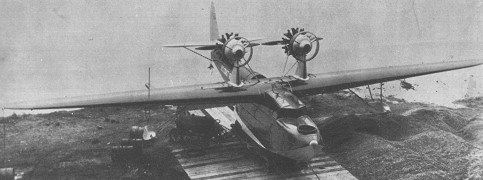
Fokker was the winner of a competition instigated by the US Coast Guard for an FLB (Flying Boat) for patrol and rescue in the open sea. The PJ-1 flying boat developed from the B.4A amphibious aircraft.
Because the American Fokker Factory was owned by the General Aviation Corp, at that time, the five flying boats ordered were designated GA 15, and the Coast Guard designation was PJ 1. They had a four man crew and were equipped with two 420 h.p. Wasp engines driving pusher propellers. The first aircraft was converted by the Naval Aircraft Factory to PJ 2, with tractor propellers. All PJs were equipped with an undercarriage to enable them to beach under their own power. The PJ flying boats the last Fokker aircraft built in America until 1958.
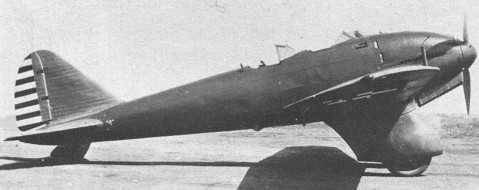
The XA 7 was an all metal attack aircraft. It appeared in 1930 and was a product of the General Aviation Corporation, as the former Fokker Factories were now named. The Army finally selected the Curtiss XA 8, which had been designed to the same specification.
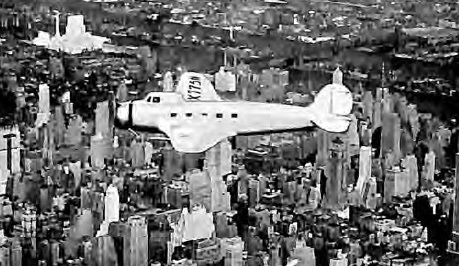
A ten-passenger single-engine cabin monoplane, which later became known as Clark GA.43. The GA-43 was all-metal and powered by a Wright Cyclone engine.
At least one was operated by Swiss Air Lines.
Twin-engine pusher monoplane flying-boat for USCG
The General Aviation Design Bureau of Ukraine has constructed trike designs for other manufacturers under contract in the past, but the T-32 is their own design. The T-32 Maverick is an ultralight trike that was under development in Kiev in 2011. The aircraft is intended to be supplied as a kit for amateur construction or as a complete ready-to-fly-aircraft.
The T-32 Maverick features a cable-braced hang glider-style high-wing, weight-shift controls, a three-seat open cockpit, with the pilot sitting in front and a two-seat bench in the back, with a cockpit fairing. It can be mounted on tricycle landing gear or floats and has a single engine in pusher configuration.
The aircraft is made from bolted-together aluminum tubing, with its double surface wing covered in Dacron sailcloth. Its 10.2 m (33.5 ft) span wing is supported by a single tube-type kingpost and uses an “A” frame weight-shift control bar. The aircraft has many powerplant options, including the twin cylinder, liquid-cooled, two-stroke, dual-ignition 64 hp (48 kW) Rotax 582 engine, the four cylinder, air and liquid-cooled, four-stroke, dual-ignition 80 hp (60 kW) Rotax 912UL or 100 hp (75 kW) Rotax 912ULS engine and the turbocharged 115 hp (86 kW) Rotax 914. Automotive conversion engines of 60 to 110 hp (45 to 82 kW) can also be fitted.
As a three-seat trike the T-32 Maverick does not comply with the Fédération Aéronautique Internationale microlight or the US light-sport aircraft categories, which are both limited to two seats, but may fit some country’s amateur-built aircraft rules.
At least one has been built.
Engine: 1 × Rotax 912UL, 60 kW (80 hp)
Propeller: 3-bladed composite
Wingspan: 10.2 m (33 ft 6 in)
Wing area: 16.5 sq.m (178 sq ft)
Empty weight: 280 kg (617 lb)
Gross weight: 640 kg (1,411 lb)
Useful load: 360 kg (794 lb)
Fuel: 60 litres (13 imp gal; 16 US gal)
Wing loading: 38.8 kg/m2 (7.9 lb/sq ft)
Maximum speed: 140 km/h (87 mph; 76 kn)
Cruise speed: 100 km/h (62 mph; 54 kn)
Stall speed: 55 km/h (34 mph; 30 kn)
Rate of climb: 3 m/s (590 ft/min)
Crew: one
Capacity: two passengers on a bench seat
A four-seat development of the F.22 Pinguino.
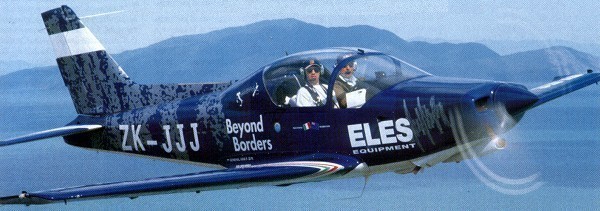
The F.22 Pinguino two-seat aerobatic lightplane and trainer was built in several versions with retractable or fixed undercarriages (first flown June 1989), and the F.22 Bupp variant with only fixed undercarriage and other changes.
The aircraft is built at Perugia Airport, Italy.
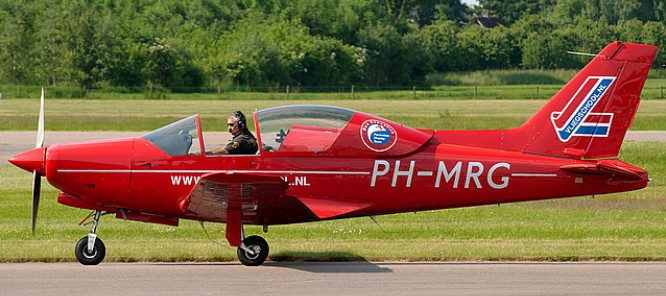
F.22R
Engine: Lycoming O-320-D1A, 160 hp.
Limits: +6 / -3G

In Italy the prototype (I-PROL) of the General Avia/Procaer F15F four seat lightplane was flown for the first time on 20 October 1977.

The General Airplane Service Model 11 is a modified biplane Piper Cub for crop dusting. Created by General Airplane Service of Sheridan, Wyo, it was modified to a reverse-tagger biplane, the plane is fitted with tandem one-wheel landing gear. The fuselage of a J-3 Cub with a Piper PA-18 top cabin structure, wing and tail. Power was a Ranger 200 hp in a Fairchild PT-19 cowling.
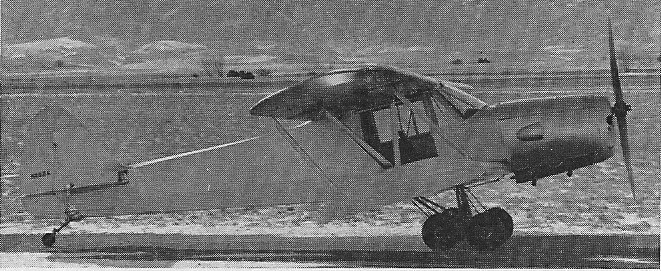
The first flight was on October 12,1953.
Engine: Ranger 200 hp
Span: 32 ft 2.5 in
Length: 24 ft
Height: 6 ft 8 in
Empty weight: 1200 lb
Gross weight: 3000 lb
Payload: 1500 lb
Operating speed: 40-100 mph

