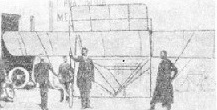
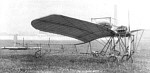
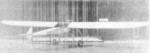
An airplane designed by Willibald Gold in Lviv. It was built by the Lviv Mechanical Laboratory of Witold Tranda.
The unfinished construction was exhibited at the First Lviv Exposition in Lviv. In the end, the construction of the aircraft was not finished and as a result no attempts were made to take off.
The Gold plane was in the high-wing brace system. Truss hull with wire strainers. Single surface wing covered with canvas.
Wingspan: 6.75 m Length: 8.0 m Wing area: 10.5 sq m Empty weight: 110 kg Gross weight: 190 kg
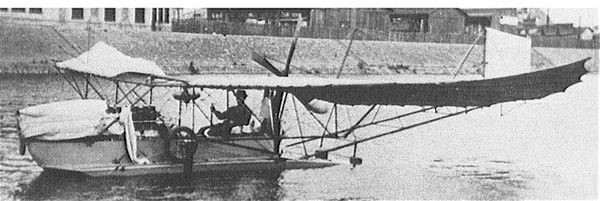
The second Amphibium, or “Amphibium II”, constructed by the Jacob Goedecker Flugmaschinen-Werke in 1912. At the end of August 1912 Goedecker flyer Bernard de Waal took the newly developed “Amphibium” to the First German Seaplane Competition in Heiligendamm district. Due to technical problems the Goedecker flying boat achieved only 4th place in a field of 6 participants. A second flying boat with a more powerful engine was built and tested at the Mainzer Floßhafen, and stationed in a boathouse. In a strong storm on April 6, 1913, the “Amphibium II” was severely damaged and scrapped.
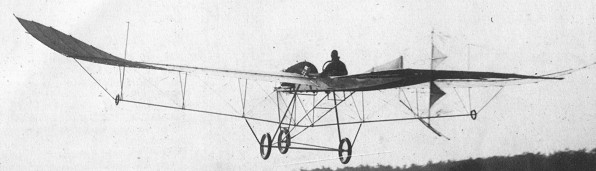
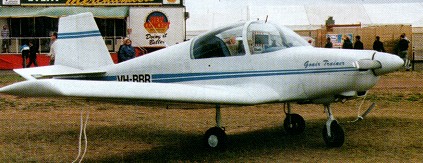
Designed as a trainer by Phil Goard, the two seater was built by Bankstown, Australia based Goair Products. Of all metal construction and powered by a Lycoming O-235 of 115 hp. Designed over a four year period, and first appeared at the Avalon 95 show.
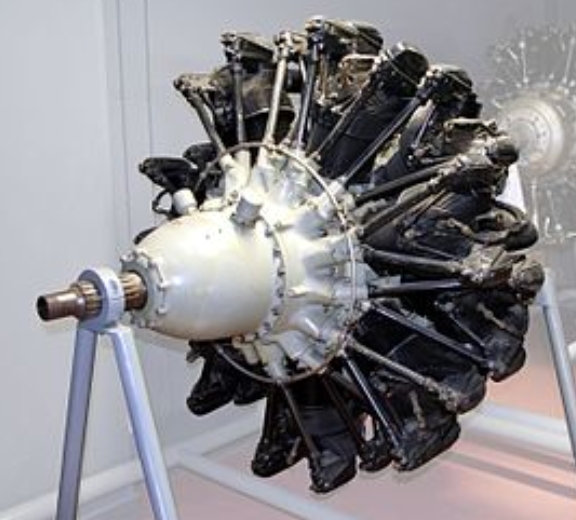
The Gnome et Rhône 18L was a French-designed twin-row 18-cylinder air-cooled radial engine. The 18L was a large step up in terms of displacement, power and number of cylinders. The majority of Gnome-Rhone engines were either 7, 9 or 14 cylinders. The engine proved not to be a success, and it was dropped in 1939 due to a poor power-to-weight ratio. The American and British 18-cylinder engines proved lighter, smaller and generally more reliable.
Gnome Rhone 18L Type: 18-cylinder twin-row air-cooled radial engine Bore: 146 mm (5.75 in) Stroke: 180 mm (7.09 in) Displacement: 54.2 L (3,308 cu in) Height: 1,400 mm (55.12 in) Dry weight: 736 kg (1,622 lbs) Valvetrain: 1 inlet and 1 exhaust valve per cylinder Supercharger: Yes Fuel system: 1 Bronzania Carburetor Fuel type: 87 octane Cooling system: air Power output: 1,300 hp at 2,150 rpm Compression ratio: 6.1:1 Power-to-weight ratio: 0.8 hp/lb at cruise speed
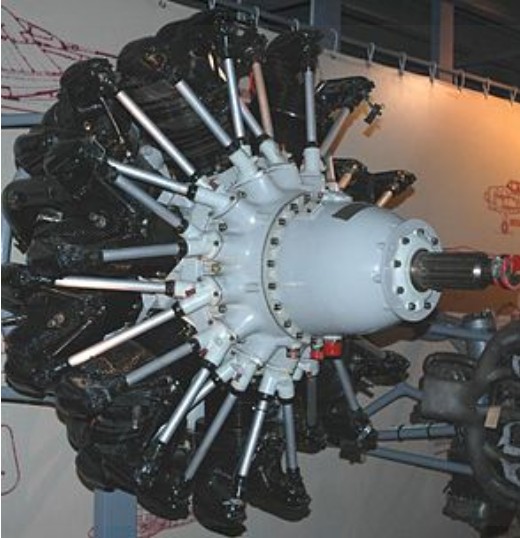
The 14N was a 14-cylinder two-row air-cooled radial engine designed and manufactured by Gnome-Rhône. A development of the pre-war Gnome-Rhône 14K, the 14N was used on several French and German aircraft of World War II.
Facing criticisms over the 14K’s reliability, Gnome-Rhône undertook a major upgrade of its 14-cylinder design, using different materials for the pistons and valves, and enlarging cooling surfaces by 39%.
The new 14N was introduced in 1937 and was quickly adopted on several aircraft models. In 1939, minor improvements allowed Gnome-Rhône to increase the compression ratio from 6.1:1 to 6.8:1, which resulted in increased power for wartime production aircraft.
The 14N was further developed into the Gnome-Rhône 14R featuring a 2-stage supercharger, but this type was not widely used until after World War II as production of improved engines was prohibited by the terms of the armistice with Germany.
The Gnome-Rhône 14K Mistral Major was a 14-cylinder, two-row, air-cooled radial engine. It was Gnome-Rhône’s major aircraft engine prior to World War II, and matured into a highly sought-after design that would see licensed production throughout Europe and Japan. Thousands of Mistral Major engines were produced, used on a wide variety of aircraft.
In 1921 Gnome-Rhône purchased a license for the highly successful Bristol Jupiter engine and produced it until about 1930, alongside the smaller Bristol Titan. Starting in 1926, however, they used the basic design of the Titan to produce a family of new engines, the so-called “K series”. These started with the 5K Titan, followed by the 7K Titan Major and 9K Mistral. By 1930, 6,000 of these engines had been delivered.
However, the aircraft industry at that time was rapidly evolving and producing much larger aircraft that demanded larger engines to power them. Gnome-Rhône responded by developing the 7K into a two-row version that became the 14K Mistral Major. The first test examples were running in 1929.
The Piaggio P.XI was a licensed derivative of the French Gnome-Rhône Mistral Major 14K produced in Italy. Isotta Fraschini also produced a version of the 14K called the K.14. Further development led to the P.XIX. This featured an increased compression rate from 6:1 to 7:1 and rpm from 2,400 to 2,600.
Piaggio P.XI
The Industria Aeronautică Română / IAR K14 was a licensed derivative of the French Gnome-Rhône Mistral Major 14K produced in Romania.
Variants IAR K14-II C32 693 kW (930 hp) engine. 44 for IAR P.24E IAR K14-II C32 – 649 kW (870 hp) engine. 50 built for IAR 37, 1 built for IAR 80 prototype IAR K.14-III C36 – 690 kW (930 hp) engine. 20 built for IAR 80, 95 built for IAR 37 IAR K.14-IV C32 – 716 kW (960 hp) engine. 30 built for IAR 80, 160 built for IAR 39, 2 built for IAR 47 prototypes IAR K.14-IV C32 1000A – 764 kW (1025 hp) engine. 430 built for IAR 80A, IAR 80B, IAR 80C, IAR 81A, IAR 81B, IAR 81C
Aircraft powered by G-R 14K derivatives Aero A.102 Heinkel He 70 IAR 37 IAR 80 Ilyushin DB-3 MÁVAG Héja Sukhoi Su-2 Weiss WM-21 Sólyom
Specifications:
Gnome-Rhône 14Kdrs Type: Fourteen-cylinder two-row air-cooled radial engine Bore: 146 mm (5.75 in) Stroke: 165 mm (6.5 in) Displacement: 38.72 l (2,363 in³) Diameter: 1,296 mm (51.02 in) Dry weight: 540 kg (1,190 lb) Valvetrain: Overhead valves Supercharger: Single-speed centrifugal type supercharger Fuel system: Stromberg carburetor Fuel type: 87 octane rating gasoline Cooling system: Air-cooled Reduction gear: 2:3 Power output: 743 kW (996 hp) at 2,390 rpm for takeoff 821 kW (1,100 hp) at 2,390 rpm at 2,600 m (8,530 ft) Specific power: 21.23 kW/l (0.47 hp/in³) Compression ratio: 5.5:1 Specific fuel consumption: 328 g/(kW•h) (0.54 lb/(hp•h)) Oil consumption: 20 g/(kW•h) (0.53 oz/(hp•h)) Power-to-weight ratio: 1.52 kW/kg (0.92 hp/lb)
IAR K14 Type: Fourteen-cylinder two-row air-cooled radial engine Bore: 146 mm (5.75 in) Stroke: 165 mm (6.5 in) Displacement: 38.72 l (2,363 in³) Diameter: 1,296 mm (51.02 in) Dry weight: 540 kg (1,190 lb) Valvetrain: Overhead valves Supercharger: Single-speed centrifugal type supercharger Fuel system: Stromberg carburetor Fuel type: 87 octane rating gasoline Cooling system: Air-cooled Power output: 743 kW (996 hp) at 2,390 rpm for takeoff 821 kW (1,100 hp) at 2,390 rpm at 2,600 m (8,530 ft) Specific power: 21.23 kW/l (0.47 hp/in³) Compression ratio: 5.5:1 Specific fuel consumption: 328 g/(kW•h) (0.54 lb/(hp•h)) Oil consumption: 20 g/(kW•h) (0.53 oz/(hp•h)) Power-to-weight ratio: 1.52 kW/kg (0.92 hp/lb)
Piaggio P.XI R.C.40 Type: 14-cylinder radial engine Bore: 146 mm (5.75 in) Stroke: 165 mm (6.50 in) Displacement: 38.6 l (2,360 cu in) Length: 1,700 mm (66.93 in) Diameter: 1,328 mm (52.28 in) Dry weight: 650 kg (1,433 lb) Frontal Area: 1.39 sq.m (15.0 sq ft) Valvetrain: 2 x overhead valves per cylinder operated by rockers and pushrods Supercharger: Centrifugal compressor, geared to 7.9:1 Fuel system: 1 x Piaggio T2-100 dual downdraught carburettor with automatic boost and mixture control Fuel type: 87 octane Oil system: Pressure fed at 482.6 kPa (70 psi), dry sump Cooling system: Air Reduction gear: Epicyclic reduction gear ratio 0.62:1 Starter: Garelli compressed air starter Ignition: 2 x Marelli MF14 magnetos, 2 x spark plugs per cylinder fed by a shielded ignition harness. Power output: Take-off: 1,000 hp (746 kW) at 2,200rpm Military: 1,000 hp (746 kW) at 2,200rpm at 4,000 m (13,000 ft) Cruising: 1,000 hp (746 kW) at 1,800rpm at 4,000 m (13,000 ft) Specific power: 19.1 kW/l (0.49 hp/cu in) Compression ratio: 6.0:1 Specific fuel consumption: 0.292 kg/kW/hr (0.48 lb/hp/hr) Oil consumption: 0.0134 kg/k/w/hr (0.022 lb/hp/hr) Power-to-weight ratio: 1.15 kW/kg (0.699 hp/lb)
The Gnome-Rhône 9K Mistral was a nine-cylinder 550 hp (405 kW) to 700 hp air-cooled radial engine, that started life as an enlarged Gnome-Rhône 7K with two extra cylinders.
The Gnome-Rhône 7K itself was an enlarged version of the Gnome-Rhône 5K which was derived from a licensed version of the Bristol Titan . A redesign of the cylinders is indicated by the K suffix. The 9K was followed by the larger and more powerful 14-cylinder twin row Gnome-Rhône 14K.
The 9K was license produced by Hungarian company Weiss Manfréd Repülogép- és Motorgyár Rt. (WM Rt, the aircraft engine factory of Manfred Weiss). The engine was used successfully in the MÁVAG Héja and Weiss WM-21 Sólyom aircraft.
The 9K was also produced in the Soviet Union as the M-75 at factory No. 29 in Zaporozhye. Only small numbers were built and it was dropped in favor of the M-25 a version of the Wright Cyclone and the M-85 a version of the 14K Mistral Major.