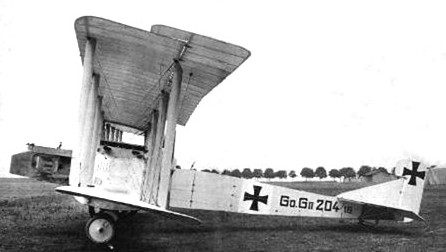
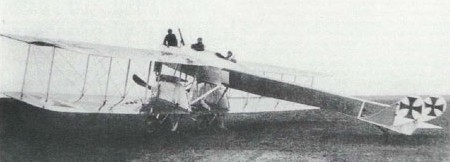
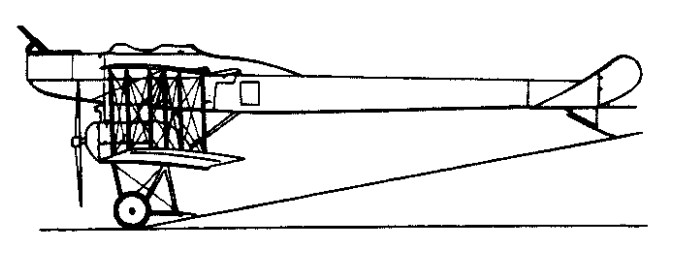
The Gotha G.II and G.III bombers made their appearance in 1916. The two bombers were remarkably similar, differing only in their engines and internal details. The G.II entered service in March of 1916 and was powered by a pair of direct drive 164kW six-cylinder liquid-cooled Mercedes DIV engines mounted in a pusher configuration. Some 15 G.IIs were used in the Balkans until they were withdrawn due to unreliable engines. Both aircraft were armed with two 7.92mm Maxim IMG Parabellum machine guns – one in the nose and another in the aft fuselage – and carried approximately 540kg of bombs. A few G.IIs and G.IIIs were equipped with a trapdoor in the undersurface of the rear fuselage, which permitted the rear gunner to take up a prone position and fire aft or downwards from a ventral position to defend the bomber’s vulnerable ‘blind spot.’ The G.II used straight-eight DIV engines of 220hp, the G.III straight-six DIVa’s with 260hp. Also the G.II did not have the trap-door, this was on G.IIIs only. Only 10 G.IIs were apparently built.
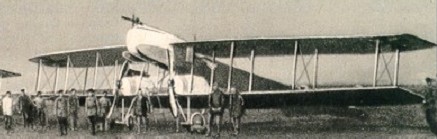
The first G.I flew in July 1915 followed by a further 17 of these three seater machines. While the prototype used two 160hp Mercedes D IIIs, the production aircraft employed two 150hp Benz Bz IIIs. mounted on the lower wing. A single Mercedes D.III-engined example of a seaplane version was also completed as the U.W.D. (Ursinus Wasser Doppeldecker, or Oscar Ursinus-designed float biplane).
G.I Engine: 2 x Benz Bz-III, 110kW Take-off weight: 2810 kg / 6195 lb Wingspan: 22.0/19.7 m / 72 ft 2 in / 64 ft 8 in Length: 12.9 m / 42 ft 4 in Height: 3.9 m / 12 ft 10 in Wing area: 82.0 sq.m / 882.64 sq ft Max. Speed: 130 km/h / 81 mph Ceiling: 2700 m / 8850 ft Range w/max.fuel: 540 km / 336 miles Crew: 3 Armament: 1 machine-gun
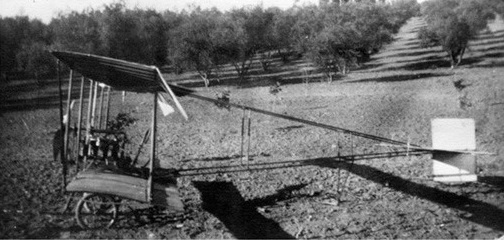
In 1903, Donald H. Gordon built a glider which took off from the top of the family barn. The contraption collapsed, and plane-building was suspended for several years. Gordon’s second aeroplane was built during 1911-1912.
M 125 Cycle: 2 stroke No cylinders: 4 Bore: 52 mm Stroke: 62 mm Displacement: 628 cc Cooling: Air Ignition: Magneto Reduction: Poly-V belt 2.56/1 Weight: 34.8 kg Max pwr: 46 hp at 6000 rpm
M 115 Cycle: 2 stroke No cylinders: 2 Bore: 52 mm Stroke: 62 mm Displacement: 314 cc Cooling: Air Ignition: Magneto Reduction: Poly-V belt 2.56/1 Weight: 20.9 kg Max pwr: 24.5 hp at 6000 rpm
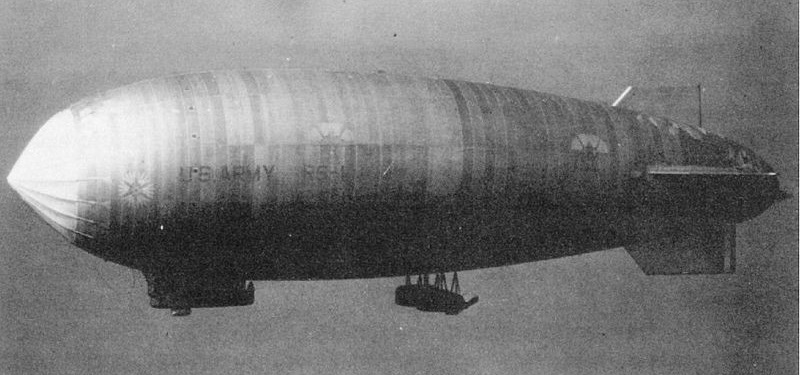
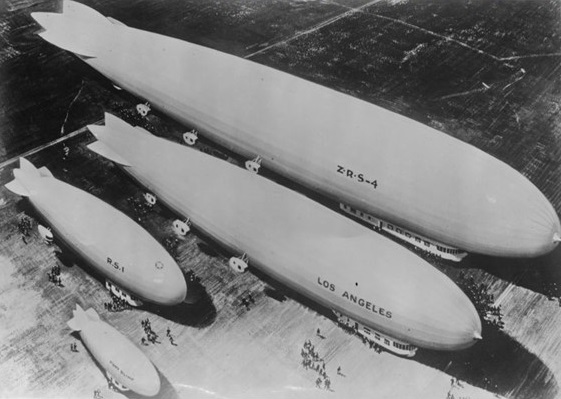
The first semi-rigid airship designed and built in the United States, the RS-1 project was initiated in 1922 and became a joint effort of the Air Service and the Goodyear Tire and Rubber Company of Akron. Ohio. It was designed by Goodyear engineer and inventor, Herman Theodore Kraft. A contract was signed with Goodyear on 13 October 1922 and actual construction was started at the Goodyear facility in Ohio in 1923.
The ship used helium as a lifting medium and power was by four 300 hp Liberty 12 engine. There were two power cars, each having a pair of engines driving a single 17 ft 6 in propeller through a transmission designed and built specifically for the RS-1. The contract to build the transmission was given to Goodyear along with one to built the airship itself. Goodyear subcontracted the transmission to the Twin Disc Clutch Co of Racine, Wisconsin. The design work was done by Thomas Farwick. Three units were built, one for testing and use for any refinements required, and two for installation in the RS-1. The first unit was delivered to McCook Field and passed is 50 hr test in the Summer of 1925. The remaining two units were delivered directly to Goodyear.
The design provided 12 to 5 reduction gearing to a single 17 ft 6 in propeller being driven by either two 300 hp Liberties or by a single one. The transmission could reverse the direction of the propeller but one engine had to be disengaged during the operation. Either or both engines could be disengaged by its own disk clutch.
The engines were mounted in staggered form. Each had its own disengaging clutch. One drove a transmission input through a short shaft and the ther through one long enough to clear its adjacent engine.
The ship was delivered to Scott Field in early 1925 where it was erected. A 35 ft (10.7 m) enclosed control car is suspended from the keel at the nose. Equipment included a bombing cockpit and the ability to carry 3,500 lb (1,588 kg) of bombs, as well as mounts for machine guns on each side at the forward end of the car.
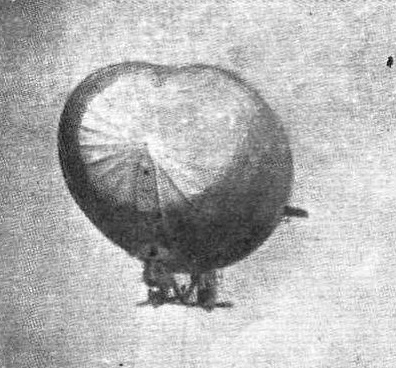
Along the belly of the envelope is an enclosed aluminium alloy keel, suspended by catenary cables, which attach to the three points of the keel at 10-ft. intervals. The load coming on the centre catenary gives the envelope a heartshape transverse cross-section, of which the greatest dimensions are 66.5 ft by 73 ft high. The envelope is divided into four compartments by transverse diaphragms. The centre diaphragm is a solid wall, while the end ones have surge holes near the bottom in the gas and air compartments.
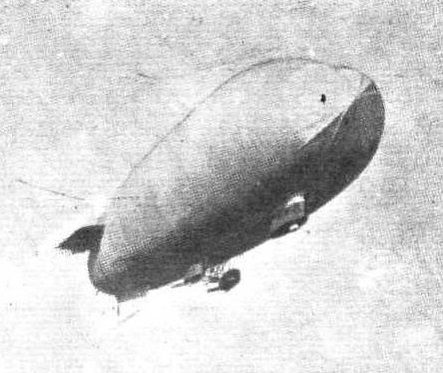
It was inflated and subjected to numerous tests and was taken on its maiden flight. The first flight was delayed due to a mistake made by a rigger during erection and eventually took place on 8 January 1926, lasting just over an hour with a crew of eight men.
On its initial trial flight, on January 8, it made a successful trip of over an hour’s duration in a mild snowstorm, carrying a crew of eight men and with Lieut. Orval Anderson in charge. During a subsequent test flight the RS-1 encountered extremely bumpy flying conditions and winds that at times exceeded 50 mph. After a flight of 19 hours’ duration, however, the RS-1 was landed at its home base in a high ground wind without mishap, the personnel rendering a favourable report of the ship’s entire performance.
13 May 1926
In 1927 the Liberty engines were replaced by 2A-1500 Packard engines. The Packards were lighter by about 150 lbs. The normal rating of the Packards was 500 hp at 2000 rpm and 600 hp at 2500 rpm. The props were replaced with 16 ft diameter.
Four airships on the ground (USS Akron, USS Los Angeles, Goodyear RS-1, Pony Blimp)
The airship was taken out of service in November 1928 because of envelope porosity pending its replacement, but because of economic conditions, a new envelope was never installed and the airship was eventually scrapped.
Engines: 4 x Liberty 12, 300 hp / 220 kW Capacity: 719,500 cu.ft / 20,000 m3 Length: 282 ft / 85.95 m Diameter: 70 ft 6 in / 21.49 m Width: 74 ft 6 in Height: 66 ft Max speed: 75 mph+ / 121 km/h / 65 kn Cruise speed: 45 mph / 72 km/h / 39 kn Useful load: 12,138 lb
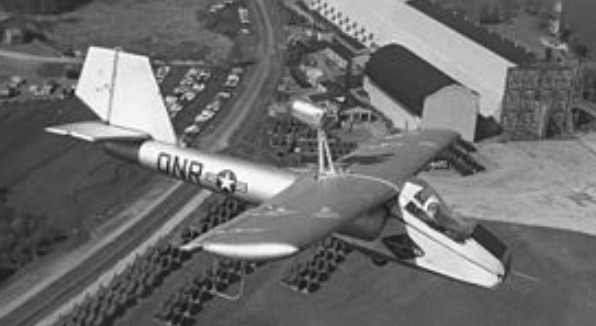
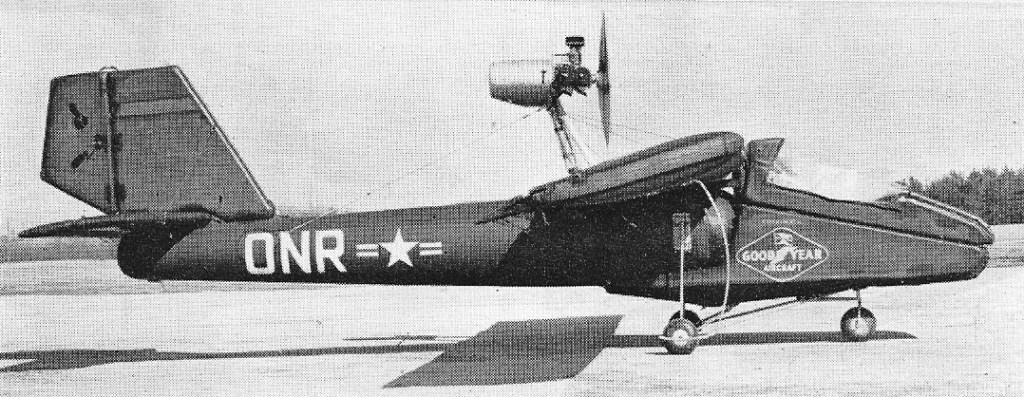
The original concept of an all-fabric inflatable aircraft was based on Taylor McDaniel inflatable rubber glider experiments in 1931. Designed and built in only 12 weeks, the Goodyear Inflatoplane was built in 1956, with the idea that it could be used by the military as a rescue plane to be dropped in a hardened container behind enemy lines. The 44 cubic ft (1.25 cubic meter) container could also be transported by truck, jeep trailer or aircraft.
The inflatable surface of this aircraft was actually a sandwich of two rubber-type materials connected by a mesh of nylon threads, forming an I-beam. When the nylon was exposed to air, it absorbed and repelled water as it stiffened, giving the aircraft its shape and rigidity. Structural integrity was retained in flight with forced air being continually circulated by the aircraft’s motor and guy wires.
There were at least two versions: The GA-468 was a single-seater. It took about five minutes to inflate to about 25 psi (170 kPa); at full size, it was 19 ft 7 in (5.97 m) long, with a 22 ft (6.7 m) wingspan. A pilot would then hand-start the two-stroke cycle, 40 horsepower (30 kW) Nelson engine, and takeoff with a maximum load of 240 pounds (110 kg). On 20 US gallons (76 L) of fuel, the aircraft could fly 390 miles (630 km), with an endurance of 6.5 hours. Maximum speed was 72 miles per hour (116 km/h), with a cruise speed of 60 mph. Later, a 42 horsepower (31 kW) engine was used in the aircraft.
Takeoff from turf was in 250 feet with 575 feet needed to clear a 50 foot obstacle. It landed in 350 feet. Rate of climb was 550 feet per minute. Its service ceiling was estimated at 10,000 ft.
The GA-466 was the two-seater version, 2 in (51 mm) shorter, but with a 6 ft (1.8 m) longer wingspan than the GA-468. A more powerful 60 horsepower (45 kW) McCulloch 4318 engine could power the 740 pounds (340 kg) of plane and passenger to 70 miles per hour (110 km/h), although the range of the plane was limited to 275 miles (443 km).
The test program at Goodyear’s facilities near Wingfoot Lake, Akron, Ohio showed that the inflation could be accomplished with as little as 8 psi (544 mbar), less than a car tire. The flight test program had a fatal crash when Army aviator Lt. “Pug” Wallace was killed. The aircraft was in a descending turn when one of the control cables under the wing came off the pulley and was wedged in the pulley bracket, locking the stick. The turn tightened until one of the wings folded up over the prop and was chopped up. With the wings flapping because of loss of air, one of the aluminum wing tip skids hit the pilot alongside the head, as was clear from marks on his helmet. Wallace was pitched out over the nose of the aircraft and fell into the shallow lake. His chute never opened. He may have been knocked unconscious and rendered unable to open it.
Only 12 Goodyear Inflatoplanes were built, but development continued until the project was cancelled in 1973. The US Army was not ready for blow up aircraft, however, and civilian certification standards prevented Goodyear from offering their Inflatobird to the public.
Mk.II with enclosed cockpit and smaller undercarriage
Goodyear donated two Inflatoplanes for museum display at the end of the project, one to the Franklin Institute in Philadelphia and one to the Smithsonian Institution in Washington, D.C.
Variants:
GA-33 Inflatoplane The initial single-seat version, with open cockpit, based on the Taylor McDaniel inflatable rubber glider experiments from the early 1930’s. One built.
GA-447 Inflatoplane An enclosed cockpit and new wing, used for undercarriage experiments (tricycle, uniwheel, and hydroskid). One built.
GA-466 Inflatoplane Company designation for the AO-2 Inflatoplane
GA-468 Inflatoplane Company designation for the AO-2 Inflatoplane
XAO-2-GI Inflatoplane Military designation for the GA-466. One built.
XAO-3-GI Inflatoplane Military designation for the GA-468. Five built.
General characteristics Engine: 1 × McCulloch 4318 air-cooled, 60 hp (45 kW) Length: 19 ft 2 in (m) Wingspan: 28 ft (8.53 m) Height: 4 ft (1.22 m) Loaded weight: 740 lb (336 kg) Maximum speed: 70 mph (113 km/h) Range: 275 mi (440 km) Service ceiling: 6,500 ft (1,981 m) Rate of climb: 500 ft/min (152 m/min) Crew: 1 Capacity: 1 passenger
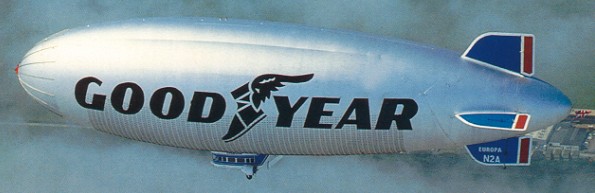
The GZ-20 class was introduced in 1969, with America (N10A) and Columbia (N3A) being the first two. The Europa (N2A) followed in 1972 and was based in Italy, the first Goodyear blimp operated outside of the United States. These blimps are slightly longer than the GZ-19. Beginning in 2014, Goodyear began retiring the GZ-20 and replacing them with the Zeppelin NT. On February 23, 2014, Spirit of Goodyear was retired in Pompano Beach after the 2014 Daytona 500. On August 10, 2015, the California-based GZ-20, the Spirit of America, was decommissioned. The Spirit of Innovation, took over California operations in September 2015 until its retirement in March 2017 as the last remaining GZ-20. In fall of 2017, Wingfoot Two will be relocated to California.
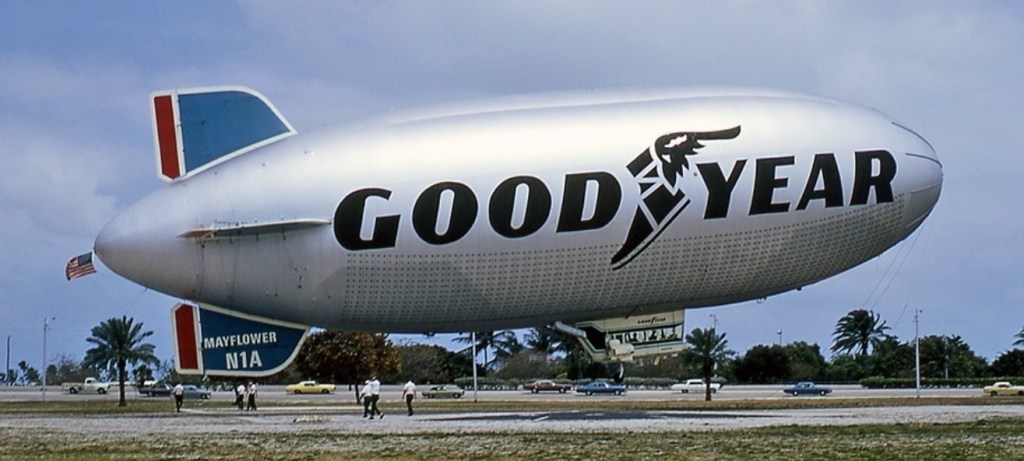
The interest shown by the general public in the Goodyear airships led in 1968 to a major expansion pro¬gramme involving the construction of a new “Mayflower” (GZ 19A) for Miami, a new “Columbia” (GZ 20) for Los Angeles, and a third ship “America” (GZ 20) for a new base near Houston, Texas. The GZ 20 type has an envelope of 202,700 cu.ft. and is powered by two 210 h.p. Continental engines. These ships became operational during 1969 and were joined in 1972 by “Europa” (GZ 20A), a brand new ship based at Rome as part of a new European venture. A completely new ship built at Akron (car) and Litchfield Park, Arizona (Envelope). Assembled and first flown at Cardington, Beds, 10 71 to 3 72.
The GZ 20 commercial airship America first flew in 1969, and was previously Ranger II and L 8. The second “Ranger” was a replacement for the first. Completed after outbreak of war and delivered direct to U.S.N. as L 8 at Moffett Field, 26 2 42. The car returned to Goodyear in 1946 and was stored. Rebuilt as GZ 20 type for AMERICA, 1968 69.
Goodyear operated four helium non-rigid airships, made of neoprene-coated dacron, for publicity and rides. The Los Angeles based airship Columbia, owned and operated by the Goodyear Tire and Rubber Company, was scheduled to be retired in late July 1975. During six years of operation the Columbia has flown more than 10,200 hours, covering more than 306,000 miles at an average speed of 30 miles per hour.
The blimp will be replaced by another airship bearing the same name, and of the same dimensions: 192 feet long, 59 feet high, and 50 feet wide. The new Columbia will be the 301st airship constructed by Goodyear since 1917, and will join three other Goodyear blimps based in Miami, Houston, and Rome in 1975.
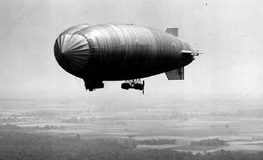
Introduced in 1963 and discontinued in 1978 after the Mayflower (N38A) was destroyed by a tornado, the GZ-19 design for this class resembles the U.S. Navy’s L class blimp.
The interest shown by the general public in the Goodyear airships led in 1968 to a major expansion pro-gramme involving the construction of a new “Mayflower” (GZ 19A) for Miami, a new “Columbia” (GZ 20) for Los Angeles, and a third ship “America” (GZ 20) for a new base near Houston, Texas.
Four American completed training for blimps when Columbia was christened in August 1963. Ray Belotti, Oxnad, Calif.; D.E.Swanson, Orange County, Fla; M.R.Johnson, St.Petersburg, Fla, and L.M.Cermak, Akron, Oh, completed 150 hrs of flight instruction including 20 hrs instrument.
The GZ 20 type has an envelope of 202,700 cu.ft. and is powered by two 210 h.p. Continental engines.
These ships became operational during 1969 and were joined in 1972 by “Europa” (GZ 20A), a brand new ship based at Rome as part of a new European venture.
The Goodyear post-war fleet was; RANGER (III) Registration: N1A. First Flight: 28 5 46. Ex U.S.N. L 18. To Goodyear 1946. Retired, 30 5 49. Flew again, 24 5 51. Wrecked, Fort Lauderdale, Fla., 26 1 58. Car stored. Rebuilt as GZ 19A type MAYFLOWER IV, 1968. VOLUNTEER (II) Registration: N2A. First Flight: 26-9 46. Ex U.S.N. L 17. To Goodyear 1946. Retired, 30 10 49. Car rebuilt as GZ 19A type for COLUMBIA II 1963. ENTERPRISE (II) Registration: N3A. First Flight: 9 10 46. Ex U.S.N. L 16. To Goodyear 1946. Retired, 10 12 59. Car rebuilt as GZ 20 type for COLUMBIA III 1969. MAYFLOWER (II) Registration: N4A. First Flight: 12 5 47. Ex U.S.N. L 14. To Goodyear 1946. Retired, 24 11 49. Car rebuilt as GZ 19 type for MAYFLOWER III 1958 59. PURITAN (II) Registration: N10A. First Flight: 27-3 47. Ex .U.S.N. K 28. To Goodyear 1946. Retired 7 4 48. Reg. transferred to AMERICA 1969. MAYFLOWER (III) Registration: N4A. First Flight: 25 2 59 Car rebuilt as GZ 19A, 1963. Retired from fleet service, 9 68. Used for R & D work and experimental military duties, 10 68 to 10 69. First airship to fly powered by stern mounted propeller system. Retired, 24 10 69. COLUMBIA (II) Registration: N2A First Flight: 23 7 63 GZ 19A type. Retired, 10 69. Ex VOLUNTEER 11 and Navy L 17.
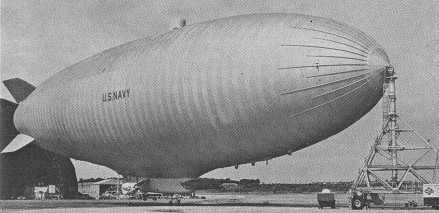
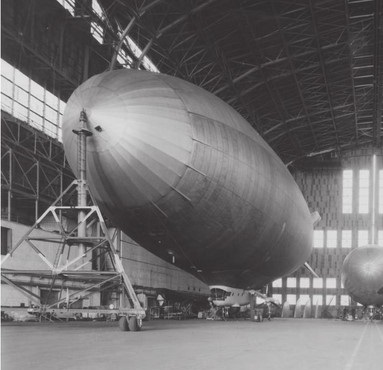
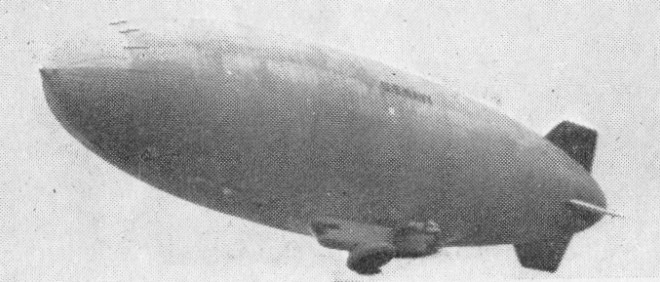
With the end of WW II, the U.S. Navy’s airship service was reduced in size, but new types were developed by Goodyear and brought into service with the Navy. First of these was the N Class of 875,000 cu.ft. flown in prototype form on June 18, 1951. Preliminary ground and flight tests for the prototype were disappointing, mandating further evaluation to explore improvements. The Board of Inspection and Survey trials for N-1 persisted into 1953.
N-1 at Lakehurst, 18 Nov 1952
Under the post war naval airship designation system NA became ZPN 1, and with a further change in 1954 became ZPG 1. This greatly improved, long range patrol ship was 334ft long and powered by, two 800 h.p. Wright Cyclone 7 engines mounted inside the car. A crew of 14 was carried in the double decked car which gave much improved messing and sleeping arrangements compared with those of the wartime ships. One of the most notable external features of the design was the angled position of the tail surfaces, so arranged to, help keep the overall height of the ship (96ft) within the limits of existing sheds. Only one example of this type was built, (GZ 9) but it served as the basis of the later ZPG 2 and ZPG 3 ships. After extensive evaluation trials with the prototype ZPN 1, an improved and slightly larger version, the ZP2N4, was completed and flown on March 20, 1953. This type was put into production in two forms known as the ZPG 2 patrol version and the ZPG 2W Airborne Early Warning version. The ZPG 2 of 975,000 cu.ft. was powered by two 800 h.p. Wright Cyclone 7 engines driving Curtiss Electric three blade, variable pitch, reversible propellers on out riggers projecting from each side of the car. The control car accommodated the fourteen crew on two decks, with all operational stations on the lower deck and crew’s quarters on the upper deck. All control surfaces were operated by a single control column, duplicated for the pilot and co pilot; a major departure from the previous normal airship practice of separated elevator and rudder control wheels. The ship was also equipped with an autopilot which was of immense value in reducing crew fatigue on patrols lasting two or more days. Twelve were 12 built 1953-1955 and were in service to 1961. The ZPG-2W version was essentially the same except that it carried large quantities of sensitive, long range, radar equipment for aircraft detection, and a large radome on top of the envelope. This could be reached from the control car by way of a 75ft vertical tunnel inside the envelope. The, ZPG 2s made many long flights, setting up World endurance records in May, 1954, of 200.4 hours continuous flight, and in March, 1957, of 264.2 hours (11 days), both flights without refuelling. The second flight took the airship from its base at Weymouth, Mass., to Key West, Florida, by way of Portugal and North Africa, 8,216 miles in all. Five were built 1957 1958 and were in service to 1961. As a further development of the ZPG type, the ZPG-3W appeared in July, 1958. The largest non rigid airship ever built, it was 404ft long with an envelope capacity of 112 million cubic feet. Power was provided by two specially developed Wright Cyclone 9 engines of 1,525 h.p., driving 18ft diameter propellers. Twenty four crew were carried in a car 83ft long, with extensive crew quarters on the upper deck. The envelope itself served as a radome for a 40ft internally mounted radar antenna which rotated within the helium gas. Four were built 1958 1960. Total post war naval airship production accounted for 55 of the 200 new airships built by Goodyear between December 1939, and July 1963. The last for the U.S. Navy was a ZPG3W delivered on April 4, 1960. At that time the Navy still had 27 airships in commission. However, changes in naval policy and the need for budget savings in the light of the costly new Polaris submarine programme, forced a re think of naval air requirements. On June 26, 1961, the Navy announced that the airship service was to be closed down, a decision which took effect during the following year. Thirteen naval airships were deflated and placed in long-¬term storage in case of future need, while two ZPG 2s were retained for experimental work with the Airship Test and Development Department at Lakehurst. In addition, one ZS2GA was made available to Mississippi State University for a programme of boundary layer control research on airship envelopes. When these ships, too, were deflated at the end of 1962, forty five years of U.S. Naval airship operations came to an end. The last Goodyear airship for the American Navy was the ZPG 3W of 1958, the largest non rigid ever built. A 40ft radar antenna rotated inside the envelope. These served until the closure of the airship service in 1962.
Goodyear ZPN
ZPG 1 (GZ 9) Volume: 875,000 cu ft. Length: 324ft. Max Dia: 74ft. Engines: 2 x 800 h.p. Wright R 1300 3A Cyclone 7.
ZPG 2 (GZ 11) Volume: 975,000 cu ft. Length: 343ft. Max Dia: 76ft. Engines: 2 x 800 h.p. Wright R 1300 3A Cyclone 7.
ZPG 2W (GZ 14) Volume: 975,000 cu ft. Length: 343ft. Max Dia: 76ft. Engines: 2 x 800 h.p. Wright R 1300 3A Cyclone 7.
Type GZ 17 (Navy ZPG 3W) 1958 Engines: 2 x 1,525 h.p. Wright R 1820 88 Cyclone 9. Length: 403ft 6in. Maximum Diameter: 85ft. Volume: 1,465,000 cu ft (before stretch). Maximum Speed: 90 m.p.h. Cruising Speed: 50 60 m.p.h. Maximum rate of climb: 2,400ft/min. Range: in excess of 5,000 miles. Endurance: 80 hours plus. Fuel: 4,375 gallons. Maximum Gross Weight: 93,496 lb. Empty Weight: 71,130 lb. Useful Load: 22,366 lb (including dynamic lift).
ZPG 3W (GZ 17) Volume: 1,490,000 cu ft. Length: 404ft. Max Dia: 85ft. Engines: 2 x l,525 h.p. Wright R 1820 88 Cyclone 9.
ZPN-1 Volume: 875,000 cu. ft. Length: 324.4 ft. Engines: two 800 h.p. Wright R1300 Top speed: 85 m.p.h.