
Gourdou-Leseurre B-3

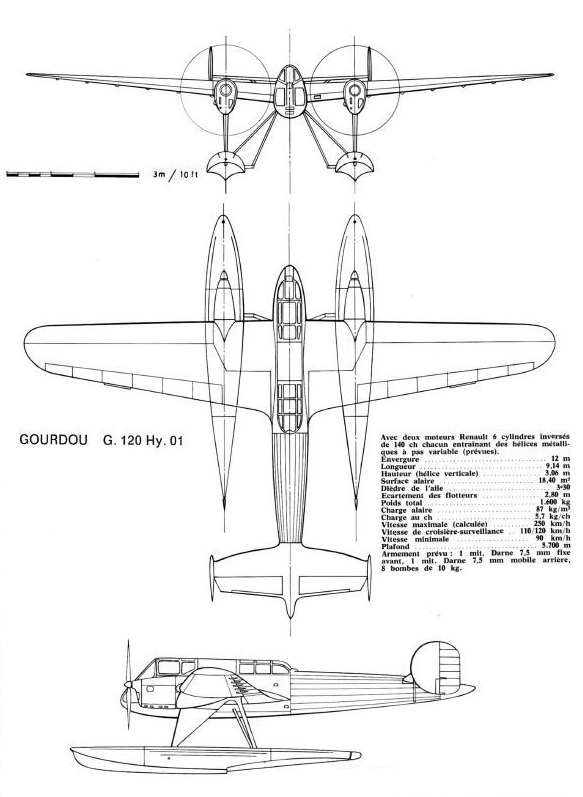
In 1937, the French Navy launched a program for a twin-engine, catapultable twin-engine seaplane for anti-submarine warfare. The aircraft should not exceed a weight of 1,600 kg, and carry 10 bombs of 10 kg. It needed a top speed of 250 km / h, a minimum speed of 90 km / h, and a cruising speed of 110 to 120 km / h. Gourdou proposed a plane equipped with high-lift devices.
In early 1938, the Technical Service of Aeronautics commissioned a life-size, rectangular wing with a constant profile, which passed the tests in the large Chalais-Meudon wind tunnel in June. This wing of 12 m wingspan and 18 sq.m wing surface, resulted in the order of a prototype.
The structure of the wing was two longitudinal members braced by oblique ribs lattice. The wing was fabric covered. The aircraft had a Fowler-type double-flap system, fitting one into the other. In the “out” position, the ensemble retreated by increasing its initial surface area by 50% and opening two slots. The slits obtained by this system were “convergent-divergent”. They differed from the converging slits of Handley-Page beaks and flaps of Bernard aircraft. Once the shutters returned, there were only small dents on the underside.
The fuselage was of welded steel-molybdenum tube structure. It had an advanced cockpit, and a firing point for the gunner behind a common fairing. This defensive post was equipped with a 7.5 mm Darne machine gun. A second machine gun of the same type, fixed, was installed in the nose. The cockpit roofs were glazed, and the front part of the fuselage was Plexiglas.
Both floats each had a volume of 1500 litres. Each float was located under the engine nacelles. They were held in the vertical plane by a triangular panel and a rear strut. Two slashes connected him to the fuselage. The floats were built in three elements, like those of the seaplanes Bernard H.52 C1 and H.110 C1.
The empennages were also made of welded steel tubes. To clear the shot in the rear weapon, the tail was twin fin.
The aircraft was subjected to static tests on a specially designed bench in the Parc Saint-Maur plant. At the beginning of the winter of 1939-1940, the seaplane was transferred to Chalais-Meudon where a special three-column support had been built on the balance plate of the large wind tunnel. In December 1939, the glider tests were carried out, flaps out. The results were disappointing. The lift was 30% lower than expected, the drag higher, the stability at depth mediocre. The director of the wind tunnel tests, Mr. Rebuffel, decided to visualize the flow on the wing with a thin stream of hot oil. The defect was a small oil cooler placed in the leading edge of the wing between the fuselage and the engine. The air intake was on the underside and the exit located on the rear. The smoke clearly indicated that this exit was prominent and caused air separation throughout the area between the fuselage and the engine. Once this radiator output changed, everything returned to normal. The exit and the return of the shutters, in 11 seconds, created a normal flow.
The powered tests began in February 1940, with test pilot Jean-Marie Le Borgne. The metal propellers that were not delivered on time were replaced by wooden pitch propellers. The results confirmed the calculations: the stability was good.
The G.120 was transported to Athis-Mons, in a rented shed on the banks of the Seine. It was launched on June 1, 1940. The test pilot Le Borgne made several hydroplanings, shutters closed, with a test engineer in the rear seat. Passing on his own wake, the pilot noticed a certain lack of rigidity in the behaviour of the floats. During another test, the flaps released, and at 70 km / h the G.120 took off by surprise, after 100 m and rose to 20 m of altitude. After a small flight of 200 m, the pilot landed without difficulty. The next day, the aircraft flew again in front of the STAé officials and flew 50 m above the water for more than 3 km. After this flight, the pilot pointed out the lack of effectiveness of the ailerons. He had been obliged to counter the lateral wind with the rudder. The flotation behaviour of the floats was remedied. This work could not be completed because of the German invasion. To prevent the prototype from falling into the hands of the enemy, Le Borgne destroyed it and sank the wreck in the Seine.
Gourdou G.120 Hy
Engines: 2 x Renault, 140 hp
Wingspan: 12 m
Length: 9.14 m
Height: 3.06 m
Wing area: 18,40 sq.m
Cruising speed: 110-120 km / h
Maximum speed: 250 km / h
Ceiling: 5,700 m
Wing load: 87 kg / sq.m
Load factor 5.7
Armament: 2 x Darne 7.5 mm machine guns
Bombload: 8 x 10 kg bombs

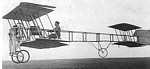
The 1911 Goupy Type AA tractor biplane was a rwo-seater with inset top-wing ailerons.
It was designed by Ambroise Goupy, built most likely by Bleriot factory.
Span: upper: 40’8″
lower: 32’10”
Length: 29’6″

The 1911 “Concours Militaire” biplane was designed and built by Ambroise Goupy in France.
Span: 46’7″
Length: 34’9″

The 1912 Goupy “hydroaéroplane” was just a land plane set on floats with wheels and all, no further alterations. Typical was the fuselage “hung” between the wings and the sesquiplane construction with the struts somewhat at an angle. The construction at the nose looks like radiators, but are unlikely that as this design was fitted with a 100 hp Gnome rotary. Maybe a streamlined construction to get the engine neatly into the ‘square’ fuselage.
The 1909 Goupy II biplane, designed by Ambroise Goupy in France, powered by a REP or Anzani engine, was built at the Bleriot factory.
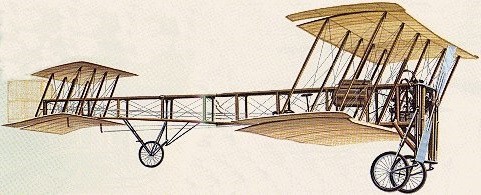
Span: 20′
Length: 23′
Weight gross: 630 lb
Wing area: 26 sq.m
The three-passenger Goupy biplane, type 1914-B, resembled in general construction other machines of this firm. The cell is composed of two staggered planes of unequal length: chord 1.6 m. top plane 19.75 m. long, lower one 10.35 m. long.
The cell is rigid and lateral balance is obtained by powerful conjoined ailerons. The fuselage is of quadrangular section. The monoplane tail is slightly lifting and approximately rectangular, terminated by a flap 3.1 by .7 m. serving as an elevator.
The quadrangular rudder, above the tail, is partly balanced and in front of it is a small vertical fin. The 100 hp Gnome supported between two bearings turns a 2.8 m. propeller, the axis being 1.8 m. above the ground. The chassis is of the usual type, skids and wheels: the wheels are far enough forward to prevent “capotage.” The skids, however, do not seem sufficient to protect the propeller in a bad landing on rough ground.

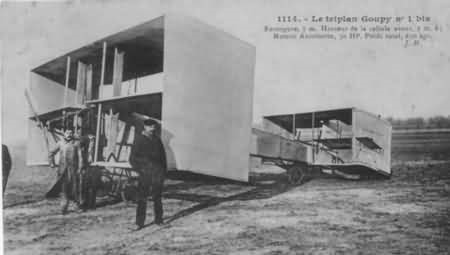
The Goupy I triplane was designed by Goupy, built by Voisin, in France 1909.

Span: 23′
Weight: 1430 lb
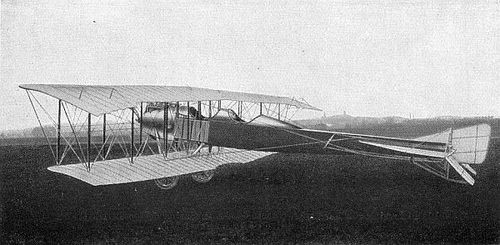
Bruno Büchner designed the 1913, 120 hp Argus powered, 20 m span Schuldoppeldecker biplane built by Gothaer Waggonfabrik.
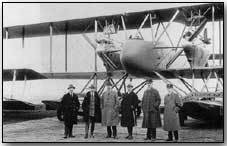
The Gotha WD.27 (for Wasser Doppeldecker – “Water Biplane”) was a patrol seaplanes developed in Germany during World War I. It was a conventional four-engine seaplane with engines grouped in tractor-pusher pairs on the lower wings. Contemporary records show three German Navy serial numbers allocated to the type, but firm evidence of only one of these being built.

