Hirth 3502 / 3503

Hirth 3503

The Hirth 3502 and 3503 are a family of liquid-cooled, in-line twin-cylinder, two-stroke, carbureted aircraft engines, with optional fuel injection, designed for use on ultralight aircraft and small homebuilts, and produced from April 2008.

The engines were developed as competitors to the 64 hp (48 kW) Rotax 582 with an identical mounting bolt pattern to the 582, allowing either to be a drop-in replacement. The engines are similar to the Rotax powerplant in being liquid-cooled, two-cylinder in-line engines, with dual capacitor discharge ignition. The 3502 was developed from the 3503 as a de-rated version and produces 60 hp (45 kW), in comparison to the 3503’s 70 hp (52 kW). Both engines have the same bore, stroke and compression ratio as the three-cylinder in-line liquid-cooled Hirth 3701 and the bore, stroke, compression ratio and displacement of the twin-cylinder Hirth 2704 and Hirth 2706.

Both the 3502 and 3503 are equipped with dual Bing 34 mm slide carburetors or optionally electronic fuel injection. The cylinder walls are electrochemically coated with Nikasil and the crankshaft is forged from 4130 steel. Standard starting is recoil start with electric start as an option. The reduction drive system available is the G-50 gearbox, with reduction ratios of 2.16:1, 2.29:1, 2.59:1, 3.16:1, or 3.65:1.
The engines run on a 50:1 pre-mix of unleaded 93 octane auto fuel and oil, or optionally oil injection.

The base price in 2009 for the 3503 model was US$5988.

Variants:

3502
Twin-cylinder in-line, liquid-cooled, two-stroke aircraft engine with dual Bing 34 mm slide carburetors or fuel injection. Produces 60 hp (45 kW) at 5000 rpm and has a factory rated TBO of 1200 hours. In production since April 2008.

3503
Twin-cylinder in-line, liquid-cooled, two-stroke aircraft engine with dual Bing 34 mm slide carburetors or fuel injection. Produces 70 hp (52 kW) at 6500 rpm and has a factory rated TBO of 1000 hours. In production.

Applications:

3502
CGS Hawk Arrow II
Fresh Breeze XCitor – powered parachute
Paraski – powered parachute

3503
Excalibur Aircraft Excalibur
GyroTec DF02
Rotortec Cloud Dancer Light
Summit Steel Breeze – powered parachute

Specifications:

3503
Type: Twin-cylinder, two-stroke, in-line, aircraft engine
Bore: 76 mm (3.0 in)
Stroke: 69 mm (2.7 in)
Displacement: 625 cc (38.1 cu in)
Length: 398 mm (15.7 in)
Width: 368 mm (14.5 in)
Height: 419 mm (16.5 in)
Dry weight: 79 lb (35.8 kg) without radiator & coolant. The G-50 gearbox adds an additional 19 lb (8.6 kg)
Fuel system: 2 X Bing 34 mm slide type carburetors or fuel injection
Fuel type: unleaded 93 octane auto fuel
Oil system: 50:1 fuel/oil premix or oil injection
Cooling system: liquid
Reduction gear: G-50 gearbox with reduction ratios of 2.16:1, 2.29:1, 2.59:1, 3.16:1, or 3.65:1 or cog-belt
Power output: 70 hp (52 kW) at 6500 rpm
Compression ratio: 9.5:1
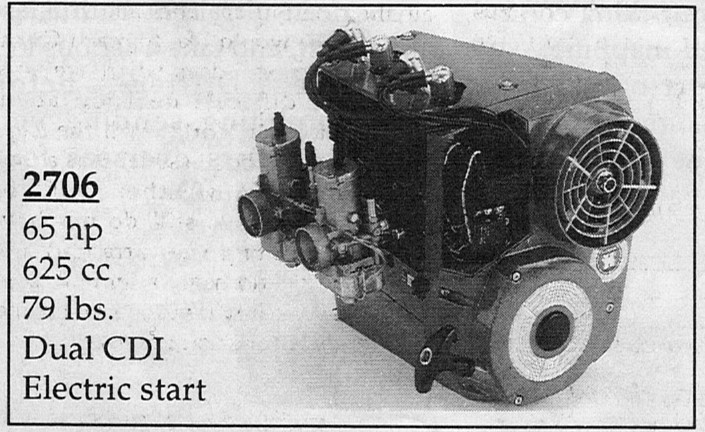
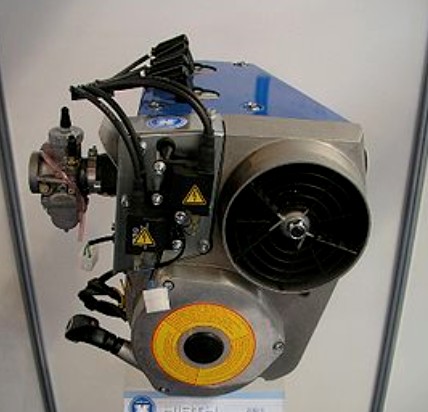
Hirth 3202 / 3203

The Hirth 3202 and 3203 are a family of in-line twin cylinder, two stroke, carburetted aircraft engines, with optional fuel injection, designed for use on ultralight aircraft, especially two seat ultralight trainers, gyrocopters and small homebuilts.

The 3203 was developed as a replacement for the Hirth 2706 and as a competitor to the 64 hp (48 kW) Rotax 582. It replaced the 2706 in the Hirth line in May 2002. The engine is similar to the Rotax powerplant in being a two-cylinder in-line engine, with dual capacitor discharge ignition, although it is air-cooled, compared to the 582’s liquid cooling. The 3202 was developed from the 3203 as a de-rated version to replace the Hirth 2704 and compete with the 50 hp (37 kW) Rotax 503. Both engines have the same bore, stroke, displacement, compression ratio, and weight as the Hirth engines they replace.
Both the 3202 and 3203 use free air or fan cooling, with dual Bing 34 mm slide carburetors or optionally fuel injection. The cylinder walls are electrochemically coated with Nikasil. Standard starting is recoil start with electric start as an option. The reduction drive system available is the G-50 gearbox, with reduction ratios of 2.16:1, 2.29:1, 2.59:1, 3.16:1, or 3.65:1, with a cog-belt reduction drive optional.

The engines run on a 50:1 pre-mix of unleaded 93 octane auto fuel and oil, or optionally oil injection. The base price of the 3202 model in 2009 was US$4423.

Variants:
3202
Twin-cylinder in-line, two stroke, aircraft engine with a dual Bing 34mm slide carburetors or fuel injection. Produces 55 hp (41 kW) at 5500 rpm and has a factory rated TBO of 1200 hours. In production. Replaced the 2704 in production in May 2002.

3203
Twin-cylinder in-line, two stroke, aircraft engine with dual Bing 34mm slide carburetors or fuel injection. Produces 65 hp (48 kW) at 6300 rpm and has a factory rated TBO of 1000 hours. In production. Replaced the 2706 in production in May 2002.

Applications:
3202
Aero Adventure Aventura
Destiny PPC – powered parachute
Lockwood Drifter
Excalibur Aircraft Excalibur
Flightstar
ISON Airbike
Kolb Firestar II
Quad City Challenger II
Raptor Tryke
Paladin Sparrow – powered parachute

3203
CGS Hawk
Excalibur Aircraft Excalibur
Fisher Classic
Kolb Firestar
Kolb Mark III
Para-Ski – twin engine powered parachute
Quad City Challenger II
Rans S-12 Airaile
Sky Twister – helicopter
Sno Bird – gyroplane
ASAP Beaver RX550
Raj Hamsa X-Air
Revolution Mini 500 – helicopter
Rotortec Cloud Dancer I – autogyro
US Light Aircraft Hornet
VSTOL SST2000 – twin engined installation

Specifications:

3203
Type: Twin cylinder, two-stroke, in-line, aircraft engine
Bore: 76 mm (3.0 in)
Stroke: 69 mm (2.7 in)
Displacement: 625 cc (38.1 cu in)
Length: 377 mm (14.8 in)
Width: 587 mm (23.1 in)
Height: 383 mm (15.1 in)
Dry weight: 73 lb (33.1 kg)with free air cooling, 79 lb (35.8 kg) with fan cooling, including electric starter and exhaust. G-50 gearbox adds an additional 19 lb (8.6 kg)
Fuel system: 2 X Bing 34mm slide type carburetors or fuel injection
Fuel type: unleaded 93 octane auto fuel
Oil system: 50:1 fuel/oil premix or oil injection
Cooling system: free air or fan
Reduction gear: G-50 gearbox with reduction ratios of 2.16:1, 2.29:1, 2.59:1, 3.16:1, or 3.65:1 or cog-belt
Power output: 65 hp (48 kW) at 5500 rpm
Compression ratio: 9.5:1

Hirth 2702 / 2703

Hirth 2702

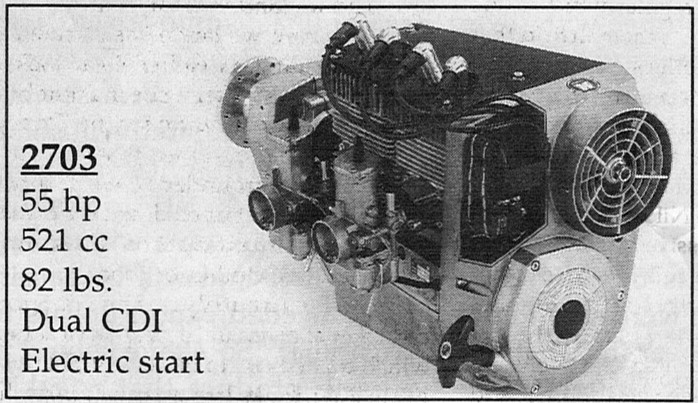
The Hirth 2702 and 2703 are a family of in-line twin cylinder, two stroke, carburetted aircraft engines designed for use on ultralight aircraft and especially two seat ultralight trainers, single seat gyrocopters, and small homebuilts.

The 2703 was developed as a competitor to the 50 hp (37 kW) Rotax 503 and is similar to the Rotax powerplant in being a two-cylinder in-line engine, with dual capacitor discharge ignition. The 2702 was developed from the 2703 as a de-rated version.

Both the 2702 and 2703 use free air or fan cooling, with Bing 34mm slide carburetors. The cylinder walls are electrochemically coated with Nikasil. Standard starting is recoil start. Reduction drive systems available are the G-50 gearbox with reduction ratios of 2.16:1, 2.29:1, 2.59:1, 3.16:1, or 3.65:1, or a multi-element cog belt drive. A tuned exhaust and electric start are optional.
The engines runs on a 50:1 pre-mix of unleaded 93 octane auto fuel and oil. Base price in 2009 was US$3476.

Variants:
2702
Twin-cylinder in-line, two stroke, aircraft engine with a single Bing 34mm slide carburetor. Produces 40 hp (30 kW) at 5500 rpm and has a factory rated TBO of 1200 hours. Still in production.

2703
Twin-cylinder in-line, two stroke, aircraft engine with dual or optionally a single Bing 34mm slide carburetor. Produces 55 hp (41 kW) at 6200 rpm and has a factory rated TBO of 1000 hours. The 2703 has been largely supplanted in production by the Hirth 3202, but in 2009 was still available as a special order from the factory.

Applications:
2702
Airfer Transan Plus 2702 (Paraplane)
Flightstar
Hy-Tek Hurricane 103
ISON Airbike
Preceptor N3 Pup
Spacek SD-1 Minisport

2703
American Sportscopter Ultrasport 254
CGS Hawk
Exkluziv Joker
Falconar Golden Hawk
Kolb Firestar
RemSchetMash Robust
US Light Aircraft Hornet

Specifications:
2702
Type: Twin cylinder, two-stroke, in-line, aircraft engine
Bore: 72 mm (2.8 in)
Stroke: 64 mm (2.5 in)
Displacement: 521 cc (31.8 cu in)
Length: 413 mm (16.3 in)
Width: 450 mm (17.7 in)
Height: 376 mm (14.8 in)
Dry weight: 70 lb (31.8 kg) with free air cooling, 76 lb (34.5 kg) with fan cooling, including recoil starter and exhaust. G-50 gearbox adds an additional 19 lb (8.6 kg)
Fuel system: 1 X Bing 34mm slide type carburetor
Fuel type: unleaded 93 octane auto fuel
Oil system: 50:1 fuel/oil premix
Cooling system: free air or fan
Reduction gear: G-50 gearbox with reduction ratios of 2.16:1, 2.29:1, 2.59:1, 3.16:1, or 3.65:1, or a multi-element cog belt drive
Power output: 40 hp (30 kW) at 5500 rpm
Compression ratio: 9.5:1

Hirth F-263

The Hirth F-263 is a twin cylinder, in-line, two stroke, carburetted aircraft engine that was designed for use on ultralight aircraft. Base price in 2000 was US$2300 but the engine was discontinued about 2001.

The F-263 uses fan cooling and piston-ported induction, with a single Bing carburetor and single capacitor discharge ignition. The cylinder walls are electrochemically coated with Nikasil. Standard starting is recoil start. A gearbox reduction drive system and electric start were factory options.
The engine produces 31 hp (23 kW) and runs on a 50:1 pre-mix of unleaded 93 octane auto fuel and oil. Recommended time between overhauls is 1000 hours.

Applications:
Howland H-3 Pegasus
Falconar HM-293

Specifications:
F-263
Type: Twin cylinder, two-stroke, aircraft engine
Displacement: 383 cc (23.4 cu in)
Dry weight: 70 lb (31.8 kg)
Valvetrain: piston-ported
Fuel system: 1 X Bing carburetor
Fuel type: unleaded 93 octane auto fuel
Oil system: 50:1 fuel/oil premix
Cooling system: fan forced air
Reduction gear: optional gearbox
Power output: 30 hp (22 kW)

Hirth F-36/ Solo 210

The Hirth F-36 is a single cylinder, two stroke, carburetted aircraft engine designed for use on ultralight aircraft, especially powered paragliders and very light ultralight trikes. The F-36 was formerly known as the Solo 210, before the design was purchased by Hirth. It is noted for its extremely light equipped weight of 28 lb (13 kg) including exhaust system, reduction drive and carburetor. Unit cost in 2009 was US$1819.

The engine uses free air cooling, single capacitor discharge ignition, with a single integral pump-type carburetor. The cylinder walls are electrochemically coated with Nikasil. Standard starting is recoil start with electric start optional. A quadruple V belt reduction drive system is an option with ratios of 1.8:1, 2.0:1 or 2.5:1.

The engine runs on a 50:1 pre-mix of unleaded 93 octane auto fuel and oil and produces 15 hp (11 kW) at 6000 rpm.

Applications:
Adventure F series
Air Est JCD 03 Pelican
Delta Sailplane Nomad
Fly Products Power
Fresh Breeze Solo
Hang Buggy ultralight trike
Paramotor Inc FX1
Rotec Rally 2
Spartan BP Parawing
Southern Skies Spymotor
UFM Easy Riser

Specifications:

Solo 210
Cycle: 2 stroke
No cylinders: 1
Bore: 70 mm
Stroke: 35 mm
Displacement: 210 cc
Cooling: air
Ignition: electronic
Reduction: Poly-v 1.75/1 – 3/1
Dimension: 260 x 320 x 210 mm
Weight: 12 kg
Max pwr: 14 hp at 6500 rpm
Fuel consumption: 350 G/hp/hr

F-36
Type: Single cylinder, two-stroke, aircraft engine
Bore: 70 mm (2.8 in)
Stroke: 54 mm (2.1 in)
Displacement: 208 cc (12.7 cu in)
Length: 275 mm (10.8 in)
Width: 359 mm (14.1 in)
Height: 341 mm (13.4 in)
Dry weight: 28 lb (12.7 kg) with reduction drive, exhaust system and recoil start
Fuel system: 1 X integral pumper carburetor
Fuel type: Minimum of unleaded 93 octane auto fuel
Oil system: 50:1 fuel/oil premix
Cooling system: free air
Reduction gear: four element cog belt with ratios of 1.8:1, 2.0:1 or 2.5:1 available
Power output: 15 hp (11 kW) at 6000 rpm
Compression ratio: 10.6:1

Hirth F-30

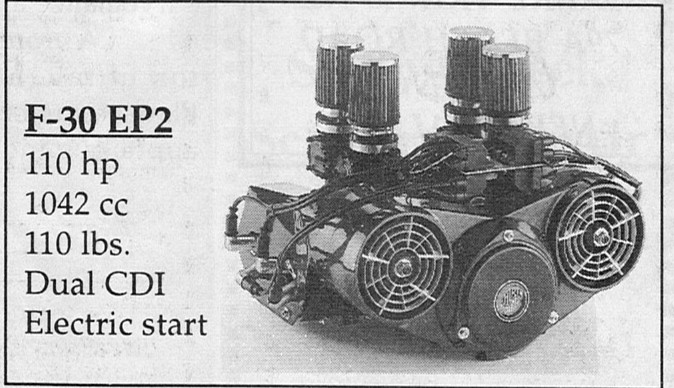
The Hirth F-30 is a horizontally opposed four-cylinder, two-stroke, carburetted aircraft engine, with optional fuel injection, designed for use on ultralight aircraft and homebuilts.

The F-30 is equipped with dual capacitor discharge ignition and is free air-cooled, with optional fan cooling. The cylinder walls are electrochemically coated with Nikasil. Standard starting is electric start and recoil start is not an option. The reduction drive system available is the G-40 gearbox with optional reduction ratios of 2.03:1, 2.25:1, 2.64:1, 2.96:1 and 3.33:1. A centrifugal clutch is also available as optional equipment.

The engine runs on a 50:1 pre-mix of unleaded 93 octane auto fuel and oil.

Variants:

F-30
Four-cylinder horizontally opposed, two-stroke, aircraft engine with a dual 38 mm diaphragm carburetors. Produces 85 hp (63 kW) at 5500 rpm if free-air-cooled or 80 hp (60 kW) at 5500 rpm if fan cooled. It has a factory rated TBO of 1200 hours.

F-30E
Four-cylinder horizontally opposed, two-stroke, aircraft engine with fuel injection. Produces 90 hp (67 kW) at 5500 rpm if free-air-cooled or 85 hp (63 kW) at 5500 rpm if fan cooled. It has a factory rated TBO of 1200 hours.

F-30S
Four-cylinder horizontally opposed, two-stroke, aircraft engine with dual integral pumper carburetors. Produces 100 hp (75 kW) at 6200 rpm if free-air-cooled or 95 hp (71 kW) at 6200 rpm if fan cooled. It has a factory rated TBO of 1000 hours.

F-30ES
Four-cylinder horizontally opposed, two-stroke, aircraft engine with fuel injection. Produces 110 hp (82 kW) at 6200 rpm if free-air-cooled or 105 hp (78 kW) at 6200 rpm if fan cooled. It has a factory rated TBO of 1000 hours.

Applications:
Acrolite
Aeros UL-2000 Flamingo
Airdrome Fokker D-VII
Airdrome Nieuport 24
Aviastroitel AC-7M
Denney Kitfox
DF Helicopters DF334
Falconar F11 Sporty
Howland H-2 Honey Bee
Kolb Mark III
Paladin Hercules
Peak Aerospace Me 109
Rans S-12
Titan Tornado

Specifications:

F30
Cycle: 2 stroke
No cylinders: 4 opposed
Bore: 72 mm
Stroke: 64 mm
Compression: 9.5
Displacement: 1024 cc
Cooling: Air
Ignition: 4CDI
Reduction: mechanical gear 2.03/1 to 2.96/1
Weight: 48 kg
Max pwr: 95 hp at 5270 rpm

F-30ES
Type: Four-cylinder, two-stroke, horizontally opposed, aircraft engine
Bore: 72 mm (2.8 in)
Stroke: 64 mm (2.5 in)
Displacement: 1042 cc (63.6 cu in)
Length: 380 mm (15.0 in)
Width: 660 mm (26.0 in)
Height: 355 mm (14.0 in)
Dry weight: 105 lb (47.6 kg), including starter and exhaust system, 129 lb (58.5 kg) with gearbox, exhaust system and electric start. Fan cooling adds 8.5 lb (3.9 kg)
Fuel system: Fuel injection
Fuel type: unleaded 93 octane auto fuel
Oil system: 50:1 fuel/oil premix or oil injection
Cooling system: free air or fan
Reduction gear: G-40 gearbox with reduction ratios of 2.03:1, 2.25:1, 2.64:1, 2.96:1 and 3.33:1 available. Optional centrifugal clutch.
Power output: 110 hp (82 kW) at 6200 rpm with free-air cooling, 105 hp (78 kW) at 6200 rpm with fan cooling
Compression ratio: 9.5:1

Hirth F-23

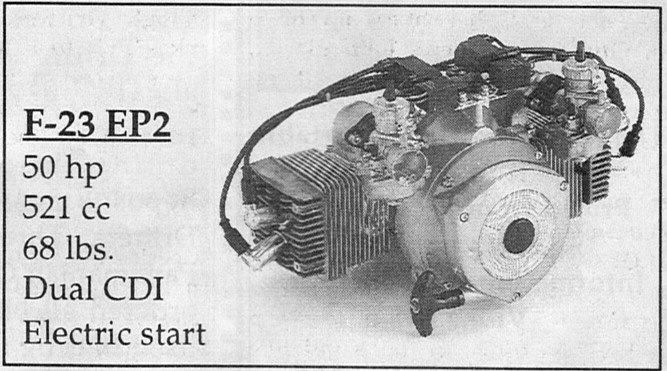
The Hirth F-23 is a twin cylinder, horizontally-opposed, two stroke, carburetted or optionally fuel injected aircraft engine designed for use on ultralight aircraft. The base price in 2009 was US$4423.

The F-23 is intended to compete with the 50 hp (37 kW) Rotax 503 and is differentiated from the Rotax powerplant by offering a horizontally-opposed cylinder layout. The F-23 uses free air cooling and piston-ported induction, with dual Bing 34mm slide or optional diaphragm type carburetors. The cylinder walls are electrochemically coated with Nikasil. Standard starting is recoil start. A belt reduction drive system, fuel injection, tuned exhaust and electric start are optional.

The engine runs on a 50:1 pre-mix of unleaded 93 octane auto fuel and oil. Recommended time between overhauls is 1000 hours.

The F-23 produces 50 hp (37 kW) at 6150 rpm and 40 hp (30 kW) at 5500 rpm.

Applications:
Air Sports AIRector 120
Aurore MB 02-2 Mini Bulle
DAR-23
Fisher FP-303
Monnett Moni – motorglider
Sadler Vampire
Spacek SD-1 Minisport
TechProAviation Merlin 100
Team Mini-Max AeroMax
TeST TST-1 Alpin
Wings of Freedom Phoenix 103

Specifications:
F-23
Type: Twin cylinder, two-stroke, aircraft engine
Bore: 72 mm (2.8 in)
Stroke: 64 mm (2.5 in)
Displacement: 521 cc (31.8 cu in)
Length: 247 mm (9.7 in)
Width: 570 mm (22.4 in)
Height: 338 mm (13.3 in)
Dry weight: 84 lb (38.1 kg) including reduction unit, full exhaust system and electric start
Valvetrain: piston-ported
Fuel system: 2 X Bing 34mm slide or optional diaphragm type carburetor or fuel injection
Fuel type: unleaded 93 octane auto fuel
Oil system: 50:1 fuel/oil premix
Cooling system: free air
Reduction gear: cog belt with 1.8:1, 2.2:1 and 2.5:1 ratios optional
Power output: 50 hp (37 kW) at 6150 rpm
Compression ratio: 9.5:1

Hirth HM 512

The Hirth HM 512 was a 12-cylinder development of the earlier, 6-cylinder HM 506, produced in the late 1930s. Both were supercharged, inverted V, air-cooled engines.

The HM 512 shared the same bore and stroke (105 mm × 115 mm) and 6:1 compression ratio with the rest of the HM500 series air-cooled engines. Other shared features were Hirth’s use of roller bearings in the crankshaft and at both ends of connecting rods. The crankshaft was of typical Hirth multipart design, the 12-cylinders requiring 7 roller bearings. Like the HM 508, the drive was geared down by 1:1.5.

Variants:

HM 512A
Initial version; take off power 400 hp (300 kW), continuous 360 hp (270 kW)

HM 512B
Take off power 450 hp (335 kW), continuous 360 hp (270 kW)

Applications:
Dornier Do 212

Specifications:

HM 512A-0
Type: Inverted 60° V-12-cylinder air-cooled piston
Bore: 105 mm (4.128 in)
Stroke: 115 mm (4.52 in)
Displacement: 11.94 L (728.6 cu in)
Length: 1,507 mm (59.33 in)
Width: 680 mm (26.87 in)
Height: 853 mm (33.58 in)
Dry weight: 270 kg (595 lbs)
Supercharger: Light alloy centrifugal type, driven at 3.86 times crankshaft speed.
Fuel system: Supercharger drew through twin Pallas 65VH2 carburetters with automatic mixture control and equipped for inverted flight. One Bosch double magneto with automatic advance.
Oil system: Metered fresh oil to cylinder barrels and crankshaft bearings. Splash lubrication for supercharger and camshaft. Stökicht Sun and planet reduction gear lubricated by high pressure oil.
Cooling system: Air
Power output: maximum 270 kW (360 hp) at 3,000 rpm, rated 224 kw (300 hp) at 2,810 rpm, take off 300 kW (400 hp)
Compression ratio: 6.0:1