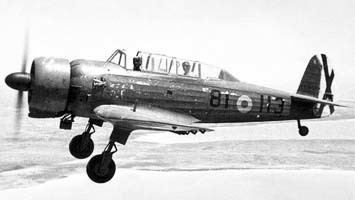
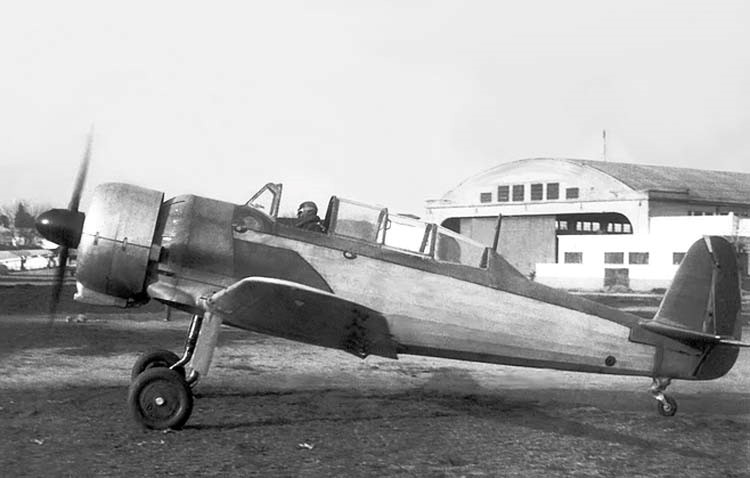
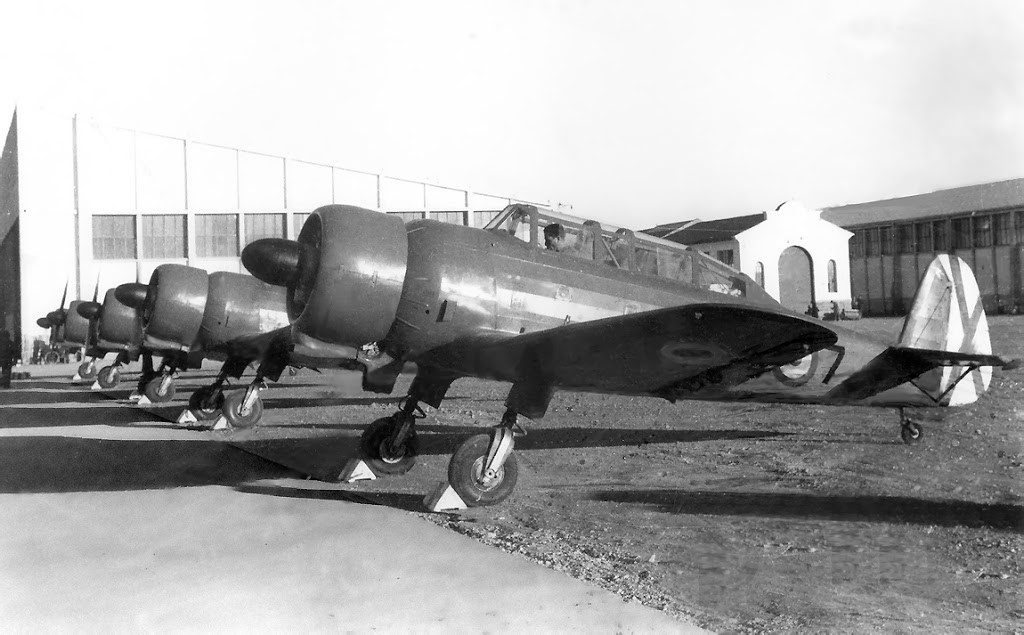
First flying in 1947, the Hispano HS-42 and its derivative, the HA-43, were advanced military trainer aircraft produced in Spain. The basic design was that of a conventional, low-wing, cantilever monoplane with seating for the pilot and instructor in tandem.
The HS-42 had fixed, tailwheel undercarriage with spatted mainwheels, while the HA-43 had retractable main units. Produced on the assembly line that had been used to build Fokker D.XXI fighters, the HS-42 shared some components with this aircraft.
HS-43 (HA-43)
The HA-43D-1 advanced two-seat military trainer went into production for the Spanish Air Force in 1947.
HS-42D
The HA-43D-1 was followed in 1953 by the HA-100 EI replacement
The British Government formulated plans for the construction of two new airships, the R100 to be built by private enterprise and the R101 to be constructed by the Government Airship Works at Cardington.
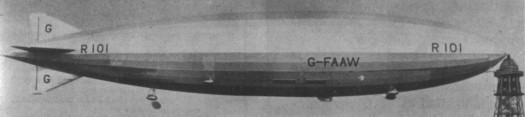
R101 G-FAAW, powered by 650 hp Beardmore Diesel engines, was launched and moored to its mast for the first time on 12 October 1929.
Both airships had their maiden flights in 1929 with R100 being the more successful of the two to the extent that R101 was returned to the Cardington hangar for extensive modification including the insertion of another section into the ship to accommodate an additional gas cell in order to increase her lifting capacity. This added another 55 feet to the length of the ship and further delayed her flight trials.
In the meantime R100 completed a successful trial flight to Canada and back before the modified R101 had begun its trials following the modifications.
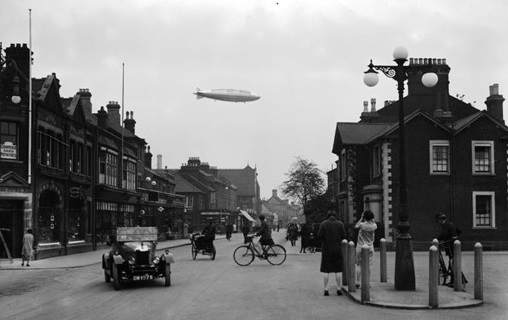
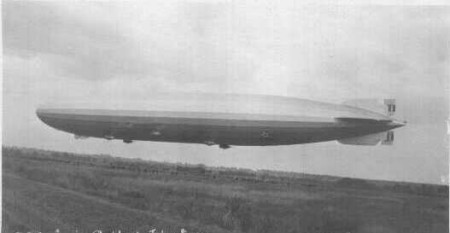
Over Bedford on its first flight
In spite of reservations, held by many technical personnel, as to the airworthiness of the modified ship, pressure brought to bear by Air Ministry Officials and the Secretary of State for Air saw the untried R101 hastily prepared for the inaugural flight to India where a mooring mast and facilities had already been prepared at Karachi.
Upon the successful completion of this flight to India and back hinged the approval of the British Government for an airship service linking the outposts of Empire including a future service to Australia and New Zealand. Sadly, political jealousies between the Government backed faction supporting the R101 and the private enterprise airship, plus the insistence of Lord Thomson, Secretary of State for Air that the India Flight begin without delay saw the R101 lift off from Cardington on 4 October 1930 without having completed its speed trials and with a Certificate of Airworthiness issued without an inspector’s report. R101’s departure was into overcast, wet and stormy weather. Over France worsening conditions were encountered which highlighted the airship’s deficiencies in performance and construction to the extent it became almost impossible to control. Shortly after 2 am on 5 October, almost uncontrollable, the ship made contact with the ground, burst into flames, killing all but six of the 54 persons on board. Among those killed was the Secretary of State for Air on whose insistence the airship began its ill-fated flight long before its airworthiness had been proven. The loss of the R101 heralded the end of the British dream for an airship service linking the outposts of Empire.
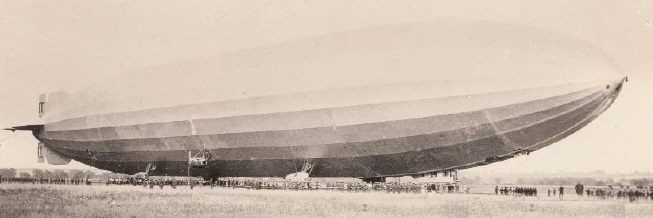
Substantially larger than the preceding R31 class, the R33 class was in the design stage in 1916 when the German Zeppelin L 33 was brought down on English soil. Despite the efforts of the crew to set it on fire, it was captured nearly intact, with engines in working order. For five months, the LZ 76 was carefully examined in order to discover the Germans’ secrets.
The existing design was adapted to produce a new airship based on the German craft and two examples were ordered, one (R33) to be constructed by Armstrong-Whitworth at Barlow, North Yorkshire and the other (R34) by William Beardmore and Company in Inchinnan, Renfrewshire, Scotland.
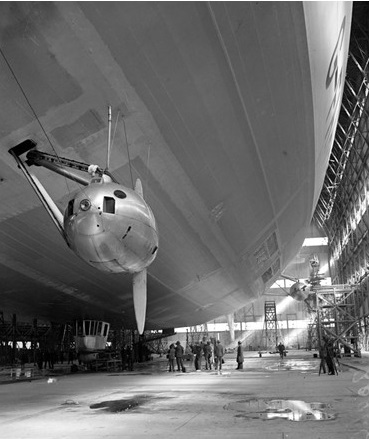
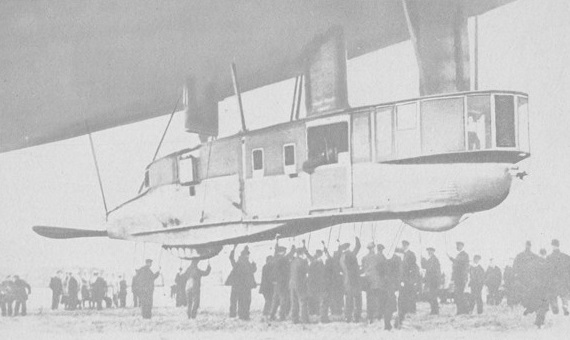
The manufacture of the components for the R33 and her sister ship R34 had begun in the summer of 1917, but the actual construction of the ship in the shed did not commence until the summer of 1918. The ship design was semi-streamlined fore and aft, with a parallel mid-ships section. The main control car was positioned well forward on the ship, and on closer inspection was separated from the engine in the rear of the car by a small gap. The small gap was faired over, so the gondola seemed to be a single structure. This was designed to stop vibrations from the engine car being transmitted down to the forward control car, with its radio detection finding and wireless instruments. Hence, the forward control car and engine car looks as if it is one combined piece, but serviced by two ladders into the hull above.
R34
Two more power cars were suspended in the wing positions further aft along the hull and a single engine aft car was positioned amidships at the rear of the craft. All five engines were 275 hp (205 kW), Sunbeam Maori water-cooled petrol units, with one in the aft section of the control car, two more in a pair of power cars amidships each driving a pusher propeller via a reversing gearbox for manoeuvering, and the remaining two in a centrally mounted aft car, geared together to drive a single pusher propeller. The power cars included two gearboxes for each engine, enabling the engines to be started up and running without the propellers rotating. The ship carried enough fuel for 48 hours engine running, but to increase range it was possible to fly the ship on only 3 engines, giving the ship a speed of some 40 knots with petrol consumption of one mile a gallon. The petrol was held inside the hull and fuel flowed from them by gravity to header tanks in the engine gondolas. The reasoning behind this change of arrangement was to feed a smoother and more precise fuel supply than the older arrangements in earlier ships of direct gravity feed.
The radiators in the forward engine gondolas had the flow of air regulated by the use of movable shutters, however the rear gondolas had the old type of traditional “elevated” radiator. Twenty main frames and thirteen longitudinals made the main structure of the ship. There were 19 gasbags within the hull giving a capacity of 1,950,000 cubic feet of hydrogen giving a disposable lift of almost 26 tons. The total construction of the R33 came to £350,000.
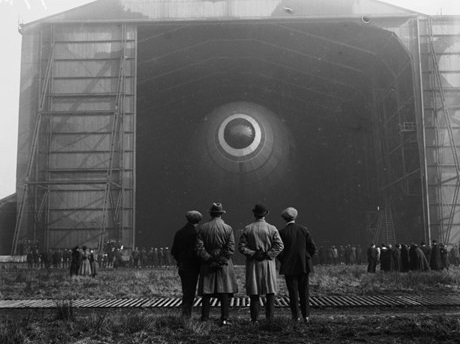
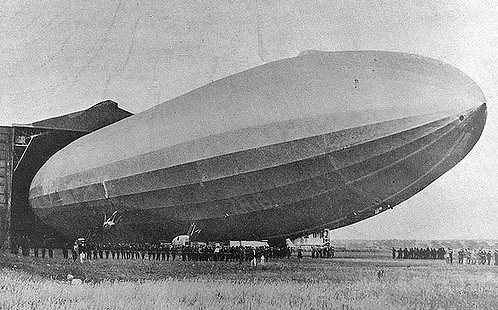
R33 in its hangar before its first flight in Barlow, Yorkshire, March 1919
R33 first flew on 6 March 1919, and was sent to RAF Pulham in Norfolk. Between then and October 14, R33 made 23 flights totalling 337 hours flying time. One of these, a flight promoting “Victory Bonds” even included a brass band playing in the top machine gun post.
In 1920 she was “demilitarised” and given over to civilian work with the civil registration G-FAAG. This work consisted of trials of new mast mooring techniques using the mast erected at Pulham. On one occasion winds of 80 mph (130 km/h) were successfully withstood while moored. Another experiment was an ascent carrying a pilotless Sopwith Camel which was successfully launched over the Yorkshire Moors. After an overhaul, R33 was based at Croydon Airport, moored to a portable mast. In June 1921 it was used by the Metropolitan Police to observe traffic at the Epsom Derby, and in July she appeared in the Hendon Air Pageant before flying to Cardington, Bedfordshire, where she was laid up for three years.
On 31 May 1921 the British government cancelled all airship development for financial reasons. Military airships were scrapped, but as a civilian airship R33 was mothballed instead. In 1925, after being inactive for nearly four years, the reconditioned R33 emerged from her shed at Cardington.
At 09:50 on 16 April 1925 the R33 was torn from the mast at Pulham during a gale, and was carried away with only a partial crew of 20 men on board. Her nose partially collapsed and the first gas cell deflated leaving her low in the bow. The crew on board started the engines, gaining some height, and rigged a cover for the bow section, but the R33 was blown out over the North Sea. A Royal Navy vessel was readied and left the nearby port of Lowestoft in case the R33 came down in the sea. The local lifeboat was launched, but was driven back by the weather conditions.
Some five hours after the initial break from the mast, R33 was under control but still being blown towards the Continent. As she approached the Dutch coast R33 was given the option of landing at De Kooy, where a party of 300 men was standing by. Late in the evening R33 was able to hold her position over the Dutch coast, hovering there until 5 o’clock the next morning. She was then able to slowly make her way back home, arriving at the Suffolk coast eight hours later and reaching Pulham at 13:50 hrs, where she was put into the shed alongside the R36.
For their actions the airships first officer, who had been in command, Lieutenant Ralph Booth was awarded the Air Force Cross, the coxswain, Flight-Sergeant “Sky” Hunt, was awarded the Air Force Medal, four other crew members were awarded the Meritorious Service Medal and the other crew members were presented with inscribed watches.
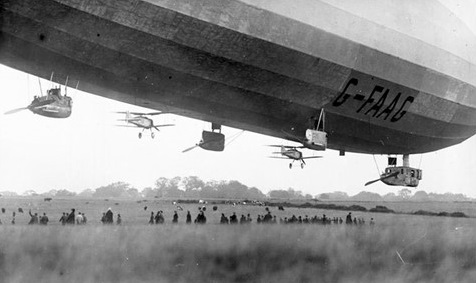
In October 1925, following repairs, she was used for experiments to provide data for the construction of the R101 airship. Once these were finished, in mid-October, she was used for trials launching a parasite fighter, using a DH 53 Hummingbird light aircraft. After some near misses, a successful launch and recapture was achieved in December that year. The following year she launched a pair of Gloster Grebes weighing about a ton apiece, the first of which was flown by Flying Officer Campbell MacKenzie-Richards. She was then sent to the sheds at Pulham where she was finally broken up in 1928, after “severe” metal fatigue was found in her frame. The forward portion of R33’s control car is on display at the RAF Museum at Hendon.
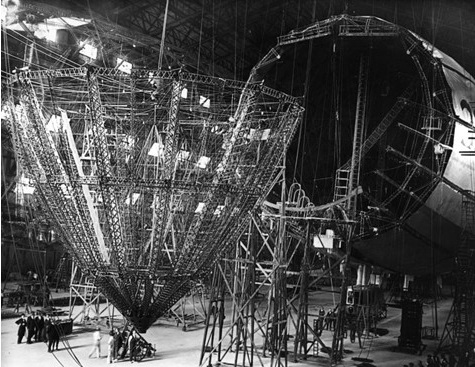
Construction of a new nose for the R33, 1925
The R33 class of British rigid airships were built for the Royal Naval Air Service during the First World War, but were not completed until after the end of hostilities, by which time the RNAS had become part of the Royal Air Force. The lead ship, R33, went on to serve successfully for ten years and survived one of the most alarming and heroic incidents in airship history when she was torn from her mooring mast in a gale. She was called a “Pulham Pig” by the locals, as the blimps based there had been, and is immortalised in the village sign for Pulham St Mary. The only other airship in the class, R34, became the first aircraft to make an east to west transatlantic flight in July 1919 and by the return flight, completed successfully the first two-way crossing, and was decommissioned two years later after being damaged during a storm. The crew nicknamed her “Tiny”.
Gloster Grebe fighter planes, tethered to the underside of the British Royal Navy airship R33, October 1926
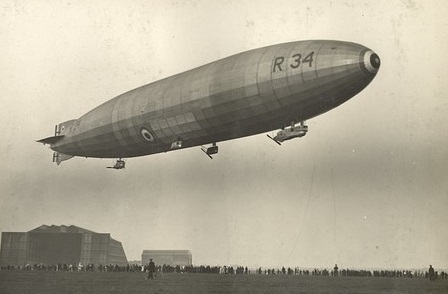
R34 made her first flight on 14 March 1919 and was delivered to her service base at East Fortune on 29 May after a 21-hour flight from Inchinnan: having set out the previous evening, thick fog made navigation difficult, and after spending the night over the North Sea the fog made mooring impossible in the morning, and after cruising as far south as Yorkshire she returned to East Fortune to dock at about 3 pm R34 made her first endurance trip of 56 hours over the Baltic from 17 to 20 June.
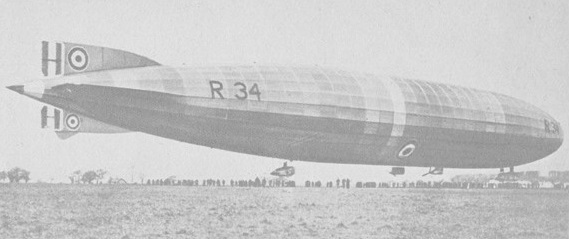
R34
It was then decided to attempt the first return Atlantic crossing, under the command of Major George Scott. R34 had never been intended as a passenger carrier and extra accommodation was arranged by slinging hammocks in the keel walkway. Hot food was prepared using a plate welded to an engine exhaust pipe.
The crew included Brigadier-General Edward Maitland and Zachary Lansdowne as the representative of the US Navy. William Ballantyne, one of the crew members scheduled to stay behind to save weight, stowed away with the crew’s mascot, a small tabby kitten called “Whoopsie”; they emerged at 2.00 p.m. on the first day, too late to be dropped off.
R34
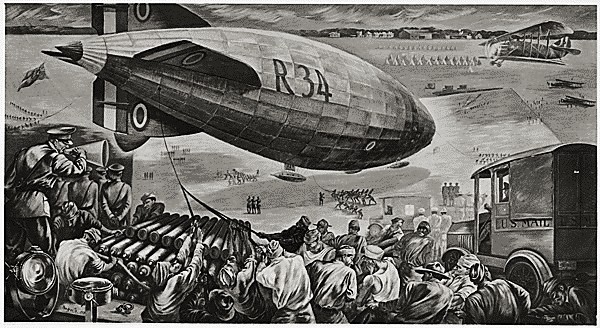
R34 left Britain on 2 July 1919 and arrived at Mineola, Long Island, United States on 6 July after a flight of 108 hours with virtually no fuel left. As the landing party had no experience of handling large rigid airships, Major E. M. Pritchard jumped by parachute and so became the first person to reach American soil by air from Europe. This was the first East-West crossing of the Atlantic and was achieved weeks after the first transatlantic aeroplane flight. The return journey to RNAS Pulham took place from 10 to 13 July and took 75 hours. Returned to East Fortune for a refit, R34 then flew to Howden, East Yorkshire, for crew training.
On 27 January 1921 R34 set off on what should have been a routine exercise. Over the North Sea the weather worsened and a recall signal sent by radio was not received. Following a navigational error the craft flew into a hillside on the North Yorkshire Moors during the night, and lost two propellers. She went back out to sea using the two remaining engines and in daylight followed the Humber estuary back to Howden. Strong winds made it impossible to get her back into the shed and she was tied down outside for the night. By the morning further damage had occurred and R34 was written off and scrapped.
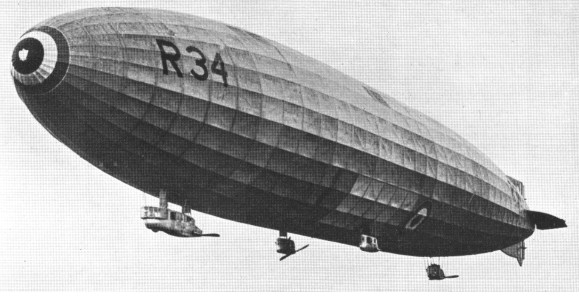
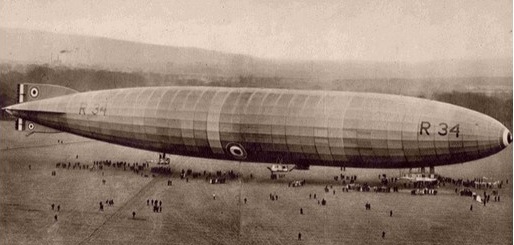
R34, the first airship to make a round-trip flight across the Atlantic.
R34 Engines: 5 × Sunbeam Maori, 275 hp (205 kW) Length: 643 ft 0 in (196 m) Diameter: 79 ft 0 in (24 m) Volume: 1,950,000 cu.ft (55,000 cu.m) Useful lift: 58,240 lb (26,470 kg) Maximum speed: 62 mph (99 km/h) Crew: 26
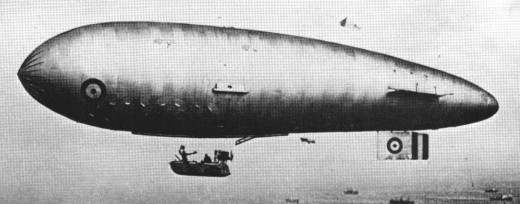
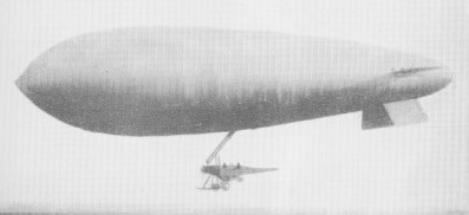
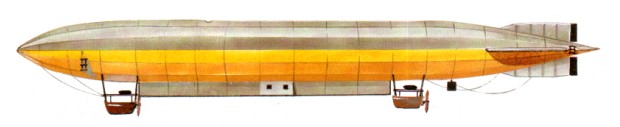
Utilised by the RNAS during WW 1 for anti-submarine patrol and convoy escort duties. Hurriedly conceived as a composite of the Willows JV (HMA No. 4) airship and a car formed from the fuselage of an RAF B. E. 2c aircraft, the resultant combination was a simple non-rigid that could be used for submarine hunting and convoy protection. It was first tested in March 1915 and given the designation ‘SS’ class, indicating ‘Sea Scout’ or ‘Submarine Scout’. Alternative cars could be fitted, and although the greater number used the B.E.2c fuselage (these being SS1 to SS3, SS8 to SS10A, SS12 to SS20, and SS23 to SS25), 11 were fitted with Armstrong Whitworth cars and 12 with Maurice Farman cars. Some are on record as going to France and Italy, while they also inspired certain US vessels of similar construction. The original ‘SS’class airships flew with a dorsal fin, while the ventral one of SS40 was extended in area. Anticipated work was agent-dropping, but it was actually used for night reconnaissance. The ‘SS’ class was used for patrols over the Dover Straits and Irish Narrows, the first base to have the type being that established at Capel near Folkestone on 8 May 1915; a second base began operations with the ‘SS’ on 6 July of the same year, this being at Polegate (Eastbourne) where there were three, compared with five at Capel. In later models the gas capacity was increased first to 1699 cu.m (60,000 cu ft) and later to 1982 cu.m (70,000 cu ft) from the original 580.5 cu.m (20,500 cu ft).
The SSO had a capacity of 70,500 cu ft., were 43.58m long and 9.14m in diameter. Useful lift was calculated to be 609.62kg. The class was powered by the 75hp Rolls Royce Hawk six cylinder engine with a maximum forward speed of 42 kts. On patrol speed was 30 kts. Other more radical variations were introduced to produce the ‘SST’ class, which had twin engines but of which only six were constructed, and the ‘SSP’ class (the last letter indicating pusher propulsion) that was even less successful, only two being built. As might be expected these airships, which gave to the English language the word ‘Blimp, had the capability to stay aloft for many hours, the normal flight duration being seven hours although records exist claiming up to twice this figure. The type served throughout the war on the same duties and certainly had a deterrent effect on submarine commanders, whose vessels it was possible to see below the surface of the water. Some, with Armstrong Whitworth F. K. 3 fuselages doing duty as their cars, were powered with 74.6-kW (100-hp) Green water-cooled motors as an alternative to the standard powerplant, the Hawk engine being particularly associated with the Maurice Farman nacelles. Production was about 150 ‘SS’ class airships. The final variant of the ‘32’ class airship was the ‘SSZ’ class (Z indicating the ultimate or zero form), of which no less than 93 were ordered although only 63 of these went to the Royal Navy: SSZ23 and SSZ24 were sent to the United States where the latter became A5472, while SSZ21 and SSZ22 went to France. The type was introduced late in 1916 and although the engine was usually the Rolls-Royce Hawk, two were fitted with the Renault V-S of similar rating, and all were used for similar work to that performed by the earlier ‘55’ type. The main visual difference between the two classes was the specially designed car that took the place of the aeroplane fuselages used formerly. In fact the SSZ was not originally intended for sea patrol, being designed to be towed by surface vessels of the Belgian coast patrol and by monitors, when their role would have been no more than aerial platforms for gunnery spotting after release and under their own power. The very first airship of this type was in fact built at Capel (Folkestone) and later flown to the Dunkirk area, where it was based at St Pol on 21 September 1916, three months after it had been constructed. Perhaps the chief claim to history enjoyed by the SSZ is the fact that, despite being of non-rigid construction and therefore capable of being flown only if the weather was suitable, they were responsible for spotting 49 submarines, of which 27 were claimed as sunk. To do this it was necessary for the airships to remain aloft for lengthy periods and the record for this goes to the crew of SSZ39, who remained in the air during the summer of 1918 for a continuous period of 50 hours. This was more than double that of the accepted ‘long patrol’, which was in the region of 24 hours, although the average was 12. A crew of three manned the airships. The crew car was designed to float like a boat and water landings were made on numerous occasions. In the front sat the wireless/telegraphist, the pilot in the centre and the engineer in the rearward position. Directional control was by rudder behind the vertical fin on the underside of the ship and elevators on the horizontal fins. To maintain envelope pressure and compensate for gas loss two ballonets were filled with air from a scoop immediately aft of the pusher propeller. The two ballonets were equivalent to about one third of the envelope volume which was a two ply rubberised fabric. Patrol duration was listed at 12 hours at full speed although at half speed patrols of 23 to 30 hours were quite common. In 1918 a flight of 50 hours 55 minutes was logged. It must be also remembered that the overhaul life of an aero engine at this time seldom exceeded 20 hours and was quite often as little as five hours. A total of seventy-one of the Submarine Scout class were built between 1916 and 1918.
‘SS’ class Powerplant: one 55.9-kW (75-hp) Renault V-S or Rolls-Royce Hawk six cylinder water-cooled piston engine, or one 74.6-kW (100-hp) Green water-cooled piston engine Maximum speed 48 kph (30 mph) with Renault or Rolls-Royce engine, or 80 km/h (50 mph) with Green engine. Useful lift 3001 kg (6,615 lb) Diameter 9.75 m (32 ft 0 in) Length 43.59 m (143 ft 0 in) Volume 1982.2 cu.m (70,000 cu ft) Armament: one 7.7-mm (0.303-in) Lewis machine-gun, plus bombs.
‘SSO’ class Engine: 1 x Rolls-Royce Hawk 6 cyl, 75 hp.
‘SSZ’ class Type: sea patrol airship. Powerplant: one 55.9-kW (75-hp) Rolls-Royce Hawk six-cylinder or Renault V-8 water-cooled piston engine. Maximum speed 77 kph (48 mph) Service ceiling 2400 m (7,875 ft) Normal endurance 12 hours Useful lift 3300 kg (7,275 lb Diameter 9.75 m (32 ft 0 in) Length 43.59 m(143 ft 0 in) Volume 1982.2 cu.m (70,000 cu ft) Armament: one 7.7-mm (0.303-in) Lewis gun for the observer, plus bombs
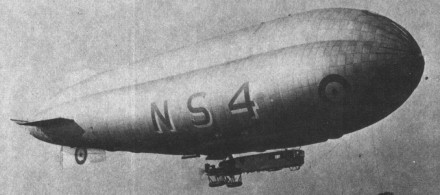
Another trefoil-section vessel, the ‘North Sea or ‘NS’ class was the last non-rigid airship type to be built for the Royal Navy, the first being ordered in January 1916 and delivered to the naval air station at Pulham in February 1917. The original idea had been for an airship which could carry out convoy duties and also co-operate with naval surface vessels, a concept that was never put into practice, the whole ‘NS’ fleet being used for patrol duties. One reason for this decision was the trouble that was experienced with the Rolls-Royce engines first fitted, the problem lying with the over-long shafting, about 3.05 m (10 ft) in length. It was only when this complicated transmission and the engines had been exchanged for direct-drive Fiats, that the type was able to prove its usefulness; previously only 18 were delivered, a mere 12 being with operational units. Although a variety of car configurations was encountered, all of them were of similar lines, with the power-plant mounted in a separate nacelle joined to the crew quarters by a wooden catwalk. This forward part of the car had been designed with some consideration to the comfort of its occupants. Such additions as a chart table and bunks were now essential, since the 10 men aboard were expected to operate as two watches, five being on duty while the remainder rested. From July 1917 the small number of North Sea airships then in use were all based on the Firth of Forth at East For¬tune, but by the end of the war over 100 had seen service. An early example (NS14) had gone to the United States and become A5580, while NS6 became a familiar sight to Londoners as a result of its frequent appearances over the capital; and in 1919 NS11 established an endurance record for a non¬stop cruise of 6437 km (4,000 miles) in 101 hours. Although its primary duty was to attack U-boats with its cargo of bombs, an historic use for NS7 and NS8 was to make up the aerial force with the British fleet sent to accept the surrender of the German naval forces on 21 November 1918. All convoy protection and coastal patrol airships carried about 181 kg (400 lb) of bombs with which to attack U-boats, but the useful load varied with the water ballast carried. Earlier models of the ‘NS’ class were powered by a pair of 186.4-kW (250-hp) Rolls-Royce engines, while latterly NS12 to NS18 received 223.7-kW (300-hp) Fiats.
Type: convoy escort airship. Powerplant: two 186.4-kW (250-hp) Rolls-Royce Eagle III V-12 or 193.9-kW (260-hp) Fiat A.12 six-cylinder water-cooled piston engines Maximum speed 93 kph (55 mph) Service ceiling about 7010 m (23,000 ft) Range 4828 km (3,000 miles) Useful lift 3810 kg (8,400 lb) Width 17.30 m(56 ft 9 in) Length 79.86 m (262 ft 0 in) Volume 10194 cu.m (360,000 cu ft) Armament: four or five 7.7-mm (0.303-in) Lewis machine-guns on free mountings, plus bombs
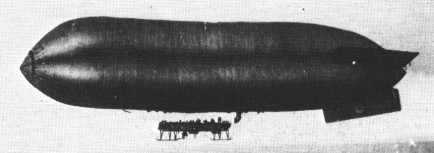
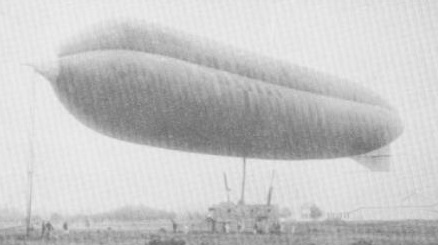
Designated the ‘C’ class from its anticipated use as a coastal type (‘Coastal’ class was an alternative name), this non-rigid type was of medium size and constructed with a trefoil envelope section, frequently known as the Astra Torrès type. The first of the pattern was ordered in June 1915 from Kingsnorth where it was assembled in the following September. The choice of envelope construction posed problems that were overcome in an interesting manner. Among these was the method of car suspension: the cables for this purpose were attached along the intersection line of the lobes and from here ran through the bottom of the covering to the car. And it is noteworthy that though the gas cells were contained in a non-rigid structure, it was possible to site one of two defensive gun positions on top.
Pembroke was the first naval air station to have the type, and the first flights took place from here in June 1916, other bases being Pulham, Howden. Mullion, East Fortune and Longside. The seas that came under the care of the ‘Coastal’ class airship patrols were those off the Norfolk coast, Lands End, the mouth of the Humber, the Firth of Forth and Aberdeen. Although the work of these vessels was largely unspectacular, one was the subject of an interesting set of experiments which were carried out on 6 September 1916. These were made with the first of the type, C1, in conjunction with the light cruiser HMS Canterbury, and were conducted offshore to look into the question of future developments, whereby an airship might be refuelled from a surface vessel.
A total of only 26 airships of this class were delivered, although these remained in service for lengthy periods. Thus they enjoyed a reputation for longevity as well as for extended flight times, the endurance of the design being as much as 12 hours. The crew of these airships consisted of five men, four of them in the car which also contained the two engines, fore and aft, driving tractor and pusher propellers respectively. The men’s accommodation was very considerably more comfortable than that of the fifth man, the upper gunner who had a special climbing tube through the envelope to reach his lofty position. ‘C’ class airships gave good and reliable service once the problems of cooling for the rear engine and blowing in of the nose cone had been solved.
When engines of differing powers were fitted in any one ship, the more powerful was normally that at the rear, while it is interesting to note that the cars were constructed from a pair of Avro 510 fuselages. Cl alone differed from the others in having a 57.9-in (190-ft) envelope with a 3964.4-cu.m (140,000-cu ft) capacity. The type had small variations of airscoop position and car details.
Naval Airship No.3
Four 1916-built Coastal airships were purchased by Russia in 1916, named Chernomor-1, 2, 3 (Name of the character of Russian fairy tale). The envelope volume was 4500 cu.m and the highest speed 80 km / h with two 173 h.p. engines.
Chernomor-1
In 1916, Chernomor-1 was at the very beginning of the next flight over the Black Sea, when engine failed. When returning to the base, the second engine failed. The situation was complicated by a decrease in the temperature of hydrogen in the envelope, which occurred as a result of the dense cloud covering the sun. The airship began to descend rapidly. The discharge of ballast and heavy equipment did not correct the situation. The gondola collided with water 10 km from the shore near the Kherson lighthouse, a boat coming to the rescue, and towed the airship to the Round Cove. When transporting the airship to the boathouse a strong wind rose, and in order to avoid the danger of damage, Chernomor-1 was dismantled. After that, it was never reassembled.
In one of the Chernomor-2 test flights, one engine failed. It was decided to land at the airfield Kachinskaya Aviation School. When landing, the second engine also failed. Despite this, the landing was done. Due to the increased wind and lack of space for safe parking, the airship “Chernomor-2” was dismantled. After that, it was never reassembled.
Chernomor -2
In the end, “Black Sea-3” was burned at the boathouse, and the “Black Sea-4” was not completed.
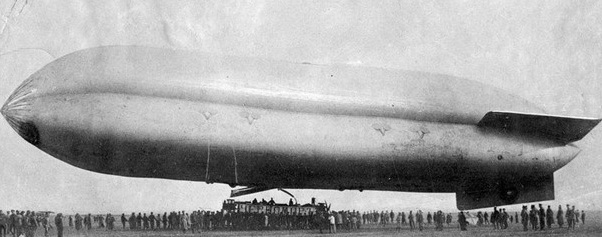
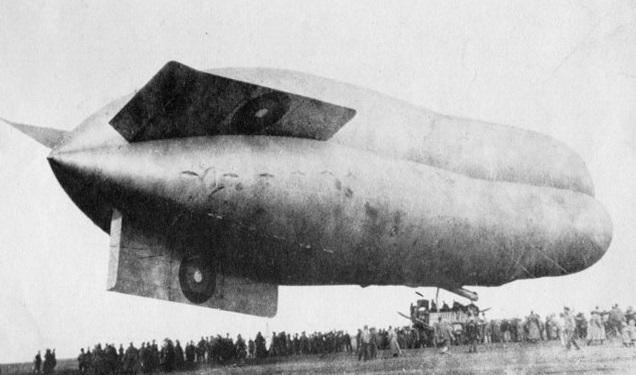
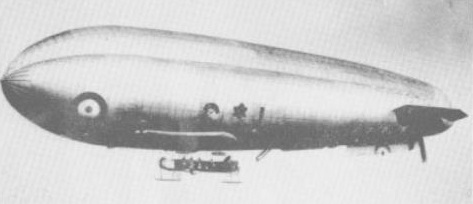
The C-Star class (sometimes written as C* class) of non-rigid airships or “blimps” were used by Britain’s Royal Naval Air Service for convoy escort duties during World War I. Developed from the Coastal class (often referred to as the “C class”), the Star in their designation indicated a modification of the original class which they slowly replaced in service.
C Star
The C-Star class were slightly larger than their predecessors. With an endurance of up to 30 hours, and more powerful (and reliable) Renault engines, the C*s had the same basic layout as the Coastal Class, with the same trilobe envelope. However, the envelope tapered towards the rear, as on the SSZ class, which greatly improved stability, as did the larger control surfaces.
‘C’ class Type: sea patrol airship Powerplant: two 111.9-kW (150-hp) Sunbeam six-cylinder water-cooled piston engines, or one 179-kW (240-hp) Fiat and one 82.0-kW (110-hp) Berliet water-cooled piston engines Maximum speed 80 kph (50 mph) Service ceiling 2134 m (7,000 ft) Useful lift 1608 kg (3,545 lb). Width 12.04 m (39 ft 6 in). Length 59.66 m (195 ft 9 in) Volume 4813.9 cu.m (170,000 cu ft). Armament: two 7.7-mm (0.303-in) Lewis machine-guns, plus bombs.
Chernomor Volume: 4,500 cu.m Max.speed: 80 km/h
C-Star Powerplant: 1 × tractor-mounted Berliet, 110 hp (82 kW) & 1 × pusher-mounted Fiat, 260 hp (193 kW) Volume: 210,000 cu ft (6,000 cu.m) Length: 218 ft 0 in (66.46 m) Width: 49 ft 3 in (15.01 m) Height: 57 ft 3 in (17.53 m) Useful lift: 4,030 lb (1,830 kg) Maximum speed: 58 mph (93 km/h, 50 kn) Endurance: at half speed 20 hours; at full speed 10 hours Service ceiling: 9,500 ft (2,900 m) Crew: Five
In June of 1918 the Admiralty made requirements for a ship to be build which would “be required to patrol the North Sea for 6 days without support, as far as 300 miles from a home base.” It was to have a combat ceiling of 22,000ft, and required to carry enough fuel for 65 hours at full speed of 70.6 mph. It was agreed that a further ship be ordered and the new ship, classed as the “Admiralty A Class” was designated the R38. The ship was also to be armed for defence of ships on escort duty and for attacking other aggressors :-
4x 520 lb of bombs 8x 230lb of bombs 1x 1pdr gun on gun platform on the top of the ship 12 pairs of machine guns spread along the top of the ship, the lower gun pit, and through the gondolas.
The order was given to Shorts Brothers at Cardington, and in February 1919 work started on the ship which would become the largest airship in the world.
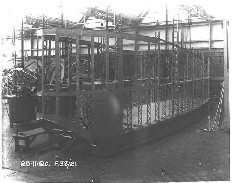
R 38 Control Car under construction
It was proposed that the R38 order was cancelled, as Cardington had been “Nationalised” under the Defence of the Realm Act. The Shorts Brothers were paid £40,000 in compensation for the cancellation, and the loss of the Cardington premises which became know as the Royal Airship Works.
However, following the Armistice the Americans still wanted a large rigid airship and so to gain experience in this field, the R38 contract was offered to them in October 1919. For the sum of $2,500,000 the British agreed to provide the Americans with a brand new and unique airship, and also offer training for her officers and crews. The contract was agreed, and it was also agreed that each country would equally borne the sharing of any possible loss. In this price was included the use of the R32 and R80 for training the crews. America also had to prepare for the delivery of the worlds largest airship, and advised that they could not expect to receive the ship for at least one year in order that they could make arrangements for it’s housing in the United States.
The whole process of building was restated. Designed as a match to the “Zeppelin Height-Climbers” the R38 was to be a high altitude, high speed airship. Slow progress was made on the ship, and when the contract was originally agreed with the United States, a delivery date of “late 1920” was agreed upon. However. The staff at Cardington were concerned when the work on the R37, which was being built in the bay beside the R38 was halted. The workmen on the R37 were then laid off when it was decided not to progress on the ship.
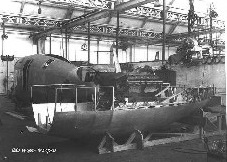
R 38 Engines under construction
Of course this worried the construction staff working on the R38 as there were no further workorders coming through the airship factory. The ship was finally completed on 7th June 1921. The pressure to get the ship “flying” was noted as there was not time to change the registration of the ship from R38 to the designated the ZRII by the American’s. It was agreed that the ship would fly with this US insignia markings on the outer cover but also with her “British” Registration R38, on her first flight, and have the conversion completed to the ZRII when she reached her Howden base.
First flown on June 23, 1921, R38 was the largest airship in the world to be built as yet, with a length of 694 ft and a diameter of 85 ft. On 23rd June 1921 she was launched from Cardington, and delivered to Howden in Yorkshire. Minor girder damage had been caused in flight by various stresses and the suggestion was made that strength had been sacrificed to achieve lightness. Later test flights were not conclusive about the strength of the ship.
23rd August 1921, the R38/ ZRII was now ready for her 4th trial flight. Now resplendent in her American livery, the ship was to fly from Howden to Pulham in Norfolk and carry our height and speed tests over the North Sea. The Following completion of the trials she flew over the coast to land at Pulham. The original plans were to have at least 150 hours of intensive flight trials for all crews on the new ship, however it was decided that once airworthiness was agreed then the ship be handed over to the Americans with their agreement. This meant that the planned 150 hours were not required and the ship fly down to Pulham, moor on the mast and be loaded up ready for her transatlantic delivery to Lakehurst New Jersey. When the ship flew in low over Norfolk, the airship station was obscured by fog and so it was agreed that the ship would fly our over the North Sea and spend the night over water. When she returned in the morning to the airship station, the airfield was still obscured by thick fog, it was then agreed that the ship return to Howden and carry out more trials en route that day. At approximately 17.00 on the 24th August Disaster struck on a test flight during a tight turn over the Humber near Hull.
Eyewitness reports confirmed that the ship seemed to crumple along mid section and then the front section broke away and detonated. The nose section detonating in two explosions killing 44 crew. Five members of the crew in the tail section were saved from the wreckage as it did not catch fire.
The tail section tilted and fell towards the Humber estuary, but was not alight. The official report attributes structural weakness as the cause of the crash, however the board of enquiry did not offer any technical opinions of the disaster. However the ship had been build far stronger than the comparable L-71, but the L-71 was not capable of being manoeuvred as sharply, and protected from higher stresses as exerted on the R38/ZRII.
44 of the 49 men on board perished in the tragedy. Among them was Air Commodore Maitland and sixteen men from the US Navy training with her.
Wreckage of the R38 being salvaged from the Humber.
In March 1922 the Air Ministry, following Commander Scott’s investigations suggested that the R36 be given to the United States as part compensation. The United States would have to bear the $30,000 expense of repairs and inflation of the ship and upkeep of Pulham after 31st March and the risks of the transoceanic flight. The Air Ministry would not approve the R36 being flown across the Atlantic by an American Crew and so Scott was to be the Commander. The US department of Aeronautics declined the offer. The final interest the US had in the R38 was the settlement of the accounts.
Three quarters of the $2,000,000 of the contract price had been paid with the final $500,000 being due on acceptance of the ship. It was agreed by both Governments that the ship was lost before delivery and hence both were equally liable for the loss. The total loss of the R38/ZRII was calculated at $1,964,334.
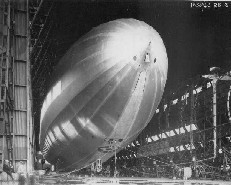
Subsequent to the loss of the R101 in 1930 the British Airship Programme was abandoned.
R 38 at Howden shed
Engines: 6 x 350hp Volume: 2,724,000cft Length: 695 ft Diameter: 85.5 ft Speed: 71 mph
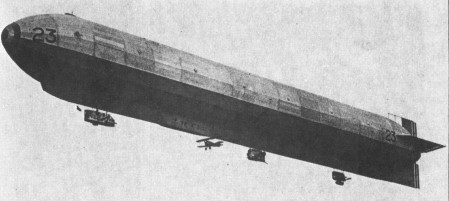
When His Majesty’s Airship No. 9 (HMA No.9) was delivered in the clos¬ing months of 1916 it was almost obso¬lete as a result of the lengthy political vicissitudes that had bedevilled its production. It served a useful purpose, however, it had become the basic pat¬tern on which the four rigid airships for the Admiralty were later to be based. The first of these ‘23’ class airships, HMA No. 23, was subsequently deli¬vered from Vickers Limited, Barrow¬-in-Furness, to Pulham on 15 Septem¬ber 1917. Design work had started in June of the previous year, the first flight being planned for that autumn, but consider¬able redesign had to be carried out when the original specification re¬sulted in a vessel that was something like 3493 kg (7,700 lb) too heavy, the greater part of this excess being attri¬butable to the choice of engines. The first trial flight of No. 23, four days after delivery, turned out to be something of an anticlimax, for it was clear that she too was at least obsoles¬cent, as might be expected from the original design source, and her mod¬ern counterparts had a lifting capacity some nine times greater than that of which she was capable. It is hardly surprising, therefore, that the planned total of 10 airships of this type was final¬ly cut back to six, while No. 23 was relegated to training duties. The other units of the class were HMA No. 24 (Beardmore), HMA No. 25 (Armstrong Whitworth), HMA R26 (Vickers), HMA R27 (Beardmore) and HMA R29 (Arm¬strong Whitworth), the last pair being of the improved ‘23X’ class without an exterior keel. No. 26 was the first to receive the ‘R’ prefix for rigid airships. Mindful that in the mid-months of 1918 there was a possibility of aerial confrontations between airships of the opposing nations, experiments were carried out with Sopwith Camel air¬craft suspended beneath the envelope of No. 23; the plan in the event of an attack was for the two fighters to be released to defend the mother vessel. There was no provision at the time for the aircraft to be reclaimed. In the spring of 1919 No. 23 was strengthened for tests at a mooring mast, but before they could be carried out she was broken up in September.
HMA No. 23 Type: naval training airship. Powerplant: four l86.4-kW (250-hp) Rolls-Royce Eagle III 12-cylinder water-cooled piston engines. Maximum speed 84 kph (52 mph) Service ceiling 914 m (3,000 ft) Range 3219 km (2,000 miles) Useful lift 6000 kg (13,228 lb) including four 45-kg (100-lb) bombs Diameter 16.15 m (53 ft 0 in) Length 163.07 m (535 ft 0 in) Volume 26674.4 cu.m (942,000 cu ft) Armament: provision for 7.7-mm (0.303-in) Lewis gun on free mounting above forward portion of hull, plus bombs.
Plans to build a second rigid airship to follow the unsuccessful HMA No. 1 (His Majesty’s Airship No. 1) Mayfly were agreed by the Committee for Imperial Defence in early 1913, and that Vickers should be asked to design an improved class of ship incorporating all that was then known about the Zeppelins. Vickers’ airship design department had been disbanded following the failure of the Mayfly, consequently a new department was formed when the original design team was reassembled with H. B. Pratt recruited as chief designer. Pratt had been working at Vickers while the Mayfly was being constructed and had predicted that it was not structurally sound and subsequently left the company. Pratt in turn hired Barnes Wallis, whom he had met while both were working for the shipbuilding firm of J. Samuel White, as his assistant. The initial order for the new ship was placed on 10 June 1913, with the final plans being agreed at the end of the year, and a formal contract was signed in March 1914.
The initial specification called for an airship with a disposable lift of 5 tons (5080 kg) capable of flying at 45 mph (72 km/h) and maintaining an altitude of 2,000 ft (610 m) for 30 minutes; however, the required load was later reduced to 3.1 tons (3150 kg). The hull was cylindrical for most of its length and was constructed from 17-sided transverse frames with a triangular section keel underneath. Two gondolas were suspended from the keel, the forward one containing the control compartment and two of the engines, the aft containing an emergency control station and the remaining pair of engines. In addition there was a radio cabin and a mess space for the crew within the keel structure, which also contained the fuel and ballast tanks. Propulsion was provided by four 180 hp (130 kW) Wolseley engines, mounted in pairs in the gondolas. Like Mayfly, it was designed with watertight cars so that it could be operated from water. The design was based in part on French plans of Z IV which had landed in France on 3 April 1913 following an accidental incursion into French airspace, permitting a thorough examination.
Construction was delayed by a number of circumstances. Difficulties were encountered with the fabrication of the duralumin girders for the transverse frames, and there were many changes to the design, including strengthening the hull so that it could be handled safely by inexperienced crews, and replacing the original drive arrangement of paired propellers mounted on the sides of the hull with swivelling propellers mounted on the gondolas (as used on contemporary British Army dirigibles).
The construction shed at the Cavendish Dock at Barrow was too small for the new design so a new hangar was built at Walney Island, off the west of Barrow. The new shed was 540 ft (160 m) long, 150 ft (46 m) wide and 98 ft (30 m) high, and had a 6 in (15 cm)-thick concrete floor with handling rails embedded into it which extended 450 ft (140 m) into the adjacent field. As a safety measure the shed had eight fire extinguishing jets fed by a dedicated reservoir. A gasbag factory employing 100 staff was also set up beside the shed.
When World War I broke out on 4 August 1914 No.9r was nearly ready for erection, and despite competing demands for materials and manpower for other projects, construction continued during the first months of the war. However, there was a feeling that the project was no longer favoured by the Admiralty: Winston Churchill, then First Lord of the Admiralty was known to be unenthusiastic about airships, and on 12 March 1915 he cancelled the order for the ship. The reasons given for this decision were that it was expected that the war would be finished in 1915, and that the vessel would not be operational by then and thus was a waste of valuable resources.
On 19 June 1915, after Churchill had been replaced as First Lord by Arthur Balfour, a conference was held at the Admiralty to consider all airship development. At that time the non-rigid airship programme was proving to be successful, and at this meeting it was agreed to expand the non-rigid programme and also to resume construction of HMA No.9. However, resumption of work was delayed by the necessity to retrieve Pratt and Wallis who had enlisted in the Army when construction was cancelled. Final erection of the ship began in the autumn of that year, but there were delays in obtaining flax from Ireland to make nets for the gasbags following the Easter Rising, and the ship was not completed until 28 June 1916.
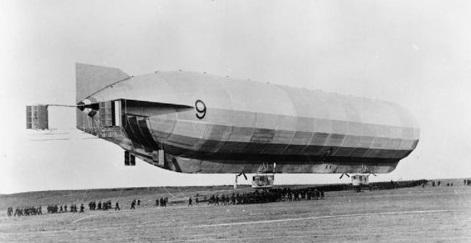
On 16 November 1916, No. 9r left its shed and was moored outside for tests of the fittings and engines, the first test flight taking place on 27 November 1916. This was the first time a British rigid airship had flown; however, it was unable to lift the contract weight of 3.1 tons. It was therefore lightened by the removal of both rear engines, replacing them with a single engine that had been salvaged from the Zeppelin L 33 which had made a forced landing in Little Wigborough, Essex, on 24 September 1916. New, lighter, gasbags were also fitted. These modifications increased the disposable lift to 3.8 tons (3861 kg), and it was accepted by the Navy in April 1917.
It served a useful purpose, however, it had become the basic pat¬tern on which the four rigid airships for the Admiralty were later to be based. The first of these ‘23’ class airships, HMA No. 23, was subsequently deli¬vered from Vickers Limited, Barrow¬-in-Furness, to Pulham on 15 Septem¬ber 1917.
No.9r was then sent to the RNAS airship station at Howden in the East Riding of Yorkshire where it spent most of the time being used for experimental mooring and handling tests. From 17 October 1917 to June 1918 it was stationed at RNAS Pulham in Norfolk where it was finally dismantled due to demand for shed space to allow construction of newer airships, having spent 198 hours and 16 minutes in the air, of which some 33 hours were at a mooring mast. Although unable to compete against contemporary Zeppelins, No.9r provided valuable experience of handling a rigid airship and the use of mooring masts, which would evolve into a unique method of mooring airships.
Engines: 4 × Wolseley, 180 hp (130 kW) each Volume: 846,000 cu ft (24,000 m3) Length: 526 ft 0 in (160.32 m) Width: 53 ft 0 in (16.15 m) Useful lift: 8,500 lb (3,900 kg) Maximum speed: 43 mph (69 km/h, 37 kn)
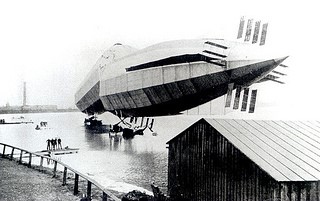
The UK’s first rigid airship was proposed in 1908 as a means of evaluating the naval airship as a weapon of war along German lines, and an order was placed with Vickers. The work was to be undertaken by a joint civilian/naval team, few of whose members had much experience in the type of work involved. Since the vessel was to be flown from water her gondolas were given planing bottoms, although alternative mooring to a mast anticipated German ideas. Construction was to be of the new alloy duralumin as a compromise between those factions who wanted wood or steel. Engine tests were begun in mid-February 1911, and it was hoped that the maiden flight might coincide with the Coronation Review of the fleet by King George V.
The extraction of HMA No. 1 (RI) from its floating shed called on the resources of a number of tugs and a hauling party of 300 sailors on the ropes, a difficult task since the airship, now nicknamed Mayfly (its official designation was ‘HMA Hermione’), proved much heavier than expected. This combined with misdirection of the handling party or (according to some reports) a sudden cross-wind, caused the airship to strike one of the uprights of the shed entrance, some damage resulting. This was unfortunate, since an earlier sojourn in the open had seen the airship successfully moored to the short mast provided as the superstructure of a naval vessel (the first use of such equipment in history) and reports speak of the RI thus riding out a storm with winds rising to as high as 72 km/h (45 mph).
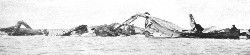
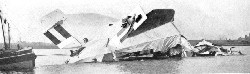
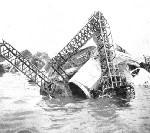
The damage now sustained had to be repaired, and the airship’s return to its shed also provided an opportunity to lighten the structure. It was not until 24 September 1911 that the RI next appeared, fully loaded with hydrogen after a 10-hour inflation of the gas cells and ready for flight. The method of handling was as before, and it was necessary for the airship’s nose to be turned. Hardly had the strain been taken on the ropes than a loud crashing was heard from within the centre of the vessel as its back broke. Understandably the crew began to leap overboard as ordered, and with the weight relieved from the rear gondola the stern rose up to complete the destruction.
The Mayfly never flew and was later scrapped.
HMA No. 1 Engines: two 1 19,3-kW (160-hp) Wolseley eight-cylinder water-cooled piston Estimated maximum speed 64 km/h (40 mph) Estimated useful lift 20321 kg (44.800 lb) Diameter 14.63 m (48 ft 0 in) Length 156.06 m (512 ft 0 in) Volume 18774 cu.m (663,000 cu ft)