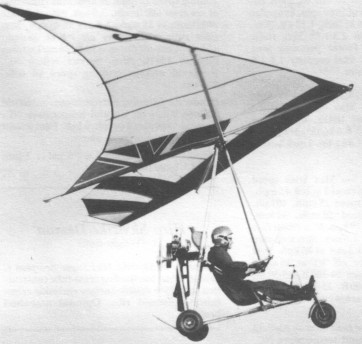
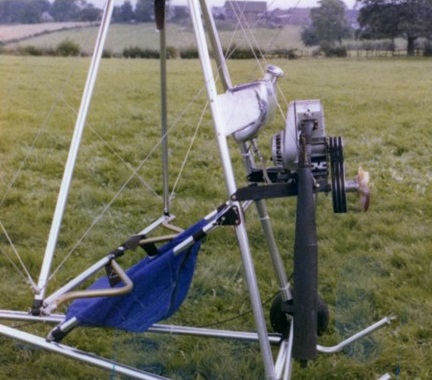
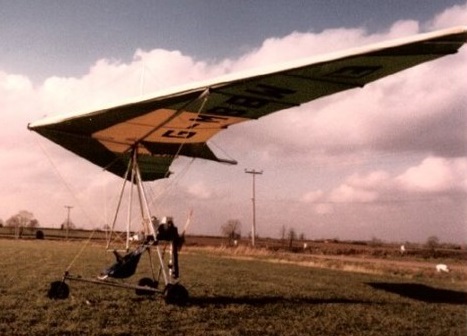
The Skytrike was the first British produced trike unit; allied to Hiway’s simple but effective Super Scorpion wing, (usually in the larger ‘C’ size). Designed by Frank Tarjanyi, the Skytrike/Super Scorpion C was introduced in 1979, the combination of a single surface wing and 10 hp did not exactly make for high performance and its pilot weight range was distinctly limited, but the basic formula was obviously right. The power shortage was solved by the introduction of Robin engines, in which form the trike unit was dubbed Skytrike Mk II, with the Valmet engined version being known retrospectively as the Mk I. Two versions of the Mk II were offered, a single cylinder 250 cc version which usually retained the Super Scorpion wing, and a twin cylinder 330 cc version which typically is flown with the Hiway Demon wing.
Hiway Skytrike with Valmet 160 (courtesy Job Chithalan)
Hiway’s next move was an attempt to retain the performance of the 330 cc version but save some weight, by using the small but powerful liquid cooled Hiro Delta MkI engine to produce the Hiro Skytrike trike unit. The result was an aircraft with an impressive performance for its engine size, due partly to the elimination of drive belts in favour of integral reduction gearing. Moreover, the liquid cooling allowed the inclusion of an effective carburettor anti icing system. Other than the engine, the only significant change to the trike unit was the replacement of the front wire by a strut.
Despite these qualities, the Hiro Skytrike found few buyers in a market which was becoming enamoured with the smoothness and reliability of the 330 cc Robin. It was not helped by the Skytrike’s growing reputation for poor detail engineering. Having made the initial great leap to power, it seemed that the company’s heart had returned to soaring; the marketing and detail development of the Skytrike were neglected and the company’s resources concentrated instead on a radical new hang glider called the Explorer. When this was received less than rapturously by the hang gliding world, it spelt the end of the company. In 1983 Hiway Hang Gliders Ltd was in liquidation.
160cc Valmet engined Hiway Skytrike with Flexiform Hilander wing (1981)
The Mk.II 330/Demon wing has floating cross tube construc¬tion with 75% double surface enclosing cross¬tube; pre formed ribs, and optional nosewheel brake.
Mk.I Engine: Valmet, 10 hp at 5000 rpm. Propeller diameter and pitch 54 x 30 ft, 1.37 x 0.76 m. V belt re¬duction, ratio 2.8/1. Max static thrust 75 lb, 34 kg. Power per unit area 0.05 hp/sq.ft, 0.5 hp/sq.m. Fuel capacity 2.1 US gal, 1.8 Imp gal, 7.9 litre. Wing span 33.5 ft, 10.21 m. Mean chord at 5.9 ft, 1.80 m. Total wing area 198 sq.ft, 18.4 sq.m. Wing aspect ratio 5.7/1. Empty weight 1251b, 57kg. Max take off weight 286 lb, 130kg. Payload 161 lb, 73kg. Max wing loading 1.44 lb/sq.ft, 7.1 kg/sq.m Max power loading 28.6 lb/hp, 13.0 kg/hp. Max level speed 26 mph, 42 kph. Never exceed speed 40 mph, 64kph. Max cruising speed 22mph, 35kph. Economic cruising speed 22mph, 35kph. Stalling speed 17 mph, 27 kph. Max climb rate at sea level 100 ft/min, 0.5 m/s. Min sink rate 190 ft/min at 21 mph, 1.0 m/s at 34 kph. Best glide ratio with power off 8/1 at 22 mph, 35 kph. Take off distance 150 ft, 45 m Land¬ing distance 70 ft, 20 m Range at average cruising speed 51 mile, 83 km.
Mk.II 250/Super Scorpion C Engine: Robin EC25PS, 18 hp at 7000 rpm. Propeller diameter and pitch 52 x 31 inch, 1.32 x 0.79 m. V belt reduction, ratio 2.3/1. (Early aircraft used a 54×24 inch propeller with reduction ratio 2/1.) Max static thrust 1301b, 59kg. Power per unit area 0.09hp/sq.ft, 1.0hp/sq.m. Fuel capacity 2.4 US gal, 2.0 Imp gal, 9.1 litre. (Early aircraft used a 1.6 US gal (1.3 Imp gal, 6.1 litre) fuel tank.) Wing span 33.5 ft, 10.21 m. Mean chord at 5.9 ft, 1.80 m. Total wing area 198 sq.ft, 18.4 sq.m. Wing aspect ratio 5.7/1. Empty weight 1651b, 75kg. Max take off weight 3491b, 158kg. Payload 1841b, 83kg. Max wing loading 1.76 lb/sq.ft, 8.6kg/sq.m. Max pow¬er loading 19.41b/hp, 8.8kg/hp. Max level speed 30 mph, 48 kph. Never exceed speed 45 mph, 72kph. Max cruising speed 25mph, 40kph. Economic cruising speed 25 mph, 40 kph. Stalling speed 18 mph, 29 kph. Max climb rate at sea level 300 ft/min, 1.5 m/s. Min sink rate 250 ft/min at 25 mph, 1.3 m/s at 40 kph. Best glide ratio with power off 9/1 at 25 mph, 40kph. Take off distance 90 100ft, 25 30 m. Landing distance 90 100ft, 25 30m. Range at average cruising speed 50 mile, 80 km.
Mk.II 330/Demon Engine: Robin EC34PM, 32 hp at 6500 rpm. Propeller diameter and pitch 52 x 30 inch, 1.32 x 0.76 m. V belt reduction, ratio 2/1. Max static thrust 180 lb, 82 kg. Power per unit area 0.18 hp/sq.ft, 2.0 hp/sq.m. Fuel capacity 2.4 US gal, 2.0 Imp gal, 9.1 litre. (Early aircraft used a 1.6 US gal (1.3 Imp gal, 6.1 litre) fuel tank.). Length overall 11.0ft, 3.35m. Wing span 32.0ft, 9.75m. Chord at root 8.2ft, 2.50m. Chord at tip 3.5 ft, 1.07 m. Dihedral 0 degs Nose angle 120 degs. Total wing area 175 sq.ft, 16.3 sq.m. Wing aspect ratio 5.9/1. Empty weight 195 lb, 88kg. Max take off weight 470 lb, 213 kg. Payload 275 lb, 125 kg. Max wing loading 2.69 lb/sq.ft, 13.1 kg/sq.m. Max power loading 14.7 lb/hp, 6.7kg/hp. Max level speed 40 mph, 64 kph. Never exceed speed 45 mph, 72 kph. Max cruising speed 35 mph, 56 kph. Economic cruising speed 30mph, 48kph. Stalling speed 22 mph, 35 kph. Max climb rate at sea level 600 ft/min, 3.0 m/s. Min sink rate 300 ft/min at 28 mph, 1.5 m/s at 45 kph. Best glide ratio with power off 7/1 at 28 mph, 45 kph. Take off distance 80 ft, 25 m. Landing distance 100 ft, 30 m. Range at average cruising speed 65 mile, 105 km.
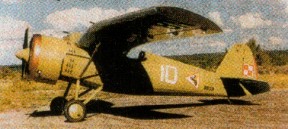
Historical Aircraft Corp offers kits to build a range of 60 percent scale single-seat fighter representations, including P-51D, Corsair, PZL P.11 c and, P-40 Tomahawk, plus an 85 percent scale representation of Ryan STA. First flown in 1990, the kit included engine, prop and instruments, with a 1997 price of US$25,500. Historical Aircraft Corp P.11c
Top speed: 105 mph Cruise: 90 mph Stall: 55 mph Range: 300 sm Rate of climb: 900 fpm Takeoff dist: 900 ft Landing dist: 900 ft Service ceiling: 12,500 ft Engine: 100 hp Fuel capacity: 11 USG Empty weight: 850 lb Gross weight: 1100 lb Height: 7.5 ft Length: 18.3 ft Wing span: 27.8 ft Wing area: 97.3 sq.ft Seats: 1 Landing gear: tailwheel
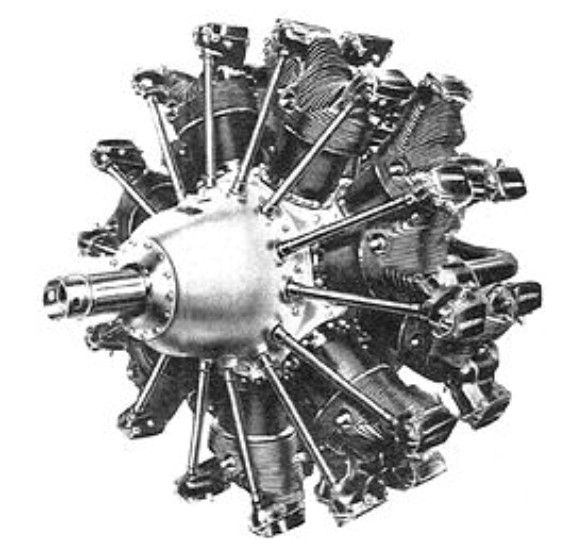
The Hispano-Suiza 14AA was a fourteen-cylinder aircraft radial engine used in France during the late 1930s. As Hispano-Suiza lacked recent experience in developing radial engines, it was derived from the licensed Wright R-2600 engine. Due to reliability problems, the engine was largely supplanted by the similar Gnome-Rhône 14N.
Not to be confused with the smaller Hispano-Suiza 14AB, which was derived from the smaller Wright Whirlwind series.
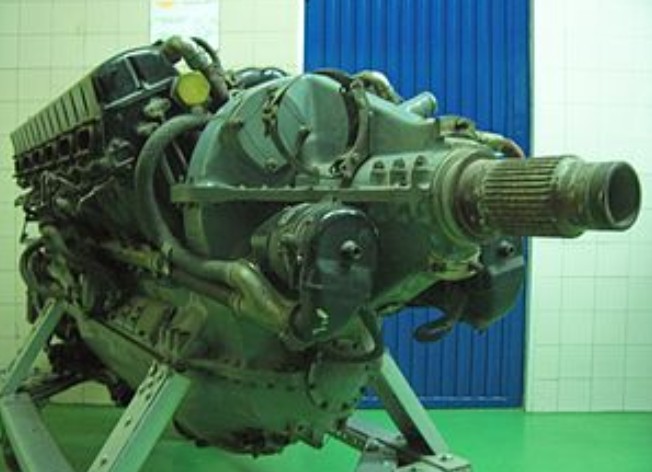
The 12Z was the final evolution of the series of Hispano-Suiza V-12 aircraft engines, which had just entered production when France fell to the Germans during World War II. A small number were produced during the war but the German occupation government would not allow full-scale production to start. After the war small numbers were built to equip new designs, but the rapid introduction of the jet engine ended further development.
The 12Z differed from the earlier 12Y primarily in the use of four valves per cylinder operated by dual overhead cams. This gave the cylinders considerably better volumetric efficiency and faster operation, raising the RPM from 2,400 to 2,700. The engine was also designed to run only on 100 octane fuel (instead of 87, which was common at that point) which allowed the compression ratio to rise from the 12Y’s 5.8:1 to the 12Z’s 6.75:1. These changes raised the power from 1,000 to 1,300 hp (750 to 970 kW) at sea level. Unfortunately the engine continued to use a single-stage, single-speed supercharger and therefore lacked the all-altitude performance of German and British designs. But tuning the supercharger for a different critical altitude improved high-altitude performance considerably, delivering 1,500 hp (1,120 kW) at 21,000 ft (6,400 m) as opposed to 930 hp (690 kW) at 2,950 ft (900 m) for the 12Y.
Small prototype runs started in 1939, and were fitted to the French Armée de l’Air’s front-line fighter aircraft, the M.S.410 and D.520, creating the M.S.450 and D.524 respectively. Production of the main model, the 12Z-17, was just starting at the time of the armistice. Production was undertaken in Hispano-Suiza’s Spanish factories, but these engines had many problems and were never used in any numbers.
After the war a new version tuned to operate with 92 octane fuel, as opposed to the -17’s 100/130, was built in limited numbers as the 12Z-89. Compression ratio was raised slightly to 7:1, but with the lower grade fuel the power dropped slightly to 1,280 hp (950 kW) at 2,600 rpm (1,479 hp (1,100 kW) maximum take-off). These engines apparently had the same sorts of reliability issues as the earlier -17’s made in Spain, and the type never entered production.
Variants: Hispano-Suiza 12Z-1 The initial version of the engine used for development
Hispano-Suiza 12Z-17 development peak at time of the Fall of France in May 1940
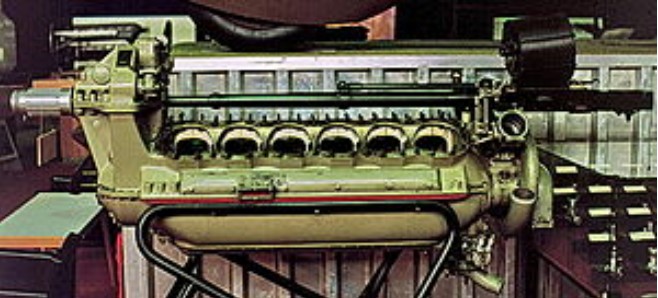
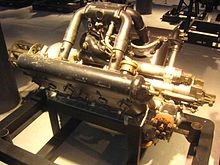
Up to 1927, Hispano-Suiza’s many engine types, of various layouts and cylinder numbers, were all recognisable developments of the World War I V-8 Hispano-Suiza 8. 1927-8 saw the introduction of four completely new engines, two V-12s designed by Marc Birkigt, and two with six cylinders inline. The Hispano-Suiza 12N, known by the manufacturers as the Type 61, was the larger of the V-12s, with a displacement of 36.0 L (2,197 cu in), the other being the 27.0 L (1,648 cu in) 12M. Apart from capacity and power, these two engines had much in common. The 12M first ran in 1927 and the 12N a year later.
Both 12M and 12N were 60° V engines with carburettors, inlets and exhausts on the outer faces. There were three carburettors per bank, each charging a pair of cylinders. Much of the new technology was in the cylinder design: these types introduced wet liners, an Hispano automobile engine innovation which brought the cooling water into direct contact with the steel cylinder barrel rather than by screwing it into an aluminium water jacket. This improved cooling, simplified assembly and allowed larger cylinder bores without increasing their separation. The cylinder barrels were open at top and bottom and threaded for screwing into the block only near the top, with valve seats ground into the aluminium cylinder head. The lower end of the barrel extended into the crankcase, simplifying both manufacture and assembly. Block and crankcase were bolted together.
The 12M and 12N engines were the first to use the gas nitriding surface hardening process on the cylinder walls, which reduced both wear and oil consumption. They also used a novel, complicated but effective method of main bearing cooling, enhancing the local lubricant flow without requiring high overall oil pump speeds. The unit cost in 1931 was 250,000 FF.
Both types were designed so that Epicyclic gearing could be added or removed quickly; some earlier Hispano-Suiza engines offered gearing but as a permanent fixture on a specific sub-type. The gears added 45 kg (99 lb) to the weight. In 1935 the 12Ner variant was fitted with an in-flight- electrically operated variable pitch propeller.
The 12N series was developed into the 12Y (Type 73) supercharged engine, first run in 1932.
A Hispano-Suiza 12Nb powered the Breguet XIX Point d’Interrogation on the first non-stop flight from Paris to New York in September 1930. This was the first east to west flight between Europe and the USA, rather than to the North American continent. In the early 1930s, 12N engines powered the flying boats operating the French Atlantic and African routes.
The Swiss government, in the form of the KTA (Kriegstechninischen Abteilung or War Technical Department) purchased construction licences for the 12Nb and in 1932 eighty units were built at the Saurer lorry factory.
Variants:
12Nb/650 Compression ratio 6.2, maximum power 560 kW (750 hp) at 2,100 rpm.
12Nbr/650 Compression ratio 6.2, maximum power 550 kW (740 hp) at 2,100 rpm. Gearing ratio of 2:1 or 1.61:1.
12Ns Compression ratio 7, nominal power 670 kW (900 hp) at 2,200 rpm. For Schneider Cup 1928.
12Nsr Compression ratio 10, nominal power 745 kW (1,000 hp) at 2,400 rpm. For Schneider Cup 1931. Farman compressor.
12Nc Compression ratio 6.2, nominal power 533 kW (715 hp) at 2,000 rpm. For Ford 14A Trimotor.
Up to 1927, Hispano-Suiza’s many engine types, of various layouts and cylinder numbers, were all recognisable developments of the World War I V-8 Hispano-Suiza 8. 1927-8 saw the introduction of four completely new engines, two V-12s designed by Marc Birkigt, and two with six cylinders inline. The Hispano-Suiza 12M, known by the manufacturers as the Type 57, was the smaller of the V-12s, with a displacement of 27.0 L (1,648 cu in), the other being the 36.0 L (2,197 cu in) 12N. Apart from capacity and power, these two engines had much in common. The 12M first ran in 1927 and the 12N a year later.
Both 12M and 12N were 60° V engines with carburettors, inlets and exhausts on the outer faces. There were three carburettors per bank, each charging a pair of cylinders. Much of the new technology was in the cylinder design: these types introduced wet liners, an Hispano automobile engine innovation which brought the cooling water into direct contact with the steel cylinder barrel rather than by screwing it into an aluminium water jacket. This improved cooling, simplified assembly and allowed larger cylinder bores without increasing their separation. The cylinder barrels were open at top and bottom and threaded for screwing into the block only near the top, with valve seats ground into the aluminium cylinder head. The lower end of the barrel extended into the crankcase, simplifying both manufacture and assembly. Block and crankcase were bolted together.
The 12M and 12N engines were the first to use the gas nitriding surface hardening process on the cylinder walls, which reduced both wear and oil consumption. They also used a novel, complicated but effective method of main bearing cooling, enhancing the local lubricant flow without requiring high overall oil pump speeds. In 1931 the unit cost was 240,000 FF.
Both types were designed so that epicyclic gearing could be added or removed quickly; some earlier Hispano-Suiza engines offered gearing but as a permanent fixture on a specific sub-type. The Farman gears added 45 kg (99 lb) to the weight.
The first commercial version of the 12M was the 12Mb of 1929. This had a compression ratio of 6.2 and a maximum power output of 432 kW (580 hp) at a speed of 2,100 rpm. In geared-down form it became the 12Mbr. These both had aluminium crankcases but the next model, the 12Mc of 1930, replaced the aluminium with Elektron metal both there and in other previously aluminium components. Though rather brittle, Elektron metal has only 2/3 the density of aluminium and the result was a 20 kg (44 lb) weight reduction from the 12Mb to the 12Mc. The 12Mc also had an increased compression ratio of 7.0, raising the power from the nominal 478 kW (575 hp) of the 12Mb to 477 kW (640 hp). The model 12Md retained the Elektron metal components but returned to the 6.2 compression ratio of the 12Mb. Both 12Mc and 12Md had geared down versions, the 12Mcr and 12Mdr respectively.
The 12Mc was an early example of an attempt to solve the problem of falling engine power with increasing altitude; it was “undercharged”, running lean at sea level and only developing its maximum power at 2,000 m (6,490 ft). A final 12M variant, the 12Mdsh run in 1932, addressed this problem differently; it was the first Hispano-Suiza engine to be supercharged, blown by a Rateau turbine. It produced 477 kW (640 hp) at 2,250 rpm at an altitude 2,950 m (9,678 ft). Test flown in a Dewoitine D.32, it maintained power up to 5,500 m (18,000 ft). The 12M series was developed into the 12X (Type 72) supercharged engine, first run in 1931.
The Swiss government, in the form of the KTA (Kriegstechninischen Abteilung or War Technical Department) purchased construction licences for the 12Mb and in 1932 sixty units were built at the Schweitzerische Lokomotive und Maschinfabrik factory.
A Blériot-SPAD S.91-7, powered by a 12Mc engine, set a 500km closed-circuit record of 308.78 km/h (191.91 mph) on 2 June 1932.
Variants:
12Mb/500 Compression ratio 6.2. Nominal power 428 kW (575 hp) at 2,000 rpm.
12Mbr/500 Compression ratio 6.2. Nominal power 421 kW (565 hp) at 2,000 rpm. As 12Mb but with Farman reducer.
12Mc/500 Compression ratio 7.0. Nominal power 477 kW (640 hp) at 2,200 rpm. Elektron crankcase and other components.
12Mcr/500 As 12Mc but with Farman reducer.
12Md Compression ratio 6.2. Nominal power 428 kW (575 hp) at 2,100 rpm. Elektron crankcase and other components.
12Mdr As 12Md but with Farman reducer.
12Mdsh Nominal power 477 kW (640 hp) at 2,250 rpm and altitude 2,950 m (9,678 ft). First supercharged version.
Applications: Blériot-SPAD 91-7[4] Dewoitine D.32[2] Lioré et Olivier LeO 252, 235, 234, 236 Nieuport-Delage 622 and 629
Specifications:
12Mbr/500 Type: V-12, water cooled Bore: 150 mm (5.90 in) Stroke: 170 mm (6.69 in) Displacement: 27.0 L (1,648 cu in) Dry weight: 455 kg (1,003 lb) Reduction gear: 2:1 Power output: (normal) 421 kW (565 hp) at 2,000 rpm Compression ratio: 6.2
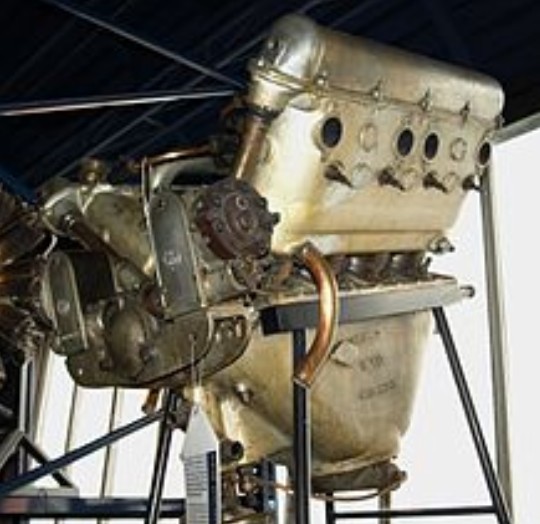
The 12Y was a fairly traditional in construction, a 36-litre water-cooled V-12 with the two cast aluminium cylinder banks set at 60 degrees to each other. The 12Y design was based on the earlier and smaller, 12X. The cylinder heads were not removable, instead the entire block could be quickly removed from the engine. This made it somewhat famous for being leak-proof, a design feature that was considered by other designers and almost became a part of the Rolls-Royce Merlin. The major design change from the earlier 12X was to use a master-articulated connecting rod system, instead of the fork-and-blade type. A single overhead camshaft (SOHC) drove the valves, which were filled with liquid sodium for cooling. Only a single intake and exhaust valve were used, unlike most designs of the era which had moved to three or four valves per cylinder. A single-stage, single-speed supercharger was standard, although the art of designing a useful intake was not as well developed as in other countries, and high altitude performance was always lacking. The first 12Y test articles were constructed in 1932, and almost immediately the entire French aviation industry started designing around it. At the time the engine developed only 760 hp (570 kW), but it was clear it had potential to the 1,000 hp (750 kW) class. An early modification led to the Hispano-Suiza 12Ycrs which used a hollow propeller shaft to allow a 20 mm cannon to fire through the propeller spinner (a combination known as a moteur-canon). All later designs shared this feature. The 12Ydrs was the next major series, with a basic rating of 836 hp (623 kW) at sea level with a compression ratio of 5.8:1. The Armée de l’Air changed their nomenclature, so the next version was the Hispano-Suiza 12Y-21, which increased the compression ratio to 7:1, when running on 100 octane gasoline. This boosted power to 867 hp (647 kW). In 1936 the connecting rod design was changed slightly to create the 12Y-31, but the lower 5.8:1 compression ratio was retained and the power was increased only slightly over the drs model to 850 hp (630 kW). Nevertheless this became one of the most used engine designs of the pre-war era, used in almost all French fighter designs and prototypes. A real effort to improve the performance of the engine in 1938 resulted in the Hispano-Suiza 12Y-45, which used the S-39-H3 supercharger co-designed by André Planiol and Polish engineer Joseph Szydlowski. The Szydlowski-Planiol device was larger, but much more efficient than the indifferent Hispano-Suiza models. When used with 100 octane fuel, the supercharger boosted to the -21’s 7:1, increasing power to 900 hp (670 kW). Combined with the fully adjustable Ratier propeller, this allowed the D.520 to perform as well as contemporary designs from Germany and England. Another improvement in supercharging led to the Hispano-Suiza 12Y-49, whose performance improved from 850 hp (630 kW) at sea level to 920 hp (690 kW) at just over 10,000 ft (3,000 m). This improvement in power with altitude was a common feature of most engines of the era, the result of the supercharger “robbing” power at low altitudes. The final major version was the 1,085 hp (809 kW) Hispano-Suiza 12Y-51, which had just started into production at the time of the Armistice with Germany. The -51 was the first version that came close to the performance limits of the engine, although the single-stage supercharging meant that it was unable to compete with designs from England and Germany above 15,000 ft (5,000 m). Foreign derivatives In the early 1930s the Czechoslovakian Republic gained rights to build a license version of the HS-12Y. This was initially known locally as the Avia Vr. 36 and was produced by Avia (Škoda) at Prag – Čakovice. The engine was intended to become the standard powerplant of all Czech military aircraft. Both the HS-12Ycrs and HS-12Ydrs were built in quantity and were more commonly known by these names rather than any Czech designation. Aircraft powered by these engines included the Avia B-34, Avia B-534, Avia B-71, Avia B-35 and Avia B-135. In the mid-1930s, Russian engineer Vladimir Klimov was sent to France to obtain a license for local production of the 12Y. A series of design changes were added to cope with cold weather operation, and the engine entered production in 1935 as the Klimov M-100 with about 750 hp (560 kW). However a series of continual upgrades increased the allowable RPM from the 12Y’s fairly low 2,400 to 2,700, thereby increasing power to 1,100 hp (820 kW). The resulting design, the Klimov M-105 (VK-105) became one of the major Soviet engine designs during the war, powering all Yakovlev fighters.
Variants:
Type 73 Hispano 12Yb Configuration: V-12 Bore: 150 mm Stroke: 170 mm Capacity: 36.0 litres Year: 1932 Compression: 6.4 Power: 785 hp Max power rpm: 2,200 TO power: 785 hp Output reduction: 1.5 Weight: 415 kg) Rated power (650 hp) less than nominal 785 hp Left turning
Type 73 Hispano 12Ygrs Configuration: V-12 Bore: 150 mm Stroke: 170 mm Capacity: 36.0 litres Year: 1932 Compression: 5.8 Power: 850 hp Max power rpm: 2,400 TO power: 800 hp Output reduction: 1.5 Supercharger optimum altitude: 4,000 m Weight: 430 Rated power (650 hp) less than nominal 850 hp Left turning
Type 73 Hispano 12Y dr Configuration: V-12 Bore: 150 mm Stroke: 170 mm Capacity: 36.0 litres Compression: 6.4 Year: 1934 Power: 800 hp Max power rpm: 2,200 TO power: 800 hp Output reduction: 1.5 Weight: 440 Left turning
Type 73 Hispano 12Y drs Configuration: V-12 Bore: 150 mm Stroke: 170 mm Capacity: 36.0 litres Year: 1934 Compression: 5.8 Power: 860 hp Max power rpm: 2,400 TO power: 835 hp Output reduction: 1.5 Supercharger optimum altitude: 4,000 m Weight: 470 kg Left turning
Type 73 Hispano 12Y 12Ydrs1 Configuration: V-12 Bore: 150 mm Stroke: 170 mm Capacity: 36.0 litres Year: 1934 Compression: 5.8 Power: 880 hp Max power rpm: 2,400 TO power: 890 hp Output reduction: 1.5 Supercharger optimum altitude: 2,400 m Weight: 470 kg Left turning
Type 73 Hispano 12Y drs2 Configuration: V-12 Bore: 150 mm Stroke: 170 mm Capacity: 36.0 litres Year: 1934 Compression: 5.8 Power: 930 hp Max power rpm: 2,400 TO power: 992 hp Output reduction: 1.5 Supercharger optimum altitude: 900 m Weight: 470 kg Left turning
Type 73 Hispano 12Y frs Configuration: V-12 Bore: 150 mm Stroke: 170 mm Capacity: 36.0 litres Year: 1934 Compression: 5.8 Power: 860 Max power rpm: 2,400 rpm TO power: 835 hp Output reduction: 1.5 Supercharger optimum altitude: 4,000 m Weight: 470 kg Right turning
Type 73 Hispano 12Y frs1 Configuration: V-12 Bore: 150 mm Stroke: 170 mm Capacity: 36.0 litres Year: 1934 Compression: 5.8 Power: 880 hp Max power rpm: 2,400 TO power: 890 hp Output reduction: 1.5 Supercharger optimum altitude: 2,400 m Weight: 470 kg Right turning
Type 73 Hispano 12Y frs2 Configuration: V-12 Bore: 150 mm Stroke: 170 mm Capacity: 36.0 litres Year: 1934 Compression: 5.8 Power: 930 hp Max power rpm: 2,400 TO power: 992 hp Output reduction: 1.5 Supercharger optimum altitude: 900m Weight: 470 kg Right turning
Type 73 Hispano 12Y 21 Configuration: V-12 Bore: 150 mm Stroke: 170 mm Capacity: 36.0 litres Year: 1935 Compression: 7.0 Power: 910 hp Max power rpm: 2,400 TO power: 880 hp Output reduction: 1.5 Supercharger optimum altitude: 3,600m Weight: 470 kg
Type 73 Hispano 12Y 25 Configuration: 60° V-12 Bore: 150 mm (5.906 in) Stroke: 170 mm (6.693 in) Capacity: 36.0 litres (2,199.9 cu,in) Length: 1,722 mm (67.8 in) Width: 764 mm (30.08 in) Height: 935 mm (36.81 in) Year: 1935 Compression: 5.8 Power: 860 hp Max power rpm: 2,400 TO power: 943 hp Specific power: 17.08 kW/lt (0.38 hp/cu.in) Specific fuel consumption: 328 g/(kW/hr) (0.54 lb/(hp/hr)) Oil consumption: 11 g/(kW/hr) (0.28 oz/(hp/hr)) Power-to-weight ratio: 1.32 kW/kg (0.8 hp/lb) Output reduction: Spur, 1.5 Fuel system: Six Solex 56 S.V.C carburetors Fuel type: 85/100 octane gasoline Supercharger: Gear-driven single-speed centrifugal type, 10.0:1 gear ratio Supercharger optimum altitude: 3,600m Dry weight: 475 kg (1,050 lb) Cooling system: Pressurised, Liquid-cooled: 600 litres/min. Valvetrain: One intake and one sodium-filled exhaust valve per cylinder actuated via a single overhead camshaft per bank. Left turning, variable ignition timing
Type 73 Hispano 12Y 27 Configuration: V-12 Bore: 150 mm Stroke: 170 mm Capacity: 36.0 litres Year: 1935 Compression: 5.8 Power: 900 hp Max power rpm: 2,400 TO power: 950 hp Output reduction: 1.8 Supercharger optimum altitude: 850m Weight: 483 kg
Type 73 Hispano 12Y 33 Configuration: V-12 Bore: 150 mm Stroke: 170 mm Capacity: 36.0 litres Year: 1936 Compression: 7.0 Power: 965 hp Max power rpm: 2,400 TO power: 960 hp Output reduction: 1.5 Supercharger optimum altitude: 2,250 m Weight: 490 kg
Type 73 Hispano 12Y 39 Configuration: V-12 Bore: 150 mm Stroke: 170 mm Capacity: 36.0 litres Year: 1936 Compression: 7.0 TO / Max Power: 1000 hp Max power rpm: 2,400 Output reduction: 1.5 Supercharger optimum altitude: 3,400m
Type 73 Hispano 12Y 5 Configuration: V-12 Bore: 150 mm Stroke: 170 mm Capacity: 36.0 litres Year: 1938 Power: 920 hp Max power rpm: 2,400 TO power: 950 hp Output reduction: 1.5 Supercharger optimum altitude: 10,000m 3 speed compressor
Type 77 Hispano 12Y crs Configuration: 60° V-12 Bore: 150 mm (5.906 in) Stroke: 170 mm (6.693 in) Capacity: 36.0 litres (2,199.9 cu,in) Length: 1,722 mm (67.8 in) Width: 764 mm (30.08 in) Height: 935 mm (36.81 in) Year: 1934 Compression: 5.8 Power: 860 hp Max power rpm: 2,400 TO power: 835 hp Specific power: 17.08 kW/lt (0.38 hp/cu.in) Specific fuel consumption: 328 g/(kW/hr) (0.54 lb/(hp/hr)) Oil consumption: 11 g/(kW/hr) (0.28 oz/(hp/hr)) Power-to-weight ratio: 1.32 kW/kg (0.8 hp/lb) Output reduction: Spur, 1.5 Supercharger: Gear-driven single-speed centrifugal type, 10.0:1 gear ratio Supercharger optimum altitude: 4,000m Weight: 470 kg 20 mm calibre Hispano-Suiza 404 cannon between cylinder banks, firing through propeller shaft. Fuel system: Six Solex 56 S.V.C carburetors Cooling system: Pressurised, Liquid-cooled: 600 litres/min. Valvetrain: One intake and one sodium-filled exhaust valve per cylinder actuated via a single overhead camshaft per bank.
Type 77 Hispano 12Y brs Configuration: V-12 Bore: 150 mm Stroke: 170 mm Capacity: 36.0 litres Year: 1934 Compression: 5.8 Power: 860hp Max power rpm: 2,400 TO power: 835hp Output reduction: 1.0625 Supercharger optimum altitude: 4,000m Weight: 470kg 20 mm calibre Hispano-Suiza 404 cannon between cylinder banks, firing through propeller shaft.
Type 77 Hispano 12Y 29 Configuration: V-12 Bore: 150 mm Stroke: 170 mm Capacity: 36.0 litres Compression: 7.2 Power: 920hp Max power rpm: 2,400 TO power: 910hp Output reduction: 1.5 Supercharger optimum altitude: 3,600m Weight: 475kg 20 mm calibre Hispano-Suiza 404 cannon between cylinder banks, firing through propeller shaft.
Type 77 Hispano 12Y 31 Configuration: V-12 Bore: 150 mm Stroke: 170 mm Capacity: 36.0 litres Year: 1936 Compression: 5.8 Power: 860hp Max power rpm: 2,400 TO power: 830hp Output reduction: 1.5 Supercharger optimum altitude: 3,250m Weight: 468kg 20 mm calibre Hispano-Suiza 404 cannon between cylinder banks, firing through propeller shaft. Redesigned connecting rods
Type 77 Hispano 12Y 37 Configuration: V-12 Bore: 150 mm Stroke: 170 mm Capacity: 36.0 litres Year: 1936 Compression: 7.0 Power: 960hp Max power rpm: 2,400 TO power: 1,050hp Output reduction: 1.8 Supercharger optimum altitude: 1,250m Weight: 483kg 20 mm calibre Hispano-Suiza 404 cannon between cylinder banks, firing through propeller shaft.
Type 77 Hispano 12Y 41 Configuration: V-12 Bore: 150 mm Stroke: 170 mm Capacity: 36.0 litres Year: 1936 Compression: 7.0 Power: 920 hp Max power rpm: 2,400 Output reduction: 1.5 Supercharger optimum altitude: 3,600m Weight: 483kg 20 mm calibre Hispano-Suiza 404 cannon between cylinder banks, firing through propeller shaft.
Type 77 Hispano 12Y 45 Configuration: 60° V-12 Bore: 150 mm (5.906 in) Stroke: 170 mm (6.693 in) Capacity: 36.0 litres (2,199.9 cu,in) Length: 1,722 mm (67.8 in) Width: 764 mm (30.08 in) Height: 935 mm (36.81 in) Compression: 7.0 Power: 920hp Max power rpm: 2,400 TO power: 935hp Output reduction: Spur, 1.5 Fuel system: Six Solex 56 S.V.C carburetors Fuel type: 92/100 octane gasoline Specific power: 17.08 kW/lt (0.38 hp/cu.in) Specific fuel consumption: 328 g/(kW/hr) (0.54 lb/(hp/hr)) Oil consumption: 11 g/(kW/hr) (0.28 oz/(hp/hr)) Power-to-weight ratio: 1.32 kW/kg (0.8 hp/lb) Supercharger: Gear-driven single-speed centrifugal type, 10.0:1 gear ratio Supercharger optimum altitude: 4,200m Dry weight: 515 kg (1,140 lb) Cooling system: Pressurised, Liquid-cooled: 600 litres/min. Valvetrain: One intake and one sodium-filled exhaust valve per cylinder actuated via a single overhead camshaft per bank. 20 mm calibre Hispano-Suiza 404 cannon between cylinder banks, firing through propeller shaft. Szydlowsky-Planiol (SP) supercharger
Type 77 Hispano 12Y 47 Configuration: V-12 Bore: 150 mm Stroke: 170 mm Capacity: 36.0 litres Year: 1936 Compression: 5.8 Power: 860 hp Max power rpm: 2,400 TO power: 830 hp Output reduction: 1.5 Supercharger optimum altitude: 3,250m Weight: 468 kg 20 mm calibre Hispano-Suiza 404 cannon between cylinder banks, firing through propeller shaft.
Type 77 Hispano 12Y 49 Configuration: V-12 Bore: 150 mm Stroke: 170 mm Capacity: 36.0 litres Compression: 7.0 Power: 910hp Max power rpm: 2,400 TO power: 910hp Output reduction: 1.5 Supercharger optimum altitude: 5,250m Weight: kg 20 mm calibre Hispano-Suiza 404 cannon between cylinder banks, firing through propeller shaft. Szydlowsky-Planiol (SP) supercharger, variable ignition timing
Type 77 Hispano 12Y 51 Configuration: V-12 Bore: 150 mm Stroke: 170 mm Capacity: 36.0 litres Year: 1939 Compression: 7.0 Power: 1,000hp Max power rpm: 2,500 TO power: 1,100hp Output reduction: 1.5 Supercharger optimum altitude: 3,260m Weight: 492kg 20 mm calibre Hispano-Suiza 404 cannon between cylinder banks, firing through propeller shaft. Szydlowsky-Planiol (SP) supercharger, variable ignition timing
Licence built variants:
Avia Vr. 36 License production in Czechoslovakia.
Klimov M-100 License production in the USSR.
Hispano-Suiza HS-77 Licence-built 12Ycrs produced in Switzerland.
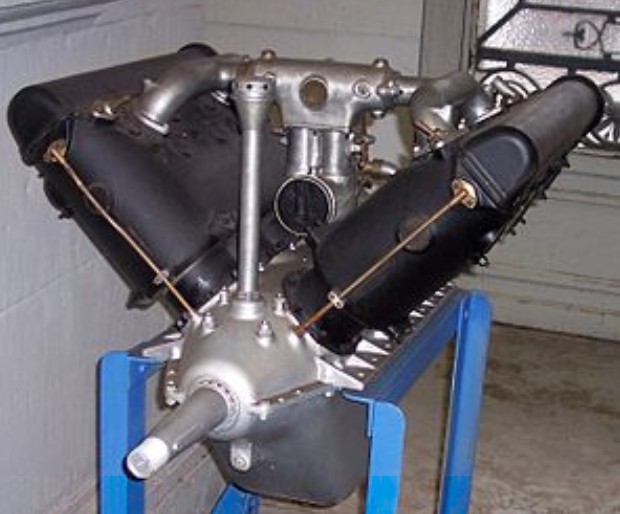
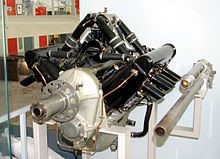
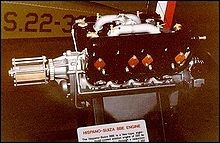
The Hispano-Suiza 8 was a water-cooled V8 SOHC aero engine introduced by Hispano-Suiza in 1914 and was the most commonly used engine in the aircraft of the Entente Powers during the First World War. The original Hispano-Suiza 8A was rated at 140 hp (102 kW) and the later Hispano-Suiza 8F reached 300 hp (220 kW).
HS-8 engines and variants produced by Hispano-Suiza and other companies under licence were built in twenty-one factories in Spain, France, Britain, Italy, and the U.S. Derivatives of the engine were also used abroad to power numerous aircraft types and the engine can be considered as the ancestor of another successful engine by the same designer, the Hispano-Suiza HS-12Y (and Soviet Klimov V12 derivative aero-engines) which served in World War II.
When World War I began, the production lines of the Barcelona based Hispano-Suiza automobile and engine company were switched to the production of war materiel. Chief engineer Marc Birkigt led work on an aircraft engine based on his successful V8 automobile engine. The resulting engine, called the Hispano-Suiza 8A (or HS-8A), made its first appearance in February 1915.
The first 8A kept the standard configuration of Birkigt’s existing design: eight cylinders in 90° Vee configuration, a displacement of 11.76 litres (717.8 cu in) and a power output of 140 hp at 1,900 rpm. In spite of the similarities with the original design, the engine had been substantially refined. The crankcase was machined from a solid piece of steel. The cylinders were cast aluminium with steel liners. The SOHC cylinder heads were also made of aluminium, using a rotary driveshaft (tower gear) coming up from the crankcase along the rear end of each cylinder bank, with the final drive for each cylinder bank’s camshaft accommodated within a semicircular bulge at the rear end of each valve cover. Aluminium parts were coated in vitreous enamel to reduce leakage. All parts subject to wear, and those critical for engine ignition were duplicated: spark plugs for dual ignition reliability, valve springs, magnetos, etc.
Although engine reliability was a great concern in these opening stages of aviation, the HS-8A also provided a good power-to-weight ratio and development potential. The engine and its accessories weighed 185 kg (408 lb), making it 40% heavier than a rotary engine of equivalent power. The design also promised far more development potential than rotary engines which, in spite of being the most common type then in use for aircraft, were getting close to the limits of their potential. Rotary engines of increased power generally had increased weight, which in turn increased the already serious gyroscopic torque generated by the engine’s rotation. A further increase in torque was considered unacceptable, and the power-to-weight ratio of the new rotary engines under development did not appeal to aircraft designers.
The new engine was presented to the French Ministère de la Guerre (Ministry of War) in February 1915, and tested for 15 hours at full power. This was standard procedure for a new engine design to be admitted in military service. However, because of lobbying by French engine manufacturers, the HS-8A was ordered to undergo a bench test that no French-made engine had yet achieved successfully: a 50-hour run at full speed. The HS-8A was therefore sent back to Chalais-Meudon on July 21, 1915 and tested for 50 hours, succeeding against all expectations.
French officials ordered production of the HS-8A to be started as soon as possible and issued a requirement for a new single-seat high-performance fighter aircraft using the new engine. The SPAD VII was the result of this requirement and would allow the Allies to regain air superiority over the Germans.
Guynemer informed Bechereau in December 1916 that “the Halberstadt [while] not faster, climbs better, consequently it has the overall advantage”. In the quest for more power, Marc Birkigt increased the compression ratio of the 8A engine from 4.7 to 5.3, which in turn raised its revolutions from 1500 to 1800 per minute. This resulted in a power output of 180hp, enabling a significant improvement in the SPAD VII’s performance to be achieved. Apart from the extra power, the new Hispano-Suiza 8Ab proved extremely reliable.
Hispano Suiza 8Ca
Approximately 49,800 were built.
The Wolseley Viper is a British-built, high-compression derivative of the Hispano Suiza HS-8 liquid-cooled V-8 engine, built under licence by Wolseley Motors during World War I and first run in 1918.
It powered later models of the S.E.5a, SPAD VII and other British or British-built aircraft designed for the Hispano-Suiza.
Wolsley Viper
Variants:
8A (HS-8A) The first model of the Hispano-Suiza 8 produced in any quantity.
8Aa (HS-8Aa) The HS-8Aa, which entered production in July 1915, was the production variant of the basic HS-8A type, with increased power output: 150 hp (110 kW) at 2,000 rpm. Early HS-8A engines were plagued with various problems which required further work. The 150 hp HS-8Aa was the standard powerplant for early-production SPAD VIIs. The demand for the Hispano-Suiza engine was such that other manufacturers began producing it under licence, in France, Great Britain (Wolseley Adder), Italy (Nagliati in Florence and Itala/SCAT in Turin) and Russia. Total production of the HS-8Aa amounted to some 6,000 engines. To avoid the problems experienced by the 8A, Wolseley reduced the compression ratio to 4.7 in the Adder but opted for 5.3 in other variations such as the Viper.
8Ab (HS-8Ab) The HS-8Ab was yet another evolution of the HS-8A. By increasing the compression ratio from 4.7 to 5.3, Birkigt was able to increase the power output to 180 hp (132 kW) at 2,100 rpm. The HS-8Ab began replacing the 8Aa on SPAD VIIs in early 1917.
8Ac (HS-8Ac)
8B (HS-8B) The HS-8Ab had been plagued by engine failures due to the high compression ratio: piston heads were sometimes pierced and engines seized. In another ploy to increase the power output of the engine, Birkigt chose to increase engine speed.
8Ba (HS-8Ba) The first, the HS-8Ba, kept the 4.7 compression ratio of the HS-8Aa but delivered 200 hp (147 kW) at 2,300 rpm.
8Ba (HS-8Bb) The second version, the HS-8Bb, had a compression ratio of 5.3. A reduction gear (3:4 ratio) was fitted to compensate for the increased engine speed. However the reduction gear system was fragile, and often broke down, sometimes with spectacular results ending up with the entire propeller, driveshaft and driven gear parting company from the airframe. Progressive refinement of the engine brought the available power to 235 hp by the end of 1917. The HS-8B was used to power the earliest versions of the S.E.5a, all examples of the SPAD S.XII and SPAD S.XIII, front-line versions of the Sopwith Dolphin and several other Allied aircraft types, with its gear reduction easily identifiable in vintage World War I photos, from its use of a clockwise (viewed from in front, otherwise known as a left hand tractor) rotation propeller.
8Ba (HS-8Be)
Hispano-Suiza 8Be
8Ca (HS-8Ca) The HS-8Ca, a gear-reduction equipped powerplant with a resultant clockwise rotation propeller like the 8B, produced 220 hp at 2,100 rpm. It had a manually loaded 37 mm Puteaux SA 18 cannon mounted between the cylinder banks (a so-called moteur-canon) that could fire a single shot at a time through the hollow drive shaft without propeller interference. The engine was used on the SPAD S.XII.
Hispano Suiza 8Ca
8F (HS-8F) The HS-8F was basically an enlarged version of the HS-8B, and was intended for use in bombers. Displacement rose to 18.5 liters (1,127.3 in3), with a power of 300 hp (220 kW) at 2,100 rpm (eq. 750 lb·ft torque). Despite the increased weight of 256 kg (564 lb), the HS-8F was installed in fighters such as the Nieuport-Delage NiD 29 and Martinsyde Buzzard, and it would have powered the never-produced Mk.II version of the Sopwith Dolphin. Engine speed being lower than that of the HS-8B, the reduction gear was deleted, thereby increasing engine reliability.
8Fa (HS-8Fa)
8Fb (HS-8Fb)
8Fd (HS-8Fd)
Wolseley W.4B Adder I
Wolseley W.4B Adder II
Wolseley W.4B Adder III
Wolseley W.4A Python I
Wolseley W.4A Python II
Wolseley W.4A Viper Was an improved 8A. Wolseley’s engineers removed problems with the crankshaft and increased the compression ratio to give more power. It did not need the reduction gearing of the H-S8.
Wolseley W.4A Viper II The Viper II could deliver 210 hp at 2,000 rpm.
Wright-Hisso A
Wright-Hisso E The American Wright-Martin aviation firm licence-produced the original 150 hp HS-8Aa engine as the Wright-Hispano E, for use in World War I combat aircraft to be built in the United States – it found its way into the JN-4H version of the Curtiss Jenny, replacing the Curtiss OX-5 liquid-cooled V8 engine of only 90 hp output. Wright-Hisso H
Wright-Hisso I
Wright-Hisso T
Applications: Austin-Ball A.F.B.1 Avia BH-21 Avia BH-22 Bartel BM-5 Bernard SIMB AB 10 Blanchard Brd.1 Caudron C.59 Caudron R.11 Curtiss JN-4H Jenny FBA Type H Fokker D.IX Fokker D.X Fokker D.XII Fokker S.III Gourdou-Leseurre GL.21 Hanriot HD.5 Hanriot HD.15 Hanriot HD.20 Letov Š-7 Letov Š-13 Letov Š-14 Martinsyde F.4 Buzzard Nieuport 29 (8Fb) S.E.5 and S.E.5a (8a and Viper), Sopwith Dolphin (8B) Sopwith Cuckoo SPAD S.VII (8a) SPAD S.XI (8Be) SPAD S.XII (8Cb), with 37 mm calibre moteur-canon mount through the hollow propshaft SPAD S.XIII (8Be) Standard J-1 training biplanes, especially on restored, airworthy examples Waco DSO (8a) Wibault 1
Wright-Hispano E Boeing NB-2 AT-3 Consolidated PT-1 Cox-Klemin TW-2 Dayton-Wright TW-3 Huff-Daland TW-5 Curtiss AT-4 Vought VE-7 Waco DSO
Hispano-Suiza 8a Type: 8-cylinder liquid-cooled Vee piston engine Bore: 120 mm (4.724 in) Stroke: 130 mm (5.118 in) Displacement: 11.76 L (717.8 in3) Dry weight: 445 lb (202 kg) Fuel system: 1 Claudel or Zenith Carburetor Cooling system: liquid Fuel consumption: 0.51 lb/(hp·h) Oil consumption: 0.03 lb/(hp·h) Power output: 140 hp at 1900 rpm Length: 1.19 m Width: 0.81 m Height: 0.77 m Compression ratio: 4.7
8Aa Bore: 120 mm Stroke: 130 mm Displacement: 11.76 lt Compression ratio: 4.7 Length: 1.25 m Width: 0.83 m Height: 0.81 m Weight: 215 kg Power output: 150 hp at 2000 rpm
8Ab Bore: 120 mm Stroke: 130 mm Displacement: 11.76 lt Compression ratio: 5.3 Length: 1.31 m Width: 0.85 m Height: 0.87 m Weight: 230 kg Power output: 180 hp at 2100 rpm
8B Bore: 120 mm Stroke: 130 mm Displacement: 11.76 lt Compression ratio: 5.3 Length: 1.36 m Width: 0.86 m Height: 0.90 m Weight: 236 kg Power output: 200/235 hp at 2300 rpm
8F Bore: 140 mm Stroke: 150 mm Displacement: 18.47 lt Compression ratio: 5.3 Length: 1.32 m Width: 0.89 m Height: 0.88 m Weight: 256 kg Power output: 300 hp at 2100 rpm
W.4A Viper Type: 8-cylinder, upright, 90 degree Vee engine Bore: 4.72 in (120 mm) Stroke: 5.12 in (130 mm) Displacement: 716.8 cu in (11.77 L) Dry weight: 500 lb Fuel system: Twin Zenith-Duplex carburettors Cooling system: Liquid-cooled Reduction gear: Direct drive, Right-hand tractor Power output: 200 hp at 2,000 rpm (takeoff power) Compression ratio: 5.3:1
During World War I, the Spanish Air Arm was unable to obtain combat aircraft from abroad to modernise its operational units. Hispano enlisted the services of French designed Emile Dewoitine who designed a fighter monoplane, the HS-50, which was to be powered by the Hispano-Suiza HS-12-Z-89 engine.
The design reached full-scale mock-up stage when the decision was made to build the Messerschmitt Bf109G-2 under licence.
Hispano designed and built a 755hp piston engined advanced trainer, the HA.100 Triana. The HA-100 EI replaced the HA-43D-1 trainer. A tandem seater, tricycle landing gear, and with a gross weight of 6,460 lbs (2,932kg) was designed by Willy Messerschmitt. It went into production for the Spanish Air Force in 1953.