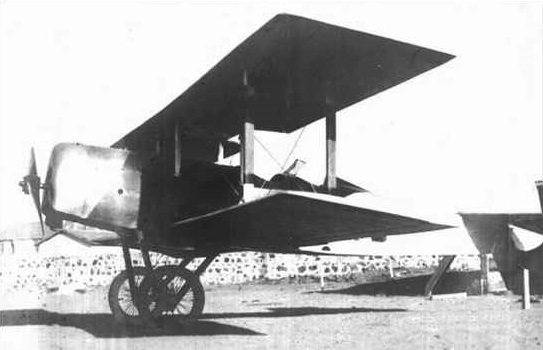
The Vecihi XI, aka Vecihi Y-XI, aircraft was displayed at the 1930 Ankara trade fair, registered TC-S.VI.
The Vecihi XI, aka Vecihi Y-XI, aircraft was displayed at the 1930 Ankara trade fair, registered TC-S.VI.
The 1933 Vecihi X, aka Vecihi SK-X, was a 2-seat touring aircraft. A modernised version of the Vecihi XIV, it was registered TC-S.V.

The Vecihi VI was a 1924 2-seat recce biplane built from salvaged parts. First flight at Izmir, 28 Jan 1925.
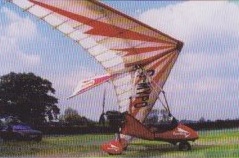
Initially a homebuilt designed and constructed by John Hunt purely for himself, the Avon trike unit and Experience wing were later marketed as an inexpensive flexwing. The wing was bought complete and the rest built from plans.
Empty weight: 160 kg
Wing span: 10.6 m
Wing area: 15.24 sq.m
Fuel capacity: 50 lt
Certification: BMAA
Engine: Rotax 582, 65 hp
MAUW: 372 kg
Seats: 2
Max speed: 121 kph
Cruise speed: 88 kph
Minimum speed: 48 kph
Climb rate: 3.3 m/s
Fuel consumption: 12 lt/hr
Plan price (1998): £115
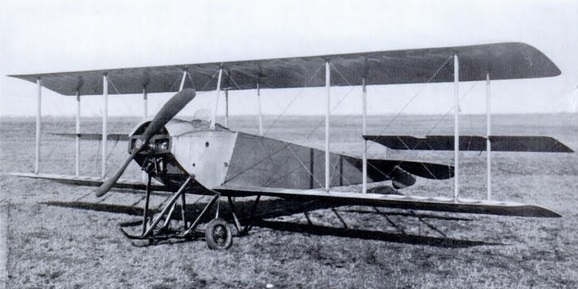
The Huntington Tractor Scout, two-place trainer, was built for an unsuccessful military evaluation in 1915. Powered by a 90 hp Gyro engine, it was built at the Hempstead Plains Airfield in Garden City.
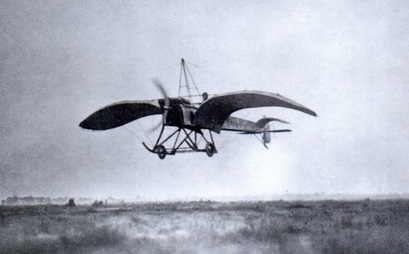
A more traditional design, the 1914 Huntington Clam was flown several times at the Hempstead Plains Airfield.
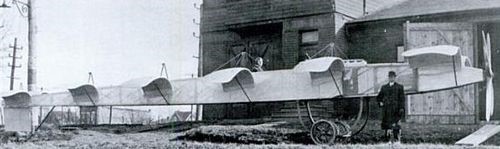
A multi-wing aeroplane designed and built by Howard Huntington sometime during 1912/1913. The photo shows Huntington in front of his house in Hollis, Queens, on January 22, 1914.
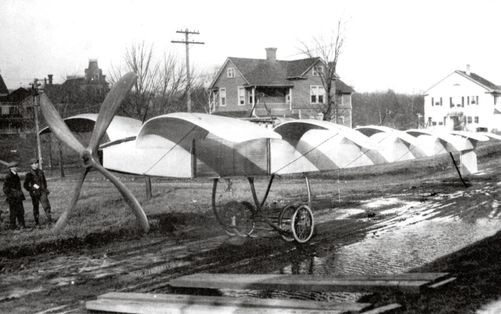
In June of 1914 Huntington constructed a single wing variant of his multiplane – the Huntington “Clam”.
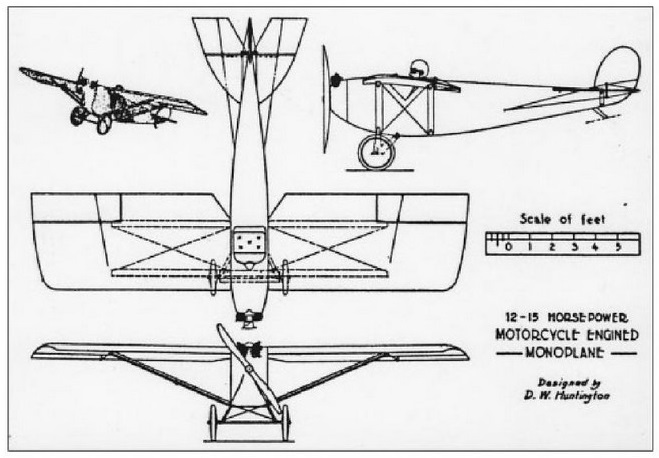
The 1920 Huntington H-12 monoplane was a successful design powered with a motorcycle engine. Designed and built by Dwight Huntington of Hempstead, this was the first kit, or plan-built, lightplane professionally engineered in the United States.
With a wingspan of 20 ft, the wings were attached to the upper longerons, but downward vision was increased by windows in the sides of the cockpit. It was powered by a 15 hp Harley Davidson motorcycle engine.
Able to cruise a 60 mph, plans of the H-12 were sold through aviation magazines into the late 1920s.
The cost of construction, without motor, was well under $80.
A four/six-seat amphibian with a Pratt & Whitney Wasp engine.
A two-seat landplane, powered by a Wright-built Gipsy.

