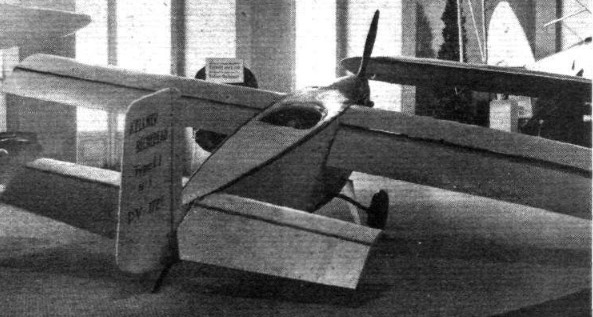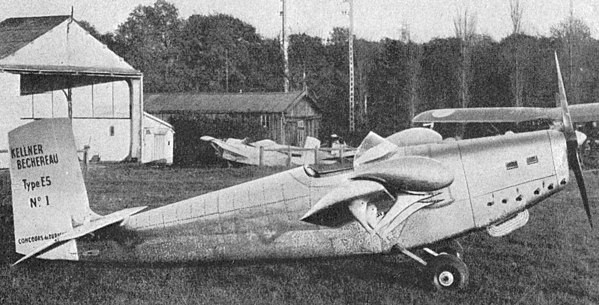
Kellner-Bechereau ED.5

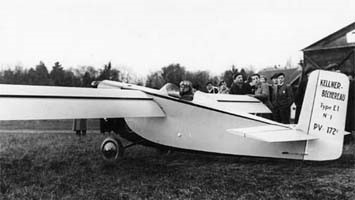
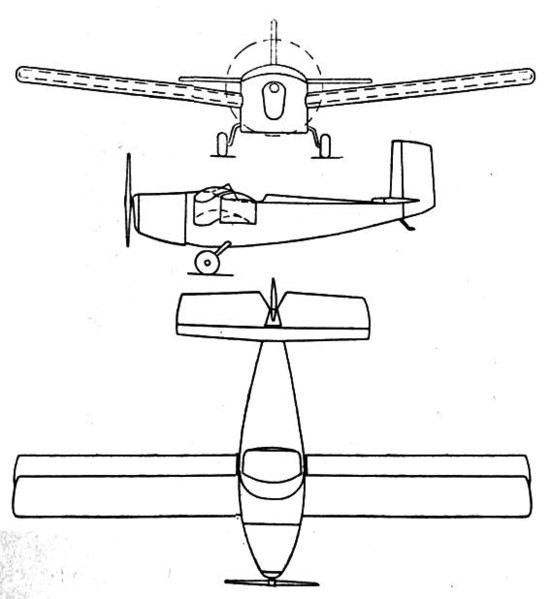
The Kellner-Béchereau EC.4 and Kellner-Béchereau ED.5 were a pair of French training aircraft with side-by-side seating and a novel “double wing” patented by their designer, Louis Béchereau. The principal difference was that the EC.4 had an all-wood structure whereas the ED.5 was all-metal. Both were single-engine, mid-wing cantilever monoplanes.

In 1936–37 Avions Kellner-Béchereau built a short series of small monoplanes exploiting one of Béchereau’s patents, a full span lateral division of the wing into two sections forming a “double wing”, a little like that used by Junkers but with a more equal division of area. The wing was first tested on the single-seat Kellner-Béchereau E.1 on 1936, which was followed by two larger and more powerful two-seaters, the EC.4 and ED.5. Both of these were designed to meet the French Air Ministry’s requirement for a pre-military trainer aircraft to be used by the clubs set up in the “Aviation Populaire” programme.

The ED.5 was similar to the EC.4 except that it was a metal aircraft. The forward part of the wing and the whole fuselage were constructed in a process also patented by Béchereau. It involved the use of wooden formers, shaped to the required skin profile but with cut-outs for strengthening members such as ribs. These were placed into the mould before the duralumin skin was fitted over the former and held down with leather belts. Once secured, the internal pieces and skin could be joined, still in the mould, by screws or rivets. The rear wing surfaces were also metal, though more conventionally built.
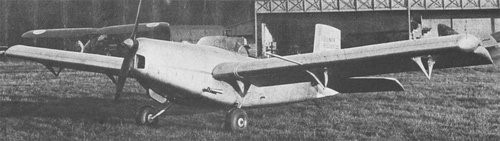
The dimensions of the EC.4 and ED.5 were the same, as were seating, engine and undercarriage. The loaded weight of the metal aircraft was 25 kg (55 lb) lower. Performance was similar, with identical maximum speeds; the lighter ED.5 had a 5 km/h (3 mph) lower stalling speed but a 55 km (35 mi) shorter range.

The ED.5 first flew in 1937.

The Kellner-Béchereau designs were not ordered for the Aviation Populaire programme, the Air Ministry preferring the Caudron C.270 and the Salmson Cri-Cri which were both bought in large numbers. Instead, Kellner-Béchereau, along with other manufacturers, built the Cri-Cri under licence.

ED.5
Engine: 1 × Train 6T, 45 kW (60 hp)
Propeller: 2-bladed
Wingspan: 8.80 m (28 ft 10 in)
Wing area: 8.2 sq.m (88 sq ft)
Length: 5.30 m (17 ft 5 in)
Height: 1.60 m (5 ft 3 in)
Gross weight: 500 kg (1,102 lb)
Maximum speed: 160 km/h (99 mph, 86 kn)
Stall speed: 60 km/h (37 mph, 32 kn)
Range: 790 km (490 mi)
Rate of climb: 2.0 m/s (390 ft/min)
Seats: 2
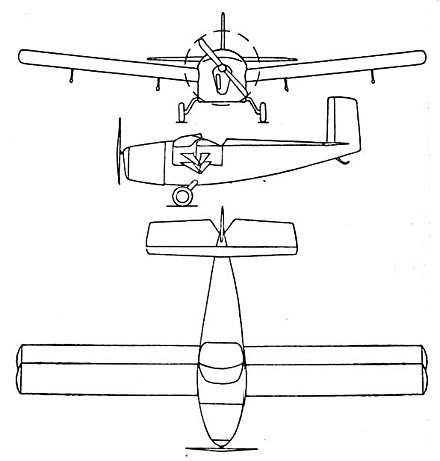
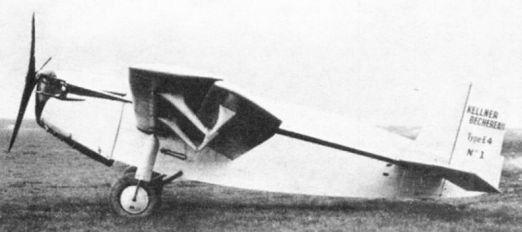
Kellner-Bechereau EC.4

The Kellner-Béchereau EC.4 and Kellner-Béchereau ED.5 were a pair of French training aircraft with side-by-side seating and a novel “double wing” patented by their designer, Louis Béchereau. The principal difference was that the EC.4 had an all-wood structure whereas the ED.5 was all-metal. Both were single-engine, mid-wing cantilever monoplanes.

In 1936–37 Avions Kellner-Béchereau built a short series of small monoplanes exploiting one of Béchereau’s patents, a full span lateral division of the wing into two sections forming a “double wing”, a little like that used by Junkers but with a more equal division of area. The wing was first tested on the single-seat Kellner-Béchereau E.1 on 1936, which was followed by two larger and more powerful two-seaters, the EC.4 and ED.5. Both of these were designed to meet the French Air Ministry’s requirement for a pre-military trainer aircraft to be used by the clubs set up in the “Aviation Populaire” programme.

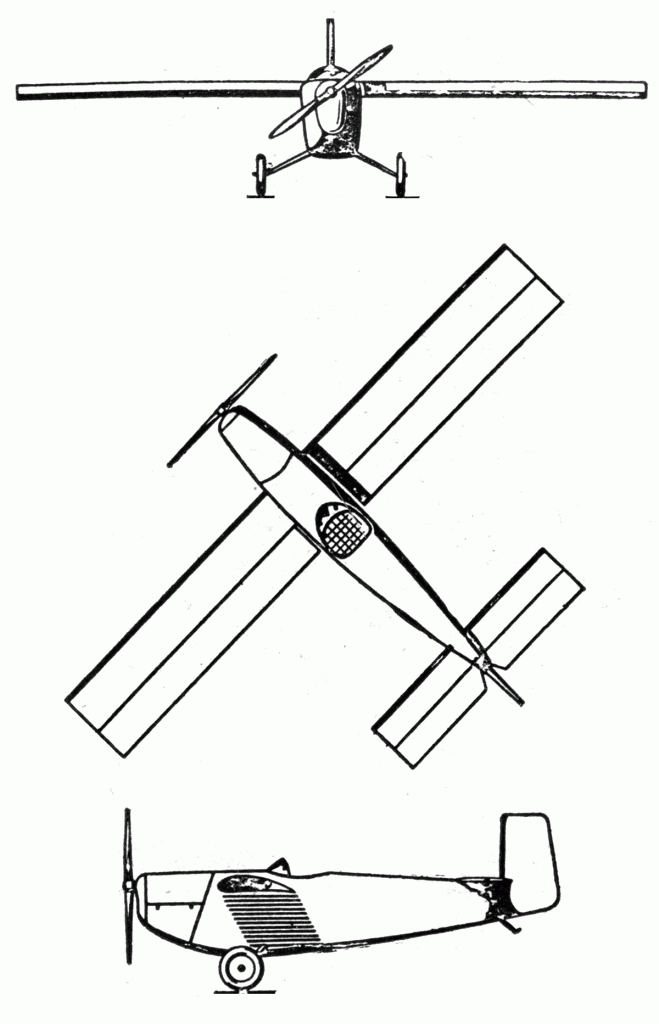
Like the E.1, the EC.4 was a wooden aircraft with spruce frames and plywood covering. It was a mid-wing cantilever monoplane with straight, thick section, constant chord wings of quite high aspect ratio (9.45). The lateral division was at about 65% chord, with the rear part joined to the front with conspicuous V-shaped faired underwing hinges. In normal flight the two parts were close together and the rear sections acted both as lifting surface and, differentially, ailerons but they could also be lowered together as slotted flaps, moving rearwards as well as down to produce a slot between fore and aft parts.

The fuselage was rectangular in cross section, with an open cockpit seating two side-by-side at the wing trailing edge and an inverted in-line 40 kW (60 hp) Train T6 in the nose. A straight edged tailplane was mounted on the upper fuselage longerons and carried elevators with a small cut-out for rudder movement. The latter, mounted on a very narrow fin, was rectangular and extended to the bottom of the fuselage. The rear control surfaces were fabric covered. The EC.4 had a conventional undercarriage with cantilever main legs hinged on the lower longerons, rubber sprung inside the fuselage.

The EC.4 first flew in 1937.

Thee dimensions of the EC.4 and ED.5 were the same, as were seating, engine and undercarriage. The loaded weight of the metal aircraft was 25 kg (55 lb) lower. Performance was similar, with identical maximum speeds; the lighter ED.5 had a 5 km/h (3 mph) lower stalling speed but a 55 km (35 mi) shorter range.

The Kellner-Béchereau designs were not ordered for the Aviation Populaire programme, the Air Ministry preferring the Caudron C.270 and the Salmson Cri-Cri which were both bought in large numbers. Instead, Kellner-Béchereau, along with other manufacturers, built the Cri-Cri under licence.

EC.4
Engine: 1 × Train 6T, 45 kW (60 hp)
Propeller: 2-bladed
Wingspan: 8.80 m (28 ft 10 in)
Wing area: 8.2 sq.m (88 sq ft)
Length: 5.30 m (17 ft 5 in)
Height: 1.60 m (5 ft 3 in)
Gross weight: 525 kg (1,157 lb)
Maximum speed: 160 km/h (99 mph, 86 kn)
Stall speed: 65 km/h (40 mph, 35 kn)
Range: 845 km (525 mi, 456 nmi)
Rate of climb: 2.0 m/s (390 ft/min)
Seats: 2
Kellner-Bechereau 28VD

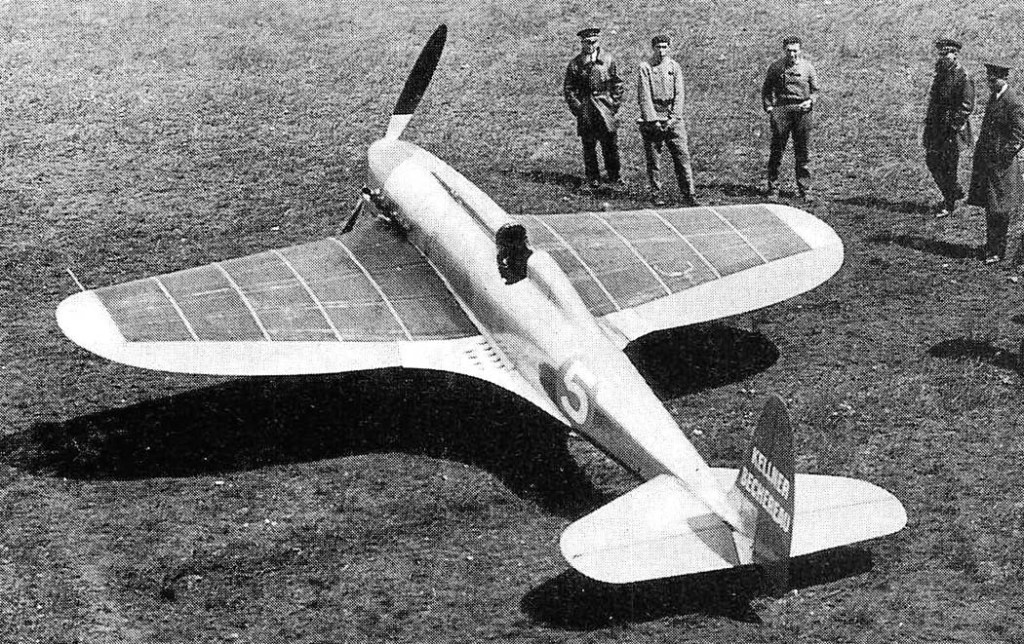
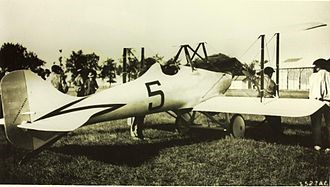
The Kellner-Béchereau 28VD was designed to compete in the 1933 Coupe Deutsch, a race around a 200 km (120 mi) circuit from Etampes in two 1,000 km (620 mi) flights separated by a refuelling stop. Engines of less than 8 l (490 cu in) were stipulated; the 7.95 l (485 cu in) Delage 12C.E.D.irs engine of the 28VD just met this limit.

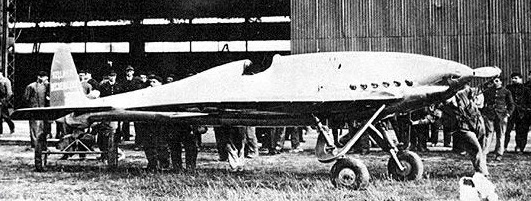
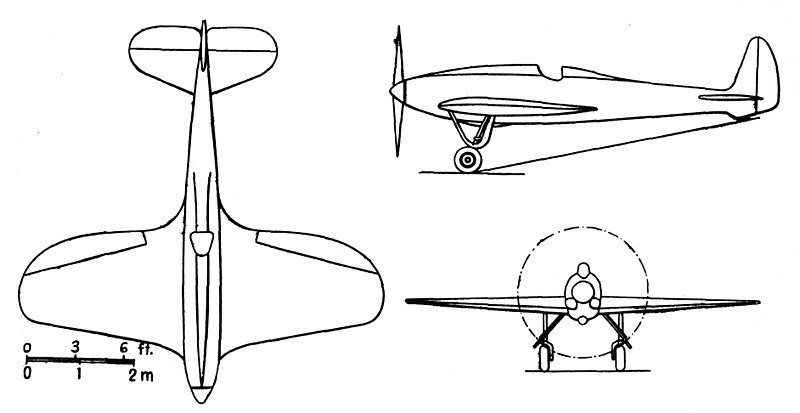
The 28VD was a low wing, cantilever monoplane. Its wing span was small (6.65 m (21 ft 10 in); a wing area large enough to keep the wing loading to values comparable to those of World War II fighter aircraft designed a few years later produced an aspect ratio of only 4.2. In plan the wing was carefully faired into the fuselage and had a swept, straight leading edge, rounded tips and a curved trailing edge entirely occupied by ailerons. There were two spars, one perpendicular to the fuselage at mid-chord and one at an angle bearing the ailerons.

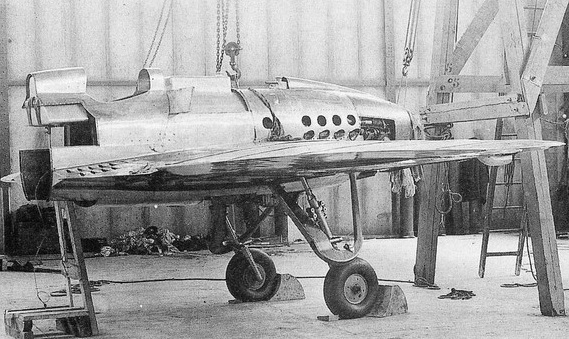
Its fuselage was slender, with a rounded cross-section. The 280 kW (370 hp) water-cooled, double-supercharged, inverted V-12 Delage engine drove a large diameter, two blade propeller. Double reduction gear produced 1,900 rpm at the propeller. Its radiators were in the wing. There were two on each side, one inboard and one outboard, both occupying the full chord and forming the wing skin. An open cockpit was placed a little in front of the trailing edge of the wing, within a narrow dorsal fairing which stretched over half the fuselage, starting close to the nose. The fuselage tapered rearwards to a conventional tail, with a round-tipped triangular tailplane, mounted at mid-fuselage, which had an adjustable angle of incidence. Its vertical tail was tall and slightly rounded and the unbalanced rudder extended down to the keel.

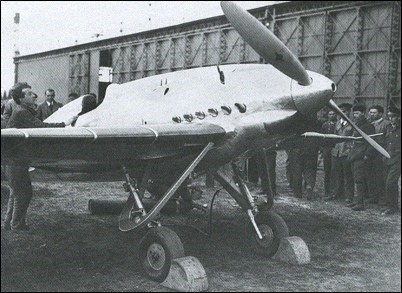
The landing gear of the 28VD had retractable mainwheels, mounted on shock absorbing forward-raked, parallel legs from the wing. These were hinged to the lower fuselage on opened U-shaped frames. Retraction was vacuum-powered; to raise the wheels the tops of the legs were translated outward, swinging frames and wheels upwards. The tailskid was fixed to a small ventral extension of the fuselage under the fin.

The 1933 Coupe Deutsch de la Meurthe was scheduled to start on 28 May and each aircraft had to make a flight at more than 200 km/h (120 mph; 110 kn) over a 100 km (62 mi) course in the period 8–14 May to participate. The 28VD arrived at Etampes on 3 May to be flown by Vernhol; it is not known how much flying it had done before that, though it was only completed a fortnight before the competition. The early days of the test period were occupied with the refinement of the 28VD but on the 12–13 May it was reported to have engine problems. During the early tests it was decided to set a finer propeller pitch as the initial setting was producing to much drag on the engine. When the aircraft attempted its qualifying flight on the last allowed day, the 14 May 1933, this change of setting allowed the engine to overspeed. As a result, a rubber joint in the cooling system failed, releasing a cloud of vapour which temporarily blinded the pilot and forced an emergency landing in which the undercarriage collapsed and the aircraft overturned. Vernhol was thrown clear and was not seriously hurt but the 28VD was too damaged to take part in the contest for which it was built.

Engine: 1 × Delage 12C.E.D.irs, 280 kW (370 hp) at 3,900 rpm.
Propeller: 2-bladed Ratier, 2.5 m (8 ft 2 in) dia approx, adjustable pitch
Wingspan: 6.65 m (21 ft 10 in)
Wing area: 10.6 sq.m (114 sq ft)
Aspect ratio: 4.2
Length: 7.16 m (23 ft 6 in)
Empty weight: 1,002 kg (2,209 lb)
Gross weight: 1,600 kg (3,527 lb)
Wing loading: 150 kg/sq.m (31 lb/sq ft)
Crew: One

Kellner-Bechereau 23

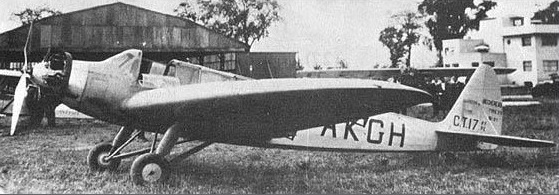
The Kellner-Béchereau 23 was the first aircraft known as a Kellner-Béchereau (the company was founded in 1931), though the only example built (F-AKGH) was originally marked as the Béchereau 23. Only one was completed, built in 1932.

It was a single engine cabin aircraft with an all-metal, three part cantilever wing constructed in a novel way. In place of spars, an approximately oval section, light metal tube, shaped around a wooden form which was then removed, provided both structural strength and formed the outer skin of the forward half of the wing. A more conventional lattice structure was attached to the rear of the tube and supported ailerons. The whole wing was then fabric covered.

In plan, the wing was approximately elliptical. The centre section, occupying about 20% of the span, was built into the fuselage and the outer panels tapered rapidly to pointed tips. The wings also tapered in section; the upper surface was horizontal but the lower sloped upwards, providing about 5° dihedral at the centreline. Their trailing edges were entirely filled with two-part, high aspect ratio ailerons.

Its flat-sided cross-section fuselage was built around four spruce longerons, transversely braced with steel tubes. They supported a light, fabric covered body formed with plywood frames and stringers. The 71 kW (95 hp) Salmson 7AC, a seven-cylinder radial engine, was in a pointed nose with its cylinders exposed for cooling. Its fuel tanks were in the wing centre-section. The tourer’s cabin seated two in tandem under a long, multi-part, fully glazed canopy which ran from the leading edge to mid-chord, then blended without change in height into the upper fuselage. The cabin had two small baggage holds in the centre wing section, each providing 0.1125 m3 (3.97 cu ft) of space.

The empennage of the Kellner-Béchereau 23 was conventional, with a triangular tailplane mounted on the upper fuselage and carrying narrow, rounded elevators was wire braced to the blunted triangular fin which carried a curved and narrow unbalanced rudder. The tourer had a fixed tailwheel undercarriage with independent mainwheels on hinged V-struts from the fuselage underside and near-vertical sprung legs, with Béchereau shock absorbers, from the wings. The mainwheels, with a track of 2.80 m (9 ft 2 in), were equipped with independent brakes. At the rear the sprung tailwheel was free to castor.

The date of the Kellner-Béchereau 23’s first flight is not known but by early September 1932 it was sufficiently developed to begin its official tests with the S.T. Aé at Villacoublay, flown by Seitz. These were resumed in December. In September 1933 it was one of the eleven aircraft in the third annual, eight day Tour de France des avions prototypes.

Engine: 1 × Salmson 7AC, 71 kW (95 hp)
Propeller: 2-blade Levasseur, 2.16 m (7 ft 1 in) diameter metal
Wingspan: 14.0 m (45 ft 11 in)
Wing area: 23.10 m2 (248.6 sq ft)
Length: 8.74 m (28 ft 8 in)
Height: 2.164 m (7 ft 1 in)
Empty weight: 565 kg (1,246 lb)
Gross weight: 860 kg (1,896 lb)
Fuel capacity: 80 kg (180 lb)
Maximum speed: 164 km/h (102 mph, 89 kn)
Cruise speed: 123 km/h (76 mph, 66 kn)
Range: 300 km (190 mi, 160 nmi)
Service ceiling: 7,950 m (26,080 ft)
Time to altitude: 45 min to 6,555 m (21,506 ft)
Take-off distance: 145 m (476 ft)
Landing distance: 140 m (460 ft)
Crew: One
Capacity: One passenger

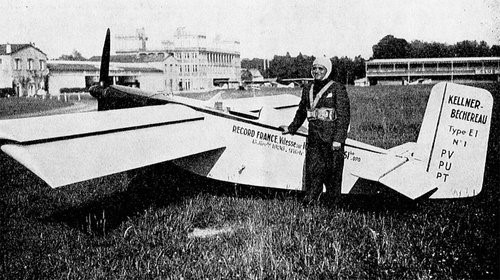
Kellner-Bechereau E.1

In the 1930s, Louis Béchereau set up Avions Kellner-Béchereau, a collaboration with the well known automobile coach builders Kellner. In 1936-7 they built a short series of small monoplanes exploiting one of Béchereau’s patents, a full span lateral division of the wing into two sections forming a “double wing” a little like that used by Junkers but with a more equal division of area. The Kellner-Béchereau E.1 was the first of these.

The Kellner-Béchereau E.1 was an experimental single engine, single seat light aircraft. It was a monoplane with a novel “double” wing, the rear part providing lift and lateral control as well as acting as slotted flaps.

The E.1 was a wooden aircraft with spruce frames and plywood covering. It was a mid-wing cantilever monoplane with straight, thick section, constant chord wings of quite high aspect ratio (8.45). The lateral division was at about 65% chord, with the rear part joined to the front with conspicuous V-shaped faired underwing hinges. In normal flight the two parts were close together and the rear sections acted both as lifting surface and, differentially, ailerons but they could also be lowered together as slotted flaps, moving rearwards as well as down to produce a slot between fore and aft parts. The fuselage was rectangular in cross section, with a single place open cockpit at the wing trailing edge, baggage space behind and an inverted in-line 30 kW (40 hp) Train 4T in the nose. A straight edged tailplane was mounted on the upper fuselage longerons and carried elevators with a small cut-out for rudder movement. The latter, mounted on a very narrow fin, was rectangular and extended to the bottom of the fuselage. The rear control surfaces were fabric covered. The E.1 had a conventional undercarriage with cantilever main legs hinged on the lower longerons, rubber sprung inside the fuselage.

The aircraft first flew in November 1934 and after flight tests in 1936, the E.1 was developed into a pair of larger and more powerful side by side seat basic trainers, the wooden Kellner-Béchereau EC.4 and the metal Kellner-Béchereau ED.5, flown in 1937.

Engine: 1 × Train 4T, 30 kW (40 hp)
Propeller: 2-bladed
Wingspan: 6.50 m (21 ft 4 in)
Wing area: 5.0 sq.m (54 sq ft)
Length: 4.42 m (14 ft 6 in)
Height: 1.98 m (6 ft 6 in)
Empty weight: 172 kg (379 lb)
Gross weight: 276 kg (608 lb)
Maximum speed: 160 km/h (99 mph, 86 kn)
Cruising speed: 145 km / h
Stall speed: 58 km/h (36 mph, 31 kn)
Endurance: 3 hr
Practical range: 500 km
Rate of climb: 2.0 m/s (390 ft/min)
Service ceiling: 6,000 m (20,000 ft)
Seats: 1

Kelly Hatz CB-1

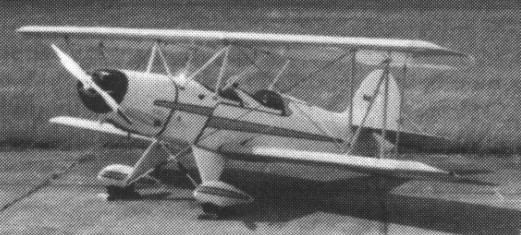
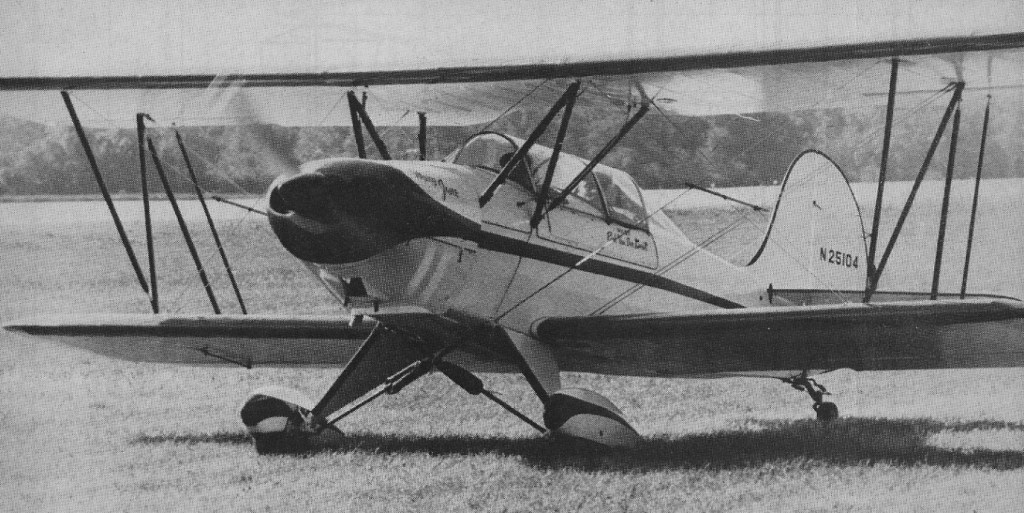
Began as a parasol monoplane, N8670E, the first flight of this tandem-seater, open-cockpit biplane took place in 1968.

The wings are a fabric-covered spruce spars with truss rib structure, while the fuselage and tail are built from welded steel tubing. Bungee shocks for the gear; 6 x 6 wheels with brakes; dual controls; space for overnight bag on shelf in front cockpit; fuel capacity 33 gallons in two tanks, or 20 gallons in one tank (center section).

The design weight of the Hatz (850 pounds) makes it perform well with the 85-hp Continental and it is stressed to take engines up to 150 hp. The Hatz can be trimmed to fly hands-off (more or less), which helps out when trying to read a map in an open cockpit. Control response is slow enough to give a feeling of a much larger aircraft, and it is capable of all aerobatic maneuvers in the power range.

The Hatz CB-1 Biplane is a two place with a 90 mph cruise.

A straight-forward design with simple details and a minimum of time consuming jig work is the result of many hours of planning and testing.

First produced by John D Hatz, Schofield and Merril WI, USA, and circa 1980, Dudley R Kelly of Versailles KY., USA, plans were marketed to home-builders at $125 and kits were available from commercial sources.

Wingspan 25’4”
Height: 7.83 ft
Length 19’
Wing area: 178 sq.ft
Range: 200 sm
Height: 7.8 ft
Seats: 2
Landing gear: tail wheel

CB-1
Engine: Continental O-200, 100 hp.
HP range: 85-150.
Span: 25 ft 4 in
Length: 19 ft
Height: 7 ft 10 in
Chord: 50″ Clark Y Airfoil
Area: 178 sq. ft
Weight empty: 850 lbs.
Gross: 1400 lbs.
Fuel cap: 18 USG.
Useful load: 550 lb
Speed max: 105 mph.
Cruise: 80 mph.
Range: 200 sm (20 min res)
Stall: 55 mph.
ROC: 750 fpm.
Take-off dist: 400 ft.
Landing dist: 600 ft.
Wing loading: 7.8 lbs per sq. ft.
Allowable G forces: +5 / -3
Landing speed: 40 to 45 mph

Classic
Engine: Lycoming O-320, 160 hp.
HP range: 100-160.
Speed max: 150 mph.
Cruise: 105 mph.
Stall: 42 mph.
ROC: 1000 fpm.
Take-off dist: 600 ft.
Landing dist: 600 ft.
Service ceiling: 10,000 ft.
Fuel cap: 25 USG.
Weight empty: 1000 lbs.
Gross: 1600 lbs.
Range: 350 nm
Length: 19.1 ft
Wingspan: 25 ft
Wing area: 180 sq.ft
Seats: 2

Kelly Kelly-D

Designed by Dudley R. Kelly, the Kelly was was available as plans only. The wings are detachable.

Engine: Lycoming O-235, 115 hp.
Height: 7.8 ft.
Length: 19.2 ft.
Wing span: 26.3 ft.
Wing area: 230 sq.ft.
Speed max: 105 mph.
Cruise: 90 mph.
Range: 270 sm.
Stall: 55 mph.
ROC: 800 fpm.
Take-off dist: 400 ft.
Landing dist: 600 ft.
HP range: 100-125.
Fuel cap: 24 USG.
Weight empty: 950 lbs.
Gross: 1500 lbs.
Seats: 2.
Landing gear: tail wheel.

Kelly F1D

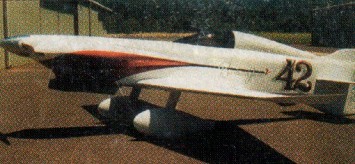
Designed and built as a formula 1 racer, the debut was at the 1995 Reno Races.

Top speed: 300 mph
Cruise: 205 mph
Stall: 60 mph
Range: 400 sm
Rate of climb: 2000 fpm
Takeoff dist: 600 ft
Landing dist: 1200 ft
Engine: Continental O-200A, 100 hp
HP range: 85-125
Fuel capacity: 13 USG
Empty weight: 500 lb
Gross weight: 800 lb
Height: 4 ft
Length: 17 ft
Wing span: 19.3 ft
Wing area: 67.5 sq.ft
Seats: 1
Landing gear: tailwheel

Kellett KH-17A

Experimental conversion of a standard Kellett KD-IB Autgiro into a convertiplane, for the U.S. Navy. Chief external changes are addition of wings and two wing-mounied engines. Was due to fly in 1955.

Engine: 1 x 275 hp Jacobs and 2 x 140 hp Lycoming
Rotor diameter: 40 ft
Rotors: 3-blade main; 3 propellers
Length (blades folded): 25 ft 11 in
Loaded weight: 3,400 lb
Seats: 1.