A number of the Keystone aircraft became one off flying testbeds for various newly developed geared or direct drive versions of the Hornet and Cyclone engines. This programme gave rise to the new designations LB 8, LB 9, LB 10, LB 11, LB 11A and LB-12. Most of these were conversions from existing LB 6 or LB 7 bombers.
Piston
Keystone LB-10 / B-3 / B-5

A number of the Keystone aircraft became one off flying testbeds for various newly developed geared or direct drive versions of the Hornet and Cyclone engines. This pro¬gramme gave rise to the new designations LB 8, LB 9, LB 10, LB 11, LB 11A and LB¬-12. Most of these were conversions from existing LB 6 or LB 7 bombers.
The major production model which follow¬ed was the single tailed LB 10A, powered originally by 525 hp R 1690 3 Hornets, of which 63 were built. These were delivered under the new designation B 3A, the USAAC having adopted a single ‘B’ category for all types of bomber in 1930. Later, 27 of them were refitted with R 1750 3 Cyclones in place of the Hornets and were redesignated B 5A.
LB 10A
Engine: 525 hp R 1690 3 Hornet
Span: 22.78 m (74 ft 9 in)
Length: 14.88 m (48 ft 10 in)
Gross weight: 5875 kg (12 952 1 b)
Maximum speed: 183 km/h (114 mph).
Keystone LB-9
A number of the Keystone aircraft became one off flying testbeds for various newly developed geared or direct drive versions of the Hornet and Cyclone engines. This programme gave rise to the new designations LB 8, LB 9, LB 10, LB 11, LB 11A and LB-12. Most of these were conversions from existing LB 6 or LB 7 bombers.
Keystone LB-8
A number of the Keystone aircraft became one off flying testbeds for various newly developed geared or direct drive versions of the Hornet and Cyclone engines. This programme gave rise to the new designations LB 8, LB 9, LB 10, LB 11, LB 11A and LB-12. Most of these were conversions from existing LB 6 or LB 7 bombers.
Keystone LB-6 / LB-7
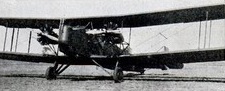
The Keystone LB series had been characterized by tapered wings, but the XLB 6 of 1927 (converted from the tenth LB 5) introduced constant chord wings with new powerplant (two 525 hp Wright R 1750 1 Cyclone radials) mounted between the wings, and a lengthened fuselage. Thus modified, this became the standard configuration for the remaining Keystone LB types, beginning with 17 production LB 6s and continuing with 18 LB 7s, which were identical except for their 525 hp Pratt & Whitney R 1690 3 Hornet engines.
Keystone LB-5
Prior to the com¬pany reorganization, Huff Daland had com¬pleted a prototype XLB 5, with triple rudders and two 420 hp Liberty engines mounted on the lower wings, and this was adopted as the initial production configuration. Ten similar LB 5s were delivered in 1927 28, followed by 25 twin tailed Keystone LB 5As delivered in 1928.
Standard armament consisted of five 0.30 in (7.62 mm) machine guns and the maximum bombload was 910 kg (2000 lb).
LB 5A
Span: 20.42 m (67 ft)
Length: 13.61 m (44 ft 8 in)
Gross weight: 5526 kg (12184 1b)
Maximum speed: 172 km/h (107 mph).
Keystone LB-1 / LB-3
The XLB-1 three-seat, single-engine light bomber was tested in 1923.
The single engined configuration, mounting an 800 hp Packard, proved unsuitable and the basic LB 1 airframe was redesigned by Keystone in 1927 as the twin engined XLB-3A, with two 410 hp Pratt & Whitney R 1340-1 Wasp nine cylinder radials mounted midway between the equal span wings. The complement was increased from three to five (pilot, copilot, bombardier, and front and rear gunners) and the bombardier was located more conventionally in the nose, instead of amidships as in the LB 1.
In 1924 Huff-Daland was reorganized as Keystone Aircraft Corporation and the production bomber aircraft was known by this latter company name.
Keystone XB-1 / Huff‑Daland XB‑1
Huff Daland’s XB 1 bomber design of 1926 was cancelled and reordered as the Keystone XB 1B, a five seat biplane with two 600 hp Curtiss V 1570 5 Conqueror engines. It never progressed beyond prototype stage.
Keuthan Zephyr / Arnet Pereyra Zephyr II
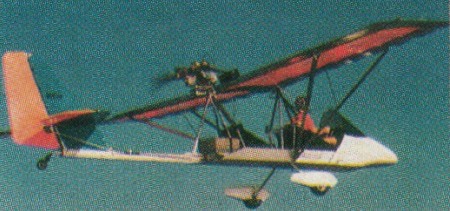
Detachable wings.
Zephyr II
Speed max: 90 mph.
Cruise: 73 mph.
Range: 200 sm.
Stall: 33 mph.
ROC: 1100 fpm.
Take-off dist: 125 ft.
Landing dist: 100 ft.
Service ceiling: 14,000 ft.
Engine: Rotax 582 DCDI, 65 hp.
HP range: 52-74.
Fuel cap: 12 USG.
Weight empty: 480 lbs.
Gross: 1100 lbs.
Height: 7 ft.
Length: 22.5 ft.
Wing span: 29.67 ft.
Wing area: 156 sq.ft.
Seats: 2.
Landing gear: tail wheel.
Keuthan Sabre / Arnet Pereyra Sabre II
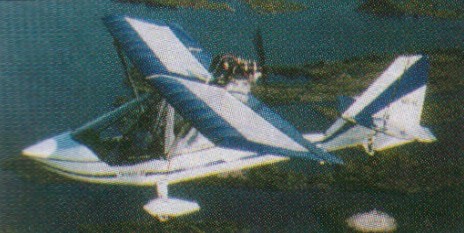
The Sabre II was first flown in July 1992. Detachable wings.
Sabre I
Speed max: 82 mph.
Cruise: 65 mph.
Range: 200 sm.
Stall: 29 mph.
ROC: 1100 fpm.
Take-off dist: 125 ft.
Landing dist: 175 ft.
Service ceiling: 14,000 ft.
Engine: Rotax 503 DCDI, 52 hp.
HP range: 40-50.
Fuel cap: 10 USG.
Weight empty: 350 lbs.
Gross: 740 lbs.
Height: 6.25 ft.
Length: 20.1 ft.
Wing span: 29.67 ft.
Wing area: 143 sq.ft.
Seats: 1.
Landing gear: nose or tail wheel.
Sabre II
Speed max: 90 mph.
Cruise: 75 mph.
Range: 220 sm.
Stall: 28 mph.
ROC: 1000 fpm.
Take-off dist: 150 ft.
Landing dist: 175 ft.
Service ceiling: 14,000 ft.
Engine: Rotax 582 DCDI, 65 hp.
HP range: 50-80.
Fuel cap: 10 USG.
Weight empty: 480 lbs.
Gross: 1100 lbs.
Height: 7 ft.
Length: 22.33 ft.
Wing span: 29.67 ft.
Wing area: 156 sq.ft.
Seats: 2.
Landing gear: tail wheel.

