KFM 112M

The KFM 112M is a four-cylinder, four-stroke, dual ignition, horizontally opposed aircraft engine designed for ultralight aircraft and motor gliders. The engine was designed and produced by the KFM (Komet Flight Motor) Aircraft Motors Division of Italian American Motor Engineering of Italy as a follow-on engine to their KFM 107 series and has been out of production since 1990.

The KFM 112 is a conventional four-cylinder engine that is very compact and lightweight at only 54 kg (119 lb), including the starter, alternator and carburetor. The engine features dual electronic ignition, a single OVC carburetor, hydraulic valve lifters, nickel-silicon treated cylinders and bi-metallic valves with chromed stems. It was offered without a reduction system. Starting is electric starter only.

The engine produces 62 hp (46 kW) at 3400 rpm for three minutes for take-off, 60 hp (45 kW) at 3200 rpm for five minutes and 54 hp (40 kW) at 3090 rpm continuous.

Applications:
Partenavia P.86 Mosquito

Specifications:

112M
Type: Four-cylinder, horizontally opposed, four-stroke aircraft engine
Bore: 90 mm (3.54 in)
Stroke: 64 mm (2.52 in)
Displacement: 1628.60 cc (99.38 cu in)
Length: 583 mm (22.95 in)
Width: 603 mm (23.74 in)
Height: 380 mm (14.96 in)
Dry weight: 54 kg (119 lb)
Fuel type: premium auto fuel or avgas
Oil system: pressurized
Cooling system: air-cooled
Reduction gear: none
Power output: 62 hp (46 kW) at 3400 rpm for three minutes for take-off, 60 hp (45 kW) at 3200 rpm for five minutes and 54 hp (40 kW) at 3090 rpm continuous
Compression ratio: 9.5:1
Fuel consumption: 16.3 l/hr (4.3 US gal/hr) at full power, 11.2 l/hr (2.97 US gal/hr) at 70% power.
Specific fuel consumption: 212 g/Hph (0.46 lb/Hph) at 90% power, 185 g/Hph (0.42 lb/Hph) at 70% power
Power-to-weight ratio: 0.90 kg/hp (1.98 lb/hp)
KFM 107

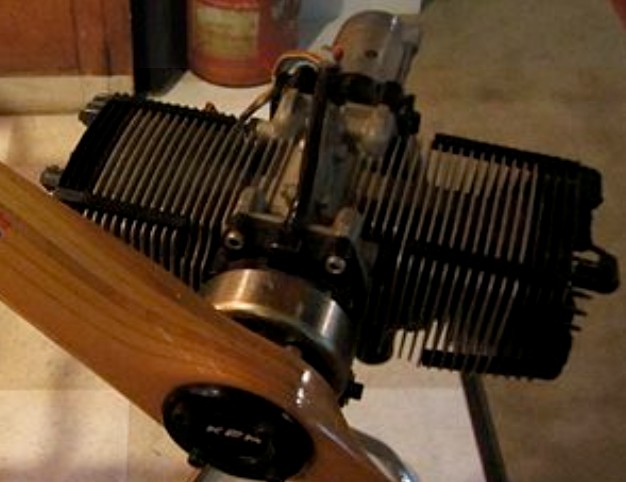
The KFM 107 is a two-cylinder, two-stroke, single ignition, horizontally opposed aircraft engine designed for ultralight aircraft and motor gliders.

KFM 107 Article

The KFM 107 is a conventional twin-cylinder engine that is very compact and light weight at only 15.2 kg (34 lb) in its 107s version. The engine features single capacitor discharge ignition, a single Tillotson butterfly-type carburetor, integral fuel pump, tuned exhaust system and reed valve induction. It was offered with 2:1 belt drive reduction system. Starting is electric starter or recoil starter.

Most versions of the 107 produce 25 hp (19 kW) at 6300 rpm for five minutes for take-off and 22.5 hp (17 kW) at 6080 rpm continuous.

The engine was designed and produced by the KFM (Komet Flight Motor) Aircraft Motors Division of Italian American Motor Engineering of Italy and has been out of production since 1986.

Variants:

107s
“Standard” version, direct drive, recoil start, 25 hp (19 kW), weight 15.2 kg (34 lb)

107e
“Electric” version, direct drive, electric start and alternator 25 hp (19 kW), weight 19.1 kg (42 lb)

107rs
“Standard with Reduction” version, reduction drive, 25 hp (19 kW), weight 17.5 kg (39 lb)

107er
“Electric & Reduction” version, direct drive, 25 hp (19 kW), weight 21.4 kg (47 lb)

107e Maxi
Upgraded version with an OVC carbutaror with fixed jets, 64 mm (2.52 in) stroke, 334 cc (20.38 cu in), 11:1 compression ratio, 2.1:1 or optional 2.55:1 reduction drive. Produces 30 hp (22 kW) at 6300 rpm for five minutes for take-off and 27 hp (20 kW) at 6080 rpm continuous.

Applications:
Alpha Marco J-5
Danieli Piuma
Diehl AeroNautical XTC Hydrolight
Latécoére 225
Monnett Monerai P
Monnett Moni
Phase 3 Eclipse
Rutan Solitaire
Sadler Vampire

Specifications:

107s
Type: Twin-cylinder, horizontally opposed, two-stroke aircraft engine
Bore: 60 mm (2.36 in)
Stroke: 52 mm (2.05 in)
Displacement: 294 cc (17.94 cu in)
Length: 432 mm (17.01 in)
Width: 440 mm (17.32 in)
Height: 353 mm (13.90 in)
Dry weight: 15.2 kg (34 lb)
Valvetrain: reed valve induction
Oil system: premixed 4% oil and fuel
Cooling system: air cooled
Reduction gear: none on the “s” model
Power output: 25 hp (19 kW) at 6300 rpm for five minutes for take-off, 22.5 hp (17 kW) at 6080 rpm continuous
Compression ratio: 10.5:1

Keystone K-55 Pronto

The Keystone K-55 Pronto was a mail plane developed in the United States in the late 1920s. It was a conventional single-bay, unequal-span biplane design with slightly staggered wings. The pilot sat in an open cockpit, in tandem with a forward cockpit that could carry two passengers side-by-side. The fixed, tailskid undercarriage had divided main units.

Pronto was the first aircraft Keystone made for the civil market. However, like many aircraft manufacturers of the late 1920s – early 1930s, this attempt was not successful. A number of these aircraft were purchased by the government of Peru. Operated by the aviation arm of the Peruvian Navy, these aircraft initiated the first airmail service into the Peruvian Amazon. The first flight of this service was made by two Prontos, piloted by Leonardo Alvariño Herr and Harold B. Grow from Lima to San Ramón on 26 October 1927.

At least one Peruvian Pronto was fitted with pontoons and used to survey the Amazon River for locations suitable for seaplane operations.

In the Colombia-Peru War one Peruvian K-55 flow by Lieutenant Suero was captured by the Colombian Army.

Engine: 1 × Wright J-5, 220 hp (160 kW)
Wingspan: 39 ft 11 in (12.17 m)
Length: 26 ft 9 in (8.15 m)
Empty weight: 594 kg
Maximum take-off weight: 1100 kg
Maximum speed: 112 mph (180 km/h)
Cruising speed: 160 km / h
Range: 500 miles (800 km)
Crew: One pilot
Capacity: 2 passengers

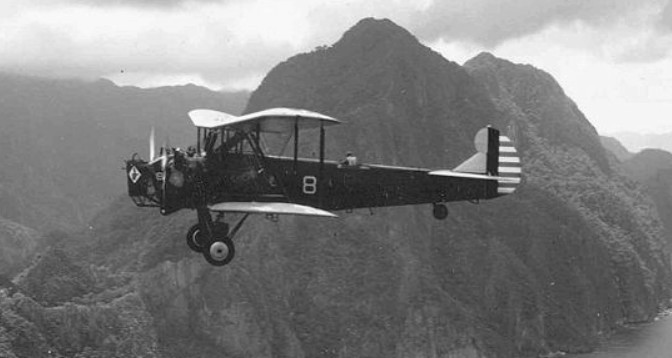
Keystone LB-13 / Y1B-4 / B-4 / B-6

Keystone Y1B-4 (S/N 30-281)

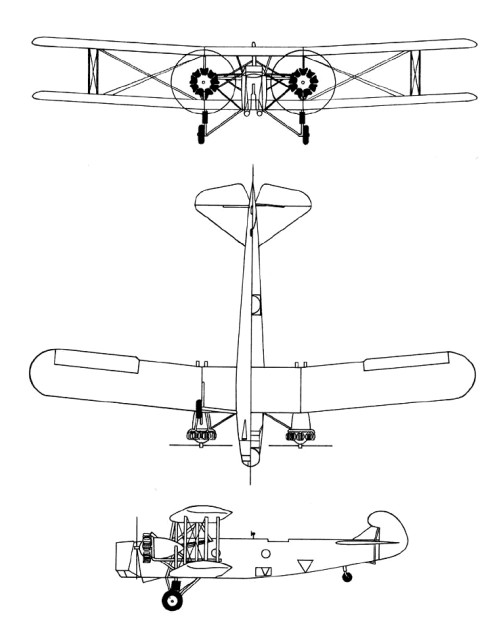
Developed from the Keystone B-3, the Keystone B-4 was a biplane bomber produced for the United States Army Air Corps in 1930. Originally seven were ordered by the United States Army Air Corps as the LB-13 light bomber. They were to be equipped with single vertical tails and were to be powered by a pair of 525 hp Pratt & Whitney GR-1690 radials. Serials were 30-344/353. When the LB- designation was dropped in 1930, the first five planes were redesignated Y1B-4. (The Y1B- designation indicates that funds for the design did not come from the normal annual funds.) Of seven LB-13s ordered, five were completed as Y1B-4s with 575 hp R-1860-7 engines (30-344/348). The Y1B-4 had a slightly better performance than the B-3A because of the more powerful engines, but was otherwise almost exactly the same.

The first B-3A (S/N 30-281) was converted to Y1B-4 configuration with the addition of R-1860-7 radial engines and low pressure tires. Because of more powerful engines, the performance of the Y1B-4 was a slight improvement on the B-3, but the only difference between the two planes was their engines.

On April 28, 1931, the army ordered 25 improved Y1B-4s as the Keystone B-4A. Serials were 32-117/141. This production version was part of the last biplane bomber order made by the Army Air Corps (along with 39 B-6As, identical in all respects except their make of engine), and the B-4As, delivered between January and April 1932, were the last biplane bombers delivered to the Air Corps.

Like the B-3A, the B-4A carried five crew members; two pilots, a bombardier, and a front and rear gunner. The B-4A was externally almost identical to the B-3A which preceded it (as well as to the B-5 and B-6 which followed it).

B-4 was the last of the Keystone biplane bombers ordered by the U.S. Army in late 1931. These aircraft were used primarily as observation and reconnaissance aircraft as early as 1934 when the Martin B-10B went into operational service. Some remained in service into the early 1940s.

In 1932, Keystone produced 25 B 4As (575 hp R 1860 7 Hornets) and 39 B 6As (575 hp R 1820 1 Cyclones). Like the B 3A, these also had single tails; their armament was reduced to three 0.30 in (7.62 mm) guns, and bombload increased to 1130 kg (2500 lb).

Gallery

Variants:

LB-13
Seven aircraft ordered but delivered as the Y1B-4 and Y1B-6 with different engine installations.

Y1B-4
Five pre-production aircraft, as the LB-10 but with two 575 hp (429 kW) Pratt & Whitney R-1860-7 engines.

B-4A
Production version of the Y1B-4, 25 built.

Serials:
Keystone Y1B-4
30-344/348

Keystone B-4A
32-117/141

Specifications:

B-4A
Engines: 2 × Pratt & Whitney R-1860-7, 575 hp (429 kW)
Wingspan: 74 ft 8 in (22.8 m)
Wing area: 1,145 sq.ft (106.4 sq.m)
Length: 48 ft 10 in (14.9 m)
Height: 15 ft 9 in (4.8 m)
Empty weight: 7,951 lb (3,607 kg)
Loaded weight: 12,952 lb (5,875 kg)
Wing loading: 11.31 lb/sq.ft (55.22 kg/sq.m)
Power/mass: 0.0888 hp/lb (146 W/kg)
Maximum speed: 130 mph (110 kn, 210 km/h)
Cruise speed: 103 mph (90 kn, 167 km/h)
Range: 850 mi (760 nmi, 1,400 km)
Service ceiling: 14,000 ft (4,300 m)
Rate of climb: 580 ft/min (30 m/s)
Crew: 5
Armament: 3 × .30 in (7.62 mm) Browning machine guns
Bombload: 2,500 lb (1,100 kg); 4,000 lb (1,800 kg) on short runs

B 6A
Span: 22.78 m (74 ft 9 in)
Length: 14.88 m (48 ft 10 in)
Gross weight: 6048 kg (13334 1b)
Maximum speed: 195 km/h (121 mph).

Keystone LB-12

A number of the Keystone aircraft became one off flying testbeds for various newly developed geared or direct drive versions of the Hornet and Cyclone engines. This programme gave rise to the new designations LB 8, LB 9, LB 10, LB 11, LB 11A and LB-12. Most of these were conversions from existing LB 6 or LB 7 bombers.