Lambert Aircraft modified a Corben Ace as the D Box Full. A single-place, open cockpit, high wing monoplane floatplane, power was an 85hp Continental.
Piston
Lam Wanderer
A two place low wing cabin monoplane, with retractable undercarriage, powered by a Lycoming O-235, and registered N186LM.
Lake Macquarie Sparrow II

A US designed two seat aircraft built in Australia by Lake Macquarie Aviation. The aircraft, powered by either a Rotax 532, 582 two stroke or 912 four stroke (79hp). Specifications include a useful load of 225 kg, a gross weight of 429 kg, a cruise of 90 knots, a 1000 fpm ROC and a take off distance a 100 ft.
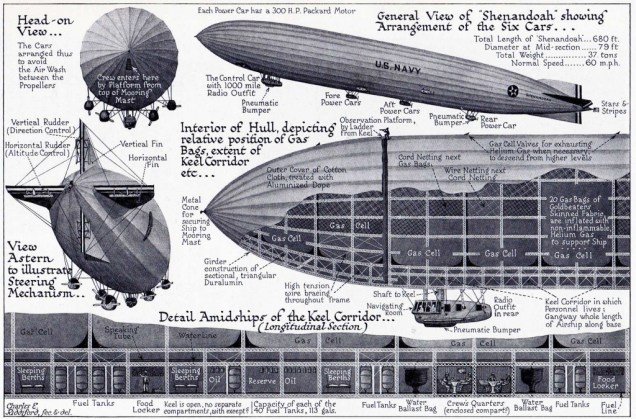
Lakehurst Naval Air Station Shenandoah / ZR-1 / Goodyear Type ZR / ‘LZ’ Class
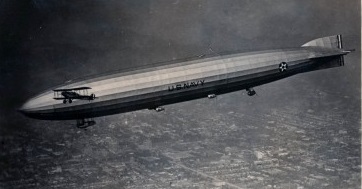
USS Shenandoah was the first of four United States Navy rigid airships. The design was based on Zeppelin bomber L-49 (LZ-96), built in 1917 which had been forced down intact in France in October, 1917 and carefully studied. L-49 was a lightened Type U “height climber”, designed for altitude at the expense of other qualities.
The L-49 was one of the “height climbers” designed by the Germans late in World War I, when improvements in Allied fighter aircraft and anti-aircraft artillery made it necessary for Zeppelins to climb to great altitudes to avoid being shot down. For the Zepeplins to rise to greater heights on a fixed volume of lifting gas, however, the weight and strength of their structures were dramatically reduced. This decrease in strength was accepted as a wartime necessity, since a structurally weaker Zeppelin flying above the reach of enemy aircraft and artillery was safer than a stronger Zeppelin that could be easily attacked.
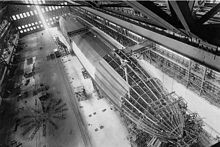
The design was found insufficient and a number of the features of newer Zeppelins were used, as well as some structural improvements. The structure was built from a new alloy of aluminum and copper known as duralumin. Girders were fabricated at the Naval Aircraft Factory. Whether the changes introduced into the original design of L-49 played a part in Shenandoah’s later breakup is a matter of debate. An outer cover of high-quality cotton cloth was sewn, laced or taped to the duralumin frame and painted with aluminum dope.
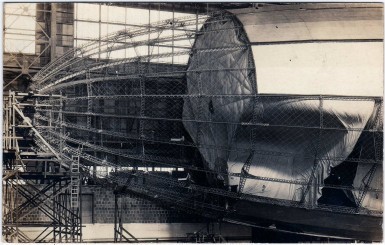
The gas cells were made of goldbeater’s skins, one of the most gas-impervious materials known at the time. Named for their use in beating and separating gold leaf, goldbeater’s skins were made from the outer membrane of the large intestines of cattle. The membranes were washed and scraped to remove fat and dirt, and then placed in a solution of water and glycerine in preparation for application to the rubberized cotton fabric providing the strength of the gas cells. The membranes were wrung out by hand to remove the water-glycerine storage solution and then rubber-cemented to the cotton fabric and finally given a light coat of varnish. The 20 gas cells within the airframe were filled to about 85% of capacity at normal barometric pressure. Each gas cell had a spring-loaded relief valve and manual valves operated from the control car.
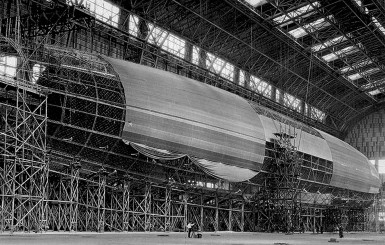
Shenandoah was originally designated FA-1, for “Fleet Airship Number One” but this was changed to ZR-1. The airship was 680 ft (207.26 m) long and weighed 36 tons (32658 kg). It had a range of 5,000 mi (4,300 nmi; 8,000 km), and could reach speeds of 70 mph (61 kn; 110 km/h). Shenandoah was assembled at Naval Air Station Lakehurst, New Jersey in 1922–1923, in Hangar No. 1, the only hangar large enough to accommodate the ship; its parts were fabricated at the Naval Aircraft Factory in Philadelphia. NAS Lakehurst had served as a base for Navy blimps for some time, but Shenandoah was the first rigid airship to join the fleet.
Like all previous zeppelins, ZR-1 had been designed on the assumption that the ship would be operated with hydrogen, but the fiery crash of the U.S. Army airship Roma in 1922 convinced the U.S. government to operate future airship’s with helium, despite the high cost and very limited supply of the gas.
As the first rigid airship to use helium rather than hydrogen, Shenandoah had a significant edge in safety over previous airships. Helium was relatively scarce at the time, and the Shenandoah used much of the world’s reserves just to fill its 2,100,000 cubic feet (59,000 cu.m) volume. Los Angeles—the next rigid airship to enter Navy service, originally built by Luftschiffbau Zeppelin in Germany as LZ 126—was at first filled with the helium from Shenandoah until more could be procured.
Shenandoah was powered by 300 hp (220 kW), eight-cylinder Packard gasoline engines. Six engines were originally installed, but in 1924 one engine (aft of the control car) was removed. The first frame of Shenandoah was erected by 24 June 1922; on 20 August 1923, the completed airship was floated free of the ground. Helium cost $55 per thousand cubic feet at the time, and was considered too expensive to simply vent to the atmosphere to compensate for the weight of fuel consumed by the gasoline engines. Neutral buoyancy was preserved by installing condensers to capture the water vapor in the engine exhaust. The need to preserve helium had many operational implications, including the timing of flights to coordinate with changes in ambient temperature.
The Navy also had to learn how to use helium to operate a large rigid airship, which had never previously been attempted. The need to conserve the expensive and scarce lifting gas required flight operations which differed considerably from the techniques which had been developed for operating airships inflated with easily-replaced hydrogen. For example, while the Germans typically began a zeppelin flight with gas cells inflated to 100% capacity, and then valved hydrogen (either manually or automatically) as the ship rose, the Americans — unable to afford the loss of precious helium — had to operate with lower inflation levels, and therefore less lift, and had to be more careful about valving gas to descend or to maintain aerostatic equilibrium.
Shenandoah first flew on 4 September 1923. ZR-1 made a series of test and demonstration flights in September and early October, 1923 — including an appearance at the National Air Races in St. Louis and flights over New York and Washington.
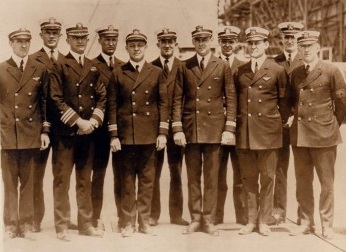
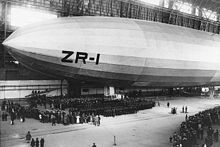
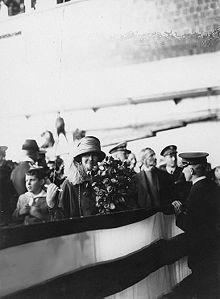
It was christened on 10 October 1923 by Mrs. Edwin Denby, wife of the Secretary of the Navy, and commissioned on the same day with Commander Frank R. McCrary in command. Mrs. Denby named the airship after her home in the Shenandoah Valley of Virginia, and the word shenandoah was then believed to be a Native American word meaning “daughter of stars”.
Shenandoah was designed for fleet reconnaissance work of the type carried out by German naval airships in World War I. Her precommissioning trials included long-range flights during September and early October 1923, to test her airworthiness in rain, fog and poor visibility. On 27 October, Shenandoah celebrated Navy Day with a flight down the Shenandoah Valley and returned to Lakehurst that night by way of Washington and Baltimore, where crowds gathered to see the new airship in the beams of searchlights.
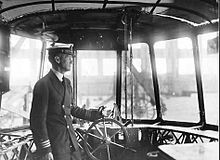
At this time, Rear Admiral William A. Moffett—Chief of the Bureau of Aeronautics and staunch advocate of the airship—was discussing the possibility of using Shenandoah to explore the Arctic. He felt such a program would produce valuable weather data, as well as experience in cold-weather operations. With its endurance and ability to fly at low speeds, the airship was thought to be well-suited to such work. President Calvin Coolidge approved Moffett’s proposal, but Shenandoah’s upper tail fin covering ripped during a gale on 16 January 1924, and the sudden roll tore her away from the Lakehurst mast, ripping out her mooring winches, deflating the first helium cell and puncturing the second. Zeppelin test pilot Anton Heinen rode out the storm for several hours and landed safely while the airship was being blown backwards. Extensive repairs were needed, and the Arctic expedition was scrapped.
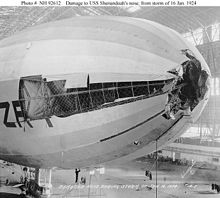
On February 12, 1924, while it was undergoing repairs, Shenandoah received a new commanding officer, Lt. Cdr. Zachary Lansdowne.
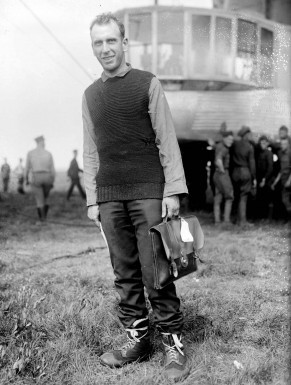
Lansdown, a 1909 graduate of the United States Naval Academy, was one of the Navy’s first officers trained in lighter-than-air aviation. He trained with the crew of the British airship R-34, and became the first American to cross the Atlantic nonstop by air as the American naval observer aboard R-34’s 1919 transatlantic flight. After service as a White House aide, Lansdowne was the Assistant Naval Attache in Germany in 1922-1923, where was involved with the negotiations for the construction of the LZ-126, which became the ZR-3 USS Los Angeles.
The ship was grounded for repairs until May 22, 1924, when it was returned to service with reinforcements to its mooring assembly, nose, and fins. The sixth engine in its control car was also removed and replaced with radio equipment, including a long distance direction finding set.
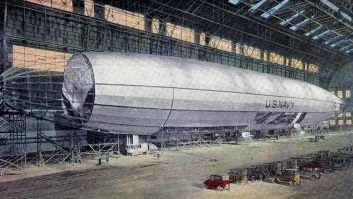
Shenandoah’s repairs were completed in May, and the summer of 1924 was devoted to work with its engines and radio equipment to prepare for fleet duty. In August 1924 it reported for duty with the Scouting Fleet and took part in tactical exercises. Shenandoah succeeded in discovering the “enemy” force as planned but lost contact with it in foul weather. Technical difficulties and lack of support facilities in the fleet forced it to depart the operating area ahead of time to return to Lakehurst. Although this marred the exercises as far as airship reconnaissance went, it emphasized the need for advanced bases and maintenance ships if lighter-than-air craft were to take any part in operations of this kind.
In July 1924, the oiler Patoka put in at Norfolk Naval Shipyard for extensive modifications to become the Navy’s first airship tender. An experimental mooring mast 125 ft (38 m) above the water was constructed; additional accommodations both for the crew of Shenandoah and for the men who would handle and supply the airship were added; facilities for the helium, gasoline, and other supplies necessary for Shenandoah were built, as well as handling and stowage facilities for three seaplanes. Lansdowne conducted pioneering operations in which he moored Shenandoah to a mast installed on the support ship Patoka, to show the possibility of underway replenishment and supply to extend the ship’s range and allow an airship to work closely with the fleet, and Lansdowne conducted operations with surface ships such as the battleship USS Texas whenever possible. The first successful mooring was made on 8 August. During October 1924, Shenandoah flew from Lakehurst to California and on to Washington State to test newly erected mooring masts. This was the first flight of a rigid airship across North America.
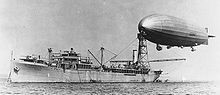
1925 began with nearly six months of maintenance and ground test work. Shenandoah did not take to the air until 26 June, when it began preparations for summer operations with the fleet. In July and August, it again operated with the Scouting Fleet, successfully performing scouting tasks and being towed by Patoka while moored to that ship’s mast.
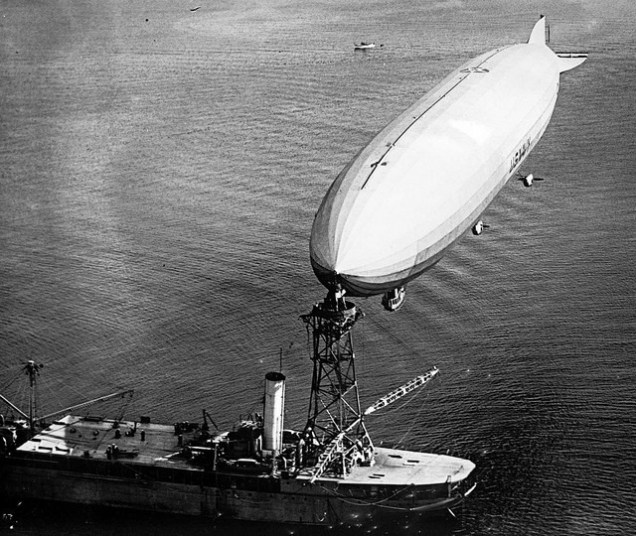
Shenandoah made one of its most impressive demonstrations in October, 1924, when the ship made a difficult 19-day journey across the United States from Lakehurst to San Diego, via Forth Worth, and then traveled up the west coast to Seattle and back to San Diego, before returning to Lakehurst via Fort Worth. Shenandoah logged 235 flight hours on its headline-making journey across the country, and captured the enthusiasm of both the American public and also leaders in the field of aviation around the world.
Upon Shenandoah’s return to Lakehurst the ship was was deflated so that its helium could be transferred to the newly arrived ZR-3 (soon to be commissioned USS Los Angeles) which had just been delivered to Lakehurst by Hugo Eckener and his German crew; the supply of helium was so scare in 1924 that the United States did not have enough of the gas to inflate two large airships at the same time.
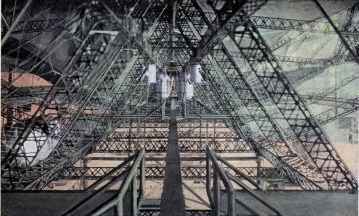
During Shenandoah’s lay-up, Zachary Lansdowne made a decision which would later be highly controversial. In order to limit the loss of helium by leakage through the automatic valves, and to eliminate several hundred pounds of weight, Lansdowne ordered the removal of 10 of the ship’s 18 automatic gas valves. These valves automatically released helium when as the ship climbed, to avoid over-expansion of the cells at higher altitude, which could damage both the cells themselves and the surrounding framework. Lansdowne’s modification limited the amount of gas that could be valved in a given time, and meant that Shenandoah’s valves could not keep up with an increase of altitude greater than 400 feet per minute; at any higher rate of climb, the ship could not release enough helium to keep up with the expansion of the gas cells.
On 2 September 1925, Shenandoah departed Lakehurst on a promotional flight to the Midwest that would include flyovers of 40 cities and visits to state fairs. Testing of a new mooring mast at Dearborn, Michigan, was included in the schedule. While passing through an area of thunderstorms and turbulence over Ohio early in the morning of 3 September, during its 57th flight, the airship was caught in a violent updraft exceeding 1,000 feet per minute that carried it beyond the pressure limits of its gas bags to an altitude over 6,000 feet. Twisted by the storm, and the ship finally suffered catastrophic structural failure, breaking in two at frame 125, approximately 220 feet from the bow. The aft section sank rapidly, breaking up further, with two of the engine cars breaking away and falling to the ground. It crashed in several pieces near Caldwell, Ohio. Fourteen crew members, including Commander Zachary Lansdowne, were killed. This included every member of the crew of the control cabin (except for Lieutenant Anderson, who escaped before it detached from the ship); two men who fell through holes in the hull; and several mechanics who fell with the engines.
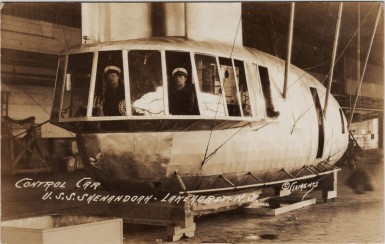
There were twenty-nine survivors, who succeeded in riding three sections of the airship to earth. The largest group was eighteen men who made it out of the stern after it rolled into a valley. Four others survived a crash landing of the central section. The remaining seven were in the bow section which Commander (later Vice Admiral) Charles E. Rosendahl navigated as a free balloon. In this group was Anderson who—until he was roped in by the others—straddled the catwalk over a hole. Without the weight of the control car, the bow section, with seven men aboard, including Navigator Charles Rosendahl, ascended rapidly. Under Rosendahl’s leadership, the men in the bow valved helium from the cells and free-ballooned the bow to a relatively gentle landing.
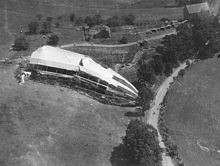
The Shenandoah Crash Sites are located in the hillsides of Noble County. Site No. 1, in Buffalo Township, surrounded the Gamary farmhouse, which lay beneath the initial break-up. An early fieldstone and a second, recent granite marker identify where Commander Lansdowne’s body was found. Site No. 2 (where the stern came to rest) is a half-mile southwest of Site No. 1 across Interstate 77 in Noble Township. The rough outline of the stern is marked with a series of concrete blocks, and a sign marking the site is visible from the freeway. Site No. 3 is approximately six miles southwest in Sharon Township at the northern edge of State Route 78 on the part of the old Nichols farm where the nose of the Shenandoah’s bow was secured to trees. Although the trees have been cut down, a semi-circular gravel drive surrounds their stumps and a small granite marker commemorates the crash. The Nichols house was later destroyed by fire.
The crash site attracted thousands of visitors in its first few days. Within five hours of the crash more than a thousand people had arrived to strip the hulk of anything they could carry. On Saturday, 5 September 1925, the St. Petersburg Times of Florida reported that the site of the crash had quickly been looted by locals, describing the frame as being “[laid] carrion to the whims of souvenir seekers”. Among the items believed to have been taken were the vessel’s logbook and its barograph, both of which were considered critical to understanding how the crash had happened. Also looted were many of the ship’s 20 deflated silken gas cells, each worth several thousand dollars, most of them unbroken but ripped from the framework before the arrival of armed military personnel. Looting was so extensive that it was initially believed even the bodies of the dead had been stripped of their personal effects, and that operatives from the Department of Justice were being sent to investigate. That this was happening was soon denied by those publicly involved in the incident, however. Still, a local farmer on whose property part of the vessel’s wreckage lay began charging the throngs of visitors to enter the crash site at a rate of $1 (equivalent to about $13.60 in 2015) for each automobile and 25¢ per pedestrian as well as 10¢ for a drink of water.
On 17 September the Milwaukee Sentinel reported that 20 Department of Justice operatives had indeed been summoned to the site and that they along with an unspecified number of federal and state prohibition agents had visited private homes to collect four truck loads of wreckage along with personal grips of several crew members and a cap believed to have belonged to Commander Lansdowne. Lansdowne’s Annapolis class ring had also been thought to have been taken from his hand by looters as it was not then recovered-it was found by chance in June 1937 near the crash site # 1. No one was charged with any crime.
Two schools of thought developed about the cause of the crash. One theory is that the gas cells over-expanded as the ship rose, due to Lansdowne’s decision to remove the 10 automatic release valves, and that the expanding cells damaged the framework of the airship and led to its structural failure.
Official inquiry brought to light the fact that the fatal flight had been made under protest by Commander Lansdowne (a native of Greenville, Ohio), who had warned the Navy Department of the violent weather conditions that were common to that area of Ohio in late summer. His pleas for a cancellation of the flight only caused a temporary postponement: his superiors were keen to publicize airship technology and justify the huge cost of the airship to the taxpayers. So, as Lansdowne’s widow consistently maintained at the inquiry, publicity rather than prudence won the day. This event was the trigger for Army Colonel Billy Mitchell to heavily criticize the leadership of both the Army and the Navy, leading directly to his court-martial for insubordination and the end of his military career. Heinen, according to the Daily Telegraph, placed the mechanical fault for the disaster on the removal of eight of the craft’s 18 safety valves, saying that without them he would not have flown on her “for a million dollars”. These valves had been removed in order to better preserve the vessel’s helium, which at that time was considered a limited global resource of great rarity and strategic military importance; without these valves, the helium contained in the rising gas bags had expanded too quickly for the bags’ valves’ design capacity, causing the bags to tear apart the hull as they ruptured (of course, the helium which had been contained in these bags became lost into the upper atmosphere).
After the disaster, airship hulls were strengthened, control cabins were built into the keels rather than suspended from cables, and engine power was increased. More attention was also paid to weather forecasting.
Several memorials remain near the crash site. There is another memorial at Moffett Field, California, and a small private museum in Ava, Ohio.
ZR-1 USS Shenandoah
Length: 680 feet
Diameter: 79 feet
Gas capacity: 2,115,000 cubic feet
Useful lift: 48,774 lbs
Maximum speed: 58 knots
Crew: 40 officers and men
First flight: September 4, 1923
Crashed: September 2-3, 1925
Total flight hours: 740:09
Lakes Flying Co Seabird
The Lakes Sea Bird was a two-seat floatplane built during 1912 by the Lakes Flying Company using the fuselage of the Avro Duigan. First flown on 28th August 1912, it gave many visitors to Windermere their first flight in the summer of 1913
After damaging his aircraft and returned to Australia the fuselage and tail unit was sold to the Lakes Flying Co. based at Windermere, who rebuilt it as a two-seat floatplane. The straight parallel-chord high aspect ratio wings of irregular three-by layout resembled those of Avro’s Avro Type D. It was originally fitted with a single central two step float, later changed to a pair of narrower floats, and demountable so that the aircraft could readily be used as a landplane. It was powered by a rotary 9-cylinder Gnome of 50 hp (37 kW),
The single Sea Bird carried many holiday makers in 1912-3. Later, it was restored for training and it was ultimately lost when a student pilot spun in in 1915.
Powerplant: 1 × Gnome 9-cylinder rotary, 50 hp (37 kW)
Wingspan: 39 ft 4 in (12.00 m)
Height: 10 ft 6 in (3.2 m)
Wing area: 350 sq.ft (32.5 sq.m)
Length: 29 ft 4 in (8.94 m)
Seats: 2
Maximum speed: 62 mph (100 km/h)
Lakes Flying Co Waterhen
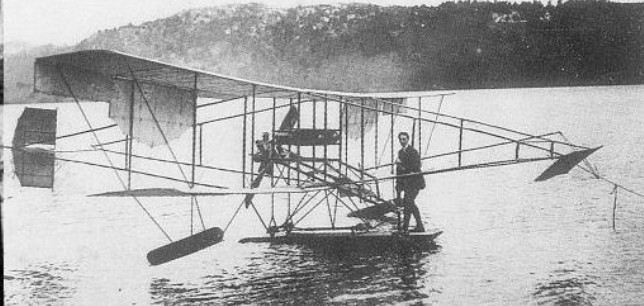
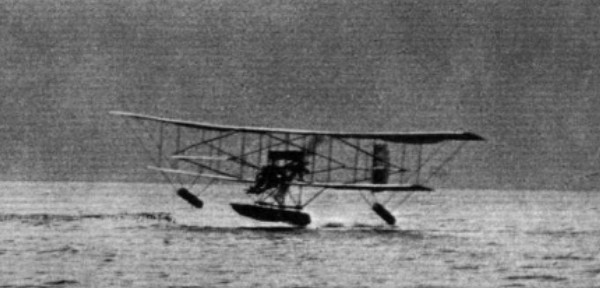
Water Bird was succeeded by the Lakes-built Water Hen, their first complete product. It was initially almost identical to its predecessor apart from straight edged ailerons. Larger, later modifications removed much of the similarity between the two aircraft, the later Water Hen having a much wider central float.
Water Bird’s successor, identical, but entirely designed and built at Windermere by Capt. Wakefield’s Lakes Flying Company later in 1912, was known as “Water Hen”. Its only Avro component was the airscrew and at first it could be distinguished from its Avro-built forerunner by the wingtip floats and straight trailing edges to the ailerons. These were mounted parallel to the chord line of the mainplanes instead of at a considerable angle to it. They were later remounted in the angled position but by that time more drastic modifications had been made and all similarity to Water Bird ceased.
Lakes Flying Co Waterbird / Avro Curtis / Waterbird / Lakes
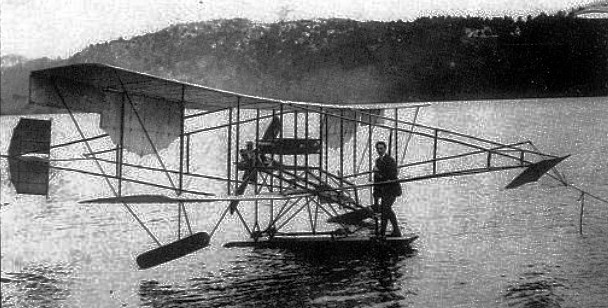
In the summer of 1910 A. V. Roe and Company declared its willingness to build aeroplanes to other people’s designs. A Curtiss-type, of the familiar outrigger-tail and front-elevator variety with 50 h.p. Gnome rotary, was built in 1911 to the order of Capt. Edward W. Wakefield of Kendal. He wanted it to follow the basic layout of the USA’s Curtiss machine – hence sometimes known as Avro-Curtis. This was never given an Avro designation.
The Lakes Water Bird was built for Wakefield, of the Lakes Flying School, Windermere. It was built as a landplane with the intention of converting it to a seaplane once testing was complete. Wakefield had been interested in water-borne aircraft since 1909 and had performed experiments with different float designs towed at speed across Lake Windermere. Unsticking problems persisted until he visited Henri Fabre in France and got useful advice on float design. The 12 ft (3.66 m) long float for the Water Bird followed Glen Curtiss’ three-step float and was built by boat builders Borwick of Bowness-on-Windermere using mahogany reinforced with metal strips and canvas covered by local.
Avro built the aircraft in Manchester, transporting it to Brooklands on 25 May 1911 for its first flight on 19th June. It was a two-bay seat pusher biplane with wings of unequal span. The outer half of each upper wing carried a pair of ailerons; the larger inner one had a semicircular trailing edge extending well behind the wing trailing edge. Bamboo outriggers fore and aft of the wings supported leading elevators and tail surfaces plus rudder. Both elevator and rudder were operated by bamboo pushrods. Power was provided by a 50 hp (37 kW) Gnome 7-cylinder rotary engine driving an 8 ft 6in (2.59 m) propeller.
It was operated by the Avro School for a short period before being dismantled on July 7th 1911 and moved to Lake Windermere. At the Avro School during it was flown by F. P. Raynham, R. C. Kemp, F. Conway-Jenkins and Louis Noel. After testing as a landplane at Brooklands in May 1911, the Water Bird was brought to the Hill of Oaks on Windermere and the float fitted in place of the wheeled undercarriage. A pair of cylindrical floats was mounted below the wing-tips for lateral stability on the water. Once at Windermere it was known simply as Waterbird. It had a Gnome 50hp engine and the successful first flight was on 25 November 1911, with ex-Avro school pilot H. Stanley Adams. The floats were all made by Borwicks at Windermere. The press where invited to an exhibition flight two days later, the favourable description’s in the press seem to lead to the name ‘Lakes Water Bird’ being adopted.
Water Bird was the first consistently successful seaplane in the United Kingdom and during the next few months its fame spread quickly and a considerable waterborne joyriding business was done during December 1911 and January 1912. Sixty flights were made in the first 38 days, the best being of 20 minutes duration up to a height of 800 ft. On December 7, 1911 Stanley-Adams flew the whole length of the lake at a speed of approximately 40 m.p.h. These operations continued throughout the winter, but the night of March 29-30, 1912 brought gales which demolished the lakeside hangar at Cockshott and damaged “Water Bird” beyond repair. Its float, tailplane and rudder (the last still proudly displaying the legend “A. V. Roe and Company, Manchester”) are still in the possession of the Wakefield family at Windermere.
Engine: 1 x Gnome et Rhône 7-cylinder rotary, 50 hp (37 kW)
Length: 36 ft 5 in (11.10 m)
Wingspan (upper): 41 ft 0 in (12.50 m)
Span (lower) 32 ft. 0 in.
Wing area: 365 sq.ft (33.9 sq.m)
Empty weight: 780 lb (354 kg)
Gross weight: 1,130 lb (513 kg)
Maximum speed: 45 mph (72 km/h)
Service ceiling: 800 ft (244 m)
Maximum speed 45 m.p.h. (72 km/h)
Crew: 1
Capacity: 1
Lake LA-4 / LanShe Aerospace LA-4 / Sun Lake Aircraft LA-4

Lake Aircraft Corp marketed the Colonial Skimmer as the Lake Skimmer, and developed the aircraft into the LA4. The initial Lake prototype, the “LA-4P”, very similar to the C-2 Skimmer, performed its initial flight in November 1959; it was followed by two “LA-4A” prototypes in 1960, N1001L c/n 244 and N1002L c/n 245, which featured a 1.22 meter (4 foot) wingspan stretch and structural reinforcement. Power was a 180hp Lycoming O-360A1A pusher.
The LA-4A in turn led to the production “LA-4”, which featured a bow stretched by 43 centimeters (17 inches), with the nose gear now fully retracting. Powerplant remained the O-390-A1A. The first production model of this version flew in 1960, N261B c/n 121. Total production of the initial model of the LA-4P appears to have been about 70 aircraft, including a one-off pure seaplane with no landing gear. In 1970 Lake removed the retractable gear from some LA-4s and offered them as seaplanes with detachable beaching gear.
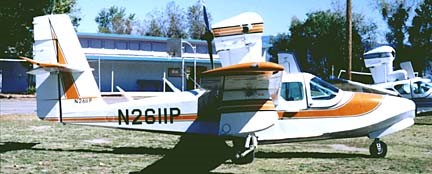
In 1968, work began on a new model with a Lycoming IO-360-A1B engine featuring 150 kW (200 HP), with an LA-4 converted as a testbed. The “LA-4-200” went into production in 1969 and did much to raise the profile of the LA-4, with sales picking up. It featured other modest improvements, notably fuel storage in the floats, plus an optional combustion heater in a fairing above the cockpit, and also acquired the name of “Buccaneer”. Performance increased substantially, as did the price tag. Both the 180 hp and 200 hp Buccaneer versions are similar in appearance and differ only in instrument layout apart from the engine power.
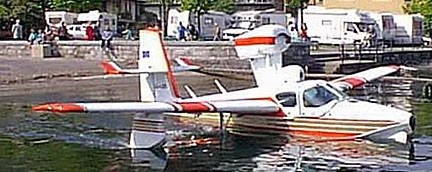
It then generated a modestly refined version, designated the “LA-4-200EP”, the “EP” indicating “Enhanced Performance”, other interpretations being “Extended Propeller”, that being one of the features. It also had a new IO-360-A1B6 engine, same horsepower but smoother operation, a revised engine nacelle, batwings, cargo door, and fuel floats as standard equipment. An “LA-4-200EPR” was also introduced that was much the same, but with a reversible propeller. Some LA-4-180, -200, and -200EP had after-market Rajay turbochargers.
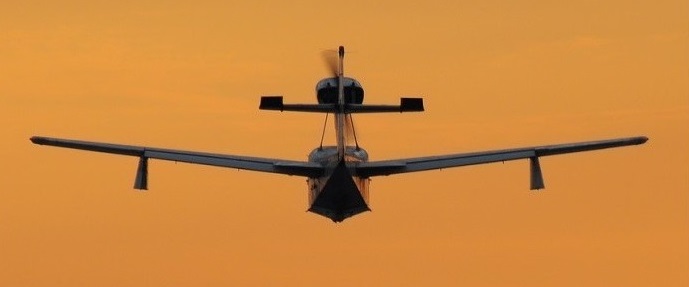
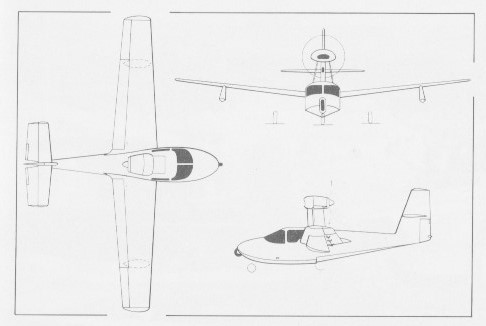
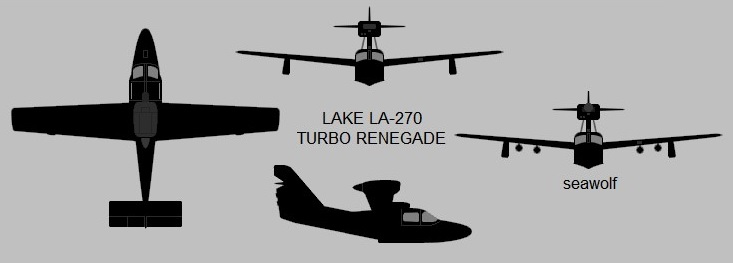
In 1984 Lake then produced the LA-250 Renegade, which featured a stretch of 1.05 meters (41 inches), permitting accommodations for four or six, with additional pop-up doors on each side of the rear cockpit; a revised and more rakish tailfin with a forward fillet of greater area; and a Lycoming IO-540-C4B5 flat-six air-cooled engine providing 185 kW (250 HP). A militarized version of the LA-250 was introduced in 1985 as the “Seawolf”, featuring four underwing pylons and radar, the radome being mounted on the front of the engine nacelle. The pylons could carry munitions including bombs and rockets, reconnaissance pods, or parachutable survival pods kitted for different environments.
Lake discontinued the LA-4 and the Seaplane and concentrated on production of the Buccaneer and the Renegade. Standard fuel tanks in the Lake were 40 gallons until someone decided that the pontoons could also be used as fuel links. The new auxiliary tanks took 7-1/2 gallons on each side, and the total capacity increased to 55 gallons. The extra 20 hp in the 200-hp Buccaneer has increased cruising speed by 12 mph and top speed by 14 mph. Allowable gross weight also increased an additional 200 pounds.
The LA-250 led in turn to the LA-270 Turbo Renegade, which was much the same but had a turbocharged TIO-540-AA1AD engine providing 200 kW (270 HP). The major visible difference was a turbocharger inlet extension at the base of the engine pylon. A militarized Seawolf version was offered as well. Sources mention a “Sea Fury”, which was an LA-250/270 with salt-water corrosion protection.
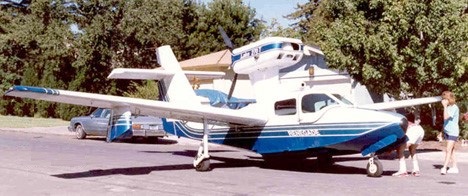
The Renegade T270 is longer in the fuselage and is fitted with six seats. The model offered four to six passenger seating, improved useful load and 90 gallons of fuel on board. In 1987 turbo charging was added via the Lycoming TIO-540-AA1AB, resulting in 20 more horses to the Renegade and a ceiling of up to 23,800 ft. The Turbo 270 Renegade, which differs from previous versions in having a lengthened cabin, a turbocharged 250 shp (186 kW) Lycoming IO-540-C4B5 flat-six engine. The Seawolf is a maritime patrol version with underwing stores pylons.
Lake Aircraft’s 270 hp turbocharged Renegade has set four new world records in the light seaplane class, including an altitude record of 27,300 feet.
In 1987 the Buccaneer model was put into retirement. Latest models of the 250 and 270 hp Lakes are all marketed under the name Seafury, and incorporate improvements in corrosion protection for operation in salt water.
The LA-4 1960 base price was $26,580 and the 1968 LA-4-200 Buccaneer $31,000, rising to $53,000 in 1980. The LA-4-200EP Buccaneer $96,600 in 1983, and by 2004, $110,000-125,000. The Renegade sold for $146,000 in 1982, and $220,000 by 1986. About 135 had been built to 2005.
Twenty-four were built to 1961 and about 916 to 2005, excluding Renegade. More than 1,200 of the Lake series single-engined amphibians had sold to 1990. The LA-270T / Turbo Seafury sold for $348,000 in 1991, and $745,500 by 2001.
The four seat Lake LA 4 200EP am¬phibian, first built in 1983, has been revived by LanShe Aerospace in Florida and in 2004 was selling for US$299,000. The EP version has an IO 360 engine and a payload of around 900 lbs. It has Keelson boosters on the hull and “bat wing” wing root fillets to increase performance. The LA-270T / Turbo Seafury was priced at $348,000 in 1991, and $745,500 in 2001. The sole 1969 gearless Lake was for sale at $23,562.
The 1985 Seawolf was a military version of the LA-4-250, 2 of which reportedly were boosted to 290hp. One prototype, N1401G, was built.
The final Lake amphibian was produced in 2007. At last notice, the Lake firm was still in business, but it had been reduced to a small shop providing parts and service to the customer base.
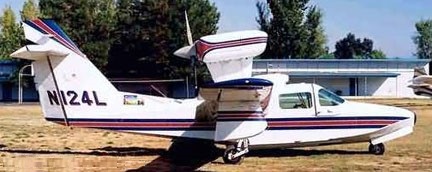
LA-4
1960 TC 1A13
Engine: Lycoming O-360A1A 180hp
Wing span: 38’0″
Length: 24’11”
Height: 9 ft 4 in
Wing area: 170 sq.ft
Gross wt. 2,400 lb
Empty wt. 1,600 lb
Useful load: 850 lb
Fuel capacity 40 USG
Max speed: 140 mph
Cruise 75%: 131 mph
Econ cruise: 125 mph
Stall: 50 mph
Initial climb rate: 800 fpm
Service ceiling: 14,000 ft
Range: 627 mi
Takeoff run (land): 650 ft
Takeoff run (water): 1,125 ft
Landing roll (land): 475 ft
Landing run (water): 600 ft
Seats: 4
LA-4A
1960
Engine: Lycoming O-360A1A 180hp
Seats: 4
LA-4P
1960
Engine: Lycoming O-360A1A 180hp
Length: 24’11”
Seats: 4
No built: 1
Aerofab LA-4-180
1961-69
Engine: Lycoming O-360A1A 180hp
Seats: 4
LA-4/200 Buccaneer
1968
Engine: Lycoming IO-360-A1B, 200 hp.
TBO: 1600 hrs.
Prop: Hartzell 2-blade, 74-in.
Seats: 4.
Length: 25 ft.
Height: 9.3 ft.
Wingspan: 38 ft.
Wing area: 170 sq.ft.
Wing aspect ratio: 8.6.
Maximum ramp weight: 2690 lbs.
Maximum takeoff weight: 2690 lbs.
Standard empty weight: 1555 lbs.
Maximum useful load: 1135 lbs.
Maximum landing weight: 2690 lbs.
Wing loading: 15.2 lbs/sq.ft.
Power loading: 13.5 lbs/hp.
Maximum usable fuel: 324 lbs.
Best rate of climb: 1200 @ 69 kts.
Climb gradient: 1043 ft/nm.
Service ceiling: 14,000 ft.
Maximum speed: 134 kts.
Normal cruise @ 65% pwr @ 8000 ft: 130 kts.
Fuel flow @ normal cruise: 56 pph.
Endurance at normal cruise: 5.6hrs:
Stalling speed clean: 45 kts.
Stalling speed gear/flaps down: 39 kts.
Turbulent-air penetration speed: 106 kts.
Amphibious retractable nose wheel undercarriage.
Takeoff run (water) 1,100 ft
Takeoff run (land) 600 ft
Landing run (water) 600 ft
Landing roll (land) 475 ft
Fuel capacity 54 USG
Rivard LA-4-200EP Buccaneer
1982-86
Engine: Lyoming IO-360-A1B6
Useful load: 1135 lb
Lake 250 Renegade
Engine: Textron Lycoming TIO 540 AA2AD, 266 hp
Length : 29.659 ft / 9.04 m
Height: 10.007 ft / 3.05 m
Wingspan: 38.320 ft / 11.68 m
Aspect ratio: 8.96
Wing area: 164.043 sq.ft. / 15.24 sq.m
Max take off weight: 3139.9 lb / 1424.0 kg
Weight empty: 2074.9 lb / 941.0 kg
Max. payload weight: 1065.0 lb / 483.0 kg
Landing speed: 49 kt / 91 km/h
Cruising speed: 155 kt / 287 km/h
Take off distance: 879 ft / 268 m
Landing distance: 607 ft / 185 m
Initial climb rate: 905.51 ft/min / 4.6 m/s
Service ceiling: 20013 ft / 6100 m
Wing load: 19.07 lb/sq.ft / 93.0 kg/sq.m
Range: 1120 nm / 2074 km
Crew: 1+3
Rivard LA-4-250 Renegade / Sun Lake LA-4-250 Renegade / Sun Lake Renegade 2
1982
Engine: Lycoming IO-540-C4B5, 250hp
Prop: 3 blade metal
Wing span: 38’0″
Length: 28’4″
Gross wt. 3,140 lb
Useful load: 1200 lb
Empty wt. 1,850 lb
Fuel capacity 90 USG
Cruise speed: 140 mph / 122 kt
Stall: 56 mph
Initial climb rate: 900 fpm
Ceiling: 12,500′
Takeoff run (land) 650 ft.
Takeoff run (water) 1,125 ft.
Landing roll (land) 475 ft.
Landing run (water) 600 ft.
Seats: 4-6
Sun Lake Renegade 2T
Engine: Lycoming TIO-540-AA1AD
Prop: 3 blade metal
Wing span: 38’0″
Length: 28’4″
Fuel capacity: 90 USG
Seats: 4-6
LA-270T / Turbo Seafury
1987
Engine: Lycoming TIO-540-AA1AD, 270hp
Seats: 4
Renegade T270
Engine: Lycoming TIO-540- AA1AB, 270 hp.
Gross wt. 3,140 lb.
Empty wt. 1,850 lb
Fuel capacity 90 USG
ROC: 1000 fpm @ 75 kts.
Payload: 1200 lb.
Seats 4-6.
Cruise 128 kts.
Stall 53 mph.
Initial climb rate 900 fpm
Ceiling 23,800 ft ft.
Takeoff run (land) 650 ft.
Takeoff run (water) 1,125 ft
Landing roll (land) 475 ft
Landing run (water) 600 ft
Seaplane
1969
Engine: Lycoming O-360, 180hp
No built: 1, N7637L c/n 411
Undercarriage: boat
Seats: 4
Price: $23,562
Seawolf 1
1985
Engine: 290hp
No built: / N1401G
Lamprecht-Gerstel Eindecker

Built by the fitter Eugen Lamprecht and engine mechanic Heinrich Gerstel in Pforzheim in 1909. Lamprecht was the initiator of the project with Gerstel to install the engine. When funds ran out, the machine was exhibited at the guest house “Schwarzer Adler”, where it is told that the engine was occasionally started inside the ball room. Afterwards the monoplane was tested at the Exerzierplatz Forchheim, with only minor success.
Lambert The Major Lambert / R-266
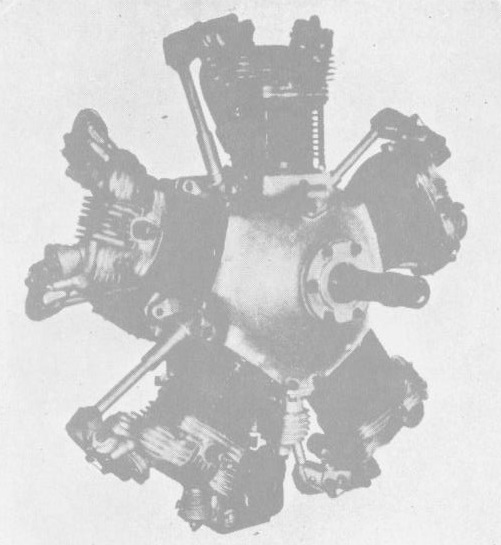
The Lambert R-266 features a solid master connecting rod and two piece crankshaft. A two piece magnesium alloy crankcase, split on the cylinder centreline, is held together with ten bolts. The front section carries the front main ball-bearing and thrust ball-bearing. The inlet passage and valve lifter guides are cast in the rear section.
Cylinder barrels are nickel semi-steel castings. Removable cylinder hads of aluminium alloy with exhaust and inlet ports toward the rear, are held in place with four long studs which run through the crankcase. Enclosed valve actuating mechanism is at the rear of the cylinders.
Accessories and their drives are grouped at the rear making for easy cowling.
Equipment incules a propeller hub, exhaust ring, carburettor air heater and muffler, tool kit, and instruction and parts book.
Type: 5 cylinder air cooled, fixed radial
Dept of Commerce Rating: 90 hp at 2375 rpm
Displacement: 266 cu.in
Compression ratio: 5.55-1
Bore: 4 1/4 in
Stroke: 3 3/4 in
Length: 30 3/8 in
Diameter: 33 in
Weight: 214 lb
Fuel consumption: not more than .55 lb/hp/hr
Oil consumption: not more than .025 lb/hp/hr
Lubrication: Pressure and dry sump
Ignition: Dual Scintilla
Carburation: Stromberg NAR 3
Spark plugs: 2 per cylinder Champion

