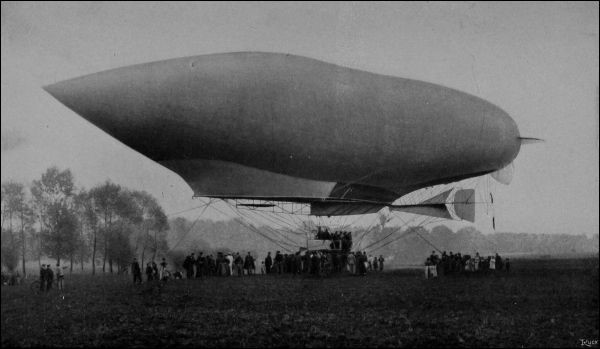
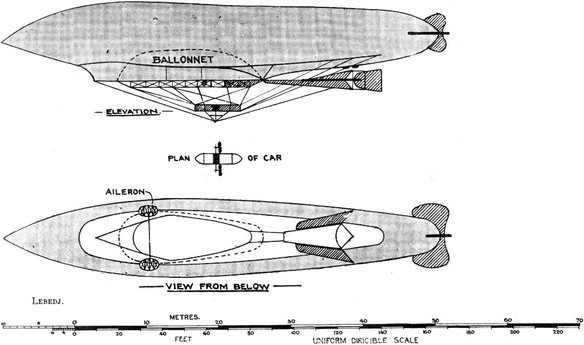
Lebaudy Russie / Lebedj

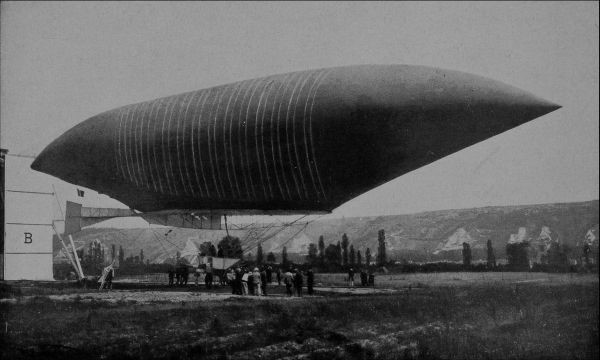
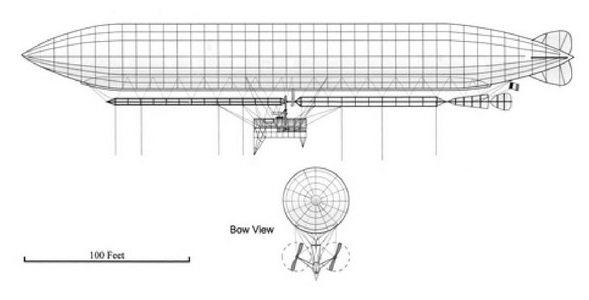
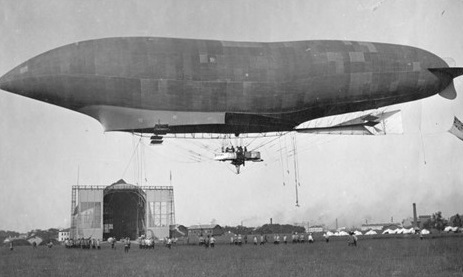
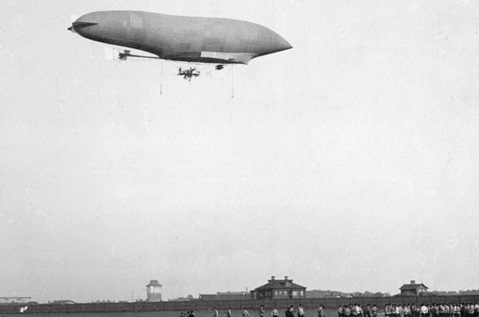
In 1909 Lebaudy produced two other vessels patterned after the République. The Russie and La Liberté, built respectively for Russia and France. The fourth designed dirigible, the Russie made her first voyage on May 29th, ascending 600 feet with eight passengers, and manoeuvring under perfect control. After her official trial, in June, she was sent to St. Petersburg, being the first dirigible furnished to a foreign government by a private concern.

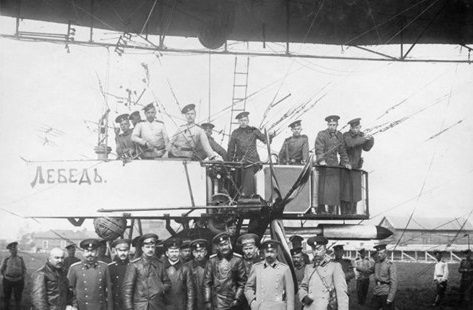
This dirigible was originally known as La Russie, and later renamed by the Russians as Lebedj, and was supposed to be an exact copy of the République.

Featuring a single Panhard-Levassor motor, twin propellers capable of 70 horsepower, the Lebedj dirigible had a volume of 3,800 cubic meters, and could achieve a speed of 49 kph.

Length: 61.2 m
Beam: 10.9 m
Volume: 3,800 m³
Engine: 1 x Panhard-Levassor, 70 hp
Props: 2
Ballonet: 900 m
Speed: 49 km/h

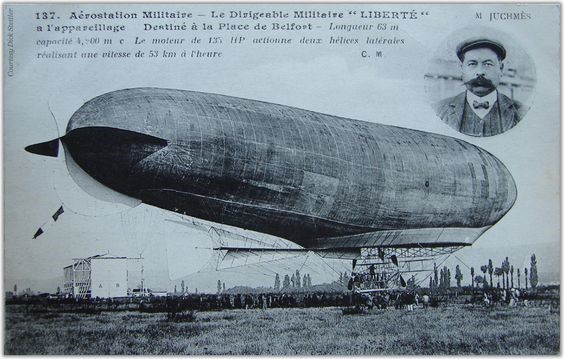
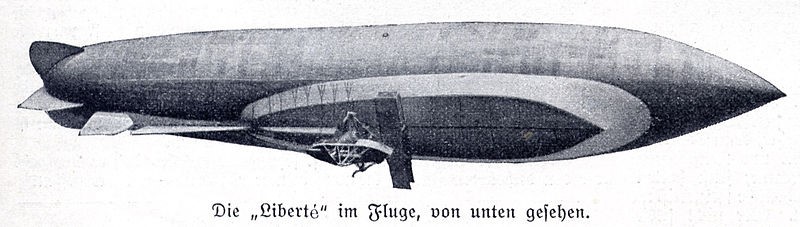
Lebaudy Liberté

In 1909 Lebaudy produced two other vessels patterned after the République. The Russie and La Liberté, built respectively for Russia and France.

The Liberté was launched the last week in August and, after various practice and official tests, was accepted by the French government two months later. On a notable voyage, made on September 20th, she sailed ten hours with her Panhard motor constantly working.

Lebaudy Le Jaune / The Yellow

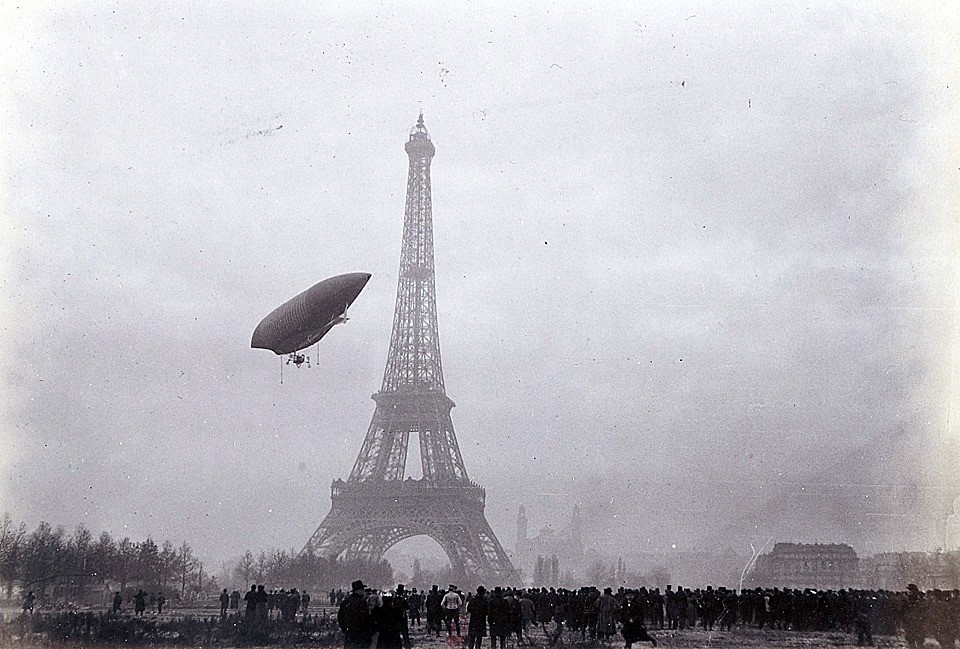
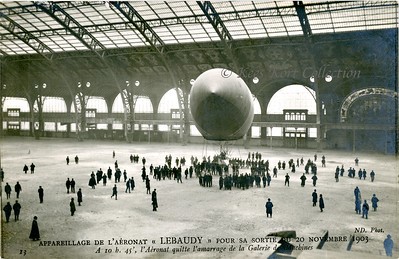
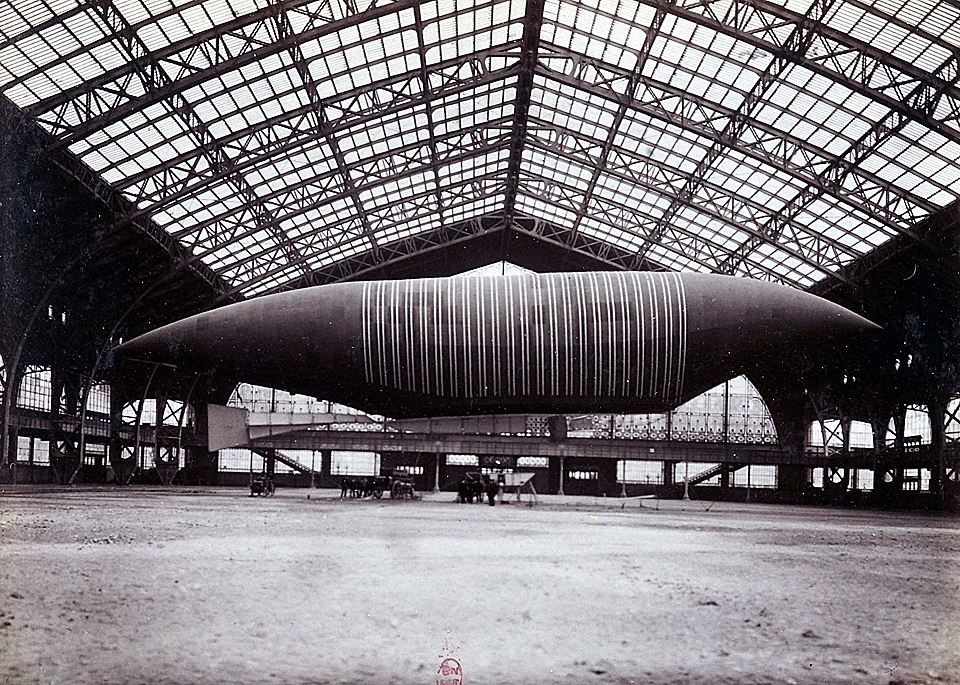
The company’s first airship, simply known as the Lebaudy, and dubbed by the French public “Le Jaune” (“The Yellow (One)”) because of the yellow colour of the lead chromate paint on its cloth exterior, was considered the most successful airship then in operation.

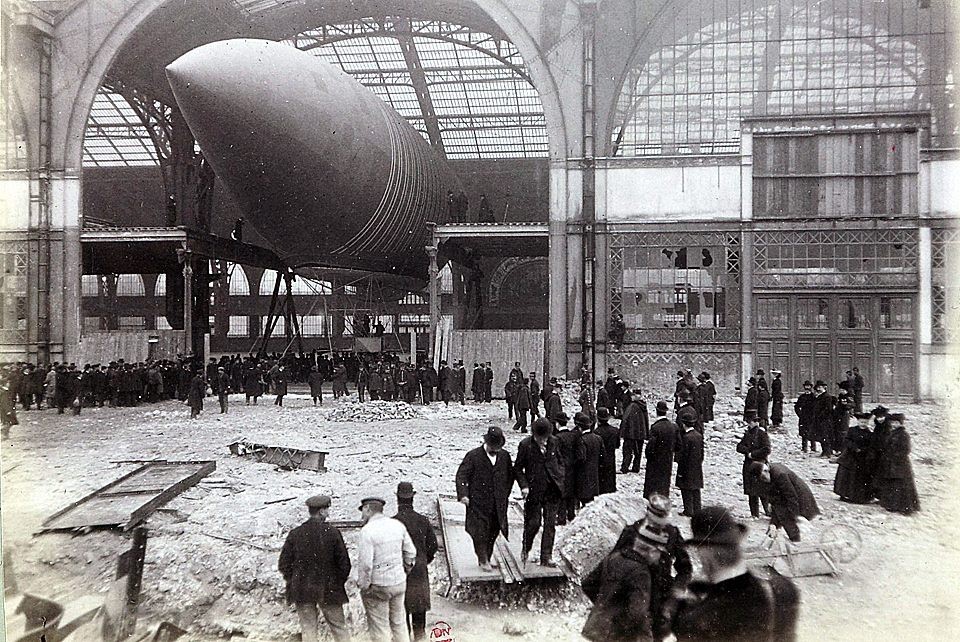
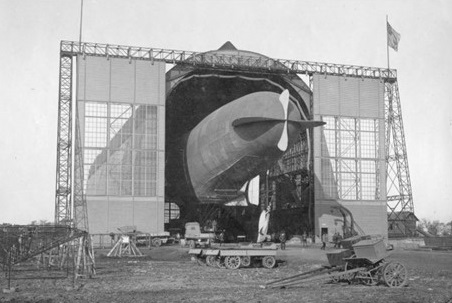
The Lebaudy Le Jaune (‘The Yellow’) dirigible was in the enormous Halles des Machines in Paris on 20 November 1903 in preparation for a flight over Paris. The flight got enormous publicity and a series of 30 (!) photographs / postcards were published to commemorate the event.

The Halle des Machines or Galerie des Machines was built specially for the Exposition Universelle in Paris of 1889. The Galerie des Machines had a span of 115 metres (377 ft) and height of 45 metres (148 ft). The whole building was demolished in 1910.

It had a 35 hp Daimler Mercedes engine driving two propellers. The ship was further improved on several trips, including one of 2 hours and 46 minutes. These activities continued in the following years, with the ship being rebuilt several times after crash landings in trees.

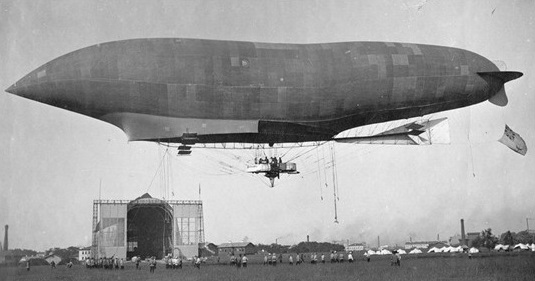
Lebaudy 190 / 1910 Morning Post

Two large dirigibles were ordered by Great Britan from France. The second airship, the Lebaudy, was purchased by the Morning Post newspaper as a gift to the nation, despite the fact there was at that time no shed large enough to house the 337 foot long craft. After protracted negotiations with the War Office agreement was reached to provide a new shen at Farnborough.

The Lebaudy had a gas capacity of 353,000 cu.ft giving a gross lift of 10.4 tons, powered by two 135hp Panhards. Colonel Capper had flown aboard her during trials earlier in the year in France and had reported favourably on her capabilities.

The airship was flown to England on 26 October 1910, maned by a French crew of seven and two representatives of the War Office including Major Bannerman who had succeeded Templer as superintendent at Farnborough. They crossed the coast at Cao Gris Nez, the airship easily overhauling the escorting destroyers at a speed of 35 mph.

After an uneventful flight of 5 hours 15 minutes the airship landed at Farnborough. On being taken to the shed the major in charge of docking became concerned that the top of the airship was too high to pass under the shed entrance, but was overruled by a senior officier who insisted the ship be walked in at once.

As the Lebaudy entered the shed the upper portion of the envelope was torn by the roof girder work, causing the ship to collapse and become a total wreck. It would appear that the dimensions of the ship supplied before the erection of the shed were different from the craft as completed, with the diameter being some 10 feet wider.
The wreckage was dragged into the shed and followed by an inquiry, during which the War Office refused to pay the purchase price to the Lebaudy Company, declared them negligent in not advising them of the increased diameter of the envelope. It was eventually agreed the Lebaudy Freres would foot the bill to repair and make the ship airworthy.

During the winter months the shed roof was raised by 15 ft, and a complete reconstruction was started. A test flight of the refurbished airship took place in May 1911 in the hands of the manufacturers with an all French crew. Soon after takeoff and following a short flight, problems with directional control were experienced, most likely due to the craft being badly rigged following certain modificatins to the suspension system.

The crew limped back to Farnborough where while attempting to land the airship lost control and dived into the round, crashing on to a house and becoming a complete wreck. There was no fire and the crew suffered only minor injuries.

Lebuady 190
Envelope volume: 353,000 cu.ft
Length: 337 ft
Width: 39 ft
Height: 64 ft
Gross lift: 10.4 ton
Disposable lift: 2.6 ton
Engines: 2 x 135 hp Panhard
Speed: 38 mph
Range: 600 mi
Crew: 7
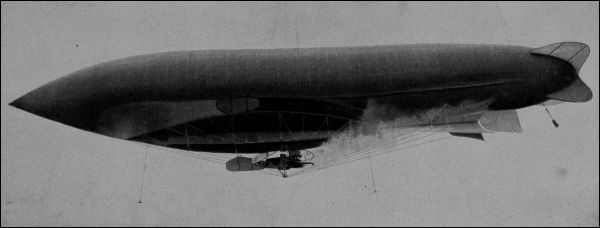
Lebaudy Patrie / Krechet / Gerfalcon

In February 1907, with the Chief Military Engineering Directorate, was created a commission under the chairmanship of N.L. Kirpicheva, which received the task to run the necessary experiments and to build a large dirigible. To the works were drawn the researchers: N.E. Zhukovsky, A.N. Krylov, V.V. Kuznetsov, E.S. Fedorov, K.A. Antonov, D.M. Smirnov, and others. The project they developed was under the direct management of N.I. Utesheva. Construction was somewhat drawn out, and only on July 30, 1910, the airship “Krechet” performed its first flight. It was the largest airship at the time.

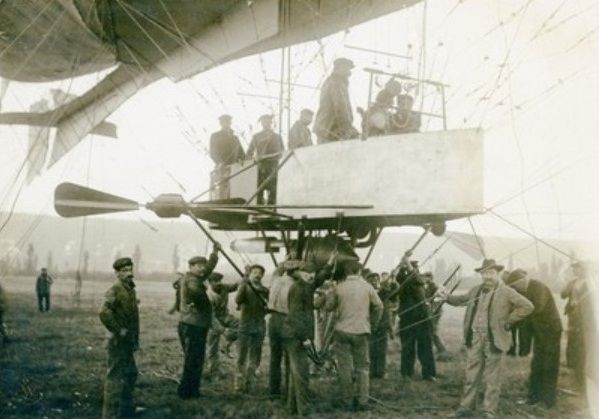
The Patrie employed a non-combustible shield over the motor, for the protection of the envelope: its steering wheel was in front and the motor about in the middle of the car. The gasoline tank was under the car, compressed air being used to force the fuel up to the motor, which discharged its exhaust downward at the rear through a spark arrester.

The semi-rigid Lebaudy Patrie was used for training by the Russian Empire as the Krechet (Gerfalcon).

The Patrie was destroyed by a storm.

Engines: 2 x 84 h.p
Volume: 6000 cu.m
Length: 70 m
Diameter: 11,4 m

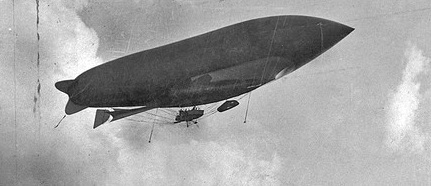
Lebaudy La Republic / Swan

Built in 1908, it was the first airship which the Russian War Department ordered abroad (in 1909), and named “The Swan”. The airship perfected the overall suitability for the role of airships in the fighting. The results were disappointing as in the case of air defense, airships of the attacking force quickly transformed into a huge target. The airship was assigned only the role of reconnaissance.

The semi-rigid La République crashed in September 1909 and all four crew members were killed.

Engine: 2 x Panhard, 64 hp
Length: 200.131 ft / 61.0 m
Width of hull: 33.793 ft / 10.3 m
Contained volume: 184724 cu.ft / 5230 cu.m
Max speed: 24 kts / 45 km/h

Lebedj / Swan
Envelope volume: 3700 cu.m
Length: 61,4 m
Diameter: 11,1 m
Engine: 68 hp

Leading Edge Air Foil / LEAF Trike

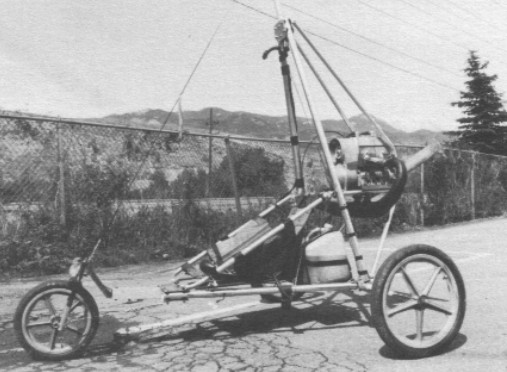
Single seat single engined flex wing aircraft with weight shift control. Rogallo wing. Pilot suspended below wing in trike unit, using bar to control pitch and yaw/roll by altering relative positions of trike unit and wing. Undercarriage has three wheels in tricycle formation; suspension on nosewheel and glass fibre suspension on main wheels. Push-¬right go left nosewheel steering independent from yaw control. No brakes. Aluminium ¬tube trike unit, without pod. Engine mounted below wing driving pusher propeller.
This single seat, single ¬engine trike unit uses a double pole structure, stiffened by the tubes forming the side supports of the seat, and is adaptable to fit most weight shift hang gliders.
The combination of glass fibre laminate suspension on the main wheels and large wheel diameters should guarantee it remark¬able all terrain performance. Previously powered by a Cuyuna 430D or 430R 30hp engine with a 2/1 reduction drive, it was later offered with the type ULII 02 35hp engine from the same company, still with a 2/1 reduction drive. The Leaf is easy to rig and when folded it measures 8.0 x 5.7 x 3.7ft (2.44 x 1.70 x 1.09m). Price was $2495 built in 1982.

Trike unit
Engine: Cuyuna ULII 02, 35hp.
Propeller diameter and pitch 54×27 inch, 1.37 x 0.69 m.
Reduction ratio 2.0/1.
Max static thrust 165 lb, 75 kg.
Fuel capacity 5.0 US gal, 4.2 Imp gal, 18.9 litre.
Length overall 7.4ft, 2.26m.
Height overall 8.3 ft, 2.51 m.
Width 5.6 ft, 1.70 m.
Wheelbase 5.1 ft, 1.55 in.
Nosewheel diameter overall 16 inch, 40 cm.
Main wheels diameter overall 20 inch, 51 cm.
Empty weight 149 lb, 67 kg.
Payload 250 lb, 113 kg.
Max level speed 45 mph, 72 kph.
Max cruising speed 32 mph, 51 kph.
Stalling speed 24 mph, 39 kph.