By 1931 Alexander Lippisch had progressed to a triangular wing form which he called ‘delta’, and his Delta 1 was ready for demonstration to top German aviation ministry officials at Berlin’s Templehof airport. The test pilot, Gunther Gronhoff, performed a low level aerobatic routine (even spinning the 30 hp Bristol Cherub powered delta), they remained unconvinced. Lippisch would not get an airworthiness certificate, they declared, until he put tails on his aircraft.
Piston
Lipnur NU-200 Sikumbang
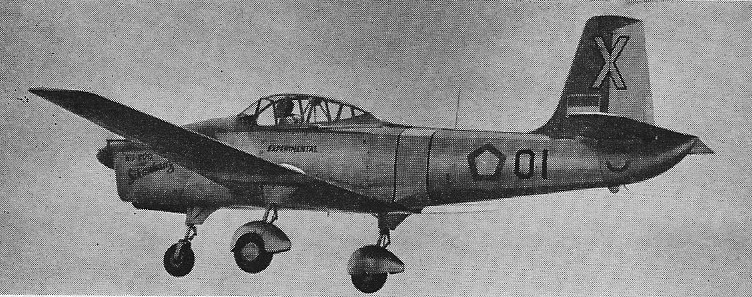
The NU-200 Sikumbang (Bee) was designed in 1953 by Major Nurtanio Pringgoadisuryo of the Experimental Section of the Indonesian Air Force’s Technical Staff.
Of mixed construction, the wing being of all-wood construction with plywood covering and the fuselage being a welded steel-tube structure with metal covering. The Sikumbang was to carry a fixed forward-firing armament of two machine guns and various underwing stores.
The prototype Sikumbang was first flown on 1 August 1954 and the type was intended as a light ground support monoplane.
Engine: 200 hp de Havilland Gipsy Six
Wingspan: 34 ft 9.5 in
Length: 26 ft 9 in
Height: 11 ft
Loaded weight: 2400 lb
Max speed: 160 mph at SL
Cruise: 140 mph
ROC: 1000 fpm
Service ceiling: 16,500 ft
Range: 600 mi
Seats: 2

Lipkowski Helicopter
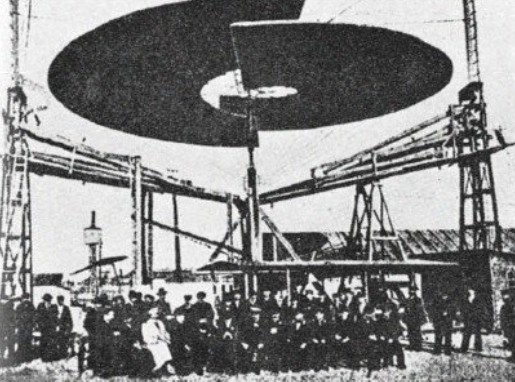
Jozef Lipkowski, a Polish engineer and inventor working in France and Russia, designed a huge helicopter-type flying machine in Russia at the end of 1904. According to descriptions in the contemporary press, the proposed aircraft featured two vertical co-axial shafts of steel tubes, to which two gigantic contra-rotating ‘screws’ (rotors) were attached. Each ‘screw’consisted of two half-circular ‘wings’ (blades) which were supported by a long steel tube and comprised a wooden ‘felloe’ and steel ‘spokes’ covered with doped silk. A nacelle, accommodating the aviators and two engines, one for vertical and the other for horizontal flight, was mounted beneath. A rudder and a propulsive airscrew on a horizontal shaft were attached to the nacelle and provided means of control.
Early in 1905 the Pitulovskie Establishments in Petersburg constructed one complete rotor for the proposed aircraft for tests which were aimed at determining whether a vertical ascent would be possible. Ground trials with the gigantic rotor device, driven by an electric motor, yielded remarkably interesting results, confirming in full the designers calculations. An official report, dated 16 March, 1905, and signed by Prof N. L. Shtchukin, who was appointed to witness and supervise the experiment, stated that Lipkowski’s rotor, consisting of two ‘half-wings’ with an overall diameter of 16m and a combined gross area of 200 sq m, which were powered by a 35hp (electric) motor, lifted 778kg at 40rpm, this indicating a lift/power ratio of 22.22kg/hp (or more than twice as good as the then best achievements).
For these initial tests the half-circular blades were set at a very efficient angle of incidence of 3.5°. Later Lipkowski made further trials with the blades set at various angles from 5° to 8°. Allowing for unforeseen contingencies and the possible loss of rotor efficiency in a complete machine, the designer accepted a lift/power ratio of 12.5kg/hp as the basis for his final calculations. Estimated weights of various elements of his giant helicopter included: two rotors 2000kg; nacelle, steering and transmission systems 1000kg; crew and fuel 1000kg; two engines 4500kg; the estimated gross weight of the machine being 8500kg. Lipkowski proposed using a 700hp engine for vertical movement and a 150hp engine for horizontal flight. In later years he went to France to see whether he could obtain the required engines, but impressed with Wrights’ and Bleriot’s flights, he came to the conclusion that the future of flying belonged to fixed-wing aircraft and abandoned work on his pioneering project.
Lioré-et-Olivier 1911 monoplane
The 1911 Liore et Olivier monoplane designed and built by Liore et Olivier featured two tractor propellers.
Span: 28’2″
Length: 29’6″
Weight: 770 lb
Lioré-et-Olivier LeO 45 / LeO 451
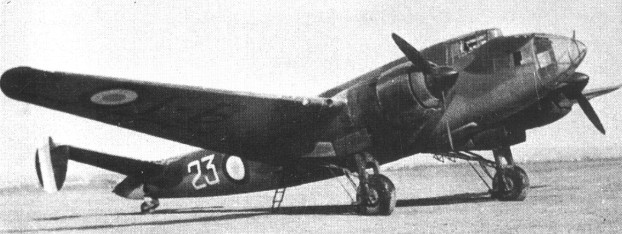
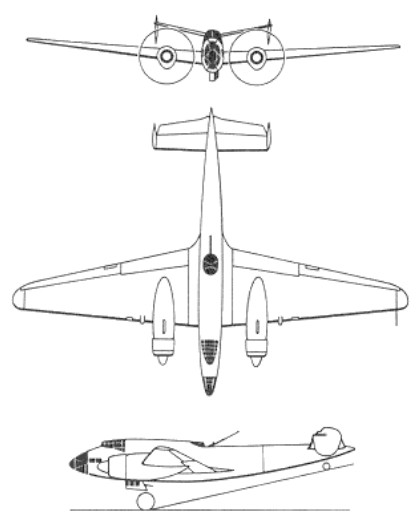
The LeO 45.01 B4 – designed by Jean Mercier to Armee de l’Air Programme A21 (1934) – first flew on 16 January 1937. It was an all-metal low-wing monoplane powered by two 805-kW (1,080-hp) Hispano¬Suiza 14Aa radial radial engines. The wings had considerable dihedral and the streamlined elliptical monocoque fuselage had a pointed and fully glazed nose. The landing gear was fully retractable. Accommodation provided for a pilot in an enclosed cockpit, behind which was the radio operator’s panel and below the retractable ventral gun turret.
Trials revealed that the tail needed revision, and development problems with the Hispano-Suiza engine led to the decision in favour of Gnome-Rhone 14 radials in the LeO 451, which was built by SNCASE, the nationalised organisation into which LeO had been absorbed.
Production LeO 451s had two 849.5kW Gnome-Rhone 14N 48/49 or 38/39 radial engines in specially designed Mercier cowlings. Despite excellent performance, construction of the type was slow. The first production aeroplane flew in March 1939, and although 1,783 aircraft were ordered only 452 had been produced by the fall of France. Only five LeO 451s were on first-line strength by 3 September 1939. Subsequent production amounted to 225 more aircraft.
Liore et Olivier LeO 451 Article
A number of modifications were incorporated during series production, the principal being a totally redesigned fin and rudder assembly. Armament included a fixed 7.5mm MAC 1934 nose machine-gun, another gun of the same type flexibly mounted in the ventral gondola, and a somewhat troublesome 20mm HS-404 on a special mounting in the dorsal position. Maximum bomb load – carried in fuselage and wing bomb bays – was 2,400kg.
The LeO 451s were used initially for long-range reconnaissance missions, then for daylight bombing during the Battle of France and in night raids on Italian targets during June 1940. A further 225 were ordered by the French Vichy regime, the type serving in French overseas territories, later relegated to transport and liaison duties (a number flown in these roles by the Luftwaffe). Twenty-seven LeO 451s were ceded to Italy in 1941 but saw little service.
Variants with different engines reached prototype form, and some production aircraft were modified as transports, glider tugs, mailplanes and trainers. There were numerous experimental conversions of the basic design. Several examples remained in use in secondary roles for several years following the end of the Second World War.
LeO 451
Engines: 2 x Gnome-Rhone 14N-48/49, 850kW (1,140 hp).
Span: 22.5m (73 ft 9.75in).
Length: 17.17m (56 ft 4in).
Max T/O weight: 11400 kg (25,133 lb).
Max speed: 308 mph at 15,750ft.
Operational range: 1,429 miles.
Armament: 1×20-mm Hispano¬Suiza cannon and 2×7.5 mm (0.295-in) MAC machine-guns plus up to 1500 kg (3,307 lb) bombs internal.
LeO 451 B.4
Engine: 2 x Gnome-Rhone 14N 48/49, 850kW
Max take-off weight: 11400 kg / 25133 lb
Loaded weight: 7815 kg / 17229 lb
Wingspan: 22.5 m / 73 ft 10 in
Length: 17.17 m / 56 ft 4 in
Height: 5.24 m / 17 ft 2 in
Wing area: 68.0 sq.m / 731.95 sq ft
Max. speed: 495 km/h / 308 mph
Ceiling: 9000 m / 29550 ft
Range: 2300 km / 1429 miles
Crew: 4
Armament: 2 x 7.5mm machine-guns, 1 x 20mm cannon, 1500kg of bombs
Lioré-et-Olivier H-246
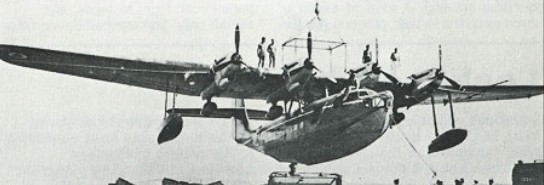
In January 1938, Air France ordered six H-246.1 aircraft in addition to the prototype, and two aircraft were about to enter service on the Marignane-Algiers route when war broke out. The French navy intended to impress all six series aircraft for maritime reconnaissance, but in the event only one was converted. This was the third series aircraft, which flew in June 1940, and then went into service with Escadrille 9.E with a modified extended glazed nose section. It was armed with four 7.5mm Darne machine-guns and 600kg of bombs.
From October 1939 to November 1942 the civil LeO boats operated the route to Algiers for Air France. After that they were seized by the Luftwaffe, converted to carry 21 troops or 14 stretcher cases, and armed with five 7.92mm MG 15 machine-guns, one in a bow turret, two in lateral positions and two more firing through windows at the rear of the flight deck. They were used on a variety of tasks, including brief operations in Finland. Post-war, two surviving LeO H-246.1s were used for a time on the Air France Marignane-Algiers route.
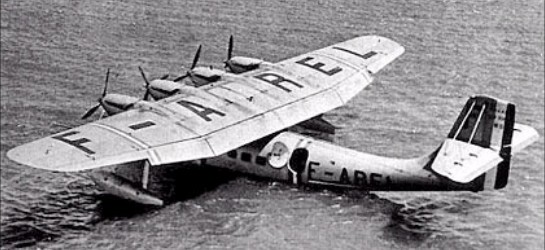
Designed to an official requirement of 1935, the Liore-et-Olivier LeO H-246.01 flying-boat prototype flew on 30 September 1937. A graceful parasol-wing monoplane, its metal hull incorporated a flight deck for the four-man crew and a main cabin for 26 passengers.
H-246.1
Engine: 4 x Hispano-Suiza 12Xgrs/Xhrs V-12, 537kW
Max take-off weight: 15000 kg / 33070 lb
Loaded weight: 9800 kg / 21605 lb
Wingspan: 31.72 m / 104 ft 1 in
Length: 21.17 m / 69 ft 5 in
Height: 7.15 m / 23 ft 5 in
Wing area: 131.0 sq.m / 1410.07 sq ft
Max. speed: 330 km/h / 205 mph
Ceiling: 7000 m / 22950 ft
Range: 2000 km / 1243 miles
Lioré-et-Olivier LeO 203 / LeO 204 / LeO 206
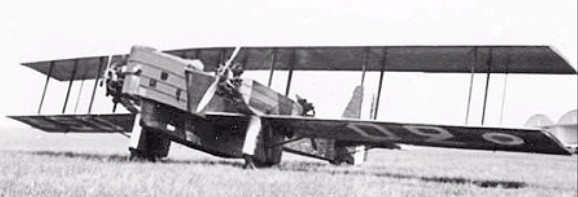
In search of a more powerful night-bomber, the Liore-et-Olivier design team developed a large four-engined machine, the Liore-et-Olivier LeO 203. This was first flown in May 1930, and was powered by four 224kW Gnome-Rhone 7Kb radials mounted in pairs on the lower wings. Soon afterwards a floatplane version was flown under the designation LeO 204.
A 1931 order for 40 LeO 203s was transferred to the LeO 206, the first of which made it maiden flight in June 1932. This had a redesigned nose, a ventral balcony which housed the bomb-bay and, at the rear, a defensive gun position, and was powered by four 261kW Gnome-Rhone 7Kd radials. The LeO 206 equipped Groupe de Bombardement III/12 at Reims and then GB I/22 at Chartres. Three aircraft of the original order for 40 were completed as LeO 207 machines with a nose section similar to that of the LeO 203 and a smaller ventral balcony than that of the LeO 206. Performance was improved by the installation of Gnome-Rhone Titan Kds supercharged engines.
The ability of the LeO 206 to remain aloft on only three or even two engines gave it an extended life. Nicknamed Caravelle, 29 were still in flying condition in September 1939, the majority of them stationed in Morocco.
LeO 206
Engine: 4 x Gnome-Rhone 7Kd Titan radial, 261kW
Max take-off weight: 8450 kg / 18629 lb
Loaded weight: 4230 kg / 9326 lb
Wingspan: 24.54 m / 80 ft 6 in
Length: 14.77 m / 48 ft 5 in
Height: 6.28 m / 20 ft 7 in
Wing area: 118 sq.m / 1270.14 sq ft
Max. speed: 215 km/h / 134 mph
Ceiling: 7250 m / 23800 ft
Range: 2000 km / 1243 miles
Armament: 6 x 7.7mm machine-guns, 1500kg of bombs
Lioré-et-Olivier H-24
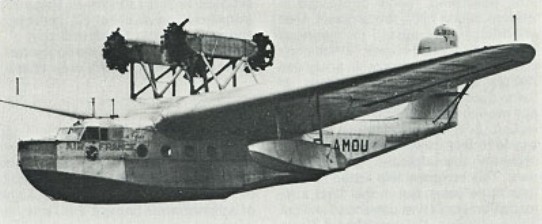
The result of prolonged design work by Benoit and his design team, the Liore-et-Olivier H-24.01 made its first flight in November 1929. A cantilever high-wing monoplane flying-boat, the H-24 had an enclosed pilot’s cockpit, cabin accommodation for 10 passengers and a distinctive tall single fin and rudder, and was powered by two 373kW Renault 12Jb V-12 engines mounted in tandem on a pylon over the hull. This single aircraft was used purely for development, making a number of test and demonstration flights before being scrapped at Antibes in 1934.
Developed from the H-24 was the H-24-2, of similar configuration but powered by four Gnome-Rhone radial engines mounted in tandem pairs over the thick-section wing. The first two of 14 production aircraft for Air France were H-24-2s, and the remaining 12 were H-24-2/1 aircraft with a revised engine installation. The first H-24-2 had flown for the initial time in March 1933, and before long all the machines were employed on Air France routes linking Marseilles with Athens, Tunis and Beirut. Ten aircraft were still operational in September 1939, and were flown under Italian supervision after the German occupation of southern France in November 1942. It is understood that most were scrapped shortly afterwards. The H-24-2 and H-24-2/1 had an enclosed crew cabin with side-by-side pilots’ seats and a navigation and radio compartment; 15 passengers could be accommodated in a cabin beneath the wings, and there was a sizeable luggage and mail hold at the rear.
LeO H-24-2/1
Engines: 4 x Gnome-Rhone 7Kd Titan Major radial, 261kW
Max take-off weight: 8700 kg / 19180 lb
Loaded weight: 5868 kg / 12937 lb
Wingspan: 28.0 m / 91 ft 10 in
Length: 18.45 m / 60 ft 6 in
Height: 6.33 m / 20 ft 9 in
Wing area: 116.25 sq.m / 1251.30 sq ft
Max. speed: 240 km/h / 149 mph
Ceiling: 4500 m / 14750 ft
Range: 1100 km / 684 miles
Lioré-et-Olivier LeO.25 / Leo.252/ H-252 / Leo.253 / H-254/ H-256 / H-257 / H-258 / H-259 / H-25
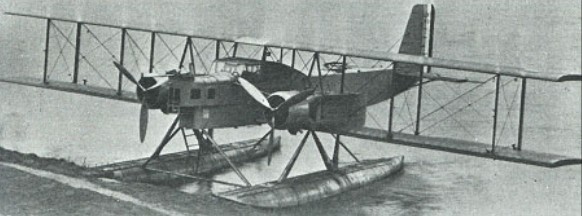
Powered by two 429kW Hispano-Suiza 12Hb engines, the Liore-et-Olivier LeO 25 prototype four-seat night-bomber was delivered in 1928 as part of the second series batch of LeO 20s. It showed little improvement over the LeO 20, from which it could be distinguished by its redesigned fin. The next year it was redesignated LeO 252.01 after being re-engined with Hispano 12Mbr engines, and in 1931 it was fitted with two large wooden floats for evaluation by the French navy. The second LeO 252, slightly modified, appeared in 1932 and was bought by Romania.
Three landplane developments of the LeO 252 were delivered to Brazil as LeO 253 aircraft in 1931, but were not assembled until the following year when they took part in the civil war in that country. The LeO 253 had a maximum speed of 215km/h.
The LeO H-254 flew for the first time in the summer of 1932, and was a refined version of the H-252 intended for production, but only two examples were built and these were used at Berre to familiarise Farman F.168 crews with the more advanced aircraft to come.
The LeO H-255 was a version of the H-254 with 515kW Hispano-Suiza 12Xbrs engines. Flown first as a landplane, then as a seaplane, it gained several world height with load records for seaplanes.
The LeO H-256 appeared in late 1932, introducing increased wing area.
The LeO H-257 was a considerable advance over the previous prototypes, powered by the Gnome-Rhone 14Kbrs Mistral Major radial engines preferred by the French navy, and with an enclosed cabin for the pilot. It first flew in March 1933 and was sufficiently impressive to earn an order for 60 LeO H-257bis series seaplanes with more powerful Gnome-Rhone 14Kirs/Kjrs engines, a strengthened structure, and the nose gun position enclosed in a glazed rotating cupola.
The LeO H-258 was delivered before the H-257bis, 26 going into service, initially with Escadrilles 3B1 and 3B2, from June 1935 onwards. The H-258 had two 484kW Hispano-Suiza 12Nbr engines and attained a maximum speed of 240km/h. The H-257bis went into service from June 1936, equipping seaplane Escadrilles 3B1, 3B2, then B-1, B-2, B-3 and finally E.7 and 3S4. The Armee de I’Air used the landplane version with fixed independent mainwheels in Groupe de Bombardement II/25.
After neutrality patrols during the Spanish Civil War, the LeO floatplanes were used as convoy escorts and for submarine patrols from September 1939, seeing action in the English Channel, and on the Atlantic and Mediterranean coasts. Some were flung into action on bombing raids against the German Blitzkrieg in the summer of 1940, suffering heavy losses. At the outbreak of war 19 landplane LeO H-257bis aircraft were still in service in North Africa, and in August 1940 the Vichy regime had 53 floatplanes on strength. The last examples were withdrawn from training and target towing duties at the end of 1944.
The solitary H-259, the last of the H-25 series, had 641kW Hispano-Suiza 12Ydrs/Yfrs engines and disappointing performance, and, after test flights in 1935, no orders were received.
H-257bis
Engine: 2 x Hispano-Suiza 12Xgrs/Xhrs V-12, 537kW
Max take-off weight: 9560 kg / 21076 lb
Loaded weight: 5300 kg / 11685 lb
Wingspan: 25.5 m / 83 ft 8 in
Length: 17.54 m / 57 ft 7 in
Height: 6.8 m / 22 ft 4 in
Wing area: 133.5 sq.m / 1436.98 sq ft
Max. speed: 230 km/h / 143 mph
Ceiling: 8000 m / 26250 ft
Range: 1500 km / 932 miles
Armament: 3 x 7.5mm machine-guns, one 670kg torpedo or 600kg of bombs
Lioré-et-Olivier LeO.21 / LéO 213
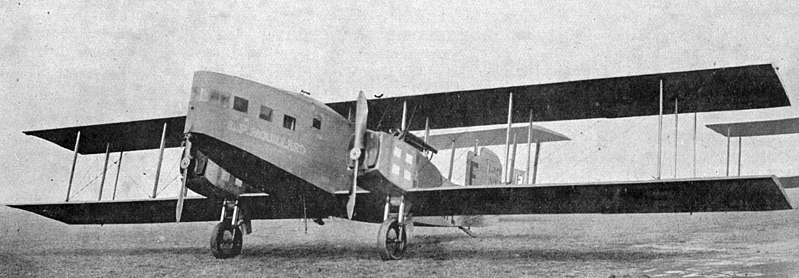
The Lioré et Olivier LéO 21 was based on the earlier LéO 20 night bomber. First flown in August 1929 the LéO 21 was a twin-engined biplane airliner with a fixed tailskid landing gear. It retained the basic structure of the LéO 20 night bomber but with a new wider fuselage. It had room for six passengers in a nose cabin and a further 12 passengers in the main cabin with an open cockpit for the pilot.
The second LéO 21 was fitted with two 450 hp (336 kW) Renault 12Ja engines and re-designated as a LéO 212. It was converted by the Wagons-Lits company as a dining aircraft. The first LéO 21 became an avion-bar in 1929 and was re-designated LéO 211; it was later modified in 1931 with Renault engines as the LéO 213.
One aircraft was produced as the LéO 21S fitted as a 10-stretcher ambulance.
The first production LéO 213 was built in 1928 and a total of eleven were built and operated by Air Union on routes from Paris to London, Lyons, Marseilles and Geneva. The LéO 213 had an increased wingspan, improved sound proofing and three baggage holds. When modified for night services they were re-designated as LéO 213N.
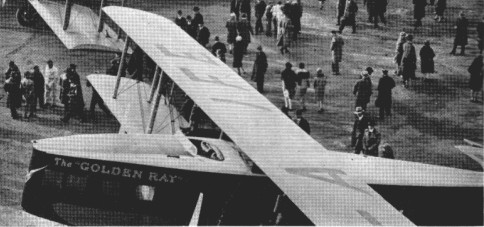
Operated by Air Union circa 1929. Air France replaced its LeO 21 biplanes with a fleet of Wibault 282s, which in turn gave way to Bloch 220s.
On 25 July 1930, LeO 21 F-AIZO Golden Ray/Rayon d’Or of Air Union made a forced landing at Snave, Kent following an engine failure. The aircraft was subsequently dismantled and removed to Hythe, Kent.
The Spanish Republican Air Force operated Lioré et Olivier 213.
Liore & Olivier LeO 213 Article
In 1934 all the surviving LéO 213s were bought by the Armée de l’Air (French Air Force) and were converted to transports for 14-troops on bench seats and re-designated LéO 214.
Variants:
LeO 21
Prototype
Engines: 2 x 310 kW (420 hp) Gnome & Rhône 9Ab Jupiter
LeO 211
First prototype modified
LeO 212
Second prototype
Engines: 2 x 340 kW (450 hp) Renault 12Ja
LeO 213 / LéO 213N
Production version
Engine: Renault 12Ja
LeO 214
Armée de l’Air conversions from LéO 213
Powerplant: 2 × Renault 12Ja, 336 kW (450 hp)
Wingspan: 23.03 m (75 ft 6.75 in)
Wing area: 108 m2 (1,162.54 sq ft)
Length: 15.55 m (51 ft 0.25 in)
Height: 4.50 m (14 ft 9.25 in)
Empty weight: 3,440 kg (7,584 lb)
Gross weight: 5,700 kg (12,566 lb)
Maximum speed: 190 km/h (118 mph, 103 kn)
Range: 560 km (348 mi, 302 nmi)
Service ceiling: 4,500 m (14,765 ft)
Crew: 1
Capacity: 14 troops
LeO 21S
Air ambulance, one built.

