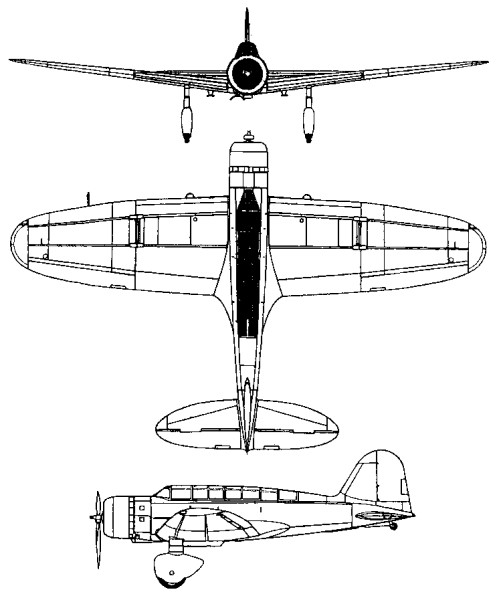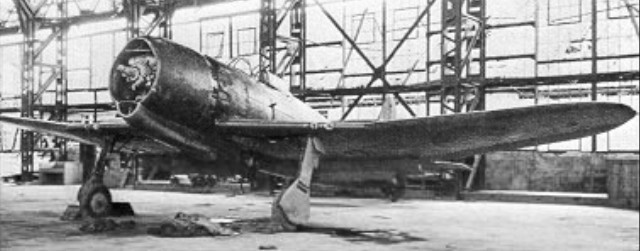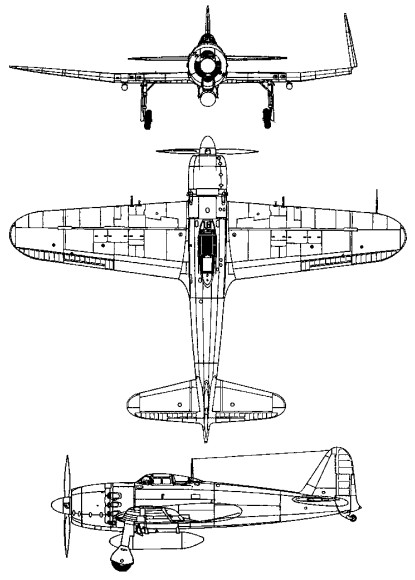
Mitsubishi G4M / G6M

G4M

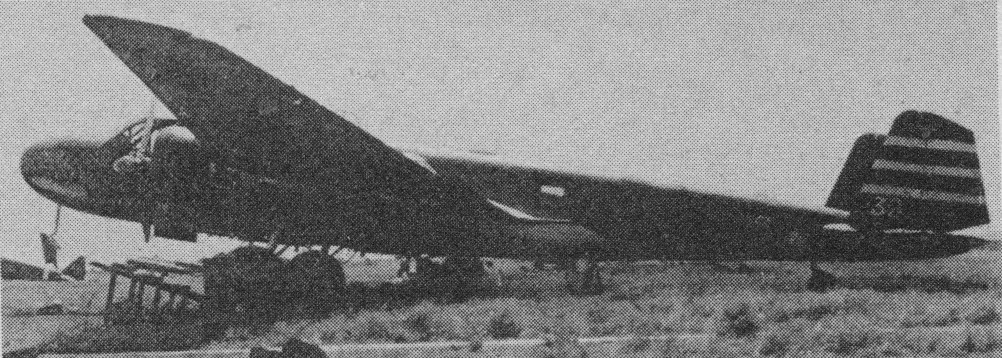
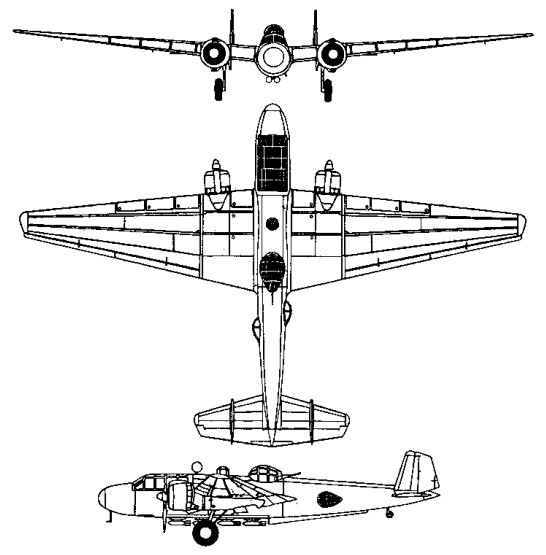
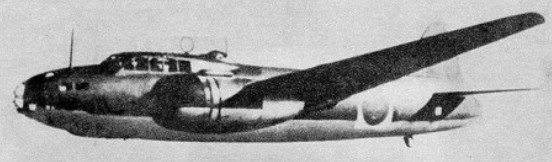
Kiro Honjo led the design team to a 12-Shi requirement of the Imperial Navy specifying the range, and twin engines. The result was very light and devoid of any protection for crew, engines, fuel tanks or systems.

The first flight by the first of two prototypes was made on October 23, 1939, to a 1937 requirement for a long-range bomber. During trials recorded an extraordinary performance of a 444km/h top speed and 5,555km range, albeit without bombload.

Mitsubishi G4M Article

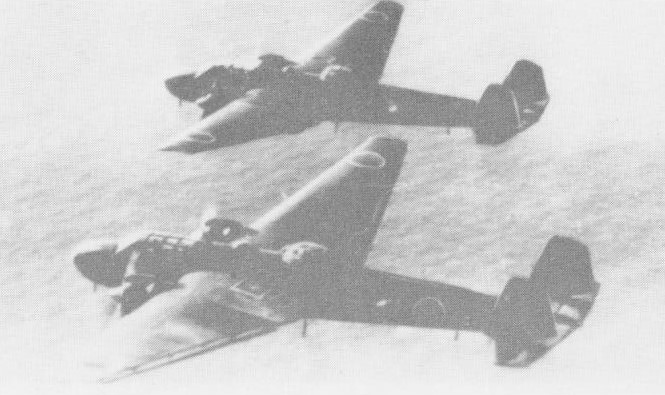
Almost immediately afterwards its development was channelled in an entirely different direction. The company was instructed by the navy to adapt it instead for bomber escort duties. This meant sacrificing some 25% of the fuel load to offset the added weight of extra guns and ammunition, and increasing the crew to a total of ten men, compared with seven in the bomber version. No fewer than 30 examples of the G6M1, as this version was known, had been completed and put through service acceptance trials in 1940 before the JNAF was forced to admit that performance was just not good enough for the escort job. The aircraft themselves were later adapted to serve as G6M1 K trainers and, later still, as G6M1 1 2 paratroop transports.
G4M

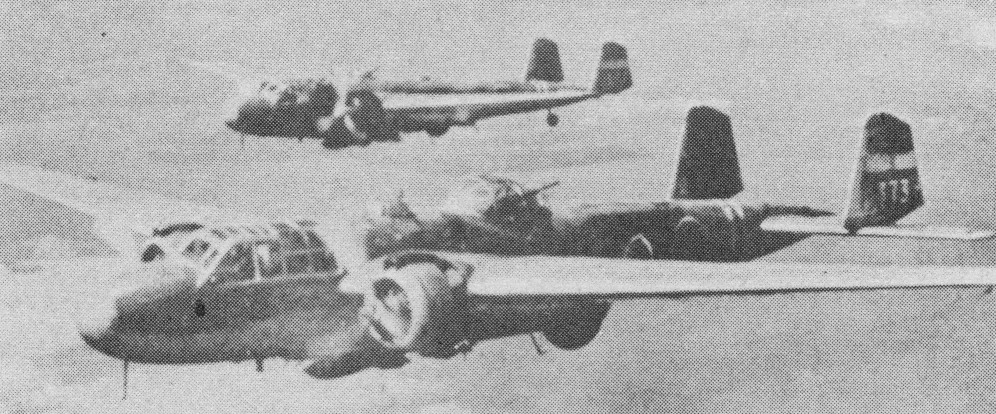
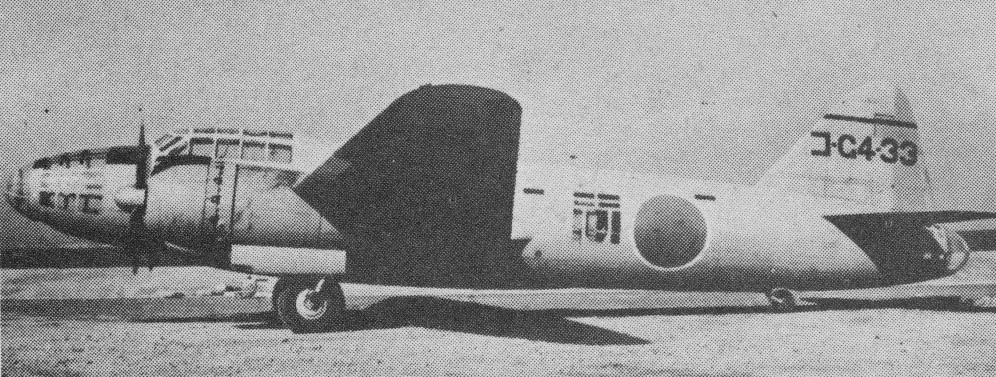
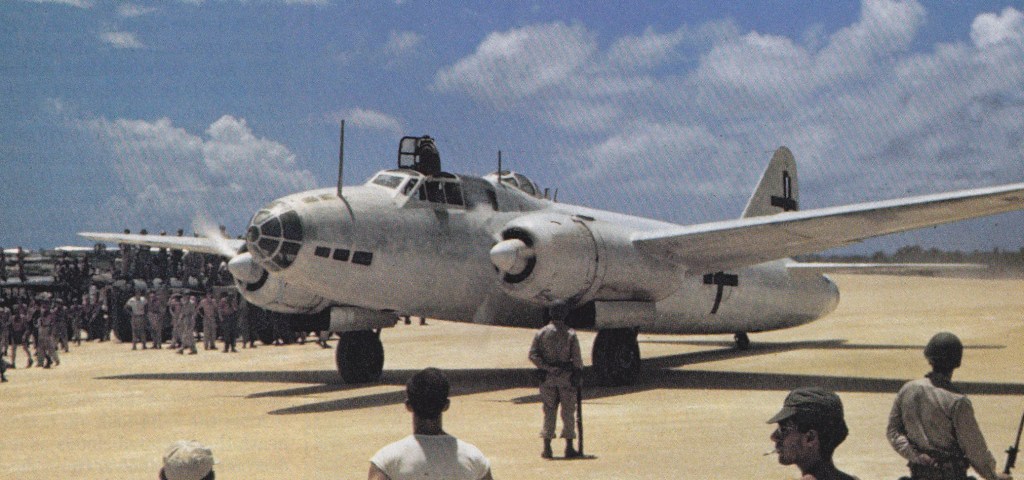
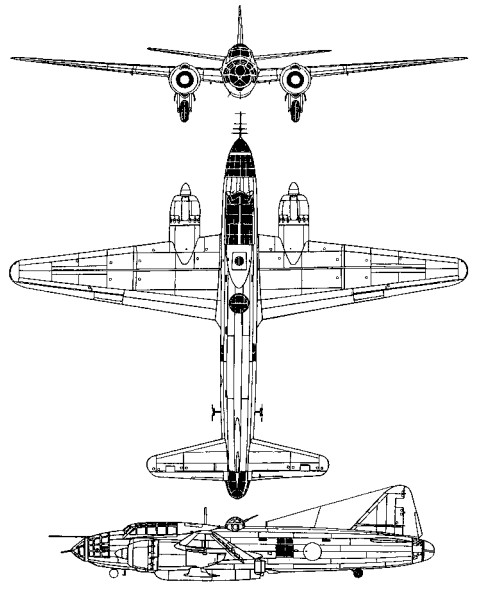
Continuing G4M development, however, Mitsubishi managed to get another 14 of these bombers completed by the end of March 1941, and in April this version was accepted for service as the G4M1 Model 11. They were soon in successful operation against targets in China, and by the time of the Pearl Harbor attack at the end of that year, 120 or so were in service. The Model 11 was armed with four single 7.7 mm (0.303 in) Type 92 machine guns in nose, waist and dorsal positions, and a 20 mm (0.79 in) Type 99 cannon in the tail, and could carry the specified 800 kg (1764 1b) weapon load. Powerplant was a pair of 1530 hp Mitsubishi Kasei 11 14 cylinder two row radial engines. The Model 11 scored a number of early successes, but when losses began to mount, Mitsubishi produced the improved G4M1 Model 12, with Kasei 15 engines.

The first production G4M1s (Navy Type 1 Attack Bomber Model 11) were initially deployed against China in mid-1941 but on the eve of the attack on Malaya the bombers moved to Indo-China and within a week had successfully attacked the Prince of Wales and Repulse. When Allied fighter opposition eventually increased to effective proportions, the G4M1 was seen to be very vulnerable, possessing little armour protection for crew and fuel tanks, and it was in a pair of G4M1s that Admiral Yamamoto and his staff were travelling when shot down by P-38s over Bougainville on 18 April 1943. Little improvement had been secured in the Navy Type 1 Attack Bomber Model 22 with revised powerplant.

Its inherent weakness, which earned it the totally unwelcome sobriquet of ‘the one shot lighter’, was not altogether surprising when it is considered that the September 1937 JNAF requirement to which it was designed demanded a twin engined aircraft with a range of nearly 4830 km (3000 miles) and, over 3706 km (2300 miles), an 800 kg (1764 1b) weapon load. This ‘range at all costs’ philosophy could only be met by cramming every available bit of wing space with 4900 litres (1078 Imp gal) of fuel, and only then by omitting any kind of armour protection for either the crew or the fuel tanks. Everything else had to go into the fuselage and, by the standards of the day, was necessarily large and bulky.

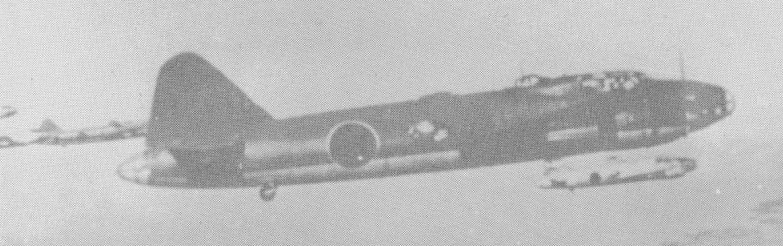
After the Solomon Islands campaign in August 1942, when losses were particularly heavy because of the bomber’s extreme inflammability, there quickly followed the prototype G4M2.
G4M2

This had more powerful engines, 1343kW / 1800 hp Kasei 21s with water¬methanol injection and several aerodynamic improvements. Armament was increased by adding two more 7.7 mm (0.303¬in) guns in the nose and replacing the dorsal 7.7 mm by a turret mounted 20 mm (0.79 in) cannon; internal bombload went up to 1000 kg (2204 lb). Fuel capacity was increased, to 6490 litres (1427 Imp gal), but still the tanks remained virtually unprotected. This version (Navy Type 1 Attack Bomber Model 22A and Model 22B) remained in production until the end of the war in steadily improved Navy Type 1 Attack Bomber Model 24 variants. The G4M2 was built in such numbers as to become the second most important production model, a total of 1154 being completed compared with 1200 G4M1s. These included the G4M2 Model 22A (Type 99 cannon in the waist positions) and 22B (all four Type 99 cannon of a later type); the G4M2a Model 24 (with 1850 hp Kasei 25 engines and bulged bomb bay doors); the G4M2b Model 25 testbed (1795 hp Kasei 27s); two G4M2c Model 26s (testbeds for turbocharged Kasei 25s); the G4M2d Model 27 testbed (1825 hp Kasei 25b engines); and the G4M2e Model 24.1 a version with one 7.7 mm (0.303 in) and four 20 mm (0.79 in) guns.
G4M

In the face of continuing heavy losses, in 1944 Mitsubishi built 60 examples of the G4M3, with armour protection for the crew and a much ¬redesigned wing containing a reduced fuel load of 4490 litres (988 Imp gal), stored in fully protected tanks, produced in small numbers as the Navy Type 1 Attack Bomber Model 34. Final versions were two G4M3 Model 36 prototypes, which made test flights with exhaust driven engine turbo¬chargers.

The ‘Betty’ did per¬form as the carrier aircraft for the air launched Yokosuka MXY¬7 Ohka piloted flying bomb, developed in the latter half of 1944. The Ohka should have entered service at the end of that year, but the first consignment of 50 was lost in November, when the carrier Shinano was sunk on its way to the Philippines. The first combat encounter was thus deferred until March 21, 1945, when a force of 16 Ohka¬-carrying G4M2e Model 24J bombers (the version chosen for this role), with an escort of 30 Zero fighters, was despatched against a US task force some 480 km (298 miles) off Kyushu. On the way, however, the force was met by more than 50 US Hellcat fighters, and lost every Ohka carrying bomber and half of the escorting Zeros. In order to attach the Ohka beneath the belly of the G4M2e the latter’s bomb bay doors were removed. Launch was usually made from an altitude of around 8200 m (26900 ft), at an airspeed of about 319 km/h (198 mph), the Ohka then gliding towards its target, cutting in the rocket motor only for the last few miles of flight and the terminal dive.

Many G4M1s were converted into trainers, maritime reconnaissance aircraft or 20 passenger troop transports towards the end of the Second World War. The G4M can also claim to have served from beginning to end of the Pacific war, for a pair of white painted G4M1s were used to trans¬port the Japanese delegation to Ie Shima on August 19, 1945, to sign the instrument of surrender.

Of the total production of 2446 G4M series aircraft, production amounted to 1,200 G4M1s, 1,154 G4M2s and 60 G4M3s.

Gallery

G4M1
Engine: 2 x Mitsubishi Kasei (Mars) II 14 cyl, 1530 hp
Crew: 7 Armament: 4 x 7.7mm mg, 1 x 20 mm cannon
Max speed: 266 mph at 13,870 ft
Cruise speed: 196 mph at 9840 ft
Service ceiling: 30,000 ft
Range: 1900 mile
Bomb load: 2200 lb or 1 x 1760 lb torpedo

G4M2
Crew: 7-10
Engines: 2 x Mitsubishi MK4P “Kasei-21”, 1350kW
Max take-off weight: 12500 kg / 27558 lb
Empty weight: 8160 kg / 17990 lb
Wingspan: 24.9 m / 81 ft 8 in
Length: 19.62 m / 64 ft 4 in
Height: 6 m / 19 ft 8 in
Wing area: 78.13 sq.m / 840.98 sq ft
Max. speed: 430 km/h / 267 mph
Cruise speed: 310 km/h / 193 mph
Ceiling: 8950 m / 29350 ft
Range w/max.fuel: 6000 km / 3728 miles
Armament: 2 x 20mm cannons, 4 x 7.7mm machine-guns, 2200kg of bombs

G4M2a Model 24
Engine: 2 x Mitsubishi Kasei 25, 1850 hp
Span: 24.89 m (81 ft 8 in)
Length: 19.63 m (64 ft 5 in)
Height: 13 ft 5.75 in
Empty weight: 18,449 lb
Gross weight: 15,000 kg (33 069 lb)
Maximum speed: 436 km/h (271 mph) at 15,090 ft
Service ceiling: 29,350 ft
Normal range: 2262 mi
Armament: 4 x 20mm Type 99 cannon, 1 x 7.7mm Type 97 mg
Bombload: 2200 lb or 1 x 1764 lb torpedo
Crew: 7
Mitsubishi G4M BETTY

Mitsubishi G3M / Ka-15 / L3Y

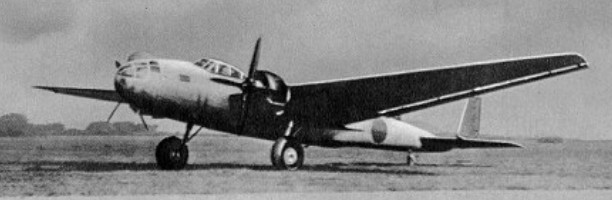
In response to a 1935 Japanese naval requirement for a landbased twin-engine reconnaissance aircraft, Mitsubishi flew the first Ka-15 prototype, an aircraft which possessed a design potential that allowed development as a long-range medium bomber. Following successful flight trials, the aircraft entered production in June 1936 as the Navy Type 96 Attack Bomber Model 11 (Mitsubishi G3M1).

Mitsubishi G3M Article

In its original prototype form the Ka 15, designed by Kiro Honjo, made its first flight in July 1935. Two 750 hp Hiro Type 91 12-cylinder V type engines were mounted on the mid set wings, which were essentially the same as those of the Ka 9.

Twenty more prototype/preproduction Ka 15s were completed, of which three had Hiro engines; the remaining 17 were powered by 830 hp or 910-hp Mitsubishi Kinsei 2 or 3 14 cylinder two-row radial engines, giving enhanced performance. These aircraft had the designation G3M1, and unofficially they were subdivided into G3M1a (the four with Hiro engines and solid noses), G3M1b (two with Kinseis and solid noses), and G3M1c (the other 15 Kinsei powered aircraft, which had a transparent bombing station in the nose). Twelve were used for service trials, but before these had been completed a production batch of 34 Kinsei 3 powered G3M1s, with modified cockpit windows, was authorized by the IJN. These had a crew of five, and could carry an 800 kg (1763 1b) torpedo beneath the fuselage; defensive armament consisted of two retractable dorsal turrets each containing one 7.7 mm (0.303 in) Type 92 machine gun, with another of these guns in a retractable ventral turret.

As the improved Kinsei 41 and 42 engine became available in 1937 a new version, the G3M2, started production and, with a total of 581 built by mid-1941, was the principal variant. With a top speed now increased to 374km/h, a bombload of up to 800kg carried externally and a defensive armament of three 7.7mm machine-guns, the G3M2 possessed a maximum range of 4380km.

It was built in two basic variants, the Model 21 and Model 22. The 21 had uprated Kinsei 41 or 42 engines of 1075 hp, increased fuel tankage and modified dorsal turrets; the 22 had 1075 hp Kinsei 45s (also fitted to some late¬production Model 21s), and a completely revised armament system that eliminated the retractable ventral and rear dorsal turrets, replacing the latter by a large turtleback enclosure housing a 20 mm (0.79 in) Type 99 cannon, and the former by a pair of blisters, one each side of the rear fuselage, each with single Type 92 gun. Between 1937 39, Mitsubishi built 343 Model 21s, following these in 1939 41 with 238 Model 22s.

G3M2

Mitsubishi G3M2s were first flown in action by the Japanese navy’s Kanoya Kokutai in August 1937 in raids on Hangchow and Kwangteh in China. By 1940 four kokutais in China were equipped with a total of about 130 G3M2s, a number that grew to 204 by the date of Pearl Harbor with the deployment of forces against Wake Island, the Philippines and the Marianas. And it was a force of 60 G3M2s of the Genzan and Minoro Kokutais (with 26 Mitsubishi G4Mls of the Kanoya Kokutai) which, flying from bases in Indo-China, found and sank the British warships HMS Prince of Wales and HMS Repulse as they steamed without fighter protection off the Malayan coast on 10 December 1941. The type was known to the Allies as the ‘Nell’.

G3M2

When Mitsubishi production was then phased out in favour of the later G4M bomber, production of the G3M was carried on by the Koizumi factory of the Nakajima company, which built 412 G3M type bom-bers, of which a proportion were of a fourth model, the G3M3. These had Kinsei 51 radials of 1300 hp each, and a further increase in fuel tankage, extending the max¬imum range to 6230 km (3870 miles) com-pared with the 4380 km, (2720 miles) of the G3M2 Model 22.

At the time of Pearl Harbor, the backbone of Japan’s long range strike force consisted of just over 200 G3Ms (mostly G3M2s and G3M3s) and about 120 of the later G4M1s. The G3M (‘Nell’ under the Pacific system of codenarnes introduced by the Allies during the Second World War) had made its service debut in August 1937, with raids on Chinese mainland targets from bases on Kyushu (Omura) and Formosa (Taipei).

The G3M was used throughout the war, in most of the Pacific theatres, as was the G3M1 L, a prewar transport conversion with Kinsei 45 engines which took part in the invasion of Celebes. Wartime transport con¬versions were the L3Y1 Model 11 and L3Y2 Model 12 (both codenarned ‘Tina’), con¬verted from G3M1s and G3M2s respectively by the First Naval Air Arsenal at Kasurnigaura. These carried up to ten pas¬sengers, and had a single 7.7 mm (0.303 in) machine gun for defence.

Total production of the G3M series reached 1100, including the Kinsei 42 powered G3M2b, the transport G3M2d (L3Y2) and the G3M3 final bomber.

G3M 1
Engines: 2 x 678kW Kinsei 3
Maximum speed: 360km/h at 1975m

G3M2
Engines: 2 x Mitsubihi Kinsei 45, 1000 hp
Wingspan: 82 ft 0.25 in
Length: 53 ft 11.75 in
Height: 11 ft 11.75 in
Empty weight: 11,442 lb
Loaded weight: 17,637 lb
Max speed: 238 mph at 9,840 ft
Service ceiling: 29,890 ft
Amament: 1 x 20mm cannon, 2 x 7.7mm mg
Bombload: 2200 lb or 1 x 1760 lb torpedo
Crew: 7
G3M2 Model 22
Span: 25m (82ft 0.25in)
Length. 16.45 m (53 ft 11.75 in)
Gross weight: 8000 kg (176371b)
Maximum speed: 373 km/h (232 mph)

G3M3
Engines: 2 x Mitsubishi MK8 Kinsei-51, 975kW
Max take-off weight: 8000 kg / 17637 lb
Empty weight: 5250 kg / 11574 lb
Wingspan: 25.0 m / 82 ft 0 in
Length: 16.5 m / 54 ft 2 in
Height: 3.7 m / 12 ft 2 in
Wing area: 75.1 sq.m / 808.37 sq ft
Max. speed: 415 km/h / 258 mph at 6000m
Cruise speed: 295 km/h / 183 mph
Ceiling: 10300 m / 33800 ft
Range w/max.fuel: 6200 km / 3853 miles
Armament: 1 x 20mm cannon, 4 x 7.7mm machine-guns, 800kg of bombs
Crew: 5

Mitsubishi G3M NELL

Mitsubishi Ka-16 / B5M / Type 97

With the company designation Mitsubishi Ka-16, this cantilever low-wing monoplane, carrier-based torpedo-bomber flew in prototype form as the Navy 10-Shi Experimental Attacker in 1936.

A three-seater, it had a long glazed crew canopy and was distinguished easily from its Nakajima B5N rival by having fixed cantilever landing gear with spat-type wheel fairings. The wings outboard of the landing gear could be folded upwards for carrier stowage.

Mitsubishi B5M1

As a precaution against problems with the B5N, this Mitsubishi B5M1 design was placed in production and went into service as the Navy Type 97 Carrier Attack Bomber Model 2, gaining initially the Allied codename ‘Mabel’, later changed to ‘Kate 61’.

At least 125 had been delivered when the obvious success of the B5N brought production to a halt. The B5M1 saw some action from land bases in the South Pacific before being relegated to training and liaison duties.

B5M1
Engine: 746kW Mitsubishi Kinsei 43
Wingspan: 15.3 m / 50 ft 2 in
Length: 10.23 m / 33 ft 7 in
Height: 3.12 m / 10 ft 3 in
Wing area: 37.95 sq.m / 408.49 sq ft
Max take-off weight: 4000 kg / 8819 lb
Max. speed: 379 km/h / 236 mph
Range: 2187 km / 1359 miles
Armament: one 7.7mm machine-gun, 800kg torpedo or 800 kg bombs
Crew: 3

Mitsubishi B5M MABEL

Mitsubishi M-50 / A7M

The Reppu (Hurricane) was designed to the requirements of a 17-Shi specification as an A6M successor, and was the responsibility of Jiro Horikoshi. It was not until 1942 that design of the M-50 Reppu (hurricane) began, but the continuing pressure on Mitsubishi for developments of the ABM meant that it was not until 6 May 1944 that the first prototype, which by then had the company designation Mitsubishi A7M1, was flown for the first time.

The first of two A7M1 prototypes was powered with a Nakajima NK9K Homare 22 engine rated at 2,000 hp for take¬off.

A cantilever low-wing monoplane with retractable tailwheel landing gear, and hy¬draulically-operated outer wing panels, the A7M1 revealed excellent flight characteristics, but as predicted by Mitsubishi the type’s maximum speed on the power of the installed Nakajima NK9K Homare 22 engine was below specification.

Further testing was abandoned until availability of the 1641kW / 2,200 hp for take-off Mitsubishi MK9A radial engine made it possible to build seven A7M2 prototype and service trials aircraft, the first prototype being flown on 13 October 1944. Plans for large-scale production were immediately initiated, and it was proposed that series aircraft would have either four 20-mm cannon or two cannon and two 13,2-mm machine guns.

The Reppu had a maximum speed of 630km/h at optimum altitude and was ordered into production as the Navy Carrier Fighter Reppu Model 22. A further six A7M2 prototypes and one production aircraft had been completed by the time hostilities terminated, at which time work was proceeding on the extensively modified A7M3-J which was to have been powered by a turbosupercharged version of the MK9A engine and carry an armament of four wing-mounted and two oblique-firing fuselage-mounted 30-mm cannon.

Allied air attacks and an earthquake limiting production to only one aircraft. Development of similar land-based fighters was planned under the designations A7M3 and A7M3-J, but neither was built before the war ended.

A7M1
Engine: Nakajima NK9K Homare 22, 2,000 hp

A7M2
Engine: Mitsubishi MK9A, 2,200 hp / 1650kW
Max speed, 390 mph (628 km/h) at 21,655 ft (6 600 m)
Time to 19,685 ft (6 000 m), 6.15 min
Range (internal fuel), 570 mls (917 km)
Cruise speed: 410 km/h / 255 mph
Ceiling: 10900 m / 35750 ft
Empty weight, 7,112 lb (3 226 kg)
Max take-off weight, 10,406 lb (4720 kg)
Span, 45 ft 11¼ in (14,00 m)
Length, 36 ft 1¼ in (11,00 m)
Height, 14 ft ½ in (4,28 m)
Wing area, 332.17 sq ft (30,86 sq.m)
Armament: 4 x 20mm cannons, 2 x 250-kg bombs
Crew: 1

Mitsubishi A7M Reppu / SAM

Mitsubishi A6M Zero / Zeke / Nakajima A6M2-N

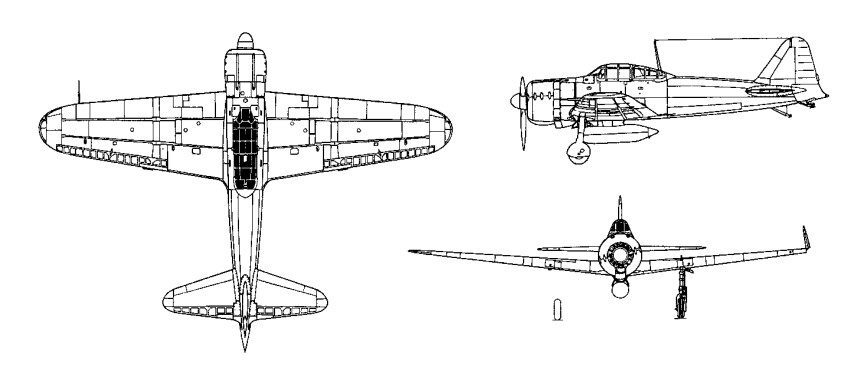
A6M Zero-Sen

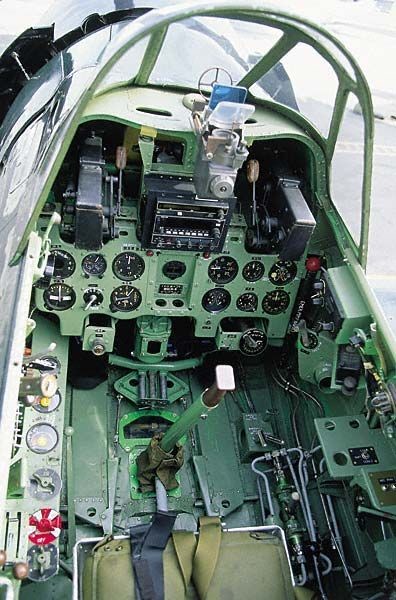
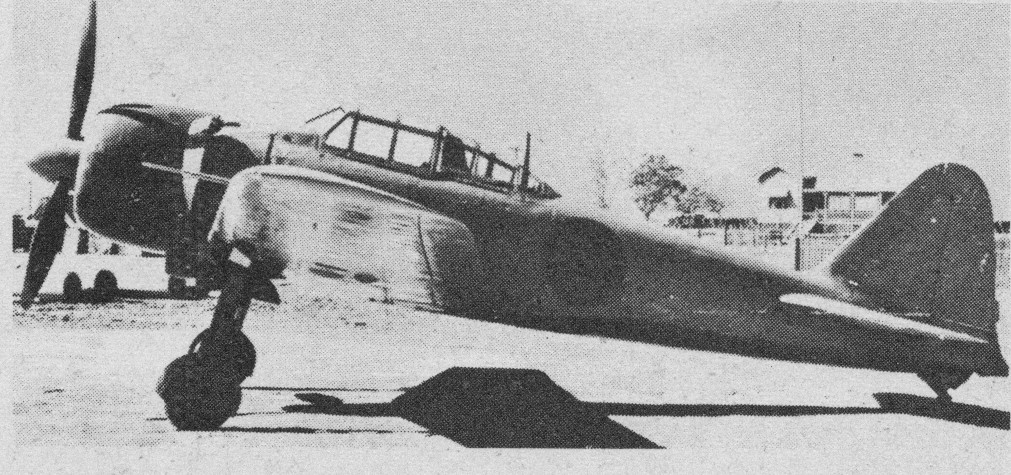
On 5 October 1937 the Japanese Navy furnished the Mitsubishi and Nakajima companies with its requirements for a new fighter. Mitsubishi alone accepted the task and design work began under the direction of Jiro Horikoshi. The power plant for the new navy fighter, on which work began in 1938, was the Mitsubishi MK2 Zuisei 13, a fourteen cylinder radial of 780 hp / 582kW, later known as the Ha.31/13. Care was given to structural weight and extensive use was made of Extra-Super Duralumin. In March 1939, at Mitsubishi’s Nagoya plant, the first prototype was completed.

Mitsubishi A6M Zero Article

The prototype A6M1 was first flown on 1 April 1939 by Katsuzo Shima with a 780 hp Mitsubishi Zuisei 13 radial, and accepted by the Navy as the A6M1.

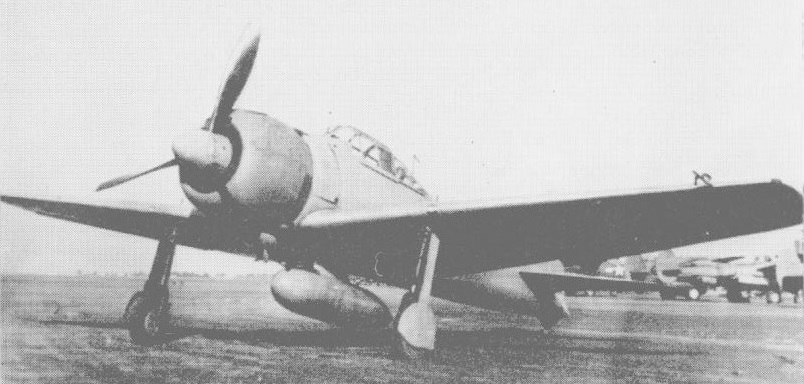
With a Nakajima NK1C Sakae 12 engine of 925 hp / 708kW, the third prototype became the A6M2 Model 11, first flying on 18 January 1940. At the end of July 1940 the A6M2 was officially adopted as the Type 0 Carrier Fighter, Model 11, or Zero-Sen. Production A6M2 fighters (64 built) were fitted with two wing-mounted 20mm guns and two nose-mounted 7.7mm guns. It was with this version that the Japanese navy escorted the raiding force sent against Pearl Harbor, and gained air superiority over Malaya, the Philippines and Burma. The reporting name ‘Zeke’ was given to the A6M.

The major production version was the A6M2 Model 21 which featured folding wingtips for carrier stowage. About 2/3 of the 740 Model 21s (also built by Nakajima) were in service when Japan entered the war.

During 1942, 508 of a two-seat training variant, the A6M2-K, were manufactured by Hitachi and Sasebo.

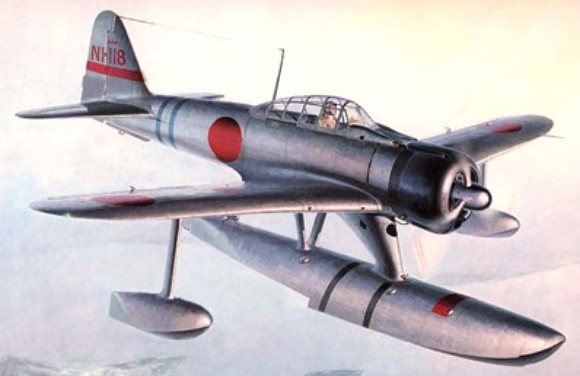
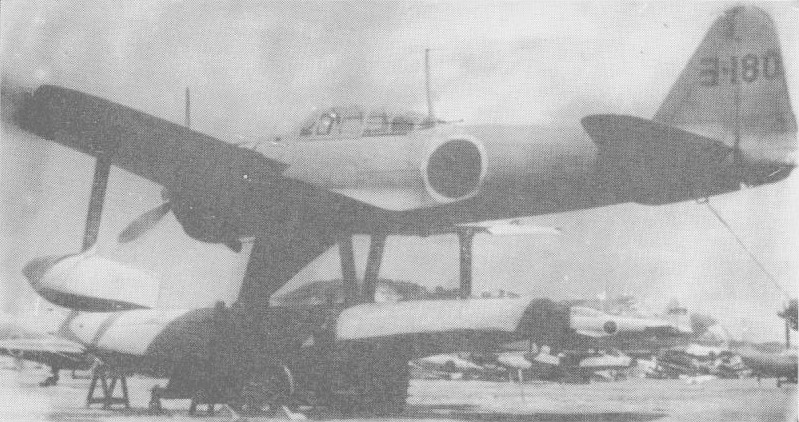
A Japanese Navy specification was issued in 1940 for a single seat fighter seaplane to cover early phases of amphibious landings and for the defence of small islands where hard runways were unnecessary or impracticable. The Nakajima firm was building the Mitsubishi A6M2 Zero under licence and was ordered in February 1941 to develop a float seaplane version.

After removing the wheel landing gear and fairing over the wheel wells of a standard A6M2, Nakajima mounted a large float under the fuselage by means of a forward-raked central pylon and a pair of V-struts below the cockpit; two cantilever stabilizing floats were also mounted under the wings. The standard Zero gun armament was retained, and the first prototype was flown on 7 December 1941, the day on which the Japanese navy attacked Pearl Harbor.

Nakajima A6M2-N

Entering production as the Nakajima A6M2-N and codenamed ‘Rufe’ by the Allies, the new fighter still displayed a creditable performance, being first issued to the Yokohama Kokutai and deployed to Tulagi in the Solomons where the Japanese had first landed during the Battle of the Coral Sea. Almost all the ‘Rufes’ were destroyed in a strike on the seaplane base by 15 Grumman F4Fs from USS Wasp on 7 August 1942.

A6M2-N

Better success attended the ‘Rufes’ which fought in the later Aleutian campaign, but losses soared as soon as American fighter strength could be built up. During the final year of the war, when American heavy bombers and naval aircraft opened their great attacks on the Japanese homeland, ‘Rufes’ of the Otsu Kokutai, based on Lake Biwa, were thrown into the battle as interceptors in defence of Central Honshu but suffered very heavy losses. Total production of ‘Rufe’ amounted to 327 before being halted in September 1943.

In the Spring of 1942 the A6M3 with 1130 hp two-stage supercharged Sakae 21 entered service. Shortcomings revealed during testing led to the clipping of the folding 1 ft 8 in off each wingtip before entering production as the A6M3 Model 32.

Code-named Hap in honour of Gen. Hap Arnold, Arnold requested his name not be used. It was re-coded Hamp before its identity was established as a Zero variant (Zeke 32). The A6M3 Model 32 became operational in 1942 and 343 were built be Mitsubishi. A further 560 A63 Model 22, with normal full-span wing were also completed by Mitsubishi.

A6M3

By 1943 the A6M5 Model 52, which ultimately accounted for more than half the overall Zero production, was in production. The short-span wing of the Zeke 32 were used, but with its tips rounded off, and the Sakae 21 engine was modified to boost the top speed to 358 mph. Various refinements were the A6M5a, 5b and 5c, with differing degrees of firepower, armour protection and other features. A trainer version, the A6M5-K, did not pass beyond the pre-production stage.

A6M5

The Sakae 32-powere A6M6 did not meet expectations, but a further adaptation of the A6M5 produced the A6M7, which entered production, as the European war ended, for the dive bombing role.

Difficulties over the supply of Sakae engines enabled Mitsubishi, late in 1944, to introduce the 1560 hp Mitsubishi Kinsei 62 engine in the A6M8. Only two prototypes were ever flown.

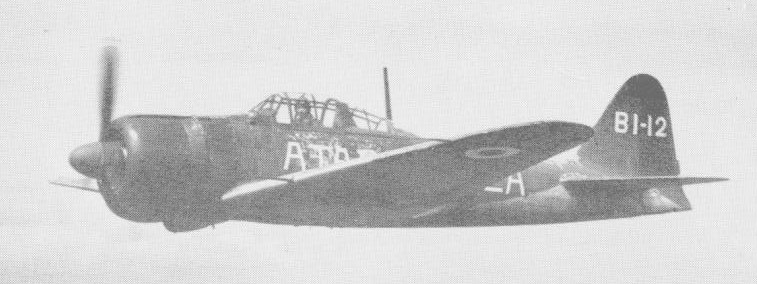
The Battle of Midway represented the Zero’s combat zenith; thereafter the fighter found itself outclassed by the American F6F Hellcat and P-38 Lightning. To counter the new American fighters the A6M5 was rushed to front-line units. This version, with Sakae 21 engine and improved exhaust system, possessed a top speed of 565km/h, more A6M5s (and subvariants) were produced than any other Japanese aircraft.

It was five A6M5s of the Shikishima kamikaze unit that sank the carrier St Lo and damaged three others on 25 October 1944.

Other versions were the A6M6 with water-methanol boosted Sakae 31 engine and the A6M7 fighter/dive-bomber.

Total production of all A6Ms was 10,939, including 327 Rufe floatplanes, of which Mitsubishi built 3879 and Nakajima 6215.

A6M recovery and Restoration Article

Replica:
Roberts Zero
War Aircraft Replicas Zero

Gallery

A6M1
Engine: Mitsubishi MK2 Zuisei 13, 780 hp
Armament: 2 x 20mm cannon & 2 x 7.7mm mg

A6M2
Engine: 1 x Nakajima NK1F Sakae 12, 705kW
Max take-off weight: 2410-2796 kg / 5313 – 6164 lb
Empty weight: 1680 kg / 3704 lb
Wingspan: 12.0 m / 39 ft 4 in
Length: 9.06 m / 29 ft 9 in
Height: 3.05 m / 10 ft 0 in
Wing area: 22.44 sq.m / 241.54 sq ft
Max. speed: 525 km/h / 326 mph
Cruise speed: 330 km/h / 205 mph
Ceiling: 10000 m / 32800 ft
Range w/max.fuel: 3050 km / 1895 miles
Range w/max.payload: 1850 km / 1150 miles
Crew: 1
Armament: 2 x 20mm cannons, 2 x 7.7mm machine-guns, 60kg of bombs

A6M2 Model 11
Engine: Nakajima NK1C Sakae 12, 925 hp

A6M2 Model 21
Max speed: 317 mph @ 16,400 ft
Time to 19,680 ft: 7 min 27 sec

A6M2-N
Engine: Nakajima Sakae 12, 925 hp
Wingspan: 39 ft 4.5 in
Max speed: 270 mph at 14,110 ft

A6M5
Wingspan 11 m (36 ft. 1 in.)
Length 9.12 m (29 ft. 11 in.)
Height 3.51 m (11 ft. 6 in.)
Empty weight 1,876 kg (4,136 lb.)

A6M5b
Engine: Nakajima Sakae 21, 1139 hp
Span: 36 ft 1 in
Length: 29 ft 9 in
Height: 9 ft 2 in
Empty weight; 4175 lb
Loaded weight: 6047 lb
Max speed: 351 mph at 19,685 ft
Service ceiling: 35,100 ft
Max range: 975 mi
Armament: 2 x 20mm cannon, 1 x 12.7 mm mg, 1 x 7.7 mm mg
Bombload: 700 lb
Seats: 1

A6M6c Model 53C
Engine: Nakajima NK1P Sakae 31
Power: 1120 hp @ 2800 rpm (T/O), 1210 hp (war emergency @ 8000 ft), 1055 hp @ 20,400 ft.
Wing span: 36 ft 1 in (10.99m)
Length: 29 ft 9 in (9.06m)
Height: 9 ft 2 in (2.79m)
Empty wt: 3920 lbs (1778 kg)
Operational wt: 6026 lbs (2733 kg)
Max speed: 346 mph (556 kph) @ 19680 ft (5998m)
Service ceiling: 35,100 ft (10698m)
Range: 1130 sm (1818 km) @ 152 mph (244 kph), 875 sm (1408 km) @ 212 mph (341 kph)
Max range: 635 sm (1022 km)
Armament: 2 x Type 99 (Oerlikon) 20 mm cannon, 3 x 13.2 mm mg & 1 x 7.7 mm mg.

Nakajima A6M2-N
Engine: 1 x Nakajima “Sakae-12”, 705kW
Wingspan: 12 m / 39 ft 4 in
Length: 10.1 m / 33 ft 2 in
Height: 4.3 m / 14 ft 1 in
Wing area: 22.44 sq.m / 241.54 sq ft
Max. speed: 435 km/h / 270 mph
Cruise speed: 300 km/h / 186 mph
Ceiling: 10000 m / 32800 ft
Range: 1150 km / 715 miles
Range w/max.fuel: 1780 km / 1106 miles
Armament: 2 x 20mm cannons, 2 x 7.7mm machine-guns
Crew: 1

Mitsubishi A6M Reisen / ZEKE
Nakajima A6M2-N RUFE

Mitsubishi Ka-14 / A5M / Type 96 / Ki-18 / Ki-33

Ka-14

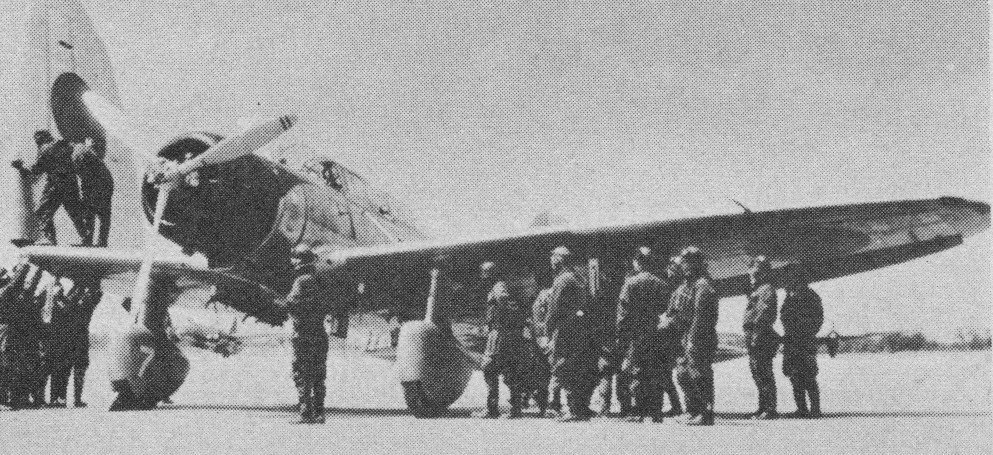
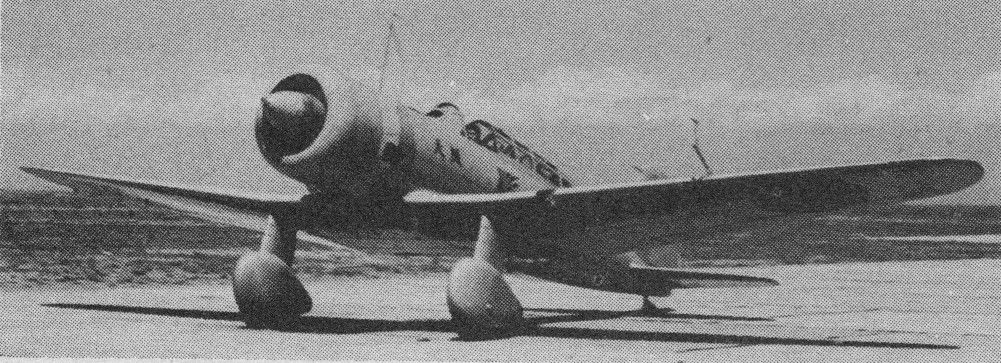
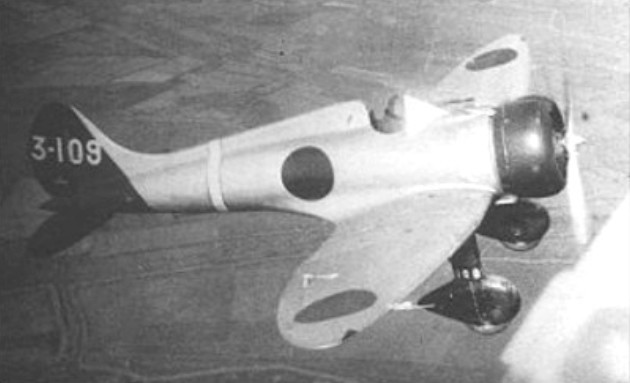
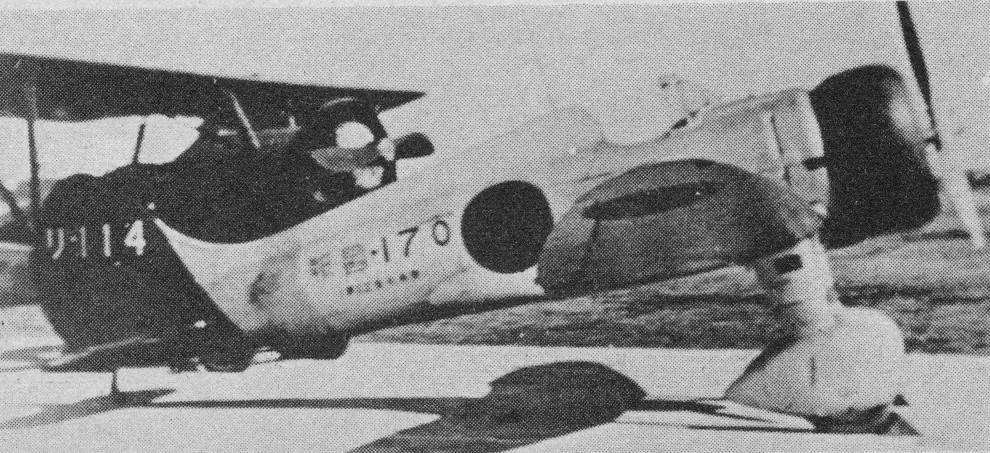
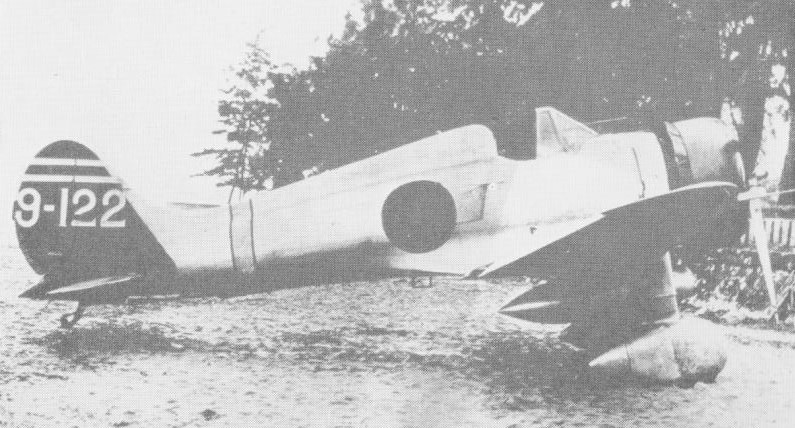
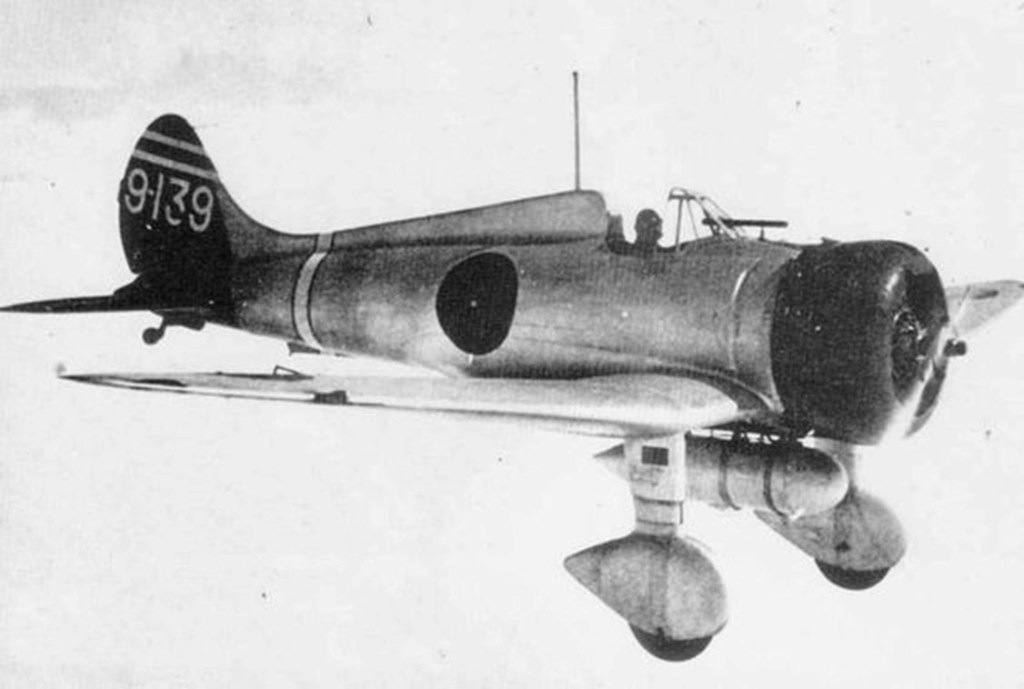
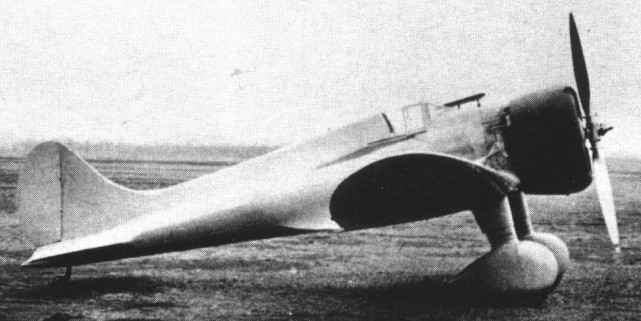
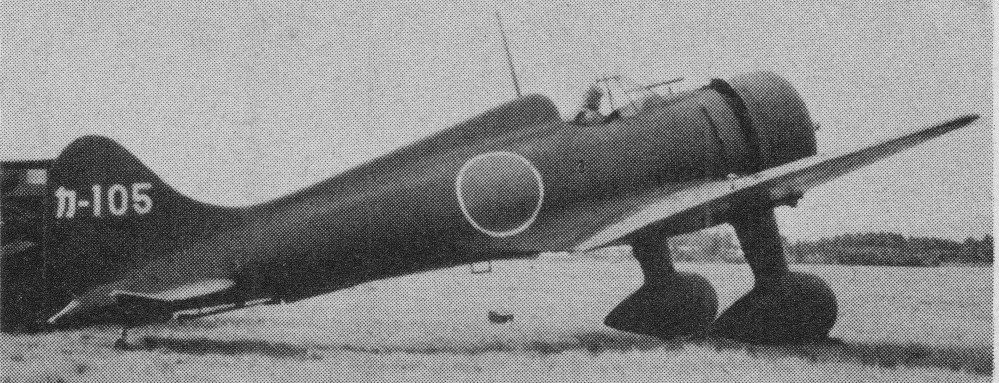
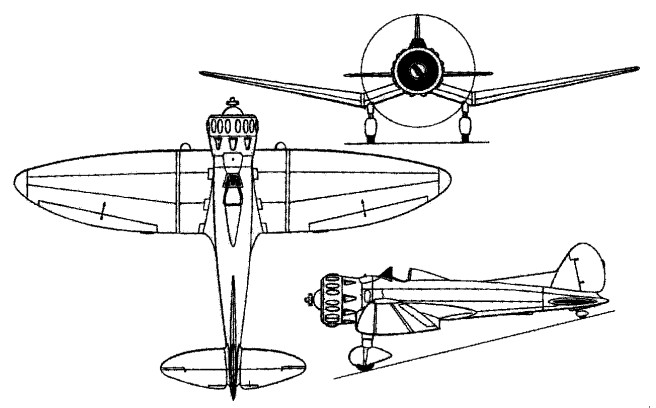
Among several 9-Shi requirements, in February 1934, the Imperial Navy issued an outline specification for a single-seat fighter. Carrier compatibility was not demanded, it being assumed that accommodating the dictates of deck use from the outset would inhibit the design team in achieving an advance in the state of the fighter design art although it was self-evident that the service would have no use for a fighter incapable of shipboard operation. In view of his experience with the earlier 7-Shi fighter, design responsibility was assigned to Jiro Horikoshi who created an all-metal semi-monocoque stressed-skin monoplane of inverted gull form designated Ka-14. Powered by a 550 hp Nakajima Kotobuki (Congratulation) 5 nine-cylinder radial and carrying two 7,7-mm guns, the first Ka-l4 was flown on 4 February 1935. Latent doubts concerning the wing gulling had, meanwhile, led to elimination of this feature from the wing of the second prototype Ka-14 which also embodied split flaps and switched to a 560 hp Kotobuki 3 engine. This prototype was to provide the basis for the series production A5M1 (Type 96) fighter, the first Ka-14 being fitted with a close-fitting, long-chord cowling as part of a drag reduction programme. An engine change saw the 585 hp Kotobuki 2 installed in the A5M1.

An Imperial Japanese Navy specification of 1934 for a single-seat fighter with a maximum speed of 350km/h then seemed an almost unattainable target. Mitsubishi’s Ka-14 prototype was designed to this requirement, and flown for the first time on 4 February 1935. It demonstrated a top speed of 450km/h in early trials but had some aerodynamic shortcomings. The inverted gull-wing of this aircraft was replaced by a conventional low-set monoplane wing in the second prototype which, with a 436kW Nakajima Kotobuki 2-KAI-1 radial engine, was ordered into production as the Navy Type 96 Carrier Fighter Model 1 (Mitsubishi A5M1).

The generally similar A5M2a which followed in 1937, powered by the 455kW Kotobuki 2-KAI-3 engine, and the 1937 A5M2b with the 477kW Kotobuki 3 engine, were regarded as the Japanese navy’s most important fighter aircraft during the Sino-Japanese War. The A5M2b experimenting with an enclosed cockpit position which, in service, did not find favour and was omitted from subsequent production models.

Two experimental A5M3 aircraft were flown with the 690 hp Hispano-Suiza 12Xcrs engine, but the final and major production version was the A5M4 which was the version standard at the time of Pearl Harbour, built also as the A5M4-K tandem two-seat trainer.

A5M4
Mitsubishi A5M4 Type 96 fighter

All versions of the A5M were allocated the Allied codename ‘Claude’. ‘Sandy’ was actually the code for a version of Claude with nothched wing roots, a design feature of the original 9-shi protype. When production ended a total of 788 had been built by Mitsubishi, including prototypes; a further 303 were built by Watanabe (39) and the Omura Naval Air Arsenal (264). The Japanese army had also shown interest in the A5M, resulting in the evaluation of a Ki-18 prototype generally similar to the Ka-14, but although fast this was considered to be lacking in manoeuvrability. Mitsubishi produced two re-engined and improved Ki-33 prototypes but they, too, were considered insufficiently manoeuvrable and no army production contract resulted. At the beginning of the Pacific war the A5M4 was in first-line use, but its performance was found inadequate to confront Allied fighters and by the summer of 1942 all had been transferred to second-line duties, many surviving A5M4 and A5M4-Ks being used in kamikaze attacks in the closing months of the war.

Ki-33

The acceptance of the Ka-14 9-Shi fighter by the Imperial Navy and evaluation of a modified prototype of this aircraft as the Ki-18 by the Imperial Army encouraged the formulation by the latter service during 1935 of a requirement for what was termed an “advanced fighter”. Kawasaki, Mitsubishi and Nakajima were each asked to produce prototypes of a fighter surpassing the performance of the Ki-18. Whereas both Kawasaki and Nakajima produced fighters of entirely new design to meet the requirement (as the Ki-28 and Ki-27 respectively), Mitsubishi, preoccupied with refining the Ka-14 for series production for the Navy, lacked sufficient design capacity to develop yet a further fighter. The Ki-18, with comparatively minor changes, was therefore resubmitted.

As the Ki-33, the modified fighter was powered by a Nakajima Ha-l-Ko engine rated at 745hp at 3700m and enclosed by a broader-chord cowling. An aft-sliding part-canopy was added, the aft fuselage decking was raised and the vertical tail surfaces were modified. Completed during the early summer of 1936, the Ki-33 was submitted to comparative trials with the Ki-27 and Ki-28 from November 1936 until the spring of 1937. It was found to offer marginally superior max speeds between 2500m and 3500m over the 167kg lighter Ki-27, but the Ki-33 revealed an inferior turn rate and climb to those of the Nakajima contender which was selected for series production.

Total production of the A5M series (Claude) was nearly 1000, of which 200 were completed by Sasebo and Watanabe.

Gallery

KA-14 (1st)
Engine: Nakajima Kotobuki (Congratulation) 5 nine-cylinder radial, 600 hp
Max speed, 276 mph (444 km/h) at 10,500 ft (3200 m)
Time to 16,405 ft (5 000 m), 5.9 min
Loaded weight, 3,087 lb (1373kg)
Span, 36ft l¼ in (11,00m)
Length: 25ft 2 in (7,67 m)
Height, l0 ft 8½ in (3,26 m)
Wing area, 172.23 sq ft (16,00 sq.m)
Armament: two 7,7-mm guns

KA-14 (2nd)
Engine: Kotobuki 3, 715 hp

A5M4
Engine: 1 x Nakajima Kotobuki-41, 530kW / 710 hp
Wingspan: 11 m / 36 ft 1 in
Length: 7.57 m / 24 ft 10 in
Height: 3.27 m / 10 ft 9 in
Wing area: 17.8 sq.m / 191.60 sq ft
Max take-off weight: 1671 kg / 3684 lb
Empty weight: 1216 kg / 2681 lb
Max speed: 430 km/h / 267 mph at 9840 ft
Service Ceiling: 9800 m / 32150 ft
Max Range: 1200 km / 746 miles
Crew: 1
Armament: 2 x 7.7mm machine-guns, 2 x 30-kg bombs

Ki-33
Engine: 1 x Nakajima Ha-l-Ko, 745hp at 3700m
Wingspan: 11.00 m / 36 ft 1 in
Length: 7.54 m / 24 ft 9 in
Height: 3.19 m / 10 ft 6 in
Wing area: 17.80 sq.m / 191.60 sq ft
Max take-off weight: 1462 kg / 3223 lb
Empty weight: 1132 kg / 2496 lb
Max. speed: 474 km/h / 295 mph

Mitsubishi Ka-14
Mitsubishi A5M
Mitsubishi Ki-33

Mitsubishi 2MR8 / Type 92

In 1927 Mitubishi enlisted the help of German designer Baumann to meet an Imperial Japanese Army requirement for a new reconnaissance aircraft. The results were the unsuccessful Mitsubishi 2MR1 Tobi, the 1MF2 Hayabusa and the 2MR7 short-range reconnaissance biplane of 1928.
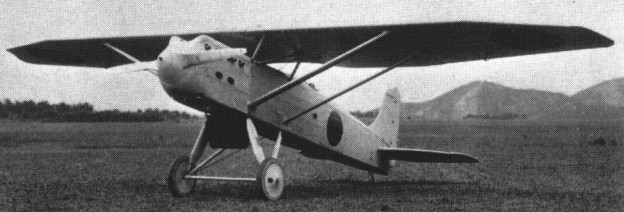
In 1930, three 2MR8 parasol-wing reconnaissance monoplanes were built and tested successfully. Of mixed construction, they had fixed wide-track divided landing gear and were powered by a 354kW Mitsubishi Type 92 radial engine.

Accepted by the army, the 2MR8 went into service in 1932 as the Type 92 Reconnaissance Aircraft. Production terminated in 1933 with the 230th machine.

The Type 92 was normally armed with a fixed forward-firing 7.7mm machine-gun mounted above the wing centre-section, with single or twin guns of the same calibre on a ring mounting over the observer’s cockpit.

The Type 92 saw active service in Manchuria with the air battalions (later air wings) of the army’s Kanto Command Air Corps between 1933 and 1936. A civil version of the Type 92 was used as a survey aircraft by Japanese National Railways. Powered by a 298kW Mitsubishi A-5 engine, it was registered J-AARA and differed externally from the military aircraft in having a glazed canopy over the crew cockpits and spat-type main wheel fairings.

Engine: 354kW Mitsubishi Type 92 radial
Maximum speed: 220km/h
Wing span: 12.75m
Maximum take-off weight: 1770kg

Mitsubishi 2MR / Type 10 / 2MRT / R-2.2 / R-4

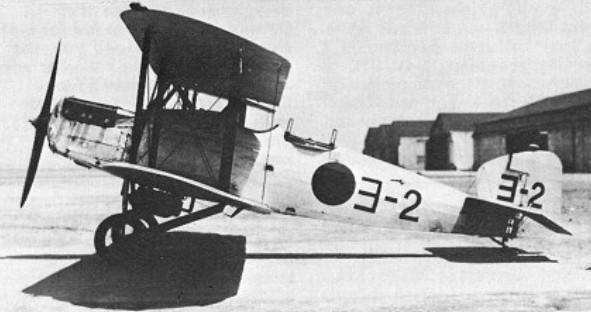
Designed by Herbert Smith, the first Mitsubishi 2MR two-seat carried-based reconnaissance biplane flew in January 1922. The type entered service as the Type 10 Carrier Reconnaissance Biplane and was built in a number of versions.

The 2MR1 had a 224kW Hispano-Suiza 8 engine with a frontal radiator, while the 2MR2 had twin underslung Lamblin radiators and redesigned tail surfaces. The 2MR4, which was the main production version, had some further revisions of the wing and tail unit, and other variants with minor changes were the 2MRT1, 2MRT2, 2MRT2A, 2MRT3 and 2MRT3A. Total production of all versions was 159, the last completed in 1930. After long carrier service, the 2MR was used as a trainer in the late 1930s.

The 2MR4 version spanned 12.04m, had a maximum take-off weight of 1320kg, and was armed with two fixed forward-firing 7.7mm machine-guns, with twin guns of the same calibre mounted over the observer’s cockpit, and could carry three 30kg bombs.

The R-2.2 and R-4 civil conversions had an enclosed cabin for two passengers replacing the rear cockpit, and a number of ex-army surplus 2MRs were sold on the civil market in the 1930s.

2MR4
Wingspan: 12.04 m / 39 ft 6 in
Max take-off weight: 1320 kg / 2910 lb

Mitsubishi 1MF10

1MF10

To meet a 7-Shi (1932) requirement for an advanced single-seat shipboard fighter to succeed the Nakajima A1N (Type 90), a Mitsubishi design team led by Jiro Horikoshi and assisted by Eitaro Sano, Konosuke Nakamura and Tomio Kubo initiated work on the first cantilever low-wing mono¬plane to be designed in Japan, the 1MF1O.

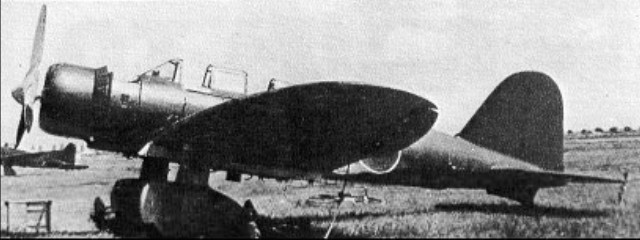
Featuring a duralumin monocoque fuselage and a fabric-skinned dur¬alumin wing, the 1MF10 was powered by a 710 hp Mitsubishi A-4 14-cylinder two-row radial and carried an armament of two 7,7-mm machine guns. The first of two prototypes was flown in March 1933, but was lost during the following July when the vertical tail surfaces disintegrated during a dive. The second prototype, which was completed shortly afterwards, differed essentially in having a new undercarriage, the three struts of each unit being replaced by single legs enclosed by trouser-type fairings. The 1MF10’s max speed proved to be 30 mph (48 km/h) less than that required by the Imperial Navy at 9,840 ft (3 000 m) and climbing performance was considered inadequate, and the fighter was rejected for series production, the second prototype being lost from a flat spin in June 1934.

Engine: Mitsubishi A-4 14-cylinder two-row radial, 710 hp
Max speed, 199 mph (320 kph) at 9,840 ft (3 000 m)
Time to 10,000 ft (3 050 m), 42 min
Endurance, 3.0 hrs
Empty weight, 2,700 lb (1225 kg)
Loaded weight, 3,479 lb (1578 kg)
Span, 32 ft 9 2/3 in (10,00 m)
Length, 22 ft 8 2/3 in (6,92 m)
Height, 10 ft 10 1/3 in (3,31 m)
Wing area, 190.53 sq ft (17,70 sq.m)
Armament: two 7,7-mm machine guns

Mitsubishi 1MF10

Mitsubishi 1MF2 Hayabusa

1MF2

In March 1927, the Imperial Army ordered Kawasaki, Nak¬ajima and Mitsubishi to investigate design of a fighter on a competitive basis to replace the ageing Ko-4 (Nieuport-Delage NiD 29). Designed by Shinshiro Nakata assisted by Jiro Horikoshi and Jiro Tanaka, the Mitsubishi contender in the contest, the 1MF2 Hayabusa (Falcon), was a parasol monoplane without wire bracing, emphasis being placed on ease of assembly and disassembly.

Powered by a 600 hp Mitsubishi Hispano-Suiza water-cooled V-12 engine, the first prototype Hayabusa was completed in May 1928. After manufacturer’s flight testing at Kaga¬migahara, both first and second prototypes were transferred to the Tokorozawa Army test centre where the Hayabusa recorded a maximum speed of 168 mph (270 km/h) at 9,840 ft (3 000 m), but during a diving test the Mitsubishi fighter broke up in the air after exceeding 248 mph (400 km/h). The Army suspended evaluation of the contending types, cancelling the programme and testing the prototypes to destruction. The Hayabusa was of mixed construction with wooden wing and metal fuselage, its armament being two 7.7mm guns.

Engine: Mitsubishi Hispano-Suiza water-cooled V-12, 600 hp
Max speed, 168 mph (270 km/h) at 9,840 ft (3 000 in)
Time to 16,405 ft (5 000 m), 11.3 min
Empty weight, 2,789 lb (1 265 kg)
Loaded weight, 3,968 lb (1 800 kg)
Span, 41 ft 4 7/8 in (12,62 m)
Length, 26 ft 10 7/8 in (8,20 m)
Height, 10 ft 11 7/8 in (3,35 m)
Wing area, 247.58 sq ft (23,00 sq.m)
Armament: two 7,7-mm machine guns

Mitsubishi 1MF2 Hayabusa