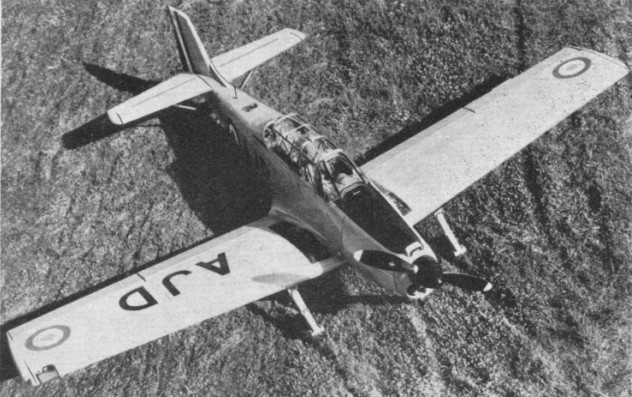
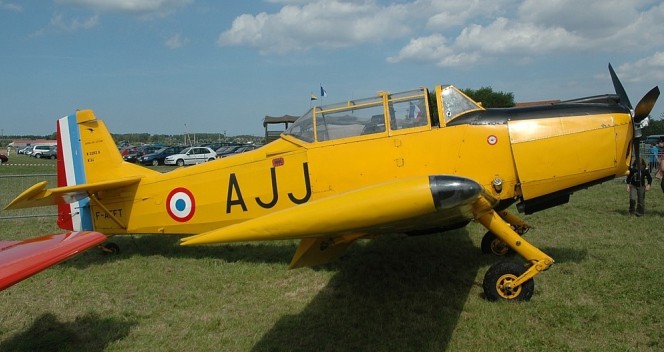
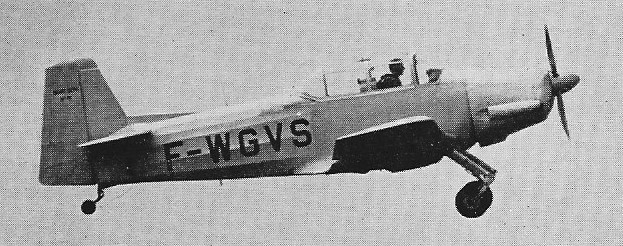
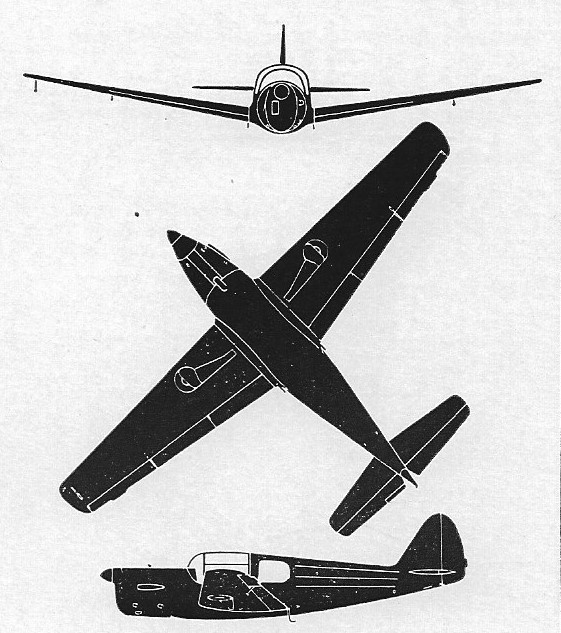
Engine: Potez 4D.32, 240 hp Span, 31 ft 2 in (9.5 m) Length, 26 ft 8 in (8.12 m) Wing area, 175 sq.ft (16.26 sq.m)
Engine: Potez 4D 34B, 260 hp Max speed, 161 mph (260 kph) Cruise, 146 mph (235 kph) at 7,545 ft (2425 m) Initial climb, 1,180 fpm. (6 m/sec) Normal range, 620 mls (998 km) at 7,545 ft (2 425 m) Empty weight, 1,896 lb (860 kg) Loaded weight, 2,690 lb (1220 kg) Span, 31 ft 2 in (9.5 m) Length, 26 ft 8 in (8.12 m) Wing area, 175 sq.ft (16.26 sq.m)
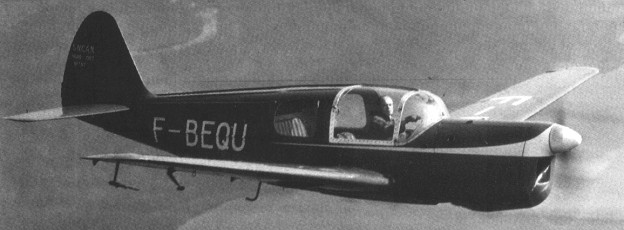
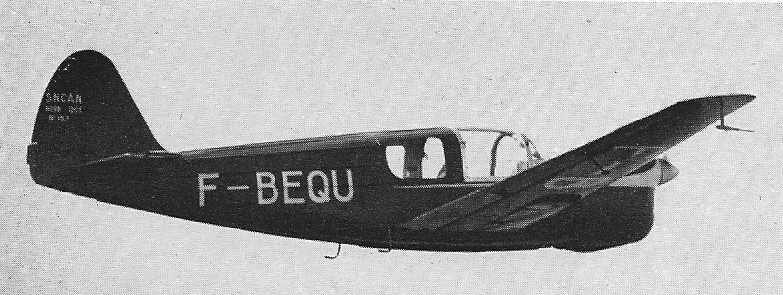
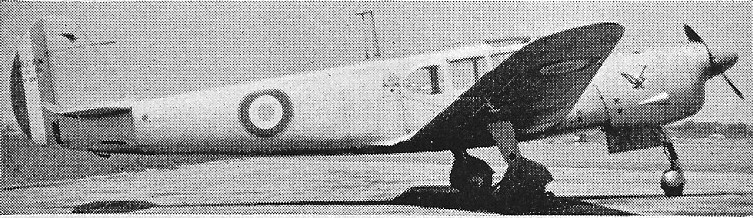
The N.3201 was designed for an official competition for a tandem two-seat primary trainer for the government-sponsored flying schools.
The N.3201 first flew on 22 June 1954, powered by a 170 hp SNECMA-Regnier engine.
The N.3200 prototype first flew on 10 September 1954, powered by a 260 hp Salmson-Argus 8AS-03 engine.
Apart from the engine installed, both models are identical,
N.3200 Engine: Salmson-Argus 8AS-03, 260 hp Wingspan: 32 ft 1.5 in Length: 26 ft 2.5 in Height: 10 ft 2.75 in
N.3201 Engine: SNECMA-Regnier, 170 hp Wingspan: 32 ft 1.5 in Length: 26 ft 2.5 in Height: 10 ft 2.75 in Empty weight: 1742 lb Loaded weight: 2405 lb Max speed: 150 mph at SL Cruise: 124 mph ROC: 984 fpm Endurance: 2 hr
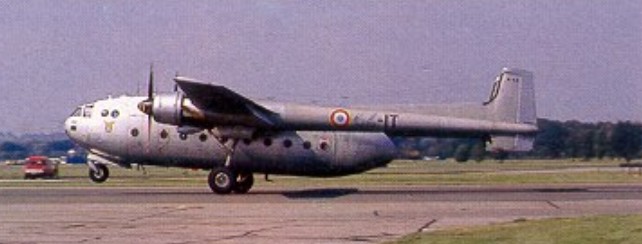
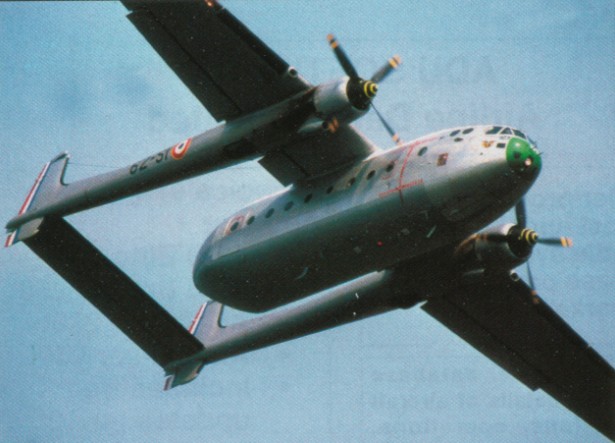
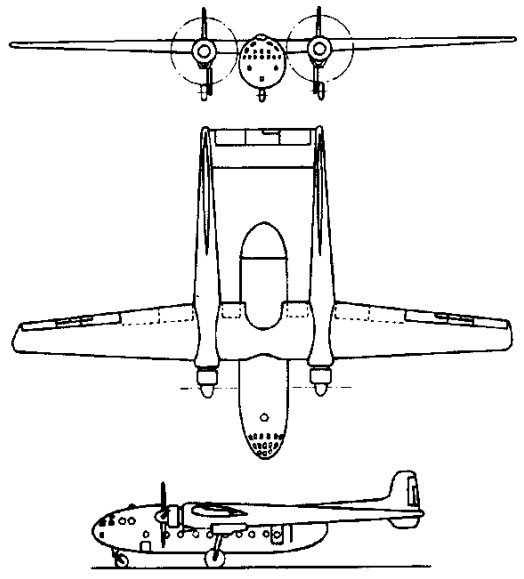
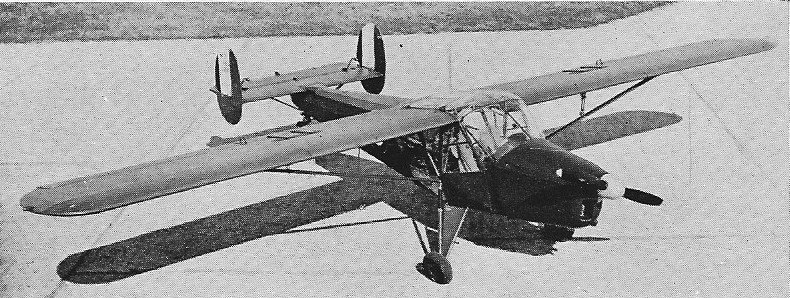
Designed as a military transport for service with the French air force, the Nord 2500 Noratlas prototype (F-WFKL) was flown for the first time on 10 September 1949. Of similar twin-boom configuration to the Fairchild C-82 and C-119 Flying Boxcar, the prototype was powered by two 1212kW SNECMA-built Gnome-Rhone 14R radial engines. This was followed by two N 2501 prototypes which introduced the powerplant intended for production aircraft, comprising two 1521kW SNECMA-built Bristol Hercules 739 radial engines, and the first of these (F- WFRG) was flown on 28 November 1950.
Satisfactory testing led to the initiation of production, and the Noratlas became standard equipment in the air forces of France, West Germany and Israel, providing valuable long-term service. Operated normally by a crew of four or five, the Noratlas has the capacity for 7.5 tons of cargo, or can accommodate 45 troops (or passengers in civil use), 36 fully-equipped paratroopers, or 18 stretchers and medical attendants when used for casualty evacuation. The German Luftwaffe received a total of 186 of these transports, 25 built by Nord and the balance produced under licence in Germany by the Flugzeugbau Nord. When production ended in October 1961, French and German sources had built a total of 425 Noratlas aircraft in several versions, and the type remained in service until the late 1980s.
Nord 2501 Engines: 2 x SNECMA Hercules 730, 1521kW / 2012 hp Max take-off weight: 21000 kg / 46297 lb Empty weight: 13075 kg / 28826 lb Wingspan: 32.5 m / 106 ft 8 in Length: 21.95 m / 72 ft 0 in Height: 6.0 m / 19 ft 8 in Wing area: 101.2 sq.m / 1089.31 sq ft Max. speed: 238 kts / 440 km/h / 273 mph Service ceiling: 7500 m / 24600 ft Range: 3000 km / 1864 miles Crew: 4-5 Passengers: 45 Payload: 8458kg
The N.1700 was a two-place aircraft; the rotor had two blades with a stabilizer bar. The engineer Andre Bruel wanted to get rid of the cyclic control, considered too complex. The rotor head was installed on an articulated parallelogram, allowing lateral motions. The lateral control was obtained by relative displacement of the rotor head in relation to the center of gravity.
The 160hp Mathis GR7 engine directly powered a rear axial helix which blew on two flap shutter systems, some horizontal, some vertical, to control pitch and yaw. The aircraft was damaged at first, due to violent vibrations of transmission, induced by brutal clutching. Alter repairing it, they resumed power checks but, in the hands of an inexperienced pilot, it hit an obstacle.
Management decided then to abandon the N.1700 and to turn to a smaller aircraft, the 1950 single seat N.1710, built in accordance with the same principle. SNCAN asked SNCASE to send Jean Boulet to test this machine:
“The first free flight took place on July 1, 1950. After several difficult hovers (all controls had very larges forces that we tried to compensate somehow by elastic cords), I performed the first forward flight on July 22. The longitudinal control appeared to be very insufficient. Modifications were then made, above all we increased the deflection of the horizontal flap shutters. On September 20, 1950, I took off again to make a forward flight under these new circumstances, but the effect of the modifications appeared to be just the contrary of what we expected: the longitudinal control was even less efficient and moreover the yaw control had lost its efficiency (the horizontal flaps were over deflected and it is probably they stalled and banked the vertical flap shutters). I very quickly found myself flying forward more and more rapidly and banking to the left, with the controls in an extreme position. I had to end this terrible merry-go-round. I reduced the pitch to touch the ground, but the aircraft overturned immediately. I was thrown to the ground and was very lucky not to be killed by a blade. The aircraft was repaired, and we lengthened the tail to improve the efficiency of the control surfaces. In the spring of 1951, I made several more flights, then as my company sent me to Marignane.”
The Societe Nationale de Constructions Aeronautiques du Nord (Nord-Aviation) built its first helicopter prototype in 1947. The N.1700 was a two-place aircraft; the rotor had two blades with a stabilizer bar. The engineer Andre Bruel wanted to get rid of the cyclic control, considered too complex. The rotor head was installed on an articulated parallelogram, allowing lateral motions. The lateral control was obtained by relative displacement of the rotor head in relation to the center of gravity.
Collective pitch and also cyclic pitch were respectively controlled by the radial and the flapping movements of small auxiliary blades set at 90° to the main blades. In this helicopter, the anti-torque device consisted of a fixed-pitch airscrew placed at the end of the tail and blowing backwards on to an assembly of suitably adjusted vanes.
The 160hp Mathis GR7 engine directly powered a rear axial helix which blew on two flap shutter systems, some horizontal, some vertical, to control pitch and yaw. The aircraft was damaged at first, due to violent vibrations of transmission, induced by brutal clutching. Alter repairing it, they resumed power checks but, in the hands of an inexperienced pilot, it hit an obstacle.
Management decided then to abandon the N.1700 and to turn to a smaller aircraft, the single seat N.1710.
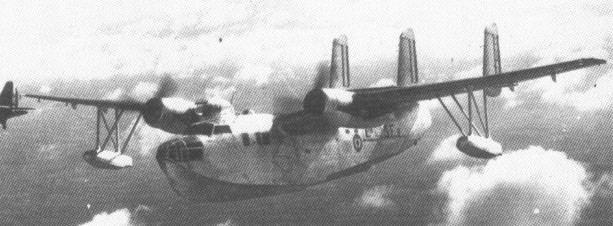
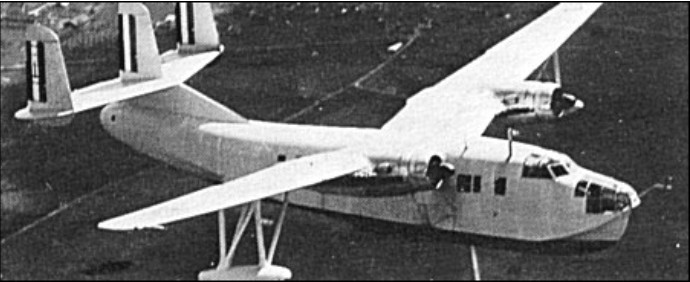
Despite the decline of the seaplane’s importance after the Second World War, France still saw a limited future for the type and commissioned from the Societe Nationale de Constructions Aéronautiques du Nord (generally known as SNCAN or Nord) a flying boat for the reconnais¬sance and air/sea rescue roles.
This was an all-metal monoplane with a gulled wing and a two ¬step hull, and had accommodation for a crew of seven, plus a roomy rear cabin with a large sliding door on the port side for rescue operations. It first flew on 6 January 1949 as the N.1400.01 Noroit prototype (F-WFDL) with 1,600-hp (1,193-kW) Gnome-Rhone 14R radials. The N.1400.02 second prototype introduced retractable tailwheel landing gear to provide an amphibious capability. Retractable tailwheel landing gear was installed on the N 1400-01 at a later date. There followed a pair of N.1401 pre-production machines with two 1,800-hp (1,342-kW) SNECMA-built Junkers Jumo inlines and annular radiators. The N 1401 Noroit (F-WFKU) was flown on 6 August 1949, the second example (F-SFKN) being flown later, and both were tested in 1950 with two Bristol Hercules radial engines. Finally there came 21 N.1402 Noroit (North-West Wind) production aircraft, the last of them delivered in 1956. Together with the two N.1401s modified to the same standard, these served with Flottille 5F.
Nord N. 1402 Noroit Engines: two 2,100-hp (1,566-kW) SNECMA 12H.00 (Junkers Jumo 213A) inline piston Maximum speed 230 mph (370 km/h) at 8,695 ft (2,650 m) Initial climb rate 984 ft (300 m) per minute Range 2,610 miles (4,200 km) Empty weight 28,660 lb (13,000 kg) Maximum take-off weight 45,040 lb (20,430 kg) Wingspan 103 ft 8 in (31.60 m) Length 72 ft 4 in (22.05 m) Height 22 ft 5.5 in (6.85 m) Wing area 1,076.43 sq ft (100.00 sq.m) Armament: six 20-mm cannon in two-gun nose, dorsal, and tail positions, and bombs carried in nacelle bays plus provision for eight rockets on the hull sides. Crew: 7
Using the same basic configuration as the Messerschmitt Bf 108, Nord developed the three-seat Nord 1200 with fixed tricycle landing gear, whose prototype flew on 15 December 1945 with a 75-kW (100-hp) Mathis G4R engine.
There were several military and civil variants, the main versions to enter civil service being the three-seat Nord 1201 Norécrin I with the 104-kW (140-hp) Renault 4Pei engine.
The four-seat Nord 1203/II Norécrin II was powered with the 101-kW (135-hp) Regnier 4L00 engine. In 1948 the Nord 1203/II was placed in production.
Nord 1203/II Norécrin II
The Nord 1203/III Norecrin III had a modified landing gear.
The Nord 1203/lV Norecrin IV had the 127-kW (170-hp) Regnier 4L02 engine.
The Nord 1203/Vl Norécrin VI had the 108-kW (145-hp) Regnier 4L14 engine, and the final Nord 1204 and the experimental Nord 1204/II models of 1959 with the 93- and 108-kW (125- and 145-hp) Continental C125 and C145 engines respectively.
A total of 380 had been built when production was suspended, being resumed in 1955 with an order for another 90.
Nord 1200 Engine: Mathis G4R, 75-kW (100-hp) U/C: fixed
Nord 1201 Norécrin I Engine: Renault 4Pei, 104-kW (140-hp) Seats: 3
Nord 1203/II Norécrin II Powerplant: l x Regnier 4L00, 101 kW (135hp) Span: 10.22m (33ft 6.25 in) Wing area: 410 sq.ft Length: 7.21 m (23ft 8in) Empty weight: 1437 lb Max T/O weight: 1050kg (2,315Ib) Max speed: 174 mph Cruise speed: 137 mph at sea level Operational range: 559 miles ROC: 985 fpm Seats: 4
Nord 1203/III Norecrin III
Nord 1203/lV Norecrin IV Engine: Regnier 4L02, 127-kW (170-hp)
Nord 1203/Vl Norécrin VI Engine: Regnier 4L14, 108-kW (145-hp) Length: 23.163 ft / 7.06 m Height: 9.088 ft / 2.77 m Wingspan: 33.465 ft / 10.2 m Wing area: 140.685 sqft / 13.07 sq.m Max take off weight: 1730.9 lb / 785.0 kg Weight empty: 1080.5 lb / 490.0 kg Max. weight carried: 650.5 lb / 295.0 kg Max. speed: 133 kts / 246 km/h Initial climb rate: 708.66 ft/min / 3.60 m/s Service ceiling: 16404 ft / 5000 m Wing load: 12.3 lb/sq.ft / 60.0 kg/sq.m Range: 486 nm / 900 km Endurance: 5 h Crew: 2
The four seat Nord 1101 Noralpha was developed by the French company SNCAN post war from the Messerschmitt 208.
Nord 1101 Ramier
Two prototype Me 208s, powered by Argus 10c engines, were built at Les Mureaux in occupied France during 1943 44, one being destroyed in an Allied bombing raid. The surviving aircraft was redesignated Nord 1100 after the Liberation, and production versions were fitted with the Renault 6Q engine as Nord 1101s.
Two hundred were built, many serving with French forces on communications, training and liaison duties.
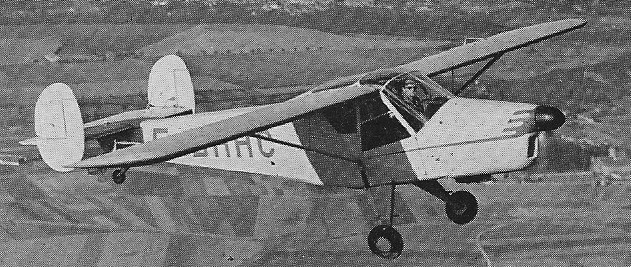
The SNCA du Centre NC.856 tourer first flew on 12 March 1949, powered by a 105 hp Walter Minor 4-III, but development ceased with the liquidation of SNCA du Centre.
A second prototype, modified for use as an air observation post, was built by SNCA du Nord, and first flown on 15 March 1951.
An order for 112, designated NC.856A Norvigie, was placed for the French Army, the first production Norvigie flying on 12 March 1953.
NC.856A Norvigie
Derived from the NC.856A Norvigie, the NC.856N is a four-seat cabin monoplane. Powered by a 160 hp SNECMA-Regnier 4LO-8 engine, the NC.856N is generally similar to the three-seat NC.856H twin-float seaplane variant.
The wing is a single spar metal structure with fabric covering, and the fuselage is welded steel tube with fabric covering over light wooden formers.
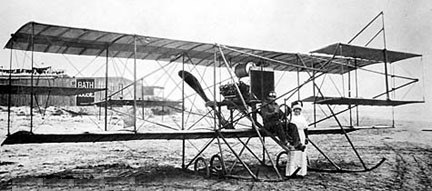
1911 (Petaluma) = A second Hall-Scott-powered aircraft was built in 1911, practically a duplicate of the first, for use by “Wiseman the Fearless” in exhibition flights throughout the West, as well as for the first Post Office-sanctioned air mail flight, on 17 February 1911, from Petaluma to Santa Rosa.
The names Wiseman-Cooke and Noonan-Wiseman often appear in conjunctive reports—Ben Noonan, a Santa Rosa butcher, supplied finances for Wiseman’s projects; Weldon B Cooke (an aircraft builder in his own right) purchased Wiseman’s 1911 machine, thought to have been repowered with 75hp Roberts, to fly in exhibitions after his Black Diamond was retired.
Restored in 1985 for the Smithsonian’s Postal Museum.