Designed in 1915 by Noel Pemberton-Billing, and built by the company bearing his name, the P.B.23E single-seat pusher fighting scout biplane was of wooden construction, but the nacelle mounted between the wings and accommodating the pilot was unusual for its time in being covered with light alloy sheet metal. Armament consisted of a single 7.7mm machine gun mounted in the nose of the nacelle and power was provided by an 80hp Le Rhone rotary. The P.B.23E was first flown in September 1915, but was not adopted in its original form, being further developed as the P.B.25.
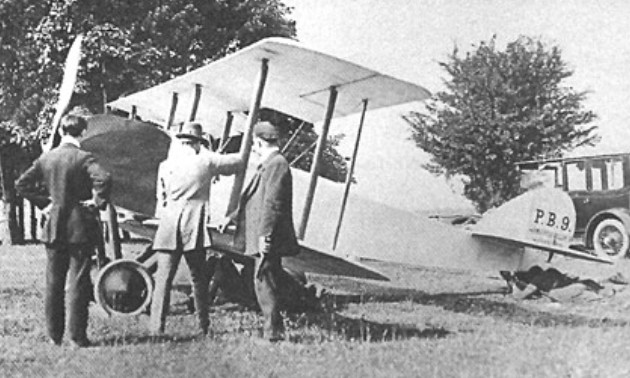
A single-seat open-cockpit equal span biplane scout aircraft, built by Pemberton-Billing Limited, which later became the Supermarine Aviation Works. Only one P.B.9 was built. The wings had full span spars with the upper and lower wings connected by four pairs of interplane struts. The fuselage had a fixed landing gear with a tail skid. While designed to allow the use of Grome 80 hp engine the prototype P.B.9 was powered by a 50 hp (36 kW) Gnome rotary engine taken from the company’s prototype P.B.1. Using a set of wings that had been obtained from Radley-England it was designed, built and made its first flight within nine days, though for publicity reasons its designer Noel Pemberton Billing claimed it had taken a week (giving rise to the nickname “Seven Day Bus”). It was first flown August 1914. Although the aircraft performed well only the prototype was built. it was later used by the Royal Naval Air Service as a trainer.
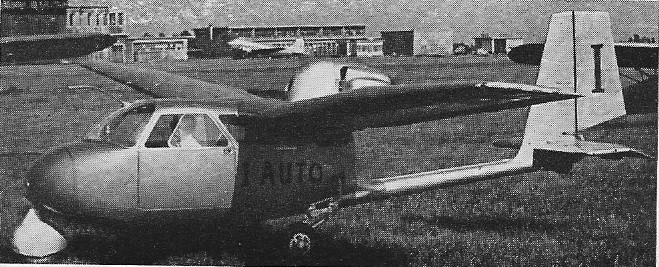
Luigi Pellarini was about 30 years old when in 1944 he partnered with Carrozzeria Colli, a Milan motor vehicle and coach-building company, to build his first prototype flying car, the PL 1.
He kept improving his prototypes and put out a new and improved model each of the next several years. L’Ala, an Italian magazine, published a description of his PL-2C, dubbed the Aerauto, in its October 1946 issue.
The PL 2 C is an entirely metal touring aircraft, with folded wings, its dimensions are about 2.20 m width for 6 m of length it can easily move on normal roads, always with the propeller thrust.
The PL 2C structure is the fuselage, with a real chassis, consisting of a tubular beam in welded sheet steel and durall bodywork. On the beam are welded the castle in tubes that support the wing and the engine, as well as all the controls, the undercarriage, the seats and the empennages.
There durall fairing covers the front of the beam and provides a to connect the wing to the engine and to the beam, as well as to form the cabin equipped with two side doors and is easily removable. The wing is cantilever monoplane divided into a fixed centre, and in two collapsible semis. The folded wing remains suspended with the front attachment to the central trunk of the wing. Structure the wing is entirely durall and the cover is 8/10 mm. The attachments are steel. Rivets were widely used in the wing tubulars, rather than bolts. The ailerons have a metal frame in durall and a cover in canvas; they can be simultaneously lowered so as to work as flaps. The horizontal plane is of a similar structure to the wing; there fixed part (whose incidence is adjustable in flight with handwheel) is covered in durall. The vertical plane, split, is structurally similar to the horizontal. The undercarriage is tricycle with low pressure wheels, the rear wheels are equipped with brakes, while the front is connected to the pedals for steering.
The prototype engine is a 60-hp Valter that drives a fixed propeller. The controls are of the usual bar and pedal type, the instrument panel the usual equipment of instruments, the brake is a pedal. The cost is 460,000 L without engine.
The following year’s PL-3C also got magazine coverage, this time in Wing.
The Aerauto PL3 C is a small-powered tourism aircraft, single engine, high wing with propeller and tricycle undercarriage. It is a two-seater side by side, with the possibility of a third place. The fuselage beam, in high strength steel sheet with a circular section, formed by two half-shells welded is of simple and easy construction, it represents the longitudinal frame of the aircraft and comes to it welded directly, support for controls, undercarriage, ribs for the support of the fairing, engine frame that also makes to the connection to the wing.
The power train consists of a Walter Micron III engine from 80hp air-cooled, operating a two-bladed propeller with variable pitch. The motor is installed behind the side member of the central trunk, raised from the tail beam in order to allow the propeller rotation. It is supported by the same framework in pipes of welded steel that supports the wing. The tail is built with two side members covered in durall sheet and canvas. The rudders are statically balanced. The undercarriage is tricycle with independent rear wheels and wheel front adjustable.
The aircraft is equipped with the regulatory instrumentation for in-flight and the landing light, installed at the bow of the aircraft, taillights and signalling etc are powered by a 12V battery.
The PL-4 was publicly known as the Aerauto AER-1. L’Ala had a more consumer-oriented article in its July 15, 1948 issue.
PL-5C Aerauto
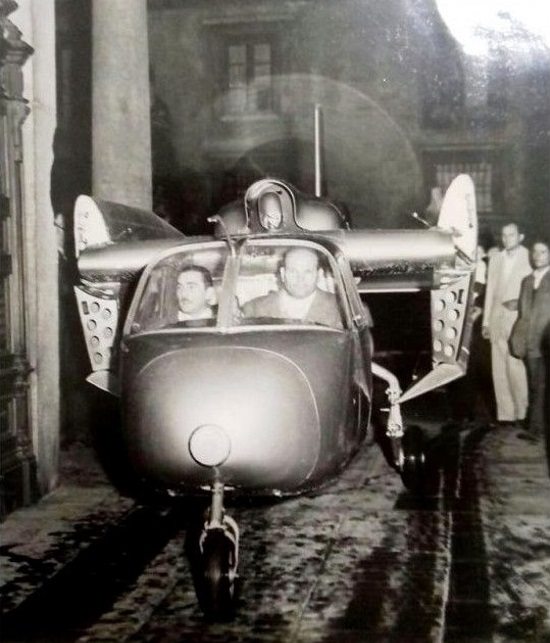
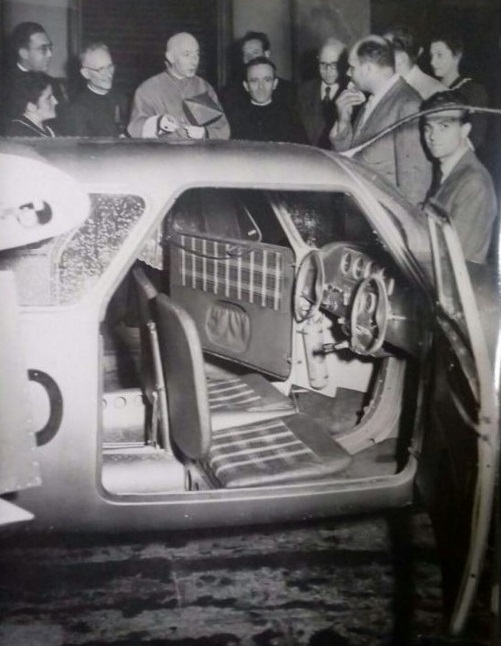
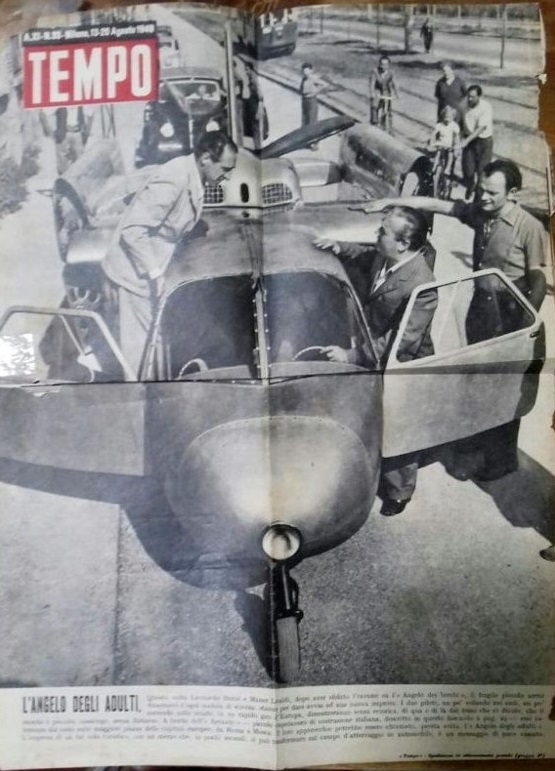
By 1949, Pellarini thought that his new model, the PL-5C, was ready for the public. Piloted by Leonardo Bonzi and Maner Lualdi, the Aerauto drove and flew across Italy from late 1949 to early 1950, 1800 km in the air and 2200 km on the ground, stopping at Turin, Florence, Pisa, Rome, Naples, Bari, Ancona, Rimini, Venice, Treviso, Vicenza and Milan. The Aerauto would fly to a location outside of a city, fold up its wings, and drive into the city proper, exactly as a commercial flying car was supposed to work. At the end, Pellarini grandly presented the Aerauto to the Archbishop of Milan, Cardinal Schuster.
Naturally, this great stunt garnered even more publicity, with Tempo magazine displaying a picture of the Aerauto, Pellarini, Bonzi, and Lualdi on a public street, taking up no more room than the cars behind them.
A British Pathé newsreel documented the Aerauto on the ground and in the air.
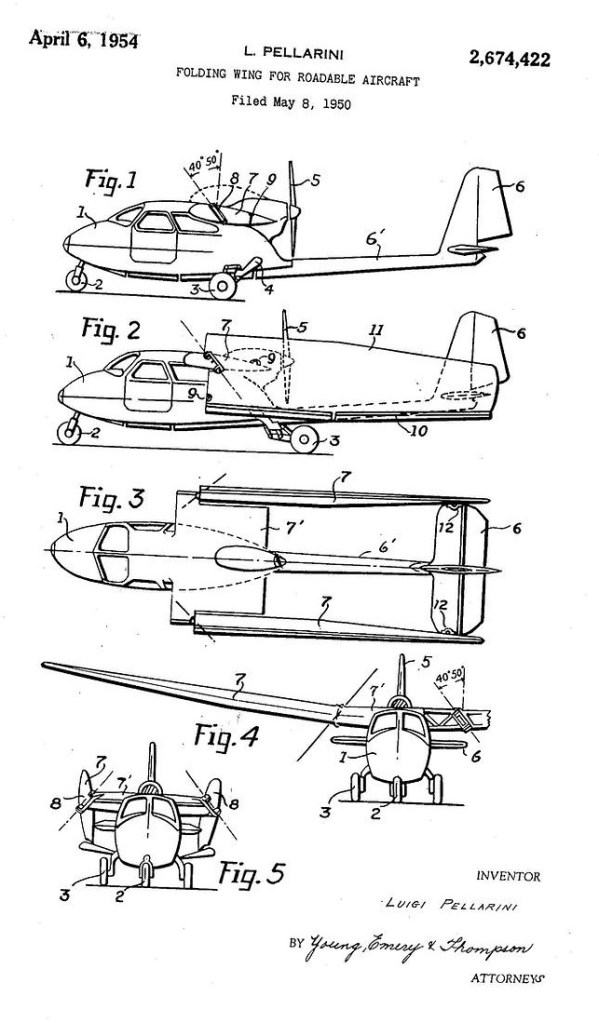
Pellarini immediately filed a U.S. patent application for a “Folding Wing for Roadable Aircraft,” which was granted after much delay in 1954.
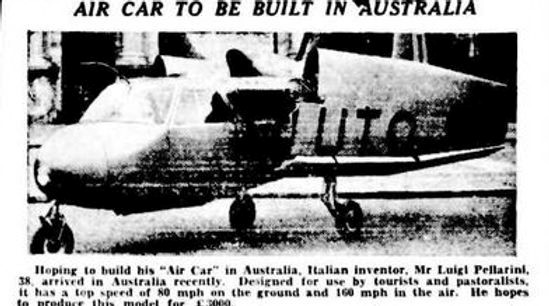
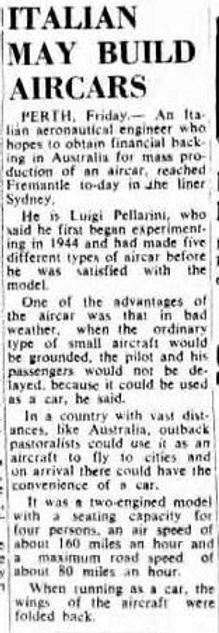
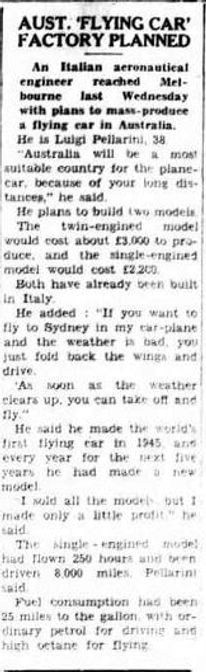
Flying cars are hard to sell at the best of times, and with Italy’s economy in 1950 Pellarini got no orders at all. He gave up and emigrated to Australia. The Australian press showered him with articles as soon as he arrived.
PL 2C Wingspan: 9,80m Wing area: 12sq.m Length: 5,70m Height: 1,60m Empty weight: 340kg Payload: 210 kg Total weight: 550kg Wing load: 45.8kg / sq m Maximum speed: 190 kph (at 2000m) Cruise: 160kmh Stall: 70kmh Road speed: 60kmh Ceiling: 4000m Range cruise: 600km Max range: 750km Take-off dist: 120m Landing dist: 60m Fuel consumption: 15 lt/ hr
PL-5C Engine: 85 hp Continental C85 Max speed: 112 mph Cruise: 100 mph ROC: 535 fpm Service ceiling: 13.120 ft Range: 500 mi Empty weight: 1012 lb Loaded weight: 1540 lb Wingspan: 33 ft 5.5 in Length: 20 ft 4 in Height: 5 ft 9 in
The Pegasus PAL 95 is a twin cylinder, horizontally-opposed four stroke aircraft engine that was developed by Pegasus Aviation (NZ) Ltd of New Zealand for use in ultralight aircraft circa1999. The engine is no longer available.
Designed to fill a similar market segment as the similar configuration and output HKS 700E, the PAL 95 produces 65 hp (48 kW) at 5200 rpm.
The PAL 95 has a computer-controlled engine management system that controls both the fuel injection system and the ignition timing, giving automatic altitude-compensated mixture control. The pistons are forged and ceramic coated. The intake valves are made from nickel-steel and the exhaust valves from stainless steel. The engine was supplied with an electric starter and an exhaust system by the factory as standard equipment.
Speed reduction is via a standard twin cog-belt system, with harmonic dampening on the crankshaft pulley. The initial TBO was estimated by the manufacturer as 1500 hours.
A major application was the American Sportscopter Ultrasport 254 and the unit cost was US$6450 in 2001.
PAL 95 Type: Twin-cylinder, four stroke aircraft engine Displacement: 924 cc (56.4 cu in) Dry weight: 137 lb (62 kg) Fuel system: fuel injection Reduction gear: dual parallel cog belts with harmonic dampening Power output: 65 hp (48 kW) at 5200 rpm Fuel consumption: 3.12 US gallons per hr (11.8 l/hr)
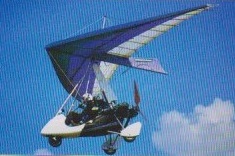
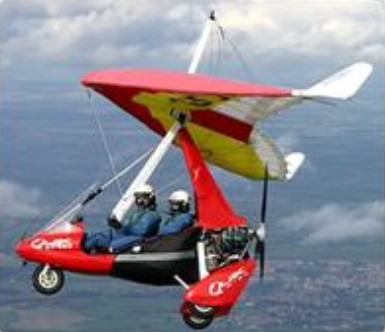
Conceived as a modular aircraft, the Quantum came in various forms from fairly simple to very slick. The Quantum came with the Rotax 462 or 582, and Q2 wing.
The top of the range Quantum 912 is structurally essentially the same as the Quantum Sport, complete with articulated monopole, fairings and under seat storage bins.
Quantum 912
Quantum Sport Empty weight: 185 kg Wing span: 10.35 m Wing area: 15.60 sq.m Fuel capacity: 49 lt Certification: BCAR S Engine: Rotax 582, 65 hp MAUW: 390 kg Seats: 2 Max speed: 125 kph Cruise speed: 100 kph Minimum speed: 42 kph Climb rate: 2.75 m/s Fuel consumption: 8.7 lt/hr Price (1998): £14,565
Quantum 912 Empty weight: 195 kg Wing span: 10.35 m Wing area: 15.60 sq.m Fuel capacity: 42 lt Certification: BCAR S Engine: Rotax 912, 80 hp MAUW: 930 kg Seats: 2 Max speed: 130 kph Cruise speed: 100 kph Minimum speed: 42 kph Climb rate: 3.4 m/s Fuel consumption: 10 lt/hr Price (1998): £20,499
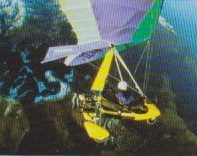
The QUIK is a light handling small wing with a hands off trim speed in excess of 80 mph, and a level speed of 100 mph making distance touring a reality and ground handling simplicity itself. The Quantum’s 409 kg MAUW is retained, but the payload has increased due to the aircraft’s lighter weight. The Quik has larger seating, more rearward headroom for the passenger and more wind protection compared to the Quantum.
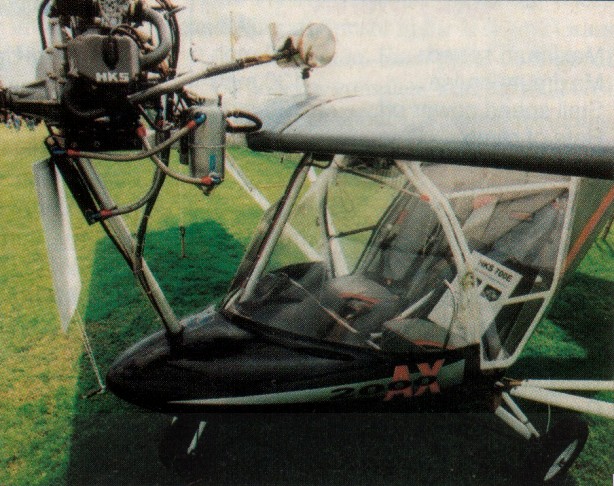
Publicly owned Pegasus Aviation bought the rights to the French edition of a highly modified Weedhopper. Some of these alterations were completed to bring the machine to a contemporary description. Others were done srictly to meet the demands of British certification under BCAR-S.
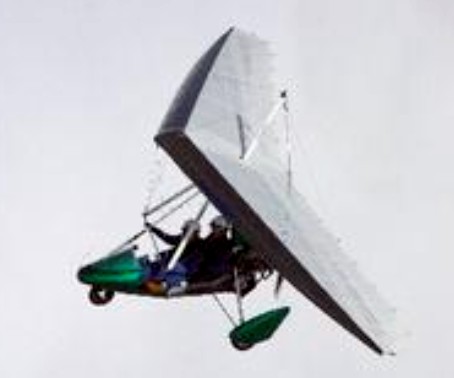
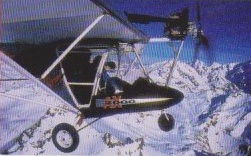
The AX2000 (previously known as the AX-3, for 3 axis) is now a fully enclosed, conventional three axis machine.
H-Power introduced the AX2000 to the US at Oshkosh 1997.
In 1998 the Rotax 582 powered version cost £17,619.
Engine: HKS 700, 60 hp Wing span: 10.3 m Wing area: 15.6 sq.m MAUW: 390 kg Empty weight: 202 kg Fuel capacity: 64 lt Max speed: 145 kph Cruise speed: 105 kph Minimum speed: 50 kph Climb rate: 3 m/s Seats: 2 Fuel consumption: 7.5 lt/hr Certification: BCAR S