In the summer of 1938 was Petlyakov able to return to work in the Special Technical Department (STO for Spetsialni Texnicheski Otdiel). These types of institutions were conceived with the aim of organizing the scientific and constructive work of specialists convicted of different causes and emerged in the USSR since the late 1920s when those accused of being part of the “Prompartia” conspiracy were concentrated in the Factory No.39, giving rise to the infamous TsKB-39, where famous aircraft builders such as DP Grigorovich and NN Polikarpov worked.
Under the direct supervision of LP Beria, the TsKB-29 NKVD was organized, a large joint construction bureau located in the TsAGI KOSOS building, on Radio Street No. 24.
Three main brigades were created: AN Tupolev ‘s working on a dive bomber, Petlyakov ‘s working on a high-altitude fighter, and Myasichev ‘s working on a long-range bomber. Later another brigade would be created under the leadership of Tomashevich . As the acronym STO corresponds in Russian to the number 100, the aircraft of this institution were known as “100” ( Petlyakov ), “102” ( Myasichev ) and “103” ( Túpolev). The STO would soon be renamed the Special Technical Bureau (OTB according to the acronym of Osoboye Texnicheskoye Byuro) and its direction was entrusted to the highest of the state security organs V. Kravchenko.
The brigade led by Petlyakov numbered about 50 specialists. Notable among them are AI Putilov, EI Pogosski, NS Nekrasov, KV Minknier, the pilot and engineer Ye. K. Stoman, also a pilot and creator of the well-known “Zvenó” NS Vaxmistrov compound aircraft , the hydraulic engineer GM Bashta, the electric AA Yengibaryan and IM Sklyanski, among others. As the first reserve of him was selected AM Izakson.
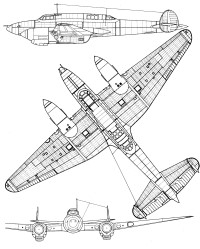
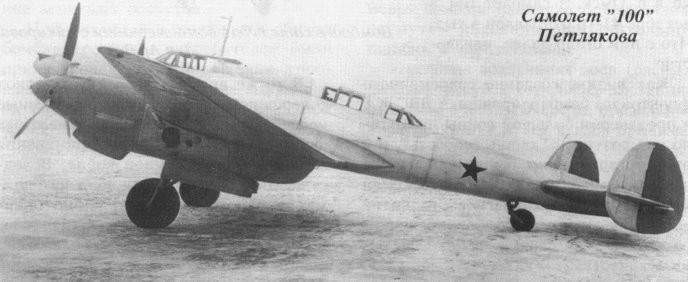
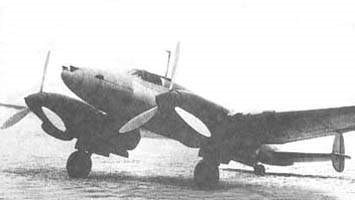
The task was to create a high-altitude fighter with a long range and powerful weaponry capable of complementing the ANT-42 bombers in their missions. In order to operate at high altitudes, a hermetic cabin was proposed. In the literature, this aircraft is referred to as “100” or VI-100, where the initials VI correspond to its conception as a high-altitude fighter (transliterated as Vysotny Istrebitel), although the official name of the prototype was: “100 with two M engines. -105, two TK-2 turbochargers and two sealed cabins”.(Russian: Петляков ВИ-100)
It is interesting to note that all the documents that left the OTB building, even those related to purely technical issues, had to be reviewed and signed by the head of the institution. The names of the builders were nowhere to be found. The internal documentation could be signed by the builders, but not with their name. Each specialist was assigned a numbered stamp with which they had to sign the documents.
The task assigned to Petlyakov’s brigade was complex. According to the technical specifications received from the military, the flight ceiling had to reach 12,500 meters and at a height of 10,000 meters the “100” had to reach a speed of 630 km/h. The deadline for the execution was also quite tense: the new high-altitude fighter had to be ready for 1939.
In May 1939 the life-size model was finished, which was approved by a commission chaired by A.I. Filin.
The fuselage of the new fighter was developed by AI Putilov and in its structure it was close to the monocoque composition. Of totally metallic construction, it presented three sections of circular section with an elongated cover in which the two hermetic cabins were located.
The fuselage skin averaged between 1.5 and 2 mm, with ribs implanted every 30 or 50 cm. No stringers were used to support the covering.
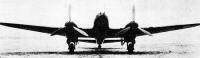
The structure was calculated to withstand overloads of 10, which allowed the fighter to execute all manoeuvres.
The wing had a trapezoidal shape in plan, with a double spar structure and practically no sagging on the leading edge. Its structure was made up of the center plane to which the motor nacelles were fixed and two consoles with a 0.6 – 0.8 mm coating. The wing mechanization included split ailerons and shrenk-type flaps. All control surfaces were made of metal and covered in fabric.
The tail unit presented horizontal planes with a positive dihedral. Almost at the end of each demiplane the double empennages with the rudders were inserted.
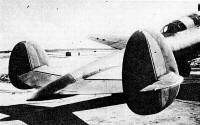
The landing gear, of the conventional type with a tailwheel, was designed by TP Saprykin. The main units had a single wheel and were collected by turning 90 degrees backwards, inside the motor nacelles. The tail unit was also retractable.
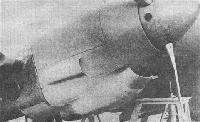
The selected powerplant was the Klimov M-105 engine, a 12-cylinder V-shaped linear engine, with two TK-2 turbochargers connected to the power scheme of the engine nacelles and moving two VISh-42 three-blade variable-pitch propellers, the latter a truly advanced quality. The compressor turbines were located on the sides of the engines, just below the wing leading edge. The engines were neatly shrouded, and like other contemporary Soviet twins, the radiators were inboard of the wing between the spars, fed through ducts from the leading edge and vented through adjustable louvers in the nose. wing extrados and planned to provide a certain increase in thrust. The fuel tanks were located in the fuselage, between the two cabins.
The “100” included two airtight cabins for the crew. The forward cockpit was dedicated to the pilot. There is divergence in the literature about the second cabin. Some well-known historians such as BV Shavrovd efine the VI-100 as a three-seater aircraft, placing the navigator and gunner in the rear cabin. In other literature it is suggested that the VI-100 was a two-seater and the second hermetic cabin was occupied by the radio gunner. This version seems to be more accurate in that an interceptor fighter did not need a navigator at all. Both cabins had independent access in the form of hatches located in the lower part of the fuselage, with emergency opening systems. These cabins worked with compressed air obtained from the turbochargers in order to maintain a constant pressure from a height of 3,700 meters and up to the operational ceiling of the plane.
The control system included remote electrical controls developed by electrical engineers AA Yengibaryan and IM Sklyanski. A 28-volt electrical system operated about 50 direct current actuators, which operated the landing gear, flaps, radiator grilles, fuel pumps, compensators and other equipment.
The aircraft featured powerful armament including two 20mm ShVAK cannons with 300 rounds each and two 7.62mm ShKAS machine guns with 900 rounds each, all located in the nose. To defend against the attack of the fighters in the rear hemisphere, the provision of a ShKAS machine gun with 700 shots was proposed, which in practice was never installed.
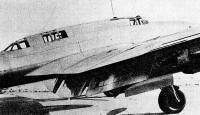
The “100” was conceived with a certain ground attack capacity. For this purpose it could carry two 250 kg or 500 kg bombs on external mounts. On the other hand, the “100” could carry a new type of weapon: the K-76 cassette with 40 unguided artillery projectiles with pre-adjustable explosion time. This weaponry had been conceived as a resource against enemy bomber formations, but could also be used against ground targets. Later the K-100 cassette with 96 2.5 kg bombs would also be developed.
The prototype was completed at Factory No.156 by the end of 1939. The entire skin of the plane had a layer of varnish and kept the original silver color. The ailerons and rudders were painted bright red. Red stars bordered in black were painted on the edges of the fuselage and on the wing intrados.
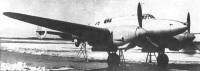
On 22 December 1939, the first flight was made, beginning the factory tests, which were carried out by test pilot PM Stefanovski. The main engineer was IV Markov. Since the beginning of these tests, a certain number of defects and problems appeared, something logical for a new and complex aircraft, but very dangerous for the situation of its creators in their condition as detainees.
During the first landing, a construction error was found in the calculation of the shock absorbers in the main landing gear, which caused the aircraft to bounce during touchdown. Incredibly, according to Stefanovski himself, this mistake saved his life, because during the flight one of the engines had stopped and the plane was descending. Without having height coverage for maneuvers, he was forced to land in an area of the aerodrome where various support structures were located. The collision was unavoidable, but during touchdown the plane made a big jump when it touched down, flying over the obstacle. This problem was soon fixed. Far more difficult was solving the problems with the engines. The oil cooling system was ineffective at altitudes above 5,000 meters. The water temperature was also rising to intolerable levels.
Despite the replacement of the engines, oil pumps and other elements of the aircraft on two occasions, it was not possible to obtain the required height and speed characteristics. Nor were the requested values achieved in relation to the rate of ascent at great heights. The maximum speed obtained at 6600 meters only reached 538 km/h. The height of 1,000 meters with a normal flight weight of 7,265 kg was reached in 6.8 minutes.
During the factory tests between December 22, 1939 and April 10, 1940, the plane only managed to fly 11 days, making 23 flights. For 122 days it was in the workshops for different reasons, including serious repairs after landing on its belly due to not being able to extend the ski gear.
From April 11, 1940, state tests began at the NII VVS. The first prototype was again flown by PM Stefanovski and Major Nikitin served as navigator.
On May 1, 1940, the “100” was presented over Red Square on International Workers’ Day, piloted by PM Stefanovski, while the group of designers and builders watched the flight, not from the grandstand, but from the roof of the distant KOSOS building. As a curious detail, it should be noted that this flight was carried out with the landing gear extended, since Stefanovski simply forgot to pick them up.
The second prototype, known as the “dublior”, was flown by Captain AM Khrinkov and navigator PI Perievalov. This prototype differed in details from the first. In addition to the bomb cassettes, it had the capacity to carry bombs from 25 to 110 kg in an internal hold. This aircraft proved unsuccessful. During the eleventh test flight a spark from an electrical contact caused a fire in the cockpit. AM Khrinkov was forced, with practically no visibility due to smoke, to urgently land the plane, which, due to the large landing angle, capsized. The crew members were hospitalized with serious traumas and the machine was practically destroyed and several people died who were at the landing site for different reasons. The tests were continued with the first prototype.
In order to increase the directional stability of the model, the area of the vertical surfaces of the tail was increased by about a third (from 0.77 to 1 m²). The transverse stability of the plane was also considered insufficient and to increase it, it was considered to increase the sagging of the leading edge of the wing consoles (this would already be introduced in the serial Pe-2). With the flaps fully extended, landing was difficult, since there was not enough rudder travel to achieve the necessary angle. For this reason it was recommended not to fully extend the flaps and in the series models to modify the angle of incidence of the stabilizers.
The most dangerous problem registered during the tests was the behavior of the airfoil at speeds close to the landing speed. In order to develop high speeds at great heights, a TsAGI V profile was selected at the root and a TsAGI VS profile at the ends. This composition actually presented less aerodynamic resistance at small angles of attack, but when this angle increased (typical of landing operations) an asymmetric behavior of the airflow appeared.
The state tests comprised a total of 34 flights with a total time of 13 hours and 25 minutes culminating on May 10. In general, the results fully corresponded to the technical requirements, with the exception of the maximum speed. Despite the problems encountered, the assessment of the aircraft was generally positive.
The conclusive report reflected:
*1 – “The “100” aircraft represents the best achieved solution to the problem of creating an armed aircraft with a sealed cabin. It is necessary to build an experimental series…”
• 3 – “In order to use the successful aerodynamics of the “100” aircraft, it is advisable to create a dive bomber without a sealed cabin on its basis. It is necessary to build an experimental series. The model of this aircraft must be submitted for approval by 1 June 1940…”
This third point of the report would radically change the fate of the “100”. Before the direction of the aeronautical industry was the unresolved need to replace the obsolete Tupolev SB bomber. The Winter War with Finland, despite the fact that this country’s aviation could not be considered among the advanced in Europe, had demonstrated the obsolescence of the 1934 model and the need to have specific bombers capable of attacking specific targets.
As a result, together with the summary of the tests of the “100”, the resolution of the head of the VVS of the Red Army, commander of the second rank Smushkevich, appeared: “The act is approved with the introduction of a correction in the conclusions: the aircraft “100” in dive bomber version consider recommendable for serial construction”.
With the appearance of the PB-100 and the beginning of its delivery, already under the name Pe-2, to operational units, the high-altitude fighter VI-100 was consigned to oblivion. The pre-series of 10 copies, which had been approved in 1940, was never produced. Attempts by Petlyakov (1941) and later by Putilov (1943) to launch a high-altitude fighter version known as the Pe-2VI were unsuccessful.
VI-100 / 100
Powerplant: 2 × 1050 hp Klimov M-105 with TC-2 turbochargers
Wingspan: 17.15m
Wing área: 40.50 m²
Length: 12.69m
Height: 3.95m
Empty weight: 5172 kg
Takeoff weight: 7260 kg
Wing loading: 179 kg/m²
Power load: 3.3kg/hp
Maximum speed at sea level: 455 km/h
Top speed at 6000m: 535km/h
ROC: 588 m/min
Practical range: 1400 km
Practical ceiling: 12200 m
Accommodation: 2
Armament: 2 x 20mm ShVAK cannons / 3 x 7.62mm ShKAS machine guns.
Bomb load: 1000 kg