Piaggio P.16

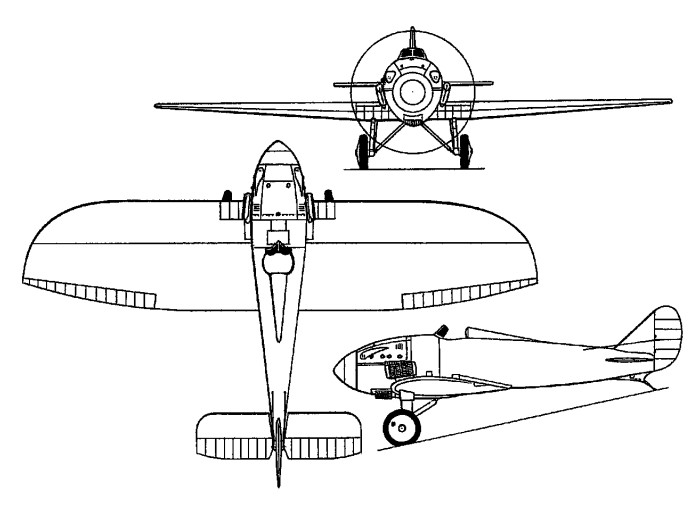
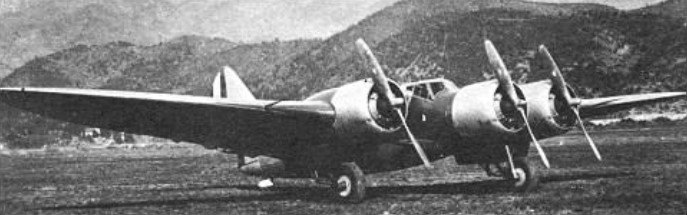
The Piaggio P.16 three-engine heavy bomber of 1934 was distinguished by a thick-section semi-elliptical wing set at shoulder height, and of inverted gull configuration. Defensive armament comprised four 7.62mm machine-guns located in the wing leading edge, in a retractable dorsal turret and in the rear fuselage beneath the high-positioned single fin and rudder. Largely of metal construction, the P.16 had retractable main landing gear units and a non-retractable tailwheel with a spat-type fairing. The bomb-aimer’s compartment was located in the underside of the fuselage, just behind the central engine.

Armament: 4 x 7.62mm machine-guns
Piaggio P.8

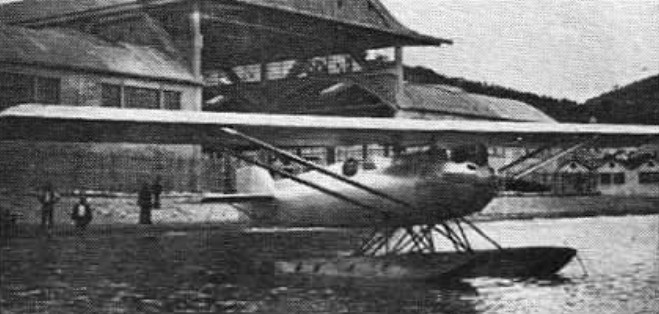
A parasol-wing single-seat floatplane, the small Piaggio P.8 reconnaissance aircraft of 1928 was intended, like its rival the Macchi M.53, to be stored in a cylindrical container aboard submarines of the large ‘Ettore Fieramosca’ class. It was designed to be assembled rapidly for deployment at sea on patrol or reconnaissance; after being recovered it could as easily be dismantled and re-stowed in its container. Powered by a 56kW Blackburn Cirrus II engine, it had a maximum speed of 135km/h.

Engine: 1 x Blackburn Cirrus II, 56kW
Max. speed: 135 km/h / 84 mph

Piaggio P.7 / Piaggio-Pegna P.c.7

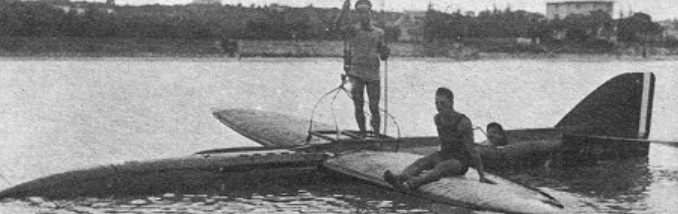
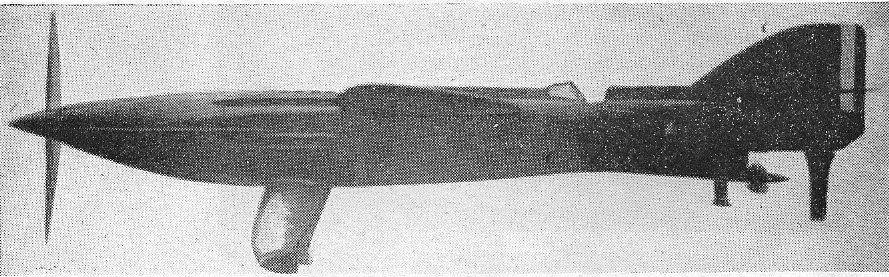
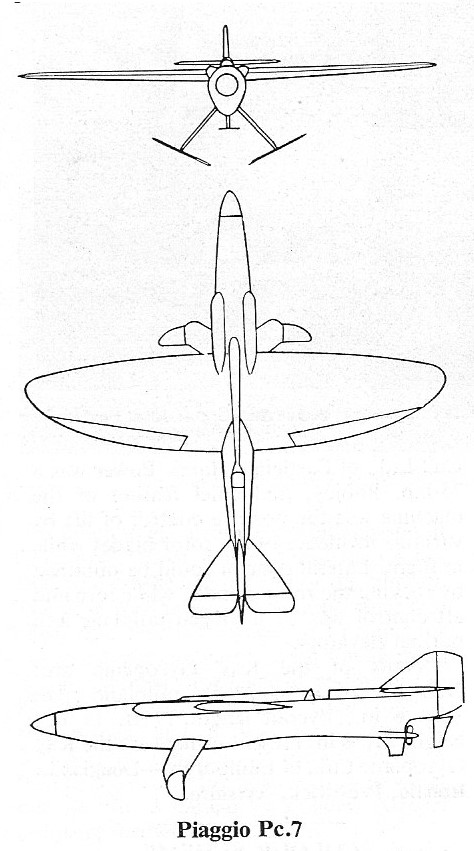
A truly remarkable design, the Piaggio P.7 or Piaggio-Pegna P.c.7 was built for the 1929 Schneider Trophy contest. A cantilever high-wing monoplane with long slender fuselage, it had twin hydrofoils instead of floats and was intended to float with the wing resting on the surface of the water. While water-borne it was to be driven by an ordinary marine propeller connected by a shaft and clutch to the rear of the 723kW Isotta Fraschini Special V.6 engine. Once sufficient speed had been attained to lift the aircraft on to the hydrofoils and the normal tractor propeller was clear of the water, this latter propeller would be clutched-in, the marine propeller disengaged, and a conventional take-off would follow.

In practice, problems with the respective clutches prevented the P.c.7 from ever taking off, and although water trials were conducted on Lake Garda by Dal Molin of the Italian Schneider team, the construction of a second aircraft was abandoned.

Engine: 1 x Isotta-Fraschini Special, 723kW / 850 hp
Wingspan: 28 ft 8.5 in
Length: 29 ft
Height: 8 ft
Empty weight: 3093 lb
Loaded weight: 3709 lb
Max take-off weight: 1738 kg / 3832 lb
Crew: 1

Piaggio P.6

In 1927 two parallel, designs were developed to meet an Italian naval requirement for a two-seat catapult-launched seaplane. One was a small flying-boat, the Piaggio P.6bis powered by a single 194kW Isotta Fraschini V.6 engine mounted between the wings and driving a pusher propeller; the other was the P.6 floatplane with a large central float, two wing-tip stabilising floats, and a 288kW A.20 engine in the nose. The two aircraft had identical wing structure, with rigid strut bracing, and each mounted a single defensive machine-gun, that of the flying-boat in the bow, and the floatplane’s in the rear cockpit.

The P.6ter of 1928 was similar to the P.6, but had an engine boosted to 306kW to provide a maximum speed of 195km/h. Wing span was 13.50m and maximum take-off weight 2360kg. A batch of 15 P.6ter floatplanes was built, and the type was used for a period aboard several Italian capital ships and cruisers.

P.6bis
Engine: 1 x 194kW Isotta Fraschini V.6

P.6
Engine: 1 x 288kW A.20

P.6ter
Engine: 1 x Fiat A.20, 306kW
Max take-off weight: 2360 kg / 5203 lb
Wingspan: 13.5 m / 44 ft 3 in
Max. speed: 195 km/h / 121 mph

Piaggio P.3

The Piaggio P.3 Pegna-designed night bomber of 1923 was a two-bay biplane with the lower wing of greater span than the upper. The biplane tail unit incorporated triple fins and rudders, and four 149kW S.P.A. 6A engines were mounted in tandem pairs on the lower wing, driving two tractor and two pusher propellers. Pilot and co-pilot were seated side-by-side in an open cockpit ahead of the wings, and there were gunner’s cockpits in the nose and amidships, the rear gunner also operating a tunnel gun for ventral defence. At a later stage two 306kW Fiat A.20V engines were installed but the P.3 was not accepted by the Regia Aeronautica for quantity production.

Engine: 4 x S.P.A. 6A, 149kW
Wingspan: 24 m / 79 ft 9 in
Max. speed: 185 km/h / 115 mph

Piaggio P.2

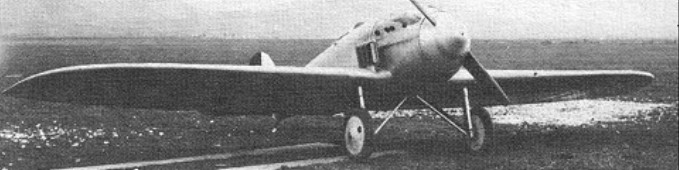
The Piaggio P.2 was the first original design for the company by Giovanni Pegna. Constructed at the Sestri Ponente (Genoa) works in 1923, it was a cantilever low-wing monoplane single-seat fighter with a semi-mono-coque fuselage and fixed, divided landing gear. Twin radiators for the 224kW Hispano-Suiza engine were mounted on the fuselage sides just forward of the pilot’s open cockpit, and armament comprised twin synchronised Vickers 7.62mm machine-guns.

Engine: 224kW Hispano-Suiza
Wingspan: 10.5 m / 34 ft 5 in
Armament: 2 x Vickers 7.62mm machine-guns

Phoenix Industries Model CV

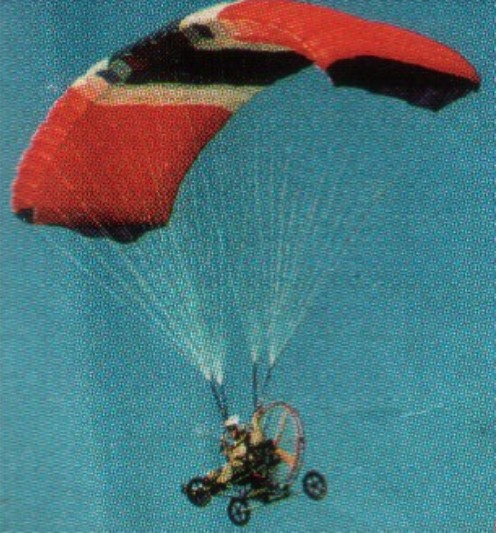
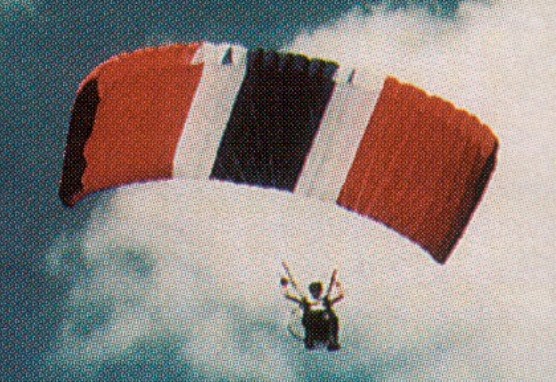
Manufactured in the US, kit prices (US$7590) includes the engine and prop. The wing was available in two sizes, and nose wheel steerable.

Engine: Zenoah G25, 22 hp
Height: 5 ft
Length: 6 ft
Wing span: 30 ft
Wing area: 315 sq.ft
Empty weight: 120 lb
Gross weight: 360 lb
Fuel capacity: 2.5 USG
Cruise: 20 mph
Range: 30 sm
Rate of climb: 350 fpm
Takeoff dist: 150 ft
Landing dist: 0-10 ft
Service ceiling: 5000 ft
Seats: 1

Phoenix Aircraft PM-3 Duet / Luton Minor III

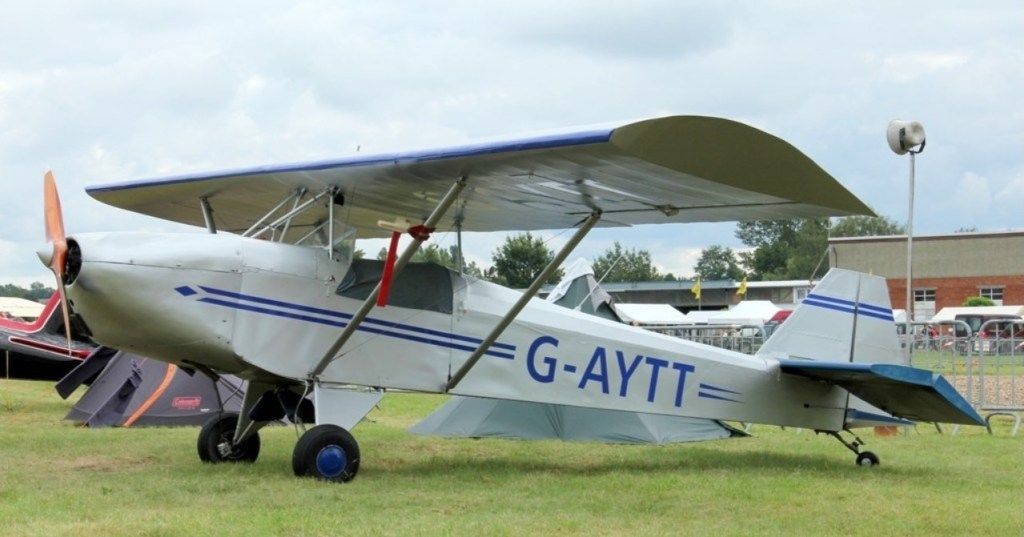
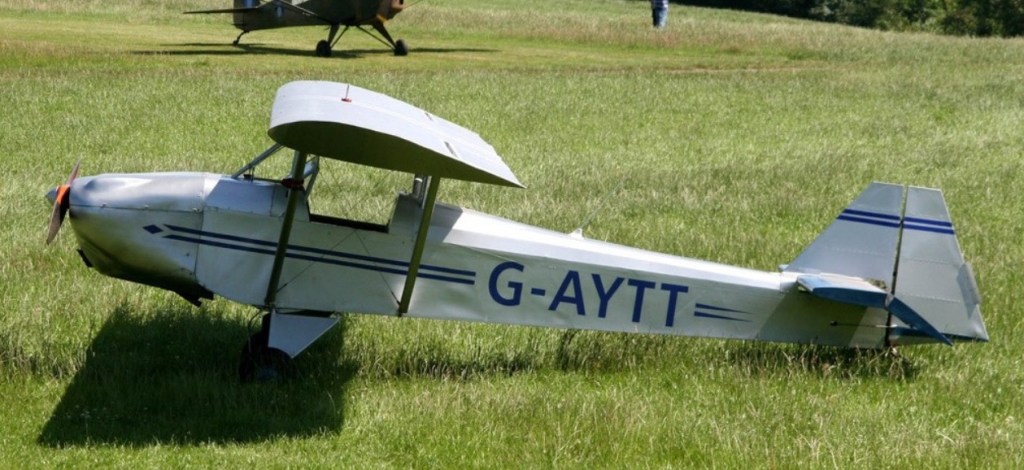
The PM-3 Duet is basically an enlarged Minor airframe. The Minor fuselage is fattened to take two people side-by-side and restressed to take a larger engine. Some modification to the wing and tail surfaces is also involved.

The design was originally designated Luton Minor III but was re-designated the Phoenix PM-3 Duet.

The prototype, G-AYTT PFA.841 was built by A.S. Knowles, who was involved in the type’s development. It first flew, at Fairoaks, on 22 June 1973 with a Continental C90 engine in a Condor cowling.

Gallery

Engine: Continental C90, 90 hp
Cruise: 100 mph
Stall: 35-40 mph

Phoenix Air Phoenix Motorglider

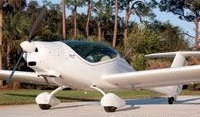
Phoenix Air’s honcho Jim Lee counts 14 more aircraft on his backordered list—a major LSA success story. The 49-foot span, Rotax 912ULS-powered low-wing taildragger won Sun ‘n Fun’s Best Commercial LSA award in 2012 and received three more sales. Base price 2012: $149,000.
Phoenix Air was rolling out a new Phoenix S-LSA motorglider every 18 days. They registered 10 aircraft in the US in 2012.

Under development in 2012 was the all-electric ePhoenix, using an in-house built motor and electronic flight controller. So far, flights have yielded one-hour durations, this is a two-seat LSA.