Under Paulhan-Pillard license-built E.5 three-engined monoplane flying-boat and T3-BN.4 twin-engined twin float coast-defense floatplane.
Piston
SPCA E.5
Under Paulhan-Pillard license-built E.5 three-engined monoplane flying-boat and T3-BN.4 twin-engined twin float coast-defense floatplane.
Sud-Est SE 2010 Armagnac

In 1946 in France, plans were drawn for three new aircraft including the Sud-Est 2010, for 150 passengers, with delivery at the end of 1948. Fifteen SE 2010s had been ordered for delivery at the end of 1948. However, it was 2 April 1949 before the aircraft, christened the Armagnac, made its maiden flight. Powered by four 3,500-hp Pratt & Whitney Wasp Majors, this was designed to carry 64 passengers (with bunks) on the South and North Atlantic routes, or 107 on shorter runs. Air France, however, refused the aircraft on the grounds that bunks were no longer required, and there was therefore excessive space in the fuselage. Four were bought by Transports Aériens Intercontinentaux for freighting, but after only eight months this company decided that they were not economical. In 1954 they were overhauled and used to transport troops and supplies from Toulouse to fight the war in Indo-China. A further five were also used for this purpose.
Engines: 4 x Pratt & Whitney R-4360 Wasp Major, 3500 hp
Pax cap: 150
Sud-Est SE 100 / Liore-et-Olivier LeO 50
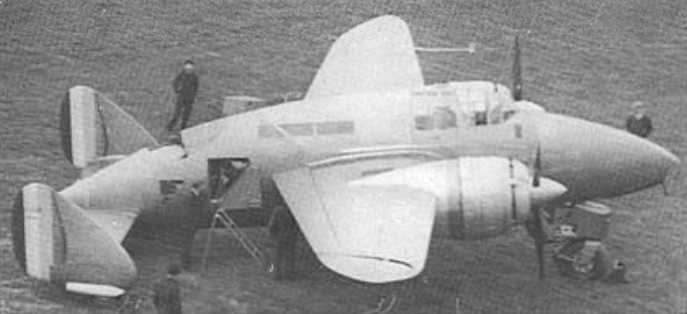
With the issue of a specification for a successor to the Potez 631 twin-engined fighter in service with the Armee del’Air, P-E Mercier and Jacques Lecarme of the Societe Nationale de Constructions Aeronautiques de Sud-Est (SNCASE) tendered the design of a highly innovative aircraft, the SE 100. Of mixed construction with a wooden wing and a duralumin-covered welded steel-tube fuselage, the SE 100 featured a retractable tricycle undercarriage with a steerable nosewheel and small outrigger wheels retracting into the bases of the endplate vertical tail surfaces. The main wheels fitted right aft, retracting into the tail rather than the wings or engine nacelles as was conventional.
Powered by two 1,030hp Gnome-Rhone 14N 14-cylinder radial engines, the first prototype SE 100 was flown on 29 March 1939 at Argenteuil. Various modifications, including provision of a retractable ventral fin, were introduced as a result of initial flight test, maximum speed being raised from 560km/h to 580km/h as a result. The proposed armament comprised a nose-mounted battery of four Hispano–Suiza HS.404 20mm cannon and a single aft-firing cannon on an electro-pneumatic mount. It was proposed that the crew would comprise two members for diurnal operations and three members for nocturnal missions, and a crawl tunnel was provided between the cockpits. A number of necessary changes were identified during the tests.
On 5 April 1940, during a landing approach, the pitch mechanism of the starboard propeller malfunctioned and the aircraft was destroyed. At this time, assembly of a second prototype had begun, this possessing slightly larger overall dimensions, dispensing with the crawl tunnel to increase fuselage fuel capacity and having an all-metal one-piece wing. Armament was also revised, the forward-firing battery being increased to six 20mm cannon, paired weapons of the same calibre being mounted in a dorsal turret and an additional 20mm cannon being mounted to fire through a ventral hatch.
The aircraft proved to be around 100 km/h faster than the Potez 631, the French Air Force’s current twin-engined fighter, and production was authorized. The Citroen factory in the suburbs of Paris began tooling-up to assemble 300 SE 100s for deliveries to commence at the end of 1940, but the German occupation of Paris prevented final assembly of the second prototype. Proposed variants included the SE 101 and 102 with 1,200hp Pratt & Whitney Twin Wasp and 1,050hp G-R14N-2/3 engines respectively.
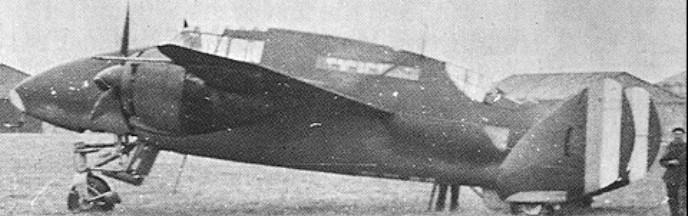
SE 100 (first prototype)
Max take-off weight: 7500 kg / 16535 lb
Empty weight: 5520 kg / 12170 lb
Wingspan: 15.70 m / 52 ft 6 in
Length: 11.80 m / 39 ft 9 in
Height: 4.28 m / 14 ft 1 in
Wing area: 33.06 sq.m / 355.85 sq ft
Max. speed: 580 km/h / 360 mph
Cruise speed: 500 km/h / 311 mph
Range: 1300 km / 808 miles
Societe Nationale De Constructions Aeronautiques Du Midi / Dewoitine D.750
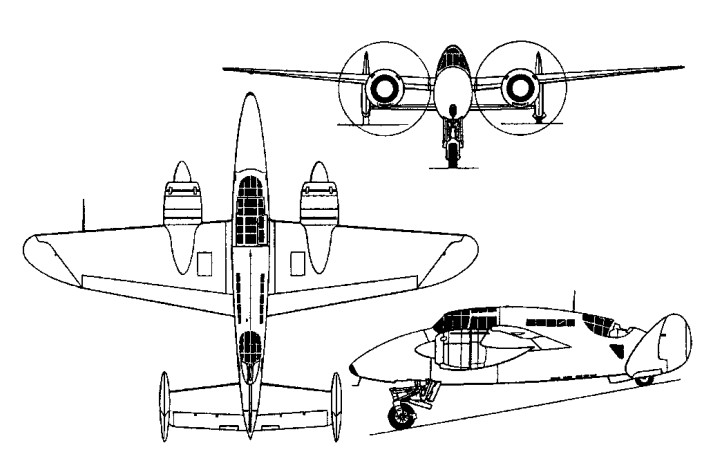
D.750, first flown 1940, was unusual twin-engined multipurpose folding-wing monoplane for operation from planned aircraft carriers.
SFCA Lignel 10 Foudre / Lightning
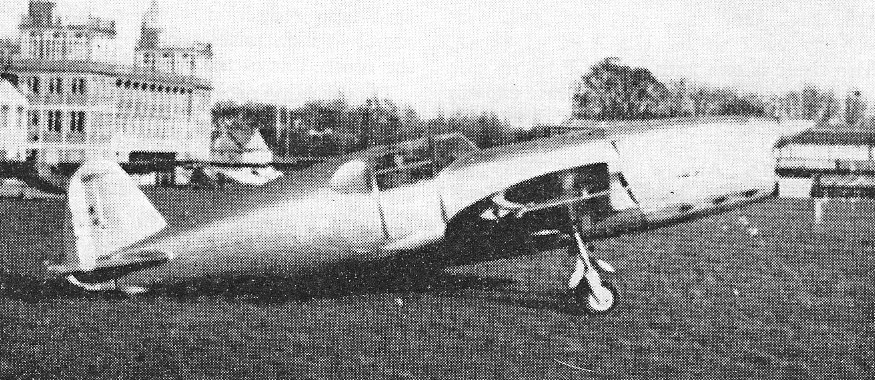
The Lignel 10 Foudre / Lightning first flew in March 1938, from Villacoublay, piloted by Colonel Rozanoff.
The Lignel 10 was only produced in prototype form.
A two-seat version, the Lignel 16, was developed from the Foudre.
Engine: 220 hp Renault 6 Q-03
Wingspan: 10.3 m
Length: 7.7 m
Height: 2.85 m
MAUW: 1200 kg
Max speed: 370 kph
Range: 3200 km
Crew: 1
Societe Francaise Deviation Nouvelle SFAN 5
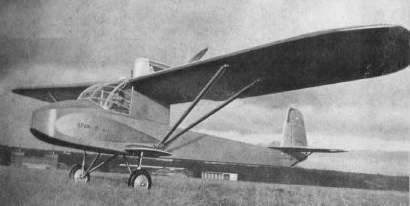
The two-seat SFAN 5 was a one-off enclosed variant of the earlier SFAN 4, first flying in 1936.
Engine: 1 × Train 4T, 45 kW (60 hp)
Propeller: 2-bladed fixed-pitch pusher
Wingspan: 12.5 m (41 ft 0 in) (10.3 m (34 ft))
Wing area: 18 m2 (190 sq ft) (16.2 m2 (174 sq ft))
Length: 7.05 m (23 ft 2 in)
Empty weight: 285 kg (628 lb)
Gross weight: 500 kg (1,102 lb)
Maximum speed: 115 km/h (71 mph, 62 kn)
Cruise speed: 120 km/h (75 mph, 65 kn)
Landing speed: 45 km/h (28 mph; 24 kn)
Range: 450 km (280 mi, 240 nmi)
Time to altitude: 1,000 m (3,300 ft) in 6 minutes
Wing loading: 30.8 kg/m2 (6.3 lb/sq ft)
Power/mass: 11.17 kg/kW (18.37 lb/hp)
Crew: 2
Societe Francaise Deviation Nouvelle SFAN 2 / SFAN 4
Licensed for British BAC Drone 1935; modified to suit French requirements as the single seat SFAN 2, powered by a 25 hp Ava engine.
A larger, two-seat side-by-side model to same formula was SFAN 4, powered by a 35 hp Mengin engine. Only two SFAN 4 were built.
It was reported that the French Air Ministry ordered forty Drones from the French company.
The SFAN 5 was a one-off enclosed variant of the earlier SFAN 4.
SRCM SRCM-153
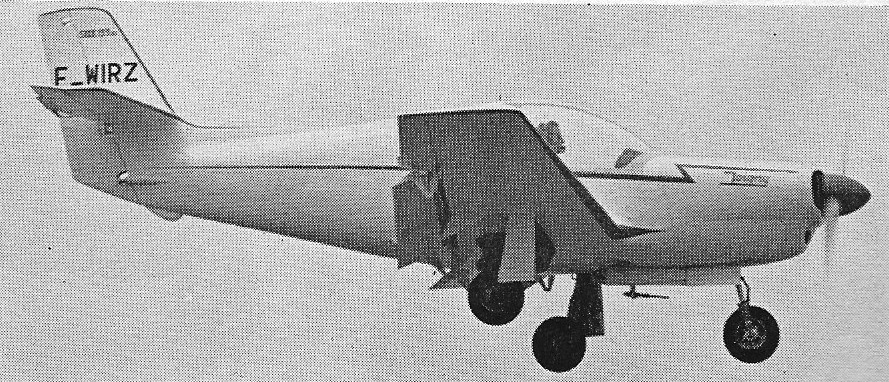
After failing to obtain a license to build the CAB Supercab, Societe De Recherches Et De Constructions Mecaniques designed a new lightplane known as the SRCM-153 Joigny, which first flew in March 1960. This was a three/four-seat monoplane with retractable landing gear, powered by a 150 hp Lycoming O-320A engine.
Constructions D’avions Detourisme RG-60
Societe D’etudes Et De Constructions D’avions Detourisme was established in 1938, produced the RG-60 single-seat biplane, RG-75 two-seat cabin monoplane, and S.5 two-seat high-wing cantilever monoplane. Production ended at outbreak of Second World War.

