A piston powered glider. Cruising speed 85 mph.
Piston
Šoštarko Monoplane
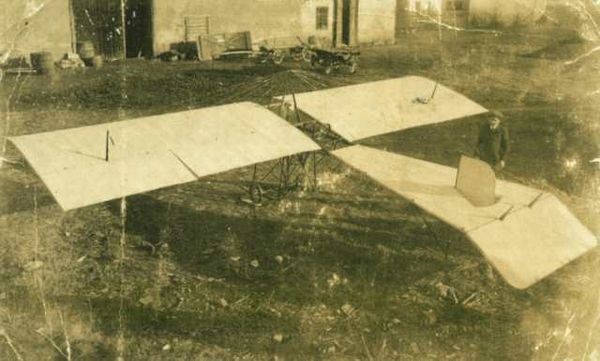
1911-12 monoplane of Austro-Hungarian/Croatian origin built by Slavoljub Šoštarko in Zagreb (Agram), Croatia – then part of the Austro-Hungarian Empire. Šoštarko was probably an automobile racer who crossed over to airplane design and flying, but when his monoplane was exhibited in Zagreb in 1912, it was destroyed during his very first attempt at flight. There is no evidence that Šoštarko flew after this. As one of a few others who were experimenting right next to the sheds of Mihajlo Mercep at the gates of Zagreb, to be expected, the Šoštarko monoplane shows some resemblance to the Mercep Rusjan-Novak monoplanes; i.e. wing-posts, tail assembly with rudder running through the stabilizer, etc.
Sorrell Bathtub
Built by Otto Sorrell circa 1950, the Sorrell Bathtub was a single-place, open cockpit, high wing monoplane, inspired by 1924 Dormoy Bathtub.
An “ultra-ultralight” powered by a geared-down chain-saw motor and tricycle gear, it was further developed by Michael Kimbrel, of Oakville WA, who in 1978 flew a tail-wheel version with a VW engine, then promptly sold 400 sets of drawings to home-builders.
Sorrell Colt
Built by Otto Sorrell, probably in the 1950s, the Sorrell Colt was a single-place, open cockpit biplane, powered by a 65hp Continental A-65.
Sorrell-Robinson Wenoso
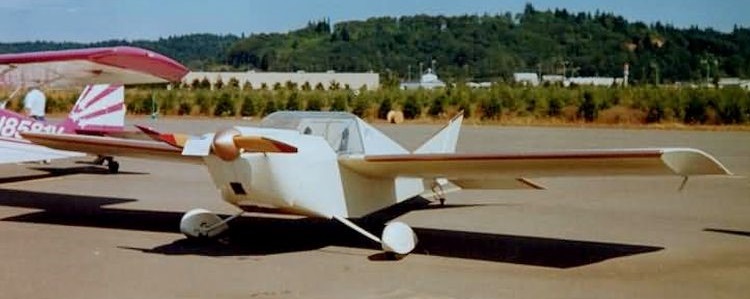
The Sorrell-Robinson Wenoso was built by Hobart “Hobie” C. Sorrell, in the mid-1960’s.
Registered N1041, the plane spent some time in the Puyallup, Washington, USA, area and was rebuilt in 1990.
The plane was destroyed in a fatal accident on December 7, 1990.
Engine: 65hp Continental
Wingspan: 25’0″
Length: 19’0″
Cruise: 125 mph
Seats: 1
Sorrell Nieuport 17C
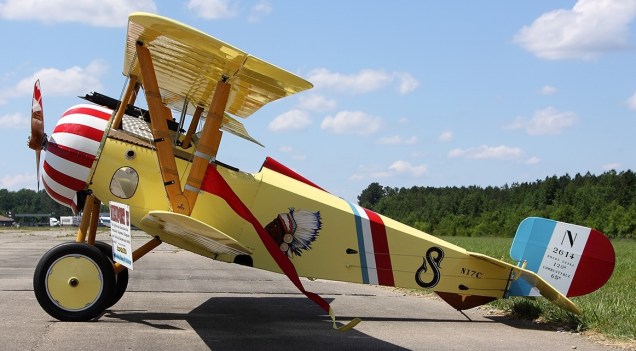
The 1961 Sorrell Nieuport 17C, N17C Serial Number 1, is a three-quarter scale replica of WW1 Nieuport 17C.
The single-seat aircraft received an Airworthiness Certificate on 26 May 1964.
It was later registered to Wild Blue Aero Squadron LLC, Indianapolis, IN, USA.
Engine: 40hp Salmson AD-9
Wingspan: 21’9″
Length: 15’3″
Useful load: 325 lb
Max speed: 99 mph
Cruise: 75 mph
Seats: 1
Sorrell Triplane
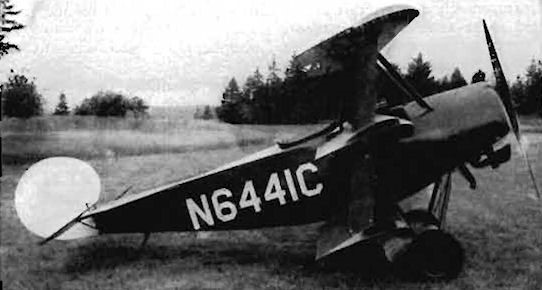
The 1957 Sorrell Triplane N6441C is a three-quarter scale replica of the WW1 Fokker triplane. Painted red, with silver rudder and white lettering, the single-seat Sorrell Triplane has a span of approximately 17 ft. 8 in., and is powered by a 65-hp Continental A65 flat-four.
The owner-constructor flew it from a private airstrip at Rochester (Washington State).
Sorrell Biggy Rat
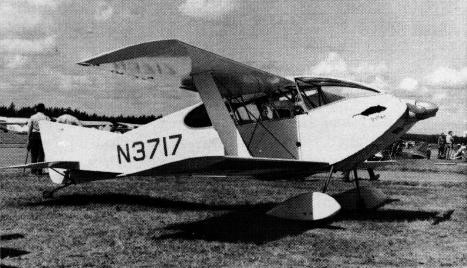
Satisfied with the lightweights, the Sorrells in 1967 constructed a sturdier negative-stagger single-place biplane powered with a converted 125 hp GPU by Lycoming. It had a streamlined fuselage profile with the windshield fairing right down to the spinner and no tapering of the side frames at the tail. Unusual was the method of mounting up – lift the rear portion of the skylight, climb up on top of the fuselage and slide down into the single seat.

Registered N3717 and named “Biggy Rat” by a younger Sorrell with an artistic bent, with the 125 hp and a very thin (10%) airfoil, “Biggy Rat” could cruise at 130 mph indicated – and could still operate with relative ease out of their 900 ft. cul-de-sac airport.
With a beefier structure and adequate power, John and Mark were able to indulge themselves in some aerobatics. “Biggy Rat” is very light on the controls – even touchy – and has done with ease all that has been asked of it in its 160+ hours of flying time.
Sorrell SNS-4
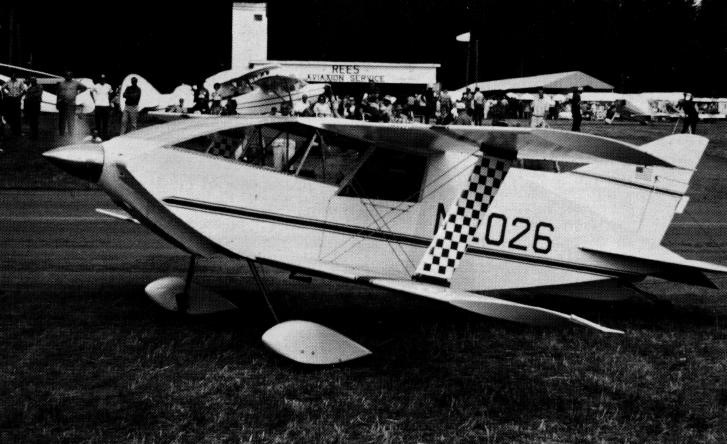
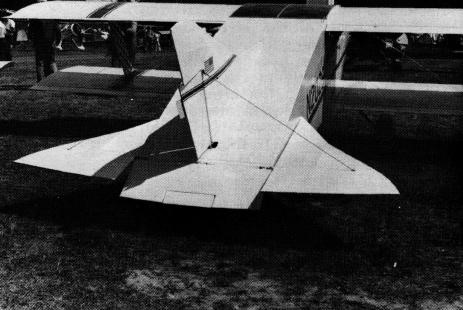
The Sorrell SNS-4 N2026 fuselage is 4130 tube and is of constant width from nose to tail. The aft end squeezes down – from the top and bottom – and ends with a fuselage-wide elevator with an adjustable trim tab in the center. Two separate, fixed, horizontal stabilizer panels are attached to each side of the fuselage and are wire braced to the vertical fin. In early test flights the original fin proved too small for good directional control, so it was enlarged and supplemented by a small dorsal fin.
The equal span, constant chord wings are of all-wood construction. Each panel has three spars and no internal bracing – everything is kept square by a 1/8 in. plywood covering. The front spar is actually the leading edge, contoured to match the thin 10 percent airfoil. The top wing panels are attached to fittings on the upper fuselage longerons and the lower panels to the lower longerons with a doubled set of tie rods to take flying and landing loads.
The tie rod attach fittings are located inside the wing and inside the fuselage to minimize drag as much as possible. As the photos indicate, a wide “I” strut completes the wing truss geometry.
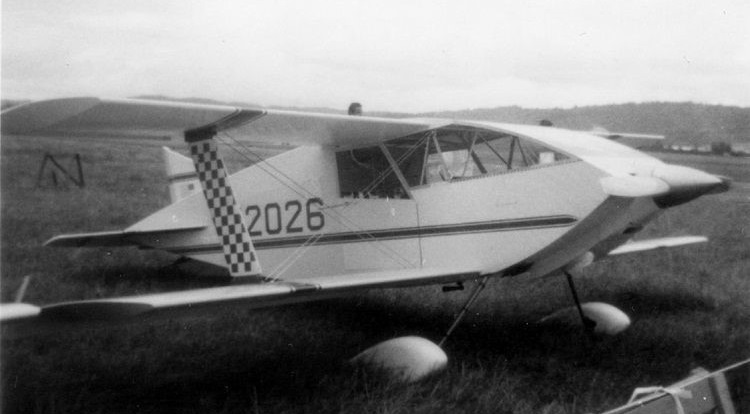
The top wings have narrow chord, full span ailerons and the lower panels full span flaps. Between the seats in the cabin is a Volkswagen parking brake lever – just where it is in a Beetle. With the lever all the way down the flaps and ailerons are in their normal, in-trail position; pull the lever up a notch and both the flap and aileron come down – the flap just twice as far as the aileron. Wiggle the stick and the ailerons work as usual in their lowered position. Another tug up on the lever results in more aileron droop and, again, twice as much flap, etc. until full travel is reached. Press the release button in the end of the lever and push it all the way down to take off all flap and aileron droop – or stop anywhere desired. The VW lever allows almost infinite-choice positioning – all push-rod actuated. It allows approach at 85 and touch down at 55 to 60 mph – its stall speed.
Mark Sorrell says that at the stall the wings obviously quit flying but the plane hangs on in a squirmy, squirrely fashion for a few more seconds – which he feels is the last gasp of the lift generated by the fuselage. When the little bird finally does quit, the remainder of the stall is docile and recovery is normal.
SNS-4 is powered b ya 125 hp GPU and cruises at 130 mph. The Lycoming fuel is from a main fuselage tank located between the panel and firewall. It has a capacity of 17 gallons which backed by an aux tank holding 11, makes 28 total.
The engine installation requires a shaft extension to get the metal prop as far out into undisturbed air as possible – and away from the cowling/windshield – for better efficiency.
The SNS-4 has fiberglas wheel pants that are constant in width. These wide pants allow the brakes to be enclosed. The brakes, are Montgomery Ward go-cart mechanicals.
SNS-4 is covered with ceconite and is white with a simple trim. The skylight – 1/8 in. plexiglas – is tinted green.
Completed on 12 July 1969, SNS-4 plans were never made available.
Sorrell SNS-4 – N2026
Engine: Lyc. 0-290-G, 125 hp
Span: 21 ft 0 in
Length: 17 ft 0 in
Empty Weight: 818 Ib
Max. Weight: 1328 Ib
Fuel Cap: 28 gal.
Cruise Speed: 130 mph
Stall Speed: 55 – 60 ind.
Seats: 2
Sorrell DFG-1
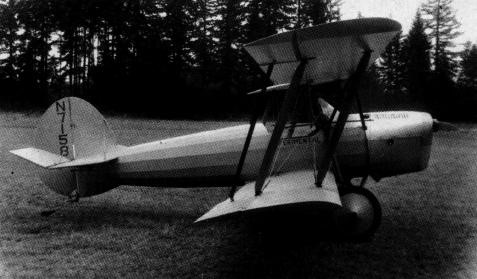
The 1958 Sorrell DFG-1 N7158 was all-wood construction; fuselage with geodetic structure.
Engine: 40hp Mercury water-cooled outboard
Wingspan 20’0″
Gross wt: 500 lb
Seats: 1

