Starr Bumble Bee

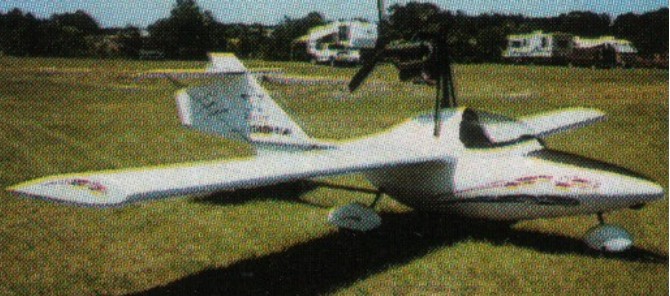
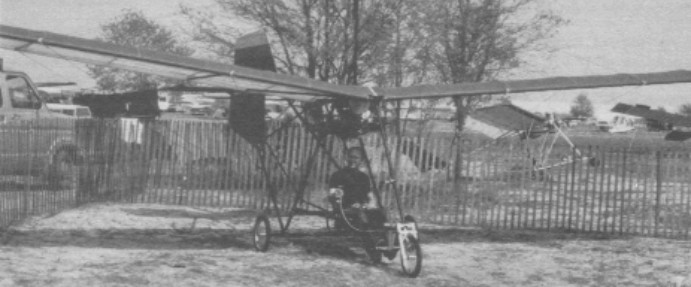
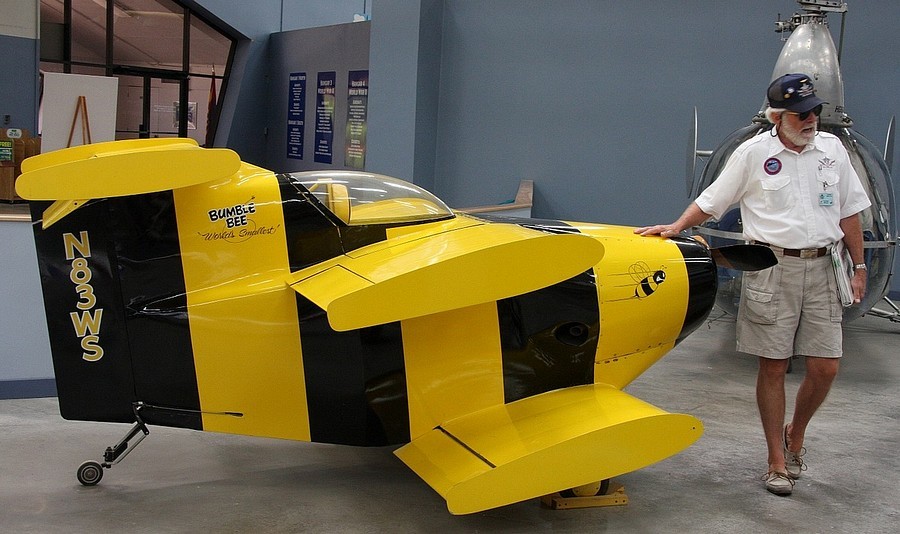
The Bumble Bee II was the world’s smallest piloted airplane. It was built by Robert H. Starr. Its first flight was on 8 May 1988. The Bumble Bee II crashed on the same day due to an engine failure. Robert Starr was seriously injured in the crash, but he fully recovered from his injuries.

Engine: 85hp Continental C-85
Wingspan: 6’6″
Length: 9’4″
Fuel capacity: 3-gal
Max speed: 180 mph
Cruise: 150 mph
Stall: 80 mph
Range: 30 mi
Ceiling: 5,000 ft
Seats: 1

Star-Lite Warp 1-A

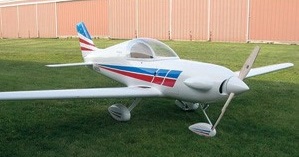
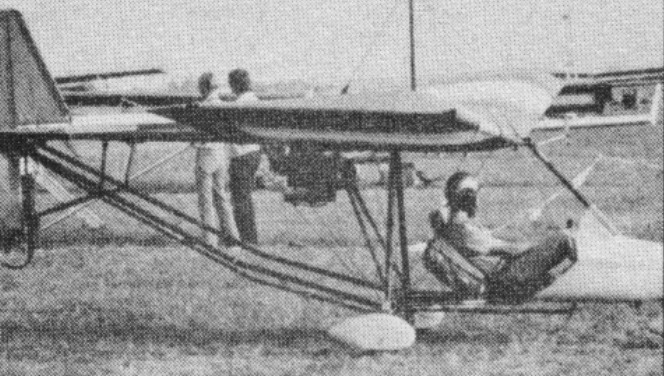
The Star-Lite Warp 1-A is an American homebuilt aircraft that was designed and produced by Star-Lite Engineering of Englewood, Ohio, introduced in 1996.

The aircraft was designed to comply with the US FAR 103 Ultralight Vehicles rules, including the category’s maximum empty weight of 254 lb (115 kg). The aircraft has a standard empty weight of 250 lb (113 kg). The original Star-Lite used a Rotax 447 engine.

The Warp 1-A features a cantilever mid-wing, a single-seat enclosed cockpit under a bubble canopy, fixed tricycle landing gear with wheel pants, a boom-mounted T-tail and a single pod-mounted engine in pusher configuration.

The aircraft is made from composites. Its 25.0 ft (7.6 m) span wing is made with an aluminum spar and S-glass vinyl-ester resin, is detachable for ground transport or storage and has a wing area of 87.5 sq ft (8.13 m2). The standard engine used is the 50 hp (37 kW) Rotax 503 two-stroke powerplant.

Introduced in 1996, the aircraft was supplied as a kit for amateur construction. The manufacturer estimated the construction time from the supplied kit as 100 hours. The kit, including engine, propeller and instruments, cost US$26,995.00 in 1998.

In March 2014 one example, the prototype, was registered in the United States with the Federal Aviation Administration as an Experimental – Amateur-built, although its registration expired in June 2013.

Star-Lite M2

Brian Burghgrave built a Star-Lite M2 using a Rotax 503, necessitating a new cowl. In addition, he installed flaps and counterbalanced the ailerons and elevator. First flown in October 2009, these changes add the “M2” to the name.

Gallery

Top speed: 70 mph
Cruise: 55 mph
Stall: 22 mph
Range: 100 sm
Rate of climb: 900 fpm
Takeoff dist: 50 ft
Landing dist: 50 ft
Service ceiling: 12,000 ft
Engine: Rotax 503, 46 hp
HP range: 40-100
Fuel capacity: 5 USG
Empty weight: 250 lb
Gross weight: 575 lb
Height: 6.5 ft
Length: 19.5 ft
Wing span: 25 ft
Wing area: 87.5 sq.ft
Seats: 1
Landing gear: nosewheel

Star-Lite Warp 1-A
Engine: 1 × Rotax, 50 hp (37 kW)
Propeller: 2-bladed fixed pitch
Wingspan: 25 ft 0 in (7.62 m)
Wing area: 87.50 sq ft (8.129 sq.m)
Aspect ratio: 7:1
Empty weight: 250 lb (113 kg)
Gross weight: 575 lb (261 kg)
Fuel capacity: 5 U.S. gallons (19 L; 4.2 imp gal)
Full fuel payload: 295 lb (134 kg)
Wing loading: 6.6 lb/sq ft (32 kg/sq.m)
Cruise speed: 95 mph (153 km/h, 83 kn)
Stall speed: 40 mph (64 km/h, 35 kn)
Never exceed speed: 110 mph (180 km/h, 96 kn)
Service ceiling: 12,000 ft (3,700 m)
Rate of climb: 900 ft/min (4.6 m/s)
Take-off & landing roll: 150 ft (46 m)
Crew: one

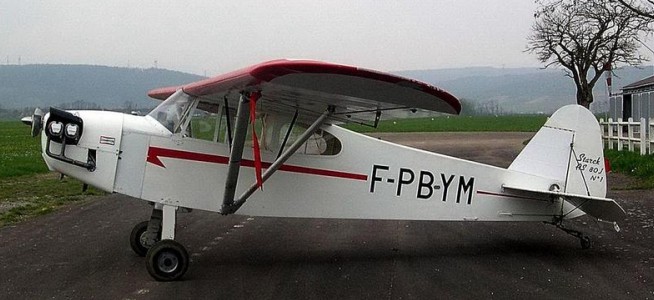
Starck AS-80 Holiday

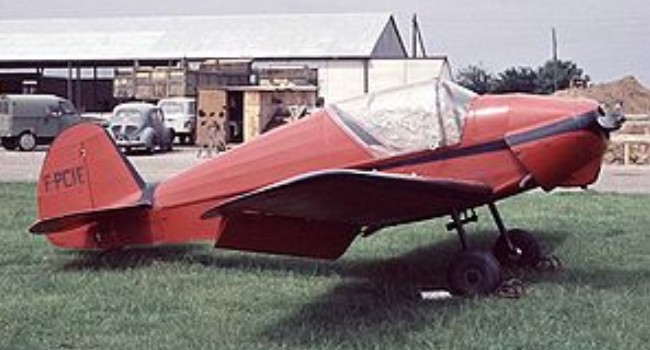
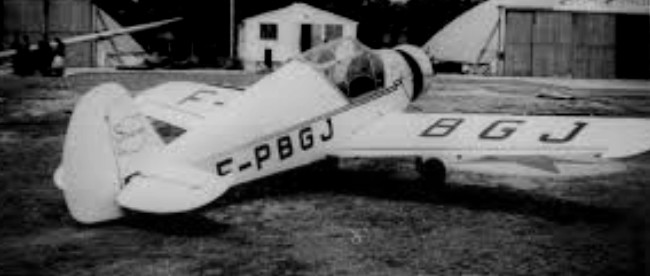
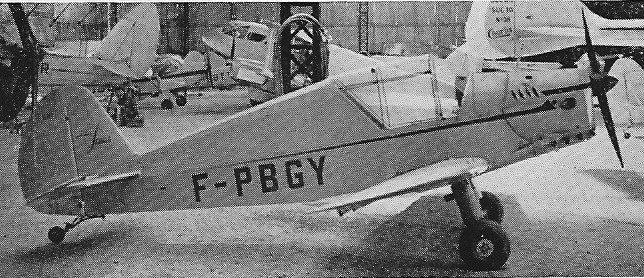
André Starck continued construction of a range of eight aircraft after 1945: AS-37, AS-57/3, AS-57 / 4, AS-57/5, AS-70 “Jac” AS-71 AS-80 “Holiday” and AS-90 “New Look”.

The AS.80 was a tandem two-seat cabin monoplane of wooden construction with fabric covering, designed primarily for construction from kits of parts by amateurs.

Engine: 75 hp Regnier 4D2
Max speed: 98 mph
Cruise: 88 mph
ROC: 590 fpm
Range: 200 mi
Empty weight: 720 lb
Loaded weight: 1210 lb
Wingspan: 32 ft 10 in
Length: 21 ft 7.5 in
Height: 6 ft 3 in

Starck AS.70 Jac / AS.71 / AS.72 / AS.75

Starck A.S.75 Jac

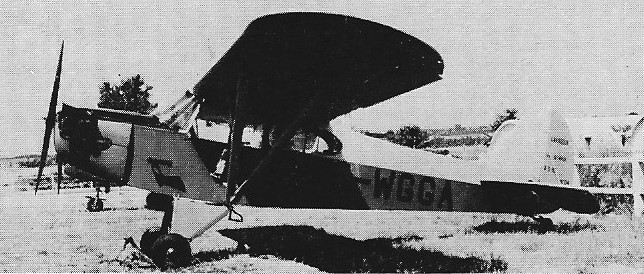
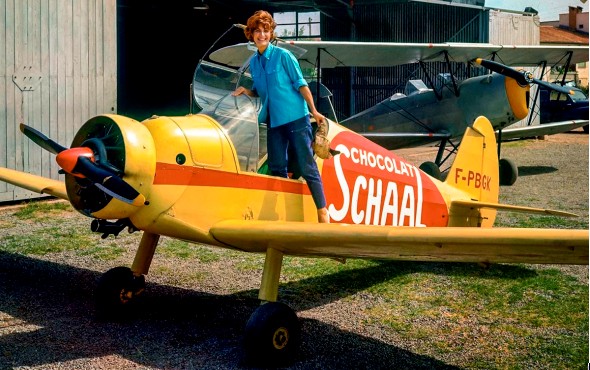
First flown on 23 May 1945, the AS-70 was developed during 1945 as a single-seat light low-wing monoplane aircraft to serve the early postwar needs of French private pilots and aero clubs. It is of mixed welded steel tube and wooden construction with fabric covering, and is fully aerobatic.

A small series of 19 Jacs was constructed by Avions Starck. These were fitted with a range of engines with power outputs of between 45 to 65 hp (34 to 48 kW). Different designations were given to aircraft powered by the various engines.

AS.71 Jac

The Jac proved to be a popular aircraft with private pilots and aero clubs and four examples remained in service in 2009.

Starck AS-70

Variants:

AS-70
fitted with 45 hp (34 kW) Salmson 9 Adb radial engine

AS-71
fitted with 65 hp (48 kW) Walter Mikron II engine

AS-72
fitted with Salmson 9 ADr radial engine

AS-72/1
fitted with a Percy II engine.

AS-75
fitted with 65 hp (48 kW) Continental A65-8S engine

Specifications:

Starck AS-70
Engine: Salmson 9Adb, 45 hp
Wingspan: 7.40 m / 24 ft 3 in
Length: 5.33m / 17 ft 7 in
Wing area: 8 sq.m / 86 sq.ft
Empty weight: 202 kg / 467 lb
Maximum weight: 300 Kg / 705 lb
Max speed: 115 mph
Cruise: 185 km / h / 104 mph
Ceiling: 6200 m
Range: 420 km / 260 mi

Starck AS-75
Engine: 1 × Continental A65-8S, 65 hp (48 kW)
Length: 17 ft 7 in (5.36 m)
Wingspan: 24 ft 3 in (7.39 m)
Wing area: 86 sq ft (8.0 m2)
Height: 5 ft 3 in (1.60 m)
Empty weight: 435 lb (197 kg)
Gross weight: 698 lb (317 kg)
Maximum speed: 126 mph (203 km/h; 109 kn)
Cruise speed: 115 mph (100 kn; 185 km/h)
Range: 320 mi (278 nmi; 515 km)
Crew: one
Capacity: one passenger

Starck AS-57

AS-57/3

André Starck continued construction of a range of eight aircraft after 1945: AS-37, AS-57/3, AS-57 / 4, AS-57/5, AS-70 “Jac” AS-71 AS-80 “Holiday” and AS-90 “New Look”.

AS-57/3
Engine: 95 hp Regnier 4-EO
Wingspan: 28 ft
Wing area: 118 sq.ft
Length: 21 ft 2 in
Empty weight: 683 lb
Loaded weight: 1322 lb
Max speed: 123 mph
Cruise: 115 mph
Ceiling: 19,000 ft
Range: 497 mi

AS-57/4
Engine: 105 hp Walter Minor 4-III

AS-57/5
Engine: 105 hp Hirth 504A-2

Starflight TX1000

Similar to the Tristar except with a conventional three-axis aerodynamic control system, nosewheel has suspension and a nosewheel brake. The prototype of the TX 1000 had its first public showing at Sun’n’Fun in March 1983 at Lakeland, Florida. Described by Dick Turner as a development of the Tristar, this newcomer uses the same wing with 5 degrees of dihedral and double skin over 30% of the chord. However, it uses a different engine, a Rotax unit.

It also has a considerably reinforced structure, the leading edge spars being 2 inch (51 mm) diameter, and the compression tubes and trailing edge spars 1.5 inch (38mm). There are other differences from the Tristar too: the horizontal tail is stiffened in flight by V struts and on the ground by stainless steel cables instead of just the cables of its predecessor. On this model a braked steerable nosewheel is standard. There is a black epoxy coating on all exposed airframe parts, bonded to the tubing and baked to a glass finish.

The TX 1000 was sold as a kit requiring 40 h for assembly for $5195 in 1983, options being electric start and a hand deployed parachute.

Manufactured by Spectrum Aircraft Inc.

Engine: Rotax 377, 34 hp at 6500 rpm
Propeller diameter and pitch 54 x 27 inch, 1.37 x 0.69 m
Belt reduction, ratio 2.1/1
Max static thrust 250 lb, 113 kg
Power per unit area 0.20 hp/sq.ft, 2.2 hp/sq.m
Fuel capacity 4.5 US gal, 3.8 Imp gal, 17.0 litre
Length overall 15.0ft, 4.57m
Height overall 9.0 ft, 2.74 m
Wing span 33.0 ft, 10.05 m
Constant chord 5.0ft, 1.52m
Dihedral 5 deg
Sweepback 0 deg
Total wing area 165 sq.ft, 15.3 sq.m
Wing aspect ratio 6.6/1
Nosewheel diameter overall 16 inch, 41 cm
Main wheels diameter overall 16 inch, 41 cm
Fin height 8.0 ft, 2.44 m
Total elevator area 25.0sq.ft, 2.32 sq.m
Empty weight 252 lb, 114kg
Max take off weight 502 lb, 228 kg
Payload 250 lb, 113 kg
Max wing loading 3.14 lb/sq.ft, 14.8 kg/sq.m
Max power loading 14.8 1b/hp, 6.7kg/hp
Load factors; +5.8, 3.6 ultimate
Max level speed 60 mph, 97 kph
Never exceed speed 75 mph, 121 kph
Max cruising speed 45 mph, 72 kph
Economic cruising speed 32 mph, 51 kph
Stalling speed 21 mph, 34 kph
Max climb rate at sea level 800 ft/min, 4.1 m/s
Min sink rate 320 ft/min at 30 mph, 1.6 m/s at 48 kph
Best glide ratio with power off 7.14 at 32mph, 51 kph
Take off distance 50 ft, 15 m
Landing distance 50 ft, 15 m
Service ceiling 12,000 ft, 3660 m
Range at average cruising speed 90 mile, 145 km

Starflight Tristar / SC-1000 / AC-2000

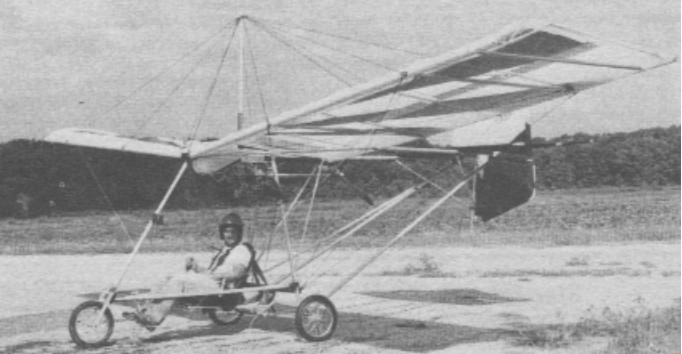
The aircraft was designed before the US FAR 103 Ultralight Vehicles rules were brought into effect, but all models comply with them anyway, including the category’s maximum empty weight of 254 lb (115 kg). The Tristar, for instance, has a standard empty weight of 220 lb (100 kg). The line of aircraft all feature a cable-braced high-wing, a single-seat, open cockpit, tricycle landing gear and a single engine in pusher configuration.

The aircraft is made from bolted-together aluminium tubing, with the flying surfaces covered in Dacron sailcloth. Its 33 ft (10.1 m) span wing is cable-braced from a single element kingpost. The landing gear features a steerable nose wheel with a bicycle-style rim brake. The powerplant is mounted underneath the wing and drives a pusher propeller.

Single seat single engined high wing mono¬plane with conventional three axis control (two axis optional). Wing has unswept leading and trailing edges, and constant chord; cruci¬form tail. Pitch control by elevator on tail; yaw control by fully flying rudder; roll control by spoilerons; control inputs through stick for pitch/roll and pedals for yaw. Wing braced from above by kingpost and cables, from below by cables; wing profile; 30% double surface. Undercarriage has three wheels in tricycle formation; with tailskid; glass fibre suspension on main wheels. Push right go¬-right nosewheel steering connected to yaw control. No brakes. Aluminium tube framework, without pod. Engine mounted below wing driving pusher propeller.

The Tristar also put in its appearance in 1982 but it is not just a three axis version of the Starfire with spoiler¬ons and elevators added to the rudder of the earlier model. The framework of the Tristar is considerably changed from that of the Starfire and the manufacturer has obviously made an important design effort, not being purely content to develop a three axis machine directly from a hybrid. The wing characteris¬tics, for example, have been considerably altered by double surfacing the first third of the chord. In fact, the Tristar does not have to be bought in three axis form as the manufac¬turer offers a two axis version as a no cost option.

The Tristar model took 25 hours to build from the factory-supplied assembly kit. Sold as a kit requiring 25 h for completion at a price of $4750 in 1983, the Tristar in standard form uses a Cuyuna 430R 30hp engine, in which form we detail it below. However, for $100 less it can befitted with the Cuyuna 215R 20hp unit. Other options include storage covers and wheel fairings ($150).

Tristar
Model designed in 1980, with a conventional three-axis aerodynamic control system, using a side stick and spoilers for roll control. Revised fuselage for new control system. The standard engine supplied was the 30 hp (22 kW) Cuyuna 430R.

SC-1000
Improved model

AC-2000
Improved model introduced in 1984.

Tristar
Engine: Cuyuna 430R, 30 hp (22 kW) at 5500 rpm
Propeller diameter and pitch 52 x 27 inch, 1.32 x 0.69 m
Belt reduction, ratio 2.0/1
Power per unit area 0.18 hp/sq.ft, 2.0hp/sq.m
Fuel capacity 2.5 US gal, 2.1 Imp gal, 9.5 litre main tank; 2.5 US gal, 2.1 Imp gal, 9.5 litre res (opt)
Length overall 15.0ft, 4.57m
Height overall 9.0 ft, 2.74 m
Wing span 33.0 ft, 10.05 m
Constant chord 5.0ft, 1.52m
Dihedral 5 deg
Sweepback 0 deg
Total wing area 165 sq.ft, 15.3 sq.m
Wing aspect ratio 6.6/1
Nosewheel diameter overall 16 inch, 41 cm
Main wheels diameter overall 16 inch, 41 cm
Empty weight 220 lb, 100kg
Max take off weight 470 lb, 213kg
Payload 250 lb, 113kg
Max wing loading 2.85 lb/sq.ft, 13.9 kg/sq.m
Max power loading 15.7 lb/hp, 7.1kg/hp
Load factors; +5.0, 3.0 ultimate
Max level speed 55mph, 88kph, 48 kt
Never exceed speed 55mph, 88 kph
Max cruising speed 38 mph, 61 kph, 33 kt
Economic cruising speed 35mph, 56kph
Stalling speed 21 mph, 34 kph, 18 kt
Max climb rate at sea level 750 ft/min, 3.8 m/s
Min sink rate 350ft/min, 1.8m/s
Best glide ratio with power off 7/1
Take off distance 75 ft, 23 m (on gravel)
Landing distance 100ft, 30m (on gravel)
Service ceiling 10,000ft, 3050m
Range at average cruising speed 60 mile, 97 km
Crew: one
Starflight Stiletto

Stiletto XC

Centre mounted joy stick, rudder pedals, nosewheel steerable through rudder pedals.

XC
Empty wt: 251 lbs
Wing span: 29’
Wing area: 160 sq.ft
Height: 7’10”
Length: 17’
Fuel cap; 5 USG
Construction: Aluminium, Dacron
Engine: Rotax 377 (368 cc) 36 hp
Static thrust: 285 lbs
Max wt: 502 lbs
Stall: 25 mph
Max speed: 63 mph
Vne: 75 mph
Climb rate: 600 fpm @ 40 mph
Design limit: +6, -3g
Glide ratio: 8-1
Wing loading: 3.14 lbs/sq.ft
Power loading: 15.69 lbs/hp

XC Series
Empty wt: 232 lbs
Wing span: 28’
Wing area: 140 sq.ft
Height: 8’
Length: 16’
Fuel cap; 5 USG
Construction: Aluminium, Dacron
Engine: Rotax 277 (268 cc) 28 hp
Static thrust: 205 lbs
Max wt: 487 lbs
Stall: 21 mph
Max speed: 60 mph
Vne: 65 mph
Climb rate: 600 fpm @ 32 mph
Design limit: +6, -3g
Glide ratio: 6-1
Wing loading: 3.48 lbs/sq.ft
Power loading: 17.39 lbs/hp

Starflight Starfire

The aircraft was designed before the US FAR 103 Ultralight Vehicles rules were brought into effect, but all models comply with them anyway, including the category’s maximum empty weight of 254 lb (115 kg). The line of aircraft all feature a cable-braced high-wing, a single-seat, open cockpit, tricycle landing gear and a single engine in pusher configuration.

Starflight Starfire Article

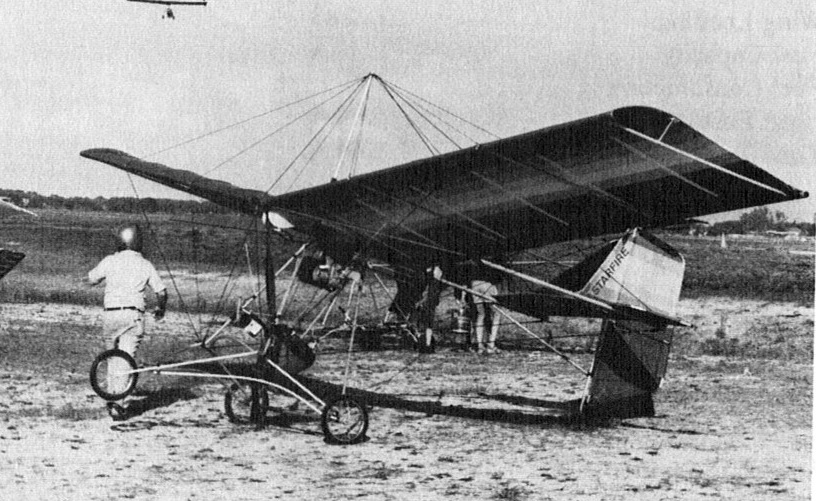
The Star Flight Starfire is the first aircraft in a large family of American ultralight aircraft that was designed by Dick Turner and produced by Star Flight Manufacturing, introduced in 1979. The aircraft were all supplied as kits for amateur construction.

The aircraft is made from bolted-together aluminium tubing, with the flying surfaces covered in Dacron sailcloth. Its 33 ft (10.1 m) span wing is cable-braced from a single element kingpost. The landing gear features a steerable nose wheel with a bicycle-style rim brake. The powerplant is mounted underneath the wing and drives a pusher propeller.
Single seat single engined high wing mono¬plane with hybrid control. Wing has unswept leading and trailing edges, and constant chord; cruciform tail. Pitch control by weight¬shift; yaw control by fully flying rudder; no separate roll control; control inputs through weight shift for pitch/yaw. Wing braced from above by kingpost and cables, from below by cables; wing profile; single surface.

Undercarriage has three wheels in tricycle formation; with additional tailskid; glass fibre suspen¬sion on main wheels. No ground steering. No brakes. Aluminium tube framework, without pod. Engine mounted below wing driving pusher propeller.

Up to the beginning of 1983 the Star Flight Aircraft company belong¬ing to Dick Turner was called Starflight Manufacturing. His basic model, the Starfire made its appearance in 1982 and was sold as a kit requiring 16 h for assembly at a price of $3995, with options including wheel fairing for $150.

However, in common with other manufac¬turers, Dick Turner has found that the market is moving away from hybrid control to stick operated machines. As a result, the Starfire was discontinued in 1983.

Engine: Cuyuna 215R engine
Max power 20 hp at 6000 rpm
Propeller diameter and pitch 52 x 24 inch, 1.32 x 0.60 in
Belt reduction, ratio 2.4/1
Power per unit area 0.12 hp/sq.ft, 1.3 hp/sq.m
Fuel capacity 2.5 US gal, 2.1 Imp gal, 9.5 litre
Length overall 9.0ft, 2.74m
Height overall 16.0ft, 4.87m
Wing span 33.0ft, 10.05m
Constant chord 5.0ft, 1.52m
Dihedral 5 deg
Sweepback 0 deg
Total wing area 165 sq.ft, 15.3 sq.m
Wing aspect ratio 6.6/1
Nosewheel diameter overall 16 inch, 41 cm
Main wheels diameter overall 16 inch, 41 cm
Empty weight 175 lb, 79kg
Max take off weight 475 lb, 215 kg
Payload 300 lb, 136 kg
Max wing loading 2.87 lb/sq.ft, 14.0 kg/sq.m
Max power loading 23.8 lb/hp, 10.83kg/hp
Max level speed 42mph, 68kph
Never exceed speed 55mph, 88kph
Max cruising speed 30mph, 48kph
Stalling speed 19 mph, 31 kph
Max climb rate at sea level 450 ft/min, 2.3 m/s
Best glide ratio with power off 6/1
Take off distance 100 ft, 30 m
Landing distance 50 ft, 15 m